Finding the Best Book on Cryptography to Accelerate Your Web3 Career
The best book on cryptography for you is the one that directly maps to your career goals in Web3. Are you aiming to build the next major DeFi protocol, audit smart contracts for critical vulnerabilities, or land a job as a protocol researcher? Your answer dictates your reading list.
For a developer diving in, a hands-on guide like Mastering Bitcoin is an excellent choice to build practical skills. But if your goal is a research position, you'll need the deep theoretical foundation found in a book like A Graduate Course in Applied Cryptography.
Why Cryptography Is Your Career Superpower in Web3

Think of cryptography as the physics of the Web3 universe. It's the bedrock that makes decentralized trust, digital ownership, and secure transactions possible. If you're serious about building a high-impact career in this space, a solid grasp of cryptography is non-negotiable.
This knowledge isn't just academic—it's what gets you hired and promoted. When a hiring manager asks you to explain how a blockchain prevents double-spending or how a zero-knowledge proof protects user privacy, they're testing your grasp of core mechanics. Candidates who can articulate these concepts clearly and connect them to real-world applications are the ones who receive job offers.
From Interview Questions to On-the-Job Value
In any technical interview for a Web3 role, your crypto knowledge is your sharpest tool. You will almost certainly be asked to explain concepts like public-key infrastructure, hash functions, and digital signatures. Answering with confidence shows you can think critically about security and system design—the exact skills needed to build secure, reliable applications and get hired.
This expertise pays dividends long after you land the job. A developer who deeply understands cryptographic primitives will write more secure smart contracts, leading to promotions and greater responsibility. A product manager who grasps the trade-offs between different privacy-preserving technologies can guide their team toward smarter architectural choices, making them a more effective leader.
Cryptography isn't just for security specialists. It's a foundational skill that helps every professional in Web3—from engineers to product managers—build, audit, and innovate with confidence. How well you can apply these concepts is a direct measure of the value you bring to a team and a key factor in your career progression.
Aligning Your Learning With Your Career Path
To maximize your return on investment, you must connect what you're learning to specific career goals. The right book for a protocol engineer is vastly different from the best one for a security auditor or a Web3 product manager. Identifying your target role from the start saves you time and makes your learning more effective for job interviews.
To help you create a targeted learning plan, I've outlined how to match your professional aspirations with the right type of cryptography book.
Choosing Your Cryptography Book by Career Goal
| Your Career Goal | Book Focus Area | Key Skills You'll Gain for Interviews |
|---|---|---|
| Blockchain/Protocol Developer | Applied Cryptography & Implementation | Explaining PKI, consensus mechanisms, and digital signatures. Writing secure code using crypto libraries. |
| Smart Contract Auditor | Security & Vulnerability Analysis | Identifying common cryptographic flaws, understanding attack vectors (like re-entrancy), and explaining ZK-proofs. |
| Web3 Product Manager | Concepts & High-Level Trade-offs | Discussing the benefits of different privacy solutions (ZKPs vs. MPC) and understanding system-level security implications. |
| Cryptographer / Researcher | Mathematical Theory & Proofs | Deeply explaining elliptic curve pairings, lattice-based cryptography, and designing novel cryptographic schemes. |
Use this table to map your dream job to the crypto topics that will give you the biggest competitive edge. This focused approach will prepare you for the technical questions and challenges you’re most likely to face in interviews.
To Build the Future, First Understand the Past
To excel in modern cryptography, you must understand its history. This isn't just for trivia; it's about grasping the high-stakes game of cat and mouse between code-makers and code-breakers that has shaped every secure system we use today.
Think of this historical knowledge as a secret weapon for your career. It provides a unique perspective on today's vulnerabilities by revealing the foundational ideas—and flaws—that modern systems are built upon. You’ll start recognizing that many of today's "new" attacks are clever twists on old cryptographic failures.
From Ancient Ciphers to Modern Careers
Learning the stories behind pivotal moments in cryptography—from the Caesar cipher to the Enigma machine—is about more than memorizing algorithms. It’s about understanding the mindset of the designers. You learn why certain methods failed spectacularly and how new thinking emerged from those failures. This is precisely the kind of analytical thinking that gets you hired.
Imagine you're in a job interview. Instead of just giving a dry definition of public-key cryptography, you can tell the story of how it evolved from a radical academic paper into the technology securing billions of dollars in digital assets. This demonstrates a deeper understanding that separates a good candidate from a great one. It shows you don't just know the what; you understand the why and the how, which is crucial for any senior Web3 role.
Knowing the history of cryptography is like a security analyst knowing the history of warfare. You don't just learn about the weapons; you learn the strategies, the deceptions, and the human ingenuity that led to victory or defeat. This perspective is invaluable for predicting and preventing future attacks.
The Stories That Teach the Code
Some of the best books for learning cryptography read like spy thrillers, packed with wartime secrets and brilliant mathematicians. These narratives make complex ideas stick because they're tied to a compelling story, turning abstract math into a real-world problem that demanded a solution.
A prime example is Simon Singh's 'The Code Book,' a classic that has sold over 1 million copies. It’s a fantastic starting point. Singh walks you through Alan Turing’s work on the Bombe machine, which cracked the German Enigma codes and is credited with shortening WWII. For those of us in blockchain, that same spirit of innovation echoes in the elliptic curve cryptography (ECC) that now secures a crypto market valued at over $1.2 trillion. You can find more breakdowns of these foundational concepts at Shortform.
Digging into the past provides three clear career advantages:
- Deeper Comprehension: History provides the context that makes complex modern systems understandable.
- Better Problem-Solving Skills: Studying past failures trains you to spot weaknesses in today's systems.
- Stronger Interview Performance: Telling the story behind the technology is far more impressive than just reciting facts.
Ultimately, cryptography is an ongoing story. By knowing the early chapters, you're not just learning facts—you're gaining the wisdom to help write the next one and build a secure, confident career in Web3.
Mastering Applied Blockchain Cryptography

If you're a developer, engineer, or architect building in Web3, theory alone won't get you a job. You must move from the historical "why" to the practical "how." This means getting hands-on with the specific cryptographic tools that power decentralized systems like Bitcoin and Ethereum.
Your career depends on connecting abstract concepts to the code you ship. You need to confidently answer the tough questions that arise in development meetings and, more importantly, in technical interviews. How exactly does this hash function prevent double-spending? Which key management scheme is the right choice for our new dApp?
Mastering this applied layer is what separates an average developer from an exceptional one. It's about more than just using a library; it's about understanding its inner workings, its security assumptions, and its limitations—knowledge that directly translates to job performance and career growth.
Connecting Code to Career Growth
Walk into a job interview for a blockchain engineering role, and you can expect to be quizzed on these fundamentals. The hiring manager needs to see that you can clearly explain the mechanics of a digital signature or walk them through the efficiency of a Merkle tree. They're looking for someone with a rock-solid grasp of the cryptographic primitives that hold the entire network together.
This is where a book focused on applied blockchain cryptography becomes your best career investment. It draws a straight line between the code you write and the security principles that make it trustworthy. These books provide the vocabulary and conceptual clarity to confidently discuss transaction finality, 51% attack vectors, and secure wallet design in an interview setting.
A prime example is the classic 'Mastering Bitcoin' by Andreas M. Antonopoulos, a foundational text that has sold over 200,000 copies. It's a top recommendation because it dives deep into the cryptographic primitives that are central to skills needed in over 52% of Web3 engineering jobs. The book masterfully explains concepts like hierarchical deterministic (HD) wallets using BIP-32 and breaks down Bitcoin's script system, which underpins 70% of DeFi smart contracts. You can find more on why it's a staple on Business Insider.
Key Applied Concepts to Master for Interviews
When preparing for a technical interview, focus on the chapters that cover the most common topics. Your study plan should be driven by the job description, targeting the skills and knowledge required for the role.
Here are the non-negotiable concepts you must be able to explain on demand:
- Hash Functions (SHA-256): Understand how hashing creates a unique digital fingerprint for data, essential for data integrity and block creation. Be prepared to explain its critical role in proof-of-work.
- Digital Signatures (ECDSA): Master the flow: how a private key creates a signature to authorize a transaction, and how the corresponding public key verifies it without ever revealing the private key.
- Merkle Trees: Articulate how this data structure allows for the efficient verification of a transaction's inclusion in a block without downloading the entire blockchain.
- Key Management and Wallets: Know the differences between non-deterministic, deterministic, and hierarchical deterministic (HD) wallets. Explain the security trade-offs and user experience benefits of each approach.
Focusing on these areas won't just make you a sharper engineer. It will arm you with the precise knowledge needed to walk into any technical interview and prove your value.
Advancing to Protocol-Level Cryptography

You've moved beyond simply using crypto libraries. Now, if you're targeting a senior role like protocol architect, cryptography researcher, or lead security engineer, a high-level understanding of algorithms is no longer sufficient. At this stage, you must transition from being a consumer of cryptography to someone who can build, validate, and innovate in the field.
This career path requires diving deep into the mathematical foundations of the Web3 ecosystem. It’s not enough to know that elliptic curve cryptography works; you need to understand why it works, from the details of group theory to the finite fields that provide its security. This is the level of knowledge that allows you to innovate, not just implement.
Why Mathematical Mastery Is Your Biggest Career Advantage
In a high-stakes technical meeting, the most valuable person is the one who can mathematically prove or disprove a protocol's security claims. This theoretical mastery is a massive career advantage. You become the expert who can dissect the trade-offs between different zero-knowledge proof systems or design a new signature aggregation scheme from first principles.
Hiring managers for these top-tier roles know precisely what they're looking for. They will test your knowledge of formal security proofs, number theory, and the algebraic structures underpinning modern ciphers. They need to be confident that you can build systems secure against both current and future threats. These are the exact skills that leading companies require for positions like a Protocol Engineer specializing in proofs.
This level of expertise is about more than just finding the best book on cryptography; it's about finding books that build your mathematical intuition. You learn to see protocols not as black boxes, but as elegant mathematical constructs with specific strengths, weaknesses, and security bounds.
Building Your Theoretical Toolkit
To reach this level, your reading list must evolve to include rigorous, mathematically-focused books. The goal is to build a mental framework that enables you to analyze and construct secure protocols from first principles, preparing you for the most advanced technical roles.
Your focus should shift to books covering these areas in detail:
- Number Theory and Abstract Algebra: This is the language of cryptography. Concepts like modular arithmetic, finite fields, and group theory are the DNA of nearly every public-key system.
- Elliptic Curve Mathematics: This is essential for understanding ECDSA (the engine behind Bitcoin and Ethereum) and more advanced constructions like pairings-based crypto, a cornerstone of many ZK-SNARKs.
- Formal Security Proofs: This is where you learn to model threats and prove, with mathematical certainty, that a protocol is secure against a specific class of attackers. It’s the gold standard for verifying a system's resilience.
- Lattice-Based and Post-Quantum Cryptography: Quantum computers are a real threat. Familiarity with quantum-resistant algorithms is quickly becoming a critical skill. Some experts estimate that up to 20 billion devices will need upgrading, creating massive demand for this expertise.
From Theory to Innovation
Mastering these subjects does more than prepare you for challenging interviews; it empowers you to push the field forward. When a new vulnerability is discovered or a breakthrough paper is published, you’ll have the foundation to grasp its implications instantly.
You’ll be able to read an academic paper on a new cryptographic scheme and not just follow the argument, but critically evaluate its claims. This is how you transition from a developer who uses the tools to a leader who creates them—making you an indispensable asset for any advanced Web3 team.
Turning Knowledge Into Job Offers
You’ve put in the hours, read the books, and understand the theory. Now what? The final step is translating that knowledge into confident, compelling answers during a high-stakes technical interview. This is how you convert study into a job offer.
Hiring managers in Web3 aren't looking for a walking encyclopedia. They need to see that you can apply abstract concepts to solve real-world problems. Your ability to think critically about security, architecture, and the trade-offs in decentralized systems is what separates a candidate from a new hire.
Structuring Your Interview Answers for Impact
When faced with a tough technical question, avoid simply reciting a definition. A much more effective approach is to define the concept, explain its practical application, and then discuss the relevant trade-offs.
Imagine being asked about wallet security. Don't just explain what an HD wallet is. Start by defining the core idea of hierarchical deterministic wallets, perhaps drawing from your reading of Mastering Bitcoin. Immediately pivot to a practical benefit, like how they enable users to recover all funds from a single seed phrase. Then, demonstrate your depth by discussing the trade-offs, such as the catastrophic risk if that single seed phrase is compromised.
"In a technical screening, your goal isn't just to be correct—it's to be insightful. Frame your answers around real-world application. Explain how a specific cryptographic primitive prevents a specific attack, and you'll immediately signal your value as a builder, not just a student."
This method proves you've gone beyond rote memorization. It shows the interviewer that you can be trusted to make sound architectural decisions on the job—a critical skill for any Web3 role. This level of applied knowledge is exactly what is required for positions like a Blockchain Security Expert.
Your Cryptography Interview Study Guide
To make your preparation as effective as possible, connect common interview questions directly to the books you've been reading. This transforms passive learning into a targeted strategy for mastering the questions that are actually asked.
Instead of trying to memorize everything, focus on the concepts that appear repeatedly in Web3 technical interviews. The table below is your cheat sheet, linking frequently asked questions to the specific concepts and book chapters you'll need to deliver outstanding answers.
Interview Prep Your Cryptography Reading List
| Common Interview Question | Key Concept to Master | Recommended Book and Chapter |
|---|---|---|
| "Explain how a Bitcoin transaction is secured." | Digital Signatures (ECDSA) & Hash Functions (SHA-256) | Mastering Bitcoin, Chapter 4 "Keys, Addresses" & Chapter 6 "Transactions" |
| "How does a blockchain prevent double-spending?" | Proof-of-Work & Consensus Mechanism | Mastering Bitcoin, Chapter 10 "Mining and Consensus" |
| "Describe the difference between symmetric and asymmetric encryption." | Public-Key Cryptography Fundamentals | Serious Cryptography, Chapter 1 "Symmetric vs. Asymmetric Encryption" |
| "What are the security benefits of using a Merkle tree?" | Data Structure for Efficient Verification | Mastering Bitcoin, Chapter 9 "The Blockchain" |
| "How can we prove something without revealing the underlying data?" | Zero-Knowledge Proofs (ZKP) Concepts | A Graduate Course in Applied Cryptography, Chapter 19 "Zero-Knowledge Proofs" |
Use this guide to turn your reading time into a focused interview prep session. Each chapter becomes a tool to help you build the articulate, insightful, and impressive answers that will capture a hiring manager's attention and help you land your next big role.
Your Path to Becoming a Cryptography Expert
Mastering cryptography is a continuous practice, not a destination. The books we've discussed are the foundation of your professional toolkit—references you'll return to throughout your career to stay sharp. The real goal isn't just to absorb information, but to apply it.
Now, it's time to translate that knowledge into tangible proof for hiring managers. This means weaving your expertise into your resume, your GitHub profile, and your performance in technical interviews. You need to demonstrate that you don't just know the theory—you can build secure, robust systems with it.
From Reading to Resumes
Review your existing projects through a cryptographic lens. Don't just say you built a "DeFi application." Instead, describe it as a "dApp secured with ECDSA signatures and Merkle proofs for data integrity." This specific, confident language is a powerful signal to anyone reviewing your resume or portfolio.
This approach transforms your interview performance. You’ll be able to confidently discuss the trade-offs between different cryptographic schemes, showing you’re an engineer who thinks deeply about security, not just someone following a tutorial.
The ultimate goal is to move from knowing cryptographic concepts to owning them. This ownership is what enables you to solve complex security challenges and makes you a high-value candidate for specialized roles.
Landing Specialized Roles
This deep expertise is what opens doors to the most exciting roles in the industry. For instance, a strong command of zero-knowledge proofs is a prerequisite for a Core ZK Engineer, a role where you are literally building the next generation of private, scalable blockchains. These are the jobs where you don't just use cryptography—you push its boundaries.
By progressing from foundational reading to hands-on application, you are building a direct path to the most challenging and rewarding careers in Web3. The journey starts with a book, but it truly takes off when you start applying what you've learned.
Frequently Asked Questions About Cryptography Books
It’s easy to feel overwhelmed by the vast number of cryptography books available. Choosing the right one comes down to understanding your own career goals and background. Let's address some of the most common questions.
Do I Need to Be a Math Whiz to Learn Cryptography?
This is the most common question, and the answer depends entirely on your career goal.
If your ambition is to design novel cryptographic protocols, then yes, a deep understanding of advanced mathematics is non-negotiable. However, for many practical roles in Web3, this is not a prerequisite.
Many of the best applied cryptography books are designed to ease you into the concepts. For a developer, a grasp of discrete math is helpful, but not always required to get started. Books like Mastering Bitcoin are excellent because they focus on real-world implementation, allowing you to build strong practical intuition first. You can always delve into the dense mathematical proofs later as your career progresses.
Do I Need to Be a Developer to Understand These Books?
Not at all. While much of the literature is geared toward engineers, there are excellent books that focus on concepts over code. If you are a product manager, UX designer, or strategist, understanding the why is far more critical to your job than the technical how.
A perfect example is Simon Singh’s The Code Book. It is a brilliant read for anyone, regardless of their technical background.
By understanding the fundamentals of public-key infrastructure or the trade-offs in using zero-knowledge proofs, you can make smarter product decisions. You'll be able to ask your engineering team better questions and guide your product toward stronger security and user privacy, making you a more effective and valuable team member.
How Do I Keep My Knowledge from Becoming Obsolete?
Cryptography evolves at a rapid pace. New algorithms are developed, and old ones are broken. The book you read is a starting point, not the final word. Continuous learning is a core part of a successful career in this field.
One of the biggest shifts on the horizon is quantum computing. The day is coming when foundational algorithms like RSA and ECC will no longer be secure. Professionals who start learning about post-quantum cryptography (PQC) now are setting themselves up for some of the most in-demand jobs of the next decade.
This flowchart maps out a solid learning journey that builds a resilient foundation.
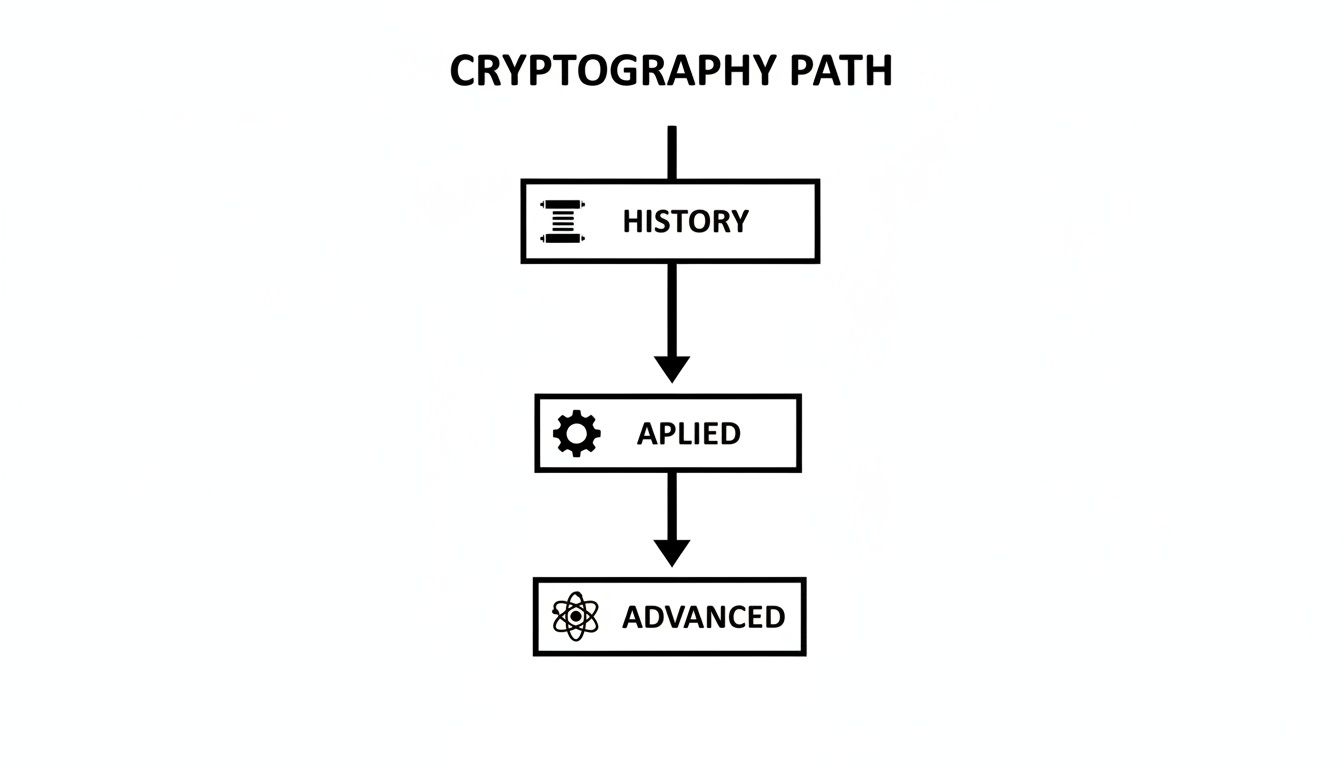
Following this path—from history to applied skills and on to advanced theory—gives you the mental models to make sense of new developments. Once you have the fundamentals down, here are some actionable ways to stay current:
- Follow Key Researchers: Keep tabs on publications from leading cryptographers and organizations like NIST.
- Read Security Blogs: Top Web3 companies often publish deep-dives and security analyses on their engineering blogs. They are a goldmine of practical, up-to-date information.
- Attend Conferences: Events like Real World Crypto and IACR conferences are where the latest breakthroughs are often presented. Many offer virtual attendance options.
Ultimately, your book is the launchpad. It gives you the framework to understand and adapt to whatever comes next, ensuring your skills remain valuable and your career continues to advance in the fascinating world of cryptography.