
Frontend Engineer Remote Jobs: A Web3 Playbook for 2026
You're probably in a familiar spot. You know React, TypeScript, component architecture, API state, and browser debugging well enough to ship production features, but every remote Web3 frontend job seems to ask for a different language: wallets, signing flows, RPC providers, token approvals, indexing, gas awareness, and “crypto native” product sense.
That gap is real. So is the opportunity.
A lot of frontend engineers waste time trying to brute force their way into crypto by spraying resumes at every remote listing with “React” in the title. That usually fails. Web3 hiring teams don't just want someone who can make screens look good. They want someone who can build trust at the UI layer, handle unreliable on-chain data, explain transaction risk to users, and work well in distributed teams that often move faster and with less structure than traditional SaaS companies.
Your Path into Remote Web3 Frontend Development
The remote market is still a strong place to build a frontend career if you pick your lane carefully. Remote frontend and backend software engineering roles represent 52.1% of the total remote software engineering labor market, which makes them the largest share of the market for location-independent engineering work in blockchain, DeFi, and NFT ecosystems, according to this SSRN paper on the remote software engineering labor market.
That matters for one reason. You don't need to become a protocol engineer to break into Web3. You can enter through the frontend and still work on serious product problems.
Why Web3 frontend is different
In a normal SaaS app, the frontend is mostly a consumer of backend decisions. In Web3, the frontend often becomes the safety layer between users and irreversible financial actions. That changes what “good” looks like.
A strong frontend engineer remote candidate in Web3 can do all of this:
- Translate contract behavior into safe UI flows so users understand approval scopes, slippage, and confirmation states.
- Handle uncertain state because blockchain reads can lag, RPC providers can fail, and indexers can fall behind.
- Work asynchronously with designers, smart contract engineers, and product leads who may span several time zones.
- Ship with judgment when docs are thin, product requirements are moving, and nobody wants a week of meetings to resolve a button state.
Practical rule: If your current skill set is “good React developer,” you're close. If your skill set becomes “good React developer who understands transactions, wallets, and trust-heavy UX,” you become much more hireable.
What actually gets people hired
Hiring managers usually care less about whether you've memorized every chain acronym and more about whether you can reduce product risk. That means your path is less about collecting buzzwords and more about proving three things:
| What teams look for | What proves it |
|---|---|
| Web3 product fluency | Portfolio projects with real wallet flows |
| Remote readiness | Clear written communication and self-directed work |
| Career upside | Evidence you can grow from implementer to product-minded engineer |
If you approach the remote Web3 market like a mid-level engineer trying to become useful fast, you'll stand out. If you approach it like a tourist chasing hype, you won't.
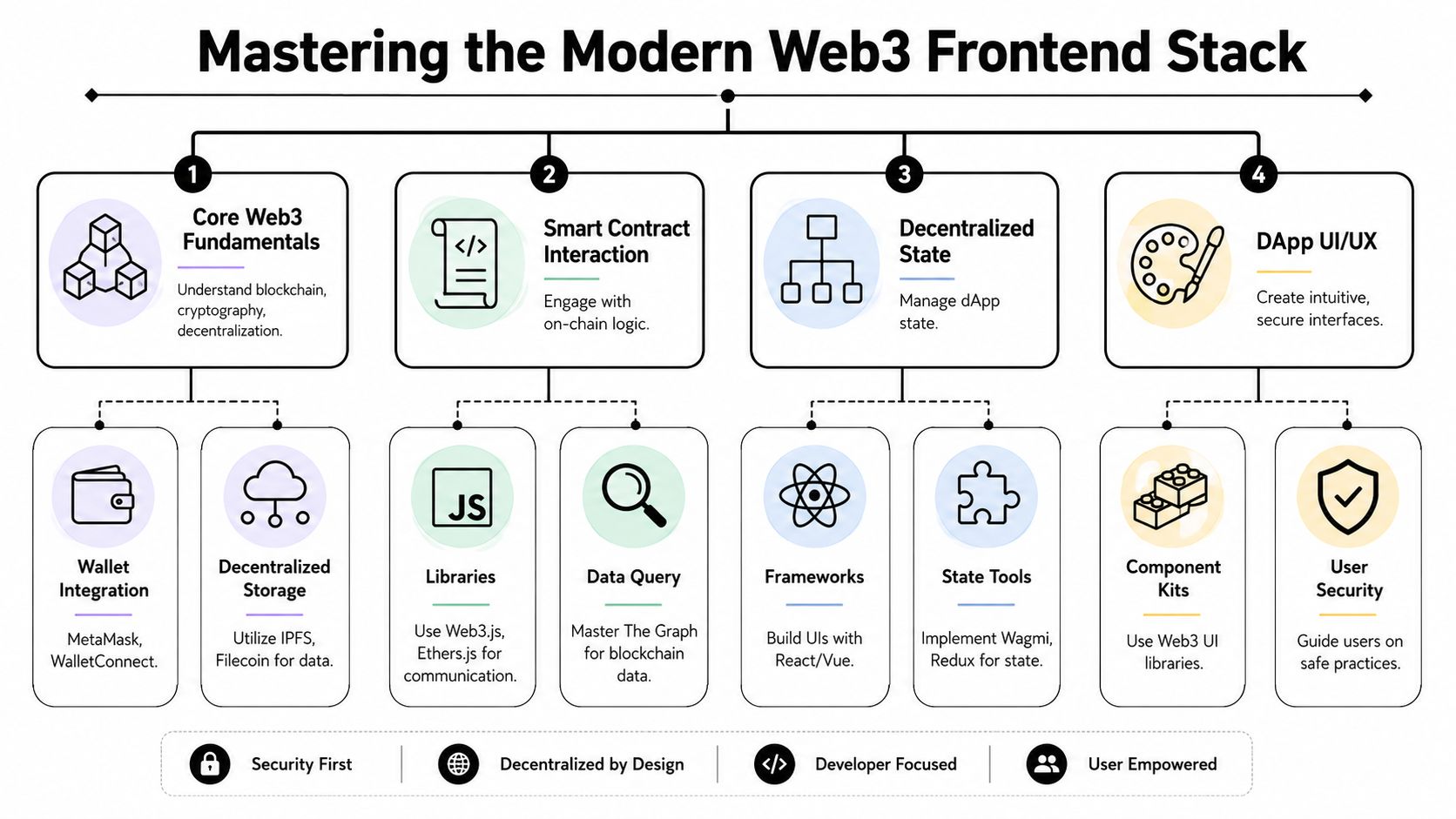
Mastering the Modern Web3 Frontend Stack
Generic frontend advice is lagging behind the market. Data discussed in this webdev community analysis points to a 10% decline in job postings for frontend engineers in 2025, with entry-level roles shrinking fastest while mid-to-senior UX-focused roles are the segment growing. That lines up with what hiring teams are signaling in practice. They're less excited by another generalist who can build a dashboard and more interested in engineers who can own messy, product-heavy interfaces.
Start with the stack you already know
React and TypeScript still carry most of the workload. Keep going deeper there. In Web3, weak TypeScript habits become expensive fast because you're often juggling wallet state, chain IDs, contract ABIs, token metadata, balances, pending transactions, and fallback fetches at the same time.
The baseline stack often expected is familiar:
- React for UI composition
- TypeScript for safer application logic
- Next.js or Vite depending on the product and rendering needs
- State tools like Zustand, Redux, or TanStack Query
- Component systems that keep transaction-heavy interfaces consistent
What changes is the data layer and the UX discipline.
Learn the Web3-specific layer
The first leap is contract interaction. You need to understand how the frontend talks to the chain, not just what a REST API returns.
Focus on these categories:
- Ethers.js or Web3.js for contract reads, writes, provider interactions, and transaction lifecycle handling
- Wagmi for wallet connection state, account hooks, network awareness, and common interaction patterns
- RainbowKit or similar wallet UI packages for connection flows users already recognize
- The Graph and indexing patterns for queryable blockchain data when direct reads become clumsy
- IPFS and related storage patterns when your app needs decentralized file or metadata access
A lot of mid-level candidates make the same mistake here. They stop at “I can connect MetaMask.” That's not enough. The real skill is handling everything after connection: unsupported chains, rejected signatures, stale balances, pending writes, replaced transactions, and UI states that still make sense while data catches up.
The best Web3 frontend engineers don't hide blockchain complexity. They absorb it and present users with clear decisions.
Build around user trust, not just integration
Crypto products punish sloppy UX. A clean button isn't useful if the user can't tell whether they're approving a token spend, signing a message, or sending a transaction.
That means your learning roadmap should include:
Transaction-state design
Pending, submitted, confirmed, failed, dropped, replaced. Each state needs a clear UI.Wallet and network ergonomics
Wrong chain detection, reconnection behavior, mobile wallet quirks, and provider fallbacks.Security-aware copy and interaction design
Approval warnings, external links, address truncation, verification cues, and anti-phishing basics.Performance on data-heavy screens
Token tables, charts, governance pages, and portfolio views can bog down quickly.
For a concrete benchmark, study the expectations in a live senior frontend developer role using React and TypeScript. Even if you're not senior yet, that kind of job description tells you what the market values: ownership, product judgment, and reliability under ambiguity.
Build a Portfolio That Screams Web3 Native
Generic portfolio work won't move the needle here. A polished to-do app, weather dashboard, or Markdown blog might show that you can code, but it doesn't show that you can operate in the weirdness of crypto.
Hiring managers want evidence that you can build interfaces where state is asynchronous, financial, and sometimes hostile to user confidence.

What a strong Web3 portfolio project looks like
Pick projects that force you to solve real Web3 frontend problems. Good examples include:
- An NFT minting interface with wallet connect, network checks, allowlist logic, transaction progress, and metadata display
- A DeFi dashboard that reads balances, positions, historical activity, and token prices from on-chain or indexed data
- A DAO governance app with proposal lists, vote states, wallet-gated actions, and signature-based flows
- A multisig or treasury interface clone that emphasizes permissions, signer clarity, and transaction review steps
The point isn't originality. The point is competence under realistic constraints.
What to include in each project repo
A serious portfolio project needs more than screenshots. It should tell reviewers how you think.
Include:
- A clear README that explains the product, stack, architecture, and setup steps
- A short product brief that says who the user is and what problem the app solves
- Thoughtful commit history instead of one giant dump at the end
- Environment handling that doesn't leak secrets and makes local setup easy
- Error states and edge cases documented with screenshots or short notes
- A deployed version if the app can safely be demonstrated publicly
If you need help packaging your work cleanly, lnk.boo's template recommendations are useful because they push you toward structure instead of decoration. That's the right instinct for Web3 hiring. Reviewers care more about clarity than visual flash.
Hiring signal: A repo that explains trade-offs beats a prettier repo that explains nothing.
Three projects that prove different strengths
A portfolio gets stronger when each project demonstrates a different hiring angle.
Project one shows protocol interaction
Build something contract-heavy. You want to prove you can read ABIs, handle writes, decode returned values, and keep UI state aligned with chain state.
You demonstrate practical engineering judgment by:
- split read and write hooks cleanly
- cache data without lying to the user
- label wallet prompts clearly
- recover gracefully from failed calls
Project two shows data and product sense
Build a read-heavy interface such as a portfolio tracker or vault analytics page. This shows you can deal with indexing, formatting, filtering, and performance.
Reviewers notice details here. Can users tell what's loading, what's estimated, and what's confirmed? Can they understand the page without already being power users?
A walkthrough like the video below can help you audit your portfolio presentation and tighten how you explain your work.
Project three shows polish under constraints
Build a small but sharp app with excellent UX around one risky user flow. Token approvals are a good choice. Bridging is another. Governance delegation also works.
This kind of project proves maturity because it shows restraint. You're not trying to impress with the biggest codebase. You're showing that you understand user fear, transaction cost, and decision clarity.
What not to do
A lot of candidates sabotage themselves with the same weak moves:
- Don't fake protocol depth by pasting boilerplate hooks you don't understand.
- Don't ignore mobile wallet behavior if your app claims to be usable by real crypto users.
- Don't leave broken testnet assumptions in the demo with no explanation.
- Don't bury your Web3 work below unrelated projects on your portfolio homepage.
If you want a quick reality check on market-fit, review a live frontend engineer opening in Web3 UX and product work. Compare your portfolio against that level of expected ownership, not against beginner tutorials.
Sourcing and Applying for Remote Web3 Roles
Applying well matters almost as much as being qualified. A lot of capable engineers lose remote roles because their application reads like a generic frontend application with a few crypto nouns sprinkled in.
That doesn't survive recruiter screening or technical review.
Search like a specialist
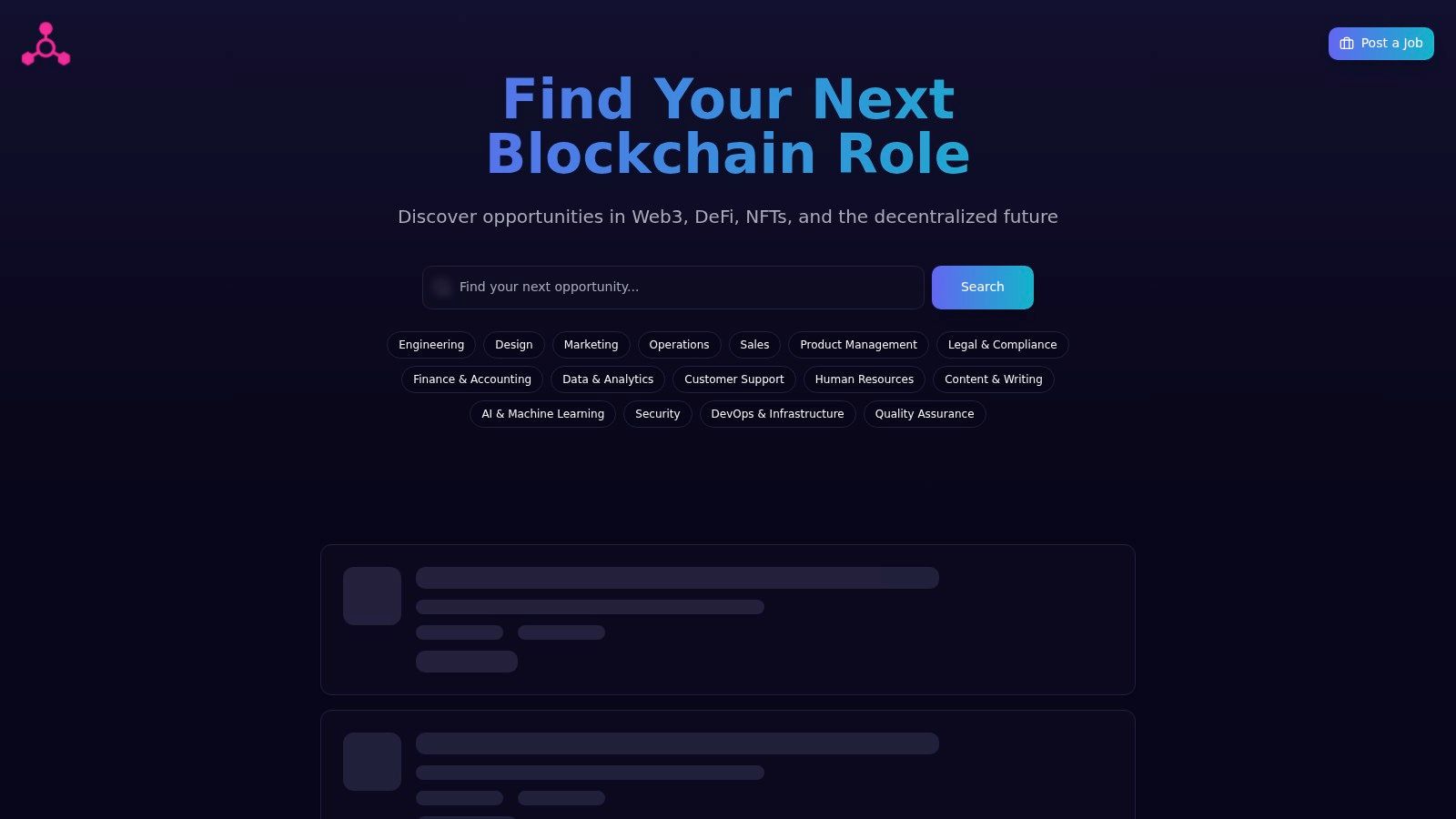
Generic job boards are noisy. For a frontend engineer remote search in Web3, niche filtering saves time because it lets you screen for the things that change your odds: remote status, protocol category, stack alignment, and product maturity.
A focused way to do it is to review remote blockchain roles in one place, then manually qualify each listing. Don't apply just because the title says frontend. Read for team expectations, wallet stack, ownership level, and whether the role sounds product-facing or implementation-only.
Use a simple decision filter:
| Apply now | Apply later | Skip |
|---|---|---|
| React or TypeScript heavy, clear product ownership, remote-first signals | Good team but stack gaps you can close quickly | Mostly backend, unclear remote setup, or vague “crypto enthusiast” fluff |
Rewrite your resume for Web3 reading patterns
Most resumes bury the strongest evidence. In Web3, lead with proof.
Put your most relevant material near the top:
- A short headline that positions you as a frontend engineer with Web3 project experience
- Selected projects with direct mentions of wallets, contracts, on-chain data, or transaction UX
- Work experience framed around product outcomes and technical ownership
- Tools grouped by frontend, Web3, and collaboration
A bad bullet says you “built responsive interfaces.” A better bullet says you built a wallet-connected interface that handled transaction states, contract reads, and user feedback around failed actions. Keep it concrete, but don't invent metrics.
Write cover letters that sound protocol-aware
Most cover letters are disposable because they could be sent to any company. That's the easiest way to tell a recruiter you don't care about their product.
A useful Web3 cover letter does three things:
Shows product-specific interest
Mention the protocol, exchange, wallet, infrastructure product, or governance system directly.Connects your background to a user problem
Say why your frontend experience fits their product surface.Signals remote maturity
Show that you communicate clearly and can work without constant supervision.
Don't write “I'm passionate about blockchain.” Write that you care about reducing approval confusion, improving transaction clarity, or making governance flows understandable to normal users.
What works better than mass applying
A smaller number of customized applications usually beats a huge volume of generic ones. For each serious application, do this:
- Read the docs first so your application reflects real familiarity
- Check the product live if it's available and note one UX issue or strength
- Reference one relevant project from your portfolio that maps to their product
- Tune your intro paragraph to their actual stack or mission
That's the kind of effort that gets interviews for remote Web3 roles. Not because it's flashy, but because it proves you already think like someone on the team.
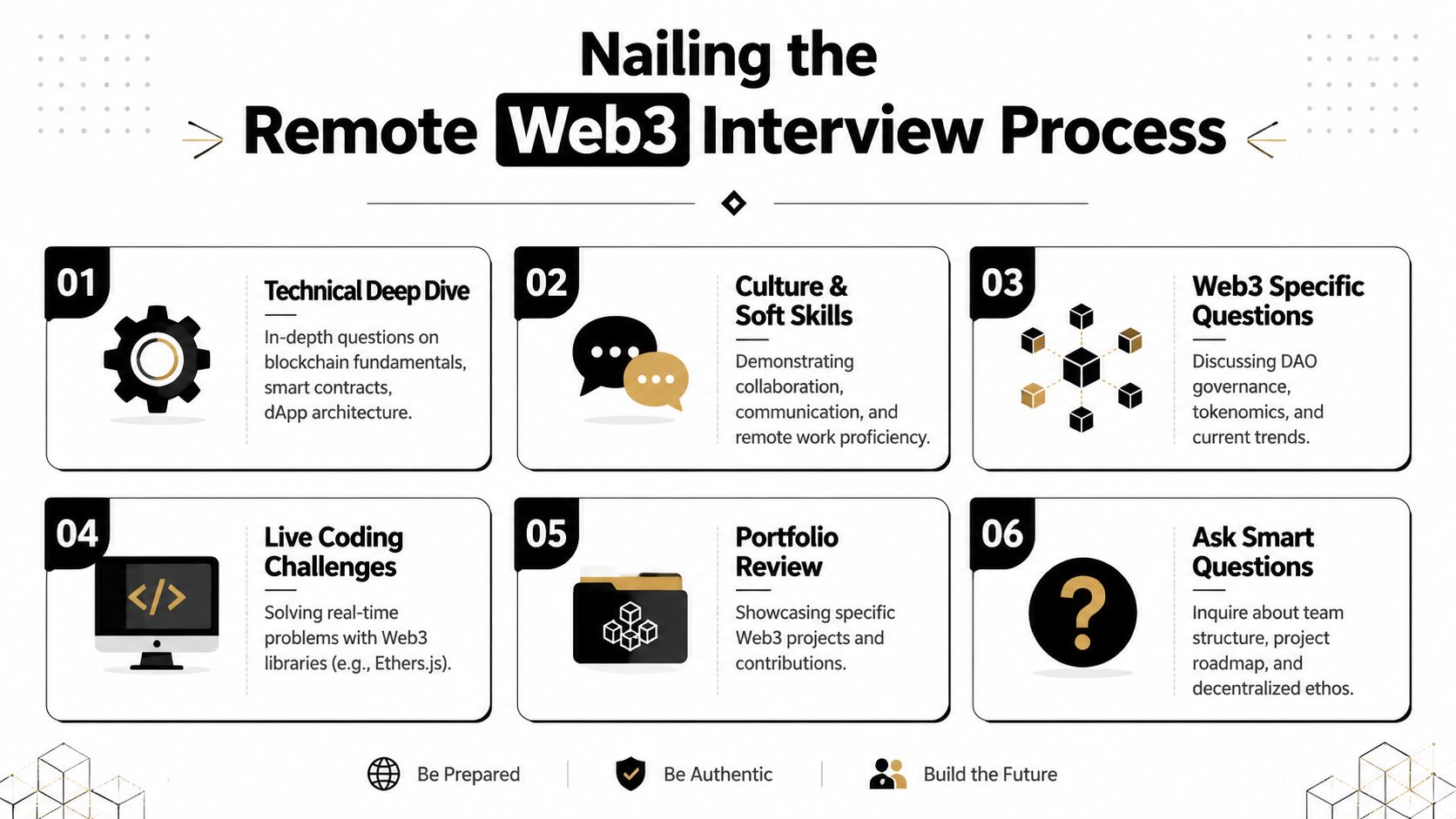
Nailing the Remote Web3 Interview Process
Remote interviews in Web3 test more than coding. They test whether you can think clearly in public, document your assumptions, and operate without a manager standing over your shoulder.
That's why strong candidates sometimes lose to slightly less experienced ones who communicate better.
The first round is usually about clarity
Early conversations often screen for communication more than deep implementation. The interviewer wants to know whether you can explain what you built, why you chose the tools you used, and how you behave in a distributed team.
Prepare concise answers to questions like:
- Why Web3, specifically from a frontend angle?
- What's the hardest UX problem you've handled?
- How do you deal with uncertain or delayed external data?
- What happens in your app when a user rejects a wallet prompt?
That last question matters more than many candidates expect. It reveals whether you think in happy-path demos or production flows.
A remote team needs engineers who write clearly, ask good questions, and surface blockers early. Your interview answers should reflect that operating style.
Treat the take-home like a real code review
Take-homes are common because they show how you work when nobody is talking over you. That's close to real remote work.
The best submissions usually have these traits:
- The README explains assumptions instead of pretending the spec was perfect
- The code is organized for review with sensible folders, naming, and component boundaries
- Trade-offs are documented so reviewers can see your reasoning
- Edge cases are acknowledged even if you didn't implement every one
A sloppy take-home often fails for avoidable reasons. Missing setup steps. No explanation of chain assumptions. Weak loading states. Hardcoded values with no notes. Components that work but are painful to read.
Prepare for live technical discussion, not just coding
Live sessions in Web3 frontend interviews often mix implementation with architecture and UX. You may be asked to reason through a wallet flow, discuss how you'd fetch or cache on-chain data, or explain when you'd query an indexer instead of the chain directly.
Use this checklist before the interview:
- Review wallet connection flows and common failure modes
- Be ready to model transaction state from initiation to confirmation or failure
- Practice explaining contract interaction in plain English
- Know your own project decisions well enough to defend them
- Rehearse small coding tasks with React, TypeScript, and async state
Show remote-readiness explicitly
Don't assume interviewers will infer this. State it in your examples.
Talk about times when you:
- wrote implementation notes before coding
- clarified unclear specs in writing
- left handoff context for teammates
- scoped work independently
- flagged risk early instead of struggling
A lot of crypto teams are distributed by default, and many are still building their operating habits as they scale. If you bring structure without becoming bureaucratic, that's a hiring advantage.
Navigating Offers Onboarding and Beyond
Once you get an offer, slow down and read it carefully. Web3 companies can differ a lot on cash compensation, token exposure, contractor structure, and timezone expectations.
For benchmark context, the average annual salary for a remote Front End Developer in the United States is $135,465, with total compensation reaching $147,393, according to Built In salary data for remote front-end developers. The same data shows entry-level remote Front End Engineers at $80,000 to $110,000 and senior-level professionals at $150,000 to $200,000.
Understand regional pay before you negotiate
Remote doesn't always mean salary parity. Geographic pay bands still shape many offers.
The split is stark in Motion Recruitment salary data for front-end roles, which notes that U.S. remote mid-level JavaScript developers earn $116–144k, while mid-level developers in India average $7–8k/year and Eastern Europe earns $25–50/hr. If you're interviewing globally, ask directly whether compensation is location-banded, role-banded, or negotiated case by case.
That question saves everyone time.
Scrutinize the contract details
A solid offer can still become a bad job if the operating terms are vague.
Check these points closely:
Employment type
Employee and contractor arrangements carry very different expectations and protections.Timezone overlap
“Remote” can still mean heavy overlap with a specific region.Token compensation terms
Ask when tokens vest, what conditions apply, and what portion of compensation is cash versus token-based.Equipment and setup
Clarify whether the company provides hardware, software budgets, or security requirements.
If a team is vague during the offer stage, expect more vagueness after you join. Clarity now is part of due diligence.
Start your onboarding like a senior, even if the title is mid-level
The first few weeks matter. In a distributed Web3 team, people remember who creates momentum without creating chaos.
Do these early:
- document your environment setup
- ask for product docs and contract references
- trace one full user flow end to end
- learn who owns frontend, contracts, design, and release decisions
- ship one small improvement fast so the team sees how you work
Long-term career progression in remote Web3 frontend roles comes from becoming the engineer people trust on critical user flows. Not the person who knows the most jargon. The person who can reduce confusion, ship safely, and help the team move.
If you're ready to turn your skills into a real Web3 role, Blockchain Jobs is a practical place to start. It's built for crypto-native hiring, which makes it easier to find remote opportunities across engineering and the wider Web3 ecosystem without sorting through irrelevant listings.