DeFi Platform Development: Architecture to Launch Guide

You've probably got a working lending prototype, a demo date, and a growing list of questions you can't answer yet. Who can pause it, which oracle failure breaks liquidations, and what happens when the first upgrade goes wrong? That's the normal point in DeFi platform development where code stops being the hard part. I would slow down, write the decisions down, and treat every launch step as a gate you either pass or you don't.
Build Phases and Release Gates at a Glance
Say a team rushes a lending app to testnet, then reaches audit and can't explain who holds upgrade power or why a collateral cap exists. The contracts compile. The reasoning doesn't. That gap usually costs more time than specification would've taken.
A gate isn't a status update. It's a pass or fail condition with a named owner, evidence, and a decision recorded before work moves on.
| Phase | Core output | Exit gate |
|---|---|---|
| 1. Specification | Economic invariants, privilege map, threat list | Invariants and roles signed off by engineering and risk |
| 2. Core contracts | Tested state transitions and gas report per function | Unit tests and fuzz tests pass with no open critical defects |
| 3. Integration and testing | Forked-state tests for oracles, flash loans and external calls | Invariant-test coverage reviewed and reported |
| 4. External audit | Audit report focused on business logic and access control | All critical and high findings resolved and re-tested |
| 5. Staged deployment | Testnet run, then capped mainnet release with timelock and multisig | Caps, pause controls and monitoring verified in production |
| 6. Live operations | Monitoring dashboards, incident runbook, upgrade procedure | Runbook rehearsed and on-call owners named |
How to Use the Gates
Copy this table into your tracker and assign one owner per gate. If the specification gate lacks signed economic invariants and a privilege map, you're not ready to debate implementation details. If the audit gate has unresolved critical findings, a launch date doesn't override it.
The phases overlap in real work. Monitoring, incident drills, and upgrade rehearsals should start during staged deployment, not after users arrive. Live operations never really close, they just become routine.
Practical rule: If nobody can point to the evidence for a gate, assume the gate hasn't passed.
For hiring, this table doubles as an interview map. Ask a candidate which artifact they'd produce at each phase and what would make them block progression. Strong engineers name evidence, owners, and failure conditions. Weak answers stay at the level of tools and timelines.
Architecture and Compliance Design Choices Before Coding
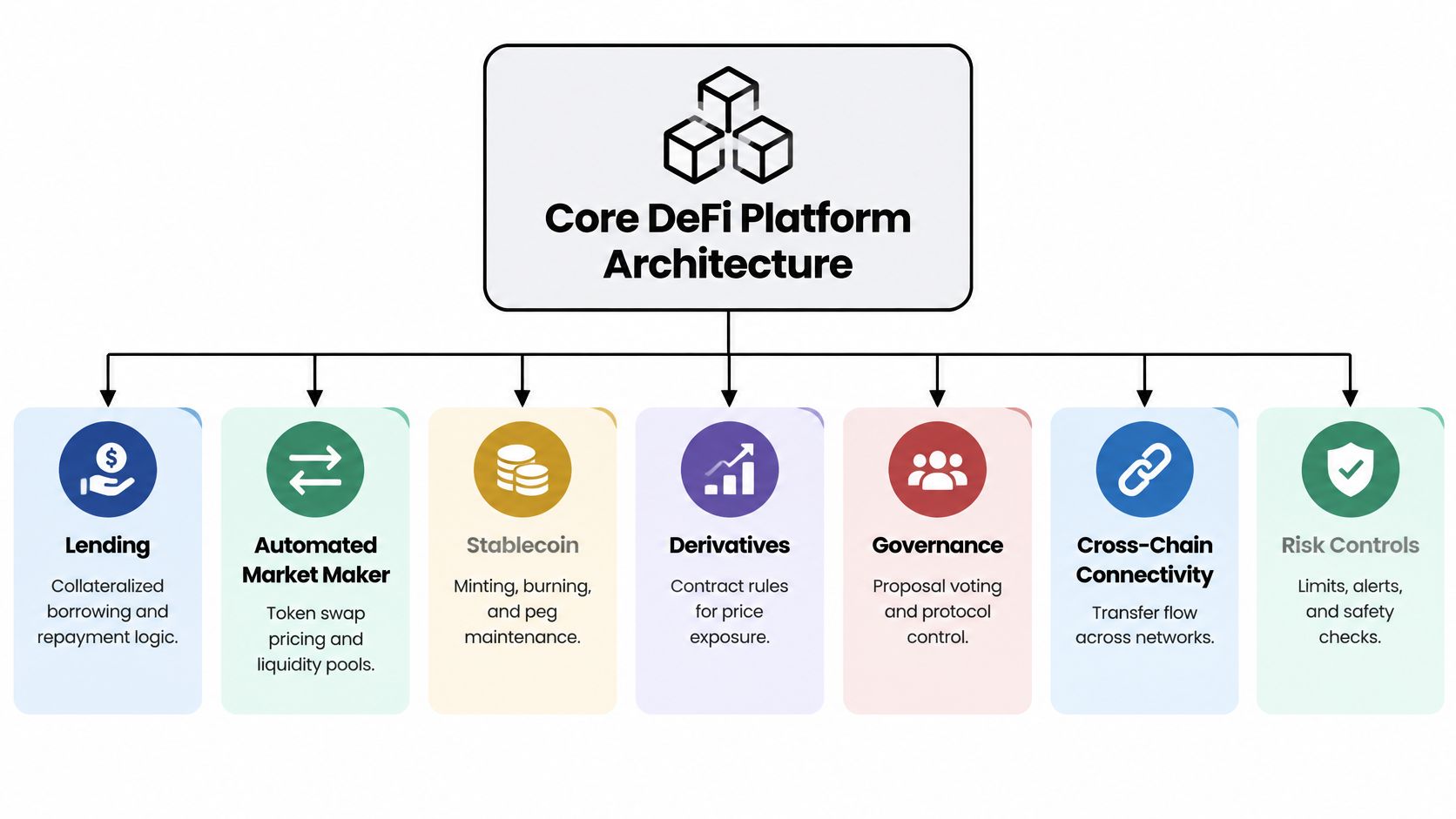
Start with a dependency map, not a contract list. Put lending, the automated market maker, stablecoin logic, derivatives, governance, cross-chain connectivity, and risk controls on one page. Mark every shared oracle, admin key, treasury, and liquidity pool, because those shared points set your blast radius when something fails.
Design for sharp swings from day one, since the academic finance study hosted by NYU Stern reports total value locked increased from below $0.6 billion in January 2020 to more than $120 billion by December 2024, while Compound exceeded $11.6 billion in November 2021 before falling to about $1.5 billion in 2023. Your caps, liquidation flow, and infrastructure need to survive both directions.
Choose the Access Model Explicitly
| Design | Where compliance logic runs | Main trade-off |
|---|---|---|
| Permissionless | No gating at the protocol layer | Maximum composability, but no built-in compliance surface |
| Permissioned | Allowlist checked on every entry | Simpler compliance, but fragmented liquidity and a narrower user base |
| Hybrid | Open settlement layer with gated front end and parameterized rules | Balanced access, but admin keys become a risk to govern |
If you're still untangling how these building blocks fit together, work through how DeFi protocols are structured and composed before locking the design. Then finish a one-page document that answers four questions.
- Regulated activities: Which flows need identity checks, sanctions screening, transaction monitoring, disclosures, or geofencing?
- Custody boundary: Can settlement stay non-custodial while the interface applies controls?
- Rule ownership: Which admin keys can change compliance parameters, and who holds them?
- Failure behavior: Does a screening outage block deposits, withdrawals, or only new positions?
Programmable freeze or rejection rules can cut manual work, but they aren't free. Overly broad rules create false positives, fragmented liquidity, and a governance attack surface. I would make every rule narrow, reviewable, and reversible through a documented process.
Tech Stack and Tooling Choices
Pick the stack in build order and write down why each dependency exists. A future hire or auditor shouldn't have to reverse engineer your reasoning from a package file.
- Language and compiler: Use Solidity for core contracts unless you've got a strong reason for another EVM-compatible language. Pin the compiler version so testnet and mainnet bytecode stay reproducible.
- Framework: Choose Foundry or Hardhat for compilation, unit tests, fork tests, and gas reports. Run the same setup in CI, because local success means little if the pipeline tests something different.
- Base libraries: Build on audited libraries for tokens, access control, and upgrade patterns instead of writing them from scratch. Review every inherited function anyway, since inherited roles often widen your privilege surface.
- Oracles: Select primary and fallback feeds during design. Their freshness, deviation, and liquidity requirements shape borrowing and liquidation logic, so they can't be bolted on later.
- Off-chain services: Add an event indexer for dashboards, a keeper or liquidation bot if the design needs one, and a key-management service. No production admin key should sit on an engineer's laptop.
- Target network: Compare Ethereum mainnet with layer-2 environments on fees, finality, tooling, and bridge risk. That choice affects user costs, deployment, and how users move collateral in and out.
If you need a broader comparison before committing, review the main blockchain development tools used by production teams and map each one to a concrete job in your pipeline. Tools without an owner or a gate tend to become decoration.
Define Audit Scope Before Asking for Quotes
List in-scope contracts, upgrade paths, admin functions, external calls, and oracle integrations. Include deployment scripts and off-chain keepers when they can affect funds. An auditor can't price or review what you haven't bounded.
For interviews, this is a useful depth test. Ask why the candidate chose a framework, library, or network, then ask what they'd change under higher fees or thinner liquidity. You're testing judgment, not brand recall.
How to Write and Test Core Smart Contracts
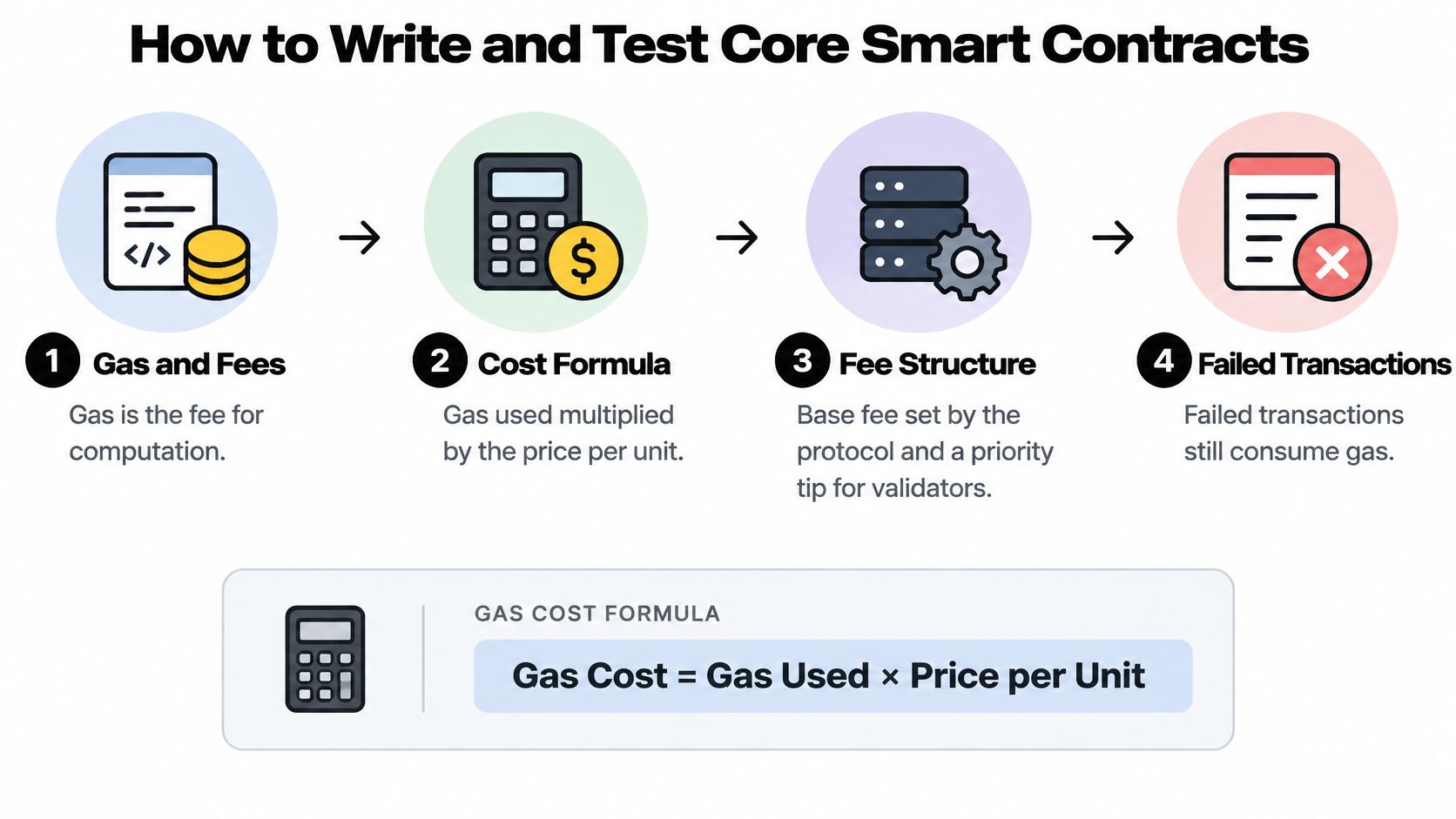
Gas is pricing for computation, and it punishes vague design quickly. The Ethereum gas documentation explains every transaction's fee is calculated from the gas consumed multiplied by the price per gas unit, with a protocol-determined base fee plus a user-selected priority fee paid to encourage validator inclusion. Fees are charged even when a transaction fails, so sloppy logic costs users money twice, once in frustration and once in fees.
Build in a Tight Loop
- Write invariants first: Turn economic rules and privilege boundaries into test-ready statements before coding. For example, total borrows can't exceed allowed collateral value after any transition. The common slip is writing invariants so loosely that they pass during an exploit.
- Implement one transition at a time: Add deposit, borrow, repay, or liquidation separately and count storage writes, since changing persistent state is expensive. Teams slip by building the full flow first, then discovering they can't isolate which step broke accounting.
- Trim repeated work: Cache repeated storage reads in local variables, prefer calldata where appropriate, and avoid loops over user-controlled arrays. The slip is optimizing tiny arithmetic while leaving an unbounded loop that can make a function unusable.
- Publish a gas baseline: Generate a report for every external function and record it with the code change. Don't measure only on empty state, because growing arrays, nonzero balances, and realistic collateral mixes expose costs that a fresh deployment hides.
- Unit-test every transition: Cover success, reverts, boundary values, zero amounts, paused states, and unauthorized callers. Happy-path tests prove the demo works. They don't prove the protocol rejects what it must reject.
- Fuzz adversarial inputs: Throw randomized amounts, ordering, rounding edges, and price moves at the system. Pay special attention to shares, interest accrual, and liquidation incentives, where small rounding choices become economic bugs.
What Healthy Looks Like
Every external function has a gas figure, a test list, stated assumptions, and a documented trade-off. If a change saves gas but makes accounting harder to audit, say so. If it improves safety but raises user cost, quantify it.
Don't present a gas optimization without the state you measured it under. The number is only useful when another engineer can reproduce it.
That's also strong interview evidence. Engineers who connect Solidity choices to execution cost, failure handling, and transaction simulation are easier to trust with protocol work than candidates who only describe DeFi concepts at a high level. Bring the report, explain the expensive operations, and show what you changed.
For career progression, keep these artifacts. A portfolio with reproducible gas baselines, adversarial tests, and clear trade-off notes signals senior judgment far better than screenshots of a wallet connected to a lending screen.
Security Controls That Match Real Exploit Patterns
A clean scanner run is not evidence that you're ready to launch. In the empirical study of 127 DeFi exploits, researchers mapped 32 attacks to vulnerability classes detectable by selected automated tools, and those tools could potentially have prevented only 11 of the 32 incidents, representing approximately $149 million of the roughly $2.3 billion in losses within the analyzed set. That's about 34% of the in-scope vulnerabilities, which should end any argument that automation alone is enough.
Use scanners, but put them in their place. They're good at repeatable checks for reentrancy, arithmetic problems, access-control mistakes, and input-validation defects. They're weak where real losses often live, in business logic, incentives, oracle assumptions, and privileged paths. For a broader testing workflow, automated security testing with AskYourQA is useful context, provided your team still triages findings by hand.
Oracle and permission design deserve explicit attention because the systematic study of DeFi incidents hosted by UCL.pdf) found price-oracle attacks represented about 15% of incidents and permissionless-interaction attacks about 10.5%, while 103 attacks, or 56%, were non-atomic. Non-atomic attacks sometimes give defenders a response window, which makes monitoring worthwhile, but they don't replace preventive limits.
| Failure mode | Control to build | Evidence to check |
|---|---|---|
| Price oracle manipulation (about 15% of studied incidents) | Multiple price sources, staleness checks, bounded rate changes, per-block caps | Deviation alerts and fallback tested on thin-market data |
| Permissionless call abuse (about 10.5% of studied incidents) | Model malicious callers, unusual call ordering and callbacks | Adversarial tests across composed calls |
| Access control and upgrade keys | Least-privilege roles, multisig administration, timelock on upgrades | Role map reviewed; no single key can upgrade or drain funds |
| Business logic and state transitions | Economic invariants, property tests, fuzz tests | Invariant coverage report and zero unresolved critical findings |
| Reentrancy and arithmetic errors | Checks-effects-interactions pattern, static analysis, symbolic execution | Scanner output triaged by hand, not only a clean run |
Audit the Logic a Scanner Cannot Judge
Commission independent manual review focused on business logic, privilege paths, upgradeability, and composed interactions with other protocols. Give auditors your invariants, threat list, role map, and known assumptions. If you only hand over code, you'll pay them to rediscover your design before they can attack it.
Before audit, report four readiness measures: unresolved critical findings, invariant-test coverage, reviewed privilege paths, and loss-limiting controls such as caps and pause functions. I would also require a named owner for every accepted risk. Unowned risk tends to become forgotten risk.
In interviews, ask candidates to attack a small design rather than recite vulnerability names. Give them an oracle, a flash-loanable pool, and an upgradeable proxy, then listen for ordering, callbacks, stale prices, and key compromise. That answer predicts production judgment.
How to Deploy and Monitor Without Losing Control
Deployment isn't a file upload. The Ethereum deployment documentation makes clear smart-contract deployment is itself an on-chain transaction and requires payment in ETH. Fund separate test and production wallets first, then treat steps one to five as testnet-only work.
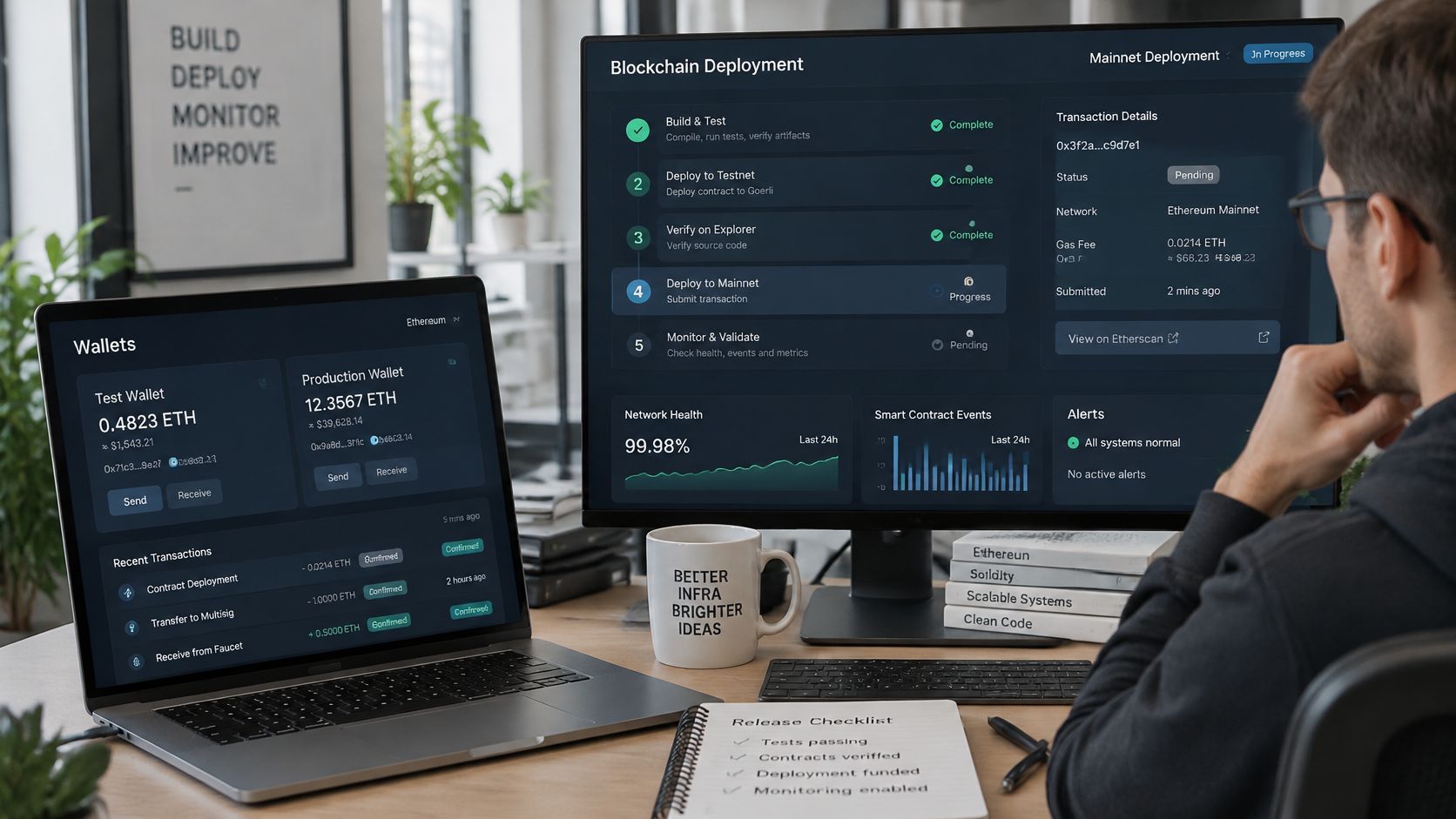
- Fund deployer wallets: Set gas limits and separate test funds from production funds. The common mistake is using a personal wallet that later becomes an untracked privileged account.
- Deploy identical artifacts: Use the same bytecode and constructor arguments planned for mainnet. Changing values between environments invalidates much of your test evidence.
- Verify source against bytecode: Confirm the published source matches what's deployed. Users and auditors can't trust code they can't match to the address.
- Run initialization deliberately: Record which calls write storage and what they cost. Teams often front-load expensive setup into initialization without noticing, then blame network fees.
- Move admin roles: Transfer administration to a multisig, place upgrades behind a timelock, and remove deployer privileges. Test that removal, don't just announce it.
- Launch under caps: Only after the pilot passes, set per-asset and per-block limits on borrowing, minting, or liquidation from pilot evidence. Starting uncapped turns your first bug into a maximum-loss event.
- Monitor what attackers change: Alert on oracle deviations, utilization spikes, governance actions, large position changes, and abnormal call patterns. If dashboards are growing by hand, scaling monitoring operations with Terraform offers a useful model for keeping coverage consistent.
- Rehearse pause and upgrade: Run the procedure before real money arrives and time it. An untested pause button is a hope, not a control.
Know What Healthy Release Evidence Looks Like
Caps hold under load, alerts fire in tests, roles match the map, and the team can pause within the documented time. The operational discipline behind that overlaps heavily with DevOps and infrastructure work for blockchain teams, especially around ownership and repeatable releases.
For hiring, give candidates a small deployment exercise. Ask them to estimate deployment gas, identify storage-writing initialization steps, and explain how testnet, mainnet, and layer-2 releases differ. That separates app developers from engineers ready for release and protocol operations.
Interview Skills That Hiring Teams Test for DeFi Roles
The Fidelity posting for a DeFi Quant Developer expects applicants to understand decentralized exchanges, lending, and derivatives, use Python with Pandas, NumPy, and Scikit-Learn, write SQL, use Git, and communicate across teams. Treat that as a practice plan, not just a job advert.
Practice in Four Parts
- Explain one mechanism clearly: Describe a lending market or automated market maker in two minutes to a non-engineer. If you can't explain collateral, liquidation, and incentives plainly, you don't understand them well enough yet.
- Analyze real data: Write a short SQL or Python analysis of on-chain activity and state your assumptions. Show how you handled incomplete data, outliers, and changing protocol rules.
- Attack your own model: Explain what breaks if an oracle goes stale, liquidity thins, or a governance vote changes parameters. Hiring teams trust candidates who can name failure paths without being prompted.
- Present the result: Write it up, then say it out loud. Quant and protocol roles both fail when good analysis can't survive a meeting.
Engineering candidates should run the same discipline on code. Estimate gas for one function, explain why a storage write costs more than arithmetic, and walk through deployment from wallet funding to role transfer. Show a portfolio project with gas per function, realistic transaction tests, and documented trade-offs, not only a working interface.
We've got 1,624 open Engineering roles on the site, and they don't all weight these skills equally. Protocol engineering leans toward invariants and gas, infrastructure toward deployment and monitoring, and quantitative research toward modeling and communication. If you're building a team and need a wider view of the market, Hire Developers is one route worth comparing against direct specialist hiring.
Confirm a Testnet Pilot Before Your Mainnet Launch
Don't launch to mainnet until a limited testnet pilot has exercised every gate with realistic value, hostile inputs, and the actual people who'll be on call. A fault in a pilot costs days. The same fault after launch costs funds, users, and trust you may not earn back.
Run Three Pilot Tests
- Push the caps and break the oracle: Drive test value to the capped limits and trigger at least one price deviation. Record how quickly alerts fire, whether the fallback feed holds, and whether borrowing or liquidations stop where they're supposed to stop.
- Make on-call execute the runbook: Have the named engineers pause the platform and run an upgrade against the documented time limit. Use the actual multisig flow and communication channels, not a shortcut deployer key.
- Set the first mainnet cap in writing: Write the initial cap, the evidence behind it, the date or condition for raising it, and get the risk owner to sign. If nobody will sign, you're not ready.
Only after those pass should you deploy the same bytecode and constructor values to mainnet and move every admin role behind multisig and timelock there. Verify roles on-chain after transfer. Screenshots of a transaction are not evidence that the old key lost power.
Staff for the gaps the pilot exposes. Protocol development, security review, compliance engineering, and operations are hard to improvise during an incident. Write job requirements from actual evidence you'd accept, such as a gas report, an invariant suite, an oracle failure test, or a timed runbook drill. Blockchain Jobs lists 6,934 open roles across crypto, DeFi and Web3, which gives hiring teams a useful benchmark for how specialist these requirements have become.
I would rather delay a launch with a signed pilot report than explain later why a known control was never exercised. DeFi platform development rewards teams that make safety observable before users supply the stress test.
If you're hiring smart-contract engineers, security specialists, compliance staff, or protocol operators for your next build, search the specialist listings at Blockchain Jobs and write your requirements around real gate evidence. If you're looking for your next role, use the same listings to target teams that value gas reports, invariant tests, and rehearsed operations, then apply with artifacts that prove you can do the work.