How to Become a Blockchain Technical Writer in 2026

You're probably sitting in a familiar spot, a decent tech writing job in front of you, a few browser tabs open, and one question that keeps coming back, should you stay general, or move into Web3 and become a blockchain technical writer. The answer isn't “learn more writing.” It's to understand the product, the risk, the hiring signals, and the kind of documentation teams pay for. In this market, the writer who gets hired is usually the one who can explain a protocol to a developer, a wallet flow to an end user, and a risky feature to a product team without making any of them work harder than they should.
What a Blockchain Technical Writer Actually Does
A good candidate usually starts with the wrong mental model. They think the job is about making prose cleaner, then they try to sell themselves as a generalist writer who can “simplify complex topics.” That's too vague for protocol teams, and it's usually why strong writers get passed over.
The work begins before the first sentence. A blockchain technical writer scopes the audience, decides what belongs in a guide versus a reference, builds the information architecture, and writes the warnings that keep users from making expensive mistakes. The role sits between software documentation and crypto explanation, which means the same smart contract has to make sense to a developer, a product manager, and a user who only wants to know what button to click next.
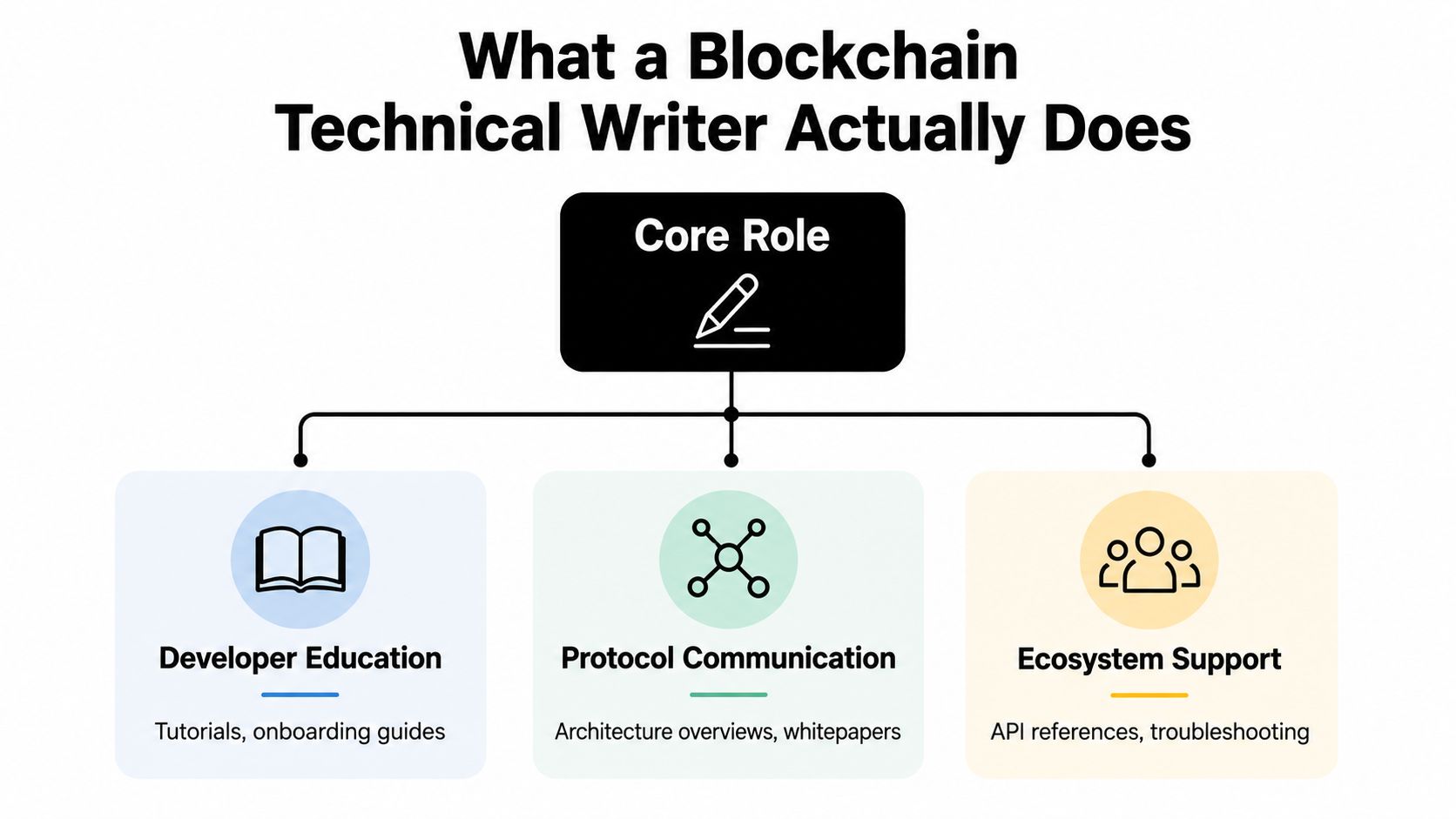
Developer education and protocol communication
The first split is simple. Some docs are for builders, some are for everyone else. A writer who understands that split immediately sounds senior because they stop treating all docs as one blob of content.
A developer-facing deliverable might be an API reference, a tutorial, or a sample code walkthrough. A protocol-facing deliverable might be an architecture overview or a whitepaper-style explainer. If you want a practical reference point for how strong API documentation is structured, look at write better API docs with Contesimal and compare the level of clarity to the docs you've seen in weaker products.
Ecosystem support is part of the job
The best writers also do ecosystem support. That means troubleshooting articles, migration notes, and risk warnings that answer the questions users ask after launch day, not just before it.
That's why blockchain teams hire for this role specifically. They need someone who can explain one system in several modes without drifting into marketing language. A general content writer can describe the idea. A protocol-facing writer can document how the thing works, where it fails, and what users need to know before they touch it.
Practical rule: if your portfolio only shows polished articles, you still look like a content marketer. If it shows audience-specific documentation, you start looking like someone who can own docs in production.
Core Responsibilities and Day-to-Day Workflow
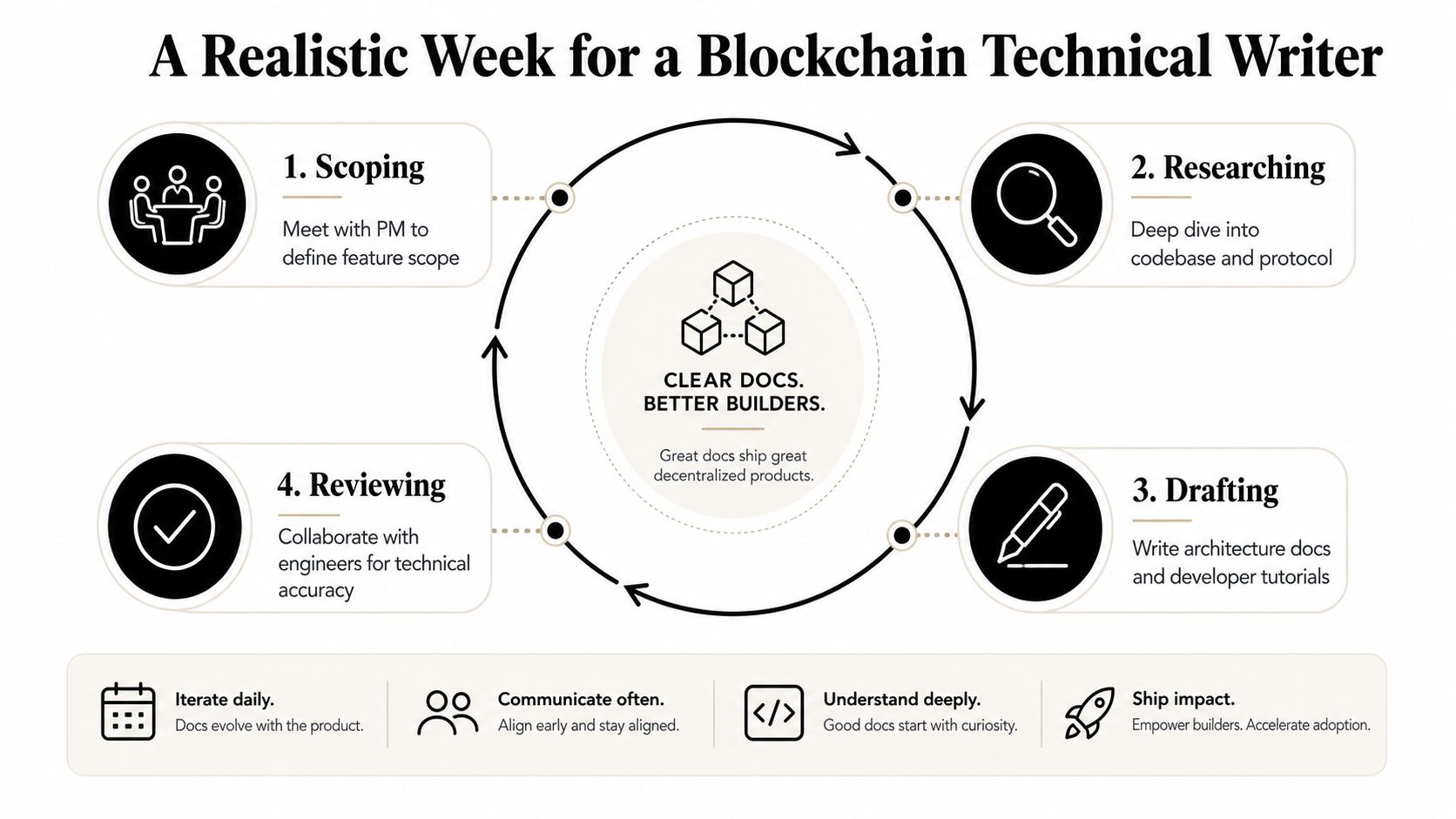
A realistic week for this role doesn't start with writing. It starts with a feature discussion, a messy spec, and a decision about who needs what level of detail. The writer who gets hired is the one who can turn that mess into a usable structure fast.
A workflow that maps to actual delivery
The job usually moves in this order, scoping, research, drafting, review, and publish. That sounds obvious, but candidates keep skipping the research layer and go straight to prose. That's how documentation becomes inaccurate, bloated, or too generic to help anyone.
The work often includes conceptual guides, how-to tutorials, API and SDK references, sample code, and migration notes. It also includes documentation hygiene, indexing, cross-linking, and contradiction warnings so a user doesn't follow two different instructions and end up unsure which one is safe. A strong writer treats those pieces as deliverables, not polish.
A good week also includes collaboration with engineers. In many teams, the writer pairs with a developer on the technical edge cases, then hands the draft back for review before anything ships in a GitHub-based docs workflow. That process matters because blockchain products change quickly, and public docs that lag behind the code become liabilities.
What hiring managers actually expect
If you're interviewing, the bar is not “can you write.” The bar is whether you can run a documentation workflow that protects the product. Hiring managers look for a writer who can define the audience, choose the right doc type, keep the structure clean, and flag risk without sounding alarmist.
One useful way to think about the job is this checklist:
- Audience fit: know whether you're writing for developers, end users, or internal teams.
- Information architecture: organize docs so people can find the right answer fast.
- Indexing and navigation: make sure the docs are searchable and connected.
- Risk warnings: spell out where users can lose time, funds, or trust.
If you can't talk through those four pieces, you sound like a freelancer who writes words. If you can, you sound like someone who can own a documentation system.
The role is operational, not decorative. That's the part most candidates miss, and it's also the part that gets them hired when they finally understand it.
Technical Skills You Need Before Your First Web3 Role
You don't need to be an engineer, but you do need to read like one. If a draft mentions Solidity, TypeScript, or a contract interaction that doesn't make sense, you should be able to spot the mismatch before an engineer has to rescue you. That level of literacy is what separates a decent writer from a credible blockchain technical writer.
The technical floor is higher than in generic tech writing
Start with the basics that show up in nearly every protocol environment. You need to understand consensus mechanisms, smart contracts, EVM and non-EVM differences, L1 versus L2 trade-offs, gas and transaction lifecycle, wallets and signing, and the vocabulary of zero-knowledge proofs.
Those concepts are not abstract trivia. They map directly to deliverables. Consensus shows up in architecture overviews. Gas and transaction flow show up in onboarding docs and user guides. Wallet signing belongs in end-user explainers. Zero-knowledge language belongs in protocol explanations where a reader needs enough clarity to trust the system without pretending they're reading a research paper.
Read the source material first
If you're learning this space, use primary sources. Whitepapers, protocol docs, and EIPs give you the technical spine that blog summaries often flatten. The wrong habit is to start with secondary articles and then try to sound authoritative. That's how writers end up repeating stale explanations that no longer match the product.
A practical learning path looks like this:
- Read the protocol docs first so you know how the system claims to work.
- Check the whitepaper or specification so you can understand the intended architecture.
- Scan the implementation docs or developer guides so you can see how builders will use it.
- Write a short explanation in your own words and compare it against the source language.
Good Web3 docs writers don't memorize buzzwords. They understand enough of the stack to ask the engineer a better question.
If you can read the technical material and then turn it into a clean guide without losing meaning, you're ready for interview prep. If you can't, you're not ready yet, and pretending otherwise will show up fast in a writing test.
Building a Portfolio That Gets You Hired
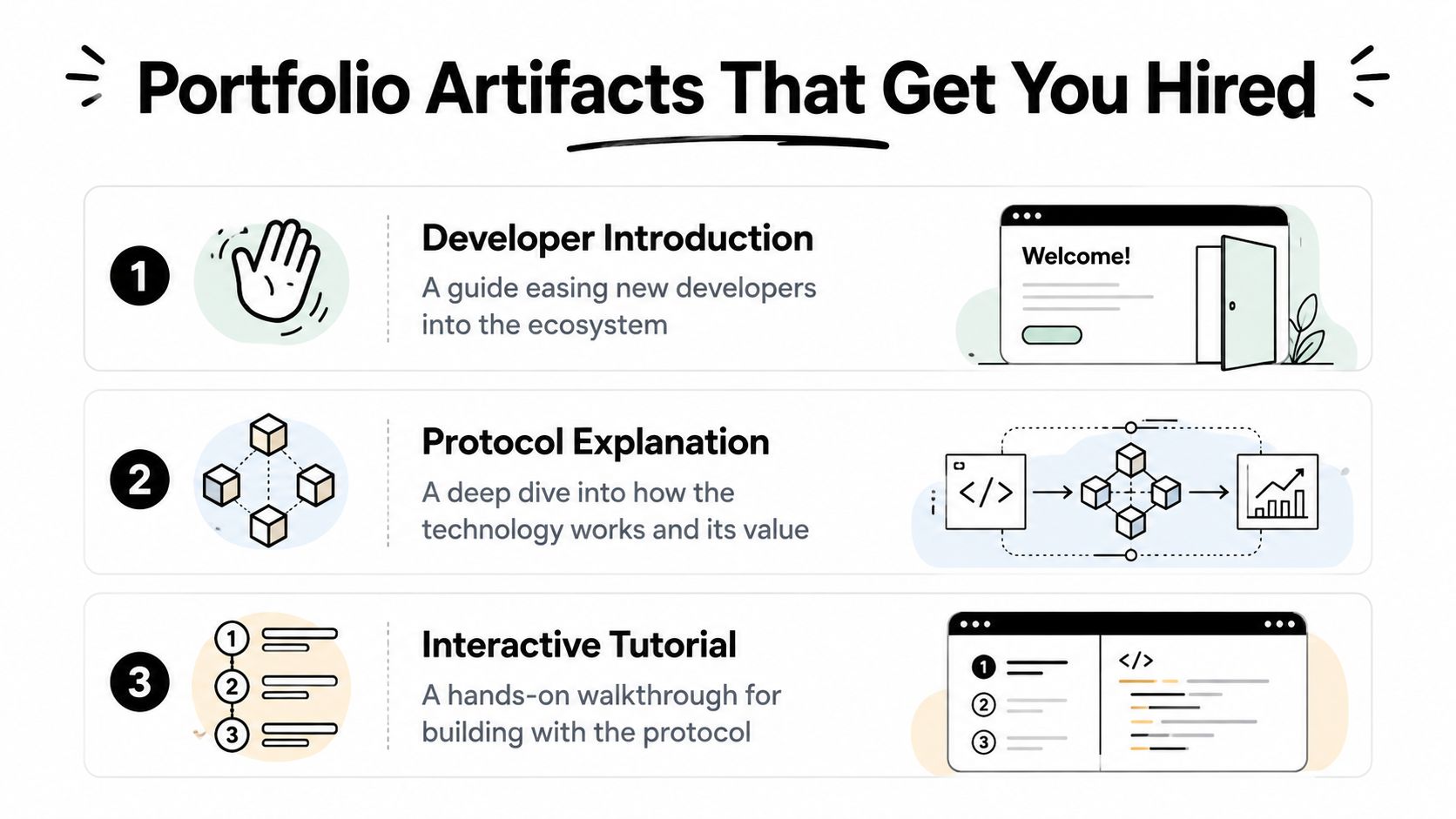
Hiring managers don't scan for “good writing” first. They scan for evidence that you can document a real protocol, not just comment on one. The portfolio that gets attention is usually built around one live product and three specific artifacts that prove range and judgment.
The three artifacts that matter
The first artifact is a developer introduction. This should help a new builder understand what the protocol is for, who it serves, and where to start.
The second is a technical explanation of how the protocol works and why it matters. This piece has to go deeper than a marketing blog post. It should show architecture, trade-offs, and the actual logic behind the product.
The third is a tutorial. You prove that you can guide someone through a real task step by step without skipping the places where they'll get stuck.
A lot of candidates ruin their portfolio by publishing random pieces on random topics. Don't do that. Pick one live protocol and build a coherent mini-library around it. That gives hiring teams a better signal than five disconnected posts ever will.
The executive-summary-first method
The strongest crypto writers don't dive into the long draft first. They start with a one-page executive summary, then move into architecture, consensus mechanism, tokenomics, and implementation roadmap. That workflow keeps the product team aligned before the draft gets too long to fix.
That same discipline helps your portfolio too. Write the summary first, even if you're building a sample on your own. If you can't state the system clearly in one page, you're not ready to write the deeper piece. That's not a style issue, it's a comprehension issue.
For distribution, publish on your own site or GitHub Pages so the work is verifiable. If you want a public hub for additional context on writing roles and job-market positioning, Blockchain Jobs blog is a useful place to compare how employers frame content work in this space.
The portfolio question isn't “Do I have content?” It's “Can I show a hiring team that I can ship documentation a protocol team would trust?”
Salary, Rates, and Negotiating Your Offer
A lot of candidates price themselves like generic content writers and get filtered out fast. Blockchain documentation pays for technical depth, product risk, and the ability to keep users from making mistakes in a fast-moving environment.
The U.S. technical writer labor market gives you a useful baseline, but treat the numbers as context, not gospel. The Bureau of Labor Statistics reported 47,970 employed technical writers in May 2023, a mean annual wage of $86,620 in May 2023, and a median annual wage of $91,670 in May 2024 at the BLS technical writers outlook. It also projects 1% growth from 2024 to 2034, with about 4,500 openings per year on average, and the 90th percentile wage reached $129,440 in the same BLS data. That is a mature profession, not a fad.
How Web3 compensation usually stacks up
Blockchain-adjacent writing pays more when the work gets more technical. A 2025 compensation summary for crypto content writers reported an average U.S. salary of about $74,296, with entry-level writers around $48,715, mid-level writers earning $70,000 to $90,000, and senior writers at roughly $92,500 annually, while protocol-heavy writing could reach up to $100,000 per year, according to crypto content writer salary data. Broader Web3 salary data also placed Technical Writer/Documentation Specialist base pay at $90,000 to $150,000 in that same source.
The range tells you how hiring teams think. If a role touches wallet flows, protocol behavior, or security-sensitive features, anchor your ask on the higher end. If the team wants someone to explain APIs, architecture, and user journeys with real technical ownership, that is not a low-end content role.
| Blockchain Technical Writer Compensation by Experience | |||
|---|---|---|---|
| Experience Level | Annual Salary Range (USD) | Hourly Rate Equivalent | Typical Hiring Signal |
| Entry Level | Lower end of the crypto writing market | Contract or junior full-time | Can follow source docs and produce clean tutorials |
| Mid Level | Around the middle of the crypto writing market | Higher contract or full-time | Can own docs for a feature or subsystem |
| Senior Level | Near the stronger protocol-writing range | Premium contract or full-time | Can lead architecture docs, reviews, and docs workflow |
| Specialist Level | Up to the top of the blockchain documentation band | Premium rate with technical scope | Can document security-sensitive systems and complex protocol changes |
Negotiation should follow scope, not word count
A writer who understands protocol depth should negotiate differently from a generalist. Do not sell speed. Sell reduced ambiguity, better adoption, and less engineering back-and-forth.
For a full-time role, say this plainly, “I'm comfortable discussing a base package that reflects protocol complexity, docs ownership, and engineer-facing collaboration.” For a contract role, say, “If you need architecture docs, API references, and tutorials tied to a security-sensitive release, I price for technical review depth, not article volume.”
That is the right frame. Blockchain teams do not pay for output alone, they pay for clarity under pressure.
Interview Prep That Mirrors How Hiring Managers Score You
Most interview advice is useless here because Web3 technical-writing interviews are not general writing interviews. They're scored on whether you can handle a real product, a real technical problem, and a real documentation workflow without drifting into fluff.
The four rounds that usually matter
The first round is the portfolio walkthrough. You show the docs, explain the audience, and defend the choices you made in structure and tone.
The second is the technical depth probe. Expect questions about ambiguous specs, consensus, wallets, smart contracts, or where a documentation explanation could mislead a user.
The third is a live writing or editing sample. A common prompt is to rewrite a weak API reference or clean up a confusing tutorial on the spot.
The fourth is a system-design conversation about documentation architecture. That's where hiring teams test whether you think in pages or in systems.
If you want a broad reference for how the modern interview process often unfolds, steps in the modern interview process is a useful external framing tool. For Web3 roles, the sequence tends to be similar, but the technical pressure is higher and the margin for vague answers is lower.
What good answers sound like
When you're asked how you'd handle ambiguous specs, don't say you'd “ask clarifying questions.” Everyone says that. Say what you'd clarify, who owns the source of truth, and how you'd prevent contradictory instructions from slipping into the draft.
When you're asked to document a security-sensitive feature, don't overpromise. State the user risk, define the safe path, and show how the docs would prevent misuse. That answer matters more than clever phrasing.
When you're asked to edit a bad API reference, start with structure. Fix the order, clean the terminology, make the example usable, then remove anything that sounds like product marketing. That sequence tells the interviewer you know what docs are for.
If your answer sounds polished but not operational, the interviewer assumes you haven't shipped real docs in a production environment.
The candidates who move forward are usually the ones who sound specific, calm, and technical without pretending to be engineers. That's the sweet spot.
Where to Find Blockchain Technical Writer Jobs and Stand Out
The market is real, but it's not evenly advertised. If you spray applications across generic boards, you'll waste time and get weak response rates. The better play is to target the places where blockchain teams already expect to hire specialized writers.
The channels worth your time
Start with specialized Web3 job boards, especially blockchain-focused boards. Then go directly to protocol foundations and company career pages, because those teams often post documentation roles where general job aggregators never surface them. Ethereum ecosystem working groups can also be worth watching because docs work often sits close to public devrel and protocol support.
Cold outreach still works when it's targeted. Reach out to engineering managers on X and Farcaster with a short note, a live portfolio link, and one clear reason your sample matches their stack. If you've ever documented something open source, that proof of work matters more than a long cover letter.

How to stand out fast
Use a one-page brief on a recent protocol release, especially if you can connect it to a docs gap. If you've contributed a pull request to an open-source docs site, put that near the top of your application. That signals you can work in a real docs workflow, not just talk about one.
For personal brand, WaveGen.ai's guide on LinkedIn personal brand is worth reading if you need a sharper public profile. The point isn't to perform online. The point is to make it easy for a hiring manager to verify that you understand the technical writing lane and can speak to blockchain work without overclaiming.
A simple 90-day plan looks like this, apply weekly, publish two portfolio pieces, and send one proactive outreach sequence every week to a team that is shipping something relevant. If you want a current example of how specialized content roles are framed, the content writing jobs page is a useful reference for the category.
The writer who wins this market is visible, specific, and already doing the work before the first interview. That's the difference.
Blockchain Jobs gives you a clean way to track real openings across the Web3 market without wasting time on scattered listings. If you're serious about becoming a blockchain technical writer, visit Blockchain Jobs and use it to find the roles where your docs portfolio has a chance to land.