How to Land High-Paying Remote Roles in Community Management
Finding a remote community manager job isn't just about finding a gig you can do from home. It’s about stepping into a critical role that directly shapes a company's growth, brand, and user loyalty—all from behind a screen. To land these roles, you need to think like a hiring manager. This guide provides actionable insights to navigate the hiring process, ace interviews, and accelerate your career progression in the world of community manager jobs remote.
The New Era of Remote Community Management

Let's be clear: the community manager role has completely transformed. What was once seen as a support-level job—mostly about policing forums—is now a linchpin of business strategy. For leading companies in Web3, SaaS, and gaming, a strong community isn't a "nice to have"; it’s the engine for product adoption, user retention, and brand identity.
This fundamental shift means hiring managers are looking for candidates who think like business owners. They don’t just want someone to chat with users; they want a professional who can turn engagement into measurable business results. The modern community leader wears many hats: part marketer, part data analyst, part product manager. This is your key to career progression.
What Top Companies Are Really Looking For
When recruiters are sifting through applications for remote community roles, they’re hunting for a specific skill set that proves you can work autonomously and deliver results. To get past the initial screen, your resume and cover letter must demonstrate a strategic mindset that goes way beyond posting memes and answering DMs.
Here’s what gets their attention in an interview:
- A Voice for the User: Frame yourself as the bridge between users and the product team. Can you give examples of how you gathered, synthesized, and championed user feedback to influence product development?
- Driving Growth: Be prepared to discuss how you grew a community. Have you designed and executed campaigns that acquired new members and increased activation rates?
- Strategy Backed by Data: You must prove your work works. In an interview, talk about the analytics you used to track community health, measure engagement, and build a business case for your initiatives.
The candidates who get interviews are the ones who speak in terms of impact. Don't just say, "I managed a Discord." Instead, frame it for a hiring manager: "I grew our Discord community by 40% in six months by launching a targeted ambassador program, which directly contributed to a 10% increase in user retention." See the difference?
This evolution is mirrored in the job market itself. More and more companies are embracing flexible work for roles built around user engagement. We've seen a huge shift, with hybrid job postings for professional roles jumping from about 15% in Q2 2023 to a projected 24% by mid-2025.
Thriving in a Global, Remote Environment
The real challenge of community manager jobs remote is building genuine connections with people you've never met in person, scattered across countless time zones and cultures. This takes incredible asynchronous communication skills and a deep understanding of digital community dynamics.
A Web3 community manager, for example, has to be a pro at engaging people on platforms like Discord and Telegram, often at hours that would make a 9-to-5er's head spin.
Succeeding in this environment demonstrates you're a self-starter who can build a global brand from a home office. And that’s exactly the kind of talent that top-tier companies, like the one in this Binance community manager job listing, are actively looking for.
Finding High-Value Remote Community Manager Jobs
If you want to land the best community manager jobs remote, you have to stop looking where everyone else is. The big, generic job boards are a black hole of resumes. The real gems—the high-impact, high-paying roles that accelerate your career—are found in more focused, niche corners of the internet.
Think of it this way: your job search isn't a numbers game; it's a strategic mission to get in front of the right hiring managers.
Your first move? Ditch the mainstream platforms and go straight to the source. For anyone serious about the blockchain space, sites like Blockchain Jobs are non-negotiable. This is where real Web3 companies go to find talent that actually gets the culture, not just the keywords.
The demand for skilled community pros is definitely heating up. We're looking at a projected 6% growth in community-related roles by 2034, which is well above the average. More recent data from early 2025 showed an 8% jump in remote community job postings in just one quarter. If you want to dive deeper into these trends, check out the analysis from The Crypto Recruiters.
Where to Find Top-Tier Remote Community Manager Roles
Knowing where to look is half the battle. The best opportunities are rarely on the front page of Indeed. Here's a breakdown of the platforms that will give you a serious edge in your job hunt.
| Platform | Primary Industry Focus | What Makes It Different | Insider Tip for Applicants |
|---|---|---|---|
| Blockchain Jobs | Web3, Crypto, DeFi, NFTs | Exclusively for blockchain roles, cutting out all the noise from other industries. | Complete your profile 100%. Recruiters use profile data to search for candidates, so a bare-bones profile is invisible. |
| Community Club | General Community Management | Run by community pros, for community pros. High-quality, vetted listings. | Engage in their Slack channel before you apply. Build a reputation as a helpful member first to get noticed. |
| Web3 Career | Web3 & Tech | Aggregates a massive list of jobs from hundreds of company career pages. | Use their filters aggressively. Filter by "fully remote" and specific sub-sectors like "DAO" or "Gaming" to find your perfect fit. |
| All Industries | Unbeatable for its network and ability to connect directly with hiring managers. | Don't just "Easy Apply." Find the person who posted the job and send a personalized connection request with a short, punchy note. |
This isn't just about finding listings; it's about positioning yourself where the right people will see you.
Tapping Into the Hidden Job Market
Let's be real: many of the absolute best jobs are never publicly posted. They're filled through backchannels and private communities where hiring managers can find trusted talent without sifting through a thousand applications.
Your mission is to get inside these circles. Here’s how to do it:
- Niche Newsletters: Find and subscribe to the newsletters that community leaders actually read. They often feature hand-picked job listings that have been vetted for quality.
- Private Slack & Discord Groups: This is huge. Join groups for community professionals. They almost always have a
#jobschannel where founders and recruiters drop exclusive openings. - Curated Twitter (X) Lists: Build a list of Web3 founders, VCs, and top community leads you admire. They often post new roles on their personal feeds to tap their network first.
Getting a referral from someone inside one of these private groups can be a golden ticket. It instantly moves your application from the "maybe" pile to the "must-read" pile in the eyes of a recruiter.
Setting Up Your Search for Success
Once you know where to look, you need to be ready to move fast. A top-tier remote role, like this Game Community Lead position, won’t stay open for long.
Set up smart job alerts with laser-focused keywords. On LinkedIn, don't just search for "Community Manager." Use boolean search strings to dial it in, like ("Community Manager" OR "Community Lead") AND (Web3 OR Crypto OR Blockchain) NOT (intern). This simple trick will save you hours by filtering out irrelevant junk.
This targeted approach isn't about applying for more jobs; it's about applying for the right jobs. You're no longer just another resume—you're a specialist who found the role through the right channels. That's the difference between getting an automated rejection and landing the interview.
Building a Portfolio That Proves Your Impact
A resume tells people what you were supposed to do. A portfolio shows them what you actually did. When you're up against dozens of other applicants for community manager jobs remote, a resume that just says "managed Discord" or "posted on Twitter" is a one-way ticket to the "no" pile.
You have to prove you can deliver real, tangible results. Hiring managers aren't just looking for a moderator; they're looking for someone who can drive growth. Your portfolio needs to immediately answer their biggest question: can you turn our community from a chatroom into a powerful business asset?
Moving Beyond Vanity Metrics
Anyone can boast about a growing member count. That’s easy. The candidates who get hired are the ones who can connect their work to real business goals. It's about changing the conversation from "here's what I did" to "here's the impact I made."
Think of your accomplishments as mini case studies. For every major project or role you’ve had, structure your story for a hiring manager:
- The Challenge: What was the business problem? (e.g., "The community was bleeding members and sentiment was tanking after a botched product update.")
- The Action: What specific steps did you take? (e.g., "I launched a 'Fix-It-Friday' feedback campaign, got the lead dev to host weekly AMAs, and created a content series addressing the issues.")
- The Result: What were the measurable business outcomes? (e.g., "This strategy resulted in a 25% jump in positive sentiment and a 15% increase in weekly active users within three months.")
A powerful portfolio doesn’t just show what you did; it proves why it mattered. Quantify everything. Numbers speak louder than words and give a hiring team cold, hard proof of your value.
Crafting Compelling Case Studies
Your portfolio should be a highlight reel, not a complete filmography. Aim for two or three really strong case studies that demonstrate you can handle the different challenges a remote community manager will face.
Here are a few story archetypes that impress recruiters:
- The "From Scratch" Build: This is your origin story. How did you take a community from zero to one? Walk them through your 90-day plan, your platform choices, and key growth milestones. This shows initiative and strategic thinking.
- The "Pouring Rocket Fuel" Campaign: Pick a time you were asked to scale an existing community. Detail an ambassador program or content contest you launched. Focus on the ROI—how many new, active members did it bring in? This demonstrates your ability to drive growth.
- The "Putting Out Fires" Scenario: This one is crucial. It shows you don't crack under pressure. Describe how you handled a crisis—a toxic user, a product exploit, or a wave of FUD. Explain your de-escalation strategy and how you restored trust. This proves your leadership potential.
To see what skills companies are truly hunting for, check out job descriptions like this Senior Marketing and Community Manager role. Notice how it's all about strategic growth and impact, not just posting memes.
Finally, package it all up professionally. You don't need a fancy custom website. A clean and simple page on Carrd or Notion is perfect. Make it look good, make it easy to read, and link to it from your resume, LinkedIn, and email signature. It shows you’re a pro who’s ready for a serious role.
Mastering the Remote Interview and Take-Home Task
So, your portfolio got you in the door. Now comes the real test. The interview process for community manager jobs remote is designed to see how you think on your feet, especially when no one is looking over your shoulder. Can you solve tricky social problems and drive growth on your own?
This is where your strategic mind, not just your resume, will land you the offer. Expect less Q&A and more practical, "what would you do if..." conversations.
Deconstructing the Interview Questions
Hiring managers for Web3 projects need to know you can handle the chaos. They’ll throw real-world scenarios at you to hear the how and the why behind your past experiences—both the wins and the losses. Fuzzy, high-level answers are a red flag.
You can pretty much count on questions that fall into three buckets:
- Conflict & Crisis Management: "Walk me through a time a community spiraled into FUD (Fear, Uncertainty, and Doubt). What was your plan, and what happened?"
- Strategic Growth: "Imagine you've inherited a Discord server with low engagement. What are the first 3 things you do to turn it around?"
- Content & Programming: "Lay out your process for creating a content calendar for our community. How would you prove it's actually working?"
When you answer, think in stories. A simple Situation, Action, Result framework is your best friend here. Briefly describe the challenge, explain exactly what you did, and—this is the most important part—back it up with numbers. Show them you don't just manage communities; you measurably improve them.
Nailing the Take-Home Assignment
The take-home task is the final boss. It's usually a case study where you're asked to build a strategic plan for a community challenge. This is where a lot of candidates stumble. They get caught up trying to propose flashy, "viral" ideas instead of a grounded, realistic plan.
Your real goal is to show them how you think. They want to see that you can break down a problem, set clear goals, and propose a solution that actually helps the business. They’re evaluating your process just as much as your final PowerPoint.
The prep work you did for your portfolio is a perfect rehearsal for this moment. It’s all about connecting your actions to measurable outcomes.
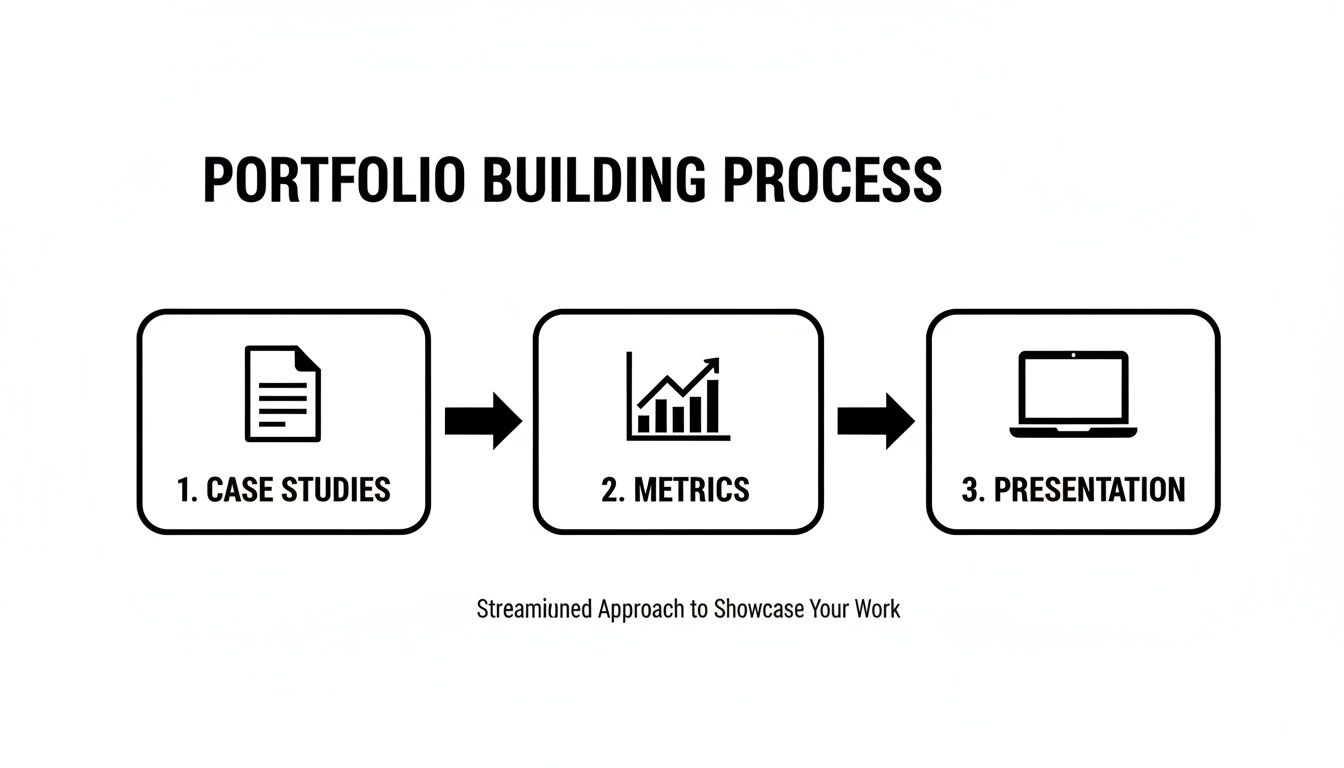
This workflow is exactly what they’re looking for: solid case studies built on real metrics, all pulled together in a convincing presentation.
When you present your take-home assignment, always lead with the ‘why.’ Don't just jump into a list of tactics. First, explain the core problem you've identified. Then, state the specific goal you're targeting. Only then should you explain why your strategy is the smartest way to get there. This frames you as a strategic partner, not just an order-taker.
And don't forget the basics. A remote interview is also a test of your remote-work hygiene. Make sure your camera and mic are solid, find a clean background, and communicate clearly. Building a vibe over a video call is half the job, and the interview is your first audition.
Negotiating a Six-Figure Remote Compensation Package

So you got the offer. Congratulations! That's a huge win, but don't pop the champagne just yet. Now comes the part where you secure a compensation package that reflects your value. This isn't about being difficult; it's about getting paid what you're worth in a competitive market to ensure long-term career satisfaction.
You can't walk into this conversation empty-handed. You need data. The market for experienced remote community pros is hot. By 2025, salary surveys showed average pay dancing around the $98,000–$99,000 mark. For senior roles or those with specialized Web3 experience, six figures is common, with some leads pulling in $125,000+. For a deeper dive, check out the salary data on remote community manager salaries at Built In.
Making the Case for More Than Just a Base Salary
Your strongest negotiation tool is everything you’ve already done—your portfolio, your interview performance, and the case studies you presented. When you talk numbers, you need to connect your ask directly to the results you’ve proven you can achieve.
It’s about framing. Instead of simply saying, "I'd like a higher salary," try a more results-oriented approach: "Based on the growth plan I outlined to boost new member activation by 30% in the first six months—which mirrors what I did at my last project—I feel a salary of [Your Target Number] is a better reflection of the immediate ROI I’ll bring to the team."
The secret to a successful negotiation is making it about their win. You're not just asking for more money; you're framing your salary as an investment that will pay them back handsomely.
And remember, a great remote offer is about more than just what hits your bank account. The best packages include perks that genuinely support a healthy and productive remote work life. These aren't just fluffy benefits; they're critical parts of your total compensation.
Key Negotiation Points for Remote Roles
A solid package for community manager jobs remote goes way beyond salary. Think bigger picture. Here are a few other crucial elements you should be ready to discuss to support your career progression:
- Equity or Token Allocation: This is huge, especially in Web3 and early-stage startups. It can become a massive part of your long-term earnings. Don't be shy about asking for specifics on the vesting schedule and what percentage it represents.
- Home Office Stipend: A one-time or annual allowance for your desk, a good chair, and other gear is a standard and reasonable ask for fully remote roles. They need you to have a proper setup to do your best work.
- Professional Development Budget: Asking for a fund for conferences, courses, or certifications does two things: it helps you grow, and it shows them you're serious about staying at the top of your game, which directly benefits them.
- Flexible Hours & Asynchronous Work: Get clear on what "flexible" really means. Are there core hours? True flexibility that respects different time zones and work styles is one of the most valuable non-monetary perks you can get.
The goal here is a partnership. You want a package that supports not just your life, but your long-term career growth. A company willing to invest in these areas is a company that truly values its people—and that's the kind of project you want to be a part of.
Your Questions Answered: Navigating Remote Community Careers
When you're diving into the world of remote community manager jobs, a ton of questions pop up. It doesn't matter if you're a seasoned pro or just starting out—the game is always changing. Let's tackle some of the most common questions from a hiring and career progression perspective.
What Skills Actually Matter for Remote Community Managers?
Forget the fluff. To get hired, you need a specific mix of skills. You must be comfortable with data. Tools like Orbit or Common Room are essential for tracking engagement and proving your work is driving business value. You have to speak the language of ROI to get hired and promoted.
Content strategy is another big one. You can't just post memes. You need to show you can build and execute a content calendar that sparks meaningful conversations and aligns with business goals.
And if you're aiming for a Web3 role? The bar is even higher. Hiring managers expect hands-on experience with Discord and Telegram automation, an understanding of token-gating, and genuine participation in the ecosystem. These aren't just buzzwords; they're the price of entry.
How Do I Break In With No "Official" Experience?
This is a big one, but the answer is simple: create your own experience. The best way to get your foot in the door is to volunteer as a moderator for a Discord server or subreddit you already love. This gives you instant, real-world experience to put in a portfolio and discuss in an interview.
Even better? Start your own community. It shows incredible drive and gives you a playground to experiment with growth tactics and document everything. When you apply for jobs, you can then connect the dots from your other work. Pulled off a tricky de-escalation in customer service? That’s crisis resolution. Ran a successful social media campaign? That's content creation. Frame your past as the perfect training ground for this job.
The best advice I can give is this: don't wait for someone to give you the title. The candidates who stand out are the ones who are already building, moderating, and growing something. That kind of initiative is exactly what hiring managers for remote roles are desperate to find.
Are Remote Community Jobs Really That Much More Competitive?
In a word, yes. A remote job posting can attract talent from all over the world, so the applicant pool is massive. But here's the flip side: you aren't limited by location, either. The number of opportunities available to you is exponentially larger.
The key to winning in this environment is proving you can thrive without supervision. Your application, portfolio, and interview answers need to send one clear message: "I get things done, and I don't need my hand held." Hiring managers for remote teams are heavily biased toward people who show they're self-starters with great time management and crystal-clear communication skills, especially in writing.
What's the Career Path After Being a Community Manager?
This role is an incredible launchpad into senior positions. The most direct route is moving up to Senior Community Manager and eventually becoming a Director or Head of Community, where you're setting the high-level strategy for the entire company.
But the skills you build are also super valuable in other departments. It’s pretty common to see experienced community managers transition into:
- Developer Relations (DevRel): A perfect fit if you love the technical side of the community.
- Product Marketing: You become the official "voice of the customer," using community feedback to shape the product roadmap.
- Customer Success or Brand Advocacy: These roles lean heavily on the empathy and relationship-building skills you've mastered.
Think about what part of the job gets you most excited—is it the strategy, the analytics, the content, or the user support? Answering that will help you map out your long-term career progression and target the right kind of roles.
Ready to find your next opportunity? Blockchain Jobs is the go-to platform for high-quality remote community manager roles in the Web3 space. Stop wasting time on generic job boards and start browsing curated positions from top blockchain companies. Find your perfect fit today at https://blockchain-jobs.com.