Open Source Blockchain Explained: Projects and Careers
If the code is public, is the project open? Most hiring conversations stop there, and that is the gap. A repository you can read is not the same as a protocol you can run, fork under a clear license, and change through a funded review process. The difference decides whether your pull request becomes a hiring signal or a weekend experiment nobody can verify.
What an Open Source Blockchain Actually Is
Think of a chess federation that publishes every rule and every recorded game. Anyone can read the rulebook, replay a match, and check that a claimed win followed the rules. An open source blockchain works the same way for a shared ledger.
In one sentence, it is a blockchain whose protocol code is publicly licensed, so anyone can read it, run a node, propose changes, and verify the ledger's state themselves.
Public code means the client is inspectable. You can see how blocks are validated, not just the marketing page.
Permissionless participation means you don't ask a company for a seat. Suitable hardware and the published client are enough to join the network.
Verifiable state means you recompute the ledger from the rules and the history. You don't take a vendor's database export on trust.
A chain run by one firm can still show you source. What it won't give you is an independent right to change the rules or to confirm that the live system matches the code you read. The owner merges, ships, and can replace the implementation without your vote.
Openness is the norm among serious projects, not a niche. A 2023 academic study found that 69.8% of the 600 leading blockchain projects examined had publicly visible code repositories on GitHub.

Run this test before you invest a weekend. Find the repository, open the license file, see who merged the last twenty commits, and check whether the docs explain how to run a node. If any of those four is missing, treat "open" as a slogan.
Four Major Projects Compared Side by Side
The license tells you what you may reuse. Governance tells you who can change the rules. The entry point tells you where a first pull request is realistic. Confirm the license file in the specific repository before you copy anything into a product.
| Project | Code license | Governance model | Primary language | Where newcomers start |
|---|---|---|---|---|
| Bitcoin Core | MIT | Maintainers and Bitcoin Improvement Proposals | C++ | Open issues and test coverage on GitHub |
| Ethereum clients (for example go-ethereum) | LGPL-3.0 | Ethereum Improvement Proposals and core developer calls | Go, Rust and others | Client issue trackers and EIP discussions |
| Cosmos SDK | Apache-2.0 | On-chain governance by staked validators | Go | SDK issues and module documentation |
| Polkadot SDK | Apache-2.0 and GPL-3.0 by crate | OpenGov referenda | Rust | Example pallets and runtime issues |
Bitcoin Core is the conservative end. MIT lets you reuse the C++ client in commercial software if you keep the copyright notice. Merges still go through maintainers, and protocol ideas travel as Bitcoin Improvement Proposals. A newcomer who opens a consensus change on day one will wait. Test coverage and well-scoped issues are the practical door.
Ethereum clients are a family, not one repo. go-ethereum is the usual first stop, and its LGPL-3.0 terms are stricter than MIT when you ship a modified library. Protocol changes move through Ethereum Improvement Proposals and public core developer calls. You can follow an EIP discussion before you touch client code, which is useful if you're still learning how upgrades get scheduled.
Cosmos SDK is Apache-2.0 Go. That patent grant and permissive reuse make it a common base for app-chains. Upgrades on those chains are on-chain proposals voted by staked validators. Your first useful change is often a module doc fix or a small SDK issue, not a governance proposal.
Polkadot SDK is Rust, and the license is not one file for the whole tree. Some crates are Apache-2.0 and others are GPL-3.0, so you check the crate you import. Network upgrades go through OpenGov referenda. Example pallets and runtime issues are where a first patch stays small enough for review.
Practical rule: If you can't name the license, the people who merge, and a first issue you could finish in a week, you don't know the project well enough to put it on a résumé.
How those networks agree on blocks is a separate skill from the license. A clear comparison of proof of work versus proof of stake helps you talk about why Bitcoin's entry work looks different from validator-voted upgrades on Cosmos or Polkadot.
From Bitcoin's 2009 Release to Today's Ecosystem
How did an openly published design become a network that strangers could inspect and use? Bitcoin's first public steps happened over roughly two months.
On 31 October 2008, Satoshi Nakamoto published the Bitcoin white paper. On 3 January 2009, Nakamoto mined block 0, the genesis block. The first public open-source client, version 0.1.0, shipped on 9 January 2009. On 12 January, developer Hal Finney received 10 BTC from Nakamoto in block 170, the first recorded transaction. The Bitcoin history on Wikipedia records the sequence: specification, live network, open client, then a payment anyone could inspect.
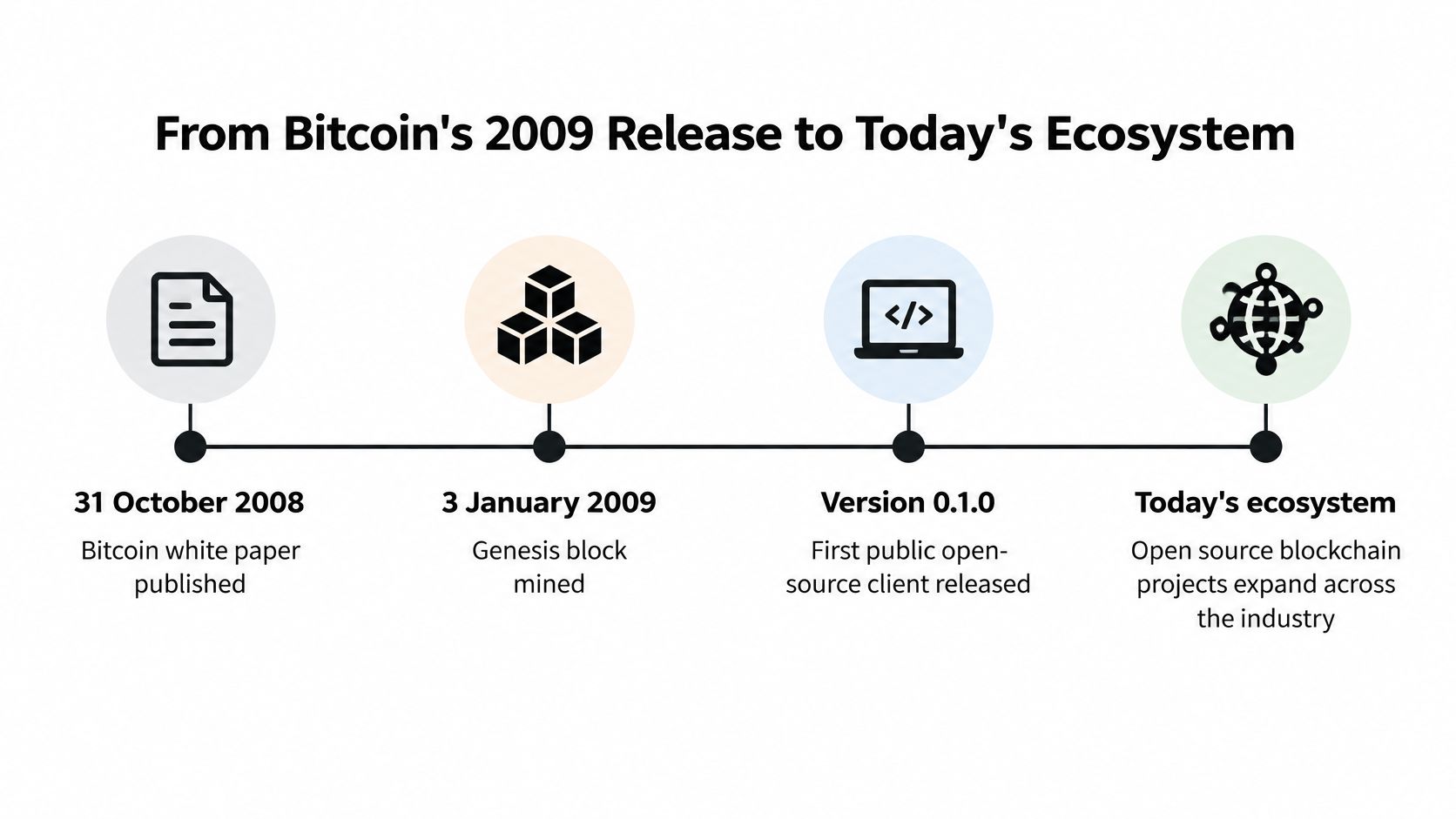
Together, these steps made the project more than public software. A specification described the rules, an open client implemented them, and a live network let people check whether blocks followed them. Anyone with suitable hardware could inspect the code, compile it, run a node, or propose an improvement without seeking a company's permission.
The same broad pattern appears in later projects, though each organizes change differently. Ethereum has public clients and improvement proposals. Cosmos chains publish SDK modules and vote on upgrades on-chain. Polkadot makes its runtime public and uses OpenGov. Across these examples, the connection between written rules, running code, and a network people can join gives contributors a way to test whether an implementation matches its design.
The field extends beyond monetary clients. Linux Foundation LFX Insights groups cryptocurrency projects by areas such as decentralized application platforms, digital-currency systems, consensus mechanisms, and protocol specifications. These categories help show the range of work involved, from defining rules to building software that runs them.
A short walk through the early client makes the 2009 release easier to picture than a date list alone.
For an interview, focus on the sequence: what was published, what was running, and how a stranger could verify the result. That explanation shows you understand how an open project becomes a working network, not just a repository of public code.
Licenses That Decide What You Can Build
A license is the hiring-relevant part of "the code is public." It decides whether your employer can ship a fork, whether you must publish your changes, and whether a patent grant comes with the code.
| License | Commercial use | Modified source must be shared | Explicit patent grant | Network use triggers sharing |
|---|---|---|---|---|
| MIT | Yes | No, copyright notice must be kept | No | No |
| Apache-2.0 | Yes | No, notices and attribution must be kept | Yes | No |
| GPL-3.0 | Yes | Yes, when you distribute a modified version | Yes | No |
| LGPL-3.0 | Yes | Yes, for changes to the library itself | Yes | No |
| AGPL-3.0 | Yes | Yes, when you distribute a modified version or offer it over a network | Yes | Yes |
Permissive licenses (MIT and Apache-2.0) let a company fork and keep its own modules closed. MIT is short and has no explicit patent grant. Apache-2.0 adds that grant, which matters when you ship cryptography or consensus code a patent holder might later claim.
Copyleft licenses (GPL-3.0 and AGPL-3.0) still allow commercial use. They require you to share source of the modified program when you distribute it. AGPL-3.0 goes further: offering the software as a network service can trigger the same sharing duty. That shows up when a team hosts an RPC endpoint built on a node client and customers never receive a binary.
LGPL-3.0 sits between them. Proprietary code may link to the library. Changes to the library itself stay open, so a wallet can keep its UI closed while publishing patches to the linked client library.
A wallet team shipping a node
Say a wallet team forks a GPL-3.0 node client, fixes peer selection, and ships the binary in the desktop app. They must publish those changes under GPL-3.0, with the build correspondence so a user can rebuild what they received. The same team, starting from Apache-2.0 node code, can keep a private fee-estimation module closed, but they still keep the Apache notices and any NOTICE file.
If they instead wrap an AGPL-3.0 client and sell hosted access, the network trigger applies even though no installer was downloaded. Hosted infrastructure is not a loophole.
Before you merge upstream code into a product repo, do three checks.
- Read the root license file in that repository, not a blog post about the project.
- Read every dependency's license, including crates and npm packages the client pulls in.
- Get legal review before you ship a fork, especially if the binary or the hosted service leaves your laptop.
Interviewers ask this because a wrong license choice is expensive to unwind after customers have the software.
Who Governs the Code and Who Pays for It
A token vote can approve an upgrade. It doesn't review the pull request, answer a security report, write the upgrade notes, or cut the release. Governance and maintenance are different jobs, and healthy projects fund both.
People often sort this as centralized versus federated governance. On a blockchain the same split shows up inside one repo: one group may set direction while another group still has to merge the patch.
Five models, by what they fund
Foundation-led stewardship pays for a legal home, trademarks, and sometimes full-time reviewers. It can miss speed. A foundation board is a poor incident-response rotation if no engineer is on call.
Core-team leadership is how Bitcoin's maintainers work. A small group merges, and Bitcoin Improvement Proposals move slowly on purpose. The trade-off is visible: changes that touch money supply or validation face a high bar, and feature ideas wait. That conservatism is a design, not a lack of process.
Corporate sponsorship pays salaries and CI minutes. It misses continuity. A sponsor can reprioritize, and the reviewers leave with the budget.
Grant programs pay for a new module or a documentation push. They rarely pay for a multi-month audit, release engineering, or the person who triages issues every Tuesday.
Token-based decisions pay for legitimacy on upgrades that token holders or staked validators approve. They miss the check that the approved bytes match reviewed code. A passed referendum with nobody reading the diff is not maintenance.
Someone has to own the pager. If you can't name that person, the upgrade process is a vote without an operator.
What this means for your role
Reviewers need paid time or public recognition, or the review queue becomes whoever is online. Contributors need a path from unpaid issues to accountable roles: reviewer, release manager, incident lead. A decentralized governance explainer is worth reading before an interview so you don't treat "decentralized" as a substitute for those jobs.
Ask any project three questions before you join or cite it.
- Who merges the code? Names and permissions, not a slogan.
- Who funds the reviewers? Salary, grant, or unpaid evenings.
- Who is on call when a critical bug is reported, and how you reach them.
If the answers are vague, your contribution may merge, but it won't sit inside a system an employer can trust.
How a Contribution Reaches a Live Network
Public code also widens the supply chain. ReversingLabs documented 23 cryptocurrency-related malicious supply-chain campaigns in 2024, and its 2025 research found a 12% increase in exposed developer secrets in open-source repositories, according to the 2025 software supply chain security report. Immutable contracts and wallet infrastructure can't be patched after deployment, so the checks below are part of every step, not a checklist you run once at the end.
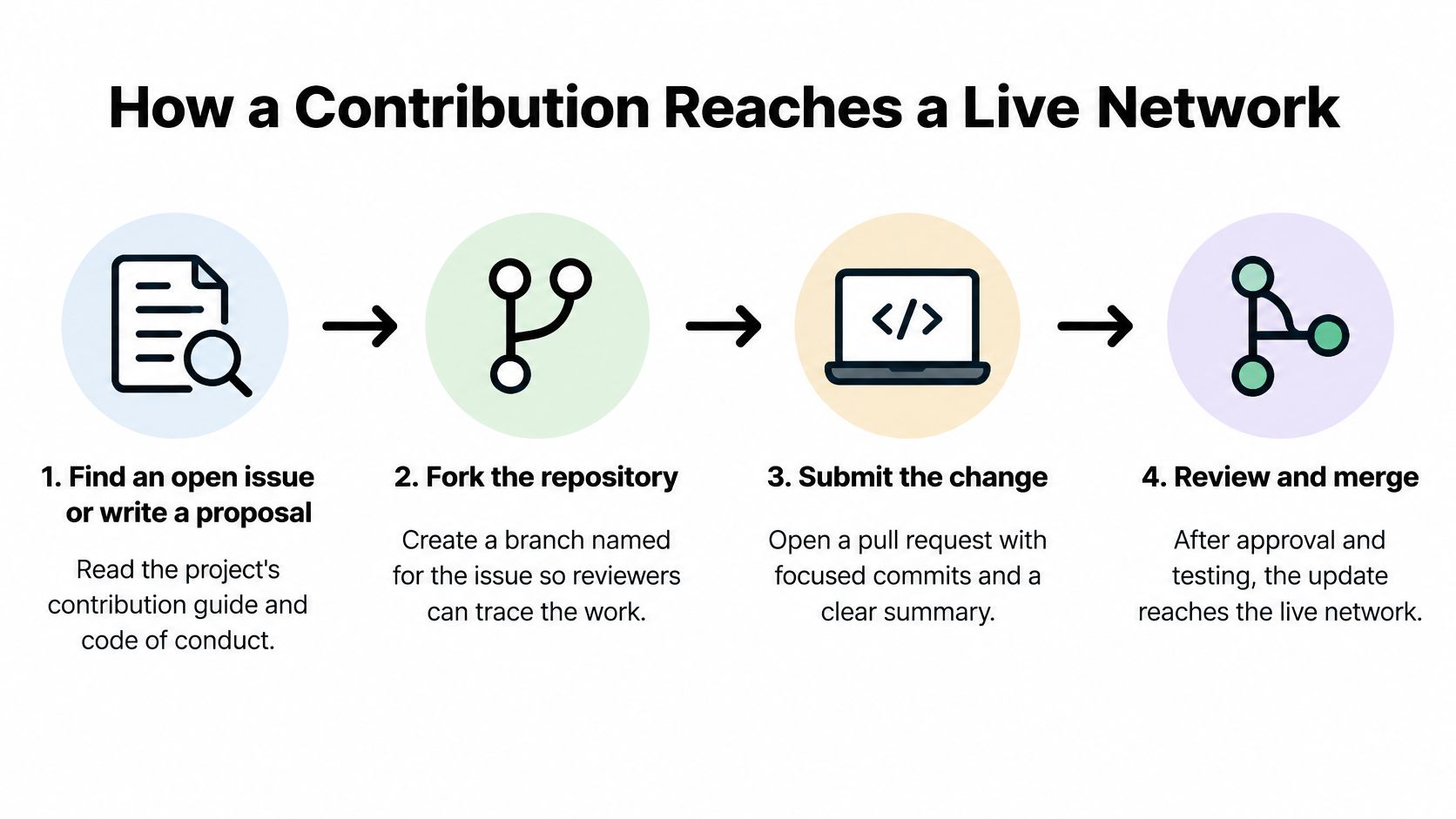
Find an open issue or write a proposal. Read the contribution guide and the code of conduct first. Pin dependency versions in any repro you attach, so a reviewer isn't building against a moving registry.
Fork the repository and branch for the issue. A branch named for the ticket lets reviewers trace the change. Verify signatures on any release artifacts you use as a base, instead of trusting a tarball link in a comment.
Write the change with tests. Run the local build and the linter before you push. Failing CI wastes the only scarce resource, maintainer time. Use an isolated CI runner for the fork so a compromised dependency can't read secrets from your other jobs.
Open the pull request. Link the issue. State the problem, the change, and the test results in plain sentences. Scan the diff for leaked keys and tokens before you request review.
Answer review. Maintainers may ask for a redesign. On consensus or networking code, bring benchmark notes: what you measured, on what hardware, and what you ruled out. If a maintainer account looks compromised, stop and rotate keys you shared with that repo.
Pass continuous integration. That includes fuzzing and reproducible builds where the project already uses them. Testing practices for safer releases are the same discipline you want in the pipeline: tests that fail the build, not tests that exist as files.
Move through release. After merge, the change typically hits a release candidate, a public testnet, and then a mainnet upgrade that maintainers schedule or token holders approve on-chain. Confirm the shipped artifact matches the commit you reviewed.
What a reviewer wants to see
A healthy pull request is small, tested, and documented. One behavior, a test that fails without the patch, and a summary a tired reviewer can audit in one sitting. That's also the artifact you'll show in an interview.
Career Paths and Hiring Signals in Open Source Blockchain
Hiring managers are short of people who can show the work. The Linux Foundation's 10th Annual Open Source Jobs Report surveyed more than 1,900 open-source professionals and 500 hiring decision-makers, and 93% of hiring managers said qualified open-source talent was increasingly difficult to find, as reported in the 10th Annual Open Source Jobs Report. A degree doesn't close that gap. A merged change with a clear story does.

| Role | Public proof employers check | Interview prompt |
|---|---|---|
| Protocol engineer | Merged consensus or networking changes with benchmark data | Explain how you measured a latency change and what you ruled out |
| Smart-contract developer | Audited contracts, test suites and reported gas savings | Walk through a bug you found, the fix and the test that now covers it |
| DevOps and infrastructure engineer | Node runbooks, release tooling and fixed CI pipelines | How would you verify a release artifact before deploying it |
| Security engineer | Responsible disclosures and fuzzing harnesses | Triage a new advisory for a dependency your project uses |
| Developer relations or documentation | Merged documentation and example repositories | Explain a complex upgrade to a new developer without losing accuracy |
How responsibility becomes visible
You start as a contributor: one issue, one diff, tests. You become a reviewer when other people's patches wait on your comments, and those comments are public. A maintainer has merge rights and a release or incident duty you can point to. A technical lead is the person who can defend a trade-off, a compatibility break, and the response to a bad release. Each step leaves a longer public trail than the last.
Write each portfolio entry in four lines: the repository, the problem, your exact commits, and a measured outcome. Reduced gas, a faster sync path, higher test coverage, or fewer findings after review all work. "Contributed to Ethereum" does not.
Whiteboard drills still show up beside that record. A set of practice algorithm interview questions is worth an evening so a graph or hashing question doesn't erase an otherwise strong protocol story. If your strength is Python tooling around nodes and indexers, a survey of open source Python projects can point you at repos where a small patch is still welcome.
A one-week action plan
- Pick one project from the comparison above and read its contribution guide this week. Don't collect five bookmarks.
- Merge one small change. A tested good-first-issue or a documentation fix that a maintainer accepts.
- Turn it into the portfolio entry the same day: repo, problem, your diff, outcome.
Then use that entry in the search. Blockchain Jobs lists 6,934 open blockchain and Web3 jobs, including 1,696 at Senior level. New York leads city listings at 851, followed by San Francisco (377) and London (330). Filter by level and city, and match your merged work to the requirements on each listing instead of sending one generic CV.
Before you apply, check four things: a merged contribution, a written portfolio entry, one prepared answer on a trade-off you accepted in review, and one application aimed at a role whose proof column you can fill.
Blockchain Jobs lists open roles across protocol engineering, smart contracts, infrastructure, security, and the rest of the Web3 stack, so the contribution record you just built has a concrete place to go. Filter by seniority and city, then line your merged work up with what each team asks for. Visit Blockchain Jobs and send the application that matches the proof you can already show.