
7 Crypto Content Writer Jobs Sources for 2026

One job board isn't enough for a serious search for crypto content writer jobs. Crypto hiring is cyclical, role names overlap, and the best opportunity for a protocol writer may appear under marketing, developer relations, documentation, or community rather than “content writer.” A stronger search compares seven discovery routes by their value at different hiring stages: finding relevant roles, validating compensation and fit, improving applications, and building a repeatable Web3 career search. This approach also complements broader resources such as top content creation sites 2026.
Start with a niche, such as DeFi education, protocol documentation, tokenomics, or regulated financial communications. Track fresh listings, record salary and location signals, tailor proof of expertise to each employer, and verify the opportunity before applying. The platforms below are most useful when you treat them as parts of a hiring workflow, not interchangeable lists of vacancies.
1. Blockchain Jobs
Blockchain Jobs is the strongest starting point when you need a crypto-native search rather than a general marketing board. It covers blockchain, DeFi, NFTs, and related decentralized technologies, with category-tagged roles across Operations, Engineering, Design, Marketing, Sales, Product Management, Finance and Accounting, DevOps and Infrastructure, Legal and Compliance, Data and Analytics, Customer Support, Security, AI and Machine Learning, Quality Assurance, Human Resources, and Content and Writing.
The breadth matters for writers because many valuable assignments sit beside editorial work. A content candidate might find a role connected to product education, community growth, compliance, developer relations, or protocol marketing. The platform's category pages display substantial volume in some areas, including approximately 2,248 Operations listings, 1,708 Engineering listings, and 525 Marketing listings, while Content and Writing has fewer opportunities. Those figures are visible platform information and should be checked on the live site before you use them as a market estimate.
Best use in the hiring funnel
Blockchain Jobs works best at the discovery and positioning stages. Its “Recently Added Jobs” feed helps candidates prioritize fresh opportunities, including listings associated with organizations such as Nubank, Blockstream, Bitpanda, Animoca Brands, Uniswap Labs, JumpCloud, and Tala. The platform also highlights remote-friendly work and maintains a “Recently Filled” area, which gives candidates context about the kinds of employers using the board.
Use the search to build a short list, then inspect the employer's product, audience, and technical vocabulary. A writer applying to a DeFi protocol should prepare a protocol explainer or risk-focused educational sample. Someone targeting infrastructure should show that they can explain nodes, APIs, integrations, or chain architecture without flattening important distinctions.
Practical rule: Apply to the role behind the title. If the listing says “content,” identify whether the actual work is SEO, documentation, community communication, product education, or financial promotion.
Advantages and limitations
- Crypto-native audience: Employers reach candidates who already understand blockchain terminology and decentralized systems.
- Broad employer context: You can compare writing roles with adjacent marketing, product, compliance, and developer-facing positions.
- Freshness signals: Recently added and recently filled areas help separate active hiring from stale discovery.
- Uneven writing volume: Technical categories contain more visible listings than specialist nontechnical categories, so writers should search related functions.
- Employer pricing requires checking: Post-a-job packages and pricing are available through the platform's employer flow, but job pages don't present one universal flat rate.
For interview preparation, study the platform's blockchain technical writer guidance. Then turn one listing into a specific evidence pack: a relevant sample, a source list, a proposed content angle, and questions about approval ownership. That combination proves more than polished prose.

2. Cryptocurrency Jobs
Cryptocurrency Jobs is a useful specialist channel when your search already has a defined editorial direction. Its Content Writer category covers writing, editing, content marketing, and communications roles from crypto startups and protocols. Location filters include Remote and United States, while segment and chain collections can help candidates focus on areas such as DeFi, Layer 2, or NFTs.
This makes the platform particularly useful for fit validation. A broad board might show a marketing vacancy that mentions writing only in passing. A dedicated content category gives you a better chance of finding a role where editorial work is central to the job rather than an extra responsibility attached to growth.
How candidates should use it
Search by both role and ecosystem. A writer interested in Ethereum scaling, for example, should review Layer 2 collections and inspect whether the employer wants developer education, user acquisition copy, or ecosystem communications. Those are different careers, even when the listing uses the same “content” label.
Some senior listings display salary bands, but compensation isn't included consistently. Deep browsing can also surface historical or closed roles, so sort by recency and confirm that the employer is still accepting applications. The site's job alerts and talent collective can support a repeatable search, especially for candidates who don't want to check every category manually.
- For discovery: Use the dedicated Content Writer filter before expanding into marketing or communications.
- For application quality: Mirror the employer's format mix, whether that's blog articles, newsletters, landing pages, or technical explainers.
- For interviews: Prepare to explain how you research protocol claims and adapt language for users, investors, developers, or communities.
- For compensation: Treat displayed salary information as a useful signal, not a guaranteed offer, and ask about employment status and token compensation.
The platform is narrower than mass-market boards, which can mean fewer total results. That limitation is useful when relevance matters more than volume. Candidates can also consult this salary guide for content writers while remembering that role scope, location, seniority, and company stage affect any final offer. For workflow development, a guide to AI-powered writing can help you demonstrate process rather than merely submit AI-generated copy.

3. Web3.career
Web3.career is most valuable when candidates want to compare role availability with salary, location, and employer signals in one workflow. Its Content Writer page presents a quick-scan view with company, location, posted date, and salary information where available. The wider site includes global and United States roles, remote and onsite filters, salary pages, company information, and an ATS option connected with Bondex.
That combination changes how you should use the board. Don't only save listings. Record the role's posting date, expected location, compensation signal, seniority, and required domain knowledge. You'll quickly see which vacancies match your target and which only use “content” as a minor part of a broader marketing position.
The interview advantage
Web3.career is especially helpful for application calibration. If several relevant roles show salary information, you can enter compensation discussions with a clearer sense of how the employer frames the position. You still need to verify the range directly, because displayed bands may not describe bonuses, tokens, contractor status, or geographic adjustments.
The platform also offers employer visibility add-ons such as stickies, highlights, and logo placements. For candidates, that means a prominently displayed vacancy may have extra visibility without necessarily being a better fit. Sort by date and read the job description before assuming prominence indicates quality.
A visible listing earns attention. A well-scoped listing earns an application.
Candidates should use the site's broad inventory carefully. Its wider Web3 coverage includes many non-writing roles, so search terms such as technical writer, documentation, developer advocate, content strategist, editorial, and product education can reveal adjacent paths. The overview of Web3 websites can also help writers map the ecosystem before choosing a niche.
For employers, the site offers an integrated ATS via Bondex at no extra charge, while employers can purchase visibility enhancements. For applicants, the practical takeaway is simpler: use the salary and location tools to shortlist roles, then tailor your portfolio around the exact audience and product named in each description.
4. CryptoJobsList
CryptoJobsList suits candidates who want a large, recognizable crypto hiring channel with a strong marketing and content presence. Its United States content-writer pages provide role filters and tags, while public statistics and trends offer a market pulse. Social promotion adds another discovery layer because listings can travel beyond the site's direct search audience.
The platform's main value is reach, not perfect precision. A candidate looking for a US-based content position can use location pages and recent examples to identify employers, then inspect each description for writing ownership, reporting lines, and required crypto knowledge. That last step is essential because an open board can include noise, duplicate-style listings, or roles where content is only one small part of the job.
Turning reach into better applications
Use CryptoJobsList to identify employers and recurring role language. If multiple companies request newsletters, community announcements, SEO articles, or product education, create portfolio sections for each format rather than sending one generic writing sample. A writer who can connect copy to activation, retention, qualified traffic, or community growth will usually present a stronger case than one who discusses grammar alone.
The board's public trends can inform your questions, but don't treat platform-level signals as proof that a specific vacancy is active or well funded. Check the employer's own careers page and confirm the application route before sharing personal information.
- Filter by date: Prioritize recent listings and remove roles that no longer accept applications.
- Separate audience from function: A “content” tag may cover social, community, SEO, or public relations.
- Audit compensation: Some roles may provide pay details, but many do not.
- Prepare for ambiguity: Ask who approves claims involving tokens, yield, security, decentralization, or user outcomes.
Employer pricing can be dynamic and may not be shown at the first step. Historical promotional information has referenced posts beginning around $100, but candidates should not infer that figure is current or that it affects applicant quality. For a writer, the more important signal is whether the description names a clear audience, deliverables, manager, and hiring timeline.
5. CryptoJobs
CryptoJobs combines job discovery with employer outreach tools, making it useful for candidates who want to understand how startups source specialized talent. Its filters include Blockchain Content Jobs and US city pages, while employers can browse a talent database and use recruiter plans for active sourcing. Listings may also receive distribution through Google for Jobs, partner channels, and newsletters.
The platform is a good choice for startup-oriented searches. Smaller companies may not have a mature editorial department, so the role could combine blog writing, social distribution, community support, product messaging, and research. That can accelerate progression if you want ownership, but it can also create unclear expectations if the employer hasn't separated marketing, communications, and compliance responsibilities.
What to verify before applying
The platform advertises a $99 price for a 30-day job listing with distribution on its employer side. That is a supplied platform pricing detail, not a salary benchmark or guarantee of listing quality. Candidates should focus on the vacancy itself, including whether the company identifies the product, target audience, manager, and review process.
A broad Web3 board requires deliberate filtering. Search content, editorial, documentation, education, community, and technical writing separately. Then compare the results by the kind of evidence you can provide.
Application test: If you can't identify the audience, publishing channel, and approval owner from the listing, ask those questions before investing heavily in a custom assignment.
Content-specific volume can vary, and many listings don't show pay ranges. That makes CryptoJobs less useful for compensation validation than a platform with stronger salary visibility, but valuable for finding early-stage opportunities and testing your ability to work across functions. Bring a portfolio that shows both independent research and collaboration with product or engineering teams.
6. CryptoJobs.com
CryptoJobs.com takes a broader portal approach, with Content Management and Writing categories alongside skill filters. Its employer tools include profile options, application scoring through subscription packages, and advertising bundles that can combine premium job posts with banner inventory. The platform also promotes listings through database outreach and social channels.
For candidates, the portal is most useful at the application-funnel stage. A highly promoted listing may receive more applicants, so a generic portfolio is less likely to stand out. Your application should show immediate relevance: name the protocol or product, identify the intended audience, and link to a sample that demonstrates comparable subject knowledge.
Read the role beyond the category
The categories can include different levels of responsibility. One listing may need a content manager who owns calendars, contractors, and distribution. Another may seek a writer who produces articles from briefs. A third may combine content with community or growth work. Date and seniority filters help, but the job description still determines the full scope.
Employer pricing isn't consolidated on one public page, with some costs appearing inside packages. Quality and recency can vary across categories, so candidates should be careful with listings that lack a clear application route or recent activity. Verify the company through its official website and never pay to apply.
- Show operating ability: Include briefs, outlines, source trails, revision notes, and distribution plans.
- Show domain judgment: Explain how you'd validate protocol mechanics, token economics, or security statements.
- Show measurement ability: Connect content to organic visibility, qualified wallet traffic, newsletter conversion, developer sign-ups, activation, or retention where you have genuine evidence.
- Show collaboration: Describe how you worked with engineers, product managers, legal reviewers, or community leads.
The wider market supports this emphasis on operational skill. A 2025 analysis of more than 80,000 Web3 job postings across over 15,900 companies found that postings requiring AI workflows rose from 2% in 2021 to 14% in 2025. The figures come from the Web3 Intelligence Report, and the career implication is clear: demonstrate accountable AI-assisted production, not just fluent output.
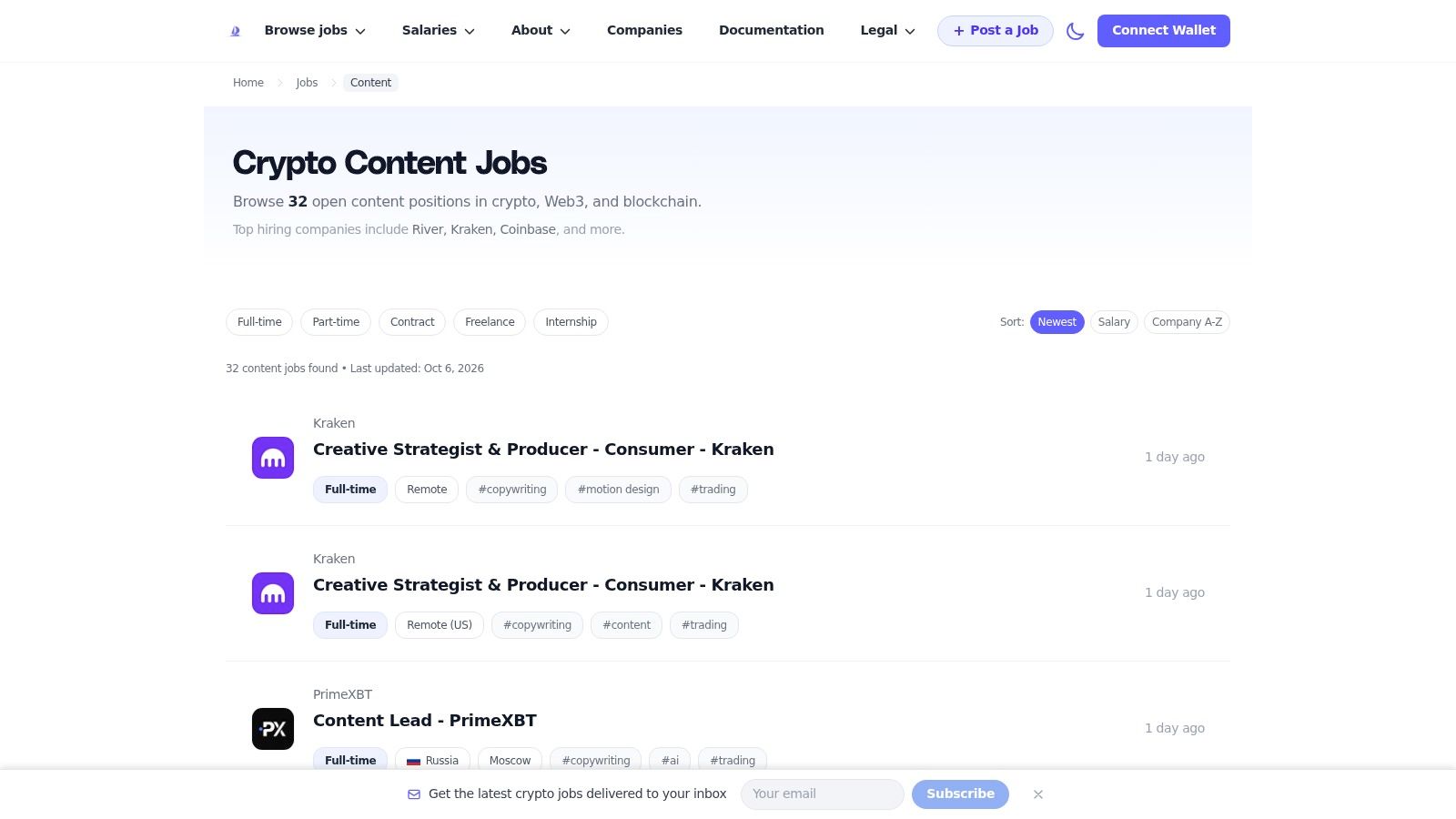
7. SailOnchain
SailOnchain is the strongest option in this comparison for candidates who want curation and pay context before they apply. Its Content category includes US-remote filters and aggregated salary ranges showing minimum, median, and maximum values. The site says it deduplicates and reviews roles, uses timestamps and frequent refreshes, and doesn't sell paid placement.
That model makes SailOnchain useful for validation, especially when a candidate wants to reduce the noise found on open boards. Its simple interface typically sends applicants to the employer's own application page rather than keeping the entire process inside one platform. That adds a step, but it also encourages direct verification of the company, role status, and application requirements.
Use salary data without overtrusting it
Published salary analytics can help you decide whether a role deserves further research, but aggregated ranges aren't promises. Ask whether the stated compensation is salary, total compensation, contractor pay, or a package that includes tokens. Confirm the employing entity, location rules, benefits, reporting line, and expected working hours before treating the opportunity as comparable with another role.
Curation also has trade-offs. Volume depends on the wider ecosystem, and the site offers fewer paid tools for employers to boost visibility. Candidates may find fewer listings than on large boards, but the reduced volume can make a focused search more manageable.
A salary range is a starting point for questions, not a substitute for an offer.
Use the Content category to build a shortlist, then compare each role against your specialization. A protocol documentation position should be assessed differently from a content marketing position, even if both appear under the same category. In interviews, ask who reviews technical accuracy, whether legal or compliance approval is required, and how the team measures content impact.
7-Platform Comparison: Crypto Content Writer Jobs
| Platform | Complexity 🔄 | Resource requirements ⚡ | Expected outcomes ⭐ | Ideal use cases 📊 | Key advantages 💡 |
|---|---|---|---|---|---|
| Blockchain Jobs | Moderate, straightforward posting flow; pricing revealed in post flow 🔄 | Moderate, paid packages; targets crypto-native audience ⚡ | High relevance to Web3 hires; strong placement signals ⭐⭐⭐⭐ | Hiring specialized Web3 roles (engineering, security, product); remote-friendly listings 📊 | Niche audience, fresh listings, broad role coverage 💡 |
| Cryptocurrency Jobs (Content Writer category) | Low, focused category and filters; simple employer flow 🔄 | Moderate, transparent pricing options (newsletter/social), crypto payments accepted ⚡ | High-quality crypto-native candidates; some posts include salary ranges ⭐⭐⭐⭐ | Recruiting content writers for crypto niches; US-remote and senior roles 📊 | Dedicated content filter, deep segmentation, clear employer options 💡 |
| Web3.career (Content Writer jobs) | Moderate, add-ons and ATS integration increase setup complexity 🔄 | Moderate–High, add-ons and ATS available; base price shown at checkout ⚡ | Large, frequently updated inventory; many roles show salary bands ⭐⭐⭐⭐ | Urgent hires needing visibility; roles where salary transparency helps sourcing 📊 | Salary data, employer add-ons (sticky/highlight), ATS integration 💡 |
| CryptoJobsList | Low, simple posting and tagging; some filtering needed 🔄 | Moderate, dynamic pricing; active social promotion ⚡ | Strong visibility and brand recognition for listings ⭐⭐⭐⭐ | US-targeted content and marketing roles; companies seeking wide reach 📊 | Public platform stats, social amplification, robust US pages 💡 |
| CryptoJobs (crypto.jobs) | Low, quick, low-friction posting; recruiter plans available 🔄 | Low, transparent $99 30-day posts; talent DB & recruiter plans ⚡ | Cost-effective reach with distribution channels; good for sourcing ⭐⭐⭐ | Startups and budget-conscious teams; active candidate outreach 📊 | Affordable pricing, talent database (30k+), Google for Jobs distribution 💡 |
| CryptoJobs.com | Moderate, subscription and scoring features add setup steps 🔄 | Moderate–High, employer subscriptions and advertising bundles ⚡ | Increased applicant pipelines via active promotion and scoring ⭐⭐⭐ | Startups wanting promoted listings and brand lift; higher-volume hiring 📊 | Application scoring, advertising bundles, active outreach 💡 |
| SailOnchain | Low, curated publishing with timestamps; minimal employer tooling 🔄 | Low, free browsing/applying; limited paid visibility options ⚡ | High signal quality and reliable salary benchmarking ⭐⭐⭐⭐ | Discovery and pay benchmarking for content roles; curated US-remote listings 📊 | Curation (no paid ranking), published salary ranges, clean signal 💡 |
Turn Listings Into a Repeatable Career Pipeline
The best platform depends on the question you're trying to answer. Use Blockchain Jobs and Cryptocurrency Jobs to discover crypto-native opportunities and adjacent functions. Use Web3.career and SailOnchain when salary, location, and role comparison matter. Use CryptoJobsList for broad reach and market signals, CryptoJobs for startup-oriented sourcing, and CryptoJobs.com when you want to study how promoted listings and employer screening shape the applicant funnel.
A practical system needs only two or three complementary sources at first. Choose one broad discovery channel, one writing-focused category, and one salary or curation source. Check them on a consistent schedule, save only recent and well-scoped roles, and record the employer, protocol, location, compensation signal, posting date, application link, and follow-up date in a simple tracker.
Your portfolio should change with the role. Prepare samples that show research accuracy, crypto fluency, and audience awareness. A DeFi explainer should distinguish product mechanics from investment claims. A technical writing sample should preserve exact terminology and explain how you verified documentation. A community or growth sample should show how you adapted the message for a specific audience and channel.
Interviews commonly test whether you can translate difficult subjects into accessible, accurate copy. Be ready to explain your sourcing process, keyword decisions, revision workflow, and response to an incorrect claim. Employers also increasingly need writers who can use AI responsibly. 81% of surveyed B2B marketing teams reported using generative-AI tools, while only 19% had integrated them into daily workflows, according to Content Marketing Institute's B2B research. Your advantage is showing a repeatable process that combines AI-assisted outlining with primary-source verification, technical fact-checking, SEO, disclosure, and human review.
Career progression comes from moving beyond article production. Published guidance places cryptocurrency content-writer compensation at $40,000 to $60,000 for entry-level roles, $60,000 to $80,000 for mid-level roles, and $80,000 to $100,000 for senior roles, with higher ranges for lead, director, and editor-in-chief positions in the cited cryptocurrency content writer career guide. Treat those as market indications, not guaranteed offers. Build evidence of organic traffic, rankings, newsletter growth, conversion, developer sign-ups, community growth, or content-led pipeline, then verify each listing's status, compensation, reporting line, and hiring timeline directly with the employer before committing to the process. You can also use resources on how to align experience for Revolut to sharpen the connection between past work and a target role.
Blockchain Jobs gives crypto content candidates a focused place to find category-tagged opportunities across Web3, including Content and Writing, Marketing, Product, Community, and technical functions. Visit Blockchain Jobs to track fresh remote-friendly roles, compare adjacent career paths, and connect your writing portfolio with employers building blockchain products.