
Crypto Jobs in 2026: A Complete Career Guide
You might be looking at a market where the headlines swing between hype and layoffs, and wondering whether crypto jobs are still worth the risk. The honest answer is that the field is no longer one thing. Some roles are fragile and cycle with token prices, while others sit inside infrastructure, compliance, and operations that companies still need when sentiment turns.
The smarter move is to stop asking whether crypto is “good” or “bad” and start asking which roles are durable, which skills transfer, and which proof points get interviews. That's the filter recruiters use now, and it's where candidates gain or lose ground fast.
The Growing Global Market for Crypto Employment
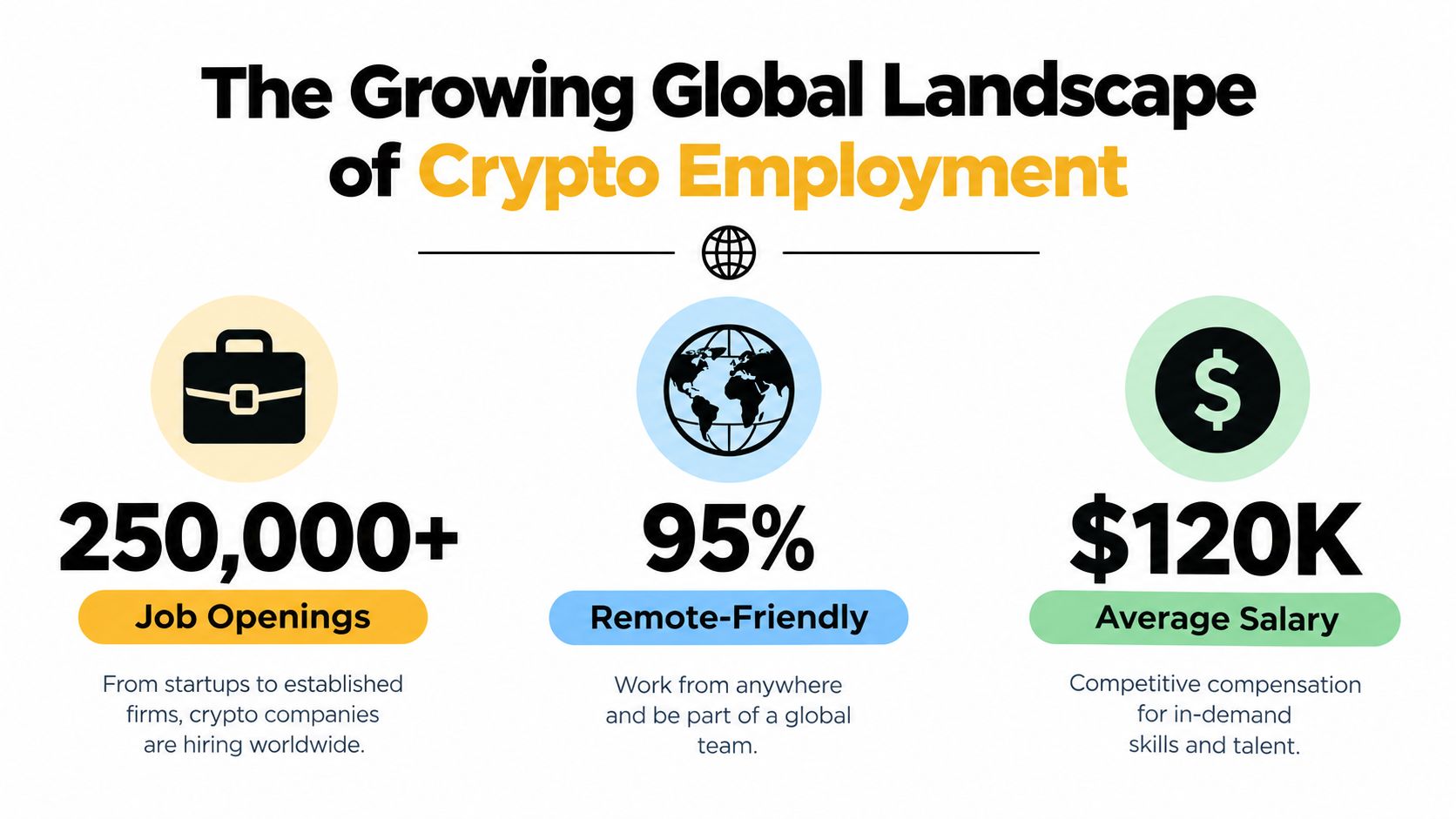
A lot of candidates still treat crypto like a side bet, but the hiring market says otherwise. The field has grown into a global employer base with real depth, and the strongest openings are not limited to people who can write smart contracts all day.
From niche speculation to a broader labor market
Gate Research reported that more than 1.6 million professionals were employed worldwide in crypto in 2025, while the sector's market capitalization was approaching $3 trillion. The same research estimated that professionals entering crypto had increased by 42% year over year since 2023, and 70% came from traditional internet and fintech companies. That matters because it shows hiring is widening beyond a narrow blockchain-only talent pool, with candidates moving into engineering, product, finance, compliance, marketing, operations, and infrastructure. Gate Research report on crypto employment
Read that data as a scale signal, not as a formal census. Crypto employment is now large enough that employers compete for people with adjacent experience, not just deep-native specialists. If you have worked in fintech, SaaS, payments, or internet operations, that background can carry more weight than a certificate if you can show how it maps to real business needs.
Blockchain Jobs' startup-focused listing guide is useful if you want to separate active hiring from noisy branding, especially at smaller teams where role scope can change quickly.
The practical lesson is simple. Employers want people who can handle ambiguity, work across functions, and stay useful when priorities shift. Generic enthusiasm rarely gets far. A portfolio that proves delivery in digital products, regulated environments, or technical systems does.
Recruiter's rule: if your background is only “interested in crypto,” you are late. If your background shows transferable delivery in digital products, regulated environments, or technical systems, you are already in the conversation.
Navigating the Bifurcated Job Market and Hiring Trends
The crypto hiring market is splitting into two very different lanes. One lane is cyclical and highly exposed to market mood, while the other is tied to infrastructure, controls, and regulated business functions that don't disappear just because token prices wobble.
Which roles absorb downturns better
Recent evidence points to that divide clearly. A Gate Research white paper reported that crypto job openings fell 80% year over year in early 2026, while demand concentrated in technical, security, compliance, and AI roles, with roughly 2,167 Web3 and crypto positions added in Q1, including about 328 developer roles. Gate white paper on employment trends in the crypto industry
That doesn't mean only developers get hired. It means the market rewards jobs that protect the business, not just the ones that help it grow loudly during bull runs. Infrastructure, security, regulated finance, stablecoin operations, compliance, and data-heavy functions tend to hold up better than token-launch work, speculative growth marketing, or exchange roles that depend on constant retail activity.
If you're mapping your own risk, ask one blunt question: does this role still matter when the market gets quieter? If the answer is yes because the company needs controls, custody, reporting, permissions, or technical resilience, you're probably looking at a more durable path. If the role exists mainly to amplify momentum, the downside is usually steeper.
The hiring playbook for founders reflects the same logic. A good founder's playbook for hiring is useful here because it reinforces a simple truth, strong hiring starts with clarity about the business problem, not with vague enthusiasm for the industry. Candidates should think the same way when deciding where to apply.
If you want a quick shorthand, compare these categories:
- More cyclical: exchange growth, token launch marketing, hype-driven community roles.
- More resilient: infrastructure, security, compliance, custody, stablecoin operations, AI-adjacent data work.
- Mixed durability: product and operations roles, where the company's model and regulation exposure matter a lot.
A lot of job seekers still chase the loudest title. That's usually the wrong move. The idea that crypto is dead misses the broader story, which is that the market has become more selective about where it hires and why.
The Dual Skill Stack Meets Technical Expertise and Domain Judgment
The strongest candidates I've seen rarely fit one neat profile. They usually combine a hard technical layer with a second layer of judgment that shows they understand how crypto businesses work.
What engineers need to show
A 2025 analysis of 2,000 Web3 job postings found Ethereum mentioned 371 times, React 213 times, NFT 213 times, Java 205 times, and Rust 102 times. In the same dataset, security roles had the highest reported average compensation at $153,295.86, followed by technical leadership at $121,526.32 and operations at $120,396.55. Web3 job-posting and compensation analysis
That reinforces the two-part skill stack. On one side, there's ecosystem-specific knowledge, things like Ethereum tooling, wallets, token standards, and protocol workflows. On the other, there's transferable engineering depth, frontend systems, backend development, and systems programming. Candidates who only know one side usually stall out.
Practical rule: if you're technical, don't just say you “know blockchain.” Show what you've built, how you tested it, and what broke before it worked.
For nontechnical candidates, the same logic applies, but the proof looks different. A compliance lead can point to sanctions-control design. A finance candidate can show reconciliation and custody controls. A product manager can document user research, prioritization trade-offs, and shipped outcomes. That's the kind of evidence that moves hiring managers because it proves you can operate in a regulated, high-stakes environment.
Skills-based hiring matters here. The logic behind 2026 skills-based hiring trends aligns closely with crypto recruiting, because the best decisions come from verified capability, not a pile of vague credentials. If a candidate can show judgment, ownership, and repeatable outcomes, they often beat a more "crypto-native" applicant who has no evidence of execution.
For product-oriented candidates, Web3 product manager roles are a good example of where domain judgment matters as much as technical fluency. The best applicants know how to translate business risk, user behavior, and platform constraints into a launch plan that survives real scrutiny.
Building a Verifiable Portfolio to Stand Out
Recruiters in this space don't trust enthusiasm very far. They trust evidence, especially when the evidence is public, specific, and difficult to fake.
What proof of work actually looks like
A strong portfolio starts with artifacts, not adjectives. For technical candidates, that can mean a testnet protocol, a formal threat model, fuzz or invariant-test results, a public code review, or a responsible-disclosure record. For nontechnical candidates, it can mean governance participation, published research, community work, regulatory analysis, or a shipped operational improvement.

The point is not to collect artifacts for decoration. The point is to create a trail that shows how you think. Hiring teams want to see how you approach risk, whether you can explain trade-offs, and whether you can work without constant supervision. In crypto, where assets, permissions, and auditability matter, that trail carries real weight.
A simple portfolio structure works better than a glossy but vague personal brand:
- Pick one role path. Engineer, compliance, operations, product, marketing, support, or finance.
- Publish one strong artifact. Show the thing you did, not just the thing you studied.
- Explain the decision-making. Why that design, control, workflow, or campaign?
- Document outcomes. Even if the outcome is limited, show what changed and what you learned.
- Keep it current. Stale proof is weak proof.
Certificates can still help, but they're weaker than demonstrated work. That's especially true for roles where judgment matters more than memorization. If you're applying without prior crypto employment, your portfolio has to answer the question, “Can this person operate responsibly in an ambiguous environment?” before you ever get to interview round two.
The best candidates also make their work easy to review. Clear README files, GitHub contributions, public writing, conference participation, and visible community involvement all help because they reduce the effort required to verify competence. In a market full of applicants, reducing that friction matters.
Where High-Paying Roles and Remote Opportunities Cluster
Crypto pay is often framed around hype, but compensation usually tracks risk, ownership, and hard-to-replace judgment.
Where premium compensation tends to cluster
Analysts looking at Web3 hiring patterns consistently place security near the top of compensation, with technical leadership and operations close behind. That matches how teams allocate their budgets. Roles that reduce losses, limit regulatory exposure, or keep core systems stable get more attention from hiring managers.
A Q3 2024 review of more than 200 Web3 technology vacancies from over 60 hiring partners found that backend development, management, and smart-contract development had the strongest upper salary ranges. Employers also looked closely at Rust, Solidity, and Golang, while cross-functional design and leadership still mattered in the final decision. Q3 2024 Web3 salary review
The strongest offers usually go to candidates who can do more than one thing well. A backend engineer who understands protocol behavior is more valuable than someone who only ships tickets. A manager who understands delivery pressure and compliance boundaries is more useful than a generic people leader. A smart-contract engineer who can explain testing, debugging, and trade-offs usually interviews better than someone who only knows the vocabulary.
Remote work widens the field. Candidates do not need to live near one hub to compete, so employers can hire from a larger pool and applicants can target more openings without relocating. That makes your portfolio and interview performance matter even more, because location is less of a filter.
A specialized board sorted by function makes that comparison faster. Blockchain Jobs groups roles across engineering, design, marketing, product, finance, legal, security, and infrastructure, which helps you compare openings against your own evidence instead of a salary headline.
That evidence should match the business need. If a role asks for protocol ownership, release discipline, and incident response, your application should show those things. If it asks for stakeholder communication and risk control, show that instead. The closer the proof fits the role, the shorter the path to an interview.
Strategic Career Progression in a Decentralized Future
A strong crypto career usually belongs to people who build cross-functional utility and can take ownership of messy problems. That is the part many candidates miss. They try to sound native. The better move is to become reliably useful in a market where requirements shift and accountability still matters.
Build for portability, not just for novelty
Protocol-specific knowledge can open doors, but portability protects your downside. Python, Go, cloud systems, SQL, Kubernetes, security controls, financial operations, and regulatory judgment travel better across market cycles than narrow familiarity with one chain or one token community. That matters when hiring slows and companies become more selective.
The candidates who last usually explain what they shipped, what they owned, and what changed because they were there.
Public credibility matters for the same reason. A visible portfolio, a clean record of contributions, and work samples tied to real outcomes make you easier to trust. They also make it easier to move across functions, which is often how people in crypto progress from individual contributor roles into lead, manager, or ownership positions.
A sensible career strategy looks like this:
- Choose a resilient lane first. Infrastructure, security, compliance, operations, or data-heavy product work.
- Add one crypto-specific layer. Token mechanics, wallets, custody, protocol workflows, or governance.
- Show public evidence. Shipping work, writing clearly, or documenting decision-making.
- Keep your story portable. Recruiters should understand how your skills transfer beyond one company or one market cycle.
That approach fits a volatile sector. Some roles rise and fall with each cycle, while infrastructure and risk-facing work tend to hold up better because they solve durable problems. The point is not to chase every headline. It is to build a record that still makes sense when the market gets quieter. Discipline is what keeps that record usable.