Your Guide to Landing a Crypto Finance Job

So, you're eyeing the crypto world from your traditional finance desk and wondering how to break in? Let me be clear: you're in exactly the right place. This guide is your map for making the leap into crypto finance jobs, showing you how to position your skills, ace the interviews, and build a career in the new frontier of finance.
The New Frontier of Finance Careers
When people talk about Web3 careers, the conversation usually gravitates toward developers and engineers. But behind every successful protocol, exchange, or DAO, there's a razor-sharp finance team keeping the whole thing running.
These are the people managing digital asset treasuries, architecting new economic models, and navigating the thorny paths of regulation. Think of it this way: you're not just switching jobs. You're moving from a well-established industry to one where you get to build the financial infrastructure of the future. For a hiring manager, a candidate who understands this shift isn't just looking for a job; they're looking to make an impact.
This isn't just a lateral move; it's a massive opportunity for career progression. The skills you've spent years honing in financial modeling, compliance, and strategic planning aren't just relevant—they're what hiring managers are desperately seeking. The real difference is the playground. Instead of just dealing with fiat and legacy banking systems, you’ll be managing treasuries full of volatile crypto assets and plugging into DeFi protocols to generate yield.
Why Your Finance Skills are Gold in Web3
As the crypto industry matures, the demand for serious finance professionals is exploding. This isn't just about hype anymore; it's about building sustainable, long-term businesses. Projects need experts to bring structure, discipline, and stability to their operations. When you interview, frame your experience through this lens.
Strategic Treasury Management: Web3 companies often sit on huge piles of crypto. They need someone who can do more than just "HODL," implementing sophisticated strategies to manage risk and optimize returns. This is a key talking point for your interviews.
Economic Design (Tokenomics): A token isn't just like a stock. It's a functional piece of a living economy. Finance pros are essential for designing token models that properly incentivize users, investors, and the core team for the long haul. Highlighting this understanding shows strategic thinking.
Financial Planning & Analysis (FP&A): Try forecasting revenue when your core assets can swing 20% in a day. It takes a unique blend of classic FP&A discipline and a deep understanding of on-chain data to get it right. Your ability to model this volatility is a highly sought-after skill.
The crypto industry isn't just looking for tech evangelists. It's actively hunting for seasoned financial minds who can apply timeless principles to a totally new asset class. Your ability to build a bulletproof financial model or dissect risk is just as valuable in DeFi as it is on Wall Street—make sure your resume and interview answers reflect this.
The hiring numbers back this up. We've seen crypto-related job postings jump by a staggering 118% year-over-year. Projections show another 22% increase in demand for these roles by 2025, which blows the growth in most other tech fields out of the water. If you want to dig deeper, you can explore more on these crypto hiring trends and see the full picture for yourself.
Breaking Down Top Crypto Finance Jobs
So, what does a finance professional actually do inside a Web3 company? The job titles might sound familiar, but the day-to-day reality is a world away from your typical corporate finance gig. To land one of these roles, you need to understand the unique challenges and strategic importance each position holds.
The whole crypto finance scene has blown up. The sector now employs over 460,000 professionals around the globe as of 2025, and a staggering 100,000 of those jobs were added in the last year alone. That’s a 45% year-over-year jump in job postings, fueled by a recovering market and a bit more clarity on the regulatory front.
This visual really captures the shift from old-school finance roles to their new, crypto-native counterparts.
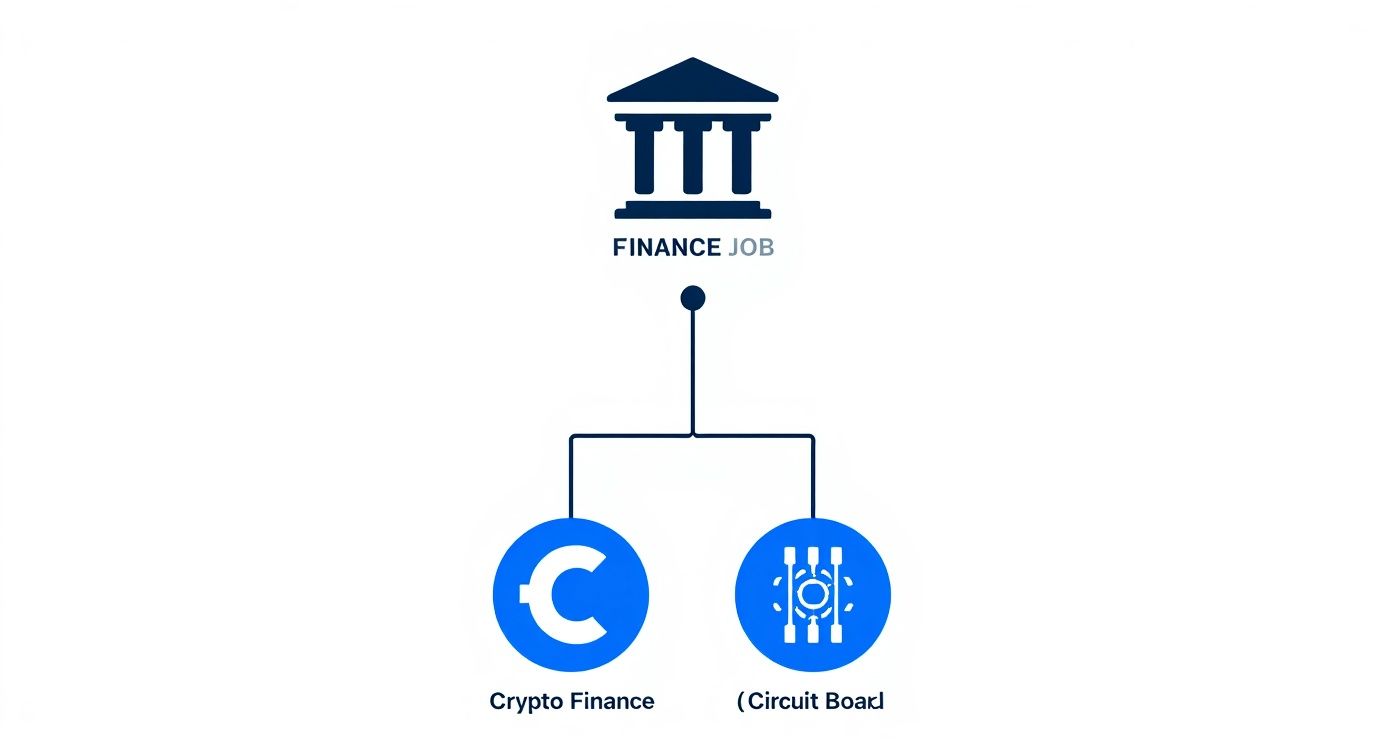
As you can see, the core principles of finance are still there, but they're being completely rewired for a decentralized, on-chain world. This has created a whole new class of specialized career paths.
Let's dive into some of the most common roles. To really understand what makes these jobs different, it helps to see them side-by-side with their traditional equivalents.
Crypto Finance Roles vs Traditional Finance Roles
| Finance Role | Traditional Responsibilities | Crypto/Web3 Responsibilities |
|---|---|---|
| Treasury Manager | Manages fiat cash flow, debt, and corporate investments. | Manages a portfolio of digital assets (BTC, ETH, stablecoins), hedges against volatility, and seeks yield through DeFi protocols. |
| Tokenomics Specialist | No direct equivalent. | Designs a token's entire economic model, including supply, distribution, utility, and incentive mechanisms. |
| FP&A Analyst | Forecasts revenue and expenses using traditional business data (sales, market trends). | Builds financial models using on-chain data (TVL, active users, transaction volume) in a highly volatile environment. |
| Compliance/Accounting | Applies established GAAP/IFRS standards for financial reporting and tax. | Navigates evolving crypto regulations, classifies digital assets for accounting, and handles tax implications of on-chain activities. |
This table gives you a snapshot, but the real story is in the day-to-day details. Each of these roles demands a new way of thinking and a completely different set of tools.
The Treasury Manager
In a normal company, a treasury manager worries about cash flow, debt, and investments. In Web3, this role gets supercharged. A Crypto Treasury Manager is the steward of a company's digital asset portfolio, which could be a mix of Bitcoin, Ethereum, various stablecoins, and the project's own native token.
Their job is to protect and grow these assets. This isn't just about HODLing; it's about active risk management and deploying capital into DeFi protocols to generate yield.
Get ready for interview questions like, "How would you hedge our treasury against a 30% market downturn?" or "Lay out a strategy to earn yield on our stablecoin holdings while minimizing smart contract risk." This job requires a deep, hands-on understanding of the DeFi ecosystem to even get past the first round.
The Tokenomics Specialist
Here's a role that simply doesn't exist in traditional finance, offering a unique career path. A Tokenomics Specialist is part central bank economist, part game theorist, and part financial modeler. They are the architects of a blockchain project's entire economic engine.
They figure out how a token is created, distributed, and used within its ecosystem to incentivize behaviors that benefit the network. In an interview, you'll need to discuss your approach to:
- Total Supply and Issuance Rate: How many tokens will ever exist, and how fast will they be released?
- Vesting Schedules: How are tokens for the team, investors, and community unlocked over time to align everyone's interests?
- Utility and Staking Mechanisms: What can you do with the token? How does it generate value for holders and the protocol?
This is a profoundly strategic role. A poorly designed token model can kill a project, making this one of the most critical and well-compensated finance jobs in the space.
The FP&A Analyst
Trying to forecast anything in crypto is a wild ride. A Financial Planning & Analysis (FP&A) Analyst in Web3 has the tough job of building financial models in an environment defined by extreme volatility. A traditional analyst might forecast next quarter's revenue based on sales data, but a crypto FP&A pro is pulling data right off the blockchain.
In Web3, your financial models must account for on-chain metrics like daily active users, transaction volume, and total value locked (TVL). In an interview, you can’t just talk about P&L; you must demonstrate how you analyze the health of a living digital economy.
This position is a blend of classic financial modeling skills and a mastery of on-chain analytics tools. Hiring managers need to see that you can build forecasts that don’t shatter the moment the market takes a nosedive.
The Compliance and Accounting Manager
Navigating financial and legal rules in crypto is a full-time battle. Compliance and Accounting Managers are the guardians who keep a project from running afoul of a constantly shifting regulatory landscape. You will be asked in an interview how you’d classify a brand-new token for the balance sheet or how to handle tax reporting for staking rewards.
Unlike their traditional peers who live by established GAAP or IFRS principles, these pros have to interpret new guidance from bodies like the IRS and SEC almost in real-time. This role is absolutely essential for any project that wants to be taken seriously, offering a stable and high-demand career path.
Building Your Web3 Finance Skill Stack

If you’re aiming for a top-tier finance job in crypto, simply polishing up your resume won't cut it. You need to speak the native language of Web3. The great news is your traditional finance background is the perfect launchpad.
Think of it this way: your skills in financial modeling, risk management, and accounting are the solid foundation of a skyscraper. Now, we’re just going to add the Web3-specific floors on top. This is how you build a skill stack that makes hiring managers sit up and take notice.
Layer 1: The TradFi Foundation
Your current expertise is your single biggest asset. Crypto hiring managers are desperately looking for professionals who can bring discipline and structure to a notoriously chaotic industry. Don't downplay your background—learn how to translate it for your resume and interviews.
- Financial Modeling: That discounted cash flow (DCF) model you perfected? Frame it on your resume as "Experience in complex financial modeling applicable to protocol valuation and network revenue forecasting."
- Risk Management: You're already a pro at assessing market and credit risk. Rephrase this as "Expertise in multi-faceted risk assessment, including smart contract vulnerabilities and protocol liquidity analysis."
- Accounting Principles: A solid grasp of GAAP or IFRS is gold. Highlight this by mentioning your ability to "apply established accounting frameworks to novel digital assets like NFTs and staking rewards." As the industry matures, roles that bridge digital assets with traditional tax are booming, like this Tax Manager for Digital Assets position.
Layer 2: Web3 Technical Literacy
This is where you really start to stand out from the crowd. No, you don’t need to be a coder, but you absolutely have to understand the mechanics of the systems you'll be managing. This is non-negotiable for passing a technical interview screen.
Start by truly understanding the core concepts of DeFi. Don't just read definitions—get your hands dirty. Go use a lending protocol like Aave or swap some tokens on Uniswap with a small amount of money. That firsthand, practical experience is exactly what interviewers want to hear about.
Next, get familiar with the tools of the trade. On-chain analytics platforms are the lifeblood of Web3 finance.
To a Web3 FP&A analyst, tools like Dune Analytics and Nansen are what Bloomberg Terminals are to Wall Street traders. They provide the raw, transparent data needed to understand a protocol’s health, spot trends, and find alpha.
Showing a hiring manager a Dune dashboard you built to track a protocol’s key metrics is infinitely more powerful than any certificate you can earn. It's tangible proof you have the curiosity and the technical chops to get insights straight from the source of truth: the blockchain itself.
Layer 3: The Essential Soft Skills
Finally, we get to the skills that tie everything together—and they’re often what secure the job offer. The crypto industry moves at a blistering pace. What was considered best practice six months ago might be completely obsolete today. This kind of environment rewards a very specific mindset.
Adaptability is everything. You have to be comfortable with ambiguity and ready to pivot your strategy as the market and regulations shift on a dime. Frame this in an interview by giving an example of a time you had to make a decision with incomplete information.
A relentless learning mindset is just as crucial. The most successful people in this space are constantly reading whitepapers, listening to podcasts, and hanging out in communities on X (formerly Twitter) and Discord to stay ahead. In an interview, talking about how you taught yourself to analyze a new DeFi protocol will impress a hiring manager far more than just listing off your past job titles.
Understanding Crypto Compensation Packages

Getting a job offer in Web3 is a whole different ballgame. It’s not just about the base salary. Crypto finance roles are typically paid with a mix of cash, equity, and tokens, and you have to weigh the risks and rewards of each piece. If you don't understand the structure, you can't negotiate effectively or know if the offer truly lines up with your financial goals.
Think of it less like a simple paycheck and more like being handed an investment portfolio. You've got your stable, predictable cash, but then you have these other assets—tokens and equity—with massive upside potential. This is where career-changing wealth can be made, but it also means you’re signing up for a level of volatility you absolutely need to be ready for.
Deconstructing the Crypto Offer Letter
Most crypto finance offers have a few key components. Your base salary, paid in a familiar currency like USD or EUR, is what keeps the lights on. The real game-changer, however, often comes from the variable parts tied directly to the project's growth. Your job during interviews is to get the full story on every single one of them.
Here's what a typical package includes:
- Base Salary (Fiat): Your guaranteed, predictable income. It’s usually competitive with traditional tech, but it’s just the foundation.
- Equity: If the company is a traditional C-Corp, you might get stock options or RSUs, just like at a regular tech startup. This gives you a slice of ownership in the actual company.
- Token Grants/Warrants: This is the uniquely Web3 part of the deal. You're awarded a set amount of the project's native tokens that unlock over time, a process called "vesting." This directly ties your personal success to the success of the protocol itself.
- Performance Bonuses: These can be paid in cash, stablecoins, or project tokens, and are usually tied to hitting specific team or company goals.
Asking the Right Questions During Your Interview
When that offer finally lands, the devil is in the details. The future value of your equity and tokens is anything but guaranteed, so you need to dig in and understand exactly what you're being offered. Coming to the table with smart, pointed questions shows you’re a serious candidate who gets the nuances of the space.
Your ability to evaluate a compensation package is a direct reflection of your financial acumen. Treat your own offer letter with the same diligence you would apply to managing a company's treasury. Ask about vesting, liquidity, and downside protection.
During the negotiation phase, make sure you get clear answers to these critical questions:
- What is the vesting schedule? Most companies use a four-year schedule with a one-year "cliff." This means you get nothing for your first year, and then your tokens or equity start to vest, usually on a monthly or quarterly basis.
- How liquid are the tokens right now? Can you actually sell them on a major exchange, or are they stuck on a decentralized exchange with no volume? A massive token grant is worthless if you can't cash it out.
- Are there any lock-up periods after vesting? Sometimes, even after your tokens vest, you’re contractually prevented from selling them for an additional period of time.
- How was the token grant valued? You need to ask how they arrived at the dollar value they're presenting. Is it based on today's price, or a 30-day average? This can make a huge difference.
While the upside is what draws people in, you have to be realistic about the market's volatility. According to the 2025 ADP employment report, average salaries actually saw a significant dip from the previous year, showing just how much market cycles can swing total pay. You can learn more about these compensation insights to get a better handle on the trends before you negotiate.
How to Ace Your Crypto Finance Interview
Landing a top-tier crypto finance job is about more than just a strong resume. It's about showing you live and breathe this stuff. You have to prove you’ve got the financial chops, of course, but also a genuine passion and a deep, practical understanding of the Web3 world.
Think of this as your playbook for getting from application to offer.
First things first: your resume needs a serious Web3 makeover. You can't just copy-paste your accomplishments from traditional finance. You have to translate them. Instead of saying you "Managed a corporate bond portfolio," reframe it as, "Analyzed and managed multi-asset class portfolios, developing strategies applicable to digital asset treasury management." See the difference?
Sprinkle in the right keywords—like “DeFi,” “tokenomics,” “on-chain analytics,” and “treasury management”—to get past the initial automated screenings. More importantly, highlight your transferable skills like risk modeling or financial forecasting, but then explicitly connect them to the unique problems crypto companies face every day.
Show, Don’t Just Tell Your Passion
In Web3, "proof of work" isn't just for miners. Hiring managers are looking for proof that you're not just here for a paycheck during the next bull run. The single most powerful way to do this is with a portfolio of your on-chain activity or relevant side projects.
You don't need to be a full-blown DeFi degen, but you should have something tangible to show for your curiosity.
- Build a Public Dashboard: Fire up a tool like Dune Analytics and create a dashboard tracking the key metrics of a protocol you find interesting. This is a fantastic way to showcase your analytical skills and a great link to include on your resume.
- Contribute to a DAO: Jump into a few governance discussions on a forum or, even better, help out with a finance-related proposal. This shows you get how community-led organizations actually work.
- Write a Research Piece: Publish a short analysis on X or Medium. Dig into a new project's token model or break down the risks of a popular DeFi protocol. This demonstrates your expertise proactively.
Your on-chain footprint is your new cover letter. A history of thoughtful swaps, staking, and governance participation on your public wallet address tells a hiring manager more about your practical knowledge than any bullet point on a resume ever could.
This kind of hands-on experience is what separates the tourists from the true builders. It proves you're an active participant, not just a spectator. This is exactly the kind of authentic engagement that the best teams are looking for—in fact, specialized roles like a Sr. Web3 Recruiter at Serotonin exist specifically to find people with this blend of skill and genuine passion.
Answering Common Crypto Finance Interview Questions
Once you get the interview, be ready for questions that dig deep into your DeFi knowledge, your problem-solving abilities, and your overall fit with the culture. The goal isn't always about getting the one "right" answer; it's about seeing how you think through complex problems that don't have easy solutions.
Expect questions designed to see how you think on your feet. Here are a few common ones and a good way to frame your answers:
"How would you hedge our treasury against a significant market downturn?"
- How to Answer: Start by acknowledging the inherent volatility. Then, walk them through a multi-layered strategy. You could discuss using derivatives on CEXs, allocating a slice to stablecoins, and maybe even exploring on-chain options protocols. The key is to also mention the specific risks of each move, like counterparty risk with an exchange or smart contract risk with a DeFi protocol.
"Explain the primary risks of a popular liquid staking protocol like Lido."
- How to Answer: Break the risks down into clear categories. Talk about smart contract risk (bugs in the code), market risk (the stETH token de-pegging from ETH), and centralization risk (what happens when one protocol controls a huge percentage of all staked ETH). This shows you can think about risk from multiple angles.
"Walk me through your process for evaluating the tokenomics of a new project."
- How to Answer: Lay out a clear, systematic framework. Talk about how you’d analyze the supply distribution (how much the team gets vs. the community), the vesting schedules, the actual token utility (what can you do with it?), and the value accrual mechanism (how does value flow back to token holders?). This proves you have a disciplined process for financial analysis in a Web3 context.
Finding and Vetting Your Next Opportunity
Knowing where to look is just the first step. The real challenge is figuring out which opportunities are solid and which are just smoke and mirrors. Let's walk through how to find legitimate crypto finance roles and, just as importantly, how to spot the red flags before you waste your time.
Don't just stick to the usual suspects. While you might see some roles pop up on LinkedIn, the best, most serious crypto-native opportunities are almost always on specialized platforms. These are the places where companies that truly live and breathe this stuff go to find talent like you.
Where to Find Crypto Finance Jobs
A scattered approach won't get you far. You need to focus your energy where the real action is.
- Specialized Job Boards: Forget sifting through thousands of irrelevant listings on mainstream sites. Head straight to places like Blockchain Jobs or CryptoJobsList. They're the home turf for Web3 projects, connecting you directly with companies that get it.
- X (formerly Twitter): This is the industry's town square. Founders, protocols, and VCs often drop hiring announcements here first, well before they hit a formal job board. Following the right people is like having an inside track.
- Community Channels: Get into the Discord or Telegram servers of projects you're genuinely interested in. Most have a
#hiringor#jobschannel. It’s a great way to see openings and even interact with the team directly.
Here’s a quick look at what you’ll find on a dedicated board. It’s not all just engineering roles.
This snapshot gives you a feel for the sheer variety of jobs out there—from product to marketing, all in crypto. The hiring market is active and diverse.
How to Vet Companies and Spot Red Flags
Found a role that looks interesting? Great. Now, put on your analyst hat. In an industry that moves this fast, you have to separate the real, sustainable projects from the flavor-of-the-month hype trains. Treat this process with the same diligence you'd use for a major investment, because that's exactly what it is—an investment of your time and career.
Look for the tell-tale signs of a healthy project and learn to recognize the warnings.
A vague job description is a massive red flag. If they can’t clearly articulate what they need from you, it’s a good bet their internal strategy is a mess. A serious company will have a well-defined role with specific responsibilities.
Dig into the project's fundamentals and don't be afraid to ask tough questions during the interview. It's your career on the line.
- Check the Fundamentals: Who's behind this? Look up the founders and investors. Do they have a solid track record? More importantly, is the project actually making money or solving a real problem, or is its valuation pure speculation?
- Analyze the Tokenomics: This is non-negotiable for a finance pro. Look at the token distribution. If the team and early investors hold a massive chunk with a short vesting schedule, that's a huge warning sign. You want to see a model that incentivizes long-term growth, not a quick cash-out.
- Evaluate the Community: Is their Discord a ghost town? Or is it just full of people screaming "wen moon"? A healthy project has a vibrant community with genuine discussions about the product, governance, and its future. No real engagement often means no real users.
- Question Unrealistic Promises: Be wary of any pitch that focuses too heavily on getting rich quick from the token. Good companies want to hire you for your skills and what you can contribute to their mission. They'll talk about the vision and the work, not just the potential for a 100x return.
Common Questions About Crypto Finance Careers
Diving into a crypto finance career can feel a bit like stepping into uncharted territory. As you start mapping out your journey, you’ll probably have some big questions about what it takes to succeed, where these roles lead, and what the future holds. Let's tackle a few of the most common ones I hear from people looking to make the switch.
Do I Need a Computer Science Degree?
This is easily the most frequent question, and the answer is a firm no. While it might seem like you need to be a coder to work in crypto, that’s not the case for finance roles. What hiring managers are really looking for is a solid foundation in economics, accounting, or traditional finance.
Your ability to build a sophisticated financial model, analyze risk, or manage a balance sheet is far more valuable than your ability to write a smart contract. That said, getting comfortable with on-chain analytics tools like Nansen or Dune will give you a massive leg up and show you can speak the language.
What Does the Career Ladder Look Like?
Another great question is about progression. If you start as a Treasury Analyst in Web3, can you climb to a management position? Absolutely. The crypto space is still incredibly young, which means there's a huge opportunity for rapid growth.
Unlike in traditional finance, where the path is often rigid and can take decades, Web3 rewards people who are quick learners and deeply understand the mechanics of things like DeFi protocols. Show you can adapt and lead, and you could find yourself in a senior role much faster than you’d expect. A career path can go from Analyst to Head of Finance or even CFO in a fraction of the time it would take in a legacy corporation.
Is This a Stable Career Path?
Given crypto's legendary market cycles, it’s completely natural to worry about long-term stability. The headlines love to focus on volatility, but the need for sharp financial professionals isn't going anywhere.
The trick is to focus on well-funded projects with a clear purpose and solid fundamentals. A company building critical DeFi infrastructure or managing a complex treasury will always need a strong finance team, whether the market is up or down. Highlighting your focus on long-term stability is a great way to stand out in interviews.
Ultimately, a career in crypto finance is a bet on your own adaptability and willingness to keep learning. The skills you'll gain—from designing token economies to managing digital asset portfolios—are at the very edge of financial innovation. That makes you incredibly valuable, no matter which way the market swings.
Ready to find your place in the future of finance? Explore hundreds of curated Blockchain Jobs and connect with top Web3 companies hiring right now. Find your next opportunity at https://blockchain-jobs.com.