Digital Asset Specialist: Skills, Tracks and Hiring

The usual advice for becoming a digital asset specialist starts with learning to code and collecting blockchain certificates. That's the wrong starting point for many candidates. Employers need someone who can make defensible decisions about assets, transactions, customers, and controls. Programming helps in some roles, but regulated-finance judgment, practical blockchain literacy, and a convincing work sample can be more relevant to the hire.
Why Firms Hired Digital Asset Specialists
In crypto, a digital asset specialist isn't a librarian for brand files. The role sits where technology, finance, risk, and regulation meet. A hiring manager might need someone to investigate a transfer, support a custody workflow, interpret transaction data, or explain why a proposed product needs another approval before launch.
Consider an asset manager preparing to support a Bitcoin investment product. The investment team understands portfolio exposure, but someone must also connect the fund's operating procedures with custody arrangements, transaction records, counterparty reviews, and incident escalation. That person doesn't replace the lawyer or engineer. They make sure neither team leaves an operational gap between them.
Why traditional finance needed the bridge
In January 2024, the SEC approved the listing and trading of spot Bitcoin exchange-traded products; the Institute of Business & Finance's digital-asset overview also describes Bitcoin's rise from zero to more than $1 trillion in fewer than 16 years and summarizes reporting that its capitalization exceeded $2 trillion, representing more than 55% of the cryptocurrency market, by late 2024. Investors could gain exposure through conventional investment accounts, bringing advisers, custodians, and capital-markets teams into digital-asset workflows.
The employment base extends beyond those institutions. A Blockchain Council career guide estimates approximately 1.6 million crypto and blockchain professionals globally, with about 66,000 new Web3 roles added during 2025. In State Street's 2025 survey of 324 institutional investors, 40% had a dedicated digital-assets team or business unit.
Hiring principle: Employers aren't buying enthusiasm for crypto. They're buying judgment about how assets move, how keys create loss exposure, and how rules change a product.
Match the business problem to the hire
The commercial side matters too. Teams that need to recruit sales talent for crypto companies can use GENTY recruitment's industry resource to distinguish client-facing hiring from custody, engineering, or compliance hiring. Those responsibilities overlap, but they shouldn't become an interchangeable job description.
For candidates moving from banking or investment operations, blockchain finance jobs offer useful adjacent paths. Before choosing a certificate, identify which specialist track matches the decisions you're already qualified to make.
Three Tracks Crypto Firms Actually Hire
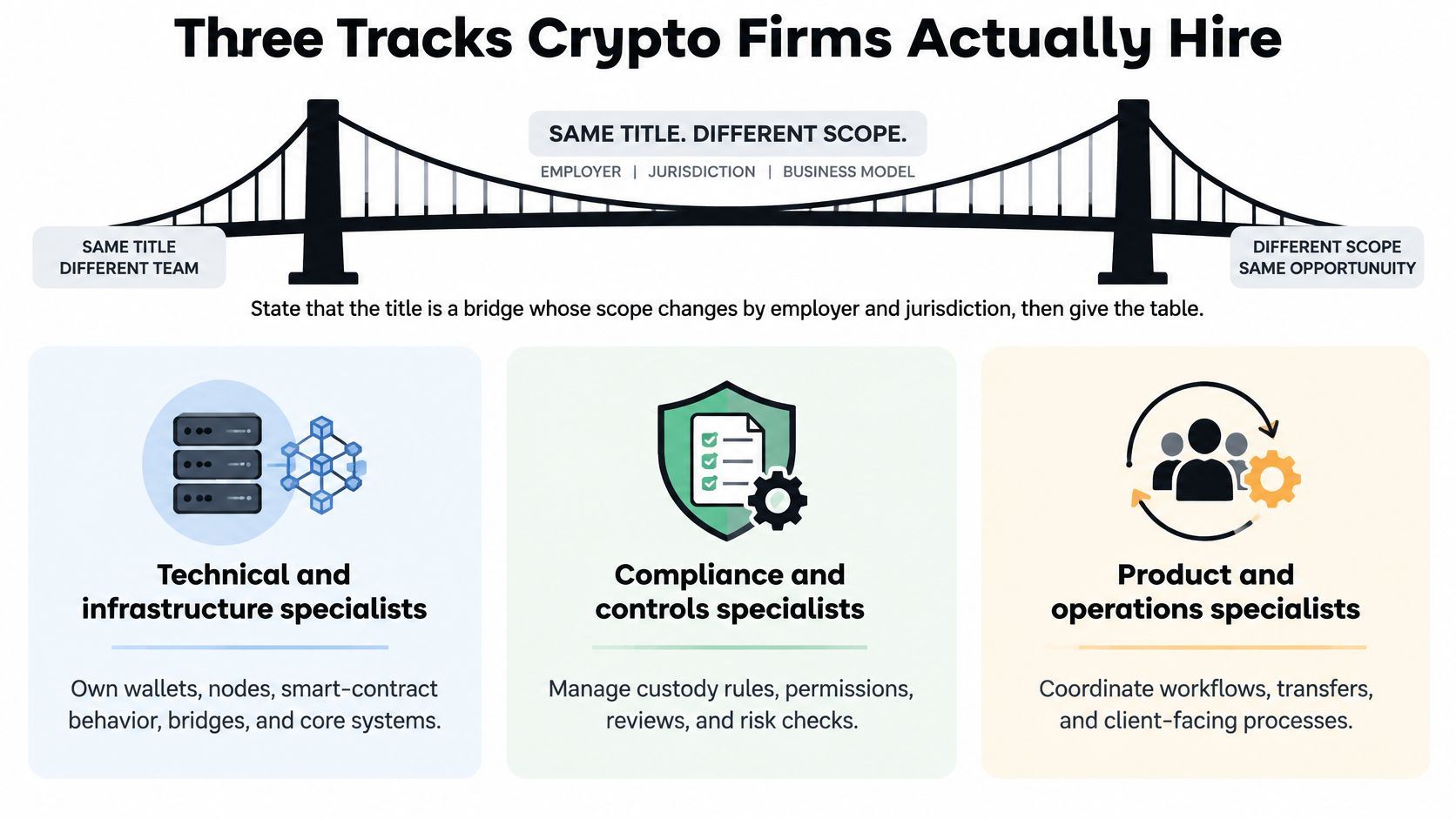
Digital asset specialist is a bridge title whose scope changes by employer and jurisdiction. Compare the work each team needs before deciding whether your strongest route is technical, operational, or regulatory.
Three digital asset specialist tracks and the proof each hire needs
| Track | What you own | Interview proof | Hiring signal |
|---|---|---|---|
| Technical and infrastructure | Wallets, nodes, smart contracts, bridges, and key systems | Shipped system, security trade-off, and test or audit note | Technical roles were over 50% of crypto employment in 2025, according to Gate Research's employment report |
| Institutional product and operations | Custody, settlement, tokenization, pricing inputs, and client adoption | Control design or product requirement that survived an exception | The institutional team-building described above creates demand for dedicated operational ownership |
| Regulatory and risk | Licensing, BSA/AML, sanctions screening, and escalation | Written gap assessment a business stakeholder can use | Inadequate in-house digital-asset skills were a compliance concern for 50% of financial institutions versus 22% of crypto businesses, according to Russell Reynolds Associates |
The comparison below shows the responsibilities that candidates need to separate when reading a broad specialist posting.
Choose by the decision you can defend
A technical specialist should explain more than which programming language they used. Say you built a transaction-signing service. Your interview evidence should identify its trust boundaries, explain why you separated approval from signing, and show how you tested unauthorized requests and recovery failures.
An institutional product and operations specialist translates a commercial promise into a workable process. A tokenized-deposit requirement, for example, needs rules for eligibility, reconciliation, permissions, failed transfers, and client communication. Preparation for continuous settlement and T+0, meaning same-day settlement, also requires clear ownership when a dependency fails outside conventional business hours.
A regulatory-risk specialist makes uncertainty usable. A good gap assessment identifies the activity, affected jurisdiction, missing control, decision owner, and launch consequence. It doesn't reproduce legislation and leave the product team to interpret it.
Why non-programmers can be strong candidates
The skills-gap comparison matters because institutions need people who understand controlled financial processes, not only software. Experience in operational risk, investigations, data governance, or regulated product delivery can be valuable when you can also follow a transaction across addresses and explain the limits of the evidence.
For jurisdiction mapping, Glentorion's overview of global crypto regulation in 2026 can provide orientation before you verify the applicable primary rules. Candidates considering crypto compliance jobs should distinguish policy interpretation from monitoring operations and program leadership.
Name one primary track before collecting credentials. You can collaborate across all of them without pretending you're equally ready to own every function.
A Day Built Around Controls Not Job Titles
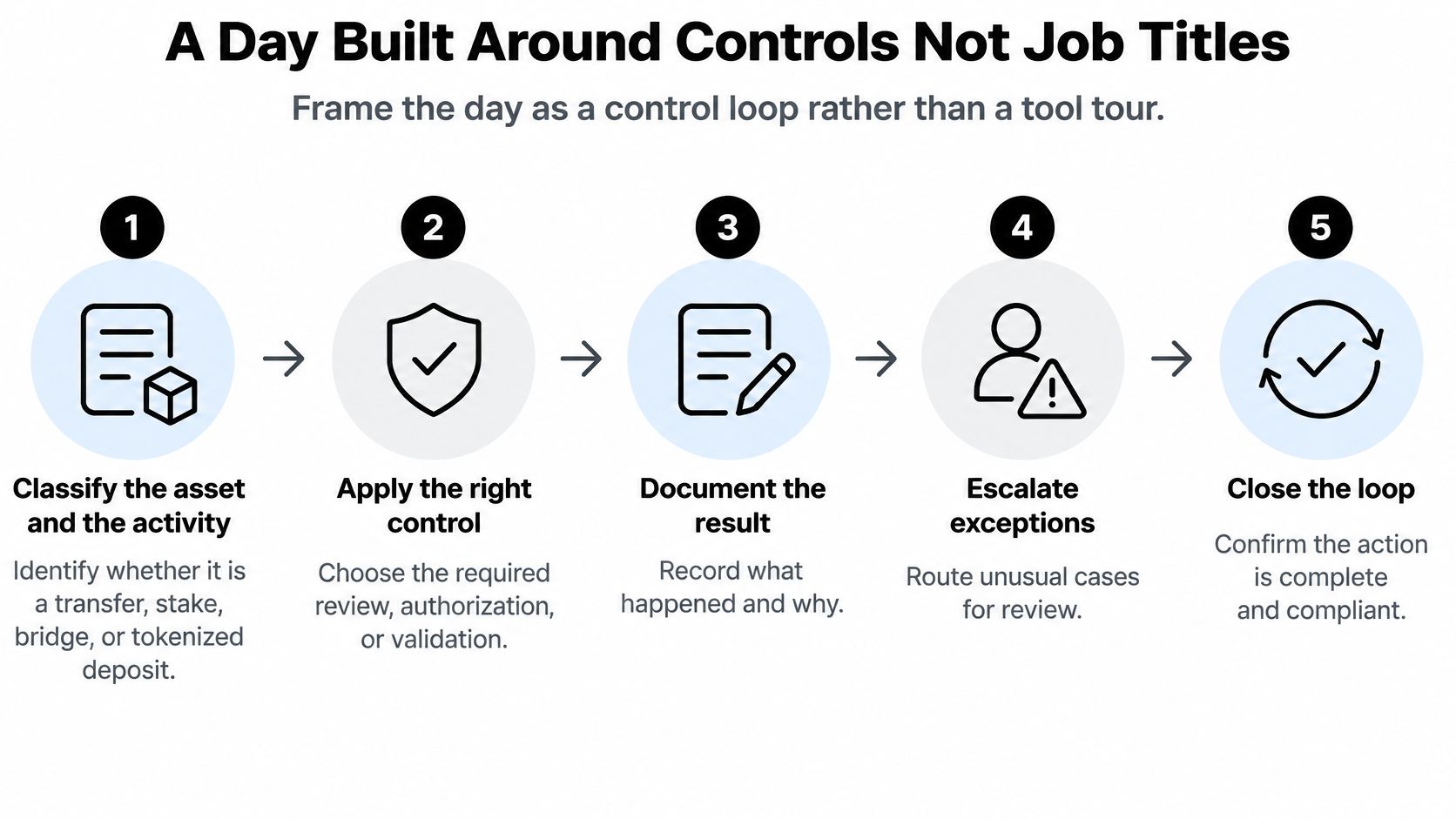
A useful daily routine is a control loop, not a tour of analytics dashboards. The objective is to reach a documented decision and make sure the relevant system or person acts on it.
- Classify the asset and activity. Establish whether you're reviewing a transfer, stake, bridge interaction, or tokenized deposit. Similar-looking wallet movements can represent different business activities.
- Identify the jurisdictions. Map the customer, operating entity, counterparty, and service location to relevant licensing or registration duties. For European activity, assess MiCA and DORA applicability with legal and compliance rather than assuming every crypto business has identical obligations.
- Trace exposure. Examine wallet history, counterparties, and unhosted-wallet involvement. Separate verified ownership information from an analytics label or an inference.
- Document the decision. Record the evidence, uncertainty, applicable policy, and approval owner. Another reviewer should be able to reconstruct your reasoning.
- Escalate anomalies. Incomplete originator information, mixer exposure, or a privacy-coin hop may require additional review. Don't equate a risk indicator with proof of wrongdoing.
- Change the control. Translate the finding into a validation rule, approval requirement, exception workflow, or product restriction rather than stopping at a memo.
A Deloitte digital-assets regulatory-management posting illustrates why this work combines licensing, financial-crime, cyber, operational, and regulatory considerations.
The workflow below provides a compact operational view of that loop.
Work one incomplete transfer through the loop
Suppose a custodian receives a transfer request whose blockchain address is valid, but whose accompanying beneficiary information is incomplete. Technical validity doesn't establish that the firm can process it under its compliance procedures.
The FATF's 2026 virtual-assets update describes the Travel Rule requirement to obtain, retain, and transmit specified originator and beneficiary information immediately and securely, and reports that 83% of surveyed jurisdictions had enacted Travel Rule legislation, with 11 additional jurisdictions implementing it. FATF sets standards that jurisdictions implement, so specialists must check the applicable local requirements.
The operational response combines counterparty identification, beneficiary screening, an exception queue, encrypted transmission, and an audit log. Hold the request under the appropriate procedure, obtain the missing information securely, and document who authorized its eventual release or rejection.
A transfer may be permissible under one jurisdiction's framework yet rejected by a receiving provider operating under another. In an interview, narrate that conflict from classification to resolution, then explain the validation you'd change to prevent another incomplete request.
Skills and Proof That Beat a Certificate List
A compromised private key can let someone authorize an asset transfer that the firm can't reverse. That makes key protection a control system, not a wallet-administration chore.
The working environment should reinforce separation of duties and careful verification.
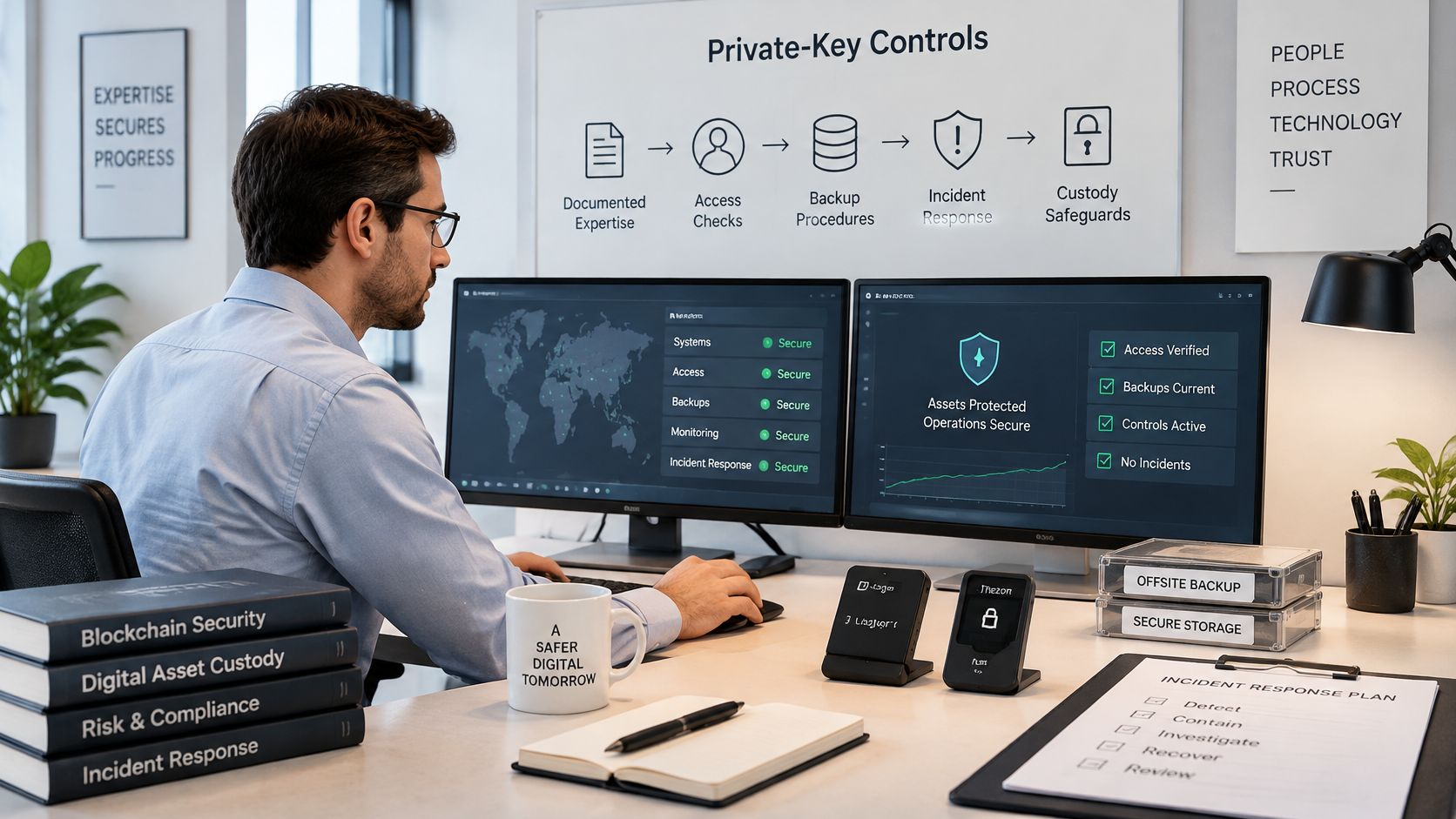
The SEC statement on proposed custody-rule amendments describes asset-specific safeguarding expertise, systems intended to prevent loss, theft, misuse, and misappropriation, and effectiveness reviews at least annually, alongside determining that no permitted custodian is available before self-custody and reassessing that determination quarterly. These are features of the proposed framework, not a blanket statement of enacted obligations for every crypto employer.
Translate safeguards into observable controls
A candidate should be able to turn those principles into a design someone can test:
- Separate signing environments. Keep signing capabilities apart from ordinary application access and administrative accounts.
- Require independent authorization. Use multi-party approval, least-privilege permissions, and independent transaction verification.
- Prepare for failure. Document recovery procedures, retain tamper-evident logs, and test whether the controls work.
The design must also address the asset. Account-based networks raise nonce and permission questions; UTXO systems require attention to inputs and change outputs. Smart-contract tokens, staking arrangements, and bridges introduce additional contract, withdrawal, and dependency risks.
Show the reasoning in a work sample
The literacy stack includes transaction settlement, smart-contract permissions, basic cryptography, cloud access, and on-chain analysis. It also includes recognizing when securities, commodities, licensing, stablecoin, or MiCA questions need specialist legal input. A practical grounding in on-chain data analytics helps you distinguish what a transaction proves from what you merely suspect.
For additional training context, use the video alongside a written exercise rather than treating viewing as evidence of competence.
An AML or blockchain certificate is a signal, not the qualification. Bring a custody-control design, transaction-monitoring investigation, or concise regulatory gap assessment, with assumptions and limitations clearly marked. TekRecruiter's discussion of hiring engineers based on demonstrated ability offers a useful parallel: evaluate the candidate's work, not just their credentials.
If you can't explain what fails when a key ceremony is skipped, the certificate doesn't establish readiness to own that control.
The Hiring Bar in a Real Senior Posting
A senior title should reflect the complexity you can own, not how confidently you describe the industry. The Deloitte digital-assets AML/KYC/BSA manager posting sets a concrete benchmark: a bachelor's degree or higher in a relevant field and at least seven years of relevant experience, including substantial exposure to digital assets, virtual assets, or crypto businesses.
Use that posting as a role-specific hiring bar, not as a universal entry requirement for the profession.
Senior digital-asset compliance bar and how to test it
| Requirement | Benchmark | What the interview should demand |
|---|---|---|
| Education | Bachelor's or higher in finance, business, law, criminal justice, or a related field | How that training shows up in a written risk decision |
| Experience | At least 7 years in financial services, consulting, compliance, financial crime, or risk, with substantial digital-asset exposure | A case from a crypto or virtual-asset business, not a classroom example |
| Regulatory topics | BSA/AML, FinCEN, FATF Travel Rule, OFAC, analytics, tracing, mixers, privacy coins, and decentralized technology | One alert walked from detection to disposition |
| Leadership | Communication, project leadership, prioritization, mentoring, and deadlines | A stakeholder briefing and a scope cut that still met the date |
Ask for cases rather than definitions
Hiring managers can make the interview more useful with prompts that require candidates to expose their reasoning:
- Walk a sanctions hit from alert to disposition. Ask what triggered the alert, how the candidate verified attribution, what remained uncertain, and who could authorize the outcome.
- Explain an incomplete Travel Rule payload. Require a distinction between missing information, a transmission failure, and a counterparty that cannot satisfy the firm's requirements.
- Brief a product owner who isn't a lawyer. Ask for the business consequence, available choices, recommended control, and unresolved legal question.
- Describe a scope cut before a filing or examination date. Probe what the candidate postponed, what they protected, and how they obtained approval.
For the analytics case, require a named workflow. A candidate might explain address screening, transaction-hash review, counterparty clustering, exposure analysis, and case recording in the blockchain-analytics platform they used. Tool familiarity matters less than explaining why a label or traced path did, or didn't, justify escalation.
Separate eligibility from interview quality
Score examples on evidence quality, decision logic, communication, and ownership. A polished explanation shouldn't compensate for invented attribution or an unexplained approval decision, and tenure shouldn't substitute for hands-on case work.
Enthusiasm for Web3 and a certificate won't satisfy this manager posting's experience requirement. Candidates below that bar should target analyst, investigations, or operations seats and bring a clearly traced case. Use public transactions or sanitized materials, never confidential customer records.
A strong early-career candidate identifies the limit of their authority and knows when to escalate. Claiming manager-level readiness without evidence makes that judgment harder to trust.
How Specialists Move Into Senior Roles
Career progression comes from owning a harder decision and proving the result. More years performing the same task won't necessarily prepare you to design a system, advise leadership, or manage a program.
From implementation to architecture or security
An engineer moves beyond implementation by explaining system-wide consequences. A portfolio artifact should show a design decision, the alternatives rejected, and evidence of the outcome, such as more reliable infrastructure, safer deployment, reduced attack surface, or improved throughput.
Don't claim an improvement without retaining its baseline and measurement method. Explain the business consequence too: whether the change reduced service interruptions, prevented unsafe signing, or made recovery more dependable.
Our current category listings show Engineering with the most open roles at 1,624, followed by Legal & Compliance at 551. Those counts show hiring volume, not that every vacancy offers the same advancement route.
From analysis to advice
The SEC Financial Economist vacancy for crypto assets and novel products emphasizes market-structure research, economic modeling, statistical analysis, and recommendations for senior management. That creates a path for specialists whose strongest contribution is analytical rather than operational.
A useful interview artifact starts with a testable question. For example, how might fragmented liquidity affect execution quality for a proposed product? State the hypothesis, explain the available evidence and limitations, and identify which result would change the recommendation.
The measurable outcome here may be a better-supported decision rather than a faster system. Keep the analysis reproducible and distinguish correlation from an explanation you haven't established.
From specialist to program owner
Program leadership requires other people to deliver consistent work. Evidence might include an escalation standard you introduced, a review process you improved, or a training package that enabled colleagues to handle cases correctly.
Our listings include 1,696 Senior-level blockchain and Web3 roles, the largest experience band, and 486 VP and C-level roles in the current executive listing. The narrower executive step calls for documented program ownership, not merely a senior individual-contributor title.
- Keep an implementation artifact. Preserve the design, test evidence, and observed result.
- Keep an advisory artifact. Save a decision memo with its assumptions, recommendation, and eventual outcome.
- Keep a leadership artifact. Show how you assigned ownership, managed exceptions, and assessed delivery.
Apply at the level whose decisions you can demonstrate, not the level whose title you'd like next.
Update each artifact as your responsibility grows. Remove confidential details, distinguish your contribution from the team's, and be explicit when a result remains unmeasured.
Pick a Track and Search Live Openings
Choose one primary track before opening another application form. Then write a short proof statement that makes your fit easy to evaluate.
Use these six lines as a preparation exercise:
- Target role. Name technical infrastructure, institutional operations, or regulatory risk.
- Business problem. Identify the failure or decision you addressed.
- Your responsibility. Separate your work from the team's contribution.
- Evidence. Name the system, investigation, control design, or requirements document.
- Judgment. Explain the trade-off, exception, or jurisdiction conflict.
- Result. State what changed, what you measured, and what remains uncertain.
For a technical application, the statement should identify a system, a security trade-off, and an observed result. For operations, name a custody or settlement control and the exception it caught. For regulatory work, explain a jurisdiction conflict and the operational change that followed.
Test the choice against actual demand
Blockchain Jobs lists 6,934 open roles across crypto, DeFi, and Web3, giving candidates a way to compare their chosen track with current openings rather than guessing from a broad title. Job seekers can also sign up for one daily email of new blockchain and Web3 jobs.
Read the responsibilities before deciding an opening fits. A wallet-infrastructure role and a digital-assets strategy role may share vocabulary while demanding very different evidence.
Hiring managers should make the same choice from the other direction. Write the posting around a primary track, identify the decisions the hire will own, and score a traced case plus a stakeholder explanation. Don't let a generalist crypto résumé satisfy every requirement by default.
Apply or post only after the track and the proof are named. That gives both sides a concrete basis for deciding whether the next conversation is worthwhile.
Visit Blockchain Jobs to find engineering, operations, product, and compliance openings that match the digital asset specialist track you can demonstrate. Bring your work sample to the search, or post a role that clearly names the decisions, controls, and evidence your next hire will own.