
Crypto Marketing Playbook for Web3 Hiring and Growth

The most popular crypto marketing advice is wrong. Buying more impressions on X, Telegram, or influencer feeds won't fix weak positioning, poor onboarding, or a product nobody trusts. The teams that survive a bear market don't treat marketing as noise generation. They build a system that connects product education, community participation, measurable usage, partnerships, and compliance.
That shift changes who you hire. A social media operator can't own an on-chain funnel, a performance marketer can't replace a community manager, and an agency retainer won't create the institutional memory required for regulated launches. Every channel should map to a clear role, a measurable outcome, and a career path.
What Crypto Marketing Really Is in 2026
Crypto marketing became a mainstream growth function during the 2021 market cycle. Crypto companies reportedly spent approximately $3.2 billion on digital advertising, while total crypto advertising expenditure reached about $7.9 billion globally, according to this industry compilation of crypto marketing statistics. That spending covered exchanges, wallets, token issuers, DeFi protocols, NFT projects, and blockchain infrastructure companies.
The lesson isn't that every Web3 company should buy ads. The lesson is that marketing now sits at the center of acquisition, trust, ecosystem development, and talent competition. A serious team treats it as connective tissue between product, community, and capital markets, not as a freelance social media task.
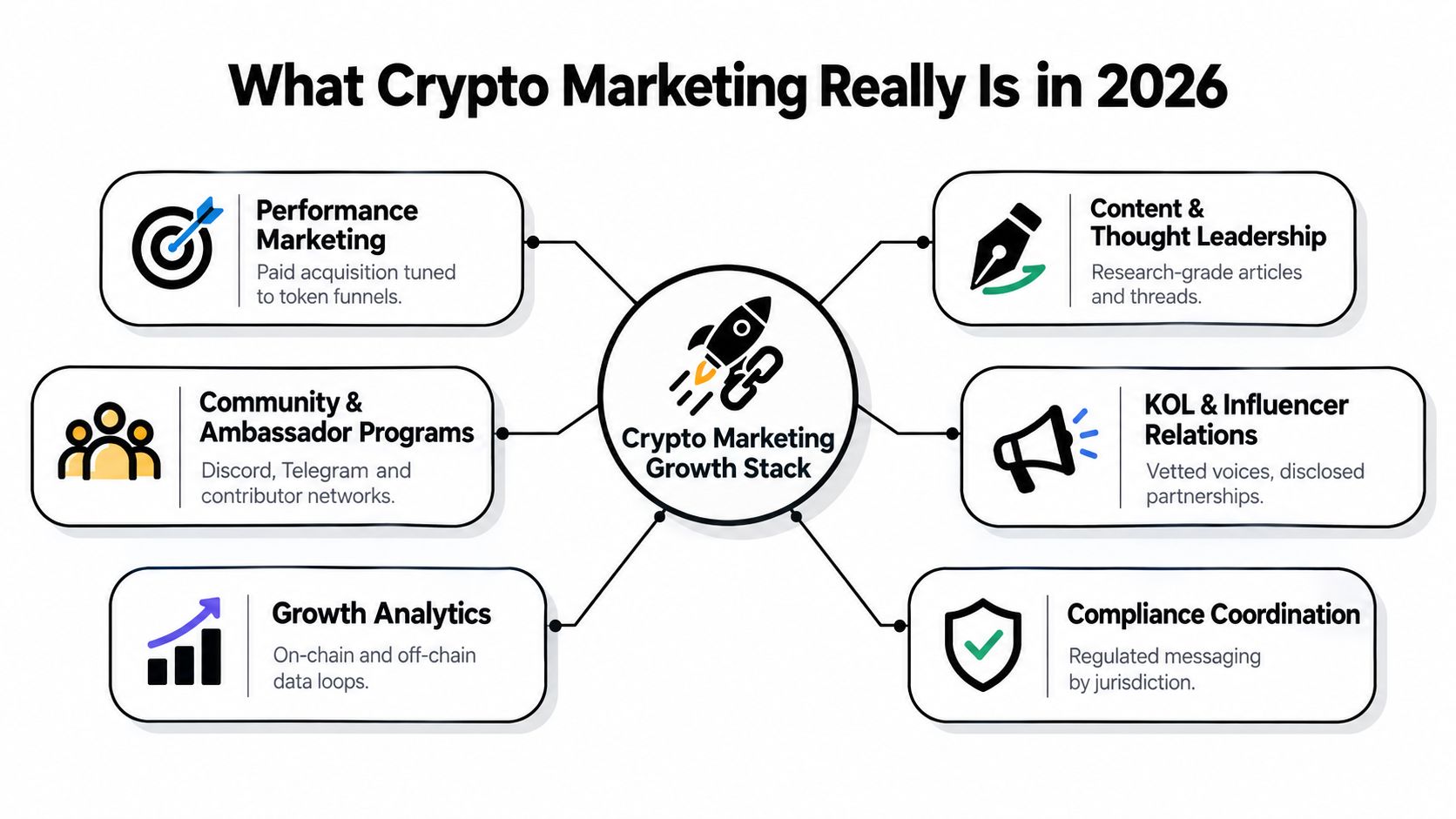
The six seats behind the growth stack
A functioning crypto marketing organization usually needs six related capabilities:
- Demand generation: Paid acquisition, lifecycle campaigns, landing pages, and funnel experimentation.
- Content and SEO: Research-grade explainers, product education, technical documentation, and search visibility.
- Community and Discord operations: Onboarding, moderation, support, events, contributor programs, and feedback loops.
- Business development and partnerships: Integrations, ecosystem deals, co-marketing, exchange relationships, and strategic distribution.
- KOL and influencer relations: Vetted voices, disclosed sponsorships, narrative alignment, and deliverable management.
- Growth analytics: Off-chain attribution combined with active wallets, TVL, governance activity, token-holder behavior, and protocol usage.
Compliance coordination cuts across all six. Under MiCA, marketing communications must be clearly identifiable, consistent with the white paper, and free from misleading claims. That means a campaign manager who can brief creators but can't connect copy to approved language is a liability.
Hiring rule: If a channel affects wallets, deposits, token ownership, or regulated claims, assign ownership to a named employee. Don't hide accountability inside an agency contract.
The org chart should reflect the funnel. A community manager owns participation quality, a content lead owns education and search demand, a growth marketer owns qualified actions, and an analytics lead proves whether those actions become durable usage. The tactic is only complete when someone can explain what shipped, why it mattered, and what the data says next.
The Roles You Need to Hire and How They Grow
Don't hire a “Web3 marketer” and hope the title covers every missing capability. Interview for specific outputs. A Growth Marketer should show a shipped acquisition experiment, a Community Manager should explain how they retained active participants, and a Partnerships Lead should demonstrate how a relationship produced qualified usage rather than attention.
A strong candidate can also explain what they wouldn't publish. Ask which crisis message they changed, which claim they rejected, and how they documented an influencer disclosure. For roles touching protocol growth, ask candidates to distinguish new wallets from returning users and to connect a campaign with TVL, governance participation, or protocol usage. Those are stronger signals than follower counts.
The role ladder
| Role | Screen For | 6-Month Win | 12-Month Win | 24-Month Win |
|---|---|---|---|---|
| Growth Marketer | Funnel design, testing discipline, qualified conversion analysis | Owns one acquisition channel and its event taxonomy | Runs a cross-channel growth program | Leads growth experiments across multiple markets |
| Content Lead | Technical clarity, SEO judgment, editorial consistency | Ships product education and cornerstone content | Owns content operations and organic demand | Builds a content team tied to product and revenue goals |
| Community Manager | Moderation judgment, empathy, retention thinking | Runs AMAs, onboarding, and community cadence | Builds contributor or ambassador systems | Leads community managers across products or regions |
| KOL and Partnerships Lead | Commercial judgment, disclosure discipline, partner quality | Delivers a coordinated partner or KOL campaign | Owns strategic ecosystem pipeline | Manages partnerships, KOL, and business development teams |
| Devrel-Adjacent Marketer | Technical fluency, developer empathy, documentation | Supports developer campaigns and technical events | Connects developer education to adoption | Owns developer growth across ecosystems |
| Head of Growth | Hiring judgment, analytics, cross-functional leadership | Establishes reporting and operating rhythm | Owns qualified pipeline and channel portfolio | Reports to the founder or token lead with a manager-of-managers structure |
The first six months are about evidence. The next six are about ownership. By the second year, the best operators stop being the person who posts every announcement and become the person who designs the system, hires specialists, and holds the team to a shared growth thesis.
For hiring teams that need more structured outbound processes, a practical resource on how dreach books more client meetings can help recruiters think about repeatable prospecting and follow-up. The same principle applies internally: define the signal, standardize the process, and inspect the outcome.
A two-person team often starts with one generalist handling content, community, and campaigns while a second person owns partnerships and analytics. As demand grows, split those responsibilities by operating rhythm. The solo executor becomes a channel owner, then a team lead. The strongest lead eventually manages managers, while specialists own the work that once depended on founder attention. Candidates building that path should study the responsibilities in crypto community manager jobs, because community work is often the first place Web3 marketers learn operational discipline.
Picking the Right Acquisition Channels for Web3
Channel selection is a hiring decision, not just a media decision. Paid ads need performance operators and compliance support. Community-led growth needs people who can moderate conflict, design participation loops, and report retention. Content needs subject-matter fluency and patience. Partnerships need commercial judgment.
The channel also determines how quickly a team can learn. Available crypto advertising benchmarks report native-ad CTR of roughly 0.15% to 0.35% and video CTR of 0.20% to 0.56%. Reported conversion ranges include 2% to 5% for exchange sign-ups, 0.3% to 0.8% for deposits, and 1.5% to 3.5% for DeFi wallet connections, according to crypto advertising benchmarks from HypeLab. These figures aren't transferable to a jobs marketplace or every protocol, but they show why downstream conversion definitions matter.
| Channel | Relative CAC | Compliance Risk | Time-to-Hire Talent | Best Stage |
|---|---|---|---|---|
| Paid ads | Fast learning, often expensive qualified traffic | High, especially for financial claims and restricted assets | Short if the candidate has regulated acquisition experience | Retargeting and post-PMF scaling |
| Content and SEO | Slow initial return, compounds through intent | Moderate, claims and financial education require review | Moderate, technical fluency matters | Pre-launch education and durable acquisition |
| Community-led growth | Low media cost, high operating effort | Moderate, incentives and claims need controls | Moderate to long, judgment matters more than posting speed | Early trust-building and retention |
| Partnerships | Variable, depends on partner quality | Moderate to high across jurisdictions | Long, senior relationship skills are scarce | Ecosystem expansion |
| Influencer and KOL | Can be efficient or wasteful | High, sponsorship and financial-promotion rules apply | Moderate, vetting is the hard part | Coordinated launches and targeted reach |
Paid ads deliver volume quickly, but the compliance runway is narrow. MiCA requires fair, clear, and non-misleading crypto marketing in the EU, while Google restricts EU crypto advertising to authorized crypto-asset service providers and Meta requires regulatory licensing for crypto ads, as summarized in this crypto marketing compliance guide. Don't hire a performance marketer into a channel that legal can't approve.
For a zero-to-one launch, start with content, founder-led education, community operations, and carefully selected partnerships. Add paid retargeting only after the product has proof and the approval workflow works. After product-market fit, expand paid acquisition and KOL programs, but keep content and community because they carry trust through regulatory winters.
Many teams over-invest in influencer reach. Hire one person who can validate KOL quality and measure qualified actions before you hire a larger roster of creators.
Planning a Token or Product Launch That Actually Converts
A launch fails before launch week when the team hasn't agreed on the audience, the promise, and the action. Separate product marketing from token marketing. Product campaigns should explain usage and retention. Token campaigns require careful treatment of utility, governance, incentives, and risk.
Four phases of launch execution
Positioning lock comes first. Create a positioning document, a narrative, target segments, and an anti-persona. The anti-persona matters because speculative users can overwhelm a product launch while contributing little durable usage. Give the content lead ownership of the language, the product marketer ownership of the promise, and compliance ownership of substantiation.
Pre-launch buildup turns the narrative into participation. Build a waitlist, contract ambassadors with specific deliverables, prepare partner co-marketing, and agree on KOL outputs before publication. Every creator brief should specify approved claims, disclosure language, links, timing, and escalation paths.
Launch week cadence is an operating plan, not a posting spree. Set an hourly publishing schedule, place community moderators on call, confirm liquidity and exchange readiness, and coordinate the PR embargo. The growth lead watches the funnel while community operations handles questions that would otherwise become public confusion.
Post-launch sustain begins immediately. Build holder retention loops, publish governance communications, and design a second-claim or participation mechanic only when it supports the product thesis. Don't reward empty activity that inflates wallets without creating repeat use.
| Channel | Day -14 to -1 | Launch Week, Day 0 to 7 | Post-Launch, Day 8 to 14 | Budget % |
|---|---|---|---|---|
| X | Narrative testing, education, founder threads | Coordinated announcements, live proof, support updates | Product milestones and transparent recap | Set through controlled testing |
| Farcaster | Technical conversation and early-user feedback | Founder and developer responses | Deeper product discussion | Set through qualified engagement |
| Telegram | Segmented onboarding and FAQ preparation | Live support, alerts, moderation | Retention prompts and feedback collection | Set through qualified actions |
| Mirror | Publish the positioning and product thesis | Release the definitive launch explainer | Document lessons and next milestones | Set through search and referral intent |
| Paid display | Test compliant retargeting creative | Reinforce approved launch messages | Re-engage qualified visitors | Set only after approval and conversion evidence |
| Influencer retainers | Approve scripts and deliverables | Coordinated creator publication | Follow-up education and usage proof | Set by verified audience quality |
The table deliberately avoids a fixed percentage split. A budget number without a qualified conversion definition is theater. Assign spend only after each channel has a landing page, event taxonomy, owner, and approval record.
Teams should also decide whether they need an agency for speed or an internal operator for daily presence. A guide to Web3 marketing agencies is useful when comparing those models, but no external partner can replace a team member who owns product truth and community context.
Tracking KPIs That Move With On-Chain Reality
A crypto marketing dashboard should answer one question: did marketing create valuable behavior that persisted beyond the campaign? Impressions and follower counts can help diagnose reach, but they can't prove activation, revenue, or retention.
Use four reporting layers. Awareness includes impressions, mention share, and branded search. Acquisition includes waitlist conversion, wallet connects, and KYC completion. Activation and revenue includes DEX volume, TVL inflow, paying users, and gas spent per cohort. Retention includes wallet return behavior, governance participation, and the Discord DAU to MAU ratio.
Replace vanity reporting with cohort decisions
Ignore a single-day spike in Discord joins. Ignore follower growth without a corresponding increase in qualified actions. Ignore tweet impressions when the team can't connect them to a defined attribution window.
Build a cohort dashboard in Dune or a comparable analytics environment. Separate new wallets from returning wallets, distinguish incentivized liquidity from durable liquidity, and report conversion by market, role or user segment, device, and traffic source. On-chain analytics can include active wallets, TVL, token-holder distribution, governance participation, wallet activity, token performance, and protocol usage, as outlined in this Web3 growth marketer career guide.
A weekly growth review should include:
- Funnel movement: Where did qualified users enter, and where did they drop?
- Cohort quality: Which acquisition source produced repeat activity?
- Channel risk: Which campaigns need legal, fraud, or platform review?
- Experiment decision: What gets scaled, changed, or stopped?
- Hiring implication: Which capability is missing from the current team?
For a practical framework on connecting campaigns to business outcomes, use the SourceLoop marketing measurement guide as a reference point, then adapt the measurement model to wallet and protocol behavior.
The right analyst doesn't just build charts. They challenge the campaign owner when the chart doesn't support the story.
Compliance as a Pre-Launch Engineering Gate
Compliance belongs in the launch architecture. Treating it as a final copy review creates rework, delays, and unapproved claims already embedded in creative, contracts, and landing pages.
Under MiCA, marketing communications must be identifiable as marketing, consistent with the project's white paper, and not misleading. They can't be distributed before the white paper is published, and they must reference the white paper, its location, and the issuer's contact details, according to this analysis of crypto marketing under MiCA. That requirement becomes a workflow: every claim, landing page, influencer script, and social post needs a traceable approved source.
Convert rules into owned deliverables
A compliance-marketing-ops role should own the asset review queue, jurisdiction matrix, version history, and launch checklist. The job isn't to slow creative work. It's to make approval predictable.
- EU assets: Map claims to white-paper language, include required references, and confirm that the communication is fair and clear.
- UK assets: Review whether a promotion falls under Financial Services and Markets Act section 21 and confirm approval by an authorized firm where required.
- US assets: Check state-specific licensing and offering restrictions before targeting audiences or making claims.
- Platform assets: Review X, Meta, Telegram, landing-page, and influencer requirements before media buying or publication.
- Operational assets: Prepare disclaimers, risk warnings, geo-block lists, target-audience gates, KYC scripts, and evidence retention.
In the UK, paid crypto influencers can create financial-promotion exposure. A breach of section 21 can constitute a criminal offense punishable by up to two years' imprisonment, an unlimited fine, or both, as described in this overview of crypto advertising regulations. Candidates for growth, community, and partnerships roles should know how to document compensation, approve scripts, preserve disclosures, and stop publication when a claim isn't authorized.
Set a legal ticket SLA of 48 hours, publish the escalation owner, and use a sign-off checklist like a continuous integration gate. A campaign shouldn't deploy when a required approval is missing. Teams building that capability can look at the responsibilities associated with crypto compliance jobs when defining the role.
For a broader checklist covering ad policies and consent flags, this guide to ad policies and consent flags provides a useful operational reference. The crypto-specific layer still needs jurisdictional review and counsel approval.
A 90-Day Plan for New Hires and Hiring Managers
The first 90 days should test whether the hire can turn context into responsible execution. It should also test whether the manager can provide access, clarity, and useful feedback. A weak onboarding process makes a capable marketer look ineffective.
Days 1 to 30 build context
The new hire audits previous campaigns, reads the important Discord threads, maps the off-chain and on-chain funnel, and interviews product, engineering, legal, and community stakeholders. They should ship one small artifact, such as a competitive teardown or community pulse report, to prove comprehension rather than imitate activity.
The hiring manager's parallel work is practical. Confirm analytics access, campaign history, product documentation, approval contacts, and channel permissions. Schedule the 30, 60, and 90-day reviews before the employee starts, then remove blockers instead of asking for updates without providing context.
Days 31 to 60 create ownership
The hire should own one channel, one campaign, and one KPI dashboard. That might mean redesigning the onboarding flow for a community, publishing a product education series, or running a controlled acquisition experiment. The manager introduces the hire to partners, makes decision rights explicit, and runs a structured interview retrospective with an external observer.
Screen candidates for specific past campaign metrics, not polished adjectives. Ask what they measured, what failed, how they handled ambiguous ownership, and when they pushed back on a founder. A strong answer includes constraints, trade-offs, and the candidate's own decision. A weak answer turns every result into a team success with no personal accountability.
Days 61 to 90 prove independent judgment
By day 90, the marketer should deliver a public win. It could be a meaningful launch contribution, a growth experiment with measurable lift, or a high-quality hiring referral. They should also write a growth thesis for the next two quarters, including the capability the team needs to hire next.
Manager test: If the new hire can't explain the metric, the audience, the risk, and the next decision, they don't own the channel yet.
Candidates should leave the first 90 days with evidence they can show in future interviews. Managers should leave with a clear answer to a harder question: is this person ready to become a specialist, a team lead, or the next owner of a broader growth system?
Blockchain Jobs connects Web3 candidates with roles across marketing, community, growth, analytics, legal, engineering, and other crypto-native functions. Visit Blockchain Jobs to find specialized opportunities or post a role for professionals who understand that sustainable crypto marketing depends on both growth execution and operational trust.