Decentralized Finance Jobs: A Guide to Breaking In

Crypto and DeFi work employed more than 1.6 million professionals globally in 2025, while approximately 66,000 new crypto-related positions were added, a 47% increase from the previous year. That makes decentralized finance jobs a serious labor market, but entering it requires more than enthusiasm for tokens or a basic Solidity tutorial.
The strongest candidates prove they can reduce risk, ship reliable systems, interpret financial mechanisms, or run operational processes under pressure. That includes protocol engineers, but it also includes compliance professionals, treasury specialists, product managers, risk analysts, customer-support leads, legal advisers, and operations teams. The hiring question isn't whether you understand crypto vocabulary. It's whether you can show useful evidence of judgment in a system where code, money, regulation, and governance meet.
Understanding the DeFi Job Market Landscape
The scale of the market has changed how employers recruit. A 2025 employment-market report estimated that the worldwide crypto industry employed more than 1.6 million professionals, with roughly 66,000 new positions added during 2025, representing a 47% increase from the previous year. Technical roles made up more than 50% of positions, while exchanges, public-chain infrastructure, and DeFi protocols collectively represented roughly 70% of the workforce. These figures cover crypto broadly, not DeFi alone, but they establish the labor-market context for decentralized finance jobs. The employment-market reporting cited in this overview shows why candidates with both domain knowledge and practical evidence attract attention.
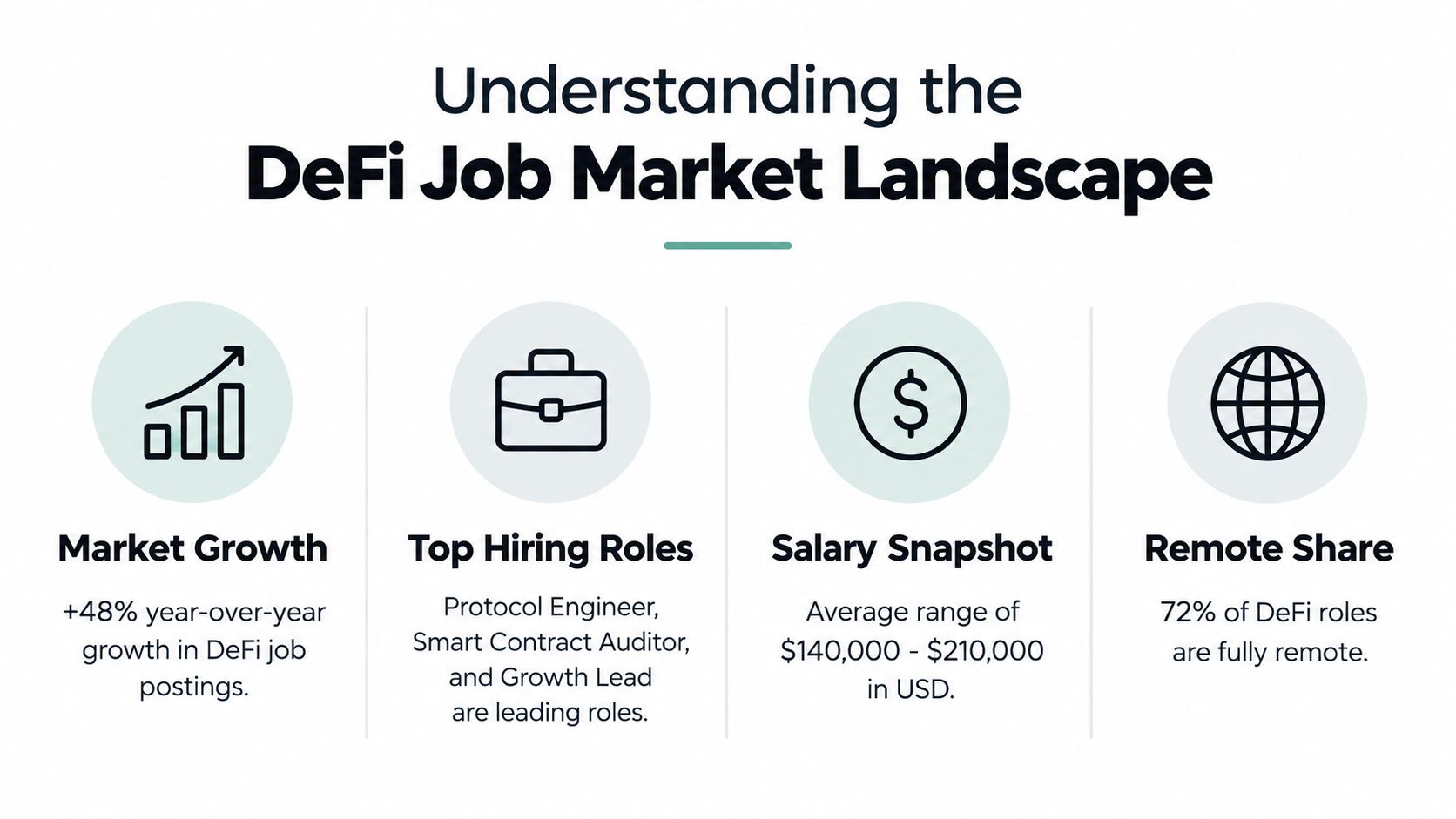
The demand has a clear economic explanation. The European Central Bank reported that DeFi total value locked, the value of digital assets deposited in protocols, rose from approximately €18 billion in January 2021 to more than €240 billion by December 2021, an increase of over €222 billion and more than thirteen times the January level. Lending, decentralized exchanges, staking, asset management, and related protocol activities all needed people who could build, secure, operate, document, and govern them. The ECB-related DeFi market history is referenced here.
Why the market expands and contracts
DeFi hiring follows adoption and liquidity more closely than conventional technology hiring does. When protocol usage expands, employers need smart-contract engineers, security auditors, quantitative researchers, product managers, compliance specialists, and operations professionals. When a major failure damages confidence, budgets can disappear quickly.
The TerraUSD collapse in May 2022 illustrates the downside. The ECB said DeFi TVL fell by almost 40%, equivalent to about €80 billion, with lending and staking protocols among the hardest-hit areas. That history matters in an interview because employers aren't only asking whether you can help growth. They're asking whether you understand what can break, how losses are contained, and how a team communicates during an incident.
Hiring reality: DeFi is a financial infrastructure labor market. Treating it like a trading hobby produces weak applications.
The sector's technical concentration shouldn't discourage non-engineers. It should clarify where they can add impact. A compliance specialist who can translate AML investigations into transaction-monitoring rules, or a finance professional who can analyze stablecoin reserves and peg risk, may solve a problem that a pure software engineer can't solve alone. The best hiring teams look for people who can connect disciplines rather than repeat crypto terminology.
Core DeFi Roles and Required Skill Sets
DeFi teams usually hire around four overlapping needs: building the protocol, deciding what it should do, analyzing how it behaves, and keeping the organization safe and functional. A candidate should choose one primary lane, then demonstrate enough adjacent knowledge to collaborate without slowing the team down.
Protocol engineering
Protocol engineers design and maintain lending markets, automated market makers, staking systems, stablecoins, and supporting services. The job is full-stack and security-critical. Production teams may expect Solidity or Vyper, backend work in Go, Rust, Python, or Node.js, blockchain-node and RPC integration, and testing with tools such as Foundry or Hardhat. Current DeFi Solidity role specifications reflect that broader expectation.
A credible engineer can explain authorization boundaries, accounting invariants, oracle assumptions, replay protection, and cross-contract interactions. They also know that a contract can compile and pass ordinary tests while remaining economically unsafe. A portfolio should include deployment scripts, monitoring, fuzz testing, static analysis, and a written threat model, not just an isolated token contract.
Product management
A DeFi product manager turns a financial mechanism into a usable, governable product. Daily work can include defining collateral rules, documenting liquidation behavior, prioritizing wallet and interface improvements, coordinating audits, managing incident communications, and aligning engineering decisions with compliance and risk requirements.
The transferable skill is not generic project management. It's the ability to make trade-offs explicit. A strong product candidate can explain why a protocol might sacrifice capital efficiency for safer collateral parameters, or why a permissions change deserves more scrutiny than a normal feature release. Product portfolios work best when they contain a protocol requirements document, user-risk analysis, launch criteria, and a post-incident improvement plan.
Research and quantitative risk
Protocol researchers examine incentives, liquidity depth, utilization, gas costs, trust assumptions, governance, and failure modes across lending markets, vaults, derivatives, stablecoins, and AMMs. They may reproduce a protocol model, analyze historical transactions, simulate liquidations, or study peg deviations.
This lane suits candidates from quantitative finance, market making, economics, data science, or risk. Blockchain career guidance from Blockchain Council highlights the importance of combining financial-mechanism design with blockchain architecture, quantitative reasoning, and on-chain analysis. A useful work sample is a risk memo that states assumptions, models adverse conditions, and explains how parameter changes affect utilization, collateral risk, and user returns.
Operations, compliance, and legal
Operations specialists keep protocol activity connected to real business controls. Their work can cover treasury processes, vendor management, incident procedures, customer escalations, governance administration, reporting, and cross-functional coordination. Compliance professionals may build transaction-monitoring rules, investigate wallet activity, document jurisdictional exposure, and convert regulatory requirements into repeatable workflows.
Traditional experience transfers particularly well in this context. AML investigations, payments operations, accounting, treasury, regulatory analysis, and financial controls all have direct relevance. Candidates should present artifacts such as a sanctions-screening workflow, a stablecoin risk assessment, a DAO control matrix, or an incident-response procedure.
For teams hiring across technical and nontechnical functions, a disciplined MyCulture.ai recruitment strategy can help clarify competencies and evaluate evidence instead of relying on keyword matching. Candidates can also broaden their understanding of career paths through this guide to Web3 careers.
Transitioning Into DeFi From Traditional Finance
Traditional finance professionals usually don't fail because they lack relevant experience. They fail because their resumes describe that experience in language DeFi hiring managers can't map to current problems.
An AML investigator shouldn't lead with “reviewed suspicious activity.” The stronger framing is: designed escalation logic for high-risk transaction patterns, documented investigation decisions, and coordinated action across compliance and operations. A treasury professional shouldn't simply list cash management. They should explain how they controlled liquidity, reconciled balances, monitored counterparties, and handled stress scenarios. Those are directly relevant to protocol treasury operations and stablecoin risk.

Translate experience into DeFi work products
Build a small evidence library before applying. Each artifact should answer a practical hiring question.
- AML and compliance: Create transaction-monitoring rules for suspicious wallet behavior, explain false positives, and define an escalation path.
- Treasury and accounting: Produce a stablecoin exposure memo covering liquidity, counterparties, redemption assumptions, and reconciliation controls.
- Regulatory analysis: Compare how a proposed product could create licensing, consumer-protection, sanctions, or reporting concerns in a chosen jurisdiction.
- Risk management: Write a protocol incident procedure covering detection, decision rights, communications, and post-incident review.
- Financial modeling: Analyze utilization, collateral, liquidation incentives, or peg stability using on-chain data and clearly stated assumptions.
You don't need to become a protocol engineer to make these projects credible. You do need enough technical fluency to read blockchain explorers, understand wallet and contract interactions, identify the role of an oracle, and explain why an on-chain event matters. Learn the difference between a contract address, an externally owned account, a multisig, a DAO vote, and an off-chain service. Then connect each concept to a business control.
Make the career pivot legible
Your resume should put the target role first, followed by evidence. Replace a broad profile such as “finance professional interested in Web3” with a specific statement about compliance operations, protocol risk, treasury controls, or product governance. Link to concise work samples, and explain the decision you made, the risk you considered, and the limitation of your analysis.
Jurisdiction-specific credentials may matter for certain compliance and legal roles, while other positions can be performed remotely if the employer permits it. Don't imply that a certificate replaces experience. A well-reasoned portfolio, a clear understanding of on-chain risk, and strong interview communication will usually provide better evidence than a collection of disconnected course badges.
Best Platforms to Find Decentralized Finance Jobs
Job sources differ in signal quality and audience. A general aggregator may give you volume, but it can also contain stale listings or roles with unclear ownership. A specialized board tends to make categories, seniority, location, and remote eligibility easier to assess. Social channels can expose roles before formal publication, but candidates must verify the employer, reporting line, employment terms, and application route.
| Platform | Primary Focus | Best For |
|---|---|---|
| Specialized blockchain job boards | Categorized Web3 and crypto roles | Candidates comparing engineering, operations, finance, legal, and product openings |
| Company career pages | Direct employer listings | Applicants who have already identified target protocols or infrastructure firms |
| Professional networks | Recruiter and hiring-manager outreach | Experienced candidates with a clear niche and public work samples |
| X and Discord communities | Community-led discovery and referrals | Crypto-native candidates who can evaluate informal leads carefully |
| Protocol governance forums | Ecosystem-specific contribution opportunities | Researchers, operations specialists, analysts, and product candidates |
Choose channels by role
Engineers should prioritize protocol career pages, technical communities, and boards where repositories and infrastructure roles appear. Compliance, finance, and operations candidates should search by function as well as by “DeFi.” Useful terms include treasury, risk, investigations, financial operations, governance, regulatory technology, and customer operations.
Blockchain Jobs provides category-tagged roles across areas including Operations, Engineering, Product Management, Finance and Accounting, Legal and Compliance, Data and Analytics, Security, and Customer Support. It also highlights remote-friendly positions and a Recently Added Jobs feed, which makes it useful when you want one search surface for both technical and nontechnical decentralized finance jobs.
Before applying, verify that the listing still exists on the employer's own site, check the named team, and inspect the responsibilities for evidence of a real hiring need. Avoid roles that promise guaranteed returns, request payment from candidates, or describe compensation without a clear employment structure. A polished posting isn't proof of a legitimate employer.
For broader guidance on evaluating specialized listings, this overview of a crypto job board is a useful reference. The practical rule is simple: use job boards to discover opportunities, then use the interview process to validate the company.
Building a Portfolio for Smart Contract Interviews
Smart-contract hiring is an evidence test. A repository that deploys a basic token demonstrates syntax. It doesn't demonstrate that you can protect funds, reason about economic behavior, or debug a protocol under adversarial conditions.
Start with one bounded protocol rather than a collection of unfinished demos. Build a small lending market, AMM, vault, staking system, or liquidation component. Document the intended users, trust assumptions, privileged roles, asset flows, and conditions under which the system should stop operating.
Prove the security process
Your repository should make the review path obvious:
- Unit tests: Cover normal state transitions, access control, accounting, and failure conditions.
- Fuzz tests: Generate unexpected inputs and state combinations instead of relying only on handpicked examples.
- Invariant tests: State what must remain true, such as solvency, conservation of assets, or correct share accounting.
- Static analysis: Run appropriate analyzers and explain which findings you accepted, fixed, or investigated.
- Threat model: Describe reentrancy, oracle manipulation, replay attacks, arithmetic errors, flash-loan exploits, and unsafe cross-contract assumptions.
- Operational evidence: Include deployment scripts, event monitoring, upgrade assumptions, emergency controls, and a debugging note.
Security testing matters because DeFi failures often emerge from interactions between contracts or from economic logic, not from obvious syntax mistakes. DeFi developer hiring guidance from 4ire Labs emphasizes unit testing, fuzzing, invariant testing, and attack-class recognition as practical differentiators.
A senior interviewer won't be impressed by a long README that avoids uncomfortable assumptions. They'll ask how your oracle obtains prices, what happens when liquidity disappears, who can pause the system, how a liquidation affects solvency, and which invariant fails first during an attack. Write those answers before the interview.
Interview standard: Explain not only how the protocol works, but how it fails, who notices first, and what action follows.
Add financial-mechanics judgment
A technically sound contract can still encode a poor market design. Explain capital efficiency, liquidity depth, gas costs, incentive sustainability, collateral risk, governance capture, and user trade-offs. Reproduce a protocol model or analyze historical transactions, then show how changing a parameter affects utilization, liquidation pressure, or returns.
Interview preparation should include design prompts. Practice explaining how prices enter a protocol, when positions are liquidated, how an oracle can be attacked, and why a cheaper execution path may create a different security assumption. Recruiting guidance from PIN on hiring blockchain talent identifies AMMs, liquidation logic, oracle manipulation, Layer 2 systems, consensus, cryptography, and security-first thinking as relevant areas.
Place the video after your core portfolio review, when candidates can use it to reinforce the difference between coding ability and protocol ownership.
Use a focused project rather than copying a tutorial. A hiring manager can tell when a candidate understands every design choice. For additional project direction, review these examples of projects on blockchain, then build something small enough to test rigorously and explain without hand-waving.
Navigating Salary Expectations and Career Growth
Compensation varies sharply by role, seniority, location, and employer, so candidates should use published ranges as negotiation inputs rather than universal averages. A hiring guide reports that in North America in 2024, junior DeFi developers typically earned $90,000 to $130,000 annually, while mid-level developers earned $130,000 to $180,000. The DeFi developer compensation guidance also connects interview expectations to career stage. Junior candidates should show implementation and security fundamentals. Mid-level candidates need protocol judgment and production experience.
Published listings show why title alone isn't enough. Examples include a remote Coinbase role at $127,000 to $149,000, an Injective Labs position in New York at $140,000 to $180,000, a Wormhole Foundation role in London at $68,000 to $90,000, and a Galaxy position in New York at $190,000 to $240,000. These are advertised ranges, not market averages. The listed DeFi compensation examples are useful for comparison, but they shouldn't be treated as a global salary scale.
Consider a compliance manager moving from payments into DeFi. The candidate may accept a role with a lower nominal cash range than a senior engineering position, but gain direct ownership of transaction monitoring, governance controls, and protocol incident procedures. That experience can support progression into compliance technology, risk leadership, or broader operations. The right comparison includes remote eligibility, token or equity terms, jurisdiction, reporting line, decision rights, and the actual work expected during incidents.
Ask what portion of compensation is fixed, what vests, what can be exercised, and what happens if the protocol changes direction. A large headline number isn't automatically the stronger offer if the role lacks mentorship, clear ownership, or credible product-market evidence.
Final Steps to Launching Your DeFi Career
Choose one lane, then build proof that matches its real work. Engineers should publish a tested protocol with a threat model. Finance and compliance candidates should publish a risk memo, monitoring workflow, treasury analysis, or incident procedure. Product and operations candidates should show how they turn ambiguous protocol behavior into clear decisions and repeatable processes.
Search specialized boards and employer sites, verify every listing, and prepare questions about security ownership, governance, jurisdiction, compensation, and incident response. Keep learning through protocol documentation, governance discussions, technical repositories, and thoughtful community participation. DeFi rewards people who can connect financial judgment with operational discipline, not people who merely collect buzzwords.
Your next step is practical. Select one target role, create one work sample that proves readiness, and apply only where your evidence matches the team's problem.
Blockchain Jobs offers a dedicated search across DeFi and wider Web3 roles, including Engineering, Operations, Finance and Accounting, Legal and Compliance, Product Management, Security, and Data. Visit Blockchain Jobs to find relevant openings, compare remote-friendly opportunities, and put your portfolio in front of employers hiring for decentralized finance work.