
What Is Blockchain Marketing and How to Build a Career in It

Blockchain marketing applies distributed ledgers, smart contracts, tokenization, and cryptographic identity to make marketing activity more transparent, verifiable, and programmable. For your career, that means employers aren't just hiring people to promote tokens: they're looking for marketers who can connect campaign work to verifiable product use, sound measurement, and responsible execution.
If you're a marketer or job seeker hearing the term everywhere, it's easy to confuse blockchain marketing with crypto advertising. The distinction matters in interviews. One is about promoting crypto products; the other can use blockchain infrastructure to verify advertising events, automate rewards, or coordinate customer data with consent.
Your useful interview definition is simple: blockchain marketing uses shared, auditable infrastructure to improve how organizations attract, reward, and understand customers. The strongest candidates can explain both the campaign and the system behind it, without treating an on-chain record as proof that marketing caused a result.
What Blockchain Marketing Actually Means in 2026
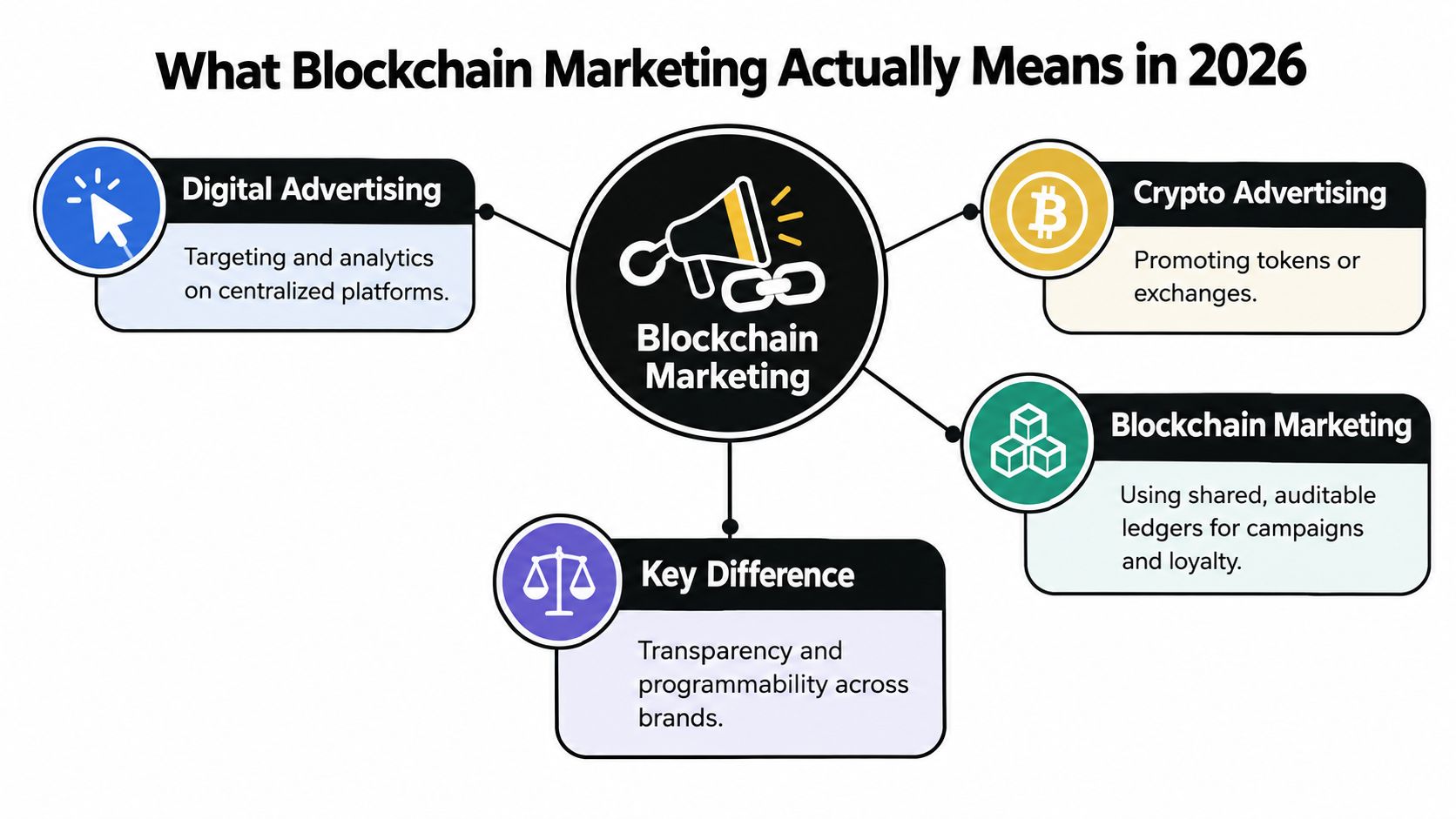
Start with the marketing problem, not the technology. A distributed ledger can give advertisers, publishers, agencies, and customers a shared way to verify campaign events. Smart contracts can carry out preset rules, while tokenization can make rewards or digital ownership transferable under defined conditions.
That's different from digital advertising, which typically uses centralized platforms for targeting and reporting, and from crypto advertising, which promotes tokens, exchanges, or other crypto products. Blockchain marketing may include promotion, but its defining feature is applying blockchain tools to how marketing activity is recorded, governed, or rewarded.
What the technology changes
The practical applications include validating ad impressions, reducing click fraud, improving consent and privacy controls, building direct customer relationships, and supporting token-based loyalty. A 2022 empirical study identified six principal benefits: disintermediation, click-fraud reduction, trust and transparency, privacy protection, digital-marketing security, and creative loyalty programs (2022 study of blockchain's marketing implications).
The same study reported that 54.5% of respondents strongly agreed and 22.7% agreed that reducing click fraud could create a more trustworthy digital-marketing environment. Those findings establish why trust and measurement became central to the conversation. They don't prove that every blockchain campaign beats conventional marketing, and candidates should say so plainly rather than overselling the technology.
How to use the definition in an interview
Explain the customer or business problem first, then identify what the ledger, contract, or token changes. For example, if an interviewer asks what blockchain adds to a loyalty campaign, describe the shared reward record and programmable redemption rules, then acknowledge the onboarding and custody trade-offs.
Hiring managers should listen for that balance. A candidate who can distinguish auditable activity from marketing impact is more useful than one who can list crypto channels but can't explain how a campaign supports product adoption.
How Blockchain Evolved Into a Marketing Discipline
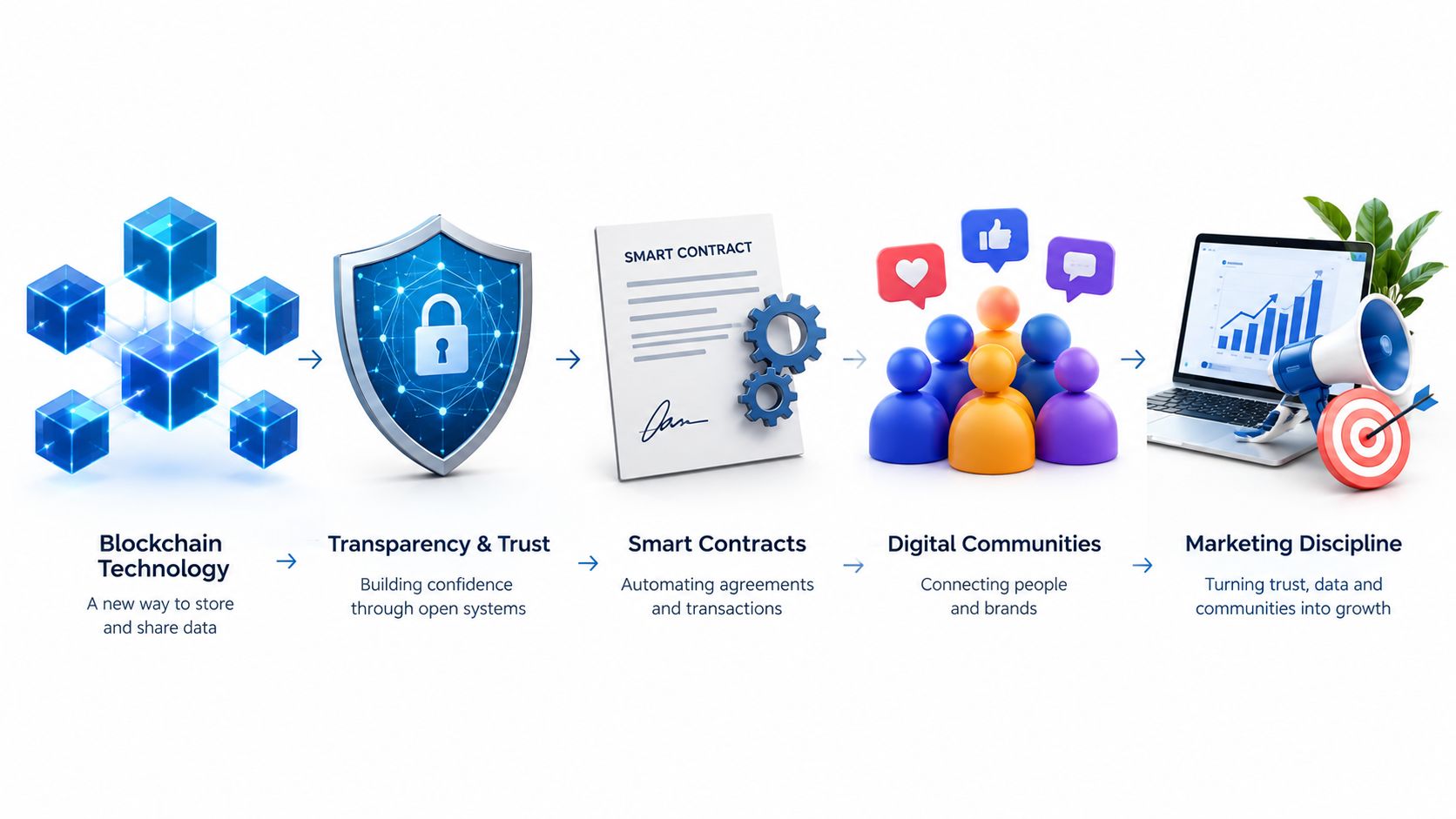
A hiring manager can learn more from one explained trade-off than from a timeline recited from memory. Still, know the arc cold.
In 1991, Stuart Haber and W. Scott Stornetta proposed a blockchain-like method for timestamping digital documents. Bitcoin's whitepaper followed in 2008, the network launched in 2009, and the result was a decentralized ledger that moved value without a central payment operator. The hiring signal is simple: candidates should connect tamper-evident records and peer-to-peer settlement to marketing problems around trust, attribution, and ownership.
From digital money to programmable campaigns
Vitalik Buterin proposed Ethereum in 2013, and its 2015 launch made smart contracts broadly practical. That changed the brief for marketers. Rewards, memberships, creator payouts, and digital ownership could be programmed, which meant campaign rules could live in code and leave an auditable trail.
The 2017 initial-coin-offering boom and Bitcoin's rise toward $20,000 pushed blockchain into mainstream attention. Decentralized finance and NFTs later gave marketers new vocabulary around wallets, tokens, custody, and community coordination. Commercial gravity followed: an industry report estimated the global blockchain-technology market at $17.57 billion in 2023 and projected $825.93 billion by 2032, a projected compound annual growth rate of 52.8% (industry report on blockchain technology).
That growth is why employers now screen for judgment, not slogans. Strong candidates explain what the infrastructure changed, then name what still has to be proven through activation, retention, qualified referrals, and post-incentive behavior. Weak candidates stop at adoption hype.
Use the history to make a sharper point in interviews: programmable incentives can coordinate users, but a marketer still has to show the campaign attracted people who stayed after the reward ended.
Channels and Tactics That Define the Role
A blockchain marketer's day-to-day work often combines community growth, incentives, partnerships, and product education. The right specialization depends on what you can demonstrate, not which channel sounds most crypto-native.
| Channel | Primary Activity | Main Metric | Typical Owner | Key Risk |
|---|---|---|---|---|
| Community | Build participation across Discord, Telegram, Farcaster, and X | Retained participation or qualified referrals | Community or growth manager | Counting members instead of active users |
| Token incentives | Run airdrops, quests, or points programs | Cost per meaningful action and post-incentive retention | Growth marketer | Reward hunters who leave when incentives end |
| Influencer and PR | Coordinate creator, media, and partner campaigns | Qualified conversions by source | Partnerships or communications lead | Weak disclosures or audience mismatch |
| Product content | Explain protocol mechanics in accessible language | Activation from content-led journeys | Content or product marketer | Copy that sounds like a whitepaper |
Choose a specialty you can defend
Community work suits candidates who can show how they turned conversations into product feedback, participation, or sustained activity. Incentive campaigns fit people who can define eligibility and target actions, and explain how they'll separate genuine adoption from reward-seeking behavior.
Partnership marketers need to demonstrate audience fit, clear responsibilities, and attribution across organizations. For a useful overview of how partner programs are structured, review Refport's partner marketing breakdown. Content candidates should bring examples that translate a protocol feature into a clear user benefit without hiding risks or making unsupported claims.
The channels are not interchangeable. A team with strong community reach but weak product education may attract interest that never becomes usage; an incentive campaign without a clear retention plan can produce activity that disappears when rewards stop.
For a broader planning framework, compare your channel choices with this guide to a Web3 marketing strategy. In interviews, be ready to explain what you owned, how you chose the channel, which event counted as success, and what you'd change after reviewing results. Hiring managers should screen for that chain of reasoning, not familiarity with platform names alone.
Tokenized Loyalty and Smart Contract Campaigns
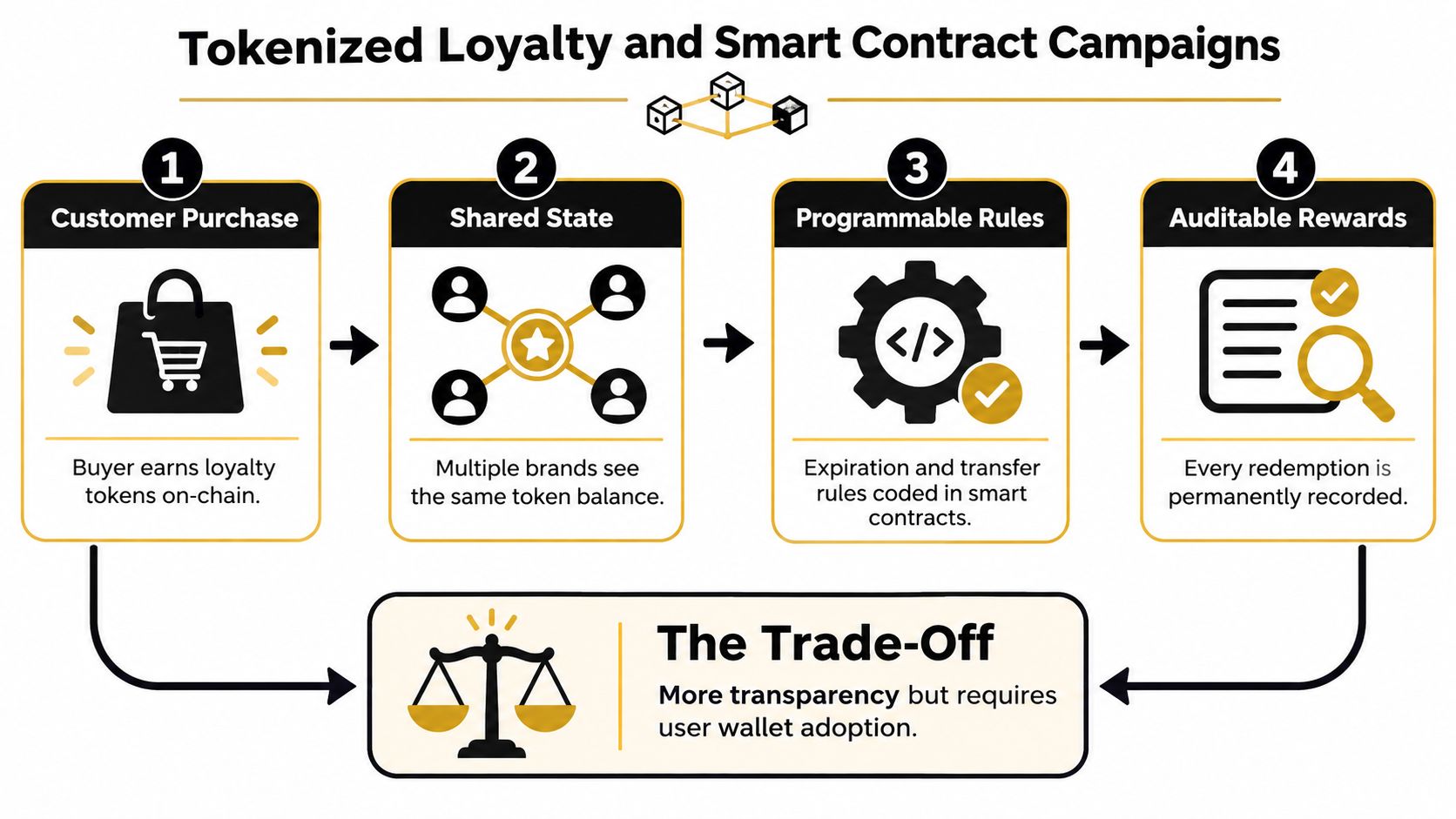
A blockchain loyalty program replaces isolated points databases with tokenized rewards governed by programmable rules. Picture an airline working with a hotel group and a retail partner. A customer earns a reward after a purchase, then uses or transfers it with the participating brands, subject to the program's rules.
The shared ledger lets authorized participants refer to the same reward state. A smart contract can define issuance, expiration, transferability, redemption, and partner settlement, while transactions leave an audit trail. That can reduce reconciliation work, but it won't eliminate the need for customer support or thoughtful program design.
Walk through the mechanics
In an interview, describe the campaign in order: the purchase triggers reward issuance; authorized partners read the shared balance; contract rules govern expiration and transfers; redemption creates a traceable record. Then explain what a customer must do to participate, including how they manage or recover access to a wallet.
That last detail is where a polished concept meets operational reality. Gas fees, key-management risks, throughput constraints, and regulatory questions around token design can make a program harder to use than familiar points. Teams should test redemption time and transaction costs, consider recovery options for nontechnical users, and judge success by incremental retention rather than token activity alone.
Evidence on consumer response is encouraging but shouldn't be stretched into a guarantee. A study of 5,059 Twitter posts found more favorable feedback toward a blockchain loyalty program, while a separate survey of 206 consumers found significantly more positive attitudes toward blockchain-based loyalty than traditional programs. A review classified 13 publications specifically around blockchain loyalty and identified transparency, automation, and interoperability as recurring benefits (research on blockchain loyalty programs).
A smart contract is only as useful as its rules and user experience. If you need a concise technical refresher before discussing the campaign in an interview, read this explanation of what a smart contract does.
The video below offers another way to think about how these mechanisms operate.
KPIs That Actually Prove a Campaign Worked
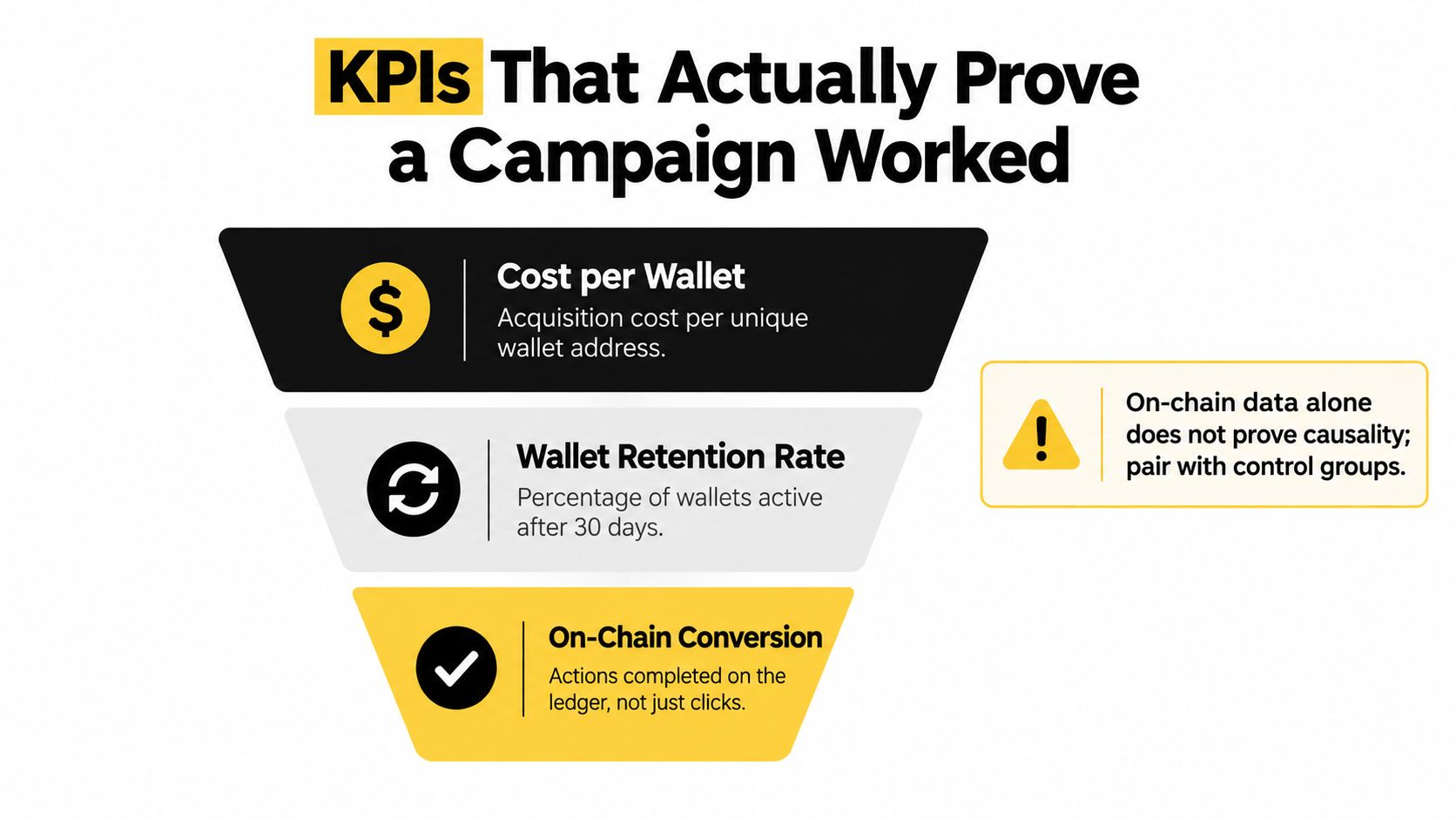
Blockchain marketing isn't automatically more measurable because transactions appear on-chain. A ledger can show that an address completed an action. It can't, by itself, prove that the campaign caused it, that the address belongs to a unique person, or that the user will return after rewards end.
Pair acquisition with meaningful use
Start with cost per wallet (CPW), campaign spend divided by new wallet addresses that interact with a protocol. Don't stop there. Track the activated-wallet rate, weekly active wallets, and cost per meaningful action (CPMA), spend divided by completed actions such as joining a community, registering for a whitelist, buying a token, or staking.
Then examine cohorts by acquisition source. Track retention after 7, 30, 60, and 90 days, and pay particular attention to activity after an incentive expires. A wallet connection is not the same as a meaningful transaction, and neither automatically demonstrates durable product adoption.
Interview standard: State the hypothesis, define the event, identify the acquisition source, and recommend an action based on retained activity.
For example, if a quest is meant to encourage a first protocol transaction, define the transaction before launch and compare users from the campaign with an appropriate comparison group. If the campaign draws connections but not completed actions, the evidence supports changing the funnel, not celebrating the wallet count.
When creator campaigns form part of that funnel, Social Cloud's guide to measuring creator performance can help you think through how to assess partnership results. For an analytics interview, be ready to show how source attribution connects to on-chain events, and how privacy considerations shape the data you collect. This guide to on-chain data analytics can help frame that discussion.
When Blockchain Marketing Becomes Regulated Promotion
Decentralized distribution doesn't erase responsibility for what a campaign says. Marketing a token, DeFi yield, or NFT can raise financial-promotion, disclosure, or consumer-protection issues, depending on the product, audience, campaign, and jurisdiction.
In the European Union, crypto-asset marketing communications must be clearly identifiable, fair, clear, not misleading, and consistent with the relevant white paper. Required communications also include prominent responsibility and approval-status language. In the UK, cryptoasset advertising is overseen by both the Financial Conduct Authority (FCA) and the Advertising Standards Authority (ASA) (Chambers guidance on advertising and marketing in Spain).
What a prepared candidate should say
If an interviewer asks how you'd launch a token campaign, don't answer only with channels and copy. Explain how you'd identify the jurisdictions and audiences, substantiate performance or yield claims, disclose paid relationships, and route material through legal or compliance approval before publication.
Hiring managers should look for a process that covers both content and distribution. A community post, livestream, influencer endorsement, or referral reward can still create exposure even when it comes from an individual or an unofficial account. Disclosures should be easy to notice in the medium where the promotion appears, including visibly on-screen in video when appropriate, rather than buried in a caption.
A practical review should check:
- Claims and evidence: Keep statements about yield, performance, and product features supported, and don't omit facts that would change how an audience reads the claim.
- Relationships and ratings: Disclose payment, affiliate arrangements, or other material connections; explain how third-party ratings were prepared and what period they cover.
- Approvals and records: Retain evidence, document sign-off, and define an escalation path to legal or compliance.
- Targeting and privacy: Review geographic and age limits, privacy notices, and wallet-screening practices where relevant.
For a wider operational checklist, consult Sift AI's social media compliance framework. In interviews, describe compliance as part of campaign design, not a final obstacle after the creative is finished.
Skills, Portfolios, and Interview Signals That Win
Strong blockchain marketers combine conventional execution with crypto-native product fluency. The conventional stack includes copywriting, SEO, analytics, campaign management, lifecycle marketing, and design fundamentals. The crypto stack means understanding wallets, tokens, DeFi, and NFTs well enough to explain how a user interacts with them.
Don't just list those terms on a résumé. Show that you can connect a product mechanic to a clear message, then track whether users act on it. A hiring panel can quickly tell the difference between someone who has used a wallet and someone who has only repeated wallet terminology.
Portfolio work that earns a real discussion
Bring artifacts that make your contribution easy to evaluate:
- Landing page plus transaction walkthrough: Show how the copy explains the product, then walk through a user action and the points where onboarding may fail.
- Community experiment: Describe the audience, the activity you changed, and the retention evidence you reviewed.
- Governance or points campaign: Explain the goal, eligibility, user journey, and how you assessed participation quality.
- Wallet cohort analysis: Define acquisition sources and events, then show how behavior differed across cohorts.
A candidate moving from content or community work into growth should present both communication quality and product understanding. A well-written campaign without evidence of user behavior is incomplete; a dashboard without a clear explanation of what the product does is just as weak.
Hiring managers can use a simple screen: Can the candidate explain the product plainly? Can they show work they personally owned? Can they define a meaningful event? Can they discuss privacy, risk, and compliance without becoming vague? Candidates should score themselves against the same questions before applying.
Plotting Your Path From First Role to Growth Lead
Consider a candidate who starts in content or community. They learn the protocol well enough to answer user questions accurately, then build a wallet-onboarding experiment that tests where new users get stuck. The next step is to present a cohort retention dashboard that connects acquisition source to later activity, not just initial interest.
From there, they can own a points or quest campaign end to end: define the target action, coordinate product and community teams, document the rules, and report what users did after rewards stopped. That work creates a credible case for broader growth responsibility. A growth lead must eventually coordinate product, analytics, marketing, legal, and compliance, because campaigns affect onboarding, data, incentives, and public claims at once.
A practical 90-day plan
- First phase: Learn the product and its user journey. Complete a transaction walkthrough, document confusing steps, and meet the teams responsible for product, community, analytics, and compliance.
- Middle phase: Propose a focused onboarding or campaign experiment. Define its hypothesis, events, source attribution, privacy limits, and review process before launch.
- Final phase: Present results through acquisition, activation, and cohort retention. Recommend whether to iterate, stop, or expand, and explain the evidence behind that decision.
For job seekers, build one portfolio artifact that proves product fluency and one that proves measurement judgment before you interview. For hiring managers, assign candidates a practical exercise that tests both, then ask how they'd handle a weak result or a compliance concern.
Apply for roles where you'll own an outcome, not just publish activity. Explore marketing and other Web3 opportunities on Blockchain Jobs, which lists roles across the blockchain ecosystem for candidates and employers. Choose a position that lets you demonstrate product understanding, accountable measurement, and sound judgment from the start.
Blockchain Jobs connects candidates with opportunities across marketing, community, product, analytics, legal, and other Web3 disciplines, with category-tagged listings and remote-friendly roles. Search the marketing openings for a role where you can demonstrate campaign execution and measurement, or use the platform to reach crypto-native candidates when hiring.