DeFi Protocols Explained: How They Work and What Can Fail
A DeFi protocol is a set of smart contracts that runs financial services such as trading, lending and borrowing without a bank or central intermediary. Understanding those contracts means understanding both how money moves and what can fail along the way.
You might be preparing for a Web3 interview, reviewing a product specification or staring at a borrowing screen that assumes you already understand collateral. Having DeFi protocols explained through actual transactions helps you move beyond vocabulary. The useful question isn't just what a protocol does, but which component enforces the rules, how it can break and who can respond.
What a DeFi Protocol Is in Plain Terms
A DeFi protocol puts financial rules into executable software. Instead of asking an employee to approve a transaction, you submit an instruction that smart contracts evaluate against their programmed conditions.
Think of a conventional bank as a building with staff who check identity, maintain accounts and decide who qualifies for credit. A DeFi protocol works more like a vending machine with published rules: provide the accepted asset, choose an available action and receive the result if you meet the conditions.
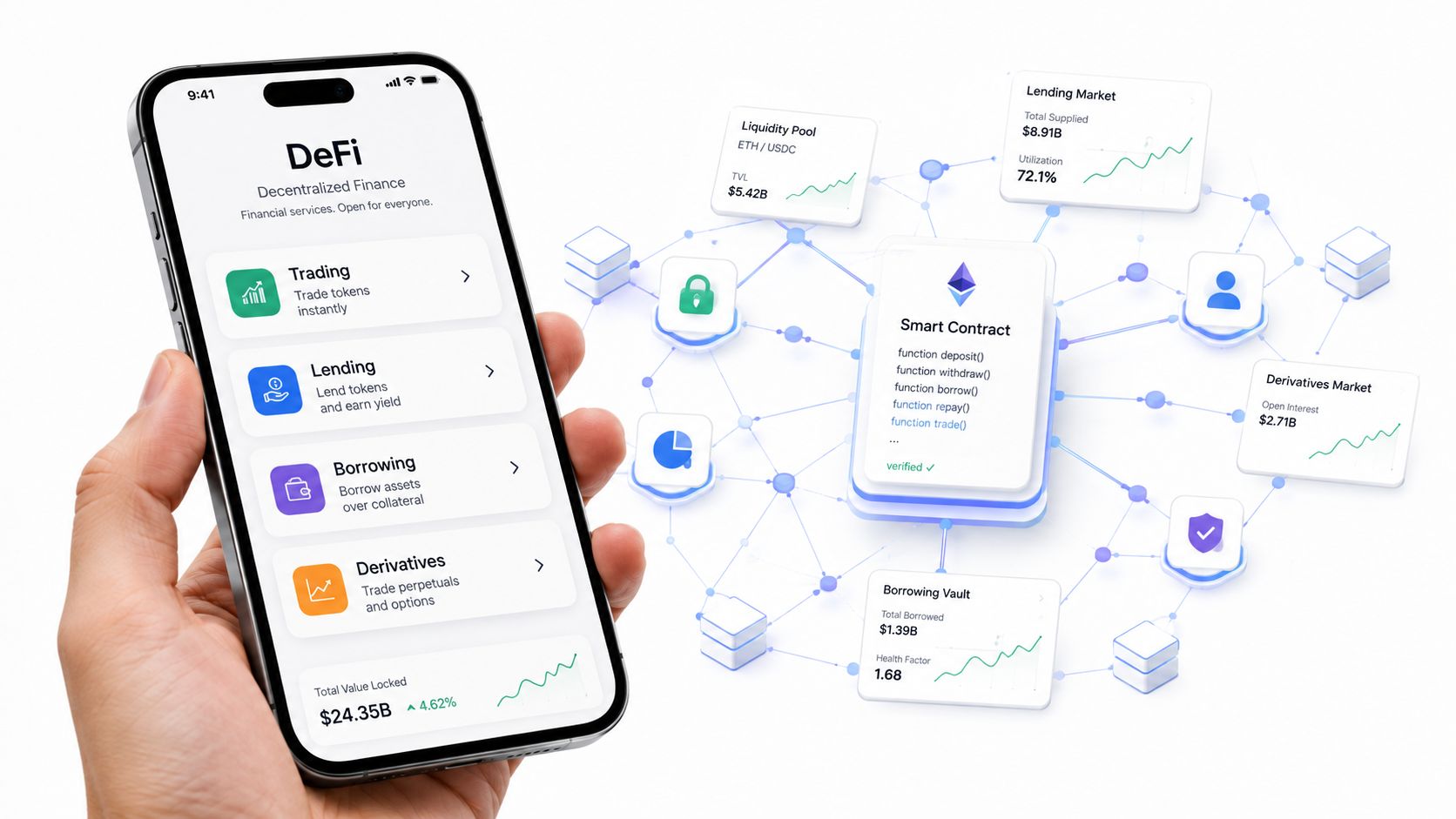
The smartphone interface is only the window into that machinery.
Separate the rules, money and interface
You can identify three practical parts:
- Smart contracts are the rule book. They specify permitted actions, calculate outcomes and control assets according to their code.
- User deposits supply the money. Trading pools and lending markets need assets available for participants to exchange or borrow.
- The front-end app is the window. It prepares transactions and displays information, but it isn't the same thing as the underlying protocol.
This distinction matters when something stops working. A broken website may prevent ordinary users from interacting comfortably even while the contracts remain available. A contract flaw, by contrast, can put deposited assets at risk even when the website looks normal.
Permissionless doesn't mean consequence-free
At the contract level, permissionless access usually means a compatible wallet is enough to participate, without account approval or a conventional credit check. Individual interfaces can still impose restrictions, and borrowing eligibility follows collateral rules rather than a personal credit assessment.
Published code applies its conditions consistently, but that doesn't make every outcome fair or every implementation correct. Public rules can contain bugs, and upgradeable contracts can have administrators with meaningful powers.
Automation removes the routine approval desk. It doesn't create a guaranteed reversal desk.
Don't assume someone can reverse a mistaken transfer or suspend your loan because you misunderstood the terms. Engineers, risk analysts, compliance specialists and product managers all need this distinction. In an interview, explain where the rules live and who controls changes, rather than calling the product decentralized.
The Five Building Blocks Behind Most Protocols
Core DeFi building blocks and their trade-offs
| Component | What It Does | Working Example | Core Trade-off |
|---|---|---|---|
| Automated market maker | Prices trades from a pool ratio using x times y equals k | Uniswap-style constant-product pool | Liquidity providers can lose value relative to holding when prices move apart |
| Lending and borrowing market | Matches deposits with loans backed by over-collateral | Aave-style supply and borrow markets | Eligible positions can be liquidated when collateral value falls |
| Oracle | Feeds external asset prices onto the blockchain | Chainlink-style price feeds | Distorted or stale prices can trigger wrong liquidations or trades |
| Stablecoin | Tracks a fiat currency, usually the US dollar | Reserve-backed dollar token | Reserve quality, redemption and issuer trust affect peg stability |
| Composability | Lets one contract call another contract | A deposit receipt used as collateral in another protocol | A failure can spread across linked protocols |
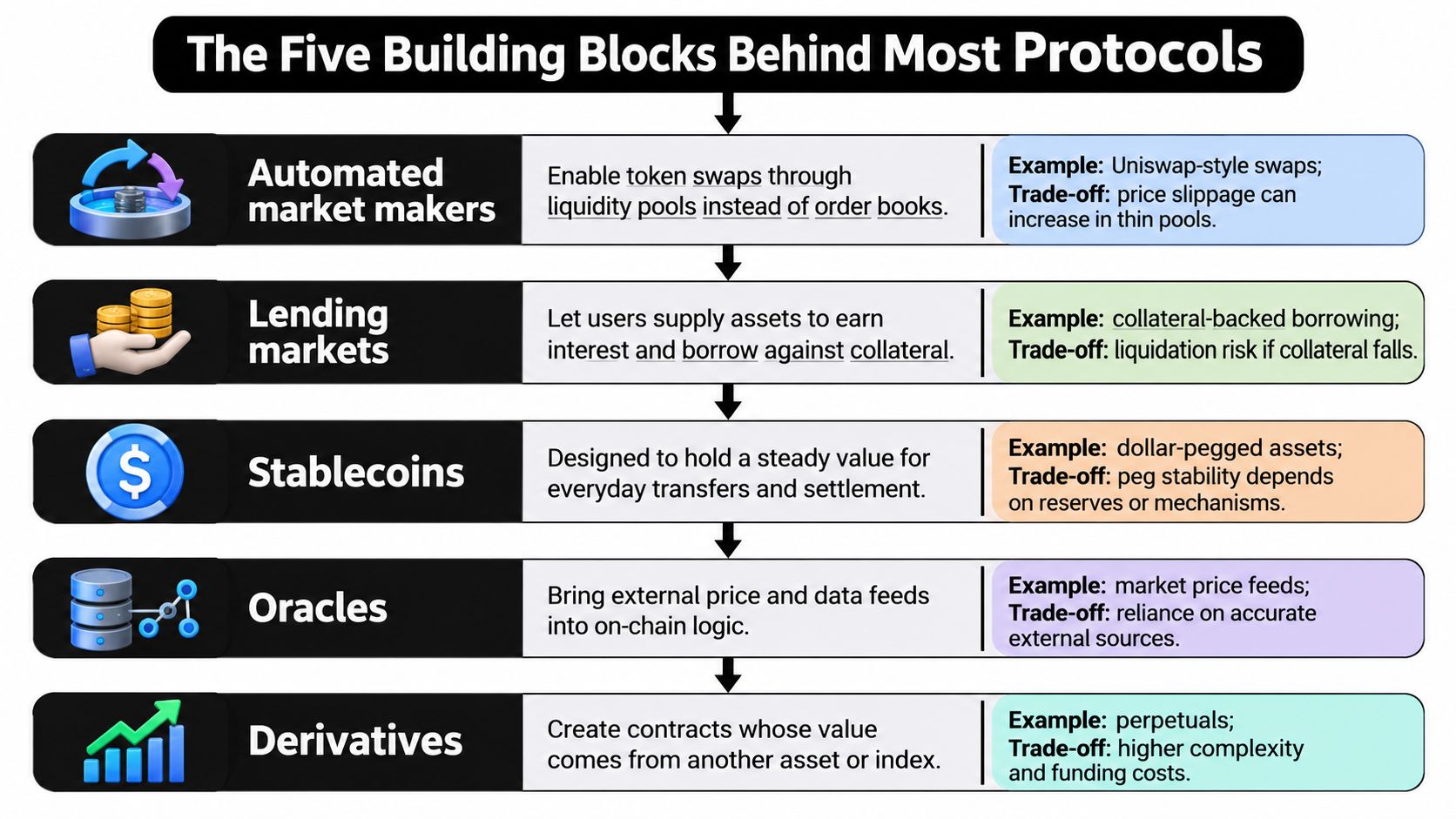
The visual map also includes derivatives, financial contracts built around underlying assets or indexes.
Trading and lending need different safeguards
An automated market maker, or AMM, lets traders exchange assets against a pool rather than finding a matching buyer. In the simplified constant-product rule, x × y = k, x and y represent token reserves. A trade changes those reserves and therefore the execution price.
Liquidity providers receive fees but face impermanent loss, the shortfall against holding the deposited tokens when their relative prices diverge. In a hypothetical fee-free, full-range 50/50 constant-product pool, if one token doubles relative to the other, the calculation 2 × √2 ÷ 3 leaves the provider with about 5.7% less value than holding. Check fee income against that gap, not just the advertised yield.
For the deposit mechanics behind that calculation, study how a liquidity pool works.
Lending markets instead connect suppliers with collateral-backed borrowers. Borrowers generally post assets worth more than their debt, and external liquidators can submit transactions that repay eligible debt and claim collateral under the contract's rules.
Oracles supply the prices those contracts need. A contract can't independently observe the wider market, so engineers must choose feeds, freshness checks and fallback behavior carefully.
Settlement assets and connected contracts
Stablecoins provide a comparatively steady accounting and settlement unit. The Federal Reserve Bank of Philadelphia reports that stablecoins in circulation grew from approximately $25 billion in 2021 to nearly $300 billion, a more-than-tenfold increase.
They serve as trading pairs, collateral and settlement assets, but their reserve, crypto-collateral or algorithmic designs create different redemption and peg risks.
Composability connects these pieces. A lending receipt can become collateral elsewhere, saving integration work while introducing another dependency. Derivatives add exposure to an underlying price, often with margin requirements and funding costs.
For a complementary walkthrough of the mechanics, use this video.
Learn AMMs and lending markets first. They're useful foundations for engineering interviews because they force you to connect pricing, collateral and available liquidity rather than memorize product names.
How a Swap and a Loan Run Step by Step
Say you want to exchange a token for a stablecoin, then use a separate asset as collateral for a loan. These are distinct actions, not an obligatory sequence, and each requires its own checks.
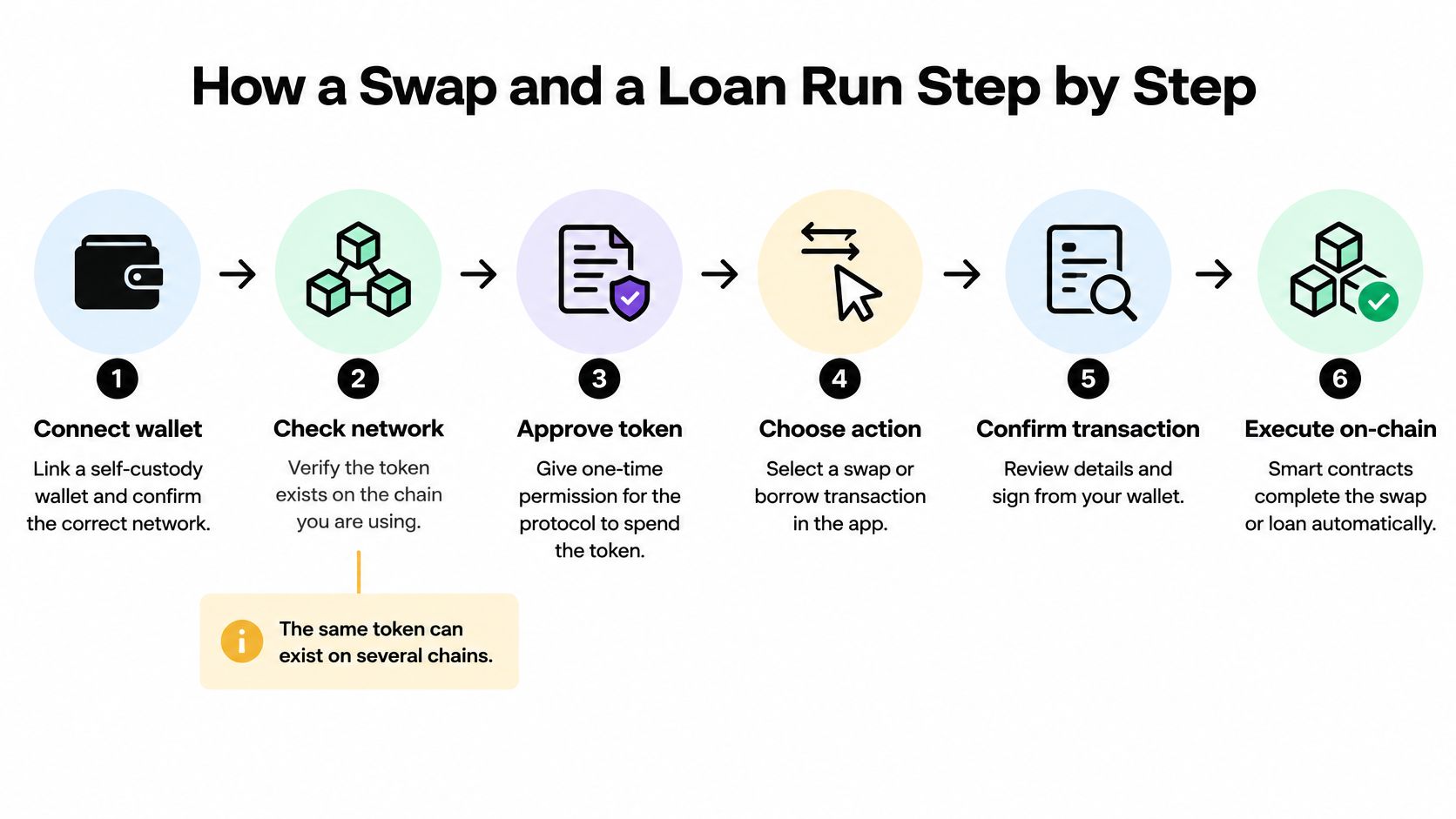
The process diagram shows where wallet decisions become on-chain instructions.
Execute deliberately
Connect your wallet and verify the network. Open the authentic app, select the intended chain and check the token contract address against the project's documentation. The same token name can appear on several chains, and connecting a wallet doesn't itself authorize spending.
Approve only the required token amount. For tokens that require an allowance, approve the intended spending contract before the swap or deposit. This permission can persist until used or revoked, so don't treat an unlimited approval as harmless or assume every action requires a fresh approval.
Set an appropriate slippage tolerance. This defines how much execution deterioration you'll accept before the transaction reverts, subject to the app's implementation. A thin pool may require more room, but increasing tolerance can expose you to worse execution; reducing the order or choosing a deeper route may be safer.
Review and confirm the swap. Check the input asset, minimum output, recipient, spending contract and network fee before signing. The displayed quote isn't a guarantee: your trade changes the pool balance, and other transactions can change conditions before yours executes.
For borrowing, deposit collateral and inspect the borrowing buffer. Read the loan-to-value limit, liquidation threshold and any health-factor display before choosing a debt amount. Borrowing at the displayed maximum leaves little room for adverse prices, interest accrual or collateral parameter changes.
Repay the debt before withdrawing all collateral. Obtain the repayment asset, settle principal plus accrued interest and confirm the remaining debt balance. Full release requires clearing the debt, although some protocols allow partial collateral withdrawals while the position remains adequately secured.
Verify the result, not just the notification
To understand why the signed instructions produce these outcomes, review how smart contracts work in blockchain. For execution analysis, copyfomo on slippage and realized PnL is a useful companion when comparing the quoted trade with the result you received.
Check the transaction hash in a block explorer. Confirm the execution status, token transfers and destination addresses, then reconcile the result with wallet balances and the protocol's position display.
Practical rule: A submitted transaction isn't a completed transaction, and a completed approval isn't a completed swap.
Keep enough native network currency for fees, including the eventual exit. For product and support interviews, turn this journey into a failure-state map: wrong network, rejected approval, reverted trade, pending transaction and insufficient repayment balance each require different guidance.
Reading Metrics and Separating Myths From Adoption
Total value locked, or TVL, is the dollar value of cryptoassets deposited in protocol smart contracts. It measures deposited value, not revenue, customer satisfaction or guaranteed withdrawal capacity.
A peer-reviewed study available through PubMed Central records the historical progression below, from approximately $119 million on 31 December 2017 to more than $83.1 billion by 19 September 2021. The intermediate observations show how sharply the ecosystem expanded around the DeFi summer period.
DeFi total value locked over time
| Date | Approximate TVL | Market Context |
|---|---|---|
| 31 December 2017 | About $119 million | Earliest observation shown, before lending and exchanges scaled |
| 2018 | About $6.4 billion | Early expansion of decentralized financial applications |
| 2019 | About $8.5 billion | Continued development of liquidity and yield applications |
| End of 2020 | $23.8 billion | DeFi summer-era acceleration |
| 19 September 2021 | More than $83.1 billion | Expanded ecosystem following the DeFi summer surge |
These observations aren't a current market ranking, and the last row shouldn't be treated as proof of a market-wide peak. They describe the period captured by the study.
TVL also has a double-counting problem: a deposited asset and a claim against it can appear across connected protocols. Dollar prices introduce another distortion, because TVL can rise when tokens appreciate even without new deposits.
Read a dashboard as a set of questions
Compare at least three metrics before judging a protocol. Choose measures that test different aspects of its operation:
- Active users: Check whether the dashboard counts addresses, transactions or estimated people, because a person can control multiple wallets.
- Protocol revenue: Separate fees retained by the protocol or distributed to token holders from fees paid to liquidity suppliers.
- Utilisation ratio: Inspect the share of lending deposits currently borrowed, since scarce unborrowed liquidity can constrain withdrawals.
- Liquidation volume: Examine how much collateral is being liquidated and whether the market can absorb those sales.
For a data interview, explain the denominator and time window before interpreting a chart. For a hiring manager, ask candidates what alternative explanation could produce the same apparent growth.
Correct the assumptions behind the numbers
Low fees don't necessarily mean low total cost. Users also face slippage, failed transactions, bridging expenses and the work of maintaining records.
High yield isn't evidence of a safe return. Separate borrower-paid interest and trading fees from token incentives, then ask which losses the quoted return excludes.
Permissionless doesn't mean easy to use. Wallet security, network selection, approvals and exit planning remain operational responsibilities.
A 2025 survey cited by Tiger Research ranked gas fees as the leading pain point at 27%, followed by security risks at 22%, slow transactions at 18% and bridging complexity at 14%. The same article cites EU regulators' estimate of 7.2 million DeFi users in the EU, with fewer than 15% appearing to participate regularly.
Those adoption constraints give UX designers, operations specialists and support leaders concrete problems to solve. Measure whether users complete an intended action and return successfully, not just whether they create a wallet.
Smart Contract, Oracle and Economic Risks
A flaw in code that controls pooled funds can allow an attacker to drain assets rather than merely interrupt service. According to Halborn's 2025 Top 100 DeFi Hacks Report, DeFi-related losses among the 100 largest recorded hacks totaled $10.77 billion through 2024.
That total establishes the stakes, not a ranking of every failure type. Investigate the full dependency chain rather than assuming an audit covers every way funds can disappear.
DeFi risk types and who can act
| Risk | What Fails | Who Can Act |
|---|---|---|
| Smart contract bug | Attackers exploit a code flaw to drain funds | Protocol developers, auditors and administrators with applicable pause powers |
| Oracle manipulation | A distorted price triggers incorrect valuations or liquidations | Oracle designers and protocol governance |
| Governance attack | Concentrated or acquired voting power changes parameters maliciously | Token holders and governance participants |
| MEV extraction | Searchers exploit transaction ordering or sandwich trades | Block builders, searchers and protocol trade designers |
| Bridge failure | Cross-chain claims no longer match locked or verified assets | Bridge operators and the bridge's validators |
| Key or approval compromise | Attackers obtain signing authority or spending permission | Users, wallet providers and parties controlling the approved contract |
Trace the failure beyond audited code
The EBA and ESMA DeFi factsheet identifies on-chain and off-chain vulnerabilities, including phishing and key compromise, and warns that MEV can transfer value from ordinary users to extractors. An attacker doesn't need a contract bug if they can obtain an authorized signature.
Decentralized doesn't mean trustless. Users still depend on code authors, oracle designers, validators, governance voters, wallet security and sometimes centralized stablecoin issuers.
A responder's ability to investigate isn't the same as their ability to recover funds.
A pause key may stop a supported function but cannot necessarily reverse completed transfers. A governance vote may authorize a repair without restoring assets already stolen, while a lost private key may leave no recovery route.
Run a dependency checklist
Before depositing or recommending an integration, inspect:
- Audit scope: Does the published review cover the deployed contracts and configuration? Use a smart contract security checklist to organize the review.
- Administrative powers: Who controls upgrades and pauses, and is there a timelock before material changes?
- Oracle behavior: What supplies prices, and what happens when feeds become stale or disagree?
- Bridge exposure: Which bridge issued the asset, and who verifies its messages?
- Incident ownership: Who monitors alerts, communicates with users and can execute the response?
If your team adds analytics tooling, review its access and data-handling controls separately. ELECTE's security documentation for AI analytics is an example of the vendor documentation to inspect, not evidence that a DeFi integration is safe.
For security hiring, ask candidates to identify the failure, detection signal, authorized responder and recovery limit. That tests operational judgment alongside code knowledge.
Pick Your DeFi Role and Start Applying
Choose a role by the component you want to own, not just by the appeal of working in Web3. Employers need people who can explain their responsibility clearly and recognize where another specialist must take over.
| Role family | Component or problem to own | Useful portfolio evidence |
|---|---|---|
| Protocol engineering | AMM pricing and lending accounting | Contract tests and documented invariants |
| Security and risk | Oracle dependencies and exploit paths | A threat model with detection and response limits |
| Product and UX | Approvals, gas, bridging and transaction states | An annotated onboarding prototype |
| Compliance and finance | Pseudonymous flows, AML controls and reporting | A transaction classification and escalation workflow |
| Data and analytics | TVL, utilisation and liquidation monitoring | A dashboard with explicit metric definitions |
Marketing, community and technical writing candidates can build an incident explainer that distinguishes confirmed facts from unresolved questions. Recruiters can use the same component map to write job descriptions with concrete responsibilities instead of an undifferentiated list of blockchain keywords.
Finance candidates should demonstrate transaction-level recordkeeping, not only familiarity with token names. Allied Tax Advisors' guidance to organize crypto records for Form 8949 provides a practical US-focused starting point; filing obligations depend on jurisdiction and circumstances.
Rehearse answers that show mechanisms
Explain the constant-product rule and impermanent loss.
The reserve product constrains a simple AMM's pricing curve. Arbitrage-driven rebalancing can leave liquidity providers behind a holding strategy when relative prices diverge, so fee income must be evaluated separately.Why does lending require over-collateral?
The protocol typically can't collect an unsecured debt through conventional credit enforcement. Excess collateral provides a buffer against price changes and liquidation costs.What happens during a liquidation?
An eligible liquidator repays debt and receives collateral under the protocol's incentive rules. If execution is delayed or collateral liquidity disappears, the market can still suffer bad debt.How could you detect oracle manipulation?
Compare the feed with independent markets, inspect freshness and liquidity, and alert on unusual deviations. Detection needs a defined response, not merely a dashboard notification.
Build a small, reviewable artifact before applying: a worked swap calculation, an oracle risk memo or a transaction-state prototype. Include assumptions, failure cases and the limits of your conclusion so an interviewer can challenge your reasoning.
Choose a role family, study its component, and tailor your portfolio to the work that role owns.
Blockchain Jobs lists 6,934 open roles across crypto, DeFi and Web3, connecting these protocol skills with engineering, product, security, finance and other career paths. Visit Blockchain Jobs, search your chosen role family and apply to the three openings where your evidence best matches the responsibilities.