How Smart Contract Works in Blockchain: A Developer's Guide
You've got a Web3 interview coming up, and the job description mentions Solidity, gas optimization, and contract security. You can explain what a blockchain is, but when someone asks what happens after a user clicks “Confirm,” your answer gets fuzzy.
Understanding how smart contract works in blockchain starts with separating the application's interface from the code that controls assets. For interview preparation, don't just memorize definitions. Learn to explain execution, identify trust boundaries, and defend your design choices when another engineer asks what could go wrong.
What Smart Contracts Really Are
An interviewer asks you to explain a smart contract to a marketplace founder who doesn't write code. Starting with “a self-executing legal agreement” sounds polished, but it introduces the wrong mental model.
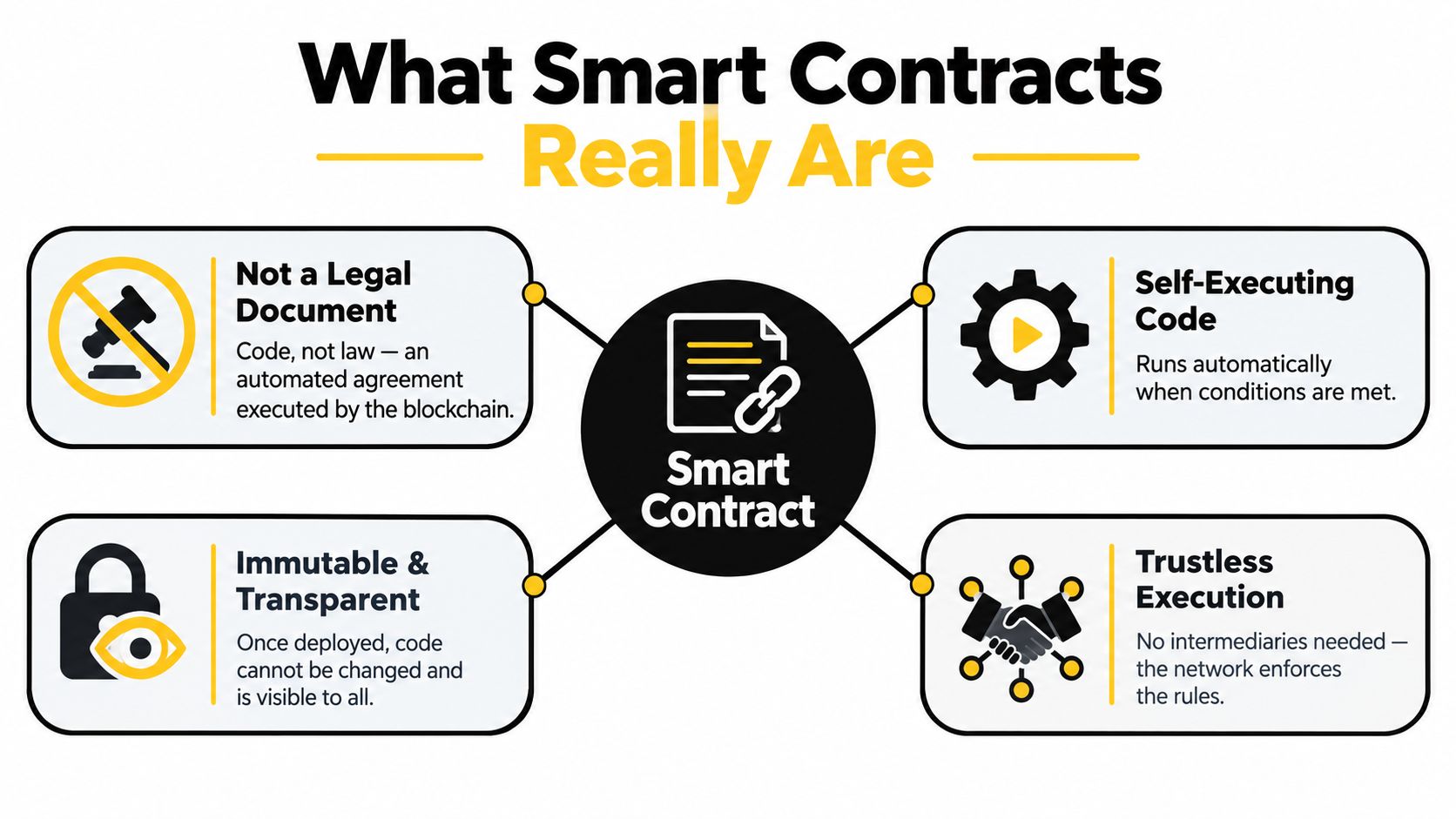
A smart contract is a program stored at a blockchain address. A transaction invokes one of its functions, and the program applies its rules to blockchain state. It can hold assets, update storage, emit event logs, and call other contracts.
Code, Not a Document
Think of a program that holds a buyer's payment and allows an authorized party to release it. The code controls whether the on-chain payment moves. It doesn't interpret a delivery dispute or decide whether a seller fulfilled a legal obligation.
The concept map below is useful as shorthand, provided you read “self-executing” as execution when invoked, not software that wakes up independently.
A traditional server application relies on an operator to run the business logic and maintain the authoritative database. A blockchain supplies shared state, cryptographic authorization, consensus, and an auditable execution history instead.
Ethereum launched in July 2015, and the earliest known successful smart contract with executable runtime code appeared in August 2015, shortly afterward, as described in Ethereum's smart-contract documentation.
The Interview-Ready Mental Model
The important property is determinism: given the same prior blockchain state and valid inputs, honest nodes should produce the same result. That's why arbitrary external information can't become part of execution without an explicit input mechanism.
Explain who invokes the program, what state it controls, and who verifies the outcome. Those details are more useful than calling it “trustless.”
Be careful with immutability, too. Deployed code is difficult to change, but an application may include administrative or upgrade mechanisms. A strong screening answer distinguishes the program's execution guarantees from the broader system's governance, rather than promising that nobody can ever intervene.
How Execution Actually Happens
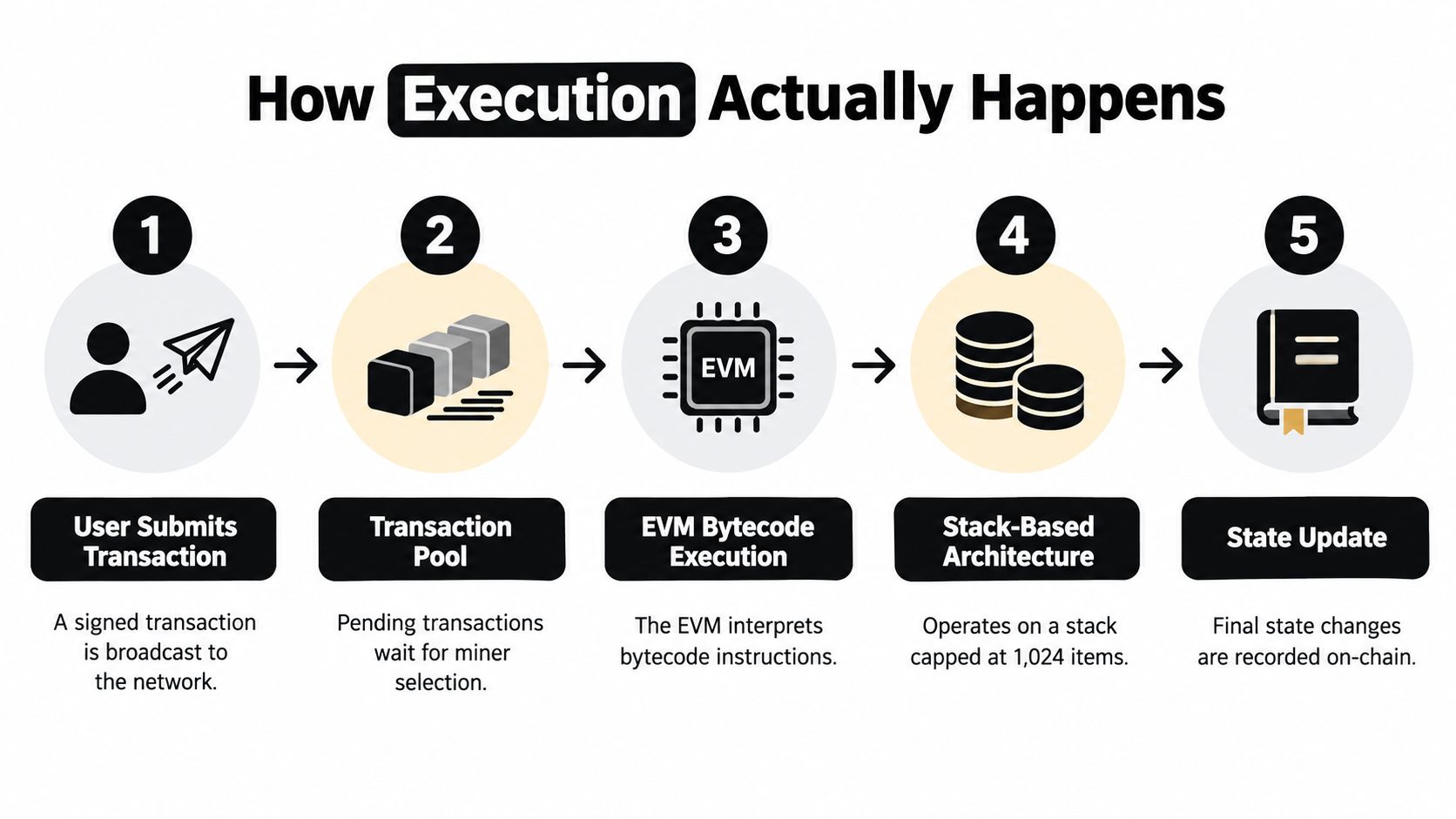
Start at the contract address. Your source code has been compiled into EVM bytecode, and a signed transaction requests execution of a function at that address. The Ethereum Virtual Machine interprets the instructions against the relevant blockchain state.
The diagram gives you a visual route through that process.
From Instructions to Shared State
The EVM uses a stack-machine architecture with a maximum stack depth of 1,024 items; persistent storage maps 256-bit words to 256-bit words and is committed to the contract's state trie, according to Solidity's introduction to smart contracts. Arithmetic, comparisons, memory operations, and storage access are represented by opcodes.
The execution environment is isolated from the host system. Contract code can't directly inspect a node's filesystem, make arbitrary network requests, or access unrelated processes.
For an interview, narrate the path without skipping the distinction between execution and agreement:
- Submission: The user signs a transaction targeting the contract and supplies the intended function inputs.
- Execution: Nodes run or verify the requested computation, including permission checks, storage updates, and any external contract calls.
- Agreement: Consensus records the accepted result in a block, making the state transition part of the shared history.
Gas Is a Budget, Not a Success Guarantee
A basic ETH transfer uses 21,000 gas; contract calls generally require more because they execute code and may access storage. If execution exhausts its gas allowance, contract state changes revert, but consumed gas is still charged, as Ethereum's gas documentation explains.
Gas meters computation and helps prevent unlimited execution. When reviewing optimization proposals, ask whether a stored value is necessary for future contract decisions or merely useful for a dashboard.
Event logs offer a bridge to off-chain consumers. For background on designing those consumers, Streamkap's event driven guide is a useful resource, but distinguish an emitted notification from authoritative contract storage.
Use the video alongside a written transaction trace to practice explaining the sequence aloud.
The engineering skill isn't reciting opcodes. It's explaining why a transaction succeeded, reverted, or cost more than expected.
EVM vs Non-EVM Platforms
Knowing Solidity doesn't mean you understand every smart-contract platform. When you change ecosystems, you may also change how programs access state, declare dependencies, handle concurrency, and account for execution costs.
For interview preparation, treat the following comparison as a map of what to investigate, not a ranking of chains.
EVM vs Non-EVM Platforms at a Glance
| Platform | Execution Model | Primary Language | Fee Model |
|---|---|---|---|
| Ethereum and EVM-compatible networks | EVM bytecode with stack-based execution | Solidity | Gas-metered execution |
| Solana | Sealevel runtime with account-based execution and parallelism for non-conflicting access | Rust | Transaction fees with compute budgeting |
| Aptos | Move-based execution with a resource-oriented programming model | Move | Gas-metered transactions |
| Sui | Move-based, object-oriented execution with concurrency dependent on object access | Move | Computation and storage-related fees |
| Bitcoin | Limited scripting for programmable spending conditions | Bitcoin Script | Transaction fees rather than EVM-style opcode gas |
Parallel execution isn't a blanket promise that every workload runs concurrently. Ask which accounts, objects, or resources a transaction touches and whether those dependencies conflict with another transaction.
Likewise, matching language names don't guarantee matching application architecture. Learning Move for Aptos doesn't remove the need to investigate Sui's object model, tooling, and transaction design.
Choose by Workload and Responsibility
A useful platform discussion starts with the product's requirements. Does the application need frequent updates to shared state, independent user-owned objects, complex composability, or relatively narrow spending conditions?
Then ask practical questions:
- Execution dependencies: What must the developer declare or lock before a transaction can run?
- Fee exposure: Which operations consume resources, and who bears their cost?
- Operational assumptions: What does the application consider sufficiently final, and how does it handle pending actions?
- Tooling: Can the team test, inspect, deploy, and monitor the program reliably?
For a cross-stack interview, propose implementing the same small workflow on different platforms and explaining the architectural changes. A reviewer can learn more from your account-access decisions than from a claim that you're “chain agnostic.”
Don't lead with unsupported throughput comparisons. Lead with the workload, the trust assumptions, and the tools you can operate. That's a more defensible way to choose both a platform and a learning path.
Security Beyond the Audit Report
An automated warning isn't proof that an attacker can steal funds. A clean report isn't proof that the system is safe. Both conclusions require more context than a detector's output.
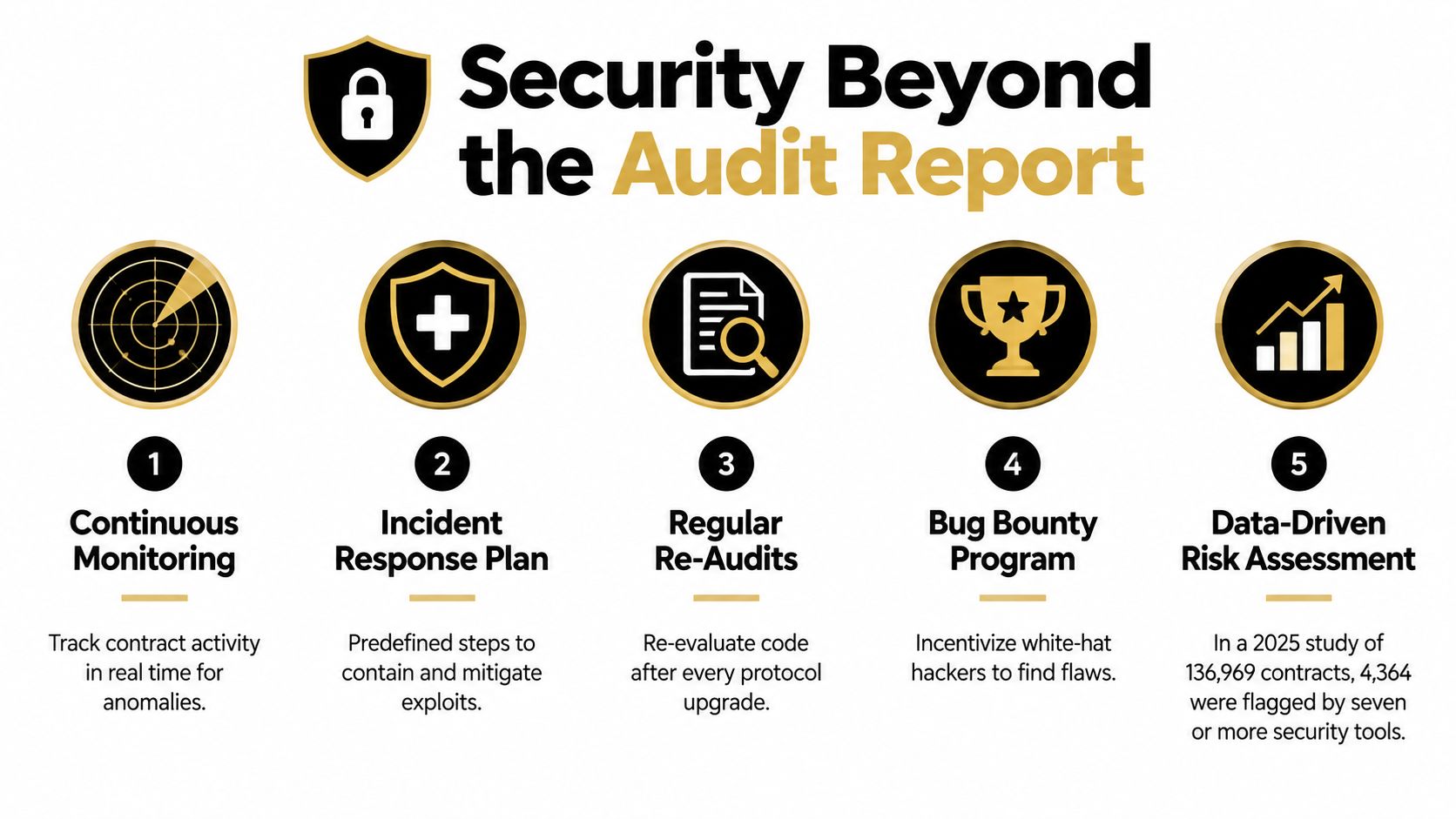
A 2025 study of 136,969 real-world contracts found 4,364 flagged by seven vulnerability detectors; 75.25% of flagged contracts were judged unexploitable, while 66 of 1,080 exploitable contracts, reported as 6%, had been exploited, according to the empirical study of contract vulnerabilities and exploitation.
Separate Findings from Incidents
Read those results as a reason to investigate reachability and consequences, not permission to dismiss warnings. Permissions, current state, available liquidity, dependencies, and attacker incentives can all affect whether a defect becomes a practical attack.
| Classification | Question for the reviewer |
|---|---|
| False positive | Does the alleged defect actually exist? |
| Latent vulnerability | Could a state or configuration change make the defect dangerous? |
| Exploitable vulnerability | Can an attacker reach the harmful path under relevant conditions? |
| Incident | Has someone actually executed the harmful behavior? |
The checklist below emphasizes ongoing maintenance. For the detector finding, retain the study's wording: the contracts were flagged by seven detectors, not necessarily by seven or more tools individually.
Build Evidence in Layers
My recommended review workflow combines static analysis with fuzzing, symbolic execution, and, where appropriate, formal verification. Use those techniques to test explicit properties, then bring audits and bug bounties into the review process rather than treating any individual method as a verdict.
For structured practice, use the smart-contract audit walkthrough to organize a public assessment. If you're assessing a Solana token, MemeAssist's safety tool for Solana degens can be a starting point for inspection, not a substitute for tracing permissions and dependencies.
Triage principle: A useful security finding explains the attack path, required conditions, potential impact, and proposed mitigation.
Monitoring and emergency controls belong in the same discussion. In a security interview, explain what you'd watch after deployment, who could respond, and how you'd validate that a mitigation doesn't introduce another failure.
Security-track progression comes from producing reproducible evidence and prioritizing risk, not merely collecting scanner output.
Reentrancy and the Checks-Effects-Interactions Pattern
You're reviewing a withdrawal function. It checks the caller's balance, sends funds to the caller, and then reduces the recorded balance. The dangerous detail is the order: the external recipient gets control while the original balance is still available.
Reentrancy occurs when that recipient calls back into the original contract before the first execution finishes. Depending on the logic, the callback can enable repeated withdrawals, duplicated allowance spending, or other unintended state changes.
Review the Sequence, Not Just the Function
Use the attack flow below to follow where control leaves the contract and where it returns.
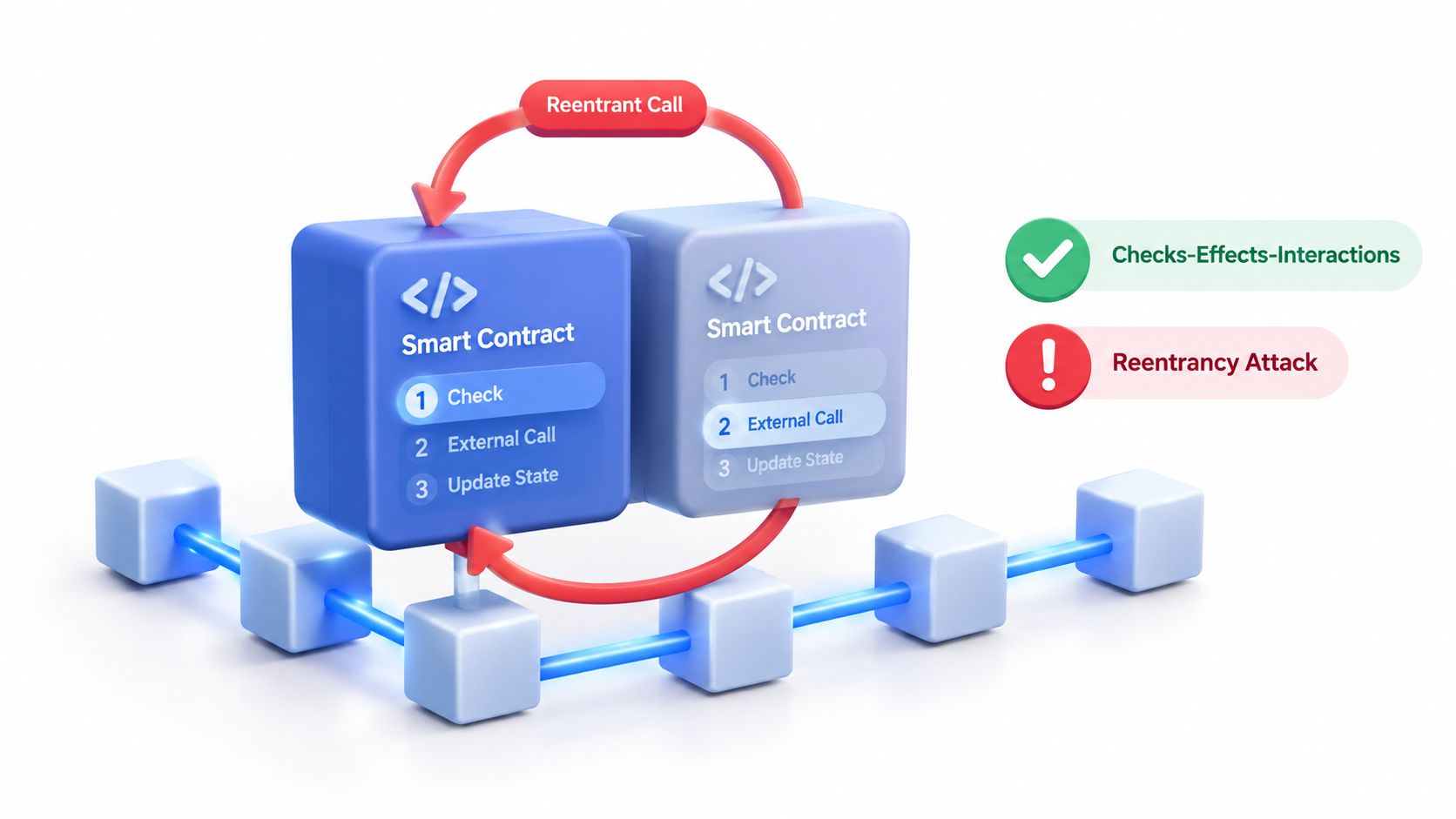
Solidity's documented defense is Checks-Effects-Interactions: validate inputs and permissions, update internal state, and only afterward call external contracts, as explained in Solidity's security considerations.
For the withdrawal review, translate that pattern into specific changes:
- Checks: Confirm that the caller is authorized and has a sufficient withdrawable balance.
- Effects: Reduce the balance before handing control to another contract. Review related accounting, not just the obvious balance field.
- Interactions: Perform the external transfer only after the internal state reflects the withdrawal.
The risk isn't limited to sending Ether. Arbitrary external function calls deserve the same attention because the called contract may invoke code you didn't expect.
Demonstrate the Fix
A convincing interview answer includes an adversarial test. Use a malicious recipient that attempts a callback, then verify that it can't obtain funds beyond its entitlement.
Discuss reentrancy guards as an additional protection, along with minimizing unnecessary external calls. Don't present a guard as a reason to stop reasoning about shared state and callable functions.
Your review should also explain failure handling. What happens if the recipient rejects the transfer, and what should the resulting accounting be?
The career-relevant habit is following control flow across contract boundaries. A candidate who can describe the exploit, implement the ordering change, and defend the test demonstrates more than familiarity with a famous vulnerability name.
A Simple Escrow Contract Walkthrough
Consider a hypothetical marketplace escrow with a buyer, a seller, and an arbitrator authorized to settle disputes. The escrow contract holds the payment; the arbitrator may be an authorized account or another contract, depending on the design.
This example doesn't require heavy code. It requires explicit answers about who can act and which actions remain possible after each transition.
Follow the Funds and Permissions
At deployment, define the parties, permitted decisions, and initial status. For this design, choose event logs that describe meaningful lifecycle changes so an application can display progress without inventing its own interpretation.
The buyer then funds the escrow through a signed transaction. The contract checks the sender and funding conditions, records the funded status, and emits the corresponding event if execution succeeds.
| Action | Intended state change | Review question |
|---|---|---|
| Fund | Unfunded becomes funded | Can the wrong party deposit or fund it again? |
| Release | Funded becomes released | Can anyone bypass the arbitrator's authority? |
| Refund | Funded becomes refunded | Can settlement happen more than once? |
Each transaction needs an execution budget. Apply the gas and failure behavior already established, rather than assuming a submitted request guarantees a completed action.
For implementation practice, consult the wei-to-ether guide and label units consistently. A correctly authorized payment can still be wrong if the interface and contract disagree about its amount.
Where Automation Ends
The contract can enforce an authorized release. It can't independently establish whether a physical shipment arrived or whether the arbitrator made an honest decision.
That boundary matters in real systems: OWASP's smart-contract incident data includes access-control failures, business-logic defects, oracle manipulation, and unsafe external calls. Trace who supplies outside facts, who controls privileged keys, and whether pauses or upgrades are possible.
For an interview, propose tests for unauthorized settlement, repeated settlement, and failed transfers. Also explain recovery limits: emergency permissions can restrict future actions, but they aren't a general undo button for completed payments.
Mapping Skills to Web3 Career Paths
Deployment counts reveal an ecosystem's footprint, not the quality of every application. On January 1, 2019, Ethereum had 12,023,046 smart contracts, averaging 38.42 incoming transactions and interaction with 1.68 distinct addresses, according to the empirical analysis of Ethereum contract activity.
Those historical figures are a reason to distinguish deployed code from meaningful usage. For career planning, focus on the responsibilities you can demonstrate, not the size of the ecosystem alone.
Match Knowledge to Responsibility
Different roles need different depths of smart-contract fluency. Use this mapping to choose what evidence belongs in your application.
| Role | Knowledge to demonstrate | Useful portfolio evidence |
|---|---|---|
| Smart-contract engineer | State design, authorization, testing, gas trade-offs | A documented contract with adversarial tests |
| Security auditor | Attack reachability, invariants, dependency risk | A reproducible finding and remediation |
| Protocol developer | Execution architecture, integration, governance | A design proposal or tested protocol contribution |
| Web3 product manager | Transaction states, permissions, recovery constraints | A product specification covering failure paths |
| Community manager | Accurate explanations of approvals, incidents, and controls | Clear user-facing risk and support documentation |
| Legal or compliance specialist | Boundaries between code, authority, and off-chain obligations | A responsibility and control map |
A designer can use the same fundamentals to distinguish pending, failed, and completed actions in an interface. A recruiter can use them to ask for evidence of ownership rather than accepting a list of languages at face value.
Choose Your Next Level Deliberately
If you can deploy a contract but can't explain its invariants, deepen your testing and state-modeling skills. If you can find defects but struggle to prioritize them, practice writing attack assumptions and operational consequences.
Portfolio advice: Show the decisions another teammate would need to maintain your work, not just the code needed to deploy it.
For independent work, the freelance smart-contract developer guide offers a relevant starting point for planning your path. Frame an engagement around reviewable deliverables, security responsibilities, and handover expectations.
Whether you learn Solidity internals, explore Move, or move toward product and operations, aim for a role where your current strengths are useful and your next responsibilities are clear.
Your Next Step in the Web3 Stack
Deploying a contract is a milestone, but it isn't enough evidence that you can maintain a production system. Your next project should demonstrate judgment under failure conditions, not just a successful transaction in a demo.
Choose a skill to deepen this quarter and define a deliverable another engineer can inspect. Avoid a sprawling application that hides weak reasoning behind an attractive interface.
Build Something Reviewable
Pick the path that matches the work you want:
- Gas optimization: Profile your escrow implementation, identify unnecessary computation or storage, and document why each change preserves behavior.
- Security auditing: Publish a write-up with a reachable attack path, a reproducing test, and a mitigation you've retested.
- Cross-chain development: Reimplement a narrow workflow in another runtime and explain changes to state access, permissions, and failure handling.
- Protocol design: Write a proposal that identifies invariants, external dependencies, privileged actions, and monitoring requirements.
Use an existing open-source project when contributing would teach you more than starting from scratch. A small, well-explained test or fix can provide clearer evidence than an unfinished protocol.
Rehearse the Design Defense
Ask a colleague to review your artifact as though they were interviewing you. They should be able to challenge the authority model, find the important state transitions, and understand what your tests don't establish.
Practice answering what happens when an external dependency behaves unexpectedly. Explain who can intervene, what that intervention changes, and what remains outside the program's control.
Finally, compare your evidence with actual role requirements and revise the gaps. Submit the artifact with your application, describe your contribution precisely, and avoid claiming guarantees your tests can't support. The aim is to make your engineering judgment visible before the interview begins.
Blockchain Jobs offers category-tagged Web3 opportunities across engineering, security, product, operations, and other disciplines, including remote-friendly roles. Visit the job board, choose openings that match your smart-contract skills, and use their requirements to sharpen the portfolio project you'll bring to your next interview.