Smart Contract Application Development: A Builder's Roadmap
A take-home test lands in your GitHub repository at 9 p.m. It asks you to add a vesting curve to a staking contract, explain the access model, and show tests that prove users can't withdraw more than the protocol owes them. The coding is only part of the evaluation. The reviewer is looking for the engineering judgment behind your implementation.
That judgment defines smart contract application development. You need to choose a chain and execution environment, model state carefully, control privileged actions, test adversarial behavior, and deploy repeatably. The same decisions help a team ship safely and help a candidate demonstrate production readiness in an interview.
Why Smart Contract Development Is a Career Skill Now
Smart contract development became a distinct software category when Ethereum's mainnet launched in 2015, introducing a general-purpose, Turing-complete environment for on-chain applications. That transition moved smart contracts from a theoretical concept into production systems and created the foundation for DeFi, NFTs, DAOs, and Layer 2 applications. A useful history of smart contracts traces the path from Nick Szabo's original concept in 1994, through Bitcoin's launch in 2009, Ethereum's whitepaper in 2013, and The DAO incident in 2016.
The stack has grown more demanding since then. Contracts now sit inside complete applications with wallets, indexers, frontends, governance, oracles, bridges, deployment scripts, and monitoring. A developer who can write Solidity but can't explain upgrade authority, storage layout, or oracle failure modes will struggle in a serious protocol interview.
What hiring managers screen for
Hiring managers usually test stack literacy before they test niche domain knowledge. They want to know whether you understand:
- Execution environments: Can you explain how the target chain executes transactions and charges for computation?
- State and permissions: Can you map storage, roles, ownership transfers, emergency controls, and upgrade authority?
- Testing discipline: Can you distinguish a unit test from a fuzz test, an invariant test, and a fork test?
- Operational judgment: Can you describe how the team pauses a system, verifies a deployment, or responds to suspicious activity?
- Trade-off awareness: Can you explain why you chose an immutable contract instead of a proxy, or a particular oracle instead of another?
The commercial context is no longer niche. One industry estimate places the global smart contracts market at USD 2.6 billion in 2025, USD 3.12 billion in 2026, and USD 7.73 billion by 2031, with a projected 19.92% CAGR. The same smart contracts market analysis reports that Ethereum-based contracts held more than 49% of market revenue in 2022, while public blockchains represented about 60% of market share.
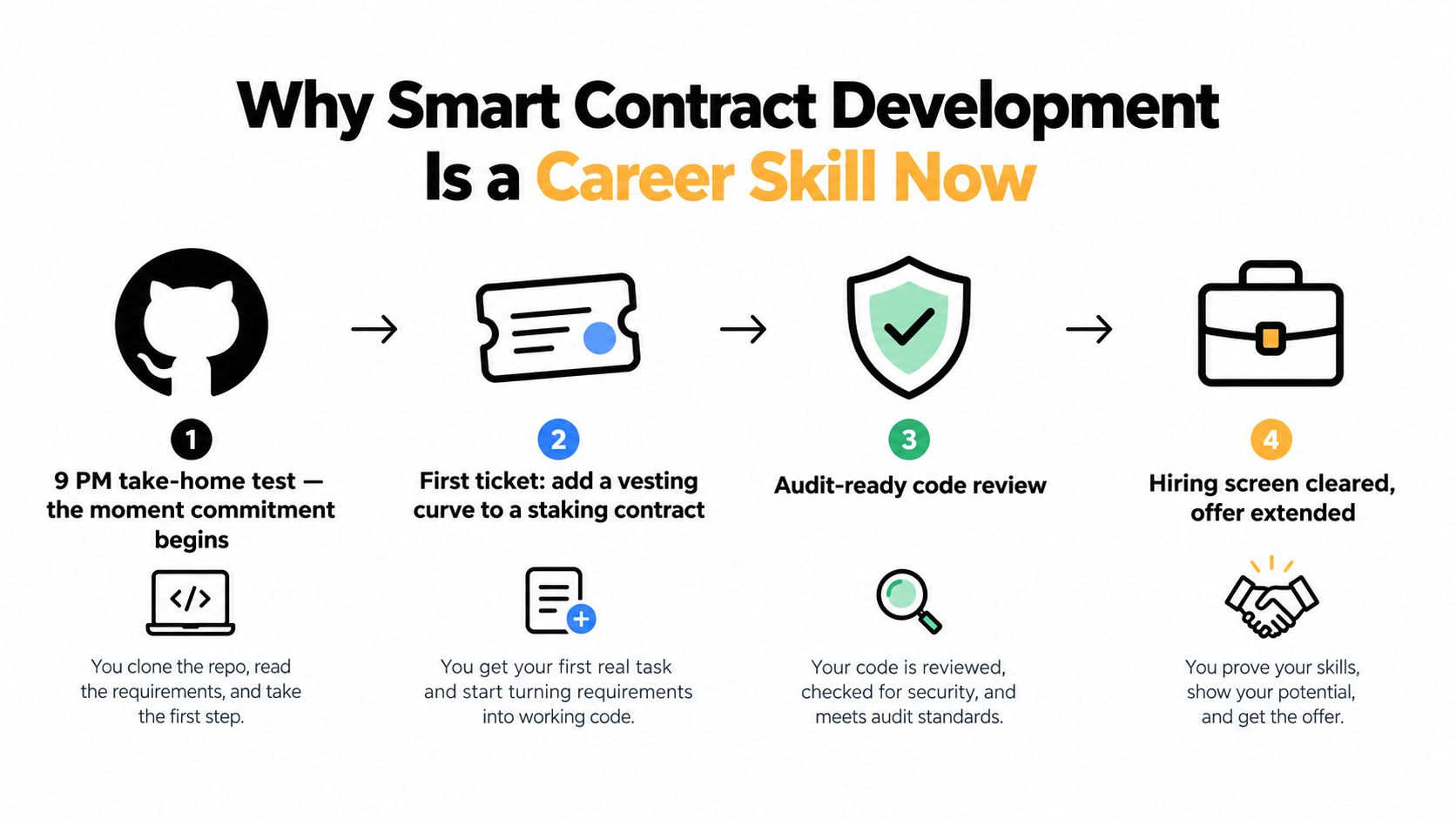
Interview signal: A strong candidate doesn't just submit working code. They explain what the contract assumes, who can change it, how those assumptions are tested, and what happens when they fail.
The build pipeline that follows is also a career progression framework. Chain selection demonstrates architecture. Contract design demonstrates implementation skill. Security gates demonstrate risk judgment. Deployment and incident planning demonstrate ownership. A hiring manager uses the same checklist when reviewing a take-home assignment and grading a system-design answer.
Choosing the Stack That Fits Your Target Chain
Chain, virtual machine, language, and framework form one decision, not four unrelated tutorials. Start with the execution environment because it determines the account model, fee behavior, storage model, transaction semantics, finality assumptions, and available tooling.
An EVM-equivalent chain such as Ethereum, Polygon, Arbitrum, Optimism, Base, or BNB Chain lets a team reuse much of the Solidity ecosystem. That can accelerate hiring, testing, library selection, and audit preparation. The trade-off is that similar syntax doesn't make every chain operationally identical. Fee markets, confirmation behavior, sequencer assumptions, bridge dependencies, and ecosystem maturity still affect application design.
Alternative virtual machines require a different mental model:
- Solana uses programs commonly written in Rust and executed through its BPF-based environment. Account data and program interactions shape how developers model state.
- Aptos and Sui use Move, which gives teams a resource-oriented language model and different assumptions around ownership and asset handling.
- Starknet uses Cairo, with development patterns tied to STARK-oriented execution.
- Polkadot parachains can use Rust-based tooling and frameworks such as ink!, depending on the target environment.
Select the language after the VM
For EVM-equivalent chains, Solidity 0.8.x remains a common hiring requirement. A role may also expect knowledge of gas, storage layout, events, access control, and wallet integration. Those requirements appear in smart contract career guidance because they map directly to the work of debugging and preparing contracts for production.
Rust is a common foundation for Solana, Polkadot, NEAR, and CosmWasm ecosystems. Move targets Aptos and Sui, while Cairo targets Starknet and other STARK-oriented environments. The right language is the one that matches the execution environment and the team's security and maintenance capabilities, not the language a developer happens to prefer.
Choose the framework for the work
Frameworks provide different strengths:
- Foundry is a strong EVM choice for fast compilation, Solidity-native tests, fuzzing, invariant testing, scripting, and fork-based development.
- Hardhat offers a flexible JavaScript or TypeScript-centered workflow with a broad plugin ecosystem and familiar integration patterns for application teams.
- Brownie remains relevant to teams that prefer Python-based EVM scripting and testing.
- Anchor provides conventions for Solana program development and client interaction.
- Aptos and Sui SDKs support application integration for Move-based systems.
A hiring manager will usually weight protocol fit, auditability, and tooling maturity above personal preference. Saying “I use Foundry because it's popular” is weak. Saying “I chose Foundry because the project needs Solidity-native invariant tests, fork simulation, and reproducible deployment scripts” shows architectural reasoning.
| Chain Family | Virtual Machine | Primary Language | Dominant Framework |
|---|---|---|---|
| Ethereum and EVM-equivalent chains | EVM | Solidity | Foundry, Hardhat, Brownie |
| Solana | Solana BPF environment | Rust | Anchor |
| Aptos and Sui | Move VM environments | Move | Aptos SDK, Sui SDK |
| Starknet | Cairo VM | Cairo | Starknet tooling |
| Polkadot parachains | Substrate-based environments | Rust, ink! | Substrate and ink! tooling |
Practical rule: Choose the chain based on execution requirements and ecosystem support, then choose the language and framework that make the threat model easiest to express and verify.
A candidate who can compare these layers will usually outperform someone who memorized framework commands without understanding what the underlying VM guarantees.
Building a Sample Token Contract Step by Step
A token contract is a useful interview exercise because it exposes decisions about arithmetic, storage, permissions, events, testing, and deployment. The implementation should begin with the data model, not with a copied template.
Start with state and precision
Define the token's unit conventions explicitly. ERC-20 balances are commonly represented as integer base units, with a decimals value used by wallets and interfaces to display amounts. The contract should document that relationship and avoid ambiguous conversions between human-readable values and stored integers.
Use uint256 balances and supply values, then examine whether the storage layout supports the intended deployment model. If the team might use a proxy, layout stability becomes part of the architecture. Reordering or changing state variables later can corrupt interpretations of existing storage, so an interview-quality answer should mention upgrade risk before discussing proxy implementation.
A token that needs minting, pausing, or administrative control should use established OpenZeppelin primitives rather than reimplementing them. AccessControl, Pausable, and ReentrancyGuard each reduce the amount of custom security-sensitive code, but they don't remove the need to understand how the imported components work.
Map permissions explicitly
Write the role model before writing the functions. A practical design might separate:
- Owner or administrator: manages high-level configuration and role administration.
- Minter: creates tokens under a clearly defined supply policy.
- Pauser: stops selected operations during an incident.
- Users: transfer and approve according to the token's intended behavior.
Use named role identifiers rather than free-form strings scattered through the contract. Document who grants each role, whether roles can be revoked, and whether administrative actions require multiple parties or a delay.
A token becomes an application rather than a code snippet at this stage. A useful crypto token vs coin guide can clarify the product distinction, but the contract still needs its own precise supply, custody, and permission rules.
Emit useful events
Every state-changing administrative action should emit an event that lets indexers and operators reconstruct what happened. Transfers and approvals already establish the core ERC-20 event pattern. Custom functions such as minting, role changes, pausing, and configuration updates need clear event names and indexed parameters where downstream consumers need efficient filtering.
Event design is an interview signal because it connects contract code to the rest of the product. A frontend, analytics pipeline, monitoring service, or indexer can't reliably infer every meaningful state transition from raw storage alone.

Build the test pyramid
Start with unit tests for arithmetic, authorization, transfers, approvals, minting, and pause behavior. Then add fuzz tests with forge-std to vary amounts, actors, ordering, and boundary conditions. The point isn't to generate random activity for its own sake. The test should express a property, such as the fact that a transfer can't create value or that an unauthorized account can't mint.
An invariant test should check that the sum of holder balances remains consistent with totalSupply, subject to the contract's explicit minting and burning rules. If the design includes fees, rebasing, or excluded accounts, state those exceptions in the invariant rather than hiding them in test helpers.
For Solidity practice, this Solidity learning resource is useful for building language fluency, but production readiness requires more than syntax. A hiring manager will ask why a test exists, which failure mode it covers, and what remains untested.
Senior-level answer: “I used a standard library for common primitives, kept the custom state machine small, defined the role graph before implementation, and wrote invariants around value conservation and authorization.”
Security Gates That Actually Catch Modern Exploits
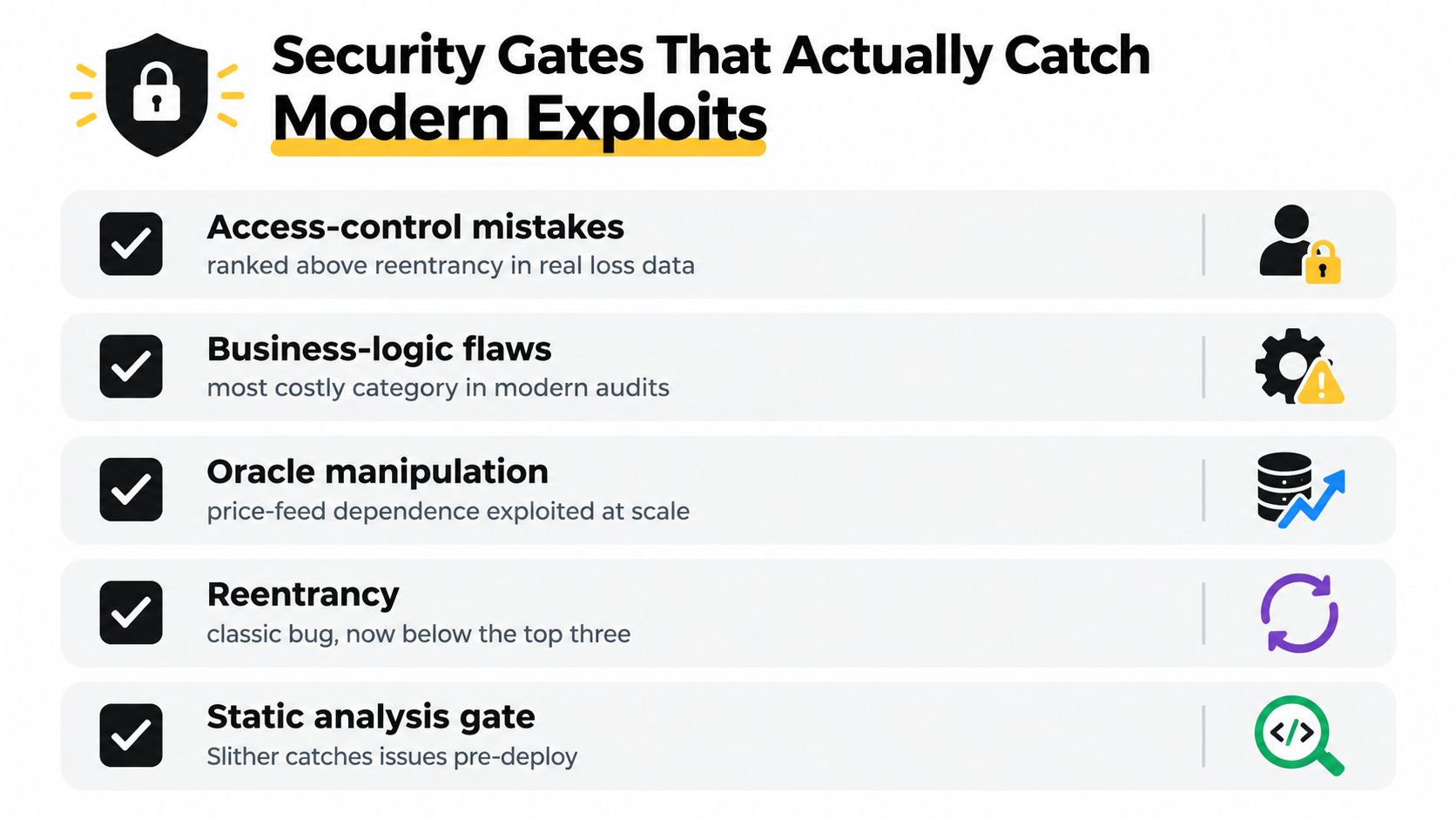
Reentrancy remains important, but it isn't the only failure mode that matters. A 2024 survey of incidents reported 767 on-chain security events and $2.36 billion in losses, with about 60% of losses, or $1.44 billion, attributed to access-control and business-logic flaws. The incident analysis is documented in this smart contract security study.
That changes the order of review. Teams still need checks-effects-interactions discipline and reentrancy defenses, but they must also prove that the right accounts can perform the right actions, that economic rules hold under adversarial conditions, and that oracle assumptions can't be abused.
Use layered gates
A reliable pipeline uses several gates because each catches a different class of failure.
- Static analysis on every commit. Run Slither or an equivalent analyzer in CI. It can flag suspicious access patterns, dangerous calls, inheritance issues, and known coding problems before a reviewer spends time on deeper reasoning.
- Fuzzing and invariant testing. Use Echidna or Foundry to explore state transitions. These tests target arithmetic boundaries, unexpected call sequences, and properties such as conservation of balances or limits on withdrawals.
- Fork testing. Run the application against a realistic chain state to expose assumptions about liquidity, token behavior, oracle responses, and integrations. Toy mocks often hide failures caused by live protocol interactions.
- Manual threat modeling. Ask what the attacker controls, what each compromised role can reach, and what value the attacker receives from each path. Business logic and governance flaws become visible here.
- Independent review. An audit adds another perspective, but it should review a defined scope, assumptions, deployment configuration, and remediation evidence. It isn't a substitute for internal ownership.
A systematic review screened 3,380 studies and retained 222 high-quality studies, producing a taxonomy of 192 vulnerabilities across 13 categories, mapping 219 detection tools, and collecting 133 benchmarks. The systematic review of smart contract security supports a practical conclusion: tool coverage is broad but fragmented, so serious teams combine analyzers and testing techniques rather than trust one scanner.
Turn security into an interview discussion
An interviewer may ask how you'd secure a two-step ownership transfer, prevent a stale-price liquidation, or limit an emergency role. Strong answers describe the attacker, the violated invariant, the test that demonstrates the failure, and the operational control that reduces exposure.
Teams can also use tools that support broader code review workflows. For example, AuricIDE on code review checks can be part of a review process, but automated review remains one layer in a larger security program.
The most valuable security explanation is concrete. “I checked for reentrancy” is incomplete. “I modeled the minter and pauser roles, fuzzed unauthorized calls, tested stale oracle responses, forked the relevant integration, and required independent review before deployment” demonstrates ownership. Candidates can find further practical guidance in how to audit a smart contract.
From Local Simulation to Mainnet Deployment
Deployment should look like a controlled progression, not a single command executed after tests pass. A system-design interviewer will want to know what changes between a local environment, a fork, a public testnet, and production.
Start locally with Anvil or Hardhat Network. These environments give fast feedback for unit tests, deployment scripts, access-control checks, and basic integration flows. They're excellent for iteration, but they don't reproduce the liquidity, oracle behavior, token quirks, or contract composition of a live ecosystem.
A Foundry fork against an Ethereum mainnet archive node provides a more realistic simulation. You can replay transactions, inspect existing integrations, and exercise the application against actual chain state. The trade-off is reproducibility and dependency on the fork configuration, so the test should record its assumptions and relevant block state.
Compare the deployment stages
| Stage | Recommended Tooling | Primary Trade-Off | Interview Signal |
|---|---|---|---|
| Local development | Anvil or Hardhat Network | Fast but simplified state | You can iterate without confusing mocks for reality |
| Fork simulation | Foundry fork mode | Realistic dependencies require controlled state | You understand integration and oracle risk |
| Public testnet | Sepolia, Holesky, or an L2 equivalent | Network behavior and liquidity differ from production | You can validate deployment and user flows |
| Verification | Etherscan and reproducible build artifacts | Verification exposes configuration mistakes | You can prove deployed bytecode matches reviewed code |
| Production release | Scripted deployment with multisig controls | Operational speed gives way to change control | You understand launch governance and incident readiness |
Use deterministic deployment practices where they add value. CREATE2 or salted deployment can help reproduce addresses across environments, but deterministic addresses introduce their own coordination and initialization concerns. A hiring manager will care less about the acronym than whether you can explain how constructor arguments, salts, dependencies, and initialization are controlled.
Oracles, verifiers, and upgrade patterns are parallel design decisions. A Chainlink feed may offer a different trust and update model from a Uniswap TWAP. Tenderly can help with transaction simulation and debugging, while Etherscan verification helps users inspect deployed source and compiler settings. A transparent or UUPS proxy gives a team an upgrade path, but an immutable contract with migration may reduce long-term administrative risk.
Before mainnet, require:
- A pause guardian with narrowly scoped emergency authority.
- A multisig for sensitive administrative actions.
- A timelock where users need notice before consequential changes.
- Monitoring for abnormal calls, role changes, oracle behavior, and value flows.
- An incident runbook that names owners, escalation paths, and communication steps.
Teams building outside a blockchain context can also benefit from sandbox environment best practices for startups, especially when separating experimental configuration from release artifacts. The same principle applies here: make unsafe experimentation difficult to confuse with a production deployment.
Turning the Toolchain Into a Career Path
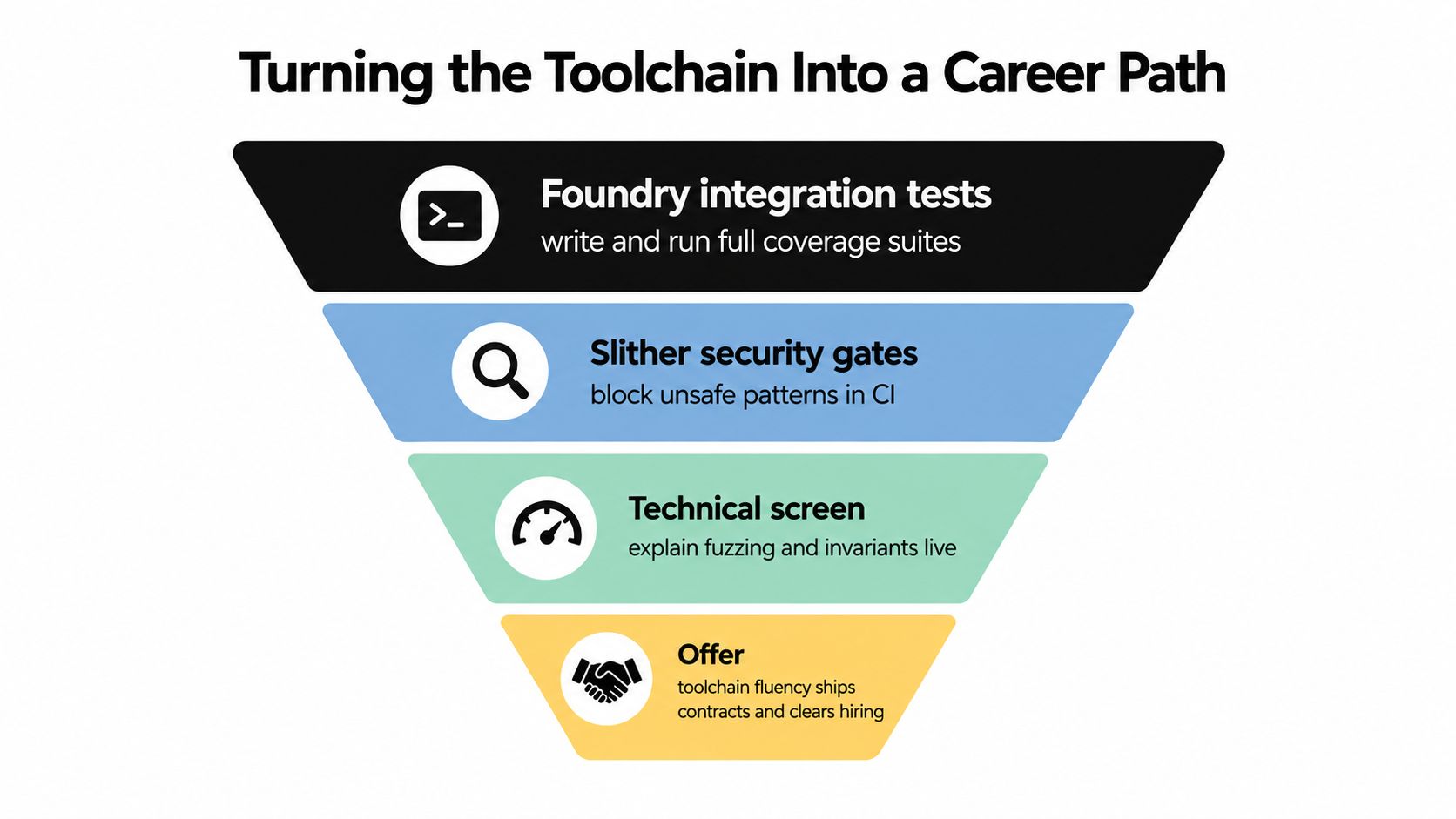
Toolchain depth becomes valuable when it produces evidence. A CV that says “Solidity developer” gives a hiring manager little to evaluate. A public repository with passing CI, clear deployment scripts, documented assumptions, and meaningful invariant tests gives them something concrete.
The progression often looks like this:
- Foundry integration tests: You can test complete flows across contracts and users, not just isolated functions.
- Slither security gates: You can put repeatable checks in CI and investigate findings instead of ignoring them.
- Audit participation: You can prepare scope, explain assumptions, reproduce findings, and verify remediation.
- Post-mortem writing: You can describe an incident without hiding the design or operational causes.
- Mainnet ownership: You can operate the contract, monitor it, manage privileges, and coordinate changes.
Each stage answers a different hiring question. Integration tests show implementation ability. Security gates show process discipline. Audit work shows that you can collaborate with reviewers. A post-mortem shows accountability. Mainnet ownership shows that you understand the system after deployment, when assumptions meet users and adversaries.
A 2026 salary guide estimates $125,000 to $170,000 for a mid-level smart-contract developer, $175,000 to $230,000 for a senior protocol or smart-contract engineer, and $180,000 to $260,000 for a smart-contract security or audit engineer. These are estimates, not guarantees, but the blockchain developer salary guide illustrates why security specialization can carry senior-level value.
Career principle: The toolchain is the career. Every reliable test, review artifact, deployment script, and incident analysis makes your engineering judgment easier to verify.
Protocols and serious DeFi teams don't price senior engineers only against generic Web3 benchmarks. They consider the value of sound permissions, controlled upgrades, accurate accounting, and avoided losses. That value becomes an advantage when you can show the work rather than merely describe it.
Why Audited Contracts Still Fail and What Interviewers Test For
An audit is a review of a defined scope at a defined point in time. It isn't a permanent guarantee that the full system is safe. A 2025 systematic review of 50 severe real-world attacks from 2022 through 2025, totaling more than $1.09 billion in losses, found that many incidents involved combined failures across protocol design, governance and lifecycle controls, dependencies, and familiar vulnerabilities. The review of exploit chains is the important counterpoint to audit-focused thinking.
That finding matters because an auditor can review contract code while missing a dangerous relationship between contracts, governance, signers, external dependencies, and deployment procedures. A signature-set change, an oracle assumption, or an upgrade path can create risk outside the narrow code path the team believes it commissioned.
Questions a hiring manager will ask
Expect questions such as:
- What did the audit cover, and what did it explicitly exclude?
- Which findings did your team fix, defer, or accept?
- How did you validate the fix?
- Which properties did you test with fuzzing or formal methods?
- What role did Slither, Mythril, or another analyzer play?
- How would you divide responsibility between internal review, automated tools, formal verification, and a bounty program?
- What happens if the deployed configuration differs from the audited configuration?
- Who can pause, upgrade, or migrate the system during an incident?
The best answer distinguishes audit readiness from incident-response readiness. Audit readiness means the code, documentation, assumptions, and test evidence are organized for review. Incident-response readiness means the team can detect abnormal behavior, limit further damage, communicate clearly, and execute a practiced decision process.
Formal verification can strengthen assurance for critical properties, but it still depends on the specification. If the specification omits an economic or governance assumption, proving the implementation won't repair that omission. Candidates who can explain that boundary, and connect it to concrete invariants and operational controls, demonstrate more maturity than candidates who merely list audit firms or vulnerability categories.
If you're preparing for deeper protocol interviews, smart contract formal verification is a useful area to study alongside fuzzing, threat modeling, and audit remediation.
Build a portfolio repository that includes Foundry tests, security gates, deployment scripts, an explicit permission model, and a short post-mortem-style threat analysis. Browse Blockchain Jobs to find engineering, security, protocol, and infrastructure roles where that evidence can support your next interview and help you turn smart contract application development into a durable career.