What Is NFT and How It Works: Web3 Career Guide
You're in a Web3 interview, and the hiring manager asks a question that sounds easy: explain what an NFT is and how it works. You mention digital art, wallets, and marketplaces. The interviewer follows up: where does the image live, what proves ownership, and what changes when the token moves to another wallet?
That follow-up separates a consumer-level explanation from an engineering answer. If you're preparing for a blockchain role, you need to understand NFTs as smart contract systems, ownership records, metadata pipelines, marketplace infrastructure, and legal products, not just as pictures sold with cryptocurrency.
Acing the NFT Technical Interview
A strong answer starts with a distinction: an NFT is not the image itself. It's a unique digital token recorded on a blockchain. The token identifies an asset through a smart contract address and a Token ID, while the contract maintains the current owner associated with that ID.
The technical definition matters because it tells the interviewer exactly where the system derives its authority. An NFT is an on-chain ownership record keyed by the combination of a smart contract address and a unique Token ID. The contract maps that ID to an owner, and minting or transferring the token updates the mapping while emitting a transfer event that others can verify independently, as explained in this technical NFT ownership overview.
A polished interview response might sound like this:
Practical rule: Explain the token, the contract state, and the media reference separately. Never describe the JPEG as the NFT.
Suppose a collection contract contains Token ID 42. The blockchain records that the wallet associated with the current owner controls that token. When the owner signs a valid transfer transaction, the contract updates the owner mapping and emits an event. A marketplace can listen for that event, update its index, and display the new ownership state to users.
The image may be referenced by metadata, but it doesn't establish ownership. Someone can copy the image without creating the same combination of contract address and Token ID. That copy may look identical, but it won't have the same on-chain provenance.
What interviewers want to hear
Junior candidates often stop at “NFTs are digital art on a blockchain.” A stronger candidate can explain:
- Non-fungibility: Each token is identified individually rather than treated as an interchangeable balance.
- Ownership state: The smart contract records which wallet currently owns a specific Token ID.
- Transfer verification: Transactions and emitted events provide an auditable history.
- Media separation: The asset file and the ownership record may live in different systems.
- Application behavior: Wallets, marketplaces, and indexers read contract state and metadata to present the token.
If Solidity is part of the role, use the interview as an opportunity to connect the definition to implementation. A candidate preparing through a practical Solidity language learning guide should be able to discuss mappings, access control, transfer functions, events, and failure conditions without treating them as unrelated syntax exercises.
The career lesson is simple. The basic NFT definition is an architecture question in disguise. Your answer should show that you understand what the chain guarantees, what external services provide, and where product risk remains.
Token Standards and Smart Contract Architecture
The token standard determines how a contract represents assets and how other applications interact with it. In interviews, don't recite ERC numbers without explaining the product decision behind them.
ERC-721 for individually unique tokens
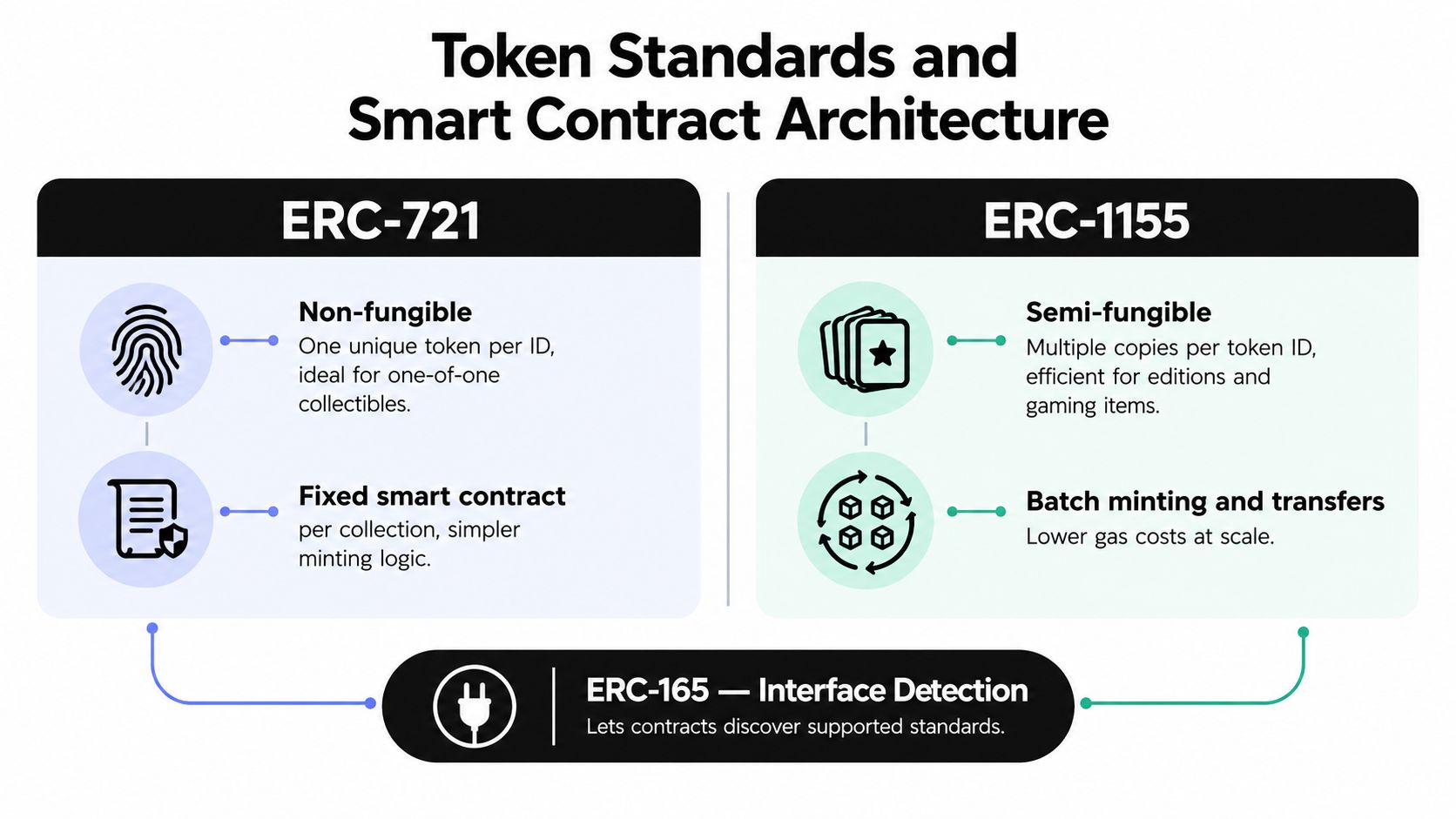
ERC-721 is commonly used when each Token ID represents a distinct, individually tracked item. A one-of-one collectible is an intuitive example. The contract treats each token as a separate ownership unit, and marketplaces can query ownership and transfer behavior through a familiar standard interface.
That standardization reduces integration friction. Wallets and marketplaces don't need a custom interpretation for every collection, provided the contract implements the expected functions and events correctly. The engineering trade-off is that a large collection of individually unique assets can require more transactions and more bespoke handling than a multi-asset design.
ERC-1155 for editions and mixed inventories
ERC-1155 supports multiple token types within one smart contract. It can represent non-fungible items, semi-fungible editions, and fungible inventories through a shared architecture. A game, for example, might use one contract for unique equipment, limited editions, and interchangeable in-game resources.
The standard supports batch minting and batch transfers, which can improve transfer efficiency and reduce contract-deployment overhead compared with patterns that create a separate contract for every token. The Ethereum ERC-1155 documentation describes how the design supports multiple asset types and reduces the cost of storing repeated contract logic.
| Design question | ERC-721 | ERC-1155 |
|---|---|---|
| Best fit | Individually unique tokens | Editions, game inventories, and mixed asset types |
| Ownership model | Each Token ID is tracked as a distinct item | One contract can manage many token classes |
| Transfer approach | Commonly handled per token | Batch transfers are supported |
| System trade-off | Straightforward semantics for one-of-one assets | More efficient at scale, with more complex inventory logic |
How to discuss the choice in a system design interview
Start with the asset model, not the standard. Ask whether the product needs unique ownership for every item, multiple editions under one ID, batch operations, or a combination of asset types. Then explain how the choice affects minting flows, marketplace indexing, wallet display, testing, and transaction costs.
Smart contracts also define more than token existence. They can encode ownership checks, transfer restrictions, payment routing, and royalty-related behavior. The exact implementation still needs security review, because a standard doesn't make custom business logic safe by itself.
ERC-165 interface detection is another useful detail. It lets contracts and applications discover which interfaces a contract supports, helping integrations determine whether a contract follows expected token behaviors. Candidates who can connect token standards, interface detection, and marketplace compatibility sound like builders rather than memorization-focused applicants.
For broader token architecture practice, compare the design assumptions behind ERC-20 and ERC-721. The important interview skill isn't naming a standard. It's defending the choice against the product's inventory, transfer, and scaling requirements.
The Reality of Metadata and Off-Chain Storage
The most common technical misunderstanding is that minting an NFT places the complete image or video on the blockchain. In most systems, the chain stores the token state and a reference, while the media remains elsewhere.
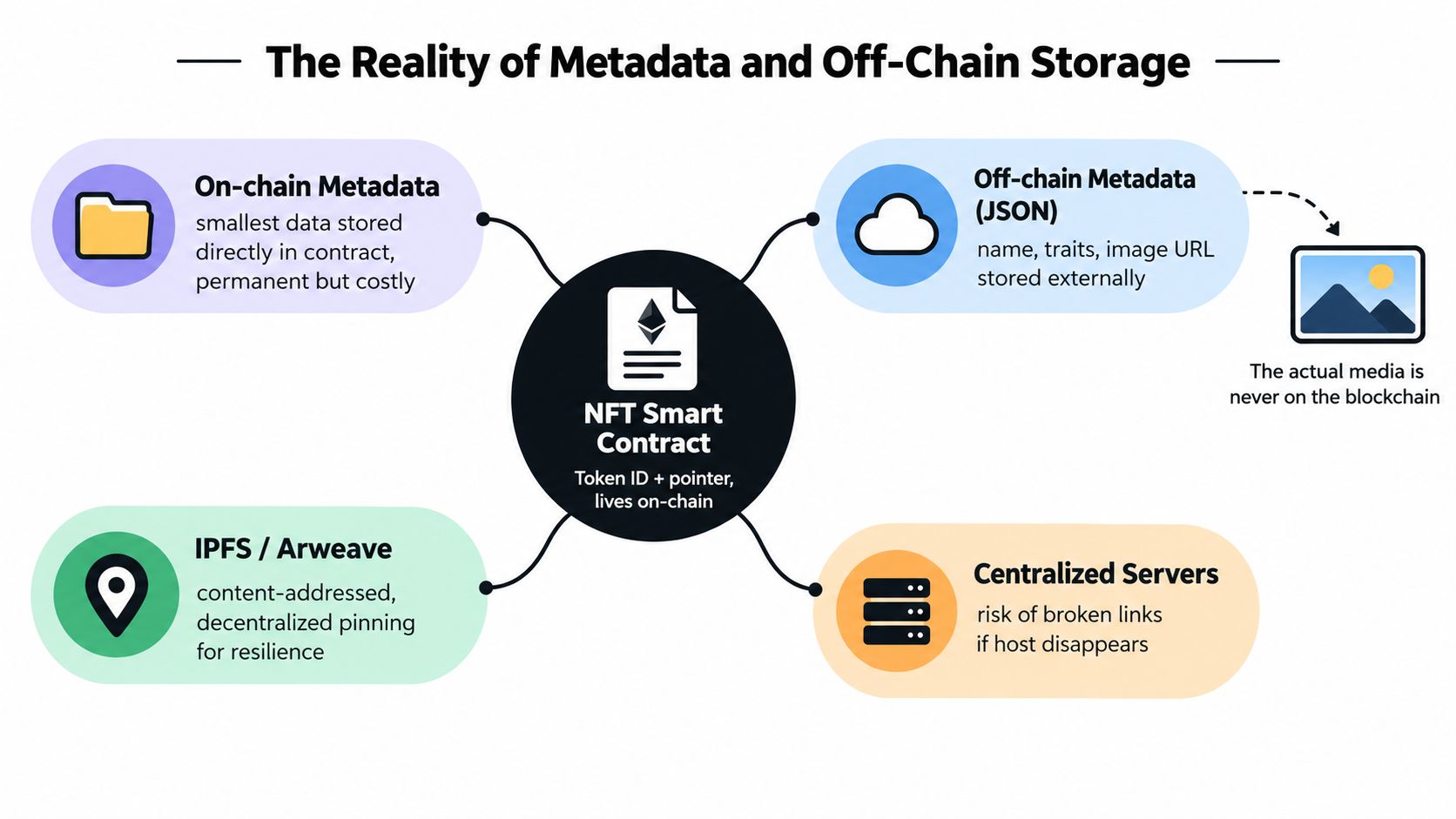
A token may point to metadata through a URI. That metadata can describe the name, traits, and image location. The image, video, or other file is often stored on IPFS or a centralized server rather than inside the contract itself. This architecture keeps expensive on-chain storage smaller, but it creates a dependency that candidates need to identify during design reviews.
If the pointer remains valid and the referenced content remains available, a marketplace can resolve the metadata and show the asset. If a centralized host disappears, the NFT can still exist on-chain while the media becomes inaccessible. If the metadata changes, the displayed attributes may change even though the Token ID and ownership history remain intact. This analysis of NFT storage risks highlights the practical gap between an enduring token record and a potentially fragile media layer.
Questions a senior candidate should ask
When reviewing an NFT product, ask:
- Where is the metadata stored? Is it in the contract, on IPFS, on another decentralized storage system, or on a private server?
- Can the pointer change? A mutable URI creates a different risk profile from content-addressed storage.
- Who controls updates? Check administrator permissions, upgradeable contracts, and any content replacement process.
- What happens after the hosting service fails? A product needs a recovery and monitoring plan.
- What does the buyer receive? Token ownership may not include copyright, reproduction rights, or commercial-use permission.
Interview distinction: A blockchain can prove control of a token without proving that the buyer owns the copyright in the media.
That legal distinction affects product copy, licensing terms, customer support, and compliance. Buying an NFT usually doesn't automatically grant the right to reproduce, modify, distribute, or commercially exploit the underlying image or file. A product manager should make those rights explicit, while an engineer should avoid building user assumptions into contract behavior unless the legal terms support them.
The same principle applies to permanence. IPFS can help create content-addressed references, but availability still depends on adequate pinning and operational stewardship. A centralized URL may be simpler to launch, yet it introduces a clearer single-host failure risk. Senior engineers explain these trade-offs without promising that “on-chain” means permanent in every practical sense.
For analytics and troubleshooting roles, metadata is also an evidence problem. An analyst may need to compare contract events, ownership history, metadata responses, and marketplace records. Learning how teams use on-chain data analytics helps you discuss the difference between raw chain facts and application-layer interpretations.
Building and Scaling NFT Marketplaces
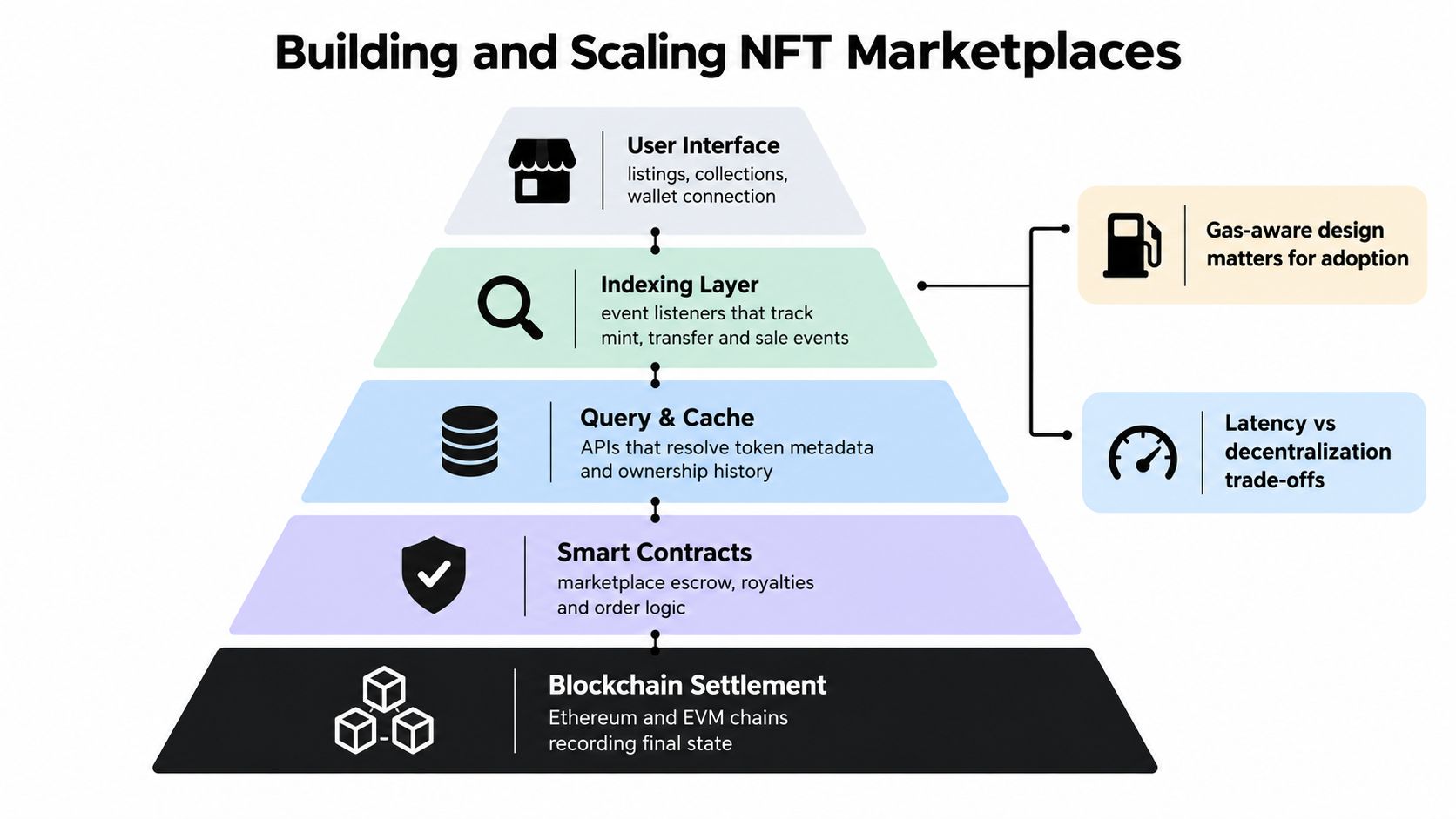
An NFT marketplace is not just a gallery with a wallet button. It combines blockchain settlement, smart contract logic, indexing, metadata resolution, APIs, and a client interface. Each layer has a different failure mode, so hiring teams often evaluate whether candidates understand the complete path from a user action to final chain state.
The marketplace stack
At the bottom sits blockchain settlement. The chain records minting, transfers, approvals, and other state changes. Above it, smart contracts handle marketplace orders, escrow behavior, payments, and collection-specific rules.
An off-chain indexing layer listens for contract events and builds data that applications can query efficiently. The client layer then turns that data into collection pages, listings, wallet connections, filters, and transaction prompts. This layered model is described in a practical NFT marketplace architecture overview.
| Layer | Typical responsibility | Relevant roles |
|---|---|---|
| Blockchain settlement | Records final ownership and transaction state | Protocol engineers, smart contract engineers |
| Smart contracts | Enforces orders, transfers, payments, and permissions | Solidity engineers, security specialists |
| Indexing and APIs | Tracks events, resolves metadata, and serves queries | Backend engineers, data engineers |
| Client application | Presents listings and wallet actions | Front-end engineers, product designers |
| Operations and growth | Supports users, collections, and community activity | Product, support, marketing, community |
Where your career can fit
A smart contract engineer might design an order flow and test authorization boundaries. A backend engineer might build event listeners, reconcile chain reorganizations, cache metadata, and expose marketplace APIs. A front-end engineer needs to handle wallet connection states, rejected signatures, pending transactions, and stale ownership data without confusing the user.
Product managers operate across these boundaries. They decide whether a feature requires on-chain settlement or can remain in the application layer. They also define what happens when indexing lags, metadata fails to resolve, or a transaction succeeds on-chain but the interface hasn't refreshed.
Designers and support teams need technical fluency too. A wallet signature isn't the same as a completed transaction, and a marketplace listing isn't necessarily a transfer of ownership. Clear interface language can prevent users from approving the wrong transaction or misunderstanding what a purchase grants them.
Comparing centralization choices
A fully on-chain approach may maximize verifiability for selected actions, but it can introduce cost and usability constraints. An off-chain order book or index can make search and browsing faster, while the final purchase still settles through a contract. The right choice depends on the trust model, not on a slogan about decentralization.
In a system design interview, draw the event flow: user action, wallet signature, transaction submission, contract execution, emitted event, indexer update, metadata resolution, and interface refresh. Then name what happens if each step fails. That answer demonstrates operational maturity.
Market Evolution and Shifting Hiring Demands
A hiring manager asks why NFT teams changed after the 2021 boom. A strong answer connects market data to engineering priorities. Reuters reported NFT sales of $24.9 billion in 2021, compared with $94.9 million in 2020. Other trackers produced lower estimates, including $18.3 billion and $15.7 billion, because their methods and blockchain coverage differed. Third-quarter 2021 sales reached $10.7 billion, showing how quickly activity concentrated during the boom. These figures come from Reuters' NFT market reporting.
A research paper in Nature found NFT volume above $2 billion in the first four months of 2021, more than 10 times the entire 2020 volume. It also reported daily exchanged volume above roughly $10 million by March 2021, with the market about 150 times larger than it had been eight months earlier. For an interview, explain what this growth meant for infrastructure: higher transaction activity, heavier indexing workloads, and greater pressure on marketplaces to present accurate ownership and metadata.
The number of unique active wallets interacting with NFTs rose from about 5,000 at the start of 2021 to roughly 140,000 by year-end, according to the same Reuters reporting. That trajectory helps explain why teams initially valued fast launches, minting flows, and community distribution. As demand became more selective, employers needed engineers and operators who could improve reliability, protect users, measure behavior, and build products with a reason to exist beyond resale activity.
What the newer market exposes
NFT sales revenue fell to about $5.63 billion in 2025, while circulating supply rose to roughly 1.34 billion tokens, according to CoinMarketCap's 2025 NFT market analysis. The combination points to a crowded market where utility, rights, and product differentiation remain unevenly understood.
Your interview story should reflect that shift. Describe how you would contribute beyond launching a collection:
- Security: Review contract permissions, signature validation, upgrade paths, and marketplace attack surfaces.
- Data quality: Reconcile ownership, index contract events, handle metadata failures, and check analytics.
- Product utility: Test whether token ownership enables a clear experience or mainly encourages speculation.
- Rights and compliance: Read licensing language, improve consumer disclosures, and define support processes.
- Sustainable growth: Connect community engagement to a functioning product instead of short-lived hype.
Marketing candidates need technical context as well. If your role involves community distribution on X, AI tools for Twitter creators can support content workflows. They do not replace knowledge of wallets, token utility, or user trust.
The durable career advantage is judgment. Hiring managers want people who can interpret market signals, choose appropriate technical trade-offs, and build NFT systems that remain understandable and useful after attention moves elsewhere.
Navigating Common Misconceptions in Interviews
Interviewers often use familiar NFT myths to test whether you can separate appearance, ownership, and legal rights. Treat each one as an opportunity to explain the system precisely.
Myth: Buying the image means buying the copyright.
The token may represent ownership of a blockchain record, while copyright and commercial rights remain with the creator or follow a separate license. Ask what rights the terms grant before designing features that let holders reproduce or monetize the media.
Myth: Right-clicking the image makes the NFT worthless.
A copied file may look the same, but it doesn't reproduce the original contract address, Token ID, ownership state, or transfer history. The value proposition, where one exists, concerns provenance and token ownership, not the impossibility of copying pixels.
Myth: The blockchain stores everything.
The token and its ownership state can be on-chain while metadata and media remain off-chain. In an interview, explain the implications of broken URIs, mutable metadata, unavailable hosts, and content storage choices rather than repeating a blanket permanence claim.
Myth: A marketplace display proves current ownership.
The interface may rely on an indexer or cache. The authoritative state comes from the relevant contract and chain, so applications need to handle delayed indexing, failed transactions, and stale metadata.
Turn myths into design answers
When an interviewer presents a misconception, don't respond with a correction alone. Connect the correction to an engineering or product decision.
For example, if asked whether a buyer owns the artwork, say that the answer depends on the license. Then explain how the product would surface those terms, store the relevant reference, and prevent marketing copy from implying rights that the seller hasn't granted.
If asked how you'd validate a transfer, describe the transaction, contract state, and emitted event. If asked what happens when an image host disappears, discuss storage redundancy, monitoring, user communication, and whether the metadata design permits recovery.
A senior answer doesn't just reject the myth. It identifies the control, dependency, and failure mode behind it.
That habit transfers well beyond NFTs. It shows that you can investigate assumptions, document boundaries, and communicate technical risk to legal, product, design, and customer-facing colleagues.
Your Action Plan for Web3 Career Progression
Start by choosing the role you want to earn, then build evidence for that role. NFT teams hire across smart contract engineering, front-end and back-end development, marketing, and business functions. Common engineering requirements include ERC-721, ERC-1155, wallet integrations, marketplace APIs, metadata and storage, and blockchain-specific knowledge, as reflected in this NFT jobs and skills overview.
For smart contract and protocol candidates
Build a small project that mints a unique token, exposes ownership queries, emits transfer events, and handles an explicit metadata strategy. Then add an ERC-1155 example with batch behavior. Your portfolio should explain why each standard fits the asset model, not just show that the code compiles.
Prepare to discuss access control, approvals, reentrancy risks, upgradeability, event indexing, and failed transactions. You don't need to claim production experience you haven't had. A clear threat model and honest test coverage are stronger than inflated project language.
For backend, data, and product candidates
Create an event-driven design for a marketplace. Document how an indexer detects mint and transfer events, resolves metadata, handles stale records, and exposes ownership history through an API. Product managers should add a decision log covering storage permanence, user rights, transaction states, and support escalation.
For interviews, practice drawing the complete journey from wallet connection to settled ownership. Explain what the user sees, what the contract guarantees, and what the application must monitor.
For design, marketing, and operations candidates
Learn the vocabulary that affects user trust. A wallet signature, listing, approval, pending transaction, completed transfer, and media license are different things. Your campaigns, interfaces, and support scripts should reflect those distinctions.
Use a focused portfolio format:
- One system explanation: Show the token, contract, metadata, and marketplace relationship.
- One risk analysis: Identify a storage, rights, security, or indexing failure and propose controls.
- One role-specific artifact: Include Solidity tests, API design, product requirements, UX flows, community content, or support documentation.
- One interview narrative: Explain what you built, what you chose not to build on-chain, and how you measured correctness.
Search specialized Web3 listings by function instead of applying only to “NFT jobs.” Engineering, product, data, security, legal, marketing, and customer support teams all contribute to NFT products. Your strongest application will connect your existing discipline to the mechanics that the team needs.
Blockchain Jobs offers a dedicated job board for opportunities across Web3, including blockchain, DeFi, and NFT roles, with categories spanning engineering, product, marketing, data, security, and other functions. Visit Blockchain Jobs to explore roles that match your NFT knowledge and career direction.