
How to Land Developer Relations Jobs

Developer Relations jobs are your chance to become the essential translator between a company and its technical audience. These roles are a fascinating mix of deep technical know-how and sharp communication skills, all geared toward building trust, educating developers, and bringing crucial feedback home.
For those looking to advance their career, a DevRel job is about championing developers so they can build incredible things, positioning you at the intersection of product, engineering, and community.
What a DevRel Job Actually Involves

Let's cut through the jargon from a hiring perspective. A Developer Relations (DevRel) professional is the empathetic, technical voice connecting a company to the developers who use its products. Think of yourself as a bridge. On one side, you’re in the trenches helping developers solve real problems. On the other, you’re carrying their invaluable insights back to your internal product and engineering teams to influence the roadmap.
This isn’t a typical sales or marketing gig. Instead of pushing a product, your main goal is to build genuine relationships and cultivate a vibrant, helpful community. Success in developer relations jobs isn't measured in sales quotas; it's measured by how well you empower other developers, which in turn drives product adoption and retention—key metrics for your career progression.
The Three Pillars of Developer Relations
To understand what hiring managers look for, it helps to break DevRel down into its core functions. While job titles vary, most roles are a blend of these three key areas, and your career will likely specialize in one or more.
- Developer Advocacy: This is the most visible part of the job and often the entry point for many. Advocates create tutorials, write technical blog posts, speak at conferences, and engage in social media conversations to teach and inspire. For your job search, this means building a public portfolio of content.
- Developer Experience (DX): Professionals in DX focus on making a product as smooth and intuitive as possible for a developer. They work on API design, SDKs, documentation, and onboarding flows to eliminate friction. To get hired in DX, you need to show a passion for product usability and an eye for detail.
- Community Management: This pillar is all about building and nurturing a space where developers connect and share knowledge. This involves moderating forums, organizing hackathons or meetups, and empowering community champions. Career-wise, this path leans heavily on communication and strategic program management.
A career in DevRel might mean specializing in one area, or—especially at a startup—you could find yourself wearing all three hats. Analyzing sample developer relations engineer job descriptions can show you how companies weigh these different skills.
The Evolving Landscape of DevRel Hiring
After a recent contraction across the tech industry, the demand for DevRel professionals is picking up steam again. The latest data shows that companies are posting more developer relations roles now than they were last year.
However, the hiring process is much more strategic. Organizations are now zeroed in on DevRel candidates who can demonstrate a clear, measurable impact on business goals. For more on this, you can check out some great insights on the state of DevRel in 2025 to understand what skills are currently in demand.
What It Really Takes to Get Hired in DevRel
When a hiring manager scans a resume for a developer relations role, they’re not just looking for a rockstar coder. They’re hunting for a rare blend of deep technical knowledge and seriously good people skills. A successful DevRel pro needs to do three things exceptionally well: Educate, Engage, and Advocate.
If you can prove you’ve got these three pillars covered in your resume, portfolio, and interviews, you’re showing a company you can create real value for both developers and the business itself. Let's break down what each of these means from a hiring standpoint so you can build a profile that gets you noticed.
Educate Your Audience
The most public-facing part of DevRel is often education. Your mission is to take complicated technical ideas and make them easy to understand and use. It’s not enough to just know the tech; you must be able to package it into content that helps developers solve real-world problems.
To get hired, you need to show concrete proof that you can teach. This usually looks like:
- Creating Technical Content: Can you write a tutorial that people can actually follow? A blog post that demystifies a tough concept? Or documentation that's actually helpful? Your portfolio needs to showcase this skill prominently.
- Public Speaking and Presentations: Getting up in front of a crowd at a meetup, webinar, or conference is a huge green flag for hiring managers. It proves you have the expertise and the confidence to connect with a live audience, a common requirement for the job.
Engage the Community
Creating content is one thing, but building a community is another. DevRel is all about fostering real relationships. Engagement means creating a space where developers feel welcomed, supported, and excited to get involved. This is where your soft skills are put to the test during an interview.
"A hiring manager wants to see proof that you can explain technical concepts clearly and help developers succeed, not just that you have an interest in DevRel."
This isn't something you can easily fake. In an interview, they'll want to see evidence that you can:
- Build Authentic Relationships: This means you're already active in the community—listening in forums, offering solid advice on social media, and being a known, trusted face in the places where developers hang out.
- Facilitate Connections: Great candidates are natural connectors. They know how to get conversations going, run events like hackathons, and inspire community members to start helping each other. Showcase these experiences in your resume and interview stories.
Advocate for Developers
Finally, and perhaps most critically for your long-term career impact, you must be the voice of the developer inside the company. You are the critical link between the people using your product and the teams building it. This is where DevRel professionals provide immense strategic value.
To do this well, you need to turn developer feedback into clear, actionable insights that actually improve the product. This requires a healthy dose of both empathy and technical credibility. You have to feel the developers' pain and have enough technical chops to explain it effectively to your own engineering team. Hiring managers are looking for candidates who can demonstrate they will champion the user and help shape the product roadmap.
To put it all together, here’s a look at the essential skills that make a DevRel professional successful. These are the abilities that hiring managers are actively seeking, so focus on how you can demonstrate them in your portfolio and interviews.
Table: Essential Skills for Developer Relations Roles
| Skill Category | Key Skills | Why It Matters for Hiring |
|---|---|---|
| Technical Proficiency | - Strong coding ability (e.g., Python, JavaScript, Go) - Deep knowledge of the product/platform - Understanding of APIs, SDKs, and developer tools - Cloud computing & infrastructure (e.g., AWS, GCP) |
You must have the credibility to speak with developers on their level. Without it, you can't earn their trust or provide meaningful feedback to your internal teams. This is a non-negotiable for most roles. |
| Content Creation | - Technical writing (docs, tutorials, blogs) - Video production (demos, walkthroughs) - Sample code & open-source contributions |
This is tangible proof of your ability to educate. A strong portfolio of clear, helpful content is often the most important asset for a DevRel candidate and a key discussion point in interviews. |
| Communication & Public Speaking | - Presenting at conferences & meetups - Hosting webinars & workshops - Clear, concise verbal and written communication |
Your job is to make the complex simple. Being a confident and engaging speaker shows you can represent the company and connect with large audiences effectively, a core function of many DevRel roles. |
| Community Engagement | - Social media management (e.g., X, Discord) - Forum moderation & participation - Event organization (hackathons, meetups) - Active listening and empathy |
This shows you can build and nurture a community, not just broadcast to it. This skill is critical for demonstrating you can foster a positive and collaborative environment, which drives user retention. |
| Strategic Thinking | - Gathering & analyzing developer feedback - Understanding business goals - Measuring the impact of DevRel activities - Product roadmap influence |
DevRel isn't just about fun and swag. You need to connect your work back to business objectives. Candidates who can articulate this are seen as more valuable and have higher career potential. |
Ultimately, a top-tier DevRel candidate is a "T-shaped" person—someone with deep technical expertise in one area, but with broad skills in communication, community building, and strategy. Focusing on developing a mix of these hard and soft skills will make you an incredibly strong candidate in the job market.
Understanding DevRel Salaries and Job Market Trends
If you're looking to break into developer relations jobs, you need to talk about money. Understanding the salary landscape is crucial for negotiating a better offer and mapping out your career progression. The demand for DevRel professionals tends to follow the health of the tech industry, and while things can fluctuate, companies always need skilled people who can connect with developers.
These days, hiring managers are laser-focused on ROI. In interviews, you must be prepared to discuss how your work—whether it’s writing a great tutorial or channeling feedback to the product team—directly impacts the bottom line. Think developer adoption, retention, and overall growth. This shift means you have to know your worth and be able to articulate it in business terms.
This infographic nails the core functions that define a DevRel role. Your ability to deliver on these is what will ultimately shape your career path and earning potential.
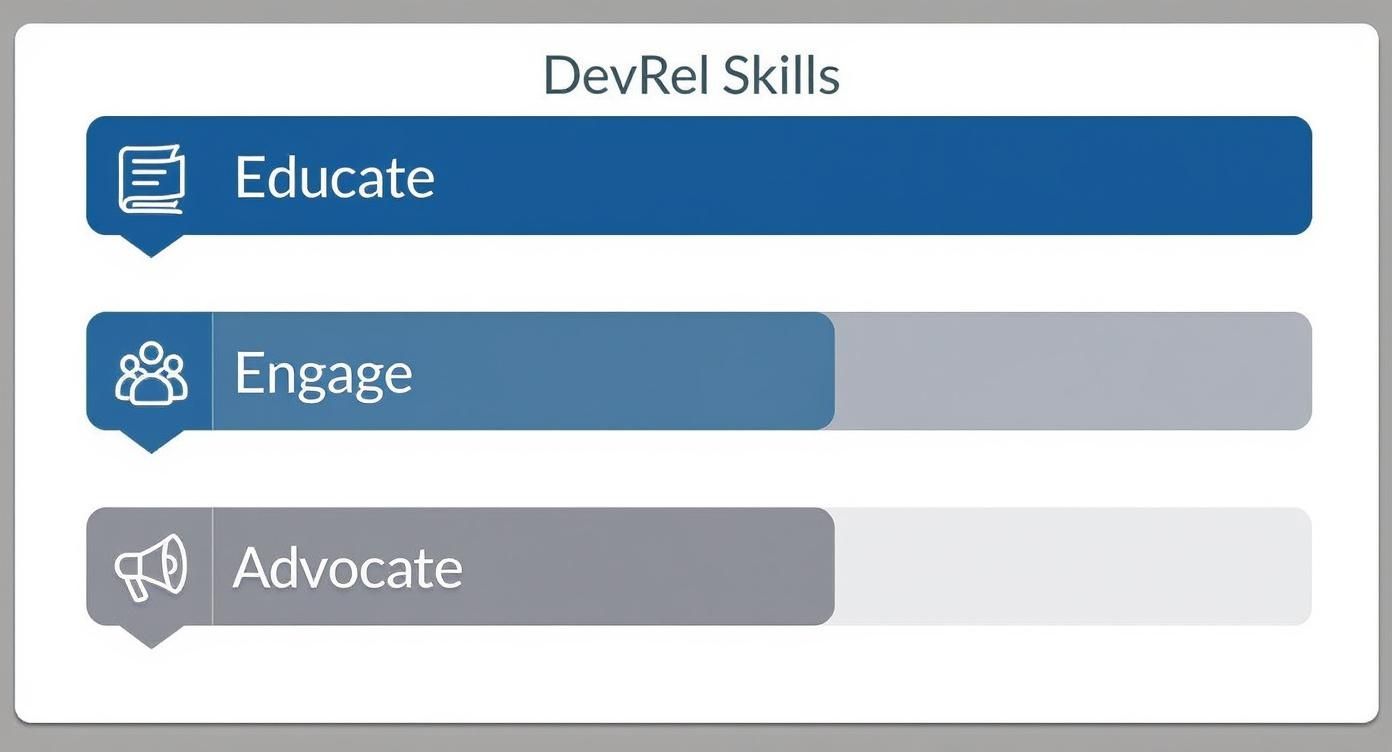
As you can see, it's a blend of teaching, connecting, and championing. The more you can prove you’ve got all three covered, the stronger your negotiating position becomes.
What to Expect on Your Paycheck
Let's get down to the numbers you can expect. DevRel compensation can vary significantly based on your experience level, the company's size, and your location. A job at a Series C startup in Silicon Valley will pay differently than one at a smaller company in a lower cost-of-living area.
In the U.S., you're generally looking at a national average salary of around $109,499 a year. That said, the full range is pretty wide, stretching from $65,000 on the low end to $174,000 for more seasoned professionals. Most roles fall between $69,000 and $150,000. Top performers with proven impact can command salaries north of $168,000 annually.
The more technical roles, like a Developer Relations Engineer, tend to command even higher salaries. It’s not uncommon for senior-level engineers in DevRel to pull in an average total compensation of $262,000. For a deeper dive into the data, you can learn more about DevRel compensation trends on ZipRecruiter.
A key takeaway for job seekers is that technical depth pays. Roles that require you to be hands-on with code are compensated at a premium because finding someone who is both a skilled engineer and a great communicator is like finding a unicorn.
Key Factors That Influence Your Salary
When you get to the offer stage, a few key things will influence your final compensation package. If you understand these levers, you can build a much stronger case for the salary you want.
- Technical Specialization: Are you an expert in a hot niche like AI/ML, blockchain, or a specific cloud platform? That kind of specialized knowledge instantly makes you a more valuable hire.
- Proven Impact: This is huge for negotiations. Can you show, with data, how your past work moved the needle? Think increased API adoption, a drop in support tickets, or a thriving community forum. Metrics are your best friend.
- Company Stage: An early-stage startup might offer a lower base salary but include a generous slice of equity. A larger public company will likely offer a higher base salary and more structured bonuses. Weigh what matters most for your career stage.
- Geographic Location: No surprise here—the big tech hubs like the San Francisco Bay Area, New York, and Seattle still pay the most to offset the high cost of living.
Keep these factors in mind as you interview. Knowing how they apply to you will help you confidently position yourself and land a compensation package that truly reflects your value.
How to Build a Portfolio That Lands Interviews

Let's be honest: a resume gets you on the list, but a strong portfolio gets you the interview. For anyone trying to break into developer relations, your portfolio is the evidence that you can do the job. It’s where you show—not just tell—that you can educate, engage, and advocate for developers.
Think of your portfolio as your highlight reel for hiring managers. Every piece should demonstrate a core DevRel skill. This isn't about having a fancy website; it's about strategically showcasing work that proves you already think and act like a DevRel professional.
Start With a Content Hub
First things first, you need a home base for your work, and a personal blog is the perfect foundation. This is your stage to show off your communication style, technical depth, and ability to break down complex topics. A blog is a living resume that you can constantly update with new projects.
Hiring managers will review your blog to see if you can write clearly, build a solid technical argument, and connect with an audience. This is your best opportunity to shape the narrative around your expertise before you even speak to a recruiter.
Demonstrate Your Skills With Actionable Projects
Writing is crucial, but your portfolio also needs to show you can actively participate in the developer ecosystem. The goal is to create assets that directly mirror the responsibilities you see in job descriptions for developer relations jobs.
Here are three high-impact areas to focus on to impress recruiters:
- Public Speaking: You don't need a keynote at a major conference. Record a talk you give at a local meetup or a webinar you host. Even a "speaking reel" with one or two solid presentations shows you have the confidence and skill to command a room—a key requirement for the job.
- Open-Source Contributions: Contributing to an open-source project is an incredibly powerful signal to employers. It proves you can collaborate, navigate a new codebase, and improve documentation—all essential DevRel skills. It shows you're a builder, not just a talker.
- Sample Projects or Demos: Build a small application or a demo using a technology you're passionate about. Document the process in a blog post and host the code on GitHub. This directly showcases your ability to learn, build, and then teach others.
A great portfolio answers the hiring manager's biggest question: "Can this person actually do the job?" By creating public work, you provide undeniable proof that you can.
Curate Your Online Presence
Your social media profiles—especially on platforms like X (formerly Twitter) and LinkedIn—are absolutely part of your professional portfolio. Recruiters and hiring managers use these platforms to vet candidates and look for people who are already part of the developer conversation.
Share your blog posts, engage in industry discussions with thoughtful comments, and connect with other developers. Your online activity should reflect your passion for technology and your ability to build professional relationships. With the market for skilled developers projected to grow by 26% between 2022 and 2032, a polished online presence helps you cut through the noise. You can discover more insights on developer job growth to see just how competitive it is.
Building a portfolio is a marathon, not a sprint. Start small, be consistent, and create work that genuinely helps other developers. This body of work will not only prove your skills but also attract the right kinds of career opportunities. You can see how these skills translate directly by looking at a real-world Developer Relations Content & OSS role, which almost always requires a strong portfolio.
Navigating the DevRel Interview Process

Interviewing for a developer relations job is a unique challenge. It blends the technical grilling of a software engineering interview with the communication and presentation skills of a public-facing role.
You must prove you can code, communicate clearly, and genuinely connect with an audience—sometimes all in the same conversation. To land the offer, you'll need to successfully navigate several distinct stages, each designed to test a different part of your DevRel toolkit.
Deconstructing the Interview Stages
Most DevRel interview loops follow a fairly standard path. While the exact order may vary, you should prepare for a mix of technical challenges, behavioral questions, and a final presentation.
- Recruiter & Hiring Manager Screens: This is the initial fit check. The recruiter matches your resume to the job description, while the hiring manager assesses your high-level understanding of the role. Be ready for questions like, "What does DevRel mean to you?" and "Why are you interested in our developer community?"
- The Technical Deep-Dive: Here, you'll meet with engineers who need to verify your technical credibility. You might be asked to walk through a project from your portfolio, explain a complex technical concept in simple terms, or debug a problem using the company's API.
- The Behavioral Interview: This stage focuses on your soft skills and experience. The team wants to see how you handle real-world scenarios. Use the STAR method (Situation, Task, Action, Result) to structure your answers and tell compelling stories about your past accomplishments.
Come prepared with a few solid stories in your back pocket. Think about times you showed empathy for a user, solved a tricky problem, or went to bat for a developer's needs. Your past actions are the best evidence of how you'll perform in the future.
Acing Common DevRel Interview Questions
Hiring managers aren't just looking for the "right" answer; they're trying to understand your thought process. Getting ready for a DevRel interview means preparing for a wide range of questions that test your technical, strategic, and people skills.
Here’s a breakdown of what to expect and how to frame your answers to show you’re a top candidate.
| Question Type | Example Question | What Hiring Managers Are Looking For |
|---|---|---|
| Behavioral | "Tell me about a time you got negative feedback from the community. How did you handle it?" | They’re testing your empathy, communication skills, and ability to turn a negative situation into a positive one. Show that you can listen, take responsibility, and work toward a constructive solution. |
| Strategic | "How would you measure the success of a DevRel program?" | This question assesses your business acumen. Can you connect DevRel activities (like blog posts) to business goals (like higher product adoption or fewer support tickets)? Show you think about ROI. |
| Technical | "A developer is stuck on our API's authentication. Walk me through how you'd help them." | This is a multi-layered test of your technical knowledge, problem-solving skills, and teaching ability. They want to see if you can guide someone to an answer, not just give it to them. |
At the end of the day, they want to see that you're not just a good engineer or a good speaker, but a true advocate who can bridge the gap between the company and its developer community.
The Mock Presentation: The Final Boss
For many candidates, the final hurdle is the mock presentation or live demo. You'll be asked to prepare and deliver a short talk on a technical topic, usually related to the company’s product. This is your chance to pull everything together and demonstrate your skills in real-time.
To nail this critical stage, concentrate on these three things:
- Topic Selection: Choose a topic you know inside and out that allows you to showcase both your expertise and the product's strengths. Keep it focused and manageable within the given time.
- Audience Focus: Frame your presentation around solving a real-world developer problem. Always start with the why—what pain point are you solving?—before you dive into the how.
- Engagement: This isn't a lecture; it's a conversation. Ask the interviewers questions, try live coding instead of just using slides, and maintain an approachable tone. Your goal is to teach and connect.
Where to Find the Best Developer Relations Jobs
Knowing where to look for DevRel jobs is half the battle. While you can cast a wide net on large job boards, the best opportunities are often found in specialized communities where DevRel leaders and hiring managers are most active.
Go Beyond Generic Job Boards
Instead of endlessly scrolling through irrelevant listings, be more strategic. Focusing your search on niche platforms and communities will yield higher-quality opportunities and give you a competitive edge.
Here’s where you should focus your job search:
- Industry-Specific Slack & Discord Channels: This is where the real opportunities are. Communities like the DevRel Collective often have private job channels where roles are posted before they hit the public market, giving you a head start.
- Specialized Newsletters: Subscribe to newsletters that cater to the DevRel community. Hiring managers use these as a direct line to a highly engaged audience, so they often share exclusive openings there first.
- Tech-Specific Job Sites: If you're targeting a particular ecosystem like Web3 or AI, use job sites dedicated to that space. Companies posting there are looking for candidates who are already deeply invested in the industry.
Your network is probably the most powerful tool you have. So many DevRel roles are filled through referrals and quiet connections long before a formal job description is ever written. Focus on building genuine relationships.
Don't underestimate the power of strategic networking, both online and at industry events. For more tips on navigating your career and staying on top of industry trends, check out resources like the Blockchain Jobs blog, which often dives into topics that are super relevant for tech roles.
Common Questions About A Career in DevRel
If you're considering a career in Developer Relations, you likely have many questions. Let's tackle some of the most common ones that job seekers ask and that come up during interviews.
Do I Have to Be a Senior Engineer?
Not necessarily, but you need solid technical credibility. Most people who successfully transition into developer relations jobs come from mid-level engineering roles with at least a few years of hands-on coding experience. The reason is simple: you need to have lived the developer experience to truly understand and advocate for it.
You don't need a "Principal Engineer" title, but you must be confident enough to build a demo, troubleshoot a complex API, and hold your own in technical discussions. This shared experience is the foundation of empathy and is non-negotiable for a successful DevRel career.
How Are DevRel Roles Changing with Tighter Budgets?
The landscape is definitely evolving. In the past, much of DevRel focused on long-term community building with less defined metrics. Today, companies demand a clearer return on investment, which directly impacts hiring and career progression.
The need for technical advocacy and community building hasn’t disappeared—it’s just evolving. Many of the developer relations engineers that have survived this change have embraced the shift into marketing, leaning on their expertise as content generators.
For job seekers, this means you need to think like a business owner. In interviews, be prepared to discuss how your efforts can drive product adoption, lower customer churn, or generate qualified leads. If you can connect your passion for community with results that impact the bottom line, you'll be a much more compelling and successful candidate in today's market.
Ready to find your place in the fast-moving world of Web3? At Blockchain Jobs, we connect top talent with the best developer relations jobs and other roles in the decentralized ecosystem. Start your search and discover your next opportunity at https://blockchain-jobs.com.