Finding and Landing High-Paying Security Freelance Jobs
More and more security professionals are ditching the traditional 9-to-5 for freelance work—and for good reason. Going independent gives you a direct line to higher pay and lets you call the shots on your own career, tackling specific projects like penetration tests or smart contract audits without the baggage of full-time employment.
The Growing Demand for Freelance Security Experts

The idea that a successful security career is tied to a single employer is quickly becoming outdated. We're seeing a major shift in the industry, fueled by a persistent global talent shortage and the highly specialized needs of modern companies, particularly in Web3.
This new reality has swung the doors wide open for freelance security pros. The global freelance market is now worth a staggering $1.5 trillion and is climbing at a 15% compound annual growth rate. Cybersecurity experts, especially those skilled in penetration testing and incident response, are right in the middle of this boom.
Why Companies Are Turning to Freelancers
From nimble startups to massive enterprises, companies are increasingly bringing in freelancers for their most critical security needs. For hiring managers, this approach gives them the flexibility to access elite talent for a specific job without the overhead and long-term commitment of a full-time hire.
Need a pre-launch security audit or a deep dive into network vulnerabilities? They can pull in an expert for exactly that, right when they need them.
For your career progression, this shift is a game-changer. Here’s what it means for you:
- Higher Earning Potential: Freelancers consistently command higher rates than their salaried peers, enabling faster financial growth.
- Total Flexibility: You set your own schedule and, more importantly, you get to pick projects that align with your long-term career goals.
- Rapid Skill Growth: Jumping between clients means you're constantly exposed to new technologies and unique challenges, which fast-tracks your learning curve and makes your resume more impressive.
When you're a freelancer, you're in the driver's seat of your own career. You're not waiting around for a promotion; you're actively building your reputation and expertise by choosing high-impact projects that lead to better future opportunities.
This model is particularly common in the blockchain space. The demand for highly specialized skills, like those required for an offensive security engineer role, simply outstrips the available full-time talent pool. As the market keeps evolving, freelance security jobs aren't just an alternative—they're a strategic career move for anyone serious about getting ahead.
Building Your Brand to Attract High-Value Clients
Before you even think about looking for freelance security gigs, you need to realize something: your professional brand is your resume that never sleeps. In a market this crowded, a strong personal brand is your best advocate. It convinces hiring managers you’re the right choice before you’ve even sent a proposal.
It’s the key difference between constantly chasing down leads and having high-value projects land in your inbox. Think of it as the foundation of your career progression. It’s what makes you stand out when your skillset looks just like the next person's.
Optimize Your LinkedIn to Show Up in Searches
Let’s be honest, your LinkedIn profile is probably the first place a hiring manager is going to look. It needs to be more than just a digital resume; it needs to be a sales page for your skills, optimized to land you interviews. Stop just listing job titles and start talking about outcomes.
Instead of saying you led a penetration test, reframe it to highlight the business impact: "Identified and helped patch 15 critical vulnerabilities in a DeFi protocol, preventing a potential $500,000 exploit." That kind of language gets a hiring manager's attention because it speaks directly to the value you provide.
You also have to get smart about keywords. Recruiters and clients don't just browse; they search. Pack your headline and summary with the exact terms they’re using to find talent.
- "Freelance Smart Contract Auditor | Web3 Security Specialist"
- "Cloud Security Consultant specializing in AWS & GCP | CISSP"
- "Independent Penetration Tester (OSCP) | Offensive Security"
Build a Portfolio That Works Around NDAs
You absolutely need a portfolio to get hired, but we all know non-disclosure agreements can make that a serious headache. You can't just share client details, but you can show off your thought process. The solution? Anonymized case studies.
Focus on the what and the how, not the who. Describe the challenge (e.g., "auditing a complex DeFi lending protocol"), the hurdles you overcame ("undocumented, complex business logic"), the tools you brought to the table, and the types of vulnerabilities you uncovered (e.g., reentrancy, oracle manipulation).
This strategy proves your technical chops and strategic thinking without breaking any agreements. It’s exactly the kind of substance clients need to see to feel confident in inviting you to an interview.
Put Your Expertise on Public Display
The single best way to advance your freelance career is to prove what you know, out in the open. This is how you build real trust and establish yourself as an authority, not just another applicant.
Jump into open-source security projects on GitHub. Finding and fixing a bug in a widely used tool is a public receipt of your skills—it's tangible proof that you can add to your resume.
Another great move is to write detailed technical blog posts. A deep dive into how you found a specific vulnerability or your methodology for auditing a new type of smart contract becomes a living part of your portfolio. It shows you can communicate complex ideas clearly, which is a massive plus for any hiring manager. This is how you build a magnetic brand that pulls in the best work.
Where to Find the Best Security Freelance Jobs
Alright, you’ve polished up your professional brand. Now for the real work: finding clients who will pay for your expertise. Don't waste your time scrolling through generic job boards. The best opportunities are on specialized platforms where serious clients are looking for top-tier security talent. Knowing where to look is half the battle for career progression.
The demand for freelance security pros is exploding. Companies are scrambling to find experts, and they’re willing to pay for them. The global freelance platforms market is on track to hit USD 6.37 billion in 2025, up from USD 5.58 billion in 2024. That’s a massive pie, and if you play your cards right, you can get a slice. You can dig into more of this data from Grand View Research.
This quick visual can help you figure out whether to double down on building your portfolio or focus on getting more hands-on experience first.
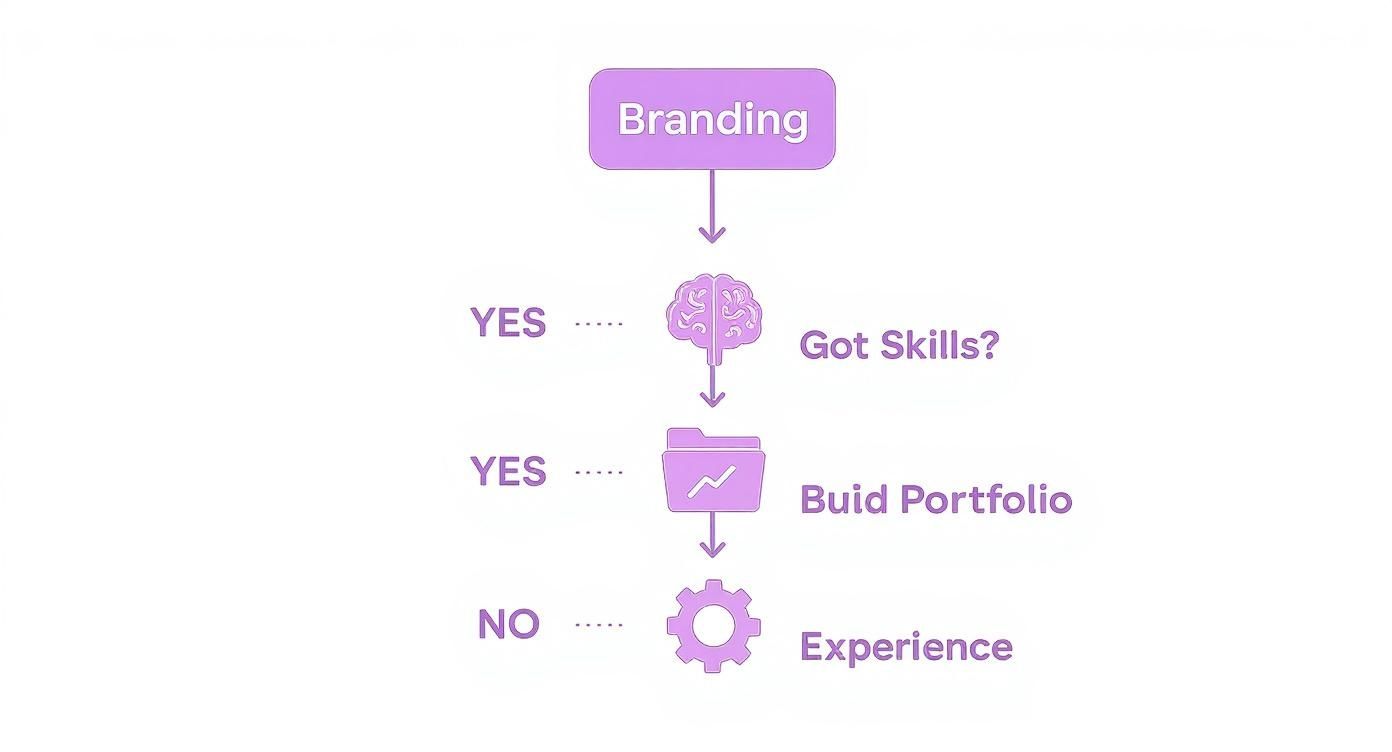
The takeaway is simple: both paths can lead to a successful freelance career. It just depends on your starting point—are you showcasing existing skills to land a job now, or building new ones for future roles?
Top Platforms for Finding Security Freelance Work
Choosing the right platform can make or break your job search. Are you looking for a steady stream of smaller projects to build experience or hunting for that one high-stakes, six-figure audit? This table breaks down your options to help you focus your energy where it'll count the most.
| Platform Type | Best For | Example Platforms | Actionable Tip for Getting Hired |
|---|---|---|---|
| Freelance Marketplaces | A consistent flow of diverse projects to build experience and a client base. | Upwork, Toptal | Your profile is your sales page. Go beyond a simple resume; detail your project wins and certifications (like OSCP or CISSP) and write custom proposals for every single job. |
| Niche Web3 Job Boards | Highly specialized, high-value roles that accelerate your career in a specific domain. | Web3.career, CryptoJobsList | These are curated communities. Demonstrate you understand the ecosystem by highlighting your GitHub contributions and past Web3-specific projects to show you're a specialist, not a tourist. |
| Bug Bounty Platforms | Proving your offensive security skills through real-world results and getting headhunted. | HackerOne, Bugcrowd | Focus on quality over quantity. A few well-documented, high-impact findings will get you noticed and invited to private programs far faster than a hundred low-level reports. This is your public resume. |
Ultimately, you don't have to stick to just one. The most successful freelancers have a presence on multiple platforms, leveraging each to advance their career.
Premier Freelance Marketplaces
Big marketplaces like Upwork and Toptal are a great place to build your initial track record. Think of them as massive digital hubs connecting freelancers with a constant stream of clients. The projects are incredibly varied—one day you might be pen-testing a network, the next you could be consulting on security policy.
The competition can be fierce, but a killer profile makes all the difference. When you apply, don’t just send a generic pitch. Read the client's brief and speak directly to their pain points. Show them you understand their problem better than they do—that's how you get the interview.
Niche Web3 and Blockchain Job Boards
If you’re deep in the world of decentralized tech, general-purpose platforms just won't cut it. The truly career-defining smart contract auditing and DeFi security gigs are posted on niche job boards. This is where innovative Web3 projects go to find experts who speak their language.
The beauty of these boards is the signal-to-noise ratio. You’re not competing with thousands of generalists. The best part? The jobs are often more interesting and pay better. For a sense of what's out there, you can browse listings for blockchain security roles to see the caliber of opportunities in this space.
Your ability to land high-value work comes down to how well you can articulate your value. A sharp, focused profile on a niche board is often your ticket to an interview for a six-figure project.
Bug Bounty Platforms
Platforms like HackerOne and Bugcrowd offer a completely different route into freelancing. Sure, you can earn rewards for finding bugs, but the real career value is in building a public track record of your skills. It's undeniable proof of your capabilities that you can point to in any interview.
Top performers on these platforms don't have to look for work; work finds them. They get invited to private, high-paying programs and are often headhunted for freelance contracts. Consistently submitting high-quality vulnerability reports is one of the most powerful career-building tools you have.
Crafting Proposals That Lead to Interviews
Your proposal is your first interview. It’s where you prove you understand the client's problem better than anyone else applying. Sending a generic, copy-pasted pitch is the fastest way to get your application tossed. A sharp, tailored proposal that speaks directly to a hiring manager’s pain points? That’s what lands you the real interview.
Think of the job description as a problem statement. Your proposal is the solution. The client isn’t just hiring a "penetration tester"; they're looking for someone to find the exact vulnerabilities that could torch their reputation. You have to frame your entire pitch around that reality to get hired.
Dissecting the Job Description for Clues
Before you write, read between the lines of the client's request. Your goal is to pinpoint their core anxieties. A gig asking for a "smart contract audit" isn't just a technical task. The hiring manager is worried about reentrancy attacks, oracle manipulation, and losing user funds.
Your proposal must address those fears head-on. Don’t just list your skills—that’s what LinkedIn is for. Instead, connect your experience directly to their specific problem.
- Instead of this: "I have experience with smart contract security."
- Try this: "My background in identifying and mitigating common DeFi exploits, especially reentrancy and flash loan attacks, is a perfect match for the need to secure your new lending protocol before it goes live. I can help prevent the types of vulnerabilities that have cost other protocols millions."
That shift changes everything. You’re no longer just an applicant. You’re now a strategic partner who understands the stakes.
A great proposal doesn't just say what you can do. It explains why it matters to the client's business. It's the difference between being a hired gun and becoming a trusted advisor, which leads to better projects and higher pay.
A Simple Framework for a Winning Proposal
Forget long introductions. You need to get straight to the point with a structure that respects a hiring manager’s time and shows your value immediately.
- The Hook (Acknowledge Their Problem): Start by restating their main problem in your own words. It’s a simple move that immediately shows you’ve read the brief and are focused on their needs.
- The Solution (Your Approach): Briefly outline how you plan to solve their problem. Mention a specific methodology or tool relevant to their tech stack. This shows you're already thinking about the job.
- The Proof (Your Experience): Drop one or two powerful, relevant examples from your past work. Use concrete results and metrics. This is your mini-case study to prove you've done this before and succeeded.
This format proves you're a problem-solver from the get-go. It’s a powerful way to filter yourself to the top of the pile for the best security freelance jobs.
Acing the Interview with the STAR Method
Once your killer proposal gets you in the door, the interview is where you close the deal. When asked behavioral questions about your experience, use the STAR method to frame your responses and tell compelling stories about your past wins.
- Situation: Briefly set the scene. "At a previous client, we were preparing to launch a new DeFi protocol..."
- Task: What was your specific responsibility? "My task was to perform a final security audit with a focus on business logic vulnerabilities."
- Action: What specific steps did you take? "I used a combination of static analysis with Slither and manual review of the contract interactions, specifically simulating flash loan scenarios..."
- Result: What happened in the end? Quantify your impact. "As a result, I discovered a critical reentrancy bug that could have been exploited to drain the protocol's treasury. We patched it before launch, securing over $2M in user funds."
Using this framework shows you can think strategically and deliver results that matter. It’s how you turn a conversation into a compelling argument for why you’re the only person for the job.
Setting Your Rates and Mastering Contract Negotiations

Let's talk about the hard part: money and contracts. Underpricing your expertise is the fastest way to burn out, and weak contracts can jeopardize your career. Getting this right isn't just about getting paid; it’s about establishing your value and building a sustainable business.
The freelance market for security pros is hot. The global freelance platforms market is on track to hit USD 13.3 billion by 2030, and specialized work like penetration testing or incident response commands top-dollar. You can find more stats on the growth of the freelance market on keywordseverywhere.com. Knowing this landscape gives you the confidence to price yourself accordingly.
Calculating Your True Value
Before you can name your price in a proposal or interview, you need to decide how you'll charge. Each pricing model serves a different purpose, and choosing the right one is a key career skill.
- Hourly Rates: Your go-to for projects with a vague scope or ongoing advisory roles. This is a good entry point but requires meticulous time tracking to ensure you're paid fairly.
- Daily Rates: Perfect for short, intense engagements like on-site assessments or team training. This keeps billing clean for concentrated work.
- Project-Based Rates: The best option for well-defined tasks like a smart contract audit or a pen test with clear deliverables. You're pricing the result, not the hours, which often leads to higher effective earnings as you become more efficient.
When calculating a project rate, estimate your hours, multiply by your ideal hourly rate, and then add a 15-20% buffer. This cushion covers scope creep, admin time, and the risks you take on as a business owner.
Don't just copy what other freelancers charge. Your rate is a reflection of your unique expertise, certifications like OSCP or CISSP, and the massive financial risk you're helping a company avoid. In a hiring conversation, you aren't just an expense; you're insurance against a catastrophic breach.
Negotiating Contracts That Protect You
A verbal agreement is worthless. A solid contract is your shield, protecting you and the client. Getting the paperwork right is as important as the security work itself for your long-term career stability.
Ensure these three clauses are rock-solid in every contract you sign:
- Scope of Work (SOW): Be brutally specific. Define exactly what you’ll do, what systems are in scope, what is explicitly out of scope, and what the final deliverables are. A tight SOW is your best defense against "scope creep"—the extra requests that derail projects and hurt profitability.
- Intellectual Property (IP): The contract needs to state who owns what. Typically, the client owns the final report. However, you must retain the rights to your own methodologies, custom scripts, and tools. This lets you reuse your processes on future jobs.
- Payment Terms: Never start work without a clear payment schedule. For large projects, milestone payments are standard (e.g., 50% upfront, 50% on final delivery). If billing hourly, be clear about your invoicing schedule and late payment penalties.
Getting comfortable with these negotiations is a skill that separates seasoned professionals from amateurs. When a client sees you handle the contract process with this level of detail—especially for a role like a senior security engineer—it builds instant trust and sets the stage for a successful engagement.
Got Questions About Going Freelance in Security?
Stepping out on your own as a freelance security pro is a significant career move. You have the technical skills, but now you're also the CEO, sales team, and accountant. It’s a lot to juggle.
Let's break down the common questions that come up during this career transition.
How Much Experience Do I Really Need to Start?
There's no magic number, but the sweet spot is typically 3-5 years of hands-on experience. Hiring managers are paying for your expertise—they expect you to solve problems independently, not learn on their dime.
But what if you're not there yet? You can still build a powerful portfolio to get hired.
- Jump into open-source: Contributing to real projects is public proof of your skills that you can show a hiring manager.
- Hunt for bugs: Participating in bug bounties on platforms like HackerOne or Bugcrowd demonstrates practical offensive security talent.
- Get certified: Credentials like the OSCP or CISSP are instant credibility boosters in interviews and on your resume. They act as a trusted third-party stamp of approval.
What Freelance Skills Are Actually in Demand Right Now?
The security landscape is always moving, but a few areas are consistently hot. Specializing here will help you get hired faster and command higher rates.
Right now, hiring managers are scrambling for experts in:
- Cloud Security: Deep expertise in securing AWS, Azure, or GCP environments is highly sought after.
- Application Security (AppSec): Companies need people who can embed security into the entire software development lifecycle (DevSecOps).
- Smart Contract Auditing: The demand in Web3 for sharp auditors who can find vulnerabilities in DeFi protocols and NFT projects is massive and pays extremely well.
Pro Tip: Don't overlook the power of a niche. Skills in areas like IoT or operational technology (OT) security can make you incredibly valuable for career progression. The talent pool is smaller, meaning less competition and higher rates.
Should I Use a Freelance Platform or Go It Alone?
The most effective career strategy is to do both, especially when you're starting.
Platforms like Upwork or Toptal are fantastic for getting started. They provide a steady stream of leads and handle payments, making them the perfect training ground for building your portfolio and getting positive reviews, even though they take a cut.
On the other hand, finding clients directly through your network or LinkedIn lets you keep 100% of your earnings and build direct, long-term relationships. A smart approach is to use platforms to build initial momentum and social proof, then focus more on direct clients as your reputation grows.
How Do I Handle Taxes and Insurance?
Welcome to being a business owner! You are now responsible for your own taxes and liability. The first actionable step is to set aside a portion of every payment for taxes. A good rule of thumb is 25-30%, but consulting a CPA is non-negotiable for long-term success.
You also absolutely need professional insurance. Do not skip this.
- Errors & Omissions (E&O): This protects you if a client claims your work was negligent or caused them a financial loss.
- Cyber Liability: This can cover your costs if you are involved in a security breach related to a client project.
Investing in advice from a CPA and an insurance agent who work with freelancers is one of the best moves you can make for your career. It protects you and your business, allowing you to focus on the technical work.
Ready to find your next opportunity in the world of Web3 security? Blockchain Jobs is the premier job board for roles in DeFi, NFTs, and the decentralized future.