
How to Hire Hyperledger Developers That Actually Ship

The most popular hiring advice is wrong: a blockchain developer isn't automatically a Hyperledger developer. Someone who can write Solidity or a basic chaincode sample may still be unable to configure a Fabric network, troubleshoot failed endorsements, integrate enterprise identity, or operate peers in Kubernetes. If you hire for syntax, you'll inherit the operational gaps later.
The better approach is to treat the role as systems integration with blockchain responsibilities. Screen for production exposure first, then test chaincode depth, distributed-systems reasoning, security hygiene, and the ability to work across platform, identity, and backend teams.
Why Hiring Hyperledger Developers Is Harder Than It Looks
Hyperledger roles often get written like generic smart-contract positions. That shortcut creates a predictable failure: the candidate understands ledger logic but hasn't operated the infrastructure that makes a permissioned network useful to an enterprise.
Fabric engineers need to reason about Membership Service Providers, certificate authorities, ordering services, gossip, channels, endorsement policies, CouchDB state, and private data collections. They also need to deploy and observe peers, orderers, and supporting services. A developer who has only built a tutorial application may know the vocabulary without knowing how those components behave together.
Practical rule: Ask candidates what they personally deployed, configured, broke, and repaired. Don't accept a list of framework names as evidence.
The hiring context matters. Hyperledger began in 2015 as a Linux Foundation project seeded by 21 founding members. By 2021, it had expanded into the Hyperledger Foundation with 18 projects, more than 50 labs, 16 Special Interest and Working Groups, and more than 200 members, according to the Linux Foundation's Hyperledger Foundation update. By 2026, the ecosystem had accumulated contributions from more than 350 companies, reinforcing that this is a multi-stakeholder enterprise environment rather than a narrow experiment.
The production gap
Frontend engineers, DeFi developers, and general backend developers can transition into Hyperledger work, but they won't all bring the required operational muscle. The strongest candidates have already handled questions such as:
- Identity: How are organizations, users, peers, and administrators represented and governed?
- Network operations: How are certificates issued, rotated, revoked, and audited?
- Data privacy: When should a team use channels, private data collections, or application-level controls?
- Reliability: What happens when an orderer, peer, or certificate authority becomes unavailable?
- Delivery: How does chaincode move through testing, approval, deployment, upgrade, and rollback?
Use those questions before discussing broad blockchain theory. A candidate who has debugged an endorsement policy failure in a real network deserves more attention than one who can explain decentralization fluently but has never deployed across multiple organizations.
The Hyperledger Stack You Are Hiring For
Hyperledger is a Linux Foundation umbrella, not a single product. Choose the framework before you define the role. That decision sets the candidate profile, interview questions, and infrastructure experience your team must hire for.
Hyperledger Fabric usually demands the broadest enterprise skill set. Its permissioned architecture includes organizational identity, access controls, channels, private data collections, and configurable network components. A Fabric developer should write chaincode in Go, JavaScript, TypeScript, or Java, and work confidently with the Fabric SDK or Gateway API, peer and orderer operations, network configuration, and gossip behavior.
The difficult hire is an engineer who can operate the whole network, not someone who only knows chaincode syntax. Production work includes coordinating organizations, configuring identities, diagnosing failed transactions, and connecting the ledger to existing enterprise systems.
Hyperledger Besu requires a different background. Besu gives teams Ethereum-compatible tooling in a permissioned environment, so candidates should understand the EVM, Ethereum clients, transaction behavior, and consensus approaches such as QBFT or Clique. Deep Fabric experience can transfer, but the operational models are not interchangeable. Review the requirements of a Besu-focused blockchain developer role before adapting a Fabric scorecard for an EVM-oriented search.
Sawtooth, Indy, and Iroha appear in narrower use cases. Sawtooth may suit provenance and supply-chain programs, Indy is associated with decentralized identity, and Iroha can fit permissioned environments that need simpler operational patterns. Select among them according to the application, governance model, identity requirements, and existing engineering stack.
Match the framework to the candidate
| Framework | Consensus Model | Primary Language | Typical Candidate Background | Hiring Difficulty |
|---|---|---|---|---|
| Hyperledger Fabric | Pluggable ordering and consensus architecture, commonly including Raft | Go, JavaScript, TypeScript, Java | Enterprise backend, platform, security, and distributed-systems engineering | High, because production operations matter as much as chaincode |
| Hyperledger Besu | QBFT, Clique, and other supported Ethereum-oriented options | Java, plus EVM tooling | Ethereum client, EVM, infrastructure, and enterprise integration work | High when permissioned-network operations are required |
| Hyperledger Sawtooth | Pluggable consensus | Python, Go, JavaScript, and other supported languages | Supply-chain, provenance, and distributed-application engineering | Specialized |
| Hyperledger Indy | Permissioned identity-oriented network model | Varies by implementation and integration layer | Decentralized identity, credentials, and security engineering | Specialized |
| Hyperledger Iroha | Permissioned consensus suited to its implementation model | C++, Rust, and application integration languages | Permissioned applications, mobile, IoT, or platform engineering | Specialized |
Write the scorecard after the architecture decision. Hiring for Fabric when the product needs Besu wastes time. Hiring an EVM specialist for a Fabric deployment leaves gaps around MSPs, channels, endorsement, and peer administration.
Defining the Role With a Hyperledger Scorecard
A vague job description is the fastest way to produce a vague hire. “Blockchain experience” should never be the core requirement. Define observable production behaviors instead.
Start by separating must-have capabilities from useful but nonessential experience. The first group should describe work the engineer must perform without a long discovery period:
- Network deployment: Can the candidate deploy a Fabric network with multiple organizations and orderer services?
- Chaincode delivery: Can they write, test, package, approve, deploy, upgrade, and troubleshoot chaincode?
- Policy design: Can they configure endorsement policies and private data collections for a real business workflow?
- Peer operations: Can they explain Raft ordering, peer discovery, gossip, ledger state, and operational failure modes?
- Identity integration: Can they connect Fabric to an existing identity environment through OIDC, LDAP, or an equivalent enterprise access pattern?
- Testing discipline: Can they write unit and integration tests, including negative-permission cases?
Score every criterion from 1 to 5, weight must-have criteria at 3x, and set a 70% weighted total as the advancement threshold. Those figures belong in the internal hiring process, not merely in a recruiter's notes. They force interviewers to distinguish a candidate who has watched a deployment from one who has owned it.
Make the evidence visible
Ask for evidence in the job description. A strong posting names Fabric 2.x, chaincode languages, Gateway API experience, network configuration, testing, and production operations. It should also explain which responsibilities are required and which are optional.
Use a shared interview rubric so every interviewer evaluates the same signals. Teams that need a more general framework for consistent interview scoring can review WorkSignal hiring compliance, then adapt the process to technical evidence rather than relying on personal impressions.
Nice-to-haves can include Besu, Sawtooth, or Hyperledger FireFly orchestration. They shouldn't outrank the ability to deploy and operate the selected framework. A blockchain architect role can help hiring managers compare how architecture responsibilities differ from an implementation-focused developer position.
Where to Find Hyperledger Developers
No sourcing channel consistently produces every kind of Hyperledger candidate. Open-source communities surface protocol contributors and technically curious maintainers, while agencies and contractors are more useful when a team needs immediate deployment leadership.
The Hyperledger Foundation's Discord and mailing lists can reveal people who participate in technical discussions, review issues, or understand governance. GitHub contribution graphs for Fabric, Sawtooth, and Besu repositories add useful evidence, but contribution volume alone isn't enough. Read pull requests, issue discussions, test changes, documentation work, and release-related activity.
Niche job boards are better for candidates who are actively looking and may have practical chaincode experience without being visible in open-source governance. LinkedIn Boolean searches can find enterprise engineers by combining Fabric with Kubernetes, Go, Java, PKI, CouchDB, or identity-management terms. Specialized agencies and contractor platforms can help when the requirement is a deployment lead, auditor, or short-term integration specialist. Guidance on managing distributed teams can also inform searches for remote developers for SaaS delivery, especially when the role spans application and platform work.
| Channel | Typical Candidate Profile | Best For | Avg. Time-to-Shortlist | Cost |
|---|---|---|---|---|
| Hyperledger Discord and mailing lists | Contributors, maintainers, protocol-focused engineers | Senior technical searches and community-aware hires | Variable | Low direct sourcing cost, high relationship effort |
| GitHub repositories | Engineers with visible implementation history | Verifying real code and issue-solving depth | Variable | Low direct sourcing cost |
| Niche blockchain job boards | Active chaincode and Web3 candidates | Mid-level and senior engineering searches | Variable | Paid posting or recruiter effort |
| LinkedIn Boolean searches | Enterprise developers and consultants | Finding adjacent platform and backend talent | Variable | Recruiter time or sourcing subscription |
| Specialized agencies | Screened consultants and deployment leads | Urgent or difficult searches | Variable | Higher external fee |
| Contractor platforms | Independent engineers and auditors | Short-term delivery, assessment, or remediation | Variable | Contract spend and management overhead |
A blended funnel works best. Start with open-source communities for senior Fabric engineers, add niche boards for mid-level chaincode developers, and use agencies or contractors when you need a deployment lead inside a compressed delivery window. Review engineering-focused listings on Blockchain Jobs as one additional channel.
Treat certification-only profiles cautiously. A credential can support a candidacy, but without GitHub activity, deployment examples, architecture explanations, or strong interview performance, it doesn't prove production capability.
Screening and Interviewing Hyperledger Candidates
The screening process should move from evidence to execution. Don't begin with an abstract blockchain quiz. Begin by asking whether the candidate has done the work your network requires.
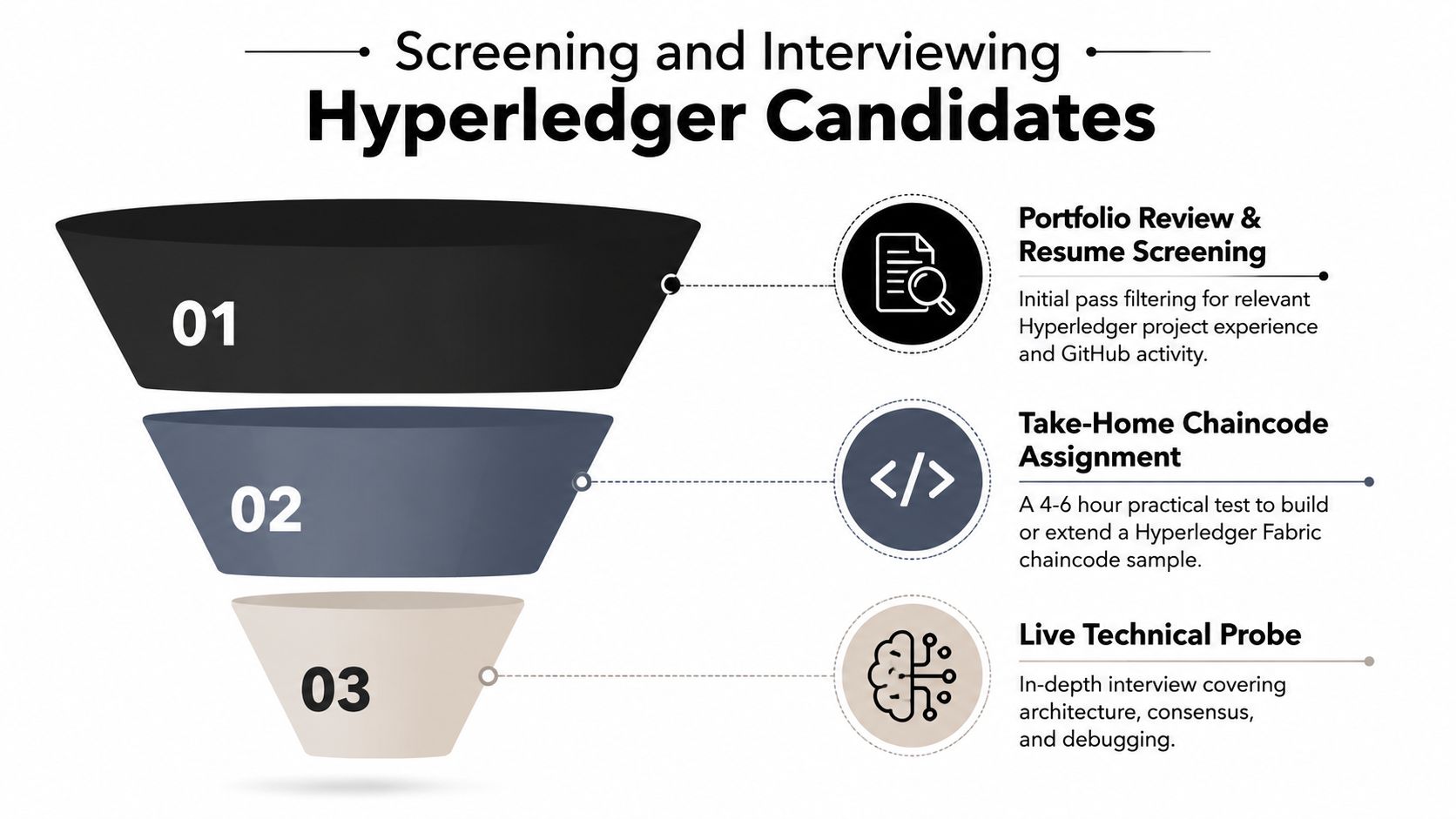
Start with portfolio evidence
Review the resume and GitHub profile for concrete signals:
- Network ownership: Look for evidence of standing up a network with multiple peers, organizations, and orderers.
- Deployment history: Ask which chaincode lifecycle steps the candidate handled personally.
- Failure analysis: Look for examples involving endorsement failures, certificate issues, peer outages, or configuration errors.
- Testing quality: Check for unit tests, integration tests, negative-permission tests, and meaningful fixtures.
- Operational context: Confirm whether the work ran in Docker, Kubernetes, or another managed environment.
Ask candidates to explain one project from architecture through incident response. Strong answers include trade-offs and failure modes. Weak answers stay at the level of definitions.
Use a bounded practical assignment
A take-home assignment should require a working Fabric chaincode implementation in Go or JavaScript, with support for private data collections and a short architecture memo. Keep the exercise bounded to 4 to 6 hours, and tell candidates exactly what the evaluator will inspect.
The pass signal is a working minimum viable implementation with coherent tests and a clear explanation of data handling. Look for awareness of CouchDB indexing, the distinction between transient data and world state, access control, and failure behavior. A polished interface doesn't compensate for insecure state transitions or an incomplete chaincode lifecycle.
The live interview should combine a 30-minute system-design probe with a 30-minute chaincode pairing exercise. Ask the candidate to design certificate-authority setup, choose an ordering service, configure MSP behavior, and explain how organizations join and govern the network.
Reject the candidate who can't explain how gossip works, how ledger checkpointing supports recovery, or how to rotate a compromised CA certificate.
Score the session across four dimensions:
- Hyperledger fluency: Fabric architecture, chaincode lifecycle, Gateway API, channels, policies, and private data.
- Distributed-systems thinking: Ordering, consistency, peer communication, failure recovery, and observability.
- Security hygiene: Certificate management, identity boundaries, authorization, secrets, and negative testing.
- Production readiness: Documentation, automation, incident response, review habits, and communication with platform teams.
The Linux Foundation's HFCP description supports this practical emphasis. The certification covers chaincode lifecycle, queries, ledger state manipulation, private data handling, endorsement policies, and client application integration, and it's positioned as a way for practitioners to demonstrate skills to prospective employers through the Hyperledger Certified Practitioner launch.
Salary and Compensation Benchmarks
Compensation discussions need a clear boundary: the verified market material available here doesn't provide regional salary figures or contract rates. Don't publish invented bands for junior, mid-level, or senior Hyperledger engineers. Instead, build compensation around the scope of the system, the scarcity of the profile, and the cost of leaving operational ownership uncovered.
Independent recruiting data illustrates why strong candidates can command attention. One 2026 recruiting estimate placed the global pool at about 26,000 active blockchain developers against more than 440,000 open positions, implying roughly a 17:1 mismatch for smart-contract roles, according to PIN's blockchain talent analysis. Hyperledger hiring is narrower still because the role combines distributed systems, security, and enterprise integration.
| Region | Junior (Base) | Mid (Base) | Senior (Base) | Contract Hourly |
|---|---|---|---|---|
| Eastern Europe | Not specified in verified data | Not specified in verified data | Not specified in verified data | Not specified in verified data |
| Latin America | Not specified in verified data | Not specified in verified data | Not specified in verified data | Not specified in verified data |
| United States | Not specified in verified data | Not specified in verified data | Not specified in verified data | Not specified in verified data |
| Western Europe | Not specified in verified data | Not specified in verified data | Not specified in verified data | Not specified in verified data |
Use salary benchmarks as negotiating anchors, not ceilings. A senior engineer who can own CA hierarchies, Kubernetes deployment, network governance, chaincode upgrades, and incident response is not equivalent to a developer who only implements application logic.
Structure the full offer
Break the package into base compensation, signing incentives where appropriate, equity, conference support, certification reimbursement, on-call expectations, and release responsibilities. Candidates evaluating enterprise blockchain roles will care about operational burden, governance meetings, and whether the team funds the training needed to maintain a complex platform.
If equity forms part of the offer, explain the instrument plainly. A resource such as non qualified stock option explained can help candidates understand one common structure, but the company still needs to provide its own terms, vesting details, tax guidance, and risk disclosures.
Onboarding and Retaining Hyperledger Talent
A Hyperledger hire shouldn't spend the first quarter assembling undocumented access, guessing at network topology, or learning identity governance through production incidents. Give the engineer a structured 30-60-90 plan that connects environment access, meaningful delivery, and long-term ownership.
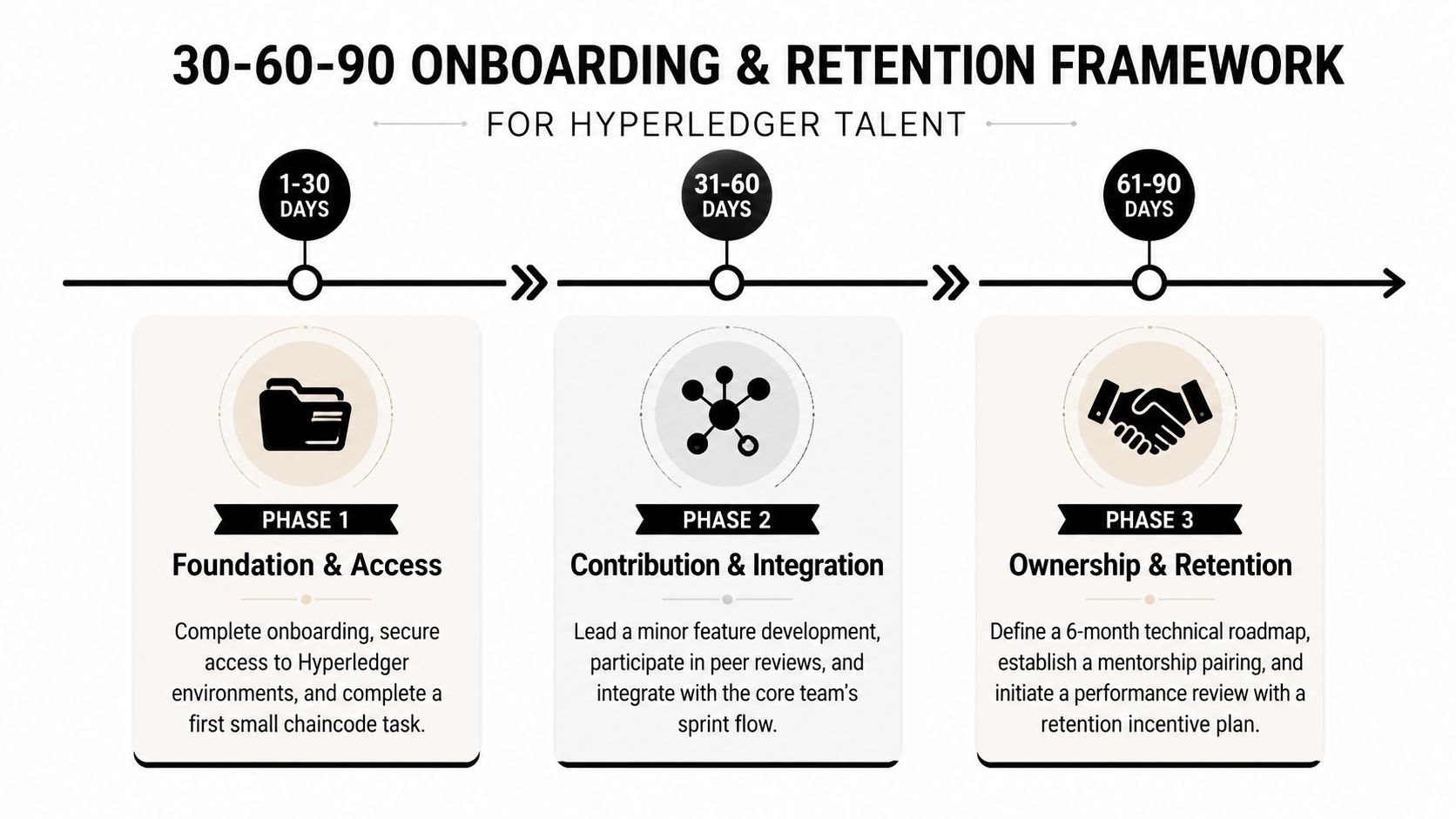
Days 1 through 30
Provision a working Fabric test network with a certificate authority, ordering service, peers, and a sample chaincode repository. The new hire should deploy the sample end to end, understand the organization boundaries, and document the commands, configuration, and access assumptions that a future teammate will need.
The first milestone checklist should confirm:
- Environment access: Repositories, test credentials, observability tools, and approved secrets access are available.
- Architecture review: The engineer can explain peers, orderers, MSPs, channels, policies, and private data boundaries.
- First delivery: A small chaincode change passes the team's tests and review process.
- Documentation: The candidate records setup and troubleshooting steps without relying on tribal knowledge.
The Linux Foundation's Fabric training material lists prerequisites including Fabric architecture, Node.js, Docker basics, Linux command-line usage, and NoSQL databases such as CouchDB. One authorized course listing describes 18 to 20 hours of self-paced material, hands-on labs and assignments, and 12 months of access, as shown in the Hyperledger Fabric developer training details.
Days 31 through 60
Assign a production-shaped ticket, such as adding a private data collection or hardening a chaincode upgrade flow. Pair the engineer with a senior reviewer from platform or security, not only another blockchain developer. This exposes integration assumptions early.
Days 61 through 90
Move the engineer into cross-team work with platform, security, and integration groups. Ask for a six-month technical roadmap, a defined ownership area, and a review of network risks. Retention improves when engineers can progress toward architecture roles, receive support for relevant Hyperledger events, and get recognition for network uptime and audit outcomes rather than feature velocity alone.
The Linux Foundation Fabric course maps training to roles such as Blockchain Developer, Solution Architect, Consultant, Engineer, and System Administrator. That progression is useful when you build a career ladder instead of treating the hire as a permanent chaincode specialist.
Avoid onboarding through generic DevOps tooling alone. Identity, ordering, channel governance, and endorsement behavior must appear in the ramp plan from the start.
Use the first 90 days to validate the original hiring decision. If the engineer can deploy independently, explain design trade-offs, collaborate across infrastructure boundaries, and improve the operating model, you hired the right profile. If not, the scorecard probably measured blockchain familiarity instead of production ownership.
If you need Hyperledger talent that can move beyond chaincode samples and help operate enterprise networks, Blockchain Jobs connects employers with specialized Web3 engineers across engineering, DevOps, infrastructure, security, and related functions. Visit the platform to post a role or find candidates whose experience better matches the systems-integration demands of Fabric and other permissioned networks.