Hiring Blockchain Developer: An Actionable Guide to Top Talent
Before you write a job description, let's get one thing straight: hiring the right blockchain developer begins with knowing exactly who you're looking for. A generic job title is a recipe for a long, frustrating search filled with mismatched candidates. Your first, most critical task is to build a detailed persona of your ideal hire.
Getting this right saves you from wasting weeks interviewing candidates who lack the specific skills your project needs. It's the foundation of your entire hiring strategy, from the interview questions you'll ask to the career path you'll offer.
Defining Your Ideal Developer Persona

The term "blockchain developer" is far too broad. It's like telling a recruiter you need a "doctor" without specifying if you need a brain surgeon or a family physician. This is the most common mistake hiring managers make, and it always leads to a pipeline full of irrelevant applications. To attract the right talent, you must map your project’s needs to a specific developer role.
This isn't just about listing programming languages; it's about defining which layer of the tech stack they will own and how their career can grow within your organization. Get this right, and everything else—from the job post to the interview questions—falls into place.
Differentiating Core Blockchain Roles
The first question to ask is: where will this person contribute? Are you building the foundational blockchain protocol itself, or the applications that run on top of it? This simple distinction helps separate the main career paths in the blockchain space.
Understanding the differences is critical for crafting a precise job description and assessing candidates effectively during interviews. Let's break down the most common specializations.
Blockchain Developer Role Specializations
| Role Title | Primary Focus | Essential Languages & Frameworks | Key Responsibilities & Interview Focus |
|---|---|---|---|
| Core Protocol Engineer | Building and maintaining the blockchain itself (Layer 1 or 2). | Rust, Go, C++ | Designing consensus algorithms, optimizing network performance, implementing core protocol rules. Interview questions should probe deep systems design and networking knowledge. |
| Smart Contract Developer | Writing secure and efficient on-chain business logic. | Solidity, Vyper, Rust (for non-EVM chains) | Writing, testing, and deploying smart contracts; focusing on security audits, gas optimization, and protocol upgrades. Interviews must test for a security-first mindset. |
| Full-Stack Web3 Developer | Connecting the on-chain backend to an off-chain user interface. | JavaScript/TypeScript, React, Ethers.js, Web3.js | Building user-facing dApps, integrating wallets, interacting with smart contracts from the frontend. Interviews should assess both frontend skills and smart contract interaction. |
Each role requires a distinct mindset and technical background. Knowing which one you need is the first step toward a successful hire.
A classic hiring mistake is posting a job for a "Full-Stack Web3 Developer" when what you really need is a security-obsessed "Smart Contract Developer." This mismatch attracts candidates who are great at building UIs but may lack the deep security and gas optimization skills that on-chain development demands, leading to failed technical interviews.
Mapping Project Needs to Technical Skills
Once you’ve identified the right archetype, connect it to a specific tech stack. The ecosystem you're building in—whether Ethereum, Solana, or something else—directly dictates the technical skills required and shapes a developer's career trajectory.
For instance, if your project is a DeFi protocol on Ethereum, your job description and interview process must be tailored for a Smart Contract Developer who lives and breathes Solidity.
Structure your technical requirements around these common pairings:
- Ethereum Virtual Machine (EVM) Ecosystems: If you're building on Ethereum, Polygon, or Avalanche, your search should focus on developers fluent in Solidity. During the interview, ask about their experience with frameworks like Hardhat or Foundry.
- Solana or NEAR Ecosystems: For projects on these high-speed chains, you need a developer proficient in Rust. Your interview process should validate their understanding of the unique programming models and tools specific to these non-EVM platforms.
- Core Protocol Development: If you're building a new blockchain, you're hunting for a rare Core Protocol Engineer. The interview must rigorously test their deep knowledge of low-level languages like Rust, Go, or C++.
Nailing down this persona with precision is the bedrock of your hiring strategy. It will guide your job description, inform your sourcing strategy, and shape the technical interviews you conduct.
Writing a Job Description That Top Web3 Talent Actually Wants to Read

In the Web3 world, your job description is your number one marketing tool. A generic corporate posting will be ignored. To attract top talent, you need to sell a story—a vision, a mission, and a set of compelling problems that a talented developer would be genuinely excited to solve.
Top-tier developers are mission-driven. They aren't just looking for a paycheck; they want to tackle fascinating technical challenges and build something they believe in. Your job description is their first window into that world and their potential career path with you.
Focus on Impact, Not Just Responsibilities
Most job descriptions are painfully boring. They list duties like "write and deploy smart contracts." This tells a candidate what they'll be doing, but it completely misses the why. Frame every responsibility around its impact to connect the daily work of coding to a larger purpose.
This simple switch helps you find builders, not just coders. You're inviting someone to help shape the future of your project and grow with it.
Let's reframe those tired bullet points for maximum impact:
Instead of: "Write, test, and deploy Solidity smart contracts."
Try: "Architect and implement secure, gas-efficient smart contracts that will manage millions of dollars in user assets, with opportunities to lead security audits and protocol design."
Instead of: "Work on our React frontend."
Try: "Build intuitive user interfaces that make decentralized technology accessible to thousands, defining the user experience that bridges the gap between Web2 and Web3."
One is a task list; the other is an invitation to take ownership and make a real impact.
Get Radically Transparent About Your Tech Stack
Experienced engineers can spot ambiguity from a mile away, and it's a huge red flag. Be upfront and detailed about your entire stack. This transparency shows technical competence and helps candidates self-select, saving everyone time in the interview process.
Don’t just list "Solidity" and "JavaScript." Get specific. Are you using Hardhat or Foundry? Ethers.js or Viem? What about testing tools like Chai and Mocha, or infrastructure like Alchemy and Infura? This level of detail shows you run a professional engineering team and gives candidates a clear picture of the technical environment they would be joining.
This honesty sets the stage for a more productive technical interview, as you can dive directly into concepts relevant to your stack.
Put the Problems Front and Center
Great developers are problem-solvers. They are drawn to complex, intellectually stimulating challenges. Your job description must highlight the specific, thorny problems they'll get to tackle. These are the hooks that grab a top developer’s attention.
The competition is fierce, with some reports showing an average of 115 applicants for a single blockchain developer role. Highlighting unique challenges is how you cut through that noise.
Frame these challenges as interview-worthy questions:
- Scaling a DeFi Protocol: "How will you help us scale our AMM to handle 10x the current trading volume while keeping gas fees manageable for users?"
- Building a Web3 Game: "What is the optimal on-chain vs. off-chain architecture for a game that needs both speed and security for its in-game assets?"
- Improving NFT Minting: "How can we design a minting process that is fair, resistant to bots, and provides a seamless experience for a community of thousands?"
By leading with the problems, you give candidates a taste of the exciting work and career growth opportunities available from day one. For a real-world example of a job post that nails this, check out this posting for a Smart Contract Engineer.
Finding and Engaging Niche Blockchain Talent

If you’re only posting on LinkedIn, you’re fishing in the wrong pond. The best talent is deep in the trenches, actively building and collaborating within dedicated Web3 communities. To find them, you have to meet them on their turf. This means becoming a credible member of the ecosystem yourself.
Sourcing in this world is about putting in the effort to understand the culture, speak the language, and offer value long before you ask to see a resume.
Go Beyond Conventional Job Boards
The most promising candidates are on platforms built for the Web3 world. Start with specialized job boards like Blockchain Jobs, which are curated for the industry and attract a pre-qualified applicant pool.
But don't stop there. The best sourcing channels are where developers showcase their work:
- GitHub: This is the ultimate proof-of-work. Look for developers contributing to open-source protocols relevant to your tech stack. A well-maintained GitHub profile with meaningful contributions is a better indicator of skill than any resume.
- Web3-Specific Job Sites: Platforms like Web3.career and CryptoJobsList are purpose-built for this audience, ensuring your role is seen by developers actively seeking their next move in the space.
Engage Authentically in Developer Communities
Your goal is to build a reputation as a knowledgeable and engaged participant. Join the right Discord servers and Telegram channels—not to spam job links, but to listen, learn, and contribute. Find the official Discord for protocols like Solidity or Arbitrum, and jump into technical discussions.
When you reach out, personalize your message. A generic "I saw your profile and was impressed" will be ignored. Reference a specific GitHub commit, a thoughtful comment they made in a Discord channel, or a project they built at a hackathon. This shows genuine interest and respect for their work, dramatically increasing your response rate.
This approach transforms a cold outreach into a warm introduction, setting a positive tone for the entire hiring process.
Turn Hackathons and Conferences into Recruiting Events
Hackathons are talent magnets. Sponsoring a hackathon or offering bounties for challenges related to your protocol is a brilliant way to spot emerging talent in action. Pay close attention to project submissions—the developers who build something impressive in a weekend are exactly the kind of problem-solvers you want on your team.
Blockchain conferences are equally valuable for networking. Focus on the side-channel discussions and developer-focused meetups where real connections are made.
The competition for these skills is intense, with a forecasted 23% annual growth rate for blockchain developer jobs. This is part of a larger trend that has seen demand for Web3 workers explode by 395%. Building relationships now is the only way to stay ahead.
Designing a Technical Interview That Actually Works
Generic algorithm questions are a waste of time when hiring a blockchain developer. Asking a candidate to reverse a binary tree tells you nothing about their ability to spot a reentrancy vulnerability or optimize gas fees. An effective technical interview must simulate the real, high-stakes challenges they'll face on the job.
This approach not only helps you find genuinely skilled engineers but also signals that your team has serious technical depth. A multi-stage process that moves from foundational concepts to practical problem-solving is the clearest way to separate the theorists from the true builders.
The Initial Technical Screen
Start with a focused 30-45 minute technical screen to gut-check a candidate's grasp of core blockchain principles. This conversation is about foundational knowledge, not deep code analysis. Keep the questions conceptual but laser-focused on the blockchain domain.
Good screening questions to ask:
- "Can you walk me through the differences between
CALL,DELEGATECALL, andSTATICCALL? What are the security implications of using each one in an interview context?" - "Describe the entire lifecycle of a transaction, from the moment a user signs it in their wallet to its final confirmation on-chain."
- "Imagine you're explaining Proof of Work vs. Proof of Stake to a non-technical stakeholder. How would you break it down?"
These questions reveal if a candidate has a solid mental model of how blockchains operate. If they struggle here, they will almost certainly fail the more practical stages that follow.
Crafting a Realistic Take-Home Assignment
The take-home assignment is your chance to see a candidate’s skills in action. Design it to mirror a real task your team would handle, and respect their time by keeping it to 3-4 hours max.
The key is to create an assignment that tests for practical, on-chain expertise. Focus on a small, self-contained problem that zeroes in on a critical skill relevant to their future career with you. For inspiration on real-world challenges, review job descriptions like this one for a Software Engineer specializing in Rust at Kraken.
A well-designed take-home task is a two-way street. It lets you evaluate their code quality and security awareness. At the same time, it gives the candidate a realistic preview of the technical challenges and engineering standards on your team, helping them decide if the role is a good fit for their career goals.
Here are a few assignment ideas and what they assess.
Effective Take-Home Assignment Ideas
| Assignment Type | Skills Assessed | Pros | Cons |
|---|---|---|---|
| Smart Contract Audit | Security analysis, vulnerability detection (reentrancy, integer overflow), understanding common attack vectors. | Directly tests the most critical skill in Web3. Shows attention to detail and a security-first mindset. | Can be tough for junior candidates. Requires a well-defined and intentionally flawed contract. |
| Gas Optimization Challenge | Deep understanding of the EVM, code efficiency, and cost-saving techniques. | Reveals a candidate's ability to write production-ready code. A key skill for career growth. | May favor developers with extensive EVM experience over those from other ecosystems. |
| Simple dApp Feature | Ability to connect a smart contract to a basic frontend, write unit tests, and structure a small project. | Provides a good overview of full-stack Web3 skills and practical development workflow. | Can get time-consuming if the scope isn't tightly controlled. May not deeply test security. |
| Protocol Logic Puzzle | System design, algorithmic thinking, and understanding of core DeFi or NFT mechanics. | Tests a candidate's ability to think through complex on-chain logic and edge cases. | Can feel too abstract if not tied to a clear, real-world use case. |
Always include a crystal-clear README with setup instructions and evaluation criteria. This level of professionalism reflects well on your engineering culture.
Probing for Depth in the Final Interview
The final technical interview should be a collaborative discussion, not an interrogation. Use the candidate’s take-home assignment as the foundation for the entire conversation. Start by asking them to walk you through their submission, then dig deeper into their thought process.
Here are some go-to interview questions to probe for depth:
- On Security: "I noticed you didn't use the Checks-Effects-Interactions pattern here. Can you explain your reasoning and talk about the potential risks?"
- On System Design: "If we needed to make this contract upgradeable, what pattern would you implement and why? What are the career-related trade-offs of specializing in upgradeable vs. immutable contracts?"
- On Code Specifics: "Why did you choose to use a
mappinghere instead of anarray? What are the gas implications of that choice?" - On Problem-Solving: "What was the most challenging part of this assignment, and how did you work through it? What did you learn?"
This turns the interview into a practical code review and architectural brainstorm, giving you far more signal than abstract puzzles ever could. It helps you hire a developer who can think critically about security, efficiency, and scalability from day one.
Structuring an Irresistible Offer
You’ve found the perfect blockchain developer. Now you’re at the stage where many companies drop the ball: making the offer. In a market where top talent often fields multiple offers, a standard compensation package won't cut it. Your offer must be a compelling blend of competitive salary, long-term incentives, and a culture that supports career growth.
Benchmarking in a Fluctuating Market
Base salary is the foundation of any good offer, but in the blockchain world, it's a moving target. Market conditions can swing wildly, so you must research current benchmarks to stay competitive.
We've seen average salary offers drop from a high of $272,000 down to $180,000 in a single month—a massive 34% drop. That volatility is tied directly to crypto market cycles. Remote work opportunities have also shifted, dropping from 83% down to 42% in a similar timeframe. Use resources like these salary trends to inform your compensation strategy and be prepared to negotiate.
It's About More Than Just Salary
Cash is king, but it's rarely the only factor. Top developers are looking for real upside and a stake in what they're building. Tokens and equity are your most powerful tools, tying their financial success directly to the project's growth and their long-term career.
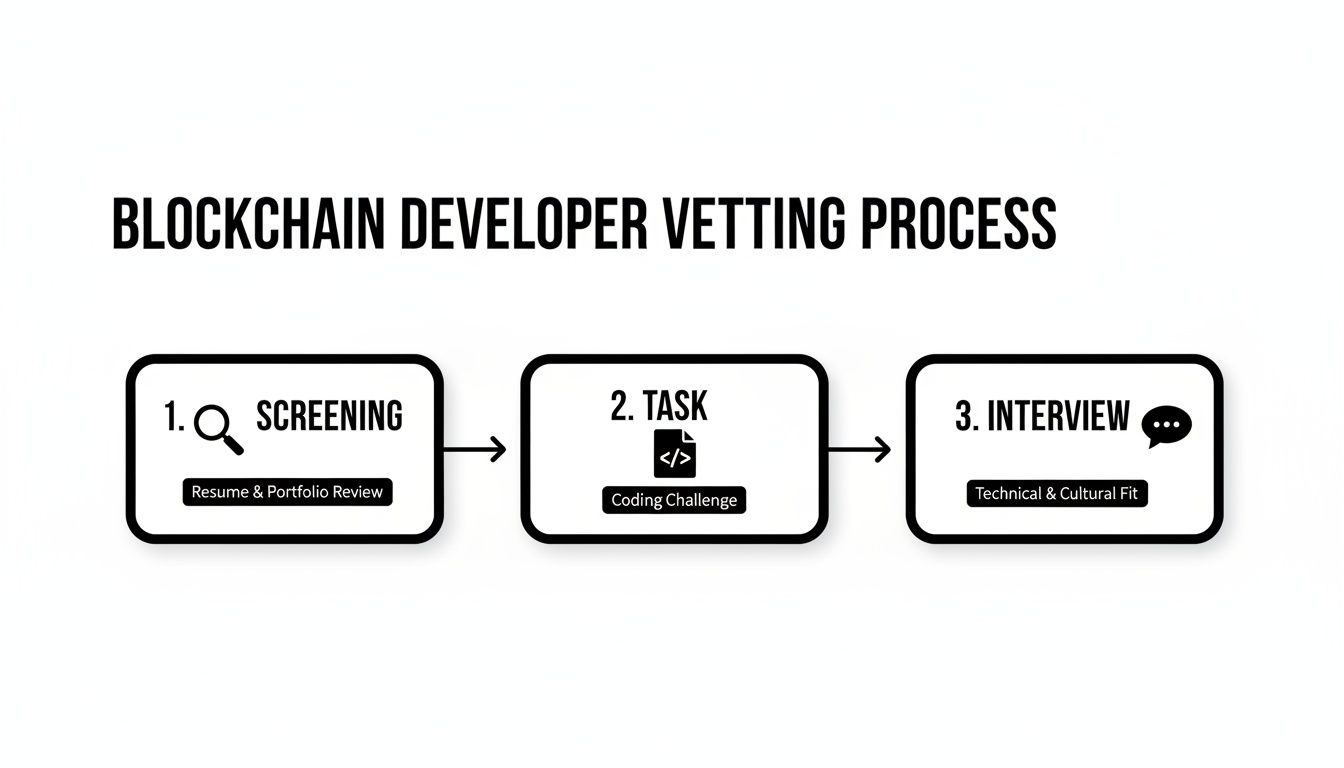
A solid vetting process, like the one illustrated above, ensures you find the right person who deserves a truly compelling, well-structured offer.
The best offers combine a strong base salary with a token package that has a clear, fair vesting schedule. This sends a powerful message: "We're not just hiring you to write code; we're inviting you to be an owner and share in the value we're creating together."
Build a holistic package with these components:
- Token Incentives: Offer a grant of your project’s native tokens with a standard vesting schedule (e.g., one-year cliff, then monthly vesting). This is a huge motivator and retention tool.
- Equity: For established companies, traditional equity through stock options is still a very attractive incentive, giving them a piece of the entire business.
- Performance Bonuses: Tie bonuses to specific, measurable achievements, like the successful launch of a mainnet feature or passing a security audit with zero critical issues. This creates clear goals for career progression.
The Power of Non-Monetary Perks
Never underestimate the pull of your company culture and the non-monetary benefits you offer. For many developers, the work environment and the chance to grow their skills are just as important as the money. A healthy engineering culture with clear documentation, a sane code review process, and a commitment to modern tools is a massive draw.
Here are a few perks that can make your offer stand out:
- A Genuinely Flexible Remote Policy: True flexibility and trust in your team to manage their own time is a huge cultural win.
- Learning and Development Budget: Offer a generous stipend for conferences, online courses, and certifications. This is a clear signal that you're invested in their career progression.
- Meaningful Work: Emphasize the challenging and interesting problems they'll get to solve. The best engineers are driven by impact and the opportunity to advance their skills.
Answering Your Top Questions About Hiring Blockchain Developers
Even with the best playbook, hiring in Web3 comes with unique challenges. Answering these common questions will help you move decisively when you find a great candidate.
What Are the Most Critical Non-Technical Skills?
While technical skills are crucial, non-technical skills separate a solid coder from a team leader. The number one trait to look for is a deep-seated security mindset. On-chain, there's no "undo" button. You need someone who thinks defensively by default.
Other non-negotiable skills for career success are:
- Adaptability: The space changes constantly. You need developers who are hungry to learn and aren't afraid to dive into new protocols and technologies.
- Clear Communication: In remote teams, the ability to explain complex ideas clearly in writing is essential for collaboration and leadership.
- Problem-Solving: You're often building things that haven't been built before. Look for engineers who are excited by that challenge and can reason through complex logic without a clear answer.
How Long Should the Hiring Process Take?
Speed is your biggest advantage. Top-tier engineers are in constant demand. Aim for a 3-4 week timeline from the first conversation to a signed offer. A slow, drawn-out process is a surefire way to lose your top pick to a faster competitor.
Be upfront with candidates about the interview timeline and stick to it. A well-organized process signals that you are a serious, professional organization—a huge green flag for any candidate.
This respects the candidate's time and shows that you are decisive.
What Is the Best Way to Onboard a New Developer?
A great onboarding experience is critical for retention and productivity. The best onboarding starts before Day 1. Once the offer is signed, provide early access to documentation, your team's communication channels, and read-only access to the codebase.
On their first day, pair them with an "onboarding buddy" to answer questions and help them navigate the team. Finally, provide a clear 30-day plan with a small, low-risk first task. Getting an easy win on the board in their first week builds confidence and makes them feel like part of the team immediately, setting them up for long-term career success.
Ready to attract top-tier Web3 talent? Blockchain Jobs is the dedicated job board connecting innovative companies with skilled professionals in the decentralized world. Post a job today and find the experts you need to build the future. Find your next hire on https://blockchain-jobs.com.