Web 3 Browser Explained: What It Is and How It Works
You're reading a job posting that asks for “Web3 browser experience,” but it doesn't say whether that means using a wallet, shipping a browser feature, or understanding transaction security. The distinction matters: a Web3 browser is a conventional browser with wallet connectivity, dApp access, and blockchain transaction signing integrated into the browsing experience. For a job seeker, knowing how those pieces work is more useful than memorizing a list of browser brands.
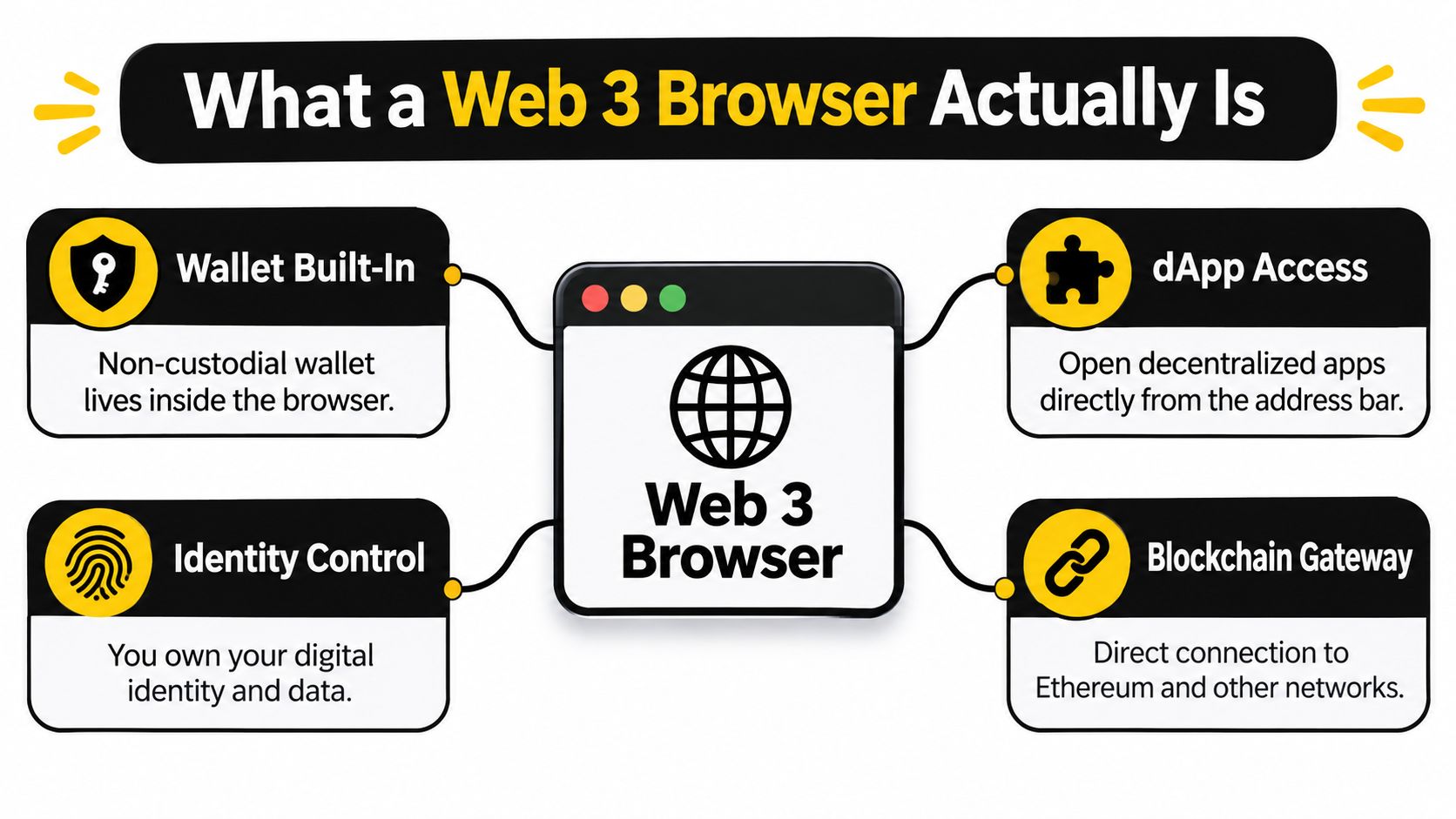
What a Web3 Browser Actually Is
Judge a Web3 browser by the decisions it helps users make: which dApp to connect to, what access to grant, and whether to approve a transaction. It still loads and renders websites. Wallet connectivity and blockchain interactions become part of that browsing workflow rather than depending entirely on a separate extension.
Evaluate a browser with crypto features through the complete user journey. A wallet icon tells you little about product quality. Follow discovery, permission requests, transaction review, and rejection. Good workflow design makes those decisions understandable, including the decision to stop.
Use that journey as a hiring lens.
For product candidates, ask how permission prompts affect user understanding. For security candidates, ask where the browser's responsibility ends and which risks wallet integration introduces. For growth candidates, ask how users discover dApps and where confusion interrupts adoption. These questions reveal more than browser-brand recall. Give permission handling and transaction rejection serious interview attention; both expose whether a candidate understands the consequences of interface choices. For nontechnical roles, focus on explaining those choices clearly. A grounding in what Web3 technology means helps keep that discussion concrete.
Opera provides historical context: it added a built-in cryptocurrency wallet in 2018, released its “Web3-ready” version 60 in 2019, and followed with the Crypto Browser Project in 2022, combining a non-custodial wallet, dApp support, and a dedicated interface, as documented in Opera's browser history and development).
Interview-ready definition: A Web3 browser is a conventional browser that integrates wallet connectivity and blockchain interactions into the user's browsing workflow.
How a Web3 Browser Differs From a Traditional Browser
Open Chrome, Firefox, or Safari and the routine is familiar: enter a URL, load a page, and sign in through the site's own account system. If you need a crypto wallet, you might install an extension or switch to a separate app. The page and wallet are distinct tools, even if they interact.
A Web3 browser keeps much of the same browsing experience but introduces a wallet interface and a way for dApps to request account access and transaction signatures. The rendering engine may be similar to what users already know. The meaningful change is what happens when a page asks to interact with a wallet.
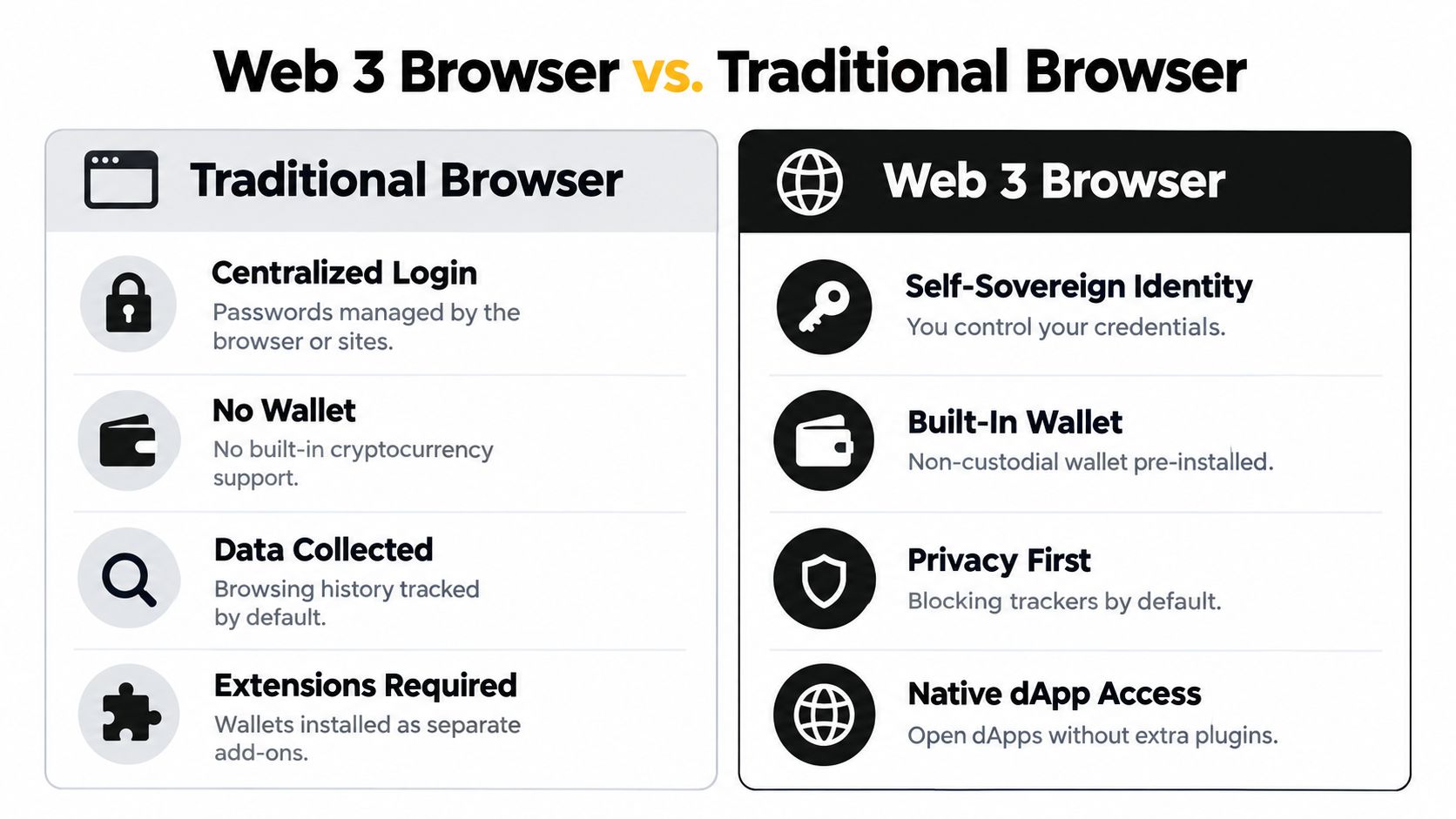
| What happens | Traditional browsing | Web3-enabled browsing |
|---|---|---|
| Page rendering | The browser loads and displays the website. | The browser still loads and displays the website. |
| Wallet access | A wallet may be a separate extension or app. | Wallet access can be built into the browser. |
| Account connection | The site typically uses its own login flow. | A dApp can request access to a blockchain account. |
| Action approval | Users submit forms or confirm site actions. | Users may need to review and sign a blockchain transaction. |
| Privacy and permissions | Defaults vary by browser and settings. | Defaults still vary, with wallet permissions adding another security boundary. |
Candidates often get stuck because they can list browser names yet can't explain the operational difference between a site loading and a site requesting a wallet connection. A dApp may communicate with an account through a browser-injected JavaScript API, and the user still needs to make an explicit decision about what access to grant.
Telemetry and privacy defaults aren't guaranteed by the “Web3” label, either. A browser may block trackers, offer privacy controls, and include a wallet, but those properties need to be assessed as product choices rather than assumed from branding.
For interviews, explain the mechanism. Talk through a wallet-injected API, a permission prompt, and why a dApp should verify the selected chain before preparing a transaction. That answer demonstrates more than familiarity with five browser names. It shows you understand how browser behavior affects product usability and security.
Wallet Integration and dApp Support in Practice
The wallet and the dApp aren't one system. They're separate parts of a transaction flow, and the browser sits between them. A non-custodial wallet holds the signing capability; a dApp requests an account interaction; the user reviews the request; and the wallet signs only after approval.
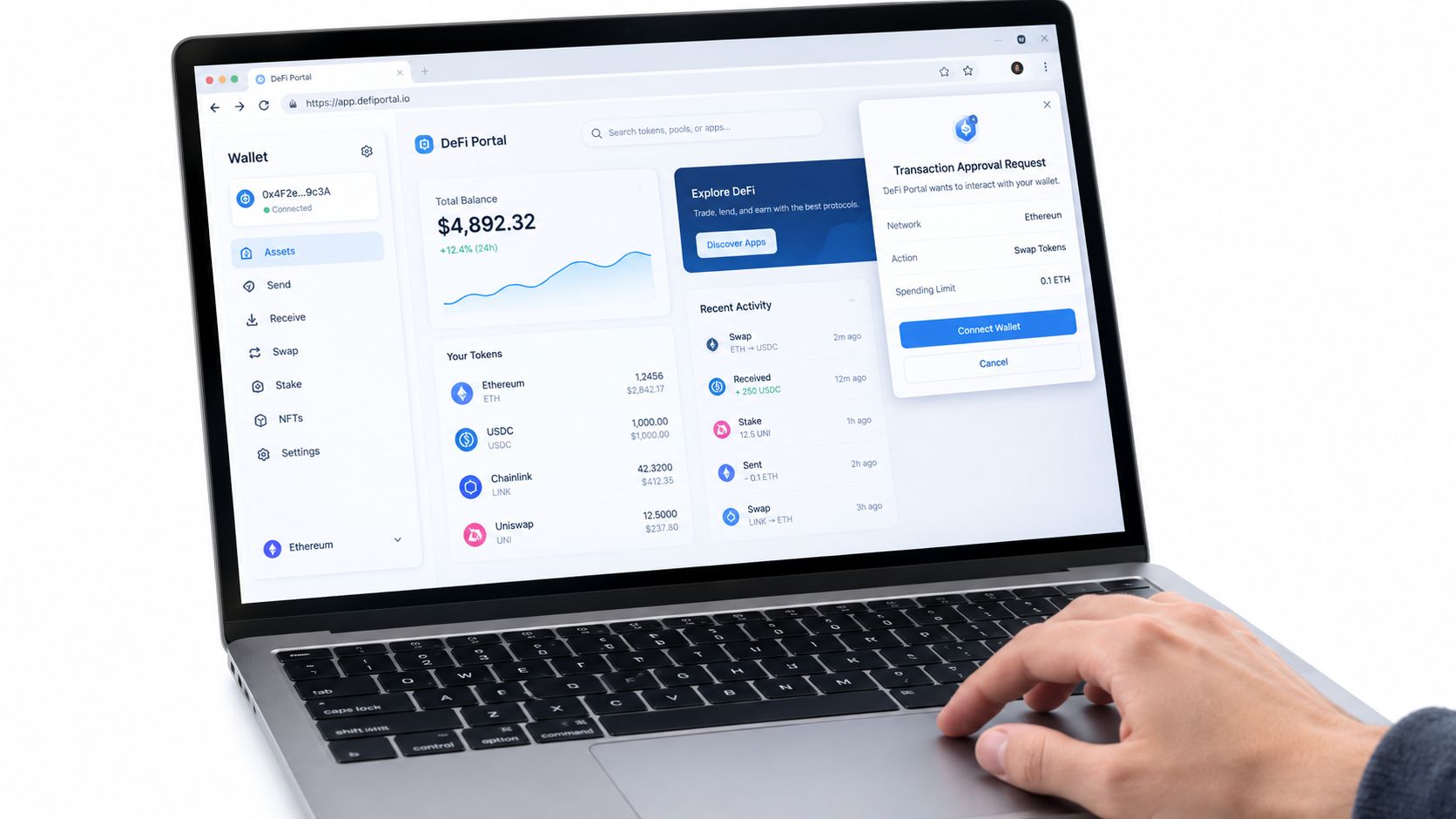
Three problems, three ownership questions
Wallet integration is an access-design problem. A product manager should be ready to explain the trade-off between automatically reconnecting a wallet and asking for explicit approval. Auto-connect can make a returning user's experience smoother, but it can also obscure which site is connected and what permissions remain active. A strong answer puts clarity and user control ahead of shaving away every click.
dApp discovery is a trust problem. A browser can make decentralized applications easier to find, but a discovery surface also shapes which products users trust enough to open. Product and growth candidates should be able to discuss how discovery works, what signals users need to judge a dApp, and how to avoid treating a directory as a security guarantee.
Transaction signing is a boundary problem. The page can request an action; the wallet controls whether to sign it. A security candidate should be able to say plainly that a connected wallet does not prove the user intended to approve every later transaction. A frontend candidate should explain wallet detection, network selection, and signature requests without implying that the website can sign on the user's behalf.
For an implementation exercise, a well-designed input matters too. A reusable copy-paste crypto input for React can help a team handle wallet-related entry fields consistently, but the surrounding experience still needs clear validation and transaction context. Candidates can also sharpen their product vocabulary by reviewing on-chain wallet options and asking how each fits into a browser workflow.
Here's a useful demonstration of how browser-based dApp interactions look in practice:
Hiring managers should listen for candidates who separate discovery, connection, and signing instead of collapsing them into “wallet support.” That separation is the difference between a feature checklist and an engineer or product lead who can reason about what the user authorizes.
Privacy Controls and the Security Boundary You Cannot Ignore
A browser-integrated wallet reduces the friction of connecting to a dApp, but it doesn't remove key-management risk. The wallet still controls cryptographic signing, and a malicious page may try to persuade a user to approve a harmful signature or transaction even if the page can't directly extract the private key. (Research on Web3 browser privacy and wallet risks)
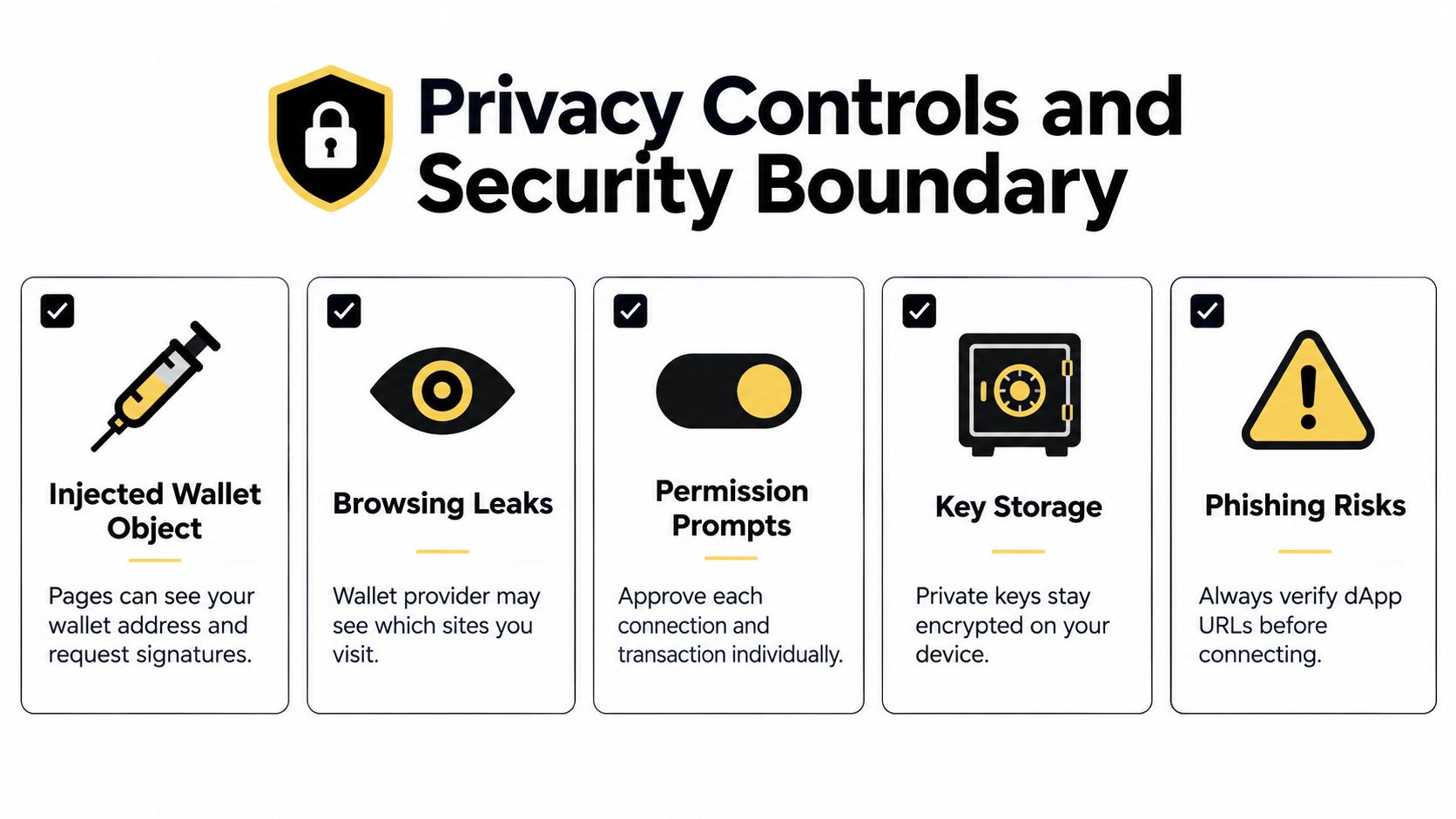
Wallet APIs can also expose account information through JavaScript activity or network traffic. That creates a privacy risk: a site or service may be able to link browsing behavior with a wallet address. For a security candidate, this isn't an abstract concern. It's a threat-modeling question about what an untrusted origin can access, what the browser exposes, and how the user can inspect or limit that access.
The controls strong candidates should name
A production browser should isolate wallet providers, limit their exposure to untrusted origins, and use explicit origin- and permission-based approvals. It should also give users transaction details they can understand before signing, rather than presenting a vague confirmation that hides the action's consequences. (Engineering analysis of Web3 browser architecture and security boundaries)
In an interview, expect to discuss least-privilege permissions, origin tagging, account segregation, chain ID checks, contract-address verification, and calldata simulation. These terms matter because each describes a specific way to reduce risk. For instance, using separate accounts for different levels of exposure can limit the damage when a user interacts with a suspicious dApp.
A browser wallet evaluation also found weaknesses that make secure storage a practical engineering concern. Researchers tested 96 wallets and identified vulnerabilities in 70, including issues involving password policies and credential storage. The paper estimated that more than 9.2 million users could face information leakage or financial loss, and described the LummaC2 stealer extracting sensitive information from more than 60 wallets across 10 browsers. (Academic evaluation of browser-based Web3 wallet vulnerabilities)
Screening test: Ask a candidate what they would do if a user connects to a dApp, then sees a signature request they don't recognize. A hire-ready answer should cover origin, permission scope, transaction details, and a safe way to decline.
For users who want a practical primer on wallet safety, this safe wallet crypto guide can complement the deeper engineering discussion. Hiring managers should be direct: if a candidate for a wallet-adjacent role can't explain how permissions, signing, and secret storage interact, they're not ready to own that boundary. For a broader technical frame, see Web3 security principles.
Three Web3 Browsers and the Product Choices Behind Them
A candidate lists wallet support, privacy controls, and dApp access in an interview. Ask them which capability defines the product, and which team owns the resulting user journey. That answer reveals more about their product judgment than a feature checklist.
Opera, Brave, and dedicated crypto-browser products offer different starting points. Use them as hiring lenses: familiar browsing, privacy-funded participation, and wallet-led interaction.
Opera takes the mainstream-browser route
Opera represents the mainstream browser adding crypto features approach: wallet and dApp access sit alongside familiar browsing. Its development provides context for that product choice without requiring another release timeline. (Opera's browser history and development)
The hiring signal is product translation. Ask a product manager or UX researcher where wallet functionality belongs in the browser interface, what deserves an explanation, and what should remain out of the user's way. Strong candidates can justify those choices for someone who opened the browser to read a page rather than trade tokens.
Look for restraint in their proposed interface.
Brave combines privacy with a token economy
Brave is a privacy-first browser with a token economy, combining privacy and ad-blocking features with Basic Attention Token in its advertising and creator-reward system. Its reported growth, from approximately 8.7 million monthly active users around its stable release to more than 57 million, gives context for evaluating that broader proposition. (Brave's user-centric Web3 model and reported growth)
Recruiters should test whether candidates can reason across user trust, advertiser incentives, and creator needs. For product and partnership roles, ask how they would explain participation without turning everyday browsing into a trading interface. This is a useful lens for nontechnical hiring: reward explanations, publisher relationships, and customer education deserve attention alongside wallet engineering.
Crypto-native products start from the wallet
The wallet-first, browsing-second approach makes blockchain interaction the organizing principle. Opera's Crypto Browser Project illustrates this dedicated experience through its non-custodial wallet, dApp support, and Crypto Corner.
Evaluate these teams around ownership. Signing, discovery, and recovery need named owners and coordinated product decisions. Frontend candidates should explain how network changes affect an in-progress wallet flow; support candidates should distinguish browser problems from account problems.
For interviews in 2026, prioritize those browser-level handoffs. Ask candidates to map one task across discovery, wallet interaction, and support, then identify who owns each failure. Hire for clear responsibility and usable flows.
Why Adoption Lags Despite the Feature Race
Adding another wallet shortcut won't fix Web3 onboarding. The harder problems are helping people understand what they're approving, recover access when something goes wrong, and decide whether a wallet fits into their everyday digital life.
The gap shows up in U.S. survey data: 12% of Americans reported using Web3 wallets, while 75% considered ordinary digital wallets intuitive compared with 13% for Web3 wallets. Only 12% said Web3 wallets fit their lives, compared with 64% for conventional digital wallets. (U.S. market research on Web3 wallet adoption and usability)
Those figures point to a product problem, not a shortage of feature ideas. Users need clearer explanations of recovery, account portability, transaction meaning, and what happens when they decline a request. A browser that can connect to more chains but leaves those questions unanswered adds complexity without resolving the reasons people hesitate.
That changes how hiring managers should build teams. UX researchers, product managers, technical writers, customer educators, and support teams are central to improving adoption. They can test whether new users understand a permission request, identify where wallet recovery instructions fail, and turn technical behavior into language people can act on.
For job seekers, this is a stronger interview position than arguing that more dApps or more networks will automatically bring mainstream adoption. Explain how you'd identify friction in a task, how you'd test whether a user understands a signing prompt, and what evidence would convince you that the product has become easier to trust.
The Hard Questions Candidates and Hiring Managers Should Ask
A browser's native wallet can reduce friction, but convenience isn't proof of safety. Use these questions to test whether a product team understands the consequences of putting wallet interactions inside the browsing experience.
- For security engineers: How does the browser isolate wallet secrets from page scripts, and how does it handle a malicious approval request?
- For product managers: What should happen when explicit wallet approval adds friction, but automatic reconnection could confuse users about which site is connected?
- For platform and infrastructure candidates: What changes for users if the browser vendor changes its wallet provider, storage model, or recovery flow?
- For AI product and security candidates: If an AI assistant moves through a dApp or initiates a transaction, how can the user inspect the action before the wallet signs it?
- For compliance candidates: What jurisdictional obligations could apply to a product built around non-custodial wallets?
AI-assisted browsing deserves particular scrutiny. Automated threat detection may help users, but autonomous actions can also hide what a system is about to sign. Strong candidates won't dismiss the technology or praise it on instinct. They'll explain where the user retains control, what the system can inspect, and which actions must require explicit confirmation.
Hiring managers should use these questions to distinguish product fluency from familiarity with crypto terminology. Candidates should be able to discuss trade-offs, failure modes, and the user's ability to reject an action.
Turning This Into Career Progress
Turn browser knowledge into evidence that you can do a job, not just describe a product. Start with three moves:
- Update your portfolio or résumé with two browser-level talking points. For example, explain how permission prompts affect transaction safety, or how a wallet connection differs from a signed transaction.
- Choose one role to target in 2026. Product, security, operations, UX research, support, and engineering all connect to browser-level Web3 workflows, but your examples should match the work you want.
- Prepare one outcome-focused interview story. Show how clearer transaction information, better network selection, or more useful wallet onboarding could reduce user confusion or failed transactions. Don't claim a result you haven't measured. Explain how you'd measure it.
The hiring data supports looking beyond protocol engineering. One employer survey reported that 86.21% of respondents were hiring or seeking newcomers for operations and business development roles, compared with 51.72% for technical positions. It also found that 96.55% valued proactivity and execution most, while 62.07% valued communication and writing skills. (Web3 employer survey on hiring demand and valued skills)
A 2025 industry report counted 66,494 new Web3 roles, a 47% increase from 2024, and said nontechnical positions made up the majority of postings. Treat those figures as evidence to explore a wider range of roles, not a guarantee of any particular opening. (2025 Web3 jobs report)
Your next step today: write a short portfolio note explaining one wallet interaction from page request to user approval, then tailor it to a role you want.
Blockchain Jobs connects Web3 candidates with opportunities across engineering, product, operations, security, marketing, legal, support, and more, including remote-friendly roles. If you can explain how browser mechanics shape wallet UX and trust, explore your next opportunity or help your team hire on Blockchain Jobs.