Hiring Flutter Developer: The Ultimate Playbook for 2026

You’re probably in one of two situations right now. You either need a Flutter hire because your product roadmap is blocked, or you already posted the role and got flooded with candidates who can build clean mobile screens but can’t reason about wallets, chain data, signing flows, or the ugly edge cases that come with Web3 UX.
That’s the gap. Hiring flutter developer talent for a normal consumer app is one problem. Hiring for a Web3 product is a different one. You’re not just screening for Dart knowledge or pixel-perfect UI work. You’re hiring for someone who can ship a polished interface while understanding transaction states, RPC instability, wallet connection failures, token balances, and security-sensitive user flows.
The mistake I see most often is simple. Teams write a generic “Flutter Developer” job post, run a generic interview, and then act surprised when the hire struggles in a dApp environment. If you want a better result, you need a tighter definition of the role, a more targeted sourcing strategy, a vetting process that mirrors real work, and onboarding that helps the new hire become useful quickly.
Defining the Flutter Role Your Web3 Project Actually Needs
Most hiring mistakes happen before the first interview. The title is too broad, the requirements are fuzzy, and the team hasn’t agreed on what success looks like in the first place.
That problem matters even more in Web3 because the talent pool is narrower. The current market shows a clear shortage in blockchain-specific Flutter expertise. A 2025 Stack Overflow survey indicated that only 8% of Flutter developers have crypto experience, compared with 25% who have general backend skills, and Web3 firms can take up to 40% longer to fill these roles, according to ZipRecruiter’s Flutter market snapshot.

Start with product impact, not years alone
A better role definition starts with the app you’re building.
If your product is a wallet, you need stronger security awareness, transaction-state UX, and reliability under flaky network conditions. If it’s a DeFi dashboard, the hire needs to handle live data, chart-heavy screens, and complex state updates. If it’s an NFT marketplace, the emphasis shifts toward media-heavy interfaces, asset metadata handling, and marketplace flows.
Use seniority as a shorthand for ownership, not just tenure:
Junior Flutter developer
Best for shipping defined UI work. They should be able to turn Figma designs into reusable widgets, manage basic state, consume APIs, and work inside an established architecture. In a Web3 team, juniors usually shouldn’t own wallet integrations or transaction flows without close review.Mid-level Flutter developer
This person should implement features end to end with limited supervision. That includes API integration, clean state management, debugging, testing, and handling awkward product details like partial loading states or failed chain reads. They can usually own a feature area such as portfolio tracking or activity history.Senior Flutter developer
Seniors shape architecture. They decide how state management should work across wallet sessions, real-time balance updates, and multi-screen transaction flows. They also set patterns for error handling, performance, test coverage, and code review, while mentoring less experienced developers.
Practical rule: If your app includes wallet connection, signing, token transfer flows, or on-chain activity displays, don’t label the role “junior-friendly” unless a senior on your team will actively supervise the work.
Define the Web3 layer explicitly
A lot of candidates can build good Flutter apps. Fewer can build good Flutter apps for decentralized products.
Your role spec should say whether the developer needs experience with:
- Wallet connectivity such as WalletConnect-style flows or embedded wallet UX
- Blockchain data handling including balances, transaction history, pending states, and confirmations
- Contract interaction awareness through tools and patterns often used around
ethers.js,web3.js, or backend services that expose chain data - Security-sensitive UX like approval warnings, seed phrase avoidance, signing prompts, and anti-phishing interface choices
- Cross-platform deployment for iOS, Android, web, or desktop if your product strategy goes beyond mobile
That clarity filters out purely mobile-focused applicants early.
A good supporting reference when shaping expectations is this breakdown of successful Flutter app developer skills. It’s useful because it separates framework fluency from the broader habits that make someone effective in production.
A practical role template
Write the job post around deliverables. For example:
What they’ll build
Wallet connection screens, asset portfolio UI, transaction confirmation flows, push-notification surfaces, staking dashboardsWhat they’ll own
Flutter architecture within a feature domain, state management decisions, performance tuning, testing standards, release readinessWhat they must already know
Dart, Flutter SDK, app performance basics, async programming, API integration, mobile debuggingWhat gives them an edge
Experience with dApps, DeFi products, NFT interfaces, on-chain data visualization, or production-grade auth and wallet flows
If you want to benchmark how other crypto teams frame engineering roles, review live listings on blockchain engineering hiring pages. Not to copy them line by line, but to pressure-test whether your role reads like an actual product need or a wish list written by committee.
Sourcing and Attracting Niche Flutter Talent
Once the role is defined properly, sourcing gets easier. Not easy. Just easier.
The mistake here is relying on broad channels alone and hoping the right person finds your post. That works when the skill is common. It doesn’t work well when you need Flutter plus Web3 familiarity plus product judgment.

Search for evidence, not keywords
LinkedIn is useful, but profile keywords aren’t enough. Plenty of candidates add “blockchain” to a headline because they once joined a crypto hackathon.
GitHub gives you better signal. Look for repositories that show:
- Flutter apps with wallet or authentication flows
- Clean state management patterns using Bloc, Provider, Riverpod, or equivalent
- Evidence of package maintenance, issue discussion, or meaningful contributions
- README files that explain architecture, setup, and trade-offs clearly
Stack Overflow and technical communities can also reveal how people think. Someone who explains async bugs, rendering issues, or dependency problems clearly is often more valuable than someone with a polished profile and weak reasoning.
Good sourcing asks, “What has this person shipped or contributed to?” not “Did they mention the right buzzwords?”
Go where crypto-native developers already pay attention
Mainstream job boards are fine for reach. They’re weaker for precision.
For niche Web3 Flutter talent, you’ll get better results if you mix standard channels with crypto-native ones: job boards focused on blockchain roles, founder communities, protocol Discords, Telegram groups, and technical communities where wallet builders, DeFi frontends, and infrastructure teams hang out. The candidate you want may not be actively applying, but they’re often visible in product or engineering conversations.
If you want a concrete example of how a crypto-specific listing can frame a Flutter role, this Flutter developer opening in Web3 is a useful reference point for language and positioning.
Write outreach like a builder, not a recruiter template
Most outreach fails because it sounds interchangeable. The candidate can’t tell whether you’re building a serious product or spraying messages.
A stronger message includes:
The product problem
Explain what the app actually does. Wallet? Trading interface? NFT discovery? Consumer payments?The hard parts
Mention the interesting engineering surface. Live balances, chain switching, transaction-state UX, deep linking, performance on lower-end devices, multi-platform supportThe team setup
State who they’ll work with. Product designer, smart contract engineer, backend lead, mobile team, founderThe compensation philosophy
Be clear on salary, contract model, equity or token upside if offered, and time-zone expectations
For broad recruiting fundamentals, this guide on general hiring strategies is worth reviewing. The useful lesson is that better candidates respond to sharper positioning, not louder messaging.
Make the role sound real
Good candidates want to know what they’ll touch.
A bad post says: “Seeking Flutter developer with blockchain knowledge, strong communication, and startup mindset.”
A better post says:
We’re building a cross-platform wallet experience for users who need clear transaction visibility, fast onboarding, and reliable asset tracking. You’ll work on the Flutter client for portfolio views, transfer flows, wallet session state, and chain-driven activity screens. You should be comfortable shipping polished UI and reasoning about asynchronous, failure-prone systems.
That difference matters. Strong developers don’t just evaluate compensation. They evaluate whether your team understands the work.
Designing a Vetting Process That Predicts Performance
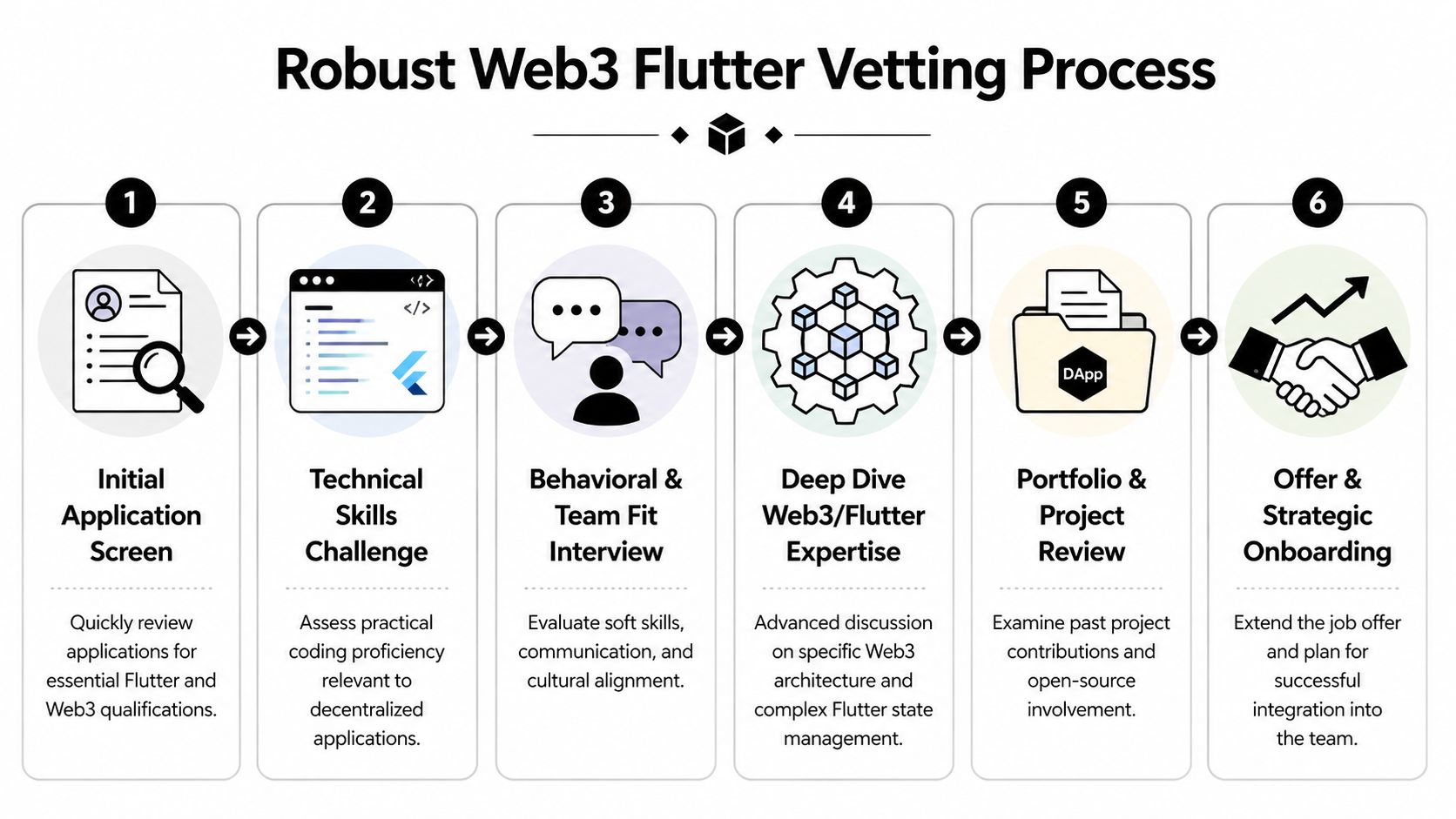
A weak interview process gives you false positives. Candidates pass because they speak confidently, know framework terminology, or rehearse standard mobile interview answers. Then they hit the actual job and stall.
A structured process is safer. Up to 70% of hiring failures come from mismatched project scopes, and practical testing plus reference checks can reduce mismatches by 60% and boost retention to 85%, according to Uplers’ hiring process analysis.
Stage one screen for fit and signal
The first screen should be short and practical. You’re not trying to prove they’re brilliant. You’re trying to avoid wasting everyone’s time.
Ask questions like:
- What kind of Flutter apps have you shipped to production?
- Have you worked on any wallet, fintech, or crypto-adjacent experiences?
- Which part of Flutter development do you usually own, UI, architecture, testing, performance, release management, or all of the above?
- How do you usually manage app state in larger projects?
- What kind of team setup helps you do your best work?
You’re listening for clarity and specificity. Strong candidates describe trade-offs, constraints, and real production problems. Weak candidates stay abstract.
Technical interviews should mirror your app’s complexity
A generic coding interview isn’t enough for this role. Your app doesn’t pay people to reverse strings on a whiteboard.
Use the technical round to probe four areas:
| Focus area | What to ask |
|---|---|
| State management | When would you choose Bloc over Provider, or another pattern, in an app with live balance updates and transaction state? |
| Performance | How do you diagnose frame drops, widget rebuild problems, or slow list rendering in a data-heavy app? |
| Architecture | How would you separate wallet session handling, chain data retrieval, and presentation logic? |
| Failure handling | How should the UI behave when an RPC call hangs, a transaction is pending, or a wallet connection fails mid-flow? |
The answers don’t need to match your exact implementation. They do need to show mature judgment.
Don’t overvalue syntax recall. Overvalue how the candidate structures uncertainty, isolates risk, and protects user trust.
Give a practical challenge with Web3 shape
The take-home or live exercise should look like a slice of the actual job.
A useful prompt is a simple wallet or asset interface. For example:
- Build a Flutter screen that shows a wallet connection state
- Fetch mock token or NFT data from a provided endpoint
- Display loading, empty, success, and failure states cleanly
- Add one user action such as refresh, disconnect, or open asset detail
- Explain architecture choices in a short README
If the candidate has Web3 experience, you can push further by asking how they’d adapt the screen for testnet wallet connectivity, pending transaction handling, or changing balances. Even if you don’t require a live chain integration in the exercise, you’ll learn a lot from how they discuss it.
What you’re evaluating:
- Code organization
- Naming quality
- State management discipline
- UI polish
- Error handling
- Documentation
- Ability to make sensible trade-offs under time limits
Review portfolio work like a product owner
Portfolio review is often too shallow. Teams glance at screenshots and move on.
Instead, ask the candidate to walk through one relevant project and explain:
- What they personally owned
- What was hardest
- Which technical choice they’d change now
- Where performance or maintainability became a problem
- How they collaborated with designers and backend or smart contract teams
That discussion usually reveals more than the portfolio itself. A polished Dribbble-like result can hide weak engineering. A less flashy app can reveal strong system thinking.
Don’t skip behavioral signal
Remote Web3 teams move fast and often operate with partial information. You need developers who can ask good questions, flag risk early, and write clearly.
Behavioral questions that work well:
- Tell me about a time requirements changed mid-build. What did you do?
- Describe a bug that looked like a UI problem but turned out to be deeper.
- How do you handle disagreement on architecture or implementation?
- What do you document without being asked?
- When do you escalate a product or engineering risk?
Reference checks should test reality
A reference check shouldn’t be a ceremonial box.
Ask former managers or peers:
- Did this person own work independently?
- How strong were they in code review?
- What kind of support did they need?
- How did they perform under ambiguity?
- Would you hire them again for a production app with user-facing risk?
A clean interview plus weak references is a warning. A slightly uneven interview plus strong references from credible builders is often salvageable.
Structuring a Competitive Offer and Compensation Package
Offer design is strategy, not paperwork. If you get this wrong, you either lose the candidate or hire someone whose expectations never matched your setup.
For Flutter talent, geography changes the math quickly. In 2025 to 2026, a senior Flutter developer in the US earns $126,500 to $134,200, while Western Europe reaches $134,400 to $172,800, and hiring from Brazil at $57,600 to $96,000 can deliver up to 59% cost savings, according to Nextbridge’s Flutter compensation breakdown.
Use a compensation table before you open negotiations
Here’s a practical benchmark view based on the verified regional data available.
| Seniority Level | North America | Western Europe | LATAM (e.g., Brazil) | Asia (e.g., India) |
|---|---|---|---|---|
| Junior | $59,000 to $116,600 | Qualitatively lower than senior benchmarks, varies by market | Qualitatively lower than senior benchmarks, varies by market | Qualitatively lower than North America, varies by market |
| Mid | $116,600 to $126,500 | Qualitatively below senior Western Europe benchmarks, varies by market | Qualitatively below senior Brazil benchmarks, varies by market | Qualitatively lower than North America, varies by market |
| Senior | $126,500 to $134,200 | $134,400 to $172,800 | $57,600 to $96,000 | Qualitatively lower than North America and Western Europe, varies by market |
This table is enough to anchor negotiations without pretending every market behaves the same way.
Decide what you’re optimizing for
Different hiring models solve different problems.
If you need a senior to set architecture and mentor a team, paying a premium in a stronger market may be worth it. If you already have technical leadership and need feature throughput, a strong mid-level hire in LATAM can be a smart move. If your roadmap is volatile, contract-first can reduce risk before you commit to a long-term package.
The big mistake is mixing expectations. Don’t offer offshore compensation while expecting principal-level ownership, odd-hour overlap, instant responsiveness, and deep product leadership.
Build the package around more than base pay
Web3 candidates often evaluate the full structure:
Base salary or contract rate
Keep this clear and predictableEquity or token component
Explain vesting, liquidity realities, and downside scenarios plainlyRemote support
Equipment, coworking, home office, or learning budget can matter, especially for senior candidatesTime-zone expectations
Define synchronous hours instead of saying “global remote” and sorting it out laterIP and contract clarity
Nail ownership, confidentiality, open-source policy, and deliverable expectations up front
A competitive offer isn’t always the highest one. It’s the one the candidate can understand, trust, and compare without guessing.
For fully distributed hiring, it helps to review how other remote crypto teams position roles and expectations. Browsing remote blockchain job listings is useful for calibration, especially if you’re still deciding between contractor and full-time structures.
Handle the close like a manager, not a negotiator only
When you present the offer, talk through why it’s structured the way it is. Explain scope, reporting line, roadmap, and what success looks like in the first few months.
Candidates are more likely to accept when they believe the team is organized and honest. Compensation gets them interested. Clarity gets them across the line.
Onboarding Your New Developer for Rapid Productivity
A signed contract doesn’t solve the original problem. It just moves the risk.
That’s especially true in Flutter hiring right now. The market has been expanding quickly, with job postings surging 40% to 60% year over year on specialized platforms in 2025, while experienced senior talent remains scarce and can command a 5% to 10% salary premium, according to Jobs with Flutter’s 2025 market analysis. When talent is hard to replace, onboarding becomes part of retention.
Week one should remove friction
Your new hire shouldn’t spend their first days hunting for credentials, asking where the repo lives, or guessing how releases happen.
Give them:
System access on day one
Repos, design files, project board, analytics, staging, docs, communication toolsA working local setup
Ideally with a starter script, environment guide, and known-issues noteArchitecture context
Show how the Flutter client interacts with backend services, wallet layers, and chain data sourcesPeople context
Introduce the product manager, designer, backend lead, and whoever owns release decisions
The first month needs a real shipping target
Don’t make the first assignment enormous. That’s how confidence drops and ramp-up drags.
A better approach is to assign one contained feature or improvement that touches the actual stack but carries limited blast radius. Good examples include refining a portfolio screen state, fixing wallet reconnect UX, improving an activity list, or tightening an error state in a transaction flow.
That first shipped change teaches the codebase faster than a week of passive documentation reading.
The fastest way to onboard a developer is to help them ship something small that matters.
Cultural onboarding matters more in remote Web3 teams
Crypto teams often move with startup speed and infrastructure-level ambiguity. New hires need clear norms or they’ll default to silence, overwork, or needless churn.
Use a simple rhythm:
- Assign a buddy for day-to-day questions.
- Set check-ins during the first few weeks.
- Document decision-making rules around architecture, code review, releases, and incident handling.
- Clarify communication expectations for async updates, blockers, and response times.
A good developer can still fail in a messy environment. Strong onboarding reduces that risk and makes the hiring decision pay off faster.
If you’re hiring for Web3 roles and want a focused place to reach crypto-native talent, Blockchain Jobs is built for that market. You can use it to find candidates across engineering and adjacent functions, or to benchmark how serious teams describe roles in DeFi, infrastructure, wallets, NFTs, and the broader decentralized ecosystem.