How to Find Contract Jobs in Web3: A Practical Guide for Professionals

If you want to land a contract gig in Web3, you need a different playbook. Forget blasting out your resume. The real game is about focusing on niche job boards like Blockchain Jobs, building a portfolio that proves you can deliver on-chain results, and embedding yourself in the developer communities where the action happens—think Discord and Telegram.
It all comes down to proving you can create value in a space that moves at lightning speed, and positioning yourself as the top candidate for your next role.
What the Web3 Contract Market Really Looks Like
The Web3 world is buzzing with contract opportunities, but finding them isn't about having a polished resume; it's about having the right hiring strategy. Trailblazing companies like Uniswap Labs and Luxor Tech often lean on contractors to stay nimble and tap into highly specific skills. This creates a vibrant, fast-moving market for pros who can parachute in and tackle tough challenges without the drawn-out process of a full-time hire.
Unlike your typical 9-to-5 tech job, Web3 contracting offers a powerful mix of freedom, serious earning potential, and a chance to accelerate your career progression. Companies are always on the lookout for experts who can hit the ground running, whether it’s for a three-month security audit or a six-month push to grow a community. This project-based approach lets them grab the exact talent they need from anywhere in the world, precisely when they need it.
Why Companies Are All-In on Contractors
From a hiring manager's perspective, the logic is simple. Using contractors lets them grow or shrink their teams in sync with their project roadmaps and funding. Think about it: if you're a startup launching a new DeFi protocol, bringing in a smart contract auditor for a limited time is a smarter, more efficient way to de-risk the launch than hiring a full-time employee for a task with a clear end date.
This setup is a huge win for your career, too. You get to work on a variety of exciting projects, build a diverse portfolio, and often command a higher rate. For a deeper dive into the latest hiring trends, check out our analysis of the Web3 job market on the Blockchain Jobs blog.
The biggest mental shift you need to make for your job search is understanding that in Web3, proof of work trumps credentials. A solid GitHub profile showing relevant contributions or a portfolio of successful projects will almost always beat a resume with a decade of experience at some big-name tech company.
The Hottest Contract Roles Right Now
While developers are a constant hot commodity, the needs of the ecosystem are much broader than just code. Demand for specialized talent is spiking in a few key areas, opening up some fantastic career paths for contractors.
Here’s a look at some of the most in-demand contract gigs that hiring managers are looking for right now:
- Smart Contract Auditors: These are the digital detectives of Web3. Professionals who can comb through code to find vulnerabilities are non-negotiable for securing user funds and protecting a protocol's reputation.
- Decentralized Community Managers: Building and engaging a global, token-holding community is the lifeblood of any project. Experts in this area are absolutely critical for long-term growth and user retention.
- DeFi Strategists: Got a knack for tokenomics, yield farming, and liquidity protocols? Projects need strategic minds who can architect sustainable economic models that attract and retain capital.
- Web3 Technical Writers: Great tech is useless if no one can understand it. Skilled writers who can create clear, concise documentation for users and developers are essential for product adoption.
Knowing which roles are in demand is just the first step. To truly stand out in the hiring process, you must position yourself as a strategic partner—someone who doesn't just fill a temporary seat but actively drives measurable results that advance the company's goals.
Where to Discover High-Value Contract Roles
If you want to find the best contract jobs, you have to go where the hiring managers are. Forget the massive, generic job boards—the really good Web3 roles are almost always found in the niche corners of the ecosystem, long before they ever hit the mainstream.
Success in your job search isn't about scrolling through endless listings for hours. It’s about being strategic. You need to know exactly which platforms to watch, which communities to join, and how to build a professional brand that brings opportunities directly to you. This approach doesn't just save you time; it puts you in direct contact with the decision-makers.
Web3 contracting is all about agility, deep expertise, and massive potential.
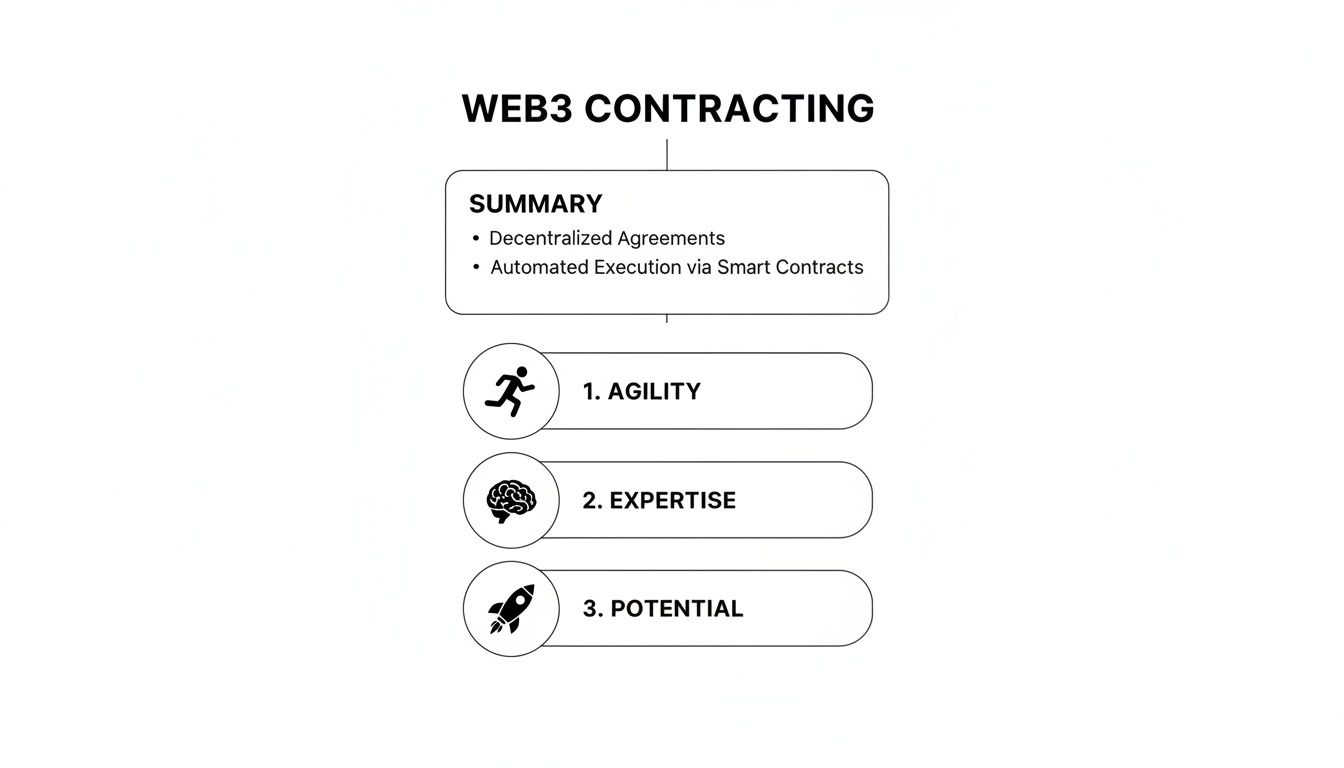
This really gets to the heart of why companies hire contractors. They need specialized talent who can jump in, adapt quickly, and push projects forward. For you, it's a fast track to leveling up your career.
To help you get started, here’s a quick rundown of the best places to look, based on what you’re trying to find.
Top Platforms for Finding Web3 Contract Roles
| Platform Type | Example | Best For Finding | Pro Tip for Your Job Search |
|---|---|---|---|
| Niche Job Boards | Blockchain Jobs | Curated, high-quality technical and non-technical roles directly from Web3 companies. | Set up targeted alerts for skills like "Solidity contract" or "DeFi marketing" to be the first to apply. |
| Gig Platforms | Upwork | Short-term tasks and smaller projects to build your portfolio and client history. | Build your reputation with smaller gigs first; positive reviews are your best asset for winning bigger contracts. |
| Communities | Discord / Telegram | Unlisted roles, network-based opportunities, and direct access to founders. | Become a known contributor, not a job seeker. Your expertise is your best marketing tool to get noticed by hiring teams. |
| Professional Networks | Getting noticed by recruiters and connecting with established Web3 companies. | Optimize your headline to signal availability, like: "Contract Smart Contract Auditor |
Each of these channels serves a different purpose in your career strategy. Your best bet is to combine them—use niche boards for active searching, communities for long-term networking, and your professional profile to attract inbound leads from recruiters.
Pinpoint Opportunities on Niche Job Boards
Specialized job boards are your primary hunting ground. Unlike the giant aggregators, these platforms are built for Web3 pros, so you'll find high-quality listings without the noise. You'll find roles posted by serious projects that know exactly what kind of skills they need to hire for.
The market is booming. Remote-friendly contract roles have surged amid a 47% year-over-year increase in global crypto job openings, with an estimated 66,000 new positions expected in 2025. The entire Web3 ecosystem now employs over 460,000 professionals worldwide.
Even better for contractors, remote work is the norm. Statistics show that remote roles make up about 40% of all new Web3 listings, and that number jumps to over 60% for blockchain-specific contracts.
To get the most out of these platforms, you have to master the filters to find the right roles:
- Contract Type: Always filter for "Contract" or "Freelance."
- Keywords: Use precise terms recruiters search for, like "Solidity audit," "tokenomics design," or "DeFi protocol marketing."
- Location: Stick to "Remote" or "Remote (Worldwide)" to maximize your opportunities.
A great place to start your search is a site like Blockchain Jobs, which does a solid job of aggregating high-quality roles from all over the ecosystem.
Immerse Yourself in Developer and Founder Communities
Here's a secret most job seekers miss: the best contract gigs are often never publicly listed. They get filled through trusted networks and communities where founders and developers spend their time. If you can become an active, helpful member of these groups, you'll be on the inside track for new opportunities.
Discord and Telegram are the digital town squares for Web3. Find and join the servers for projects you admire, protocols you use, and developer groups focused on your tech stack. But don't just lurk—contribute.
Your goal isn't to go in asking for a job. It's to become a recognized name by answering questions, offering your insights on technical discussions, and sharing your work. When a project needs help, you'll be the first person they think of, bypassing the formal application process entirely.
For instance, if you’re a smart contract dev, just hanging out in channels dedicated to security or gas optimization can quickly showcase your expertise to founders who are always scouting talent in those conversations.
Turn Your LinkedIn Profile into a Lead Magnet
I know—Web3 lives on Discord and X. But don't sleep on LinkedIn. A lot of recruiters and founders still use it for initial vetting and outreach, especially from more established companies. A properly optimized profile can become a machine that brings interview requests directly to you.
Your headline is the most important part of your profile. Don't just put your job title. You need to communicate your value and, crucially, your availability.
Instead of this: "Software Engineer" Try this: "Contract Solidity Engineer | Smart Contract Auditing & DeFi Specialist | Available for Projects"
That one simple change tells every recruiter who lands on your profile exactly what you do, what you're great at, and that you're open for business. Then, use your "About" section to tell a story. Don't just list skills; frame your experience around the problems you've solved and the results you've delivered. Make it dead simple for a hiring manager to see how you could help their project succeed.
Building a Portfolio That Closes Deals
Let's be blunt: in the Web3 space, your resume is an afterthought. Your portfolio is everything. It’s your primary sales tool, the on-chain proof that you can actually do the work. A killer portfolio doesn't just list what you know; it shows what you've built, what you've fixed, and the tangible results you've delivered.
Think about it from the hiring manager's perspective. They're moving a million miles an hour and need to bring someone on who can make an impact from day one. They're looking to de-risk their hiring decision. A well-put-together portfolio—whether on GitHub, a personal site, or even a sharp LinkedIn profile—is their assurance that you're a safe bet.

This is about showing, not telling. It’s the difference between saying you’re a great community manager and presenting a dashboard that proves you drove a 300% growth in DAO membership. Numbers talk, and they get you interviews.
Frame Your Work With the Challenge-Solution-Result Method
Stop listing your job duties. Nobody cares. Instead, frame every project in your portfolio like a mini-case study. This simple narrative trick helps hiring managers immediately understand your value and see how you can solve their problems.
Structure each project highlight like this:
- The Challenge: What was the specific problem? Was a smart contract bleeding gas? Was user engagement in the toilet?
- Your Solution: What, exactly, did you do? Detail the tech stack you used, the strategy you ran, or the system you put in place.
- The Result: What happened because of your work? Quantify everything you can. Use percentages, dollar figures, and user metrics. This is the proof that closes the deal.
A portfolio entry that reads, "Slashed gas fees by 40% for a DeFi lending protocol by optimizing contract logic, saving users over $1M in the first quarter," is infinitely more compelling to a hiring manager than, "Wrote and deployed Solidity smart contracts."
Optimize Your Digital Footprint for Hiring
Your professional presence needs to be a well-oiled machine, with every platform telling a consistent story about your expertise. Each one plays a different role in pulling in potential clients and recruiters.
Your GitHub Is Your Technical Resume For any technical role—developer, auditor, you name it—a clean and active GitHub is non-negotiable. It’s the first place a hiring manager will go to verify your skills.
- Pin Your Best Repos: Put your most impressive or relevant work front and center.
- Write Clear READMEs: Don't be lazy here. Explain the what, the why, and the how for each project. Treat it like a product page for a recruiter.
- Show Consistent Contributions: That green contribution graph is a quick visual cue that you are an active and engaged developer.
Your Personal Website Is Your Sales Pitch A personal website is your home turf. You control the narrative completely. This is where you can really flesh out those case studies, share your thinking through a blog, and give potential clients a clear way to contact you for an interview.
Your LinkedIn Is Your Professional Billboard Turn your LinkedIn profile into an inbound lead machine. Your headline should scream what you do and that you're available. Something like "DeFi Strategist | Tokenomics & Governance Consultant | Open to Contract Roles" works perfectly. Then, use the "Featured" section to link directly to your best case studies or your GitHub.
Showcase On-Chain Proof of Work
At the end of the day, Web3 is all about verifiable, on-chain actions. This is your ultimate trump card in the hiring process. Linking your portfolio to on-chain evidence builds instant trust with crypto-native teams.
Here’s how to do it:
- Link to Etherscan: Deployed a significant smart contract? Link straight to it on a block explorer.
- Reference Governance Proposals: Wrote a governance proposal that passed? Link to the Snapshot vote.
- Highlight Audited Code: If you're a security expert, showing that your work has passed a serious audit is a massive credibility signal. You could point to experience similar to what's needed for a Smart Contract Auditor at Binance, proving your skills are ready for the big leagues.
By crafting a portfolio that demonstrates real-world outcomes and verifiable proof, you completely change the conversation. You're no longer just another person looking for a gig; you're a proven problem-solver who delivers.
Winning the Outreach and Interview Game
Putting together a solid portfolio is a huge step, but it’s really just half the battle. The other, arguably more important half, is knowing how to get it in front of the right people and then ace the interviews that follow.
Let's be blunt: mass-blasting a generic resume into the Web3 void is a fantastic way to get ignored. You have to treat every single opportunity like a targeted consulting gig. Your mission is to prove your value long before anyone even thinks about a contract.
This means you’re not just applying for jobs; you’re starting strategic conversations. You need to position yourself as the indispensable expert who gets the ecosystem and can solve their specific, high-stakes problems. Every message, every call, is a chance to show you’re the lowest-risk, highest-upside candidate for the role.
Crafting Proposals That Actually Get a Reply
In a world of decentralized teams and overwhelmed founders, your first message is everything. It's your one shot to cut through the noise and land an interview. Generic, copy-paste intros are dead on arrival—they get deleted without a second thought.
A winning proposal is always personal and packed with value. It immediately shows you’ve done your homework and have a genuine idea of how you can help.
Here’s an approach that works:
- Lead with a Specific Insight. Don't open with "I'm applying for..." Instead, reference something specific. "I was reading through your latest governance proposal on Snapshot..." or "I noticed a potential gas optimization in your mainnet contract..." This instantly proves you're paying attention.
- Connect Their Problem to Your Work. Draw a direct line from their need to a project in your portfolio. Instead of a vague "I'm skilled in smart contracts," try this: "I see you're building a new NFT staking mechanism. I recently cut gas costs by 40% on a similar DeFi protocol, and I think a similar approach could work here."
- End with an Easy "Yes". Make the next step ridiculously simple. Don't just say, "Let me know if you want to chat." Propose something concrete and low-commitment, like, "I've already sketched out a few ideas. Are you free for a 15-minute call sometime next week to walk through them?"
The best outreach feels less like a job application and more like the beginning of a partnership. You're not asking for work; you're offering a solution, which is exactly what hiring managers want to see.
Nailing the Interviews: More Than Just Code
Once your killer outreach lands you a call, you’ll face interviews designed to test two things: your technical chops and your cultural alignment. In Web3, they’re equally critical. A genius dev who scoffs at decentralization is just as much of a liability as a great team player who can’t write clean code.
You have to be ready to excel in both parts of the interview.
Proving Your Technical Chops
This is where you prove you can deliver. They want to see real-world problem-solving skills, not textbook answers. This is your chance to shine and show you are the best candidate.
Here’s how to prepare:
- Know Your Portfolio Inside and Out. Be prepared to defend every decision on every project you've listed. Why that tech stack? What trade-offs did you make? What would you do differently today? They will dig in.
- Be Plugged into the Ecosystem. Show you’re not just a hired gun but a true participant. Have an opinion on recent EIPs, the fallout from a major network upgrade, or the nuances of a new L2. This is what it means to be crypto-native.
- Think Out Loud. If you get a live coding challenge or a system design question, narrate your thought process. They're often more interested in how you tackle a complex problem than in you finding the single perfect solution.
Demonstrating You Vibe with the Culture
Cultural fit in Web3 usually boils down to a few core traits: autonomy, transparency, and a genuine belief in community-led projects. Teams are looking for people who can own their work without needing constant supervision.
- Share Stories of Autonomy. Prepare examples of past projects where you took ownership from concept to completion. How did you manage your own time? How did you keep everyone in the loop in a remote, async environment?
- Show You Get Governance. Mention a DAO vote you followed closely or even participated in. What were the pros and cons? Why did it pass or fail? This shows you understand how decisions actually get made in this space.
- Ask Smart Questions. The questions you ask say more about you than the answers you give. Ask about their decision-making process, how they incorporate community feedback, and their long-term vision for decentralization. This shows you’re not just looking for a paycheck; you’re looking for a project that aligns with your values and career goals.
Getting Paid: Negotiating Your Contract and Setting Rates
You’ve aced the interviews and impressed the team. Now comes the critical part: turning that verbal offer into a solid contract that protects you and values your time. This isn't just about the money—it's about setting clear expectations that lay the foundation for a successful engagement. A strong negotiation at this stage ensures you're compensated fairly, legally covered, and positioned for a smooth project from day one.
Walking into these discussions with a clear strategy and a good sense of your market worth is non-negotiable. This is where you lock in terms that reflect the impact you're about to make, especially when your skills are in high demand across the Web3 space.

How to Set Your Rates with Confidence
Pricing your services can feel tricky. Go too low, and you're not just leaving money on the table; you might make clients second-guess your expertise. Aim too high without backing it up, and you could price yourself out of some really cool projects. The key is to anchor your rate in real-world data, not just what you feel you should earn.
Research what other contractors with your skillset are charging on niche job boards and platforms like Upwork. Ask peers in your private communities what the going rate is for your experience level. Always adjust your numbers based on the project's complexity, duration, and the specific value you bring.
Your rate isn't just a number; it's a direct reflection of the value you deliver. Stop framing it as what you "want" to be paid. Instead, present it as the market rate for a professional who solves their specific, complex problems.
It's no secret that specialized skills get you premium rates. With a projected 300% surge in blockchain job postings from 2023-2025, sharpening your skills in hot areas like Solidity and on-chain compliance is a smart career move. We’re seeing a massive 550% demand growth for technical roles like Smart Contract Engineers, while developers who know Rust or Go are seeing 35% year-over-year bumps in demand. You can learn more about the most in-demand Web3 jobs and their salary potential to get a better sense of the landscape.
Key Contract Terms You Must Understand
A contract is so much more than a payment agreement—it's the official rulebook for the job and your primary form of protection. A vague or weak contract is a fast track to scope creep, late payments, and stress. Never start work without a signed agreement that clearly defines these key terms.
Here are the clauses to always review carefully:
- Scope of Work (SOW): This is your most important section. It needs to spell out exactly what you’re delivering, the specific tasks involved, and what a "finished" project looks like. The more detailed, the better.
- Payment Schedule: How and when will you be paid? Make sure the contract clearly states if it's hourly, a fixed project fee, or milestone-based. Also, lock in the payment terms, like Net 15 or Net 30, to ensure timely compensation.
- Intellectual Property (IP) Rights: Who owns the code, design, or content you create? The standard is for the client to own the final work once you're fully paid, but this must be explicitly stated in writing.
- Termination Clause: This explains how you or the client can end the contract gracefully. Make sure it includes a notice period and guarantees you'll be paid for all work completed up to the termination date.
Fiat vs. Tokens: What to Consider
In Web3, it’s common to get offers that include payment in the project’s native token. It can sound incredibly tempting, especially in a bull market, but it comes with volatility and risk you must be prepared for.
Before you accept a token-based offer, weigh it from a career and financial perspective.
Pros of Token Payments:
- Potential Upside: If the project takes off, the value of those tokens could skyrocket, far surpassing a standard fiat rate.
- Deeper Alignment: Holding the project's token gives you skin in the game and aligns your success with the protocol's long-term health, which can be a powerful motivator.
Cons of Token Payments:
- Market Volatility: Your compensation could shrink dramatically due to a market dip that has nothing to do with your performance.
- Liquidity Issues: Cashing out can be tough with new project tokens. They might not have enough trading volume, meaning you can't sell without tanking the price.
A smart career strategy is to negotiate a hybrid payment model. Ask for a portion of your fee in a stablecoin (like USDC) or fiat to cover your living expenses. Then, take the rest in project tokens for that potential upside. This strategy provides financial stability while still letting you share in the project's future success.
Got Questions? Let's Talk Contracting Realities
Jumping into the Web3 contracting world is exciting, but it’s natural to have questions about career progression and sustainability. Let's tackle the real-world concerns head-on so you can move forward with confidence.
This isn't just a generic FAQ. Think of it as a guide to building a successful contracting career, covering what it really means to be a contractor, whether you need to form a company, how to handle taxes, and the secret to maintaining a steady flow of high-quality work.
Contract vs. Full-Time: What's the Real Difference?
Beyond the obvious, the day-to-day reality and career trajectory are worlds apart. A full-time role usually means settling into a company's culture, a steadier pace, and a career path that climbs a predictable ladder.
Contracting, on the other hand, is all about focused impact and accelerated growth. You’re brought in as a specialist to solve a specific problem. Your career progression isn't measured in titles but in the caliber and complexity of the projects you land.
Here’s how it really breaks down for your career:
- You're the CEO of your career. As a contractor, you call the shots on your schedule and projects. The flip side? The outcome and your professional reputation rest squarely on your shoulders.
- No fluff, all focus. Your work is tightly scoped. You get to sidestep most of the internal meetings and office politics, letting you zero in on what you do best: delivering results.
- Learn at lightning speed. Bouncing between different projects, teams, and tech stacks is like a steroid shot for your skills. Your portfolio and expertise grow much faster than they would in a single role.
This all requires a fundamental mindset shift. You’re no longer an employee; you’re a one-person business delivering a premium service, and every project is a stepping stone for your career.
Do I Need an LLC to Start Contracting?
This is easily one of the most common questions, and the short answer is no. You don't need to get bogged down with paperwork right away. You can legally operate as a sole proprietor—it's the default for any individual freelancer and the simplest way to get started.
However, as your contracting business grows, forming an LLC (Limited Liability Company) is a smart career move. The biggest win here is liability protection. It creates a financial wall between your business and your personal assets. If a client ever decided to sue, an LLC helps protect your personal assets, like your house or savings account.
Many seasoned contractors start as sole proprietors to test the waters. Once they have a steady flow of projects, they form an LLC. It's a great strategy that minimizes upfront headaches while planning for long-term career security.
Once you’re making consistent money, it’s worth speaking with a legal or tax professional for advice specific to your situation.
How Should I Handle Taxes?
Okay, let's talk taxes—probably the biggest operational shock for new contractors. When you're an employee, taxes are handled for you. As a contractor, you're the CFO of your own career, and you're responsible for all of it. This demands discipline.
A good rule of thumb is to immediately move 25-30% of every single payment into a separate savings account. This isn't your money; it belongs to the tax authorities. This fund will cover your income taxes and self-employment taxes (which handle Social Security and Medicare).
To stay on top of it, you need a simple system:
- Track Everything: Get into the habit of logging all your income and every business-related expense. A tool like QuickBooks or Wave makes this almost painless.
- Pay Quarterly: The IRS doesn’t want to wait a full year for their money. You'll need to pay estimated taxes four times a year. This avoids a massive tax bill and potential penalties.
- Deduct Your Expenses: The cool part of being your own business is that you can lower your taxable income. Things like software subscriptions, a new laptop, professional development courses, and part of your internet bill can be written off.
Managing your finances effectively is a core contracting skill. It's what enables a long and sustainable career.
How Do I Keep a Consistent Pipeline of Work?
The "feast or famine" cycle is a real fear, but the best contractors build a career that rarely has to worry about it. Why? Because they treat business development as a constant background task, not a desperate scramble when a project is ending.
The key is to always be networking and building your brand. Stay active in those key Discord and Telegram communities, even when you’re busy. Keep sharing your knowledge and helping people out. Your next interview often comes from someone who's been quietly watching you add value for weeks.
But the most powerful strategy of all? Absolutely crush it on your current project. A thrilled client is the best marketing you could ever ask for. They bring you repeat business and, even better, refer you to their network. That’s how you build a pipeline that fills itself with high-quality, pre-vetted leads and ensures long-term career progression.
Ready to find your first or next contract role in the Web3 space? At Blockchain Jobs, we connect talented professionals like you with top companies building the future of the decentralized web. Explore curated opportunities in engineering, marketing, finance, and more.