
Proof of Work vs Proof of Stake: The Career Implications

Proof of work and proof of stake don't just produce different energy bills. They create different industries, operating risks, interview questions, and career paths. Ethereum's move from proof of work to proof of stake reduced its electricity consumption by approximately 99.95%, according to Ethereum's Merge documentation. That change also moved demand away from mining hardware and toward validator infrastructure, staking operations, client software, monitoring, and slashing-risk management.
For a blockchain professional, the useful question isn't which mechanism is better. It's which security model matches the work you want to do, the risks you can manage, and the skills employers need.
| Area | Proof of work | Proof of stake |
|---|---|---|
| Primary participant | Miner | Validator |
| Security resource | Hash power, hardware, and electricity | Staked capital and validator participation |
| Core operational skills | ASIC management, power procurement, cooling, pool operations | Client operations, key security, monitoring, attestations, finality |
| Main failure concerns | Hardware downtime, energy costs, hash-rate concentration, reorganization | Offline validators, double-signing, stake concentration, slashing, coordination |
| Typical infrastructure | Mining rigs, power systems, cooling, pool software | Servers, consensus and execution clients, signing infrastructure, observability |
| Career emphasis | Hardware and energy markets | Distributed systems, SRE, cryptography, staking economics, incident response |
Why the Ethereum Merge Changed Career Paths
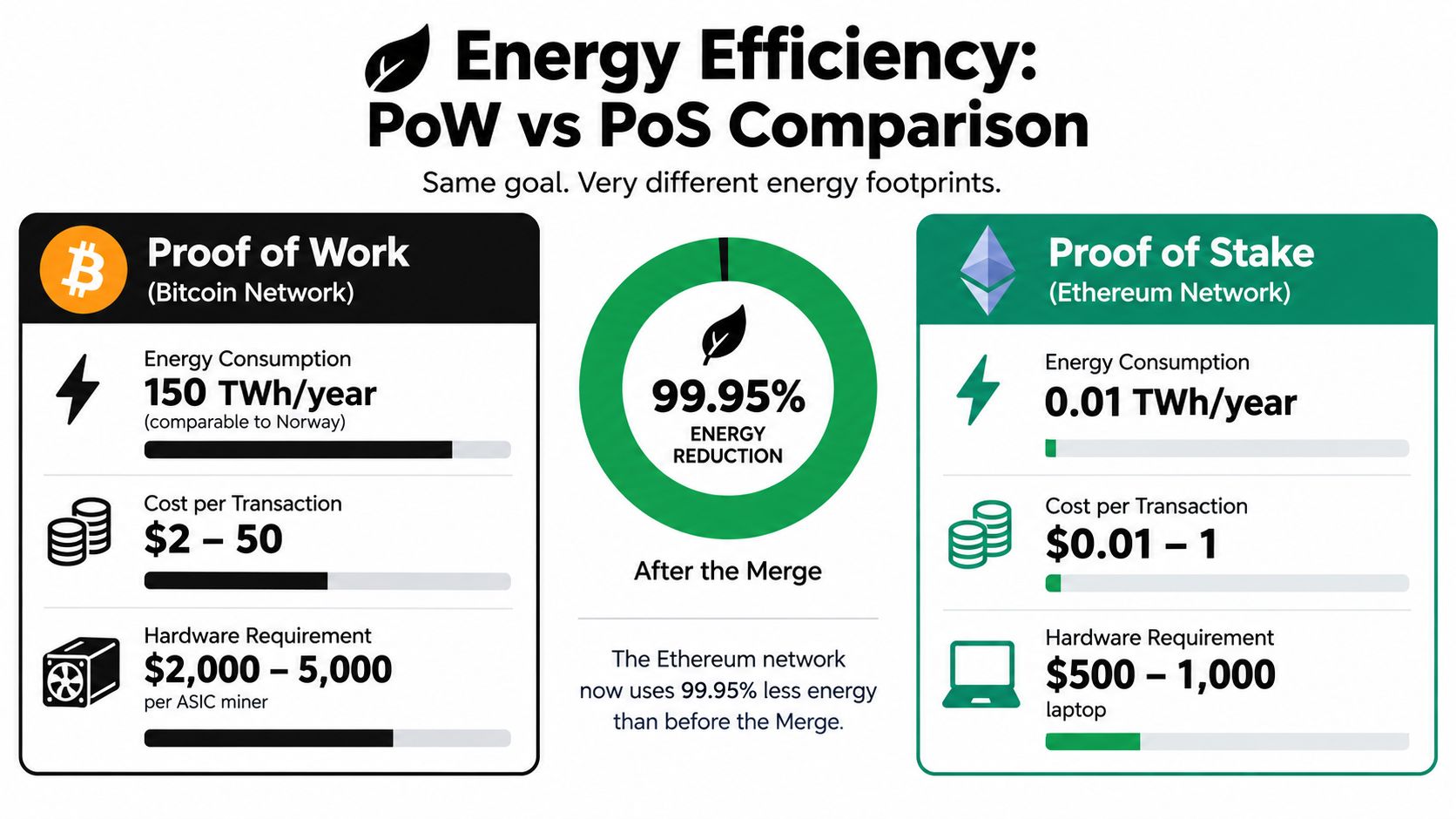
The Merge changed hiring demand across Ethereum engineering. Before September 15, 2022, Ethereum security rewarded teams that could run mining hardware at scale. After The Merge, the work shifted to validators that stake ether, keep clients online, protect signing keys, and avoid behaviors that can trigger penalties. Ethereum's account of the transition describes the protocol change itself.

For engineers, the important shift was not only lower energy use. It was a new operational center of gravity. A miner's edge came from hardware efficiency, power pricing, cooling, and pool strategy. A validator operator's edge comes from Linux administration, client behavior, key management, observability, failover design, and a clear model of slashing risk. The protocol changed. The interview loop changed with it.
Consider two engineers with similar distributed systems backgrounds. One has spent years tuning mining equipment, sourcing power, balancing thermal loads, and following hash-rate economics. The other has operated Linux servers, managed signing keys, deployed consensus clients, and built alerting for missed attestations. Under pre-Merge Ethereum, the first profile sat closer to the revenue engine. Under current Ethereum, the second profile is closer to the production risk that teams are paid to control.
Mining expertise still has a place, but in different markets. Bitcoin operators, mining facilities, and pool infrastructure teams still need engineers who understand uptime, rack design, power contracts, cooling constraints, firmware behavior, and the business impact of geographic concentration. The Merge made that specialization narrower inside Ethereum while making validator operations a core path for protocol, staking, and infrastructure roles.
What changed for job seekers
Proof-of-stake teams do not hire only for node setup. They hire for validator lifecycle management, client diversity, safe failover, key isolation, quorum participation, and recovery after outages. They also need engineers who can explain how incentives shape operator behavior, because staking is part infrastructure work and part risk management.
That creates a practical entry point for junior candidates.
You do not need to present yourself as an expert in every layer of Ethereum. A small validator lab, clear notes on client configuration choices, monitoring for missed duties, and a solid explanation of how failover can cause double-signing will usually say more than generic interest in staking.
Career rule: Learn the failure mode before learning the buzzword. “I understand staking” is weak. “I can prevent double-signing during failover and explain the monitoring signals that would catch an offline validator” is an interview answer.
Candidates targeting proof-of-work roles should be just as concrete. Explain how hash-rate shifts affect operations, how electricity pricing changes margins, and why cooling and uptime matter as much as software. Hiring managers can place those skills quickly because they map directly to operating costs and system reliability.
The divide in proof of work vs proof of stake is professional, not just technical. Each model funds a different class of operator. Choose the one that matches the incidents you want to handle, the infrastructure you want to run, and the career capital you want to build.
How Proof of Work Secures Bitcoin and Other Networks
Proof of work turns computation into a security expense. Miners collect pending transactions, assemble a candidate block, and repeatedly calculate hashes until one miner finds a result that satisfies the network's difficulty target. The winner publishes the block, other nodes verify it, and competing miners begin working on the next block.
Bitcoin's design keeps block production near a predictable interval by adjusting mining difficulty every 2,016 blocks, targeting a two-week period for that group. If miners produce those blocks faster, the next difficulty rises proportionally, with the documented adjustment able to increase by as much as 300%. A slowdown causes difficulty to fall toward the same target, as described in the Bitcoin developer guide to block-chain difficulty.
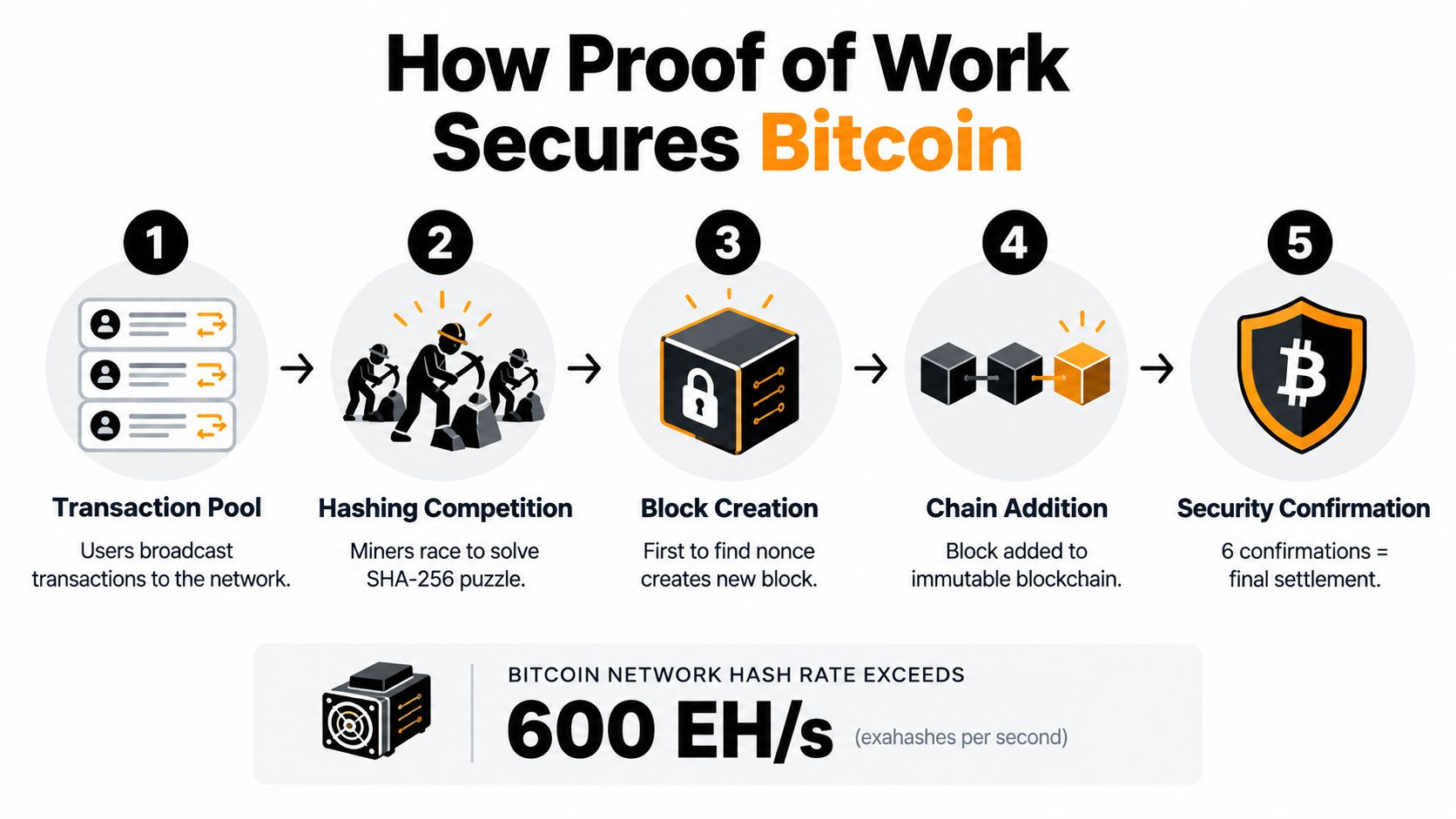
That adjustment is a useful interview test because it reveals whether a candidate understands the system as an economic machine rather than a generic puzzle. A sudden change in global hash rate affects the time needed to produce blocks, but the protocol responds at the adjustment boundary rather than instantly. Engineers working around mining operations must connect network conditions to hardware deployment, facility capacity, and revenue pressure.
The scale of the physical system matters. The U.S. Energy Information Administration's Bitcoin mining analysis, using Cambridge Centre for Alternative Finance estimates, placed global Bitcoin mining electricity consumption between 67 and 240 TWh in 2023, with a central estimate of approximately 120 TWh. The same analysis estimated annual demand around the end of January 2024 at 170 TWh, with a lower bound of 80 TWh and an upper bound of 390 TWh.
The work behind the hash
Mining isn't only a cryptography job. A serious operation needs people who can source and maintain specialized hardware, negotiate electricity access, manage cooling, schedule repairs, and monitor fleet performance. Pool operators add another layer involving payout systems, connectivity, work distribution, and protection against operational disruption.
A candidate targeting this market should build a portfolio around measurable systems work:
- Hardware operations: Explain ASIC deployment, firmware management, component failure, and replacement workflows.
- Energy management: Model how power availability and pricing affect whether machines remain productive.
- Facility reliability: Discuss thermal management, network redundancy, physical access, and maintenance windows.
- Pool infrastructure: Understand how miners receive work and how operators account for contributions.
The proof of work overview for blockchain professionals can help structure the basic vocabulary, but interviews usually go deeper. Expect questions about reorganization risk, confirmation policy, hash-rate concentration, difficulty retargeting, and what happens when a facility loses power.
Proof of work remains attractive to Bitcoin supporters because its security cost is anchored outside the token itself. An attacker needs access to hardware, electricity, and sustained operating capacity. That model has environmental and infrastructure costs, but it also gives engineers a tangible security budget to model.
How Proof of Stake Replaces Mining with Staked Capital
Proof of stake removes the race to perform equivalent large-scale calculations. Instead, participants commit capital, operate validator software, and take responsibility for proposing or attesting to blocks. Ethereum's model requires a validator to deposit at least 32 ETH, while a block becomes finalized when votes representing at least 66% of all staked ETH support it, according to Ethereum's proof-of-stake documentation.
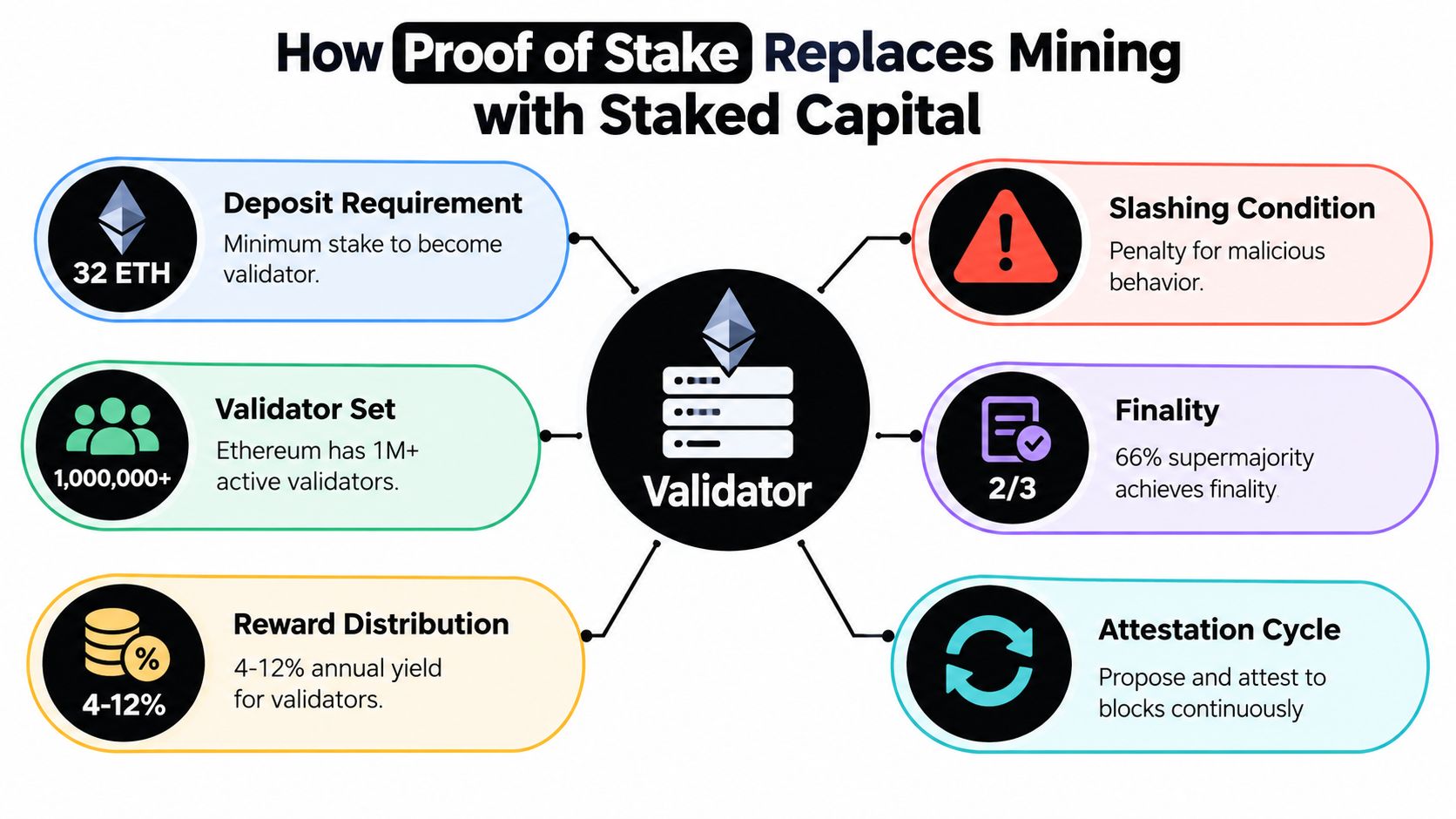
The operational substitution is straightforward but demanding. A miner tries to maximize useful hash production while controlling energy and hardware costs. A validator tries to remain available, sign only valid messages, participate in attestations, and protect keys from duplication or compromise. The resource is no longer primarily electricity. It is capital at risk plus dependable distributed-systems operations.
That changes the interview vocabulary. A staking infrastructure candidate should be ready to explain why the 32 ETH threshold exists, how a two-thirds supermajority supports finality, and what an attacker controlling at least 33% of stake could do. Ethereum identifies more than one-third of total stake as sufficient to prevent normal finalization, while an attacker with at least 33% can delay finality by going offline or withholding support.
Slashing makes correctness a production requirement
Availability alone isn't enough. Ethereum's validator rewards and penalties documentation describes penalties for provable misbehavior, including signing two different blocks for the same slot or making an attestation that surrounds another attestation. For a 32 ETH validator, the immediate penalty for specified behavior is 0.0078125 ETH, followed by a forced removal process lasting 36 days. A correlation penalty applies around Day 18, and a mass-slashing event can ultimately consume 100% of a validator's stake.
Those rules make key management a first-class engineering concern. Safe failover must prevent two machines from signing for the same validator at once. Backup procedures must preserve signing-key isolation. Monitoring must distinguish a harmless restart from a condition that could create conflicting attestations.
Interview scenario: Your primary validator host fails during a maintenance window. Explain how you transfer service without creating two active signers, how you verify state consistency, and which alerts confirm that the replacement is performing duties correctly.
Ethereum's inactivity leak illustrates another difference. If the consensus layer fails to finalize for more than four epochs, stake belonging to offline or minority-voting validators gradually decreases until active validators regain a two-thirds majority. That mechanism turns recovery into an economic process, so validator operators must monitor attestations and quorum participation rather than only server health.
For a clear introduction to the broader staking model, see what staking in cryptocurrency means for participants. The career takeaway is sharper: proof-of-stake engineers need to combine distributed systems, cryptographic key custody, observability, and incentive design.
Comparing Security Models and Attack Vectors
The simplistic comparison says proof of work needs control of hash power while proof of stake needs control of stake. That shorthand is useful, but it misses the questions a security engineer must answer: Who can acquire the resource? How quickly can the attack be detected? Can the attacker recover the investment? Can honest participants restore the chain?
Proof of work anchors security in external markets. The attacker needs hardware access, electricity, connectivity, and time. The cost is visible in the operating environment, but the attacker may retain some physical assets after an incident. Proof of stake internalizes the cost in the network's asset. The attacker must acquire or control stake, and protocol penalties can make dishonest behavior financially destructive.
A 2025 economic analysis of consensus security concluded that proof of stake can be more secure than an otherwise equivalent proof-of-work design, particularly for high-scale blockchains. The same research area highlights safety and liveness trade-offs, validator coordination, offline participation, long-range-history risks, and recovery from conflicting finalized views.
The risks change shape
PoW incident response centers on chain reorganizations, mining-pool concentration, hash-rate changes, hardware access, and infrastructure outages. A security engineer needs to understand confirmation policy and the economic conditions that might make sustained attack attempts more plausible.
PoS response work adds different questions:
- Stake concentration: Which custodians, liquid-staking services, or delegated operators control voting power?
- Client behavior: Could a software defect affect a large portion of validators?
- Key safety: Could failover, backups, or automation cause conflicting signatures?
- Finality recovery: What happens if a significant validator group goes offline or withholds votes?
- Governance response: Who can coordinate remediation without creating a second trust problem?
Research on Ethereum staking decentralization shows why validator count alone isn't enough. Control can concentrate through liquid-staking services and custodians, so candidates should learn to analyze voting power, delegation, client diversity, and access to capital.
Security principle: Count control, not machines. A large validator set can still produce concentrated decision-making if many participants depend on the same service or custodian.
The right hiring signal is therefore not loyalty to one model. Protocol teams want engineers who can compare attack incentives under changing asset prices, liquidity, infrastructure access, and jurisdictional constraints. Security researchers should be able to explain why neither proof of work nor proof of stake is universally safer, and why operational recovery matters as much as the initial attack threshold.
Energy Efficiency and Operational Costs for Engineers
Energy efficiency changes the cost structure, but it doesn't eliminate cost. Proof of work spends continuously on hardware, electricity, cooling, repairs, and facility operations. Proof of stake shifts the main burden toward capital locked as stake, server reliability, signing infrastructure, software maintenance, monitoring, and operational controls.
A peer-reviewed analysis found that Bitcoin's energy consumption exceeds that of all analyzed proof-of-stake systems by at least two orders of magnitude, implying that proof of stake can reduce consensus-related energy use by roughly 100 to 1,000 times in comparable settings, as described in the study's energy comparison. Ethereum's Merge provides a practical example of that shift, but energy figures should remain network-level estimates rather than promises about a fixed cost per transaction.
What engineers actually manage
Mining operations treat electricity as a production input. A facility's engineering team must keep machines online, move heat away from hardware, secure physical equipment, and decide whether marginal output justifies continued operation. A small change in hardware efficiency or power availability can alter the economics of the entire site.
Validator operations have a different cost curve. The machines consume far less power than a mining fleet, but a missed duty, unsafe upgrade, or signing error can affect rewards or expose stake to penalties. Operators need disciplined release management, redundant monitoring, reliable time synchronization, secure key workflows, and tested recovery procedures.
A candidate preparing for infrastructure interviews should be able to compare these budgets without reducing the discussion to “cheap versus expensive.” Proof of work converts energy and hardware into an attack cost. Proof of stake commits capital and makes correctness, governance, and coordination central operating concerns.
For practical context on the responsibilities surrounding production blockchain infrastructure, a blockchain node operations engineer role is a useful reference. It points toward the skills employers often expect from operators: deploying nodes, maintaining availability, observing system health, handling upgrades, and responding to incidents. A broader DevOps and infrastructure team guide can help candidates connect those duties to team structure.
The best transferable skills
The strongest skills travel across both ecosystems:
- Observability: Build dashboards that distinguish normal variation from a consensus-threatening failure.
- Automation: Make deployments repeatable, but keep high-risk signing actions behind deliberate controls.
- Incident response: Write runbooks for outages, degraded participation, software defects, and recovery.
- Economic reasoning: Connect infrastructure decisions to incentives, token exposure, energy markets, and operational risk.
- Systems debugging: Trace failures across networking, storage, clients, keys, and consensus behavior.
Engineers who can move between these layers are more useful than specialists who only repeat the mechanism's marketing narrative. Hiring teams need people who understand the resource being spent and the failure that resource is meant to prevent.
Career Paths and Hiring Implications for Web3 Roles
Choose proof of work if you enjoy physical systems, energy markets, hardware optimization, and operations at industrial scale. Mining hardware engineers, site reliability specialists, power procurement analysts, pool engineers, and facility managers can build strong careers in that environment. The work is concrete: machines fail, temperatures rise, power contracts constrain decisions, and hash-rate economics changes the operating plan.
Choose proof of stake if you prefer distributed systems, cryptography, cloud infrastructure, capital coordination, and software-defined security. Validator operators, consensus-client engineers, staking product managers, key-management specialists, protocol security researchers, and slashing-risk analysts work closer to the dominant problems of staking networks.
Match the mechanism to your evidence
Hiring managers don't need another candidate who says they are passionate about decentralization. They need proof that you can operate safely.
- For mining roles: Document a lab or simulation covering hash-rate changes, difficulty adjustment, hardware failure, and power constraints.
- For validator roles: Build a test environment with client upgrades, alerting, key isolation, safe failover, and participation monitoring.
- For protocol roles: Explain finality, reorganization behavior, safety-liveness trade-offs, and recovery procedures in plain technical language.
- For security roles: Model stake or hash-power concentration, attack detection, incentive changes, and incident coordination.
- For product roles: Translate consensus constraints into user-facing settlement expectations, custody choices, and operational risk.
Candidates should also read outside blockchain-specific job descriptions. A practical guide to jobs at Upworthy illustrates a broader point about career positioning: role research helps you identify the evidence an employer expects before you tailor your application. Apply that discipline here. Read several role descriptions, extract repeated requirements, then build one demonstrable project around the skill that appears most often.
My recommendation is direct. If you want to work close to physical infrastructure and energy economics, pursue proof-of-work operations. If you want a software-led path with stronger overlap with SRE, distributed systems, cryptography, and security engineering, pursue proof-of-stake infrastructure. Either way, learn the competing model well enough to discuss its attack surface without caricature.
The best blockchain professionals aren't mechanism loyalists. They're engineers who understand what secures a network, what can fail in production, and which safeguards keep an incident from becoming a loss of trust.
Blockchain Jobs helps candidates find Web3 roles across engineering, operations, security, DevOps and infrastructure, product, compliance, and other specialties where consensus knowledge matters. Browse the latest opportunities on Blockchain Jobs, then target roles that match the proof-of-work or proof-of-stake skills you can demonstrate.