Your Guide on How to Find Programming Jobs in Tech
Let's be honest, finding a great programming job isn't about luck. It’s about having a smart, focused strategy. Think of this guide as your playbook for getting hired in today's tech world, especially if you're eyeing a role in a hot space like Web3.
We’re going to move you from just another applicant in the pile to the candidate they have to interview.
Your Game Plan for the Modern Tech Job Market
Treating your job search like a project is the single best piece of advice for your career progression. It needs a clear plan, real milestones, and a solid understanding of what hiring managers actually want. It's not just about what you know; it's about proving you can solve a company's real-world problems and that you're genuinely passionate about your craft.
This is doubly true in emerging fields like Web3. The industry is evolving at breakneck speed, and the opportunities are massive. We've seen a staggering 45% increase in blockchain-related job postings in the last year alone. This isn't just about crypto—it’s finance, healthcare, and supply chain management all scrambling for skilled developers. You can see a breakdown of these new roles over at 01tek.com.
To keep your search organized and effective, let's zero in on the core pillars that will support your entire effort.
Core Pillars of Your Job Search Strategy
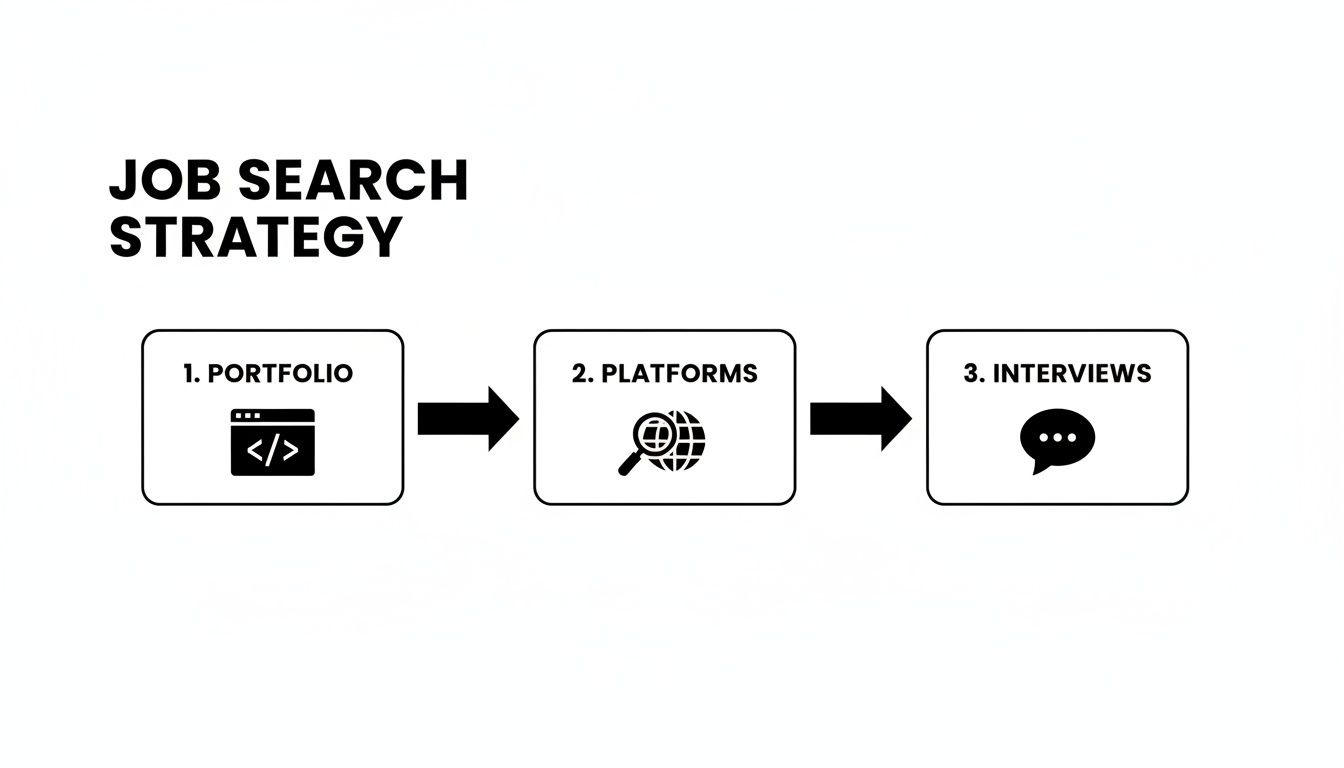
Think of your job search as having three main parts. Each one builds on the others, creating a complete picture that shows a company exactly why they should hire you and how you'll contribute to their success.
Here’s a quick summary of where to focus your energy to maximize your chances in job interviews:
| Focus Area | Key Action | Impact on Hiring & Interviews |
|---|---|---|
| Portfolio & Presence | Build tangible proof of your skills (GitHub, projects, articles). | Provides concrete talking points and evidence during interviews. It answers "Can you do the job?" before they even ask. |
| Targeted Networking | Engage in niche communities and build genuine professional connections. | Creates warm leads and referrals, which have a significantly higher interview-to-offer conversion rate. |
| Interview Execution | Practice coding challenges and prepare compelling stories about past work. | Directly demonstrates your technical and collaborative skills, proving you are the best candidate for the role. |
Getting these three areas right is the foundation of a successful search. It shifts the dynamic from you chasing jobs to opportunities coming to you, advancing your overall career progression.
I see so many developers spend 90% of their time just firing off applications and only 10% on preparation. To get hired, you need to flip that ratio. A killer portfolio and a strong network will do most of the heavy lifting for you.
This structured approach means you stop wasting time. Instead of shotgunning your resume across massive, generic job boards, you'll put your effort where it actually counts. In the next sections, we'll dive deep into each of these pillars, starting with how to build a portfolio that gets you the interview.
Build a Portfolio That Speaks for You
Your resume tells a hiring manager what you've done, but your portfolio shows them what you can do. From a hiring perspective, it’s the single most important piece of your job search puzzle because it’s hard, concrete proof of your problem-solving abilities. Just listing a bunch of tutorial projects won’t land you an interview. Your portfolio needs to tell a story about how you think, solve complex problems, and deliver value.
This is all about strategic selection. Instead of dumping every script you've ever written, curate a collection that screams, "I am the solution to your problems." If you're targeting Web3 roles, a DeFi lending protocol you built with Solidity will make a much bigger splash than another to-do list app. Likewise, a slick, custom data visualization tool will immediately grab the attention of companies hiring for Python data engineering roles.
Think of your portfolio as the prerequisite for your entire job search. It's what you build before you apply. A strong portfolio makes everything else—applications, networking, and especially job interviews—so much easier.
With tangible proof of your work, you'll be more confident, and recruiters will see you as a serious candidate from the start, fast-tracking your career progression.
Document Your Process on GitHub
Your GitHub profile isn't just a place to store code; it's a critical part of your professional brand that hiring managers and senior devs will scrutinize. They dig through it to see your coding style, understand your thought process, and judge how well you document your work—all key indicators of how you'll perform on the job.
Treat every repository like a mini case study for a future job interview. A clean profile with thoughtfully written READMEs instantly signals professionalism and clear communication—two massive soft skills.
Here’s how to make your projects stand out to a hiring manager:
- Write Incredible READMEs: Don't just state what the project is. Explain the why—the problem it solves and your solution. Detail the tech stack, and most importantly, give clear instructions on how to get it running. Add screenshots or, even better, a GIF of the finished product in action.
- Keep Your Commit History Clean: Use clear, descriptive commit messages like
feat: add user authentication endpointinstead ofstuff. This demonstrates a methodical workflow and shows you can integrate into a professional engineering team. - Show Off Your Code Quality: Ensure your code is well-commented, consistently formatted, and follows industry best practices for your language. This is a direct reflection of the quality of work you'll produce for an employer.
A well-documented project on GitHub is your pre-loaded answer to the inevitable interview question, "Can you walk me through a project you're proud of?" It lets you control the narrative and prove your expertise before you even step into the room.
Go Beyond Personal Projects
Personal projects are great, but contributing to something bigger is a career-accelerating move. It proves you can collaborate, navigate an existing codebase, and make an impact in a real-world setting—things a resume can't effectively communicate.
Look for opportunities with a high impact that directly mimic a professional environment:
- Contribute to Open-Source: Find a bug in a library you use, fix it, and submit a pull request. This is a huge signal to employers. It proves you can dive into an unfamiliar, complex codebase and make a meaningful contribution—a core skill for any developer role.
- Jump into a Hackathon: Hackathons are excellent for demonstrating your ability to build something functional under a tight deadline and, crucially, work effectively in a team. Even if your project doesn't win, you walk away with a fantastic portfolio piece that showcases collaboration and rapid development skills.
These activities are gold, especially if you lack formal professional experience. They act as a powerful substitute, proving to hiring managers you have what it takes to thrive on their team.
For those looking to make a great first impression, you might be interested in our guide on how to prepare a Quick GitHub/LinkedIn/CV Drop that gets noticed.
Find Hidden Gems on Specialized Job Platforms
Let's be real—spending hours scrolling through massive job boards like LinkedIn or Indeed can feel like screaming into the void. They definitely have their place, but from a hiring perspective, they're incredibly noisy. Your carefully crafted application for a smart contract developer role can easily get buried under a mountain of generic resumes, making it almost impossible to get to the interview stage.
A much smarter approach is to focus your energy where hiring managers are actively searching for your specific skills. Specialized, niche job platforms are absolute goldmines for targeted opportunities because they cut right through the clutter. If you're hunting for roles in decentralized finance or core protocol development, these platforms are where the most serious employers and candidates connect.
Why Niche Platforms Give You an Edge
Going niche means you're not just another applicant in a massive sea of candidates. You're a specialist competing against other specialists, which changes the entire hiring dynamic. Companies posting on these boards are looking for specific expertise and are often ready to move quickly, meaning a faster path to a job interview and offer.
The signal-to-noise ratio is just so much better. I've seen developers get dramatically higher response rates simply by shifting their focus.
Finding a programming job in the blockchain world means dealing with serious competition. On average, a staggering 117 applicants go for each Blockchain Developer position every month. But positioning yourself on the right platforms can give you a massive advantage. It's all about visibility, and platforms like Blockchain Jobs are built to aggregate remote-friendly roles across every Web3 category you can think of.
The biggest mistake developers make is treating all job boards the same. A well-optimized profile on a niche platform is more valuable than one hundred random applications on a general one. It shows hiring managers you understand the industry and are serious about your career progression.
The difference between general and specialized boards isn't just about the number of listings; it's about the quality and relevance of those listings. Here's a quick breakdown from a hiring lens:
General vs Specialized Job Boards
| Feature | General Job Boards (LinkedIn, Indeed) | Specialized Job Boards (Blockchain Jobs) |
|---|---|---|
| Audience | Massive, broad, and unfocused. Everyone from baristas to brain surgeons. | Highly targeted. Full of qualified developers, engineers, and Web3 professionals. |
| Competition | Extremely high volume of applicants, many of whom are unqualified. | Lower volume, but higher quality of competition. You're among peers, making it easier to stand out to recruiters. |
| Employer Intent | Often used for casting a wide net; roles can be generic or poorly defined. | Employers are looking for specific, hard-to-find skills. They're ready to hire and move through the interview process quickly. |
| Signal-to-Noise | Very low. You have to sift through countless irrelevant postings. | Very high. Almost every listing is relevant to your skills and career goals. |
| Community | Non-existent. It’s a transactional platform. | Often have built-in communities, newsletters, and resources for the niche, aiding career progression. |
Ultimately, while you might keep a profile on the big sites, your active job search should be concentrated on specialized boards where you're far more likely to get noticed by the right hiring managers.
Optimizing Your Presence for Maximum Impact
Just signing up and creating a profile isn't enough to secure a job interview. You need to make it work for you. Think of your profile on a site like Blockchain Jobs as your personal billboard. It needs to grab the attention of a recruiter instantly.
Here’s how to make it compelling:
- Use Specific Keywords: Don't just list "developer." Get granular. Use terms like "Solidity smart contract developer," "Rust protocol engineer," or "DeFi security auditor." Recruiters and hiring managers use these exact phrases in their searches.
- Set Up Precise Alerts: Don't wait for jobs to come to you. Create hyper-specific alerts for the exact titles, technologies, and companies you’re targeting. Being one of the first to apply is a significant advantage in any hiring process.
- Tailor Each Application: Even on a niche board, a little customization goes a long way. Mention a specific project the company just launched or a piece of tech they use in your opening line. It proves you've done your homework and are a serious candidate, not just a spammer.
Master Your Networking and Community Presence
Your portfolio and technical chops might get you in the door, but your network often lands you the interview. This is especially true in tech and even more so in close-knit spaces like Web3. The best programming jobs are often filled through referrals and connections long before they ever appear on a public job board.
This isn’t about awkwardly passing out business cards. It's about building real relationships by providing value first.
If you can flip your mindset from, "What can I get from this person?" to, "What can I offer?" you’ll stop being just another job seeker and become a valued community member. When you consistently help others, share what you know, and join conversations, people remember. Hiring managers and senior devs start to see you as someone who is not only skilled but also a great collaborator—exactly who they want on their team.
Become a Fixture in the Right Circles
Forget scrolling through generic LinkedIn groups. The hiring managers and senior engineers you want to meet are already active in high-quality communities where real work gets discussed. You just need to show up where they are.
For developers, that means diving into the platforms where the code and the community live.
- Project-Specific Discords: Found an open-source tool you love or a blockchain protocol you're excited about? Join their Discord. Don't just lurk; participate. Help a newcomer, offer feedback on a new feature, or share a helpful resource. This visibility can directly lead to interview opportunities.
- X (formerly Twitter) Discussions: Follow key people and companies in your niche. When they post something interesting, don't just "like" it—add to the conversation with an insightful question or a thoughtful reply. It’s a surprisingly effective way to get on the radar of industry leaders and hiring managers.
- Targeted Meetups and Hackathons: Whether in-person or virtual, these events are career gold. A casual conversation at a hackathon can easily lead to a job opportunity, especially after you’ve just spent a weekend building something cool together.

These are the places where developers connect. By becoming a regular, you demonstrate your expertise and build the kinds of relationships that unlock career opportunities and fast-track your progression.
Play the Long Game by Building Your Reputation
Effective networking is a long-term investment in your career. The goal is to be the person who comes to mind when a new role opens up. That only happens when you show up and contribute consistently.
A strong community presence is a massive trust signal for hiring managers. It proves you're passionate enough about your craft to engage with it outside of a 9-to-5. That's a huge competitive advantage in any job interview process.
Treat every public interaction like a mini-interview. When you help someone debug their code in a Discord channel or write a quick blog post explaining a tricky concept, you're showcasing your skills, communication style, and collaborative spirit. This public proof of your expertise can be far more convincing to a hiring team than anything on a resume.
A great way to find companies that appreciate this kind of community involvement is to look through directories of Web3 companies actively hiring, as they are often deeply woven into these developer ecosystems.
Ace the Technical and Behavioral Interviews
So, you’ve landed the interview. This is where your portfolio, networking, and applications culminate. It's your chance to prove you're not just a solid developer on paper but also a collaborative and effective team member they want to hire.
Forget about just memorizing algorithms. The real goal of a job interview is to show them how you think, how you collaborate, and how you tackle unfamiliar problems. Your ability to communicate your thought process is far more valuable to an interviewer than blurting out a "perfect" answer. Think of it less as a test and more as your first collaborative problem-solving session with a potential new teammate.

Nail the Technical Communication
Whether you’re at a whiteboard or in a shared coding environment, the objective is to articulate your logic. Don’t dive into the code and go silent—that's a huge red flag for interviewers. Instead, talk them through your entire process, demonstrating the problem-solving skills they are looking to hire.
Here’s a simple framework that succeeds in job interviews time and time again:
- Clarify the Problem. First, repeat the problem back to them in your own words. Ask clarifying questions about edge cases, constraints, or expected inputs. This shows you’re methodical and don't make assumptions—an easy way to impress.
- Outline Your Initial Approach. Before writing a single line of code, sketch out your high-level strategy. You might say, "Okay, my first instinct is to use a hash map to track frequencies. That should give us O(1) lookups, which will be efficient for the expected scale of this problem."
- Think Aloud as You Code. As you implement your solution, narrate your decisions. If you're working on a smart contract, you could mention, "I'm sticking to the
Checks-Effects-Interactionspattern here to guard against reentrancy attacks." This is a perfect way to showcase deep expertise. - Test and Refactor. Once you have a working solution, don't stop. Immediately discuss its time and space complexity and then suggest ways to optimize it. This demonstrates a senior mindset—always looking for improvements, a highly desirable trait for career progression.
This approach turns a stressful technical screen into a collaborative discussion where you showcase your skills as a future colleague.
Craft Compelling Behavioral Stories
Behavioral questions are designed to uncover your soft skills and predict your future performance. How do you handle conflict? What happens when you make a mistake? Interviewers want to hear real stories, not generic answers. The STAR method is the best tool for this.
It’s a simple structure to keep your stories focused and impactful:
- Situation: Briefly set the scene. What was the project or context?
- Task: What was your specific goal or responsibility?
- Action: Detail the concrete steps you personally took to address the task.
- Result: Explain the outcome of your actions. Quantify it with numbers whenever possible to demonstrate impact.
Don’t just say, "I improved our app's performance."
Instead, try this: "The main user dashboard (Situation) was taking over five seconds to load, leading to a high user drop-off rate (Task). I used a profiler to identify a major API bottleneck, then implemented server-side caching and batched several network requests (Action). As a result, we reduced the load time to under 800ms and cut user complaints by 75% in the next sprint (Result)."
See the difference? One is a vague claim. The other is a powerful, evidence-backed story that proves your value to a potential employer.
Ask Questions That Show You Care
The "Do you have any questions for us?" part of the interview is a critical opportunity, not just a formality. The questions you ask reveal your priorities and level of interest. This is your chance to interview them and ensure the role aligns with your career progression goals.
Asking smart, insightful questions shows you’re genuinely interested and helps you determine if this is a company where you can thrive. Ditch generic questions like, "What's the company culture like?" and dig deeper.
Here are a few examples of questions that show you're a serious candidate:
- "I saw on your engineering blog that you recently migrated your backend to Rust. What were some of the biggest technical hurdles the team had to overcome during that transition?"
- "How does your team handle technical debt? Is there a formal process for refactoring and improving the codebase?"
- "Thinking about this specific role, what would success look like in the first three to six months? What are the key milestones you'd expect me to hit?"
Questions like these shift the dynamic. You’re no longer just an applicant; you’re a thoughtful, engaged professional evaluating them as much as they are evaluating you.
Got Questions About Finding a Programming Job? You're Not Alone.
Jumping into the job market, whether it's your first time or you're a seasoned pro, always brings up questions. Here are some of the most common ones I hear from developers, with actionable answers focused on getting you hired and advancing your career.
How Do I Find a Programming Job with No Professional Experience?
This is the classic chicken-and-egg problem, but it's solvable. Shift your focus from "paid experience" to "proven experience." Your mission is to build such a compelling case for your skills that a lack of a formal job title becomes irrelevant to a hiring manager.
Start with a killer portfolio. I’m not talking about tutorial clones; you need three to four solid projects that tackle real problems. Even better? Dive into open-source. Contributing to a project on GitHub is the single best way to simulate professional experience. It proves you can read someone else's code, collaborate with a team, and make meaningful contributions—skills every hiring manager looks for in junior developers.
Also, don't sleep on hackathons. They’re a fantastic way to demonstrate teamwork and the ability to deliver under pressure. When you get to the job interview, discuss these projects with the same confidence as paid work. Explain the problems you solved, your technical decisions, and what you learned.
What Are the Most In-Demand Programming Skills Right Now?
While fundamentals like Python and JavaScript are always important, the best opportunities and career progression often lie in specialized, high-growth areas. If you’re targeting Web3, for example, mastering Rust and Solidity is non-negotiable for protocol engineering or smart contract roles.
Beyond that, here are the skills that hiring managers are consistently looking for:
- Cloud Proficiency: A deep understanding of AWS, Azure, or GCP is a prerequisite for most modern backend or DevOps roles. It's no longer a bonus; it's a requirement.
- Containerization Mastery: Experience with Docker and Kubernetes is essential. Companies rely on this tech to build and ship software efficiently.
- AI and Machine Learning: If you're in the data space, proficiency with libraries like TensorFlow or PyTorch will put you in a different league and significantly accelerate your career progression.
Remember, just listing these on your resume is not enough. You have to prove you can use them. Build a project around them or get a respected certification to provide tangible evidence to hiring managers.
"When you're starting out, being a generalist is fine—it helps you figure out what you like. But to really level up your career and your salary, you have to specialize. Finding a niche like blockchain security or AI-driven data science means less competition and, frankly, better pay."
How Important Is a Cover Letter for a Programming Job?
Think of the cover letter as your secret weapon in the hiring process. Most developers either skip it or use a generic template, which hiring managers spot immediately. This is a huge missed opportunity to stand out.
Your resume lists what you've done. A great cover letter explains why you're the right person for this specific job at this specific company. It’s your chance to tell a story that connects your skills to their needs.
- Show them you’ve done your research. Mention their mission or a product feature you admire.
- Connect the dots for the hiring manager. Explicitly link a project from your portfolio to a specific requirement in their job description.
- Let your passion and personality show. Demonstrate that you're someone they'd want to collaborate with every day.
For startups and mission-driven companies, a thoughtful cover letter can absolutely be the deciding factor that lands you the interview over another candidate with similar technical skills. It proves you're genuinely invested in this specific opportunity, not just applying everywhere.
Ready to find a role that matches your skills and passion? Blockchain Jobs is the premier destination for discovering opportunities in the Web3 ecosystem. Explore curated listings from top companies in DeFi, NFTs, and beyond at https://blockchain-jobs.com.