How to Hire Software Engineers: A Practical Guide for Web3

To hire the right software engineers, you first have to define who the "right" engineer is for your project. The process starts with a detailed role profile that outlines the essential technical skills, problem-solving abilities, and cultural alignment you need. This profile acts as your hiring North Star—ensuring every candidate is evaluated against the same objective standard from their initial application to the final interview.
Defining the Engineer Your Web3 Project Actually Needs

Before writing a job description or starting outreach, you must create a crystal-clear picture of the ideal candidate. Skipping this step is like trying to build a dApp without a smart contract—it’s a recipe for wasted time, money, and mismatched hires. A well-defined profile is the foundation of an effective hiring process and sets candidates up for long-term career success at your company.
This profile must go beyond a simple checklist of programming languages. Define the role's impact. What specific problems will this engineer solve in their first 90 days? How will their contributions directly advance your project's roadmap? Answering these questions helps you articulate a compelling career opportunity, not just another job.
Involve your technical leads in this process. This collaborative exercise forces everyone to agree on what skills are critical for success right now, ensuring alignment across the entire interview panel.
Distinguishing Must-Haves from Nice-to-Haves
A critical part of defining the role is separating non-negotiable requirements from desirable skills. Blurring these lines either shrinks your talent pool to an unrealistic size or leads to hiring someone who looks good on paper but lacks the core competencies to deliver. From a candidate's perspective, this clarity helps them understand if they are truly a good fit and what skills they need to develop for career progression.
Here’s a practical breakdown:
- Must-Haves: These are the deal-breakers. For a core protocol engineer, this could be deep experience with Solidity or Rust. For a front-end dApp developer, proven expertise in libraries like Ethers.js or Web3.js is non-negotiable.
- Nice-to-Haves: These are skills that add value but can be learned on the job. A background in DevOps or contributions to well-known open-source crypto projects are excellent bonuses, not baseline requirements.
This table breaks down common skill categories for a Web3 engineer, providing an actionable template for your role profile.
Essential vs. Desirable Skills for a Web3 Engineer
| Skill Category | Essential (Must-Have) | Desirable (Nice-to-Have) |
|---|---|---|
| Blockchain Fundamentals | Solid understanding of blockchain concepts (decentralization, consensus) and smart contracts. | Deep knowledge of specific consensus algorithms (PoS, PoW) or cryptography. |
| Programming Languages | Proficiency in Solidity or Rust for smart contract development. | Experience with other languages like Go, Python, or TypeScript. |
| Web3 Libraries | Experience with Ethers.js or Web3.js for front-end interaction with smart contracts. | Familiarity with advanced tooling like Hardhat, Truffle, or Foundry. |
| System Design | Ability to design and architect secure, scalable dApps. | Experience with L2 scaling solutions, cross-chain bridges, or MEV. |
| Security Mindset | Knowledge of common smart contract vulnerabilities (e.g., reentrancy) and best practices. | Proven experience with security audits or formal verification. |
| Collaboration | Strong communication skills and experience with Git workflows. | Active contributor to open-source projects or DAOs. |
Use this table as a starting point. Tailor it to your specific needs to avoid writing a "purple squirrel" job description that no real candidate can fulfill.
This distinction is crucial in the current market. With over half of open software engineering roles targeting senior talent, companies are looking for specialists who can contribute immediately. This trend reflects a demand for experienced developers capable of navigating complex decentralized systems with minimal ramp-up time. You can find more insights on the software engineering job market at Underdog.io.
Building a Candidate Scorecard
Translate your role profile into a practical evaluation tool: a candidate scorecard. This ensures every applicant is measured against the same objective criteria, minimizing bias and enabling data-driven hiring decisions. For candidates, this structured approach leads to a fairer and more transparent interview process.
Your scorecard should be a living document, refined with input from your entire interview panel. It’s not just an HR tool; it’s a strategic alignment framework that keeps everyone focused on what success in the role actually looks like.
A good scorecard breaks down the role into core competencies, allowing interviewers to rate candidates on a simple 1-5 scale. Key evaluation areas should include:
- Technical Competency: How strong are their skills in your core tech stack?
- Problem-Solving Skills: Can they deconstruct complex problems and articulate a clear solution?
- System Design and Architecture: Do they understand the trade-offs in building scalable, secure systems?
- Team and Values Alignment: How well do their communication and work styles align with your team’s culture?
Using a scorecard helps you compare candidates objectively, whether they are a mid-level developer applying to a program like the Binance Accelerator Program or a principal engineer. It standardizes feedback, elevating the interview debrief from a vague "I liked them" to a concrete "They scored highly on system design, but we have concerns about their front-end experience." This rigor is essential for hiring an engineer who will drive your project forward.
Writing a Job Description That Actually Attracts Top Engineers
In the Web3 world, your job description is often the first interaction a top engineer has with your company. A generic list of responsibilities is a guaranteed way to be ignored. You aren't just filling a position; you are pitching a career-defining opportunity, and your pitch must be compelling.
Treat your job description as a marketing asset, not an HR document. It must cut through the noise and give talented engineers—who have many options—a clear reason to engage with you.
Frame the Role Around Problems, Not Tasks
Top engineers are driven by solving complex challenges, not completing a checklist of duties. Lead your job description with the why. What is the core problem this person will have the opportunity to solve?
Instead of writing this:
- "Responsible for maintaining and updating smart contracts."
Frame it as an actionable challenge:
- "You'll architect and secure our new cross-chain governance protocol, solving for MEV resistance and scalability for our rapidly growing user base."
The second example presents a high-stakes mission. It speaks directly to an engineer's ambition and filters for candidates who are genuinely motivated by your project's challenges, not just seeking another job. Browsing platforms like https://blockchain-jobs.com/ can provide excellent examples of how leading companies frame their roles to attract top talent.
Be Radically Transparent About Your Stack and Team
Ambiguity is a major red flag for engineers. They want to know precisely what technologies they'll be working with. Be explicit about your entire tech stack.
- Primary Languages: Go, Rust, Solidity
- Infrastructure: Kubernetes, AWS, Alchemy
- Testing & Tooling: Foundry, Hardhat, Grafana
This transparency attracts engineers who are excited by your stack and allows those who aren't to self-select out, saving everyone time. More importantly, it builds immediate trust. Honesty about your technology signals a mature and self-aware engineering culture.
Go further by describing the team structure and career progression. Will they report to the CTO? Join a small, autonomous pod? What does the growth path look like? An engineer with 5 years of experience is looking for a role that offers a clear path to a principal or lead position.
A job description is a promise. It sets expectations for the role, the culture, and the challenges ahead. Failing to be transparent from the start erodes trust and is a leading cause of mis-hires and early turnover.
Put Your Compensation Upfront
The debate is over: you must include a salary and compensation range in your job description. Job posts with clear salary ranges consistently receive more high-quality applicants. It's a powerful filter that respects a candidate’s time and signals that you are a serious, professional organization ready to hire.
Including the range accomplishes several key goals:
- Filters Out Mismatches: You immediately disqualify candidates whose expectations are outside your budget.
- Attracts Serious Talent: It shows confidence in your offer and that you aren't trying to underpay.
- Builds Trust: Transparency around compensation is a strong indicator of a healthy culture.
Don't stop at salary. Mention perks relevant to the Web3 space, such as token incentives, equity packages, a remote work stipend, or a professional development budget. These details provide a complete picture of the total value proposition and can be the deciding factor for a candidate considering multiple offers.
Finding Talent Where Other Startups Aren't Looking
The best Web3 engineers aren't passively scrolling through job boards. They are actively contributing to open-source projects, participating in DAOs, and engaging in technical communities. To hire them, you must meet them where they are.
This requires a shift from a passive "post and pray" approach to active, strategic sourcing. The goal is to become a respected entity within the ecosystems where your ideal candidates already operate.
Get Your Hands Dirty on GitHub, Discord, and Telegram
Generic, copy-pasted outreach messages are ineffective. Successful sourcing requires thoughtful engagement that demonstrates you've done your research. This is about building genuine connections based on mutual respect for the craft of software engineering.
Identify the open-source projects critical to your tech stack and the key contributors. Who is consistently shipping meaningful code, fixing complex bugs, or proposing innovative features?
- On GitHub: Look beyond commit counts. Analyze pull requests. A well-documented PR that clearly explains a complex solution is a strong signal of both technical and communication skills.
- In Discord & Telegram: Monitor developer channels for the protocols and tools you use. The engineers who patiently help others are often the collaborative, knowledgeable team members you want to hire.
When you reach out, personalize your message. Reference a specific contribution that impressed you. Your outreach should feel less like a recruitment pitch and more like a recognition of their excellent work from a fellow developer.
Tap into Niche Web3 Talent Pools
General job boards are noisy. Specialized Web3 job platforms are highly curated talent pools that attract engineers already passionate about the space, saving you the effort of screening for domain knowledge and interest.
Moving your sourcing from broad job boards to niche communities is a huge force multiplier. You'll spend far less time explaining the basics of Web3 and far more time discussing the genuinely hard problems your project is solving—and that's what gets top-tier engineers excited.
The software engineering job market is competitive. With investment banking software hires up +91% and industrial automation up +73%, and 327,000 new developer jobs expected in the U.S. by 2033, a generic job post is insufficient. Understanding these software engineering job market trends at GetAura.ai is essential for crafting a competitive hiring strategy.
Build a Referral Program That Actually Works
Your current engineers are your most effective recruiting tool. They have the credibility to attract talent because they can speak authentically about your culture, tech stack, and the realities of the job.
A great referral program is more than just a cash bonus. It's about empowering your team to be ambassadors.
Here’s how to make it effective:
- Keep It Simple: Create a straightforward process for submitting referrals and tracking their status.
- Make the Reward Count: Offer a bonus that reflects the value of a great hire. Consider tiered bonuses for referring candidates from underrepresented backgrounds.
- Communicate Constantly: Provide regular updates to the referring employee to keep them engaged in the process.
- Celebrate the Wins: Publicly acknowledge successful referrals, celebrating both the new hire and the team member who brought them in.
Proactive sourcing is a long-term strategy. It's about building relationships and a strong employer brand so that top talent seeks you out. Joining a talent community is another excellent way to connect with pre-vetted professionals. This approach transforms hiring from a reactive search into a continuous, strategic effort.
Running Technical Interviews That Predict Real-World Success
The traditional technical interview is flawed. Asking a talented engineer to solve an abstract algorithm puzzle on a whiteboard is a poor predictor of their ability to build great software. It primarily tests memorization and performance under pressure.
An effective interview process should be a collaborative, practical exercise. It's your best opportunity to see how an engineer thinks, communicates, and solves problems that resemble the actual work. The goal is to design an interview loop that provides a clear signal of engineering talent while respecting the candidate's time.
Moving Beyond Abstract Puzzles
The best way to predict future performance is to observe it directly. Shift from theoretical brain teasers to practical, hands-on evaluations that mirror your team's daily challenges. This approach provides a more accurate assessment of a candidate's skills and gives them a realistic preview of the work.
Here are a few actionable interview formats:
- Pair-Programming Session: Give the candidate a small, well-defined feature to build on a simplified version of your codebase. This reveals how they navigate unfamiliar code, ask questions, and articulate their thought process.
- System Design Discussion: Present a high-level challenge relevant to your project, such as "How would you design our DAO's on-chain voting system?" or "Architect a reliable oracle data feed." The goal is to evaluate their ability to handle trade-offs, consider scalability, and prioritize security.
- Practical Take-Home Assignment: A small, time-boxed project can reveal a candidate's independent work style, code quality, and documentation habits.
This shift is more critical than ever with the rise of AI coding assistants. The demand for AI engineers has jumped 143% since May 2024. Tools like GitHub Copilot automate routine coding, placing a higher value on engineers who can architect complex systems, not just write boilerplate code. You can learn more in this in-depth analysis of the software job market from Codesmith.io.
A Typical Web3 Interview Funnel
A well-structured interview process provides clarity for both candidates and your team. Here is a sample 4-stage funnel that is effective for senior Web3 engineering roles.
| Interview Stage | Primary Focus | Key Evaluators | Format Example |
|---|---|---|---|
| Stage 1: Recruiter Screen | Culture fit, motivation, salary expectations | Recruiter / Hiring Manager | 30-minute introductory video call |
| Stage 2: Technical Deep Dive | Core Web3 concepts, protocol knowledge | Senior Engineer / Tech Lead | 60-minute discussion on smart contracts, EVM, security |
| Stage 3: Practical Session | Problem-solving & collaboration | 2-3 Engineers (including a peer) | 90-minute pair-programming or system design session |
| Stage 4: Final / "Bar Raiser" | Team alignment, vision, high-level thinking | Head of Engineering / Founder | 45-minute chat about long-term goals and project vision |
This structure ensures a holistic evaluation, from foundational knowledge to the ability to contribute to the big-picture vision.
Asking Behavioral Questions That Actually Matter
Technical skill is only half the equation. You need to assess a candidate's communication skills and ability to collaborate effectively, especially in a remote-first environment.
Replace generic questions like "What's your biggest weakness?" with pointed, situational questions that reveal how they operate.
"Tell me about a time you had a major technical disagreement with a colleague. How did you navigate that, and what was the result?"
This single question can reveal their communication style, conflict resolution skills, and ability to prioritize the best solution over their own ego—all critical traits for a high-performing team.
The diagram below illustrates a powerful talent flow, showing how individual contributions often lead to finding the best team members.
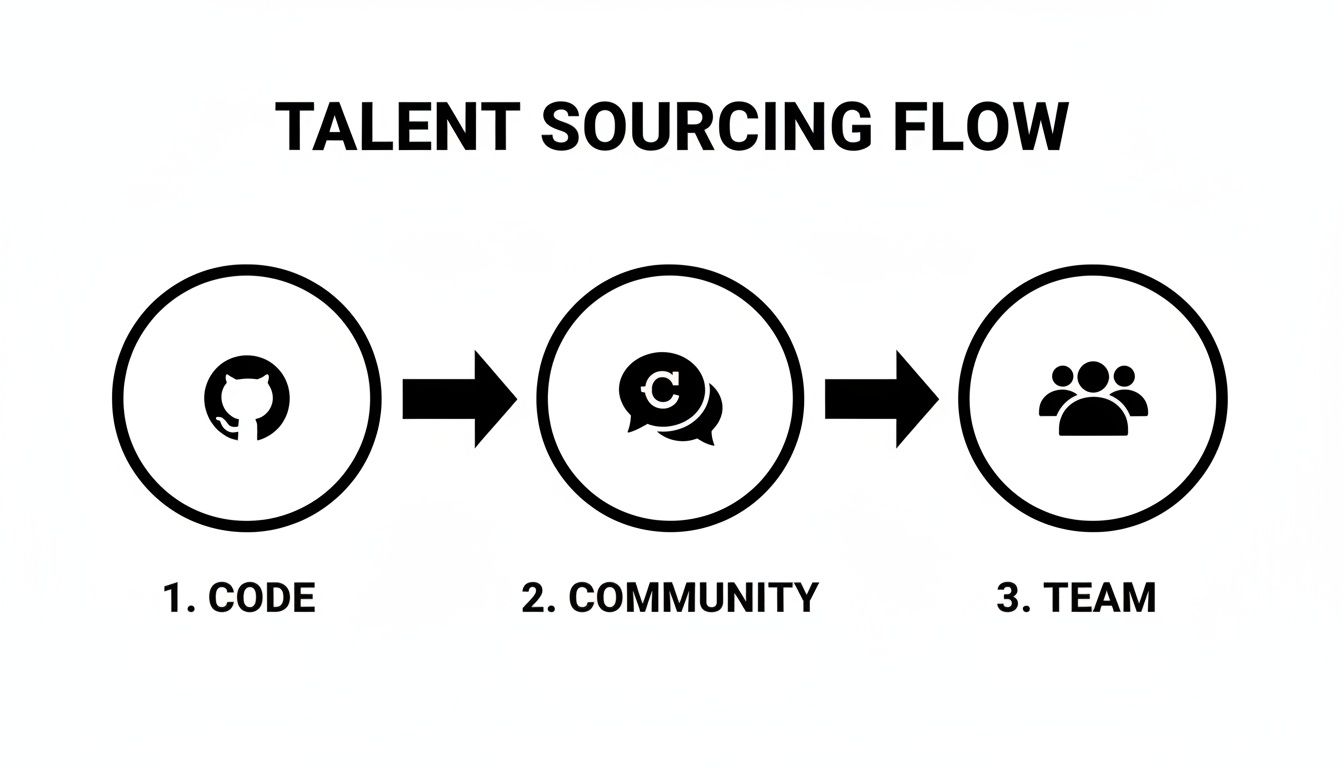
This highlights that top talent is often discovered through their public contributions (Code) and community engagement (Community) before they formally join your Team.
Creating a Killer Candidate Experience
The interview is a two-way evaluation. While you assess the candidate, they are assessing you. A professional, organized, and respectful process leaves a positive impression, even with candidates you don't hire. These individuals are part of the Web3 community and can become advocates for your company if treated well.
Actionable steps for a great candidate experience:
- Communicate Clearly and Often: Keep candidates informed about timelines and next steps.
- Give Real Feedback: When declining a candidate, provide brief, constructive feedback as a sign of respect for their time.
- Train Your Interviewers: Ensure your team is aligned on the evaluation criteria and can conduct fair, effective interviews.
Your interview process is a direct reflection of your engineering culture. By focusing on real-world problems and treating every candidate with respect, you will not only hire better engineers but also build a strong employer brand.
Closing the Offer and Onboarding for Retention
Securing a verbal acceptance from your top candidate is a milestone, but the hiring process isn't over. The period between acceptance and start date is when you are most vulnerable to counter-offers. Your handling of the offer and the first 90 days on the job determines whether you've made a great hire or just filled a seat.
Your offer is the final piece of the narrative you've been building. It must be more than just a number; it should reinforce why your mission is the best next step in their career. For Web3 talent, a powerful offer speaks to their desire for ownership, impact, and alignment with the decentralized future.
Crafting an Irresistible Offer
Your offer must be clear, comprehensive, and competitive. Lay out every component of the compensation package with full transparency to build trust and eliminate confusion.
A strong Web3 offer includes these key components:
- Base Salary: Benchmark against market rates for their experience and location.
- Equity/Stock Options: Frame this as true ownership in the project's success.
- Token Incentives: Clearly explain the vesting schedule and the token's role in the ecosystem.
- Benefits That Actually Matter: Highlight perks like a remote work stipend, a professional development budget, and flexible hours.
Present the offer over a call. This personal touch allows you to convey your excitement, explain the details, and answer questions immediately, turning a transactional moment into a human connection.
Navigating Negotiations and Counter-Offers
Senior talent will likely have multiple options. Be prepared for negotiations. Know your maximum compensation band for the role before you make the offer.
When a counter-offer from their current employer arises, remind the candidate why they began their job search. A higher salary rarely solves underlying issues like a lack of growth or uninspiring work. Re-center the conversation on the unique career opportunities and challenges your role provides.
A thoughtful onboarding process is your single best defense against the 33% of new hires who decide to quit within their first six months. It’s not an administrative checklist; it’s a strategic initiative for integration and retention.
The moment they sign, the retention work begins. A new hire's first few weeks set the tone for their entire tenure.
Designing a 90-Day Onboarding Plan for Impact
A great onboarding plan is designed to make your new engineer feel productive, connected, and confident as quickly as possible. Structure their first 90 days for success.
First 30 Days: Focus on Integration
The first month is about learning the systems and building relationships. The goal is integration, not shipping a major feature.
- Assign an Onboarding Buddy: Pair them with a peer for informal support and questions.
- Tee up a "First PR" Task: Assign a small, low-risk task in their first week to help them learn the workflow and secure an early win.
- Schedule a Round of 1-on-1s: Arrange brief meetings with key team members across the organization.
Days 31-60: Focus on Contribution
Now, they can begin taking on more ownership and contributing to sprint planning. This phase is about moving from learning how things are done to understanding why.
Days 61-90: Focus on Autonomy
By the end of three months, your new hire should be a fully integrated team member, comfortable tackling complex tasks and operating with independence. A 90-day review is a great way to celebrate their progress and set goals for the next quarter, solidifying their career progression within your team.
Got Questions? Let's Talk Web3 Hiring
Hiring in Web3 presents unique challenges. Here are answers to some of the most common questions from founders and hiring managers.
How Can We Compete with Big Tech for Top Engineering Talent?
You don't compete on salary alone; you compete on impact, ownership, and mission. Top engineers are often motivated by the opportunity to solve hard problems and see their work make a difference.
- Sell the Impact. Frame the role as an opportunity to architect a core protocol or build a new Web3 primitive, not just optimize a minor feature.
- Offer Real Ownership. Meaningful equity or token packages give them a tangible stake in the project's success.
- Highlight Autonomy. Emphasize the freedom to innovate and ship code without the bureaucracy of a large corporation.
Your pitch is about the challenge and the opportunity to build the future of the internet—a career-defining experience they won't find at a large company.
What Are the Biggest Red Flags to Watch for During an Interview?
Technical skills are important, but behavioral red flags can be more costly. Watch for these warning signs.
Poor communication is a major red flag. If a candidate cannot clearly explain their thought process or becomes defensive when questioned, they will struggle to collaborate effectively.
A lack of genuine curiosity is another deal-breaker for me. The best engineers are relentlessly inquisitive. They should be grilling you about your tech stack, your biggest roadblocks, and the product roadmap. A candidate who asks zero questions is an unengaged one.
Finally, listen for blame. If a candidate consistently complains about past colleagues or management, they may lack a sense of ownership. You want to hire people who see a problem and focus on solutions, not fault.
How Important Are Open-Source Contributions?
A strong GitHub profile is a positive signal but should not be a mandatory requirement. It provides valuable insight into a candidate's code quality and passion for their craft.
However, many talented engineers lack the time for side projects due to demanding jobs or personal commitments. Requiring open-source contributions can unnecessarily shrink your talent pool.
Treat an active GitHub as a strong bonus, but let their performance in your practical technical interviews be the ultimate decider.
How Do We Assess Culture Fit for a Remote Team?
For a distributed team, "culture fit" is about work-style compatibility. You need to screen for traits that enable success in an asynchronous environment.
Ask specific behavioral questions:
- Self-Discipline: "Walk me through how you structure your day. How do you stay focused and productive without a manager looking over your shoulder?"
- Proactive Problem-Solving: "Picture this: you're stuck on a tough problem, and your team is offline in other time zones. What's your process for getting unblocked?"
- Asynchronous Communication: "Tell me about a time you had to resolve a complex technical disagreement with a colleague, but you could only do it over Slack or GitHub comments."
Their answers will reveal whether they have the skills to thrive on a remote team. Hiring for these traits from day one is key to building a high-performing distributed organization.
Ready to attract the best builders in the decentralized world? Blockchain Jobs is the leading platform for connecting innovative Web3 projects with top-tier engineering talent. Post your role today and reach a specialized audience of crypto-native professionals who are ready to build the future. Find your next great hire on Blockchain Jobs.