Jobs at NFT: A Practical Guide to Landing Web3 Roles
You've got the résumé, the crypto enthusiasm, and a pile of NFT applications sent into the void. What you don't have is traction, because most candidates still apply like jobs at NFT means “artist wanted” or “Discord moderator wanted,” while hiring managers are screening for engineers, operators, and people who can prove they've shipped real work.
That mismatch is why so many applicants get silence. The market isn't asking for fandom, it's asking for evidence, and the best offers still go to people who can translate NFT experience into normal hiring signals, like deployment history, product judgment, remote communication, and cross-functional execution.
Why Most NFT Job Applications Get Ignored
The usual failure mode is predictable. A candidate sees a posting with “NFT” in the title, sends the same résumé they'd use for any Web3 role, and wonders why nobody replies. Recruiters don't ignore those applications because they hate the space, they ignore them because the résumé doesn't prove the candidate can do the work the employer needs.
A lot of these roles are also posted under broader labels. You'll see blockchain, Web3, protocol, platform, community, or operations instead of a clean “NFT job” label, which means search filters alone miss a huge part of the market. That's why generic job hunting fails here. The candidate thinks they're applying for one niche, while the employer is hiring for a specific function inside a broader tech stack.
Practical rule: If your résumé only says you “love NFTs,” you're already behind. Hiring teams want to see what you shipped, what broke, and how you fixed it.
The market has also normalized into a labor market, not a hype market. That matters because normal labor markets reward specialization. Technical roles, compliance, product, and operations now dominate a lot of the serious hiring conversations, while the stereotypical creator-economy view misses how many openings sit closer to standard tech recruiting than to art community management.
If you keep applying with a vague “I understand Web3” résumé, you'll keep getting filtered out. The fix is not more applications. The fix is tighter positioning, stronger proof, and a better read on where the roles live.
The Real NFT Job Market Beyond Artists and Hype
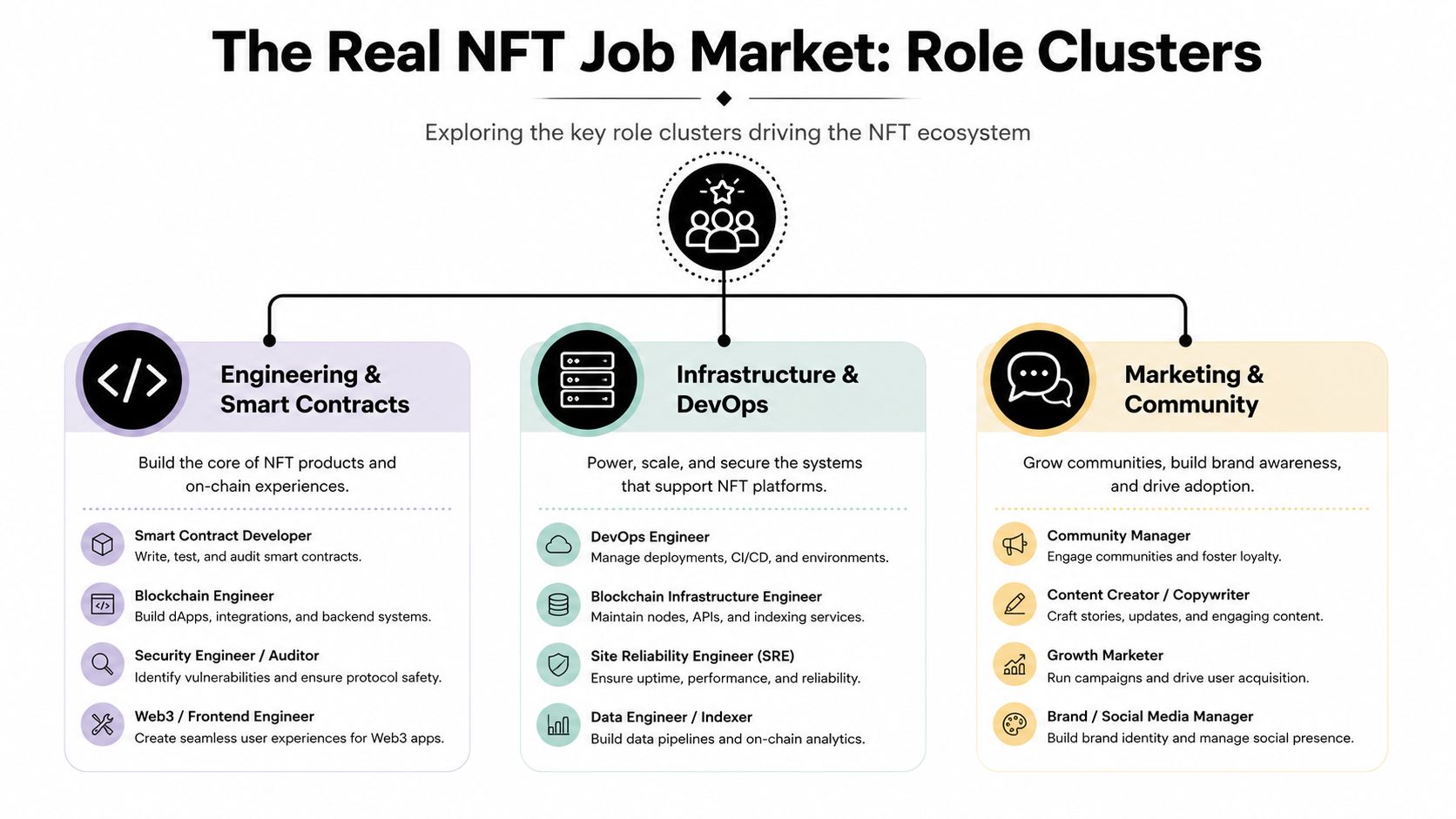
The cleanest way to think about jobs at NFT is as a set of clusters, not a single category. One cluster is engineering and smart contracts, another is infrastructure and DevOps, and the third is marketing and community. The role mix is broader than most candidates expect, and the best openings increasingly look like normal tech hiring with blockchain-specific requirements.
You can see that shift in live job-board snapshots. A specialized NFT board lists roles such as senior infrastructure engineer, fraud analyst, product manager customer support, HR business partner, and backend engineer alongside content and marketing posts, which makes the point clearly. Hiring has moved beyond the creator myth and into platform work, operations, and risk control. That's the contrarian insight most candidates miss, and it changes where you should spend your time.
For quick salary benchmarking, this is the simplest useful view:
| Role Cluster | Typical Salary Band (USD) | Demand Signal |
|---|---|---|
| Engineering and Smart Contracts | $80,000–$200,000+ | Strong, especially for deployment-ready builders |
| Infrastructure and DevOps | $80,000–$200,000+ | Strong where reliability and release work matter |
| Marketing and Community | $50,000–$120,000 | Steady, but more crowded |
| Product and Project Management | $70,000–$150,000 | Solid for candidates who can coordinate teams |
| Legal and Compliance | $100,000–$250,000 | Narrower, but expensive talent when needed |
Those bands come from NFT job aggregators, and they're useful because they show where employers are willing to pay for specialization. Legal and compliance work, for example, can command a very different conversation from entry-level community work. If you're trying to calibrate your target, use the bands as a reality check, not a fantasy board.
For a broader view of live postings and role categories, it's worth using a data source like browse NFT data sets to compare listings instead of guessing based on social media chatter. You'll notice the same pattern repeat. The serious openings cluster around engineering, infrastructure, product, and support, not just “make the community lively.”
Bottom line: if you're choosing a lane, pick the one where your evidence will be easiest to prove. That's usually technical or operational work, not vague brand enthusiasm.
Skills and Proof of Work That Actually Get You Hired
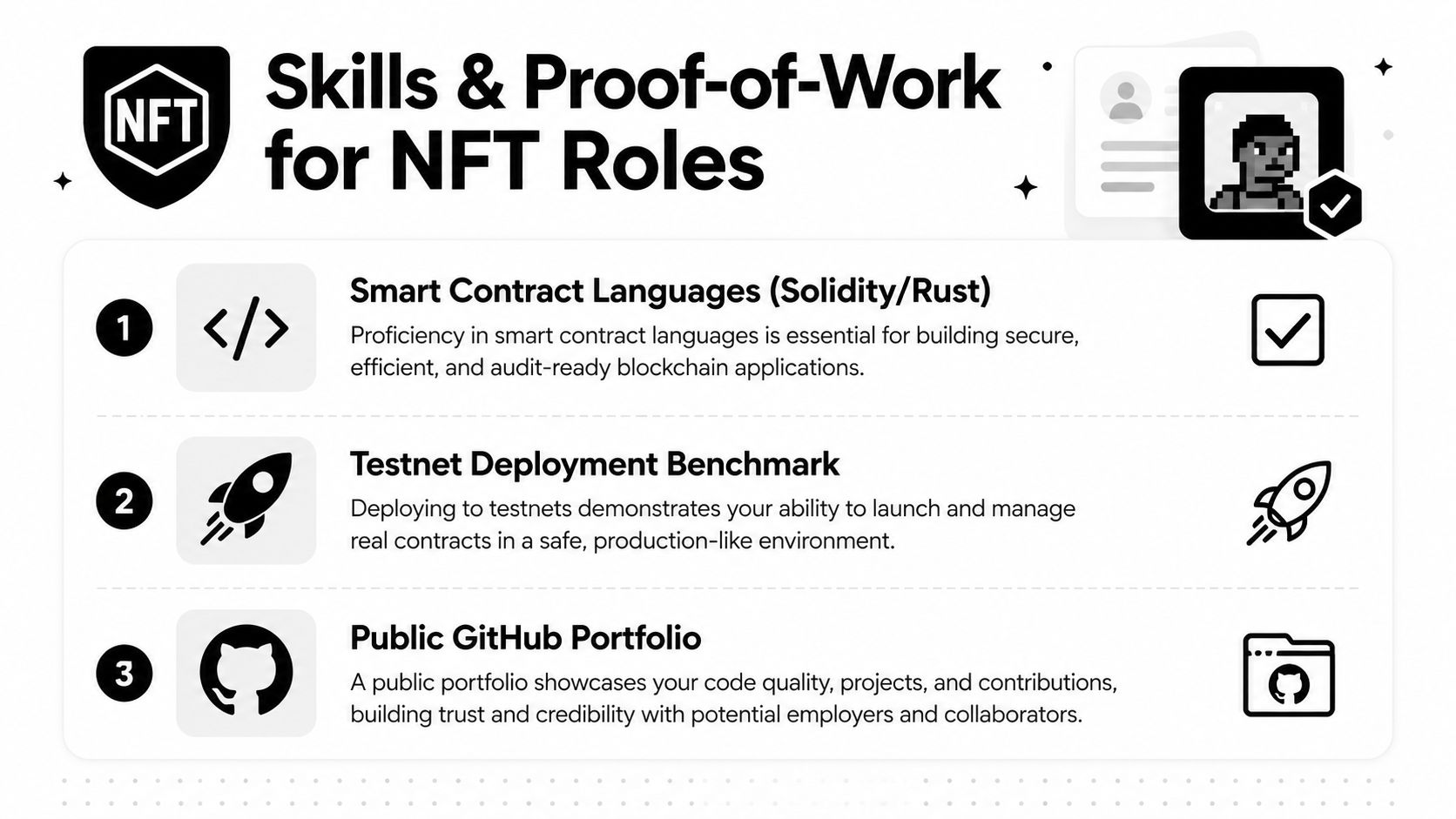
A lot of résumés fail because they list skills instead of proof. For a developer, that means the company wants to see a contract built, deployed to testnet, then pushed to mainnet, with the work sitting publicly on GitHub. That benchmark matters because it proves more than coding skill, it proves release readiness.
For non-engineering tracks, the evidence is different but just as concrete. Designers need portfolios that show actual NFT-related product work, not generic branding mocks. Marketers and community candidates need visible execution, such as campaign ownership, Discord moderation patterns, content calendars, analytics summaries, or growth programs they can describe clearly in interviews.
Hiring signal: Candidates who can point to public work get treated like adults. Candidates who only describe themselves get treated like risks.
The fastest way to self-check your materials is simple:
- Smart contract candidates: Show Solidity or Rust work, deployment history, and GitHub commits that prove you can finish.
- Design candidates: Show NFT product flows, collection visuals, marketplace interfaces, and handoff-ready files.
- Community and marketing candidates: Show posts, campaigns, moderation examples, or launch support with measurable responsibility.
- Operations candidates: Show process work, team coordination, support systems, or escalation handling.
The best hiring managers care about whether you can operate in the workflow of the team. That means the testnet-to-mainnet story is not a nice-to-have for technical roles, it's a gate. If you've only cloned tutorials and never shipped through a deployment path, you're not ready for a serious interview.
For founders who need to build trust before they even apply, public visibility helps. A clear, consistent online presence makes it easier for recruiters to understand your lane, and a resource on personal branding on X for founders is a good reminder that reputation and proof often travel together in this market.
The embedded talk below is a useful companion if you want another perspective on shipping and positioning in Web3 roles.
If your portfolio still looks like a classroom assignment, stop applying and rebuild it first. Hiring teams don't need more enthusiasm, they need lower risk.
Use this internal example if you want to see how a serious technical posting is framed: senior smart contract engineer role.
Where NFT Job Openings Actually Live
Most candidates waste time by checking only one kind of board. That's a mistake. NFT openings show up in niche crypto boards, broader Web3 platforms, and plain old job boards where the role title hides under “blockchain” or “software engineer.”
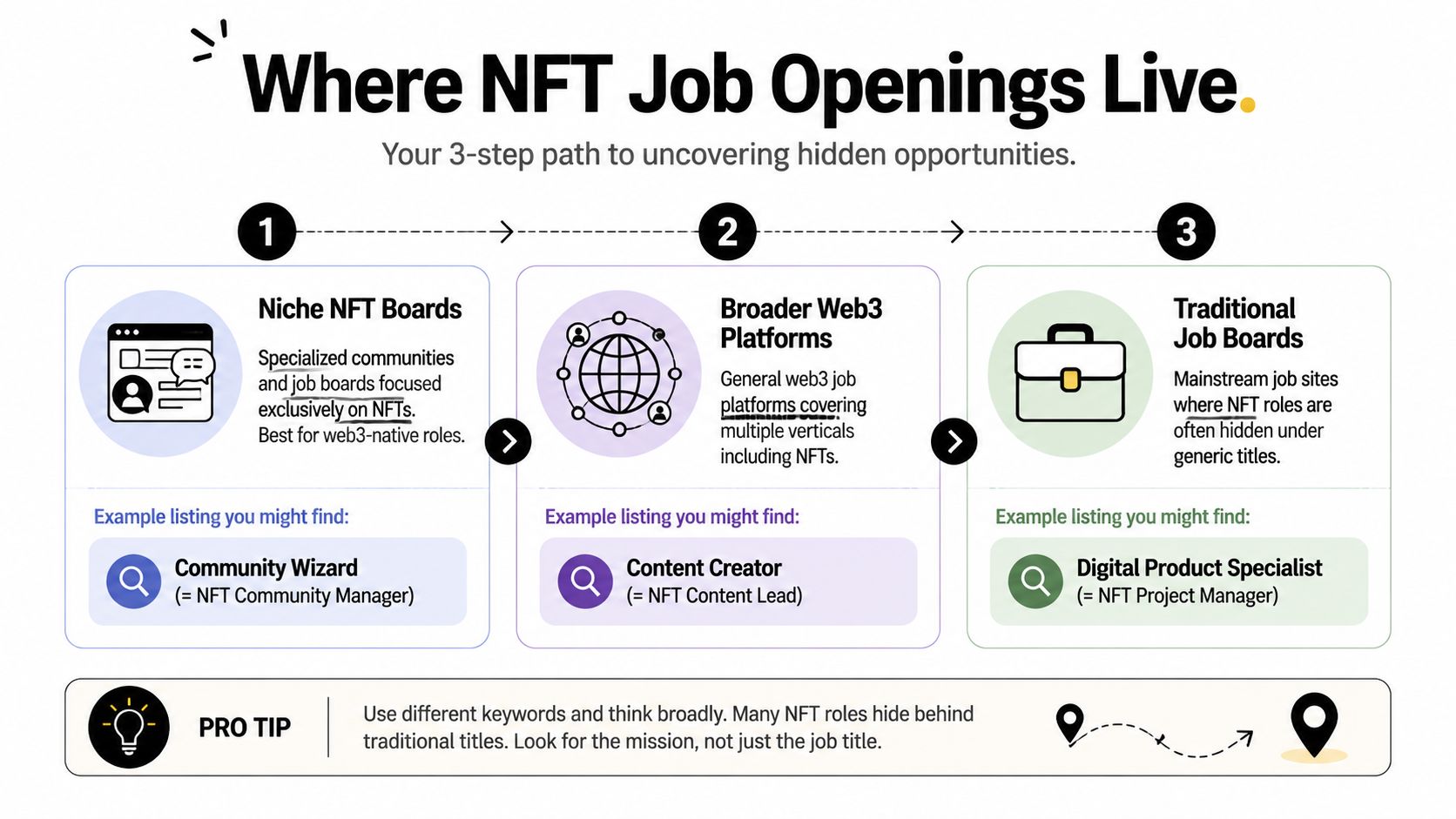
Specialized boards are still the fastest filter for crypto-native hiring. They're where you'll see roles posted with clear blockchain context, and they're also where employers go when they want candidates who already understand wallets, marketplaces, token mechanics, and async work norms. A platform like Blockchain Jobs fits that pattern, because employers can post into a focused audience instead of shouting into the general internet.
Broader Web3 platforms are your second pass. These boards surface openings that may not mention NFTs in the headline but still involve smart contracts, product, infra, support, or compliance. That's where you catch the “NFT role” labeled “backend engineer” or “product manager,” which is exactly why generic keyword hunting misses opportunities.
Traditional job boards still matter, especially for blockchain development roles. That's also where the YouTube guidance on applying through ordinary boards makes sense, because many NFT jobs are bundled inside larger blockchain hiring funnels. In practice, that means your search terms need to be wider than the niche itself.
A practical weekly routine works better than random browsing:
- Monday, niche boards. Scan specialized NFT and blockchain listings for new openings.
- Wednesday, broader Web3 platforms. Search by function, not just by NFT.
- Friday, traditional boards. Look for generic blockchain, smart contract, and remote software roles.
Useful habit: Treat every board as a different funnel, not a different world. The same employer can show up in all three.
A recruiter posting on a specialized board is already signaling crypto fluency, so your application should mirror that. Use the same vocabulary they use, and don't pretend the role is generic software if it clearly isn't. That's how you get faster replies.
Building an NFT Résumé and Portfolio That Passes Screening
Your résumé has to do one job. It has to get you to the conversation. That means the first lines should tell a recruiter what function you fit, what you shipped, and why you're credible in a blockchain environment.
Start with outcomes, not identity. If you contributed to a DAO, freelanced for a collection, or built tools for a marketplace, write it like real experience, because it is. The mistake I see constantly is people burying the work under hobby language, which makes the whole application look optional.
The portfolio needs the same treatment. For technical candidates, link GitHub first and make sure the repo history looks alive, not like a one-afternoon demo. For designers, show the full workflow. For marketers and community hires, publish examples that show consistency, not just one good thread or one lucky campaign.
Use this rubric before you submit anything:
- Clarity: Can a recruiter tell your target role in 10 seconds?
- Proof: Does every major claim point to something public or observable?
- Relevance: Did you remove unrelated work that muddies your lane?
- Translation: Did you convert NFT jargon into hiring language the company already uses?
The strongest résumés are easy to skim because they read like proof, not biography. They say what you built, what tools you used, and what happened after launch. If you're still leading with “passionate about Web3,” you're asking the employer to do too much work.
The best compaction trick is to tie every NFT project back to a normal hiring category. That can mean product integration, release management, community operations, market-facing content, or technical implementation. Recruiters understand those labels immediately, and they don't have to decode your entire background to see value.
Outreach and Community Tactics That Open Doors
Cold applications lose to warm context, especially when there are 143 applicants per job in the market data cited earlier. That doesn't mean talent is irrelevant. It means a recruiter's first filter is often familiarity, and candidates who show up in the right channels get remembered before they ever apply.
Start where the hiring team already talks. Discord and X are not just branding tools, they're pre-interview spaces. If you ask a sharp question, contribute a useful observation, or show you understand the product, your name stops being anonymous. That matters when the role finally opens.
Use outreach like a professional, not like a fan. A good DM says what you've done, why the team's work matters to you, and what kind of role you'd fit. A bad DM asks for “any opportunities” and gives the reader nothing to respond to.
Here's the kind of structure that works:
- DM opener: Mention one specific product, launch, or technical detail you noticed.
- Email intro: State your role target, one relevant proof point, and why you're reaching out now.
- Follow-up after a conversation: Reference a concrete detail from the discussion and restate the fit in one sentence.
DAO contributions and micro-interactions at conferences count too, because they create context that a résumé can't. If someone has seen your work in public, your name is already warm when you apply. That's a real hiring advantage, not a soft one.
For a concrete example of how community-facing roles get framed, look at this internal listing: community leader role. It's a good reminder that NFT hiring still values people who can operate inside communities, but the strongest candidates connect that work to execution, not just chatter.
Direct advice: Don't ask for a job in the first message. Ask for context, learn the priorities, and make it easy for the other person to continue the conversation.
Introverts usually do better with this than they expect, because the process is scriptable. You don't need charisma. You need a repeatable way to show up, ask a useful question, and follow through without sounding transactional.
Interviews, Offers, and Negotiation for NFT Roles
The interview loop in NFT hiring usually tells you a lot about the company. Technical roles often start with a smart-contract coding test, then move into system design around marketplaces, royalties, or token logic, and then finish with a conversation about how you work in remote and async settings. That sequence is not random. It's the employer checking whether you can ship, scale, and communicate without constant supervision.
If you're preparing, focus on the kinds of questions that matter in this niche. Explain how you'd handle a contract issue, how you'd think about deployment risk, and how you'd design around user-facing trust problems. For broader interview prep, a resource like prepare for interviews can help you sharpen the basics before you walk into the Web3-specific version of the loop.
Offer rule: Don't negotiate against your local market if the company is hiring remotely. Anchor to the broader remote benchmark the company is already using.
Compensation should be judged against the data, not vibes. Web3.Career reported an average yearly NFT salary of $125,000, with a range from $60,000 to $250,000, and an average hourly pay of $65 with a spread from $31 to $130. In the U.S., ZipRecruiter's June 2026 salary data showed average hourly pay of $56.85, with most workers between $45.19 and $67.31 per hour. Those numbers tell you the market is not casual about compensation, and they're useful when you're deciding whether a package is serious.
The other thing to negotiate is structure. Token grants, vesting cliffs, and the timing of liquidity matter more than most first-time candidates realize. If the base salary looks acceptable but the token terms are vague, ask for clarity before you accept.
Use this checklist before you sign:
- Role clarity: Does the title match the actual work?
- Comp structure: Is the salary competitive against remote benchmarks?
- Token terms: Are vesting and grant details written down clearly?
- Scope: Are you joining engineering, ops, product, or something fuzzy in between?
If the company won't explain the role or the compensation cleanly, that's a signal too. Strong teams know what they're hiring for, and they can describe it without improvising.
Blockchain Jobs gives you a cleaner way to find serious blockchain and NFT roles without drowning in noise. If you're ready to stop guessing and start applying with a tighter target, visit Blockchain Jobs and use it to track the roles, employers, and compensation patterns that matter.