NFT Marketing Jobs: A 2026 Guide to Landing Your Role
Most advice about NFT marketing jobs is backwards. It tells candidates to polish a conventional resume, collect certifications, and apply into roles that ask for years of experience. That's not how many people get hired.
In practice, teams often hire the person who already understands the community, knows the unwritten norms of Discord and X, and has shown they can keep momentum alive when a project gets noisy, skeptical, or tired. If you've been active in the right servers, helped mods calm down tense threads, organized feedback, or turned confusion into clarity, you may already be closer to an NFT marketing role than you think.
The gap is visibility. Hiring managers can't reward work they can't see. Your job is to turn community participation into evidence, package it like a marketer, and present it like someone who can own outcomes.
The NFT Marketer's Paradox and How to Solve It
The paradox is simple. Job posts ask for formal experience, but teams often hire from inside the community.
That gap is real. There's a documented disconnect between the “3+ years community management” requirement in NFT job postings and how people are hired. Most successful NFT marketers are hired from existing Discord moderators rather than traditional marketing backgrounds, and 70% of hiring managers prioritize people who have “been there, done that” from Discord over formal resumes, according to this NFT hiring breakdown on Cryptocurrency Jobs.
If you've been rejected because your resume doesn't look “marketing enough,” that doesn't mean you're unqualified. It usually means you haven't translated your community work into hiring language.
What hiring managers actually notice
A generic marketer can schedule posts.
A crypto-native operator can tell when a floor-price panic is really a communication problem, when a whitelist perk is attracting the wrong audience, or when a founder's thread will trigger backlash in Discord. That kind of judgment matters because NFT marketing is rarely just promotion. It's expectation management, trust repair, narrative control, and community retention.
Practical rule: In NFT marketing jobs, credibility often beats credentials.
That's why the strongest junior candidates don't lead with “aspiring marketer.” They lead with proof that they already operate like one. Maybe you ran community FAQs. Maybe you wrote better announcement drafts than the official team. Maybe you spotted sentiment shifts before they became public complaints. Those are not side activities. They're signals.
Reframe your background the right way
Don't apologize for coming from moderation, community participation, or creator support. Reframe it.
Instead of saying you “helped in a Discord,” describe what you did in a business-relevant way:
- Community operations: You kept conversations organized, answered objections, and reduced confusion during launches.
- Audience insight: You saw what people kept asking, what benefits they cared about, and what messaging they ignored.
- Content instincts: You learned which updates got shared, which announcements fell flat, and which phrases triggered distrust.
- Culture fluency: You understand the difference between a real community and a temporary hype crowd.
A lot of candidates try to sound more corporate than they are. That usually hurts them. NFT teams don't need another person who can recite funnel terminology but hasn't spent real time inside crypto-native communities. They need someone who can convert native behavior into repeatable growth.
The path in is proof of work
The fastest route into NFT marketing jobs isn't waiting for permission. It's building public evidence.
That means turning your existing activity into artifacts a hiring manager can scan in minutes:
- screenshots of community threads you improved
- campaign ideas you mocked up for real projects
- weekly content calendars for collections you follow
- sentiment summaries from Discord conversations
- post-mint retention ideas for utility, perks, or collaborations
The candidate who wins isn't always the one with the cleanest background. It's often the one who makes risk feel low. If a founder can look at your portfolio and think, “This person already gets it,” you've solved the main hiring problem.
Decoding NFT Marketing Roles and Responsibilities
A lot of first-time applicants read an NFT marketing job post, see “3+ years of Web3 marketing experience,” and disqualify themselves too early. Hiring rarely works that cleanly. Teams say they want polished marketers. In practice, they hire people who already understand the community, can protect trust, and can ship useful work without a long ramp.
That gap matters. If you know how these roles are divided, you can position yourself for the lane where community proof beats a formal resume.
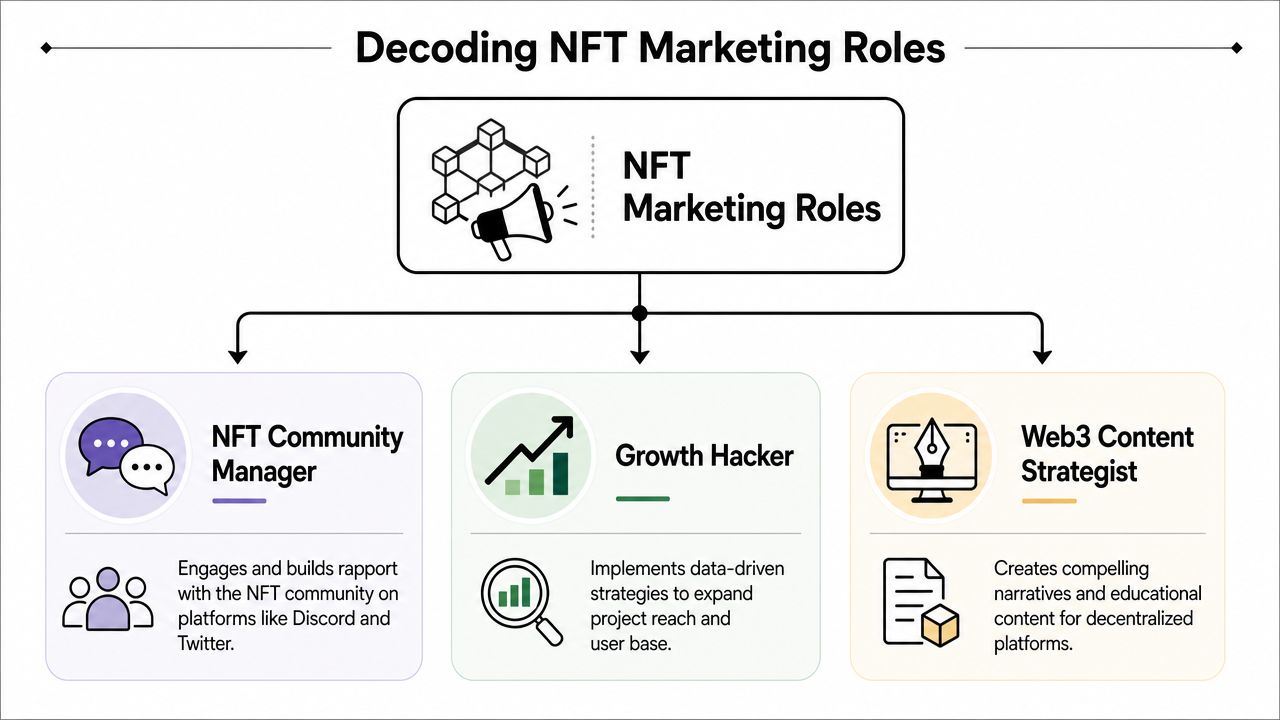
The three lanes most candidates should understand
NFT Community Manager is the strongest entry point for candidates who are already active in Discord, Telegram, and X. The job is part moderation, part customer research, part brand protection. Good community managers spot confusion early, calm down rumor cycles, escalate product feedback, and keep momentum alive after the mint hype fades. Hiring managers notice candidates who can show judgment under pressure, not just energy.
Growth Hacker is usually responsible for acquisition and conversion. That can include referral mechanics, allowlist partnerships, launch sequencing, creator collaborations, and channel testing. The trade-off is real. Aggressive growth tactics can spike attention and damage credibility a week later. Teams want someone who understands both math and market psychology.
Web3 Content Strategist turns technical plans into messages people can follow. Roadmaps, utility, token design, ecosystem partnerships, and creator narratives all need clear framing. Strong content strategists reduce friction for buyers and collectors. They also keep a project from sounding like every other collection chasing hype.
What hiring managers actually screen for
The title matters less than the operating problem you solve.
A founder hiring a community manager usually wants someone who can reduce chaos and keep sentiment from turning. A head of marketing hiring for growth wants someone who can test offers, track channel quality, and report what worked. A content lead wants someone who can write with native fluency and explain complicated mechanics without sounding forced.
Senior roles are different. Teams expect broader ownership, cleaner reporting, and the ability to coordinate creators, moderators, designers, analysts, and founders. They also expect stronger business judgment. Entry-level candidates do not need to imitate that. They need to show they can own one part of the machine well.
NFT marketing role comparison
| Role Title | Primary Focus | Key Skills | Typical Hiring Signal |
|---|---|---|---|
| NFT Community Manager | Community trust, moderation, retention, feedback loops | Discord and Telegram management, conflict handling, audience empathy, announcement writing | Proof you can manage live communities without creating drama |
| Growth Hacker | User acquisition, launch mechanics, partnerships, conversion experiments | Analytics, campaign testing, collaboration strategy, scarcity design, channel coordination | Proof you can run tests and explain results clearly |
| Web3 Content Strategist | Storytelling, education, brand positioning, launch messaging | Narrative writing, blockchain literacy, content planning, creator coordination | Proof you can make technical or speculative ideas understandable |
| NFT Marketing Manager | Cross-functional strategy, campaign leadership, agency coordination | Campaign leadership, community oversight, analytics, storytelling, business alignment | Proof you can align multiple teams and own outcomes |
How to choose your lane
Use your past behavior, not your ideal title.
Pick community manager if people already trust you to handle live conversations, answer objections, and keep channels useful during stressful moments.
Pick growth if you naturally track patterns, test ideas, and care about which partnership, post, or incentive produced measurable action.
Pick content strategy if your strength is explanation. Teams remember candidates who can translate a messy roadmap into copy that feels clear, credible, and native to Web3.
If you need sharper process thinking, study strong AI-driven content optimization guides. They help because NFT teams increasingly want marketers who can pair good instincts with repeatable execution.
Job titles can also be narrower than people expect. This Crypto Twitter Manager opening looks simple on the surface, but it still demands voice control, fast editorial judgment, and an understanding of how crypto audiences react in real time. Read listings like that carefully. The best clues are usually buried in the day-to-day responsibilities, not the headline title.
The strongest first role is usually the one that matches skills you already use inside the community, packaged in a way that makes hiring risk feel low.
Build a Portfolio That Proves Your Impact
Most applicants for NFT marketing jobs still send resumes first and evidence second. That's a mistake.
In Web3 hiring, the portfolio often does the persuading. Not a design portfolio necessarily. A proof-of-work portfolio. Something that shows how you think, how you execute, and how you'd reduce risk for a team.
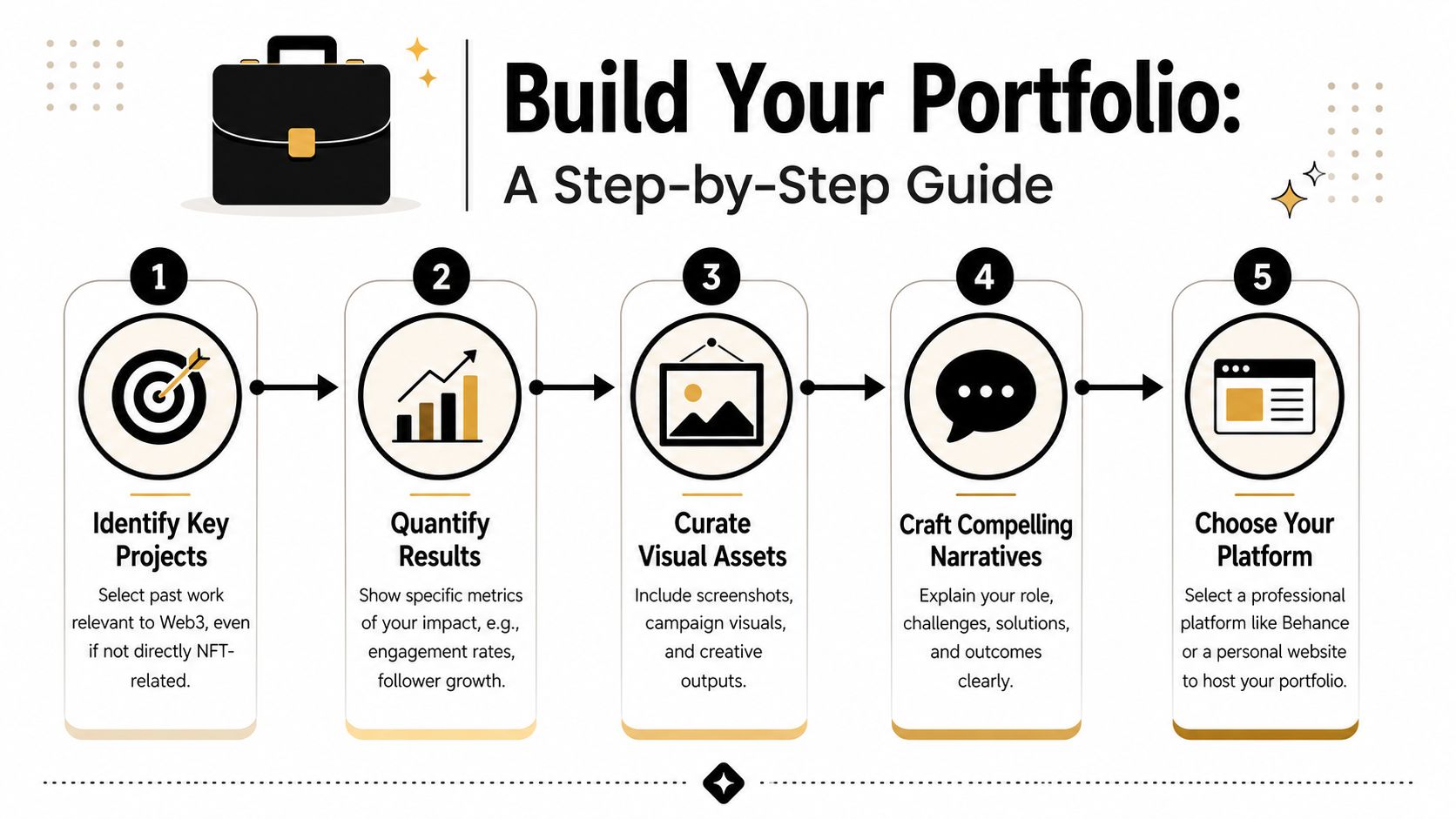
Use a launch framework that hiring managers recognize
One of the most useful structures comes from a proven 5-step NFT marketing methodology shared in this YouTube breakdown of NFT marketing strategy. The sequence is:
- Start with a community-based mission
- Build artist collaborations and whitelist partnerships
- Assemble the team
- Run a 4-week blitz
- Create post-launch utility
Projects that follow that sequence perform better than teams that skip the community foundation or rush the launch rhythm. For a candidate, that framework is gold because it gives you a realistic skeleton for a case study, even if you haven't worked on an official mint.
Turn the framework into portfolio pieces
Here's how I'd build a first portfolio from scratch.
Project one with a fictional or volunteer collection
Choose a real niche. Music collectibles, gaming assets, membership NFTs, event access, digital fashion, creator communities. Don't invent fantasy metrics. Build the strategy itself.
Include these assets:
- Mission brief: State the community promise in plain language. Why should this exist beyond speculation?
- Audience map: Identify who the collection is for, what they care about, and what would make them distrust it.
- Partnership list: Name a handful of artist, creator, or whitelist collaboration targets and explain why each is a fit.
- 4-week launch plan: Show weekly themes, channel priorities, content ideas, and moderator coordination.
- Post-launch utility memo: Explain what holders get after mint and how the team avoids the “dead server after launch” problem.
A hiring manager should be able to skim this and see strategic maturity.
Project two with community analysis
Take a live NFT project and audit it.
Write a short teardown covering:
- where the messaging is clear
- where the utility story is weak
- whether the community tone feels earned or forced
- what kind of content the team should produce next
- what launch or retention risks are visible from community behavior
This shows judgment, which is harder to teach than formatting.
Show your work like an operator
Many junior candidates hide behind aesthetics. Nice slides are fine, but hiring managers want to know what you noticed and why you chose your actions.
Use this case-study structure:
| Portfolio Element | What to include |
|---|---|
| Context | The project type, audience, and problem |
| Your role | What you owned, even if self-initiated |
| Decisions | Why you chose certain channels, partnerships, or messaging |
| Execution | Content drafts, launch calendar, community workflows, sample announcements |
| Reflection | What you'd improve, what risk you'd watch, what you'd test next |
If your portfolio only shows outputs, you look junior. If it shows judgment, trade-offs, and priorities, you start to look hireable.
You can host this work in a lightweight site, a clean Notion workspace, or a writing portfolio. If your strengths lean more toward writing and messaging, browsing active content and writing roles in Web3 can help you model how teams bundle content with broader marketing responsibilities.
What not to do
A few patterns weaken otherwise strong candidates:
- Don't fake outcomes: If a project is speculative or self-initiated, say so. Good hiring managers respect honesty.
- Don't over-index on logo walls: Namedropping communities means little if you can't explain what you did.
- Don't make the work greed-first: Teams know the difference between community-led framing and cash-grab framing.
- Don't stop at mint: Post-launch utility thinking signals maturity.
Your first portfolio doesn't need a famous brand. It needs believable thinking. In NFT marketing, believable beats polished every time.
Find and Apply for the Right NFT Marketing Jobs
The candidates who get hired first for NFT marketing roles are rarely the ones who match every line in the posting. They are the ones the team already trusts, or the ones who can make that trust easy to extend.
That matters because plenty of NFT job descriptions still ask for three years of marketing experience, even when the actual work is closer to community moderation, creator coordination, launch support, and fast feedback loops inside Discord and X. Hiring managers know this. They write a formal spec for coverage. Then they hire the person who already speaks the culture, understands the audience, and can show useful judgment.
Start where teams actually look
Broad applications have a low hit rate in Web3. Warm familiarity wins more often.
Founders usually notice candidates in four places first: active community spaces, referrals from operators they trust, niche talent networks, and job boards with enough filtering to separate real crypto roles from generic startup listings. If you want a practical starting point, browse current Web3 marketing roles on Blockchain Jobs and sort for teams whose product, tone, and community style already fit how you work.
Then go one step further. Join the project's Discord, follow the core team on X, read the last few announcement threads, and look at how they handle community questions after bad news, not just during hype cycles. That is usually where the actual job appears.
Apply to projects, not titles
“NFT Marketing Manager” can mean five different jobs.
One team needs someone to write threads, manage partnerships, and keep Discord healthy during a mint. Another wants a growth marketer who can run paid acquisition, build creator funnels, and report on conversion. A third says “marketing” but really needs a community operator who can calm holders and keep messaging consistent across channels.
Read for operational pain. If the posting mentions engagement drops, roadmap confusion, creator outreach, whitelist coordination, moderation strain, or post-mint retention, answer that problem directly in your application. Strong candidates do not mirror the title. They diagnose the workload behind it.
Your application should reduce the hiring risk
For junior or career-switching candidates, the goal is not to look traditionally qualified. The goal is to make a founder believe, “This person can help us next week.”
A useful application package usually includes:
- a short headline that positions you clearly
- two or three links to relevant proof of work
- a sentence on the communities or chains you know well
- platform fluency, only if you can use the tools in live work
- a short custom note on what you would improve first
The custom note matters more than people admit. Keep it brief. Three to five sentences is enough. Point to one gap you noticed, such as weak onboarding for new holders, repetitive announcement copy, poor coordination between X and Discord, or a community calendar that does not build momentum between milestones.
Write like an operator
A good note sounds calm, specific, and informed.
Bad applications praise the brand for a paragraph, mention “passion for Web3,” and never show understanding of the audience. Good applications make a small but credible observation: the project's content is too insider-heavy for new entrants, the community mods are carrying messaging work that should be templated, or the launch sequence created attention but not enough retention hooks afterward.
That kind of writing signals maturity fast. It tells the team you can enter a messy environment and contribute without needing a week of translation.
Cold outreach works in NFT hiring, if it is earned
I have seen candidates get interviews with no formal resume match because they sent one sharp message at the right time.
If you reach out directly, skip the generic intro. Mention the specific campaign, collection, or community motion you studied. Attach one lightweight asset, such as a revised announcement sequence, a one-page community reactivation idea, or a sample partner outreach list with positioning notes. Keep it useful enough to show thinking, but small enough that it does not feel presumptuous.
This approach works especially well for candidates whose experience comes from community contribution rather than formal marketing titles. In NFT hiring, visible participation often carries more weight than polished corporate credentials.
Presentation still affects response rates
Teams will check your LinkedIn, X profile, and portfolio before they reply. Sloppy presentation does not kill a strong candidate, but it can create doubt where none needs to exist. If your profile photo is dated or inconsistent with the level of role you want, AiHeadshots for professional LinkedIn photos is a practical option.
Just keep the priority straight. Clean presentation gets a second look. Clear proof of judgment gets the interview.
A simple application stack that works
Use this order:
- Positioning line
- Best proof-of-work link
- Relevant community or launch experience
- Tools and channels you can handle
- Short custom note for that team
If you do not meet the stated experience requirement, say less about what you lack and more about what you have already handled. Community sentiment swings. Announcement planning. Creator coordination. Holder education. Feedback collection. Post-mint engagement. Those are all marketing signals, even if your last title did not say “marketer.”
Nail the Interview and Negotiate Your Offer
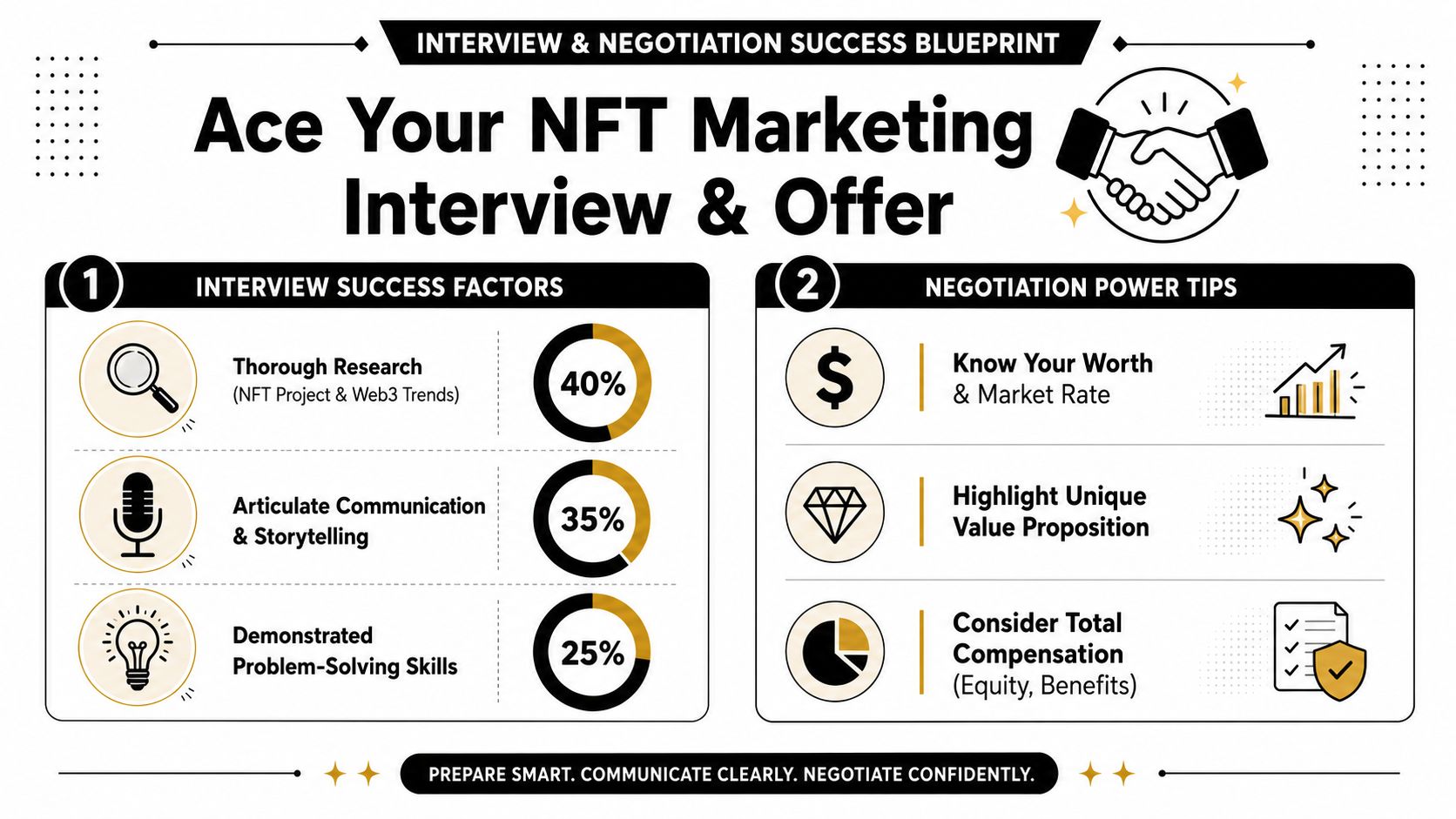
Interviews for NFT marketing jobs are rarely smooth, polished brand interviews. They're often messy and practical. Founders want to know whether you can think under pressure, calm a community, and connect marketing work to revenue or retention without sounding scripted.
That's why interview prep should center on scenarios, not memorized answers.
The questions you should expect
You may get asked direct versions of these:
- How would you respond if a mint underperformed and Discord sentiment turned hostile?
- What would you do in your first month to improve community trust?
- How would you position utility if the audience thinks the project feels speculative?
- What channels would you prioritize for our next campaign, and why?
- Tell me about a time you led change or improved a process informally
That last one matters beyond NFT specifically. Hiring managers for mid-to-senior roles are increasingly looking for candidates who have led change and can connect operational work to business outcomes, as discussed in this hiring-focused interview on modern talent expectations.
Answer with frameworks, not opinions
A good answer has four parts:
- State the problem clearly
- Explain your priority order
- Show the trade-off
- Tie it to a real example from your portfolio
Example structure for a community crisis question:
- First, stabilize communication cadence.
- Second, separate factual concerns from rumor loops.
- Third, give moderators approved language and escalation paths.
- Fourth, publish the next concrete utility or roadmap update only when the team can support it operationally.
That kind of answer sounds grounded because it is.
Strong candidates don't try to sound visionary in interviews. They sound dependable under uncertainty.
Know your market before you negotiate
Compensation in this niche is stronger than many candidates assume. The global NFT market's shift toward utility-driven models has coincided with a 48% year-over-year surge in NFT-related job postings, and the median annual US salary for these digital marketing roles is $104,723, with senior community and marketing managers earning up to $128,123, according to Coursera's overview of NFT jobs.
Use that carefully. Don't walk into negotiation reciting salary data like a threat. Use it to anchor your confidence.
A clean negotiation approach sounds like this:
- you understand the scope
- you can explain the specific value you bring
- you know the market range for the role type
- you're evaluating total compensation, not just base
That last point matters in Web3. Some offers include token exposure, flexibility, or expanded ownership over growth channels. Others offer a flashy title with unclear decision rights. Choose the package that gives you real influence and real learning.
If you're also comparing search channels, RedactAI's LinkedIn job guide is a useful companion resource for organizing outreach and role discovery outside crypto-native circles.
Don't negotiate like a beginner trying to be grateful for any offer. Negotiate like someone who understands that niche skill, community fluency, and execution under ambiguity are hard to replace.
If you're ready to stop guessing and start targeting real Web3 roles, browse open positions on Blockchain Jobs. It's one of the clearest ways to find current opportunities across NFT, crypto, content, community, and broader blockchain hiring without wading through irrelevant listings.