8 Prompt Engineering Best Practices for Hiring and Growth
A hiring manager opens two candidate portfolios. Both list prompt engineering. One contains clever one-liners and screenshots of polished answers. The other contains a defined task, source documents, prompt revisions, evaluation results, and a failure report explaining what still needs human review.
If you're preparing for an interview, that difference matters. The first portfolio shows that someone can get an appealing response. The second gives an employer evidence that they can build, test, and maintain a useful workflow.
For a blockchain team, the distinction gets concrete quickly. A generated job description mustn't invent compensation. A protocol assistant must distinguish current documentation from an outdated proposal. A compliance summary must preserve uncertainty rather than turn missing evidence into a confident recommendation.
Prompt engineering best practices are measurable engineering and communication skills, not secret phrases. Candidates should demonstrate how they define success, diagnose failures, and decide when prompting isn't the right solution. Hiring managers should assess those decisions alongside genuine domain knowledge, rather than treating fluent AI output as proof of competence.
A convincing portfolio doesn't just show what the model produced. It shows why you trust the result, where you don't, and how someone else can reproduce your test.
You can browse prompt engineering guides for techniques, but your career evidence should come from applying them to a bounded problem. Start with a workflow you can explain without hiding behind the model.
1. Structured Prompt Anatomy Without Ambiguity
A request to write a protocol-engineer job description leaves important decisions unresolved. Which protocol? What seniority? Can the model infer remote eligibility or compensation? A usable prompt separates role, context, task, constraints, and output format before generation begins.
The University of Connecticut's career guidance describes Persona–Task–Context–Format as a practical framework. For production work, add explicit constraints so the model knows which assumptions it must leave unresolved.
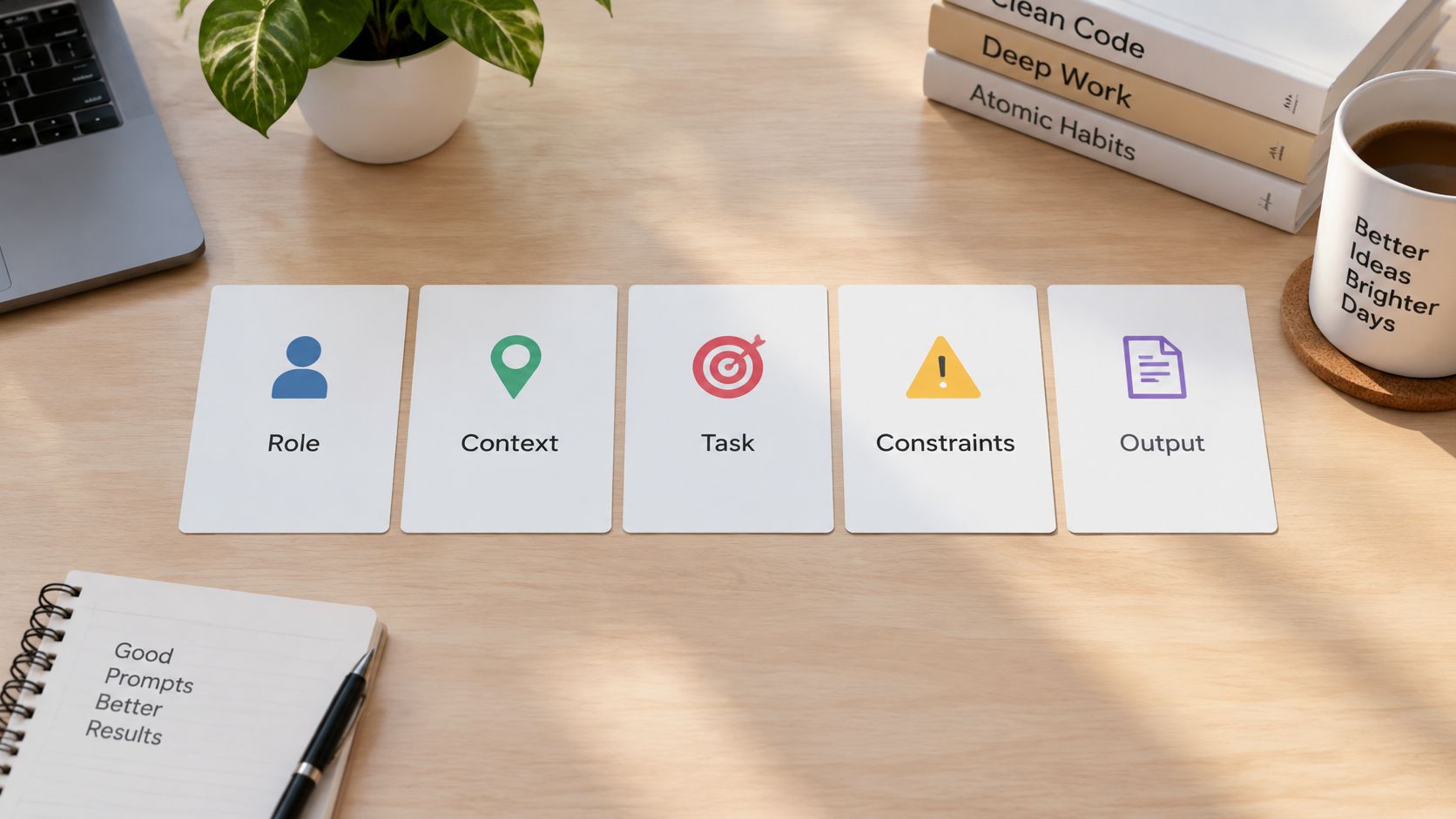
For a recruiting workflow, the anatomy could look like this:
- Role: Write from a technical recruiter's perspective, without claiming engineering authority.
- Context: Use the approved hiring intake and protocol-stack description.
- Task: Draft a candidate-facing job description.
- Constraints: Don't invent salary, location eligibility, qualifications, or benefits. Mark missing information for review.
- Output: Return separate sections for responsibilities, required experience, working arrangement, and unresolved questions.
The role establishes perspective, not expertise or permission. A legal-operations prompt can similarly organize token-listing documents into a risk table, but counsel still owns the legal assessment.
What this demonstrates in hiring
Give candidates a vague business request and ask them to rewrite it. Junior-level competence means identifying the missing structure; stronger candidates also expose conflicting requirements, missing inputs, and failure behavior.
Ask why each instruction exists. Someone who can defend a concise constraint is more useful than someone who adds paragraphs of ceremonial language.
For your portfolio, show the original request, the structured prompt, and an output annotated against the requirements. Keep the reusable template in a team wiki, and use the SupportGPT prompt engineering guide as supplementary reading, not as a substitute for testing your own workflow.
2. Few-Shot Examples and Step-by-Step Reasoning
Examples teach a pattern. Decomposition organizes a task. They solve different problems, and adding both automatically can make a straightforward workflow slower and harder to maintain.
The history of in-context learning described in Taskade's prompt-engineering overview explains how demonstrations let a general-purpose model adapt to tasks without task-specific retraining. The practical lesson is to provide representative input-output pairs, not merely attractive sample answers.
Say a crypto exchange needs to classify suspicious-transaction narratives. Supply labeled examples that distinguish policy categories, including a boundary case where the available evidence is insufficient. Keep terminology consistent with the actual policy, and don't include sensitive customer information.
For a multi-step task, such as checking a token release schedule against policy, separate the work into observable stages: extract dates and quantities, apply the relevant rule, and return the decision with supporting evidence. Request checkable intermediate results and a concise justification, rather than treating a long explanation as proof of correctness.
Practical rule: Keep an example or decomposition step only when it fixes a measured failure.
The chain-of-thought study reported GSM8K accuracy of 56.5% for its large-model configuration with worked reasoning examples, exceeding the earlier best result of 55%. Those benchmark results justify experimentation, not a promise that the same technique improves every compliance or engineering task.
Interview and portfolio evidence
Ask candidates to choose examples for a classification exercise and explain what each contributes. Strong mid-level candidates discuss coverage, conflicting labels, token usage, and maintenance burden.
In a portfolio, compare an instruction-only baseline with examples and with task decomposition. Publish the failures as well as the successes. Knowing when to remove a technique is a stronger signal than knowing its name.
3. Evaluation-Driven Prompt Development
A prompt revision isn't an improvement until it passes a relevant test. Better-sounding output can conceal omitted requirements, fabricated protocol details, or worse performance on a less common category.
A systematic survey of prompting techniques emphasizes evaluation across models, tasks, and datasets rather than assuming a universally reliable template. Apply that principle by defining success before editing the prompt.
For a Web3 job board's summary generator, evaluate factual accuracy, required-field coverage, and inclusive wording. For a DeFi support router, measure misrouting by category rather than relying only on an aggregate score that might hide failures on security-related tickets.
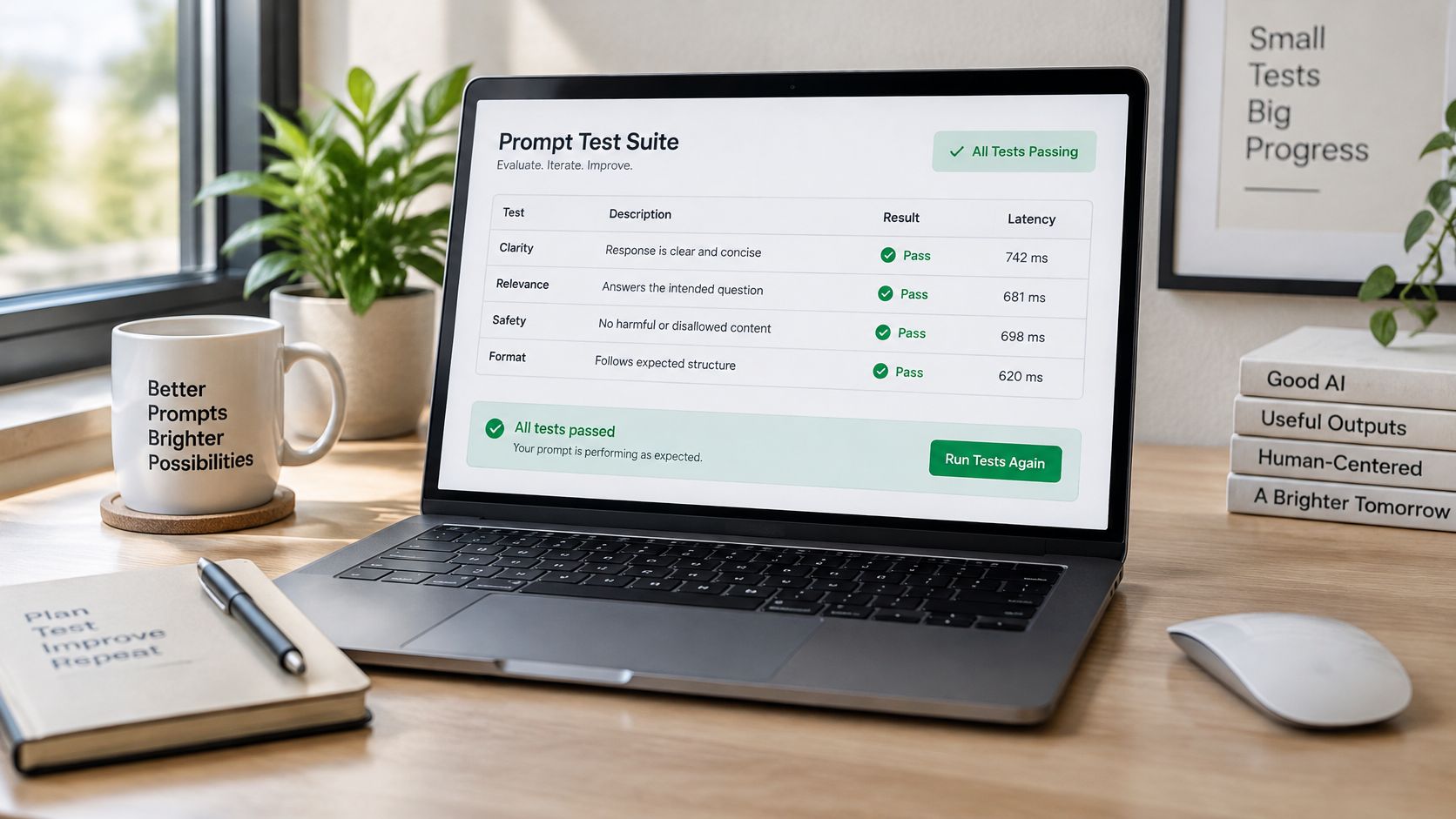
Build the evaluation around distinct responsibilities:
- Gold set: Include representative requests, ambiguous inputs, missing information, and domain-specific edge cases.
- Scoring: Automate objective checks, then use a written rubric for judgments that need a reviewer.
- Holdout: Keep evaluation examples separate from the cases used to revise the prompt.
- Release gate: Define which failures block deployment, even when average quality improves.
For generated Solidity, executable tests and security review matter more than whether the explanation sounds convincing. Connect the evaluation harness to appropriate blockchain development tools, rather than grading code entirely through another model's opinion.
The strongest hiring signal
Ask a candidate to design a small evaluation plan, including representative cases and distinct quality metrics. Look for separation between development feedback and release evidence.
For career progression, owning the evaluation suite demonstrates more than prompt-writing ability. Your portfolio should include the scoring rubric, reproducible run instructions, failure categories, and an explanation of why you accepted or rejected each revision.
4. Context Engineering and Grounding with Retrieved Sources
A protocol onboarding assistant receives a question about validator requirements. Its instruction may be clear, but if retrieval supplies an obsolete governance proposal instead of the current architecture document, rewriting the instruction won't fix the underlying problem.
Context engineering means controlling what evidence reaches the model. Retrieval-augmented generation, or RAG, adds relevant documents at query time. The prompt must then define how the assistant uses those documents, cites supporting passages, and handles unanswered questions.
Detailed context matters outside retrieval, too. A study of software developers reported that 94% included complete error messages or stack traces when using generative AI for debugging. For an engineering assistant, preserve the relevant error text, environment details, and code context rather than replacing them with a vague description.

Make missing evidence visible
For a token-terms assistant, require each material answer to identify the supporting clause. Distinguish supported, conflicting, and not found outcomes, and keep document identifiers and effective versions attached to retrieved passages.
Don't ask the model to fill documentary gaps from general knowledge. If the documents don't establish jurisdictional applicability, the assistant should identify that limitation and route the question for review.
In an interview, provide a short document set containing an outdated passage and an unanswered question. Ask the candidate to design both the prompt and the diagnostic logs.
A baseline candidate requests citations. A stronger systems candidate explains document versioning, passage selection, context budgets, and how to distinguish retrieval failure from answer-generation failure. For a portfolio, include an answer trace showing retrieved passages, used evidence, and an intentional abstention when the documents don't support an answer.
5. Structured Output Control for Reliable Integrations
A recruiting platform can't reliably filter candidate profiles using a paragraph that describes someone as fairly experienced with smart contracts. It needs defined fields, allowed values, and evidence-backed extraction.
For example, a profile parser might return skill tags, supporting text, seniority evidence, and unresolved fields. Define whether absent information becomes null, an empty collection, or an explicit unknown value. Don't let the model interpret missing evidence as a negative finding.
A prompt-optimization benchmark discussion supports treating optimization as a measurable process rather than assuming a more elaborate prompt is better. For integrations, make schema compliance and factual correctness separate acceptance criteria.

Use JSON Schema or a typed validator such as Pydantic to check output in code. Where supported, configure schema-constrained generation, but still validate the result before a downstream service consumes it.
- Structural validation: Reject missing required fields, incorrect types, and unsupported enum values.
- Semantic validation: Check that extracted skills and dates appear in the supplied material.
- Failure handling: Route invalid responses to a bounded retry or human-review path.
- Action separation: Don't let a valid extraction authorize a database mutation or financial operation by itself.
Valid JSON is a transport requirement. It isn't evidence that the contents are true.
Test the integration, not just the prompt
Ask candidates to design a schema and implement a validator for a governance-proposal extractor. Then supply an output that is structurally valid but factually wrong.
Recognizing that distinction signals backend or platform maturity. A strong portfolio includes the schema, validator tests, rejected examples, and the behavior of the consuming application when validation fails.
6. Prompt Security and Defenses Against Injection and Data Leakage
A retrieved document can contain useful protocol information and malicious instructions in the same passage. If an assistant treats both as trusted directions, a harmless-looking document review can become an attempt to expose data or misuse a tool.
Prompt injection is a trust-boundary problem, not merely a wording problem. The systematic review of prompt-injection defenses describes the limitations of prompt-only protections and the need for layered controls.
For a DeFi wallet assistant, require explicit user confirmation before drafting a transaction from natural-language instructions. Keep signing authority outside the model, and independently verify chain, destination, asset, and amount before any approval or execution.
The embedded video offers an additional discussion point for a security review.
Apply concrete controls around the prompt:
- Separate trust levels: Treat uploaded PDFs, retrieved passages, and tool responses as untrusted data.
- Restrict privileges: Allow only the tools and resources required for the current task.
- Protect secrets: Keep API keys, signing material, and unnecessary personal information out of prompts.
- Validate actions: Enforce authorization and parameter checks in application code.
- Review safely: Log flagged behavior without creating a secondary store of exposed secrets.
What security-aware candidates demonstrate
In an interview, insert hostile instructions into an otherwise useful document. Ask candidates to identify the attack path, propose containment, and explain what remains vulnerable.
Senior-level judgment means refusing to describe delimiters or a stronger system instruction as a complete defense. Connect the design to secure coding practices, including least privilege and explicit authorization.
A security portfolio should include the threat model, adversarial cases, observed failures, and containment behavior. Measure attack success separately from detection: noticing an attack doesn't prove the system prevented its consequences.
7. Prompt Version Control, Documentation, and Ownership
An audit-summary prompt changes, and reviewers start receiving different severity labels. Without the previous prompt, model configuration, and evaluation inputs, the team can't tell whether the change came from wording, context assembly, or a model update.
Store production prompts in Git, alongside their schemas, examples, and evaluation configuration. Require pull-request review for behavior changes, and assign a named maintainer who can decide whether to release, investigate, or roll back.
The survey of prompt-engineering capabilities and evaluation challenges supports treating this work as a broader engineering function rather than a narrow writing specialty. Reproducibility is part of that responsibility.
Document enough to reproduce the behavior
A prompt file header or adjacent configuration should record the task owner, model identifier and version, generation settings, input dependencies, and output contract. The change description should explain the targeted failure and link to evaluation results.
- Purpose: State what the workflow does and which decisions remain human-owned.
- Limitations: Record unsupported languages, missing document coverage, and known failure categories.
- Release evidence: Preserve the tested prompt, configuration, evaluation results, and approval.
- Rollback: Keep a known-good configuration and a clear procedure for restoring it.
Use technical documentation practices that help another engineer operate the workflow without its original author. Treat verifying agent work before release as a release responsibility, not an optional final glance.
In an interview, ask how the candidate would investigate a regression after a model upgrade. Strong answers preserve the full execution configuration, not only the prompt text.
For your portfolio, include a meaningful changelog and a rejected revision with its evaluation rationale. Senior and staff-level evidence comes from making a workflow maintainable by others, not becoming its indispensable prompt editor.
8. Model-Aware Prompting, Cost, and Latency Tradeoffs
The largest available model isn't automatically the right choice for resume extraction, FAQ routing, or governance analysis. Choose the least expensive configuration that meets the workflow's quality, security, and response-time requirements.
A software-engineering prompting study evaluated 14 prompting techniques across 10 tasks and four large language models. That scope reinforces a practical testing principle: don't assume a prompt's behavior transfers unchanged between tasks or models.
Consider a Web3 product assistant. Straightforward documentation questions might use a smaller model, while ambiguous governance questions require a more capable configuration or human review. The routing decision must itself be evaluated, because incorrect escalation can undermine the entire design.
Compare complete workflows
Measure the prompt, retrieved context, model settings, validation, retries, and review path together. A cheap initial call can become expensive if it frequently needs repair or produces answers reviewers must rewrite.
Track cost per successful task, end-to-end latency, factual accuracy, abstention behavior, and manual-review burden. Shorten prompts only after testing that the removed instructions or examples aren't protecting an important edge case.
Hiring signal: A strong candidate can explain when to use a larger model, when to improve retrieval, and when to replace generation with ordinary code.
For a technical interview, ask candidates to propose a selection experiment under explicit quality and latency constraints. Look for a plan to rerun evaluations after model updates and to test multilingual terminology where the product serves multilingual communities.
Your portfolio should show the decision record, including configurations you rejected. For a product or engineering lead, the valuable skill is defending a tradeoff in operational terms, not claiming that a particular model is universally best.
How the eight prompt engineering best practices compare for hiring and skill-building
| Item | Core Purpose | Interview Test | Typical Career Level |
|---|---|---|---|
| Structured Prompt Anatomy: Role, Context, Task, Constraints, and Output Format | Turn ambiguous requests into clear, repeatable prompts | Rewrite a vague request and explain each prompt section | Junior to senior |
| Few-Shot Examples and Step-by-Step Reasoning | Improve accuracy on classification and multi-step tasks | Choose examples and reasoning instructions; justify the tradeoffs | Intermediate |
| Evaluation-Driven Prompt Development | Measure prompt quality and catch regressions | Design a small evaluation plan with test cases and metrics | Senior to lead |
| Context Engineering and Grounding with Retrieved Sources | Ground answers in relevant documents and cite sources | Write a prompt that cites provided documents and admits gaps | Intermediate to systems engineer |
| Structured Output Control for Reliable Integrations | Produce validated, machine-readable outputs | Write a schema and validator for an extraction task | Production AI, backend, or data engineer |
| Prompt Security: Defending Against Injection and Data Leakage | Reduce injection, data-leakage, and unsafe-action risks | Identify injection risks in a sample prompt and propose mitigations | Senior or security specialist |
| Prompt Version Control, Documentation, and Ownership | Track prompt changes, evaluations, and accountability | Explain how to track and roll back a production prompt change | Senior to staff |
| Model-Aware Prompting, Cost, and Latency Tradeoffs | Balance model quality, operating cost, and response speed | Propose a model-selection plan with quality and cost metrics | Product manager or engineering lead |
Turn These Practices Into a Prompt Portfolio
Pick a bounded workflow connected to the role you want. A protocol engineer could build an incident-summary assistant, a recruiter could extract requirements from approved hiring intakes, and a compliance candidate could organize document clauses for counsel review. Choose something whose correctness you can assess without relying entirely on another model.
Write the baseline before optimizing it. Save the prompt, representative inputs, actual outputs, and a plain-language definition of success. Keep private repository content, customer information, wallet identifiers, and unreleased security details out of the demonstration.
The University of Tampa's AI career guidance recommends supplying relevant context while avoiding identifiable information and treating generated material as something to refine. Apply that same standard to your case study: you own the claims, even when the model drafted them.
Build a case study someone can inspect
Change a specific part of the workflow, then rerun the same evaluation process. Your intervention might be a better example set, grounded source passages, schema validation, or a stricter authorization boundary. Avoid changing everything at once, because you won't know which decision helped.
Include an evaluation table in your portfolio artifact comparing the baseline and revised workflow. Record the criteria, observed results, remaining failures, and operating tradeoffs, without inventing precision your test set can't support.
- Problem and scope: Explain the intended user, task, and consequences of a wrong answer.
- Before and after: Show the prompt changes and representative outputs.
- Evaluation evidence: Publish the rubric, test procedure, and results you can reproduce.
- Engineering judgment: Explain what you rejected, what still fails, and where a human must decide.
Prepare to discuss the case study without reading generated prose. Explain a failure, defend your chosen metric, and describe what you'd test next. That conversation gives an interviewer a clearer view of your reasoning than a gallery of successful screenshots.
Hiring managers can use the same practices as a structured screening rubric, choosing exercises relevant to the actual role rather than testing vocabulary. Evaluate prompt work alongside live technical discussion and domain expertise, especially when the position involves security, legal interpretation, or financial actions.
At Blockchain Jobs, our listings can be filtered by arrangement, level, contract type, and city. Our email alerts can send new mid-level jobs once a day as they're posted, helping you connect a focused portfolio to relevant openings. Set up an alert, choose a suitable role, and adapt your case study to its responsibilities without overstating your experience.
Blockchain Jobs connects candidates with opportunities across Web3, including Engineering, Security, Legal & Compliance, and AI & Machine Learning. Visit Blockchain Jobs to find roles where you can demonstrate these skills, or post a job and use the practices above to build a more useful hiring assessment.