
Mastering Remote Contract Work for Career Growth in Web3
In Web3, remote contract work isn't just an option—it's the primary path for career acceleration. This model gives projects the agility to innovate and lets ambitious professionals like Solidity developers and DeFi marketers build a powerful portfolio by contributing to high-impact ventures from anywhere in the world. This is a career built on what you can prove you can do, not where you're located.
The New Frontier of Web3 Careers
Welcome to the decentralized workforce. The Web3 space moves at a breakneck pace, and traditional 9-to-5 employment models often stifle the rapid skill development required to stay relevant. That's why remote contract work isn't just a perk; it's the foundational operating model for most serious blockchain projects and a strategic choice for career-minded individuals.
This project-based approach is a win-win. For companies, it provides access to a global pool of specialized talent on demand. For you, the contractor, it offers the freedom to choose high-impact projects, rapidly accumulate diverse experience, and build a career track record that stands out in any hiring process.
Why Contracting Dominates the Web3 Space
The shift to flexible work is a global phenomenon. By 2026, about 27% of full-time employees are expected to be fully remote, with 52% in hybrid setups. This means nearly 80% of the workforce will have some form of flexibility. This trend is amplified in Web3, where the number of remote jobs has tripled since 2020. You can dig into more stats on this trend over at Breeze.pm.
This environment is tailor-made for Web3, an industry that’s decentralized by nature. A few key drivers make this a perfect match for career progression:
- Project-Based Agility: Web3 moves in sprints. Teams form to build a protocol or launch a dApp. For a contractor, this means you can gain experience on a full project lifecycle in months, not years, rapidly building skills for your next, more senior role.
- Access to Niche Expertise: A project might need a top smart contract auditor for six weeks or a tokenomics guru for a single quarter. As a specialist, contracting allows you to apply your most valuable skills across multiple high-profile projects, making your resume incredibly compelling.
- Global Talent Pools: The best Solidity developer for a project might be in Berlin, while the top community manager is in Singapore. For your career, this means geography is no longer a barrier to working with the best teams and most innovative projects in the world.
High-Demand Roles in the Web3 Contract Market
To accelerate your career, you must target roles where demand outstrips supply. While you can find contract opportunities in almost any function, a few key areas are always hiring. These are the roles projects desperately need to build, launch, and grow.
Focusing on these in-demand contract roles is a strategic career move. Each project adds a new, verifiable achievement to your portfolio. A track record of successful, diverse projects is often more valuable than a linear career path when you're interviewing for senior or leadership positions.
Finding and Vetting High-Value Web3 Gigs
To land elite remote contract work that advances your career, you must be more strategic than simply scrolling through generic job boards. The best Web3 opportunities are often filled through niche channels before they're ever posted publicly. Sourcing high-value gigs requires a proactive approach focused on the platforms and communities where founders are actively looking for top-tier talent.
This means shifting your search to the heart of the Web3 ecosystem, where quality opportunities are curated. This is the difference between finding just another gig and building a pipeline of projects that will get you noticed by top-tier companies.
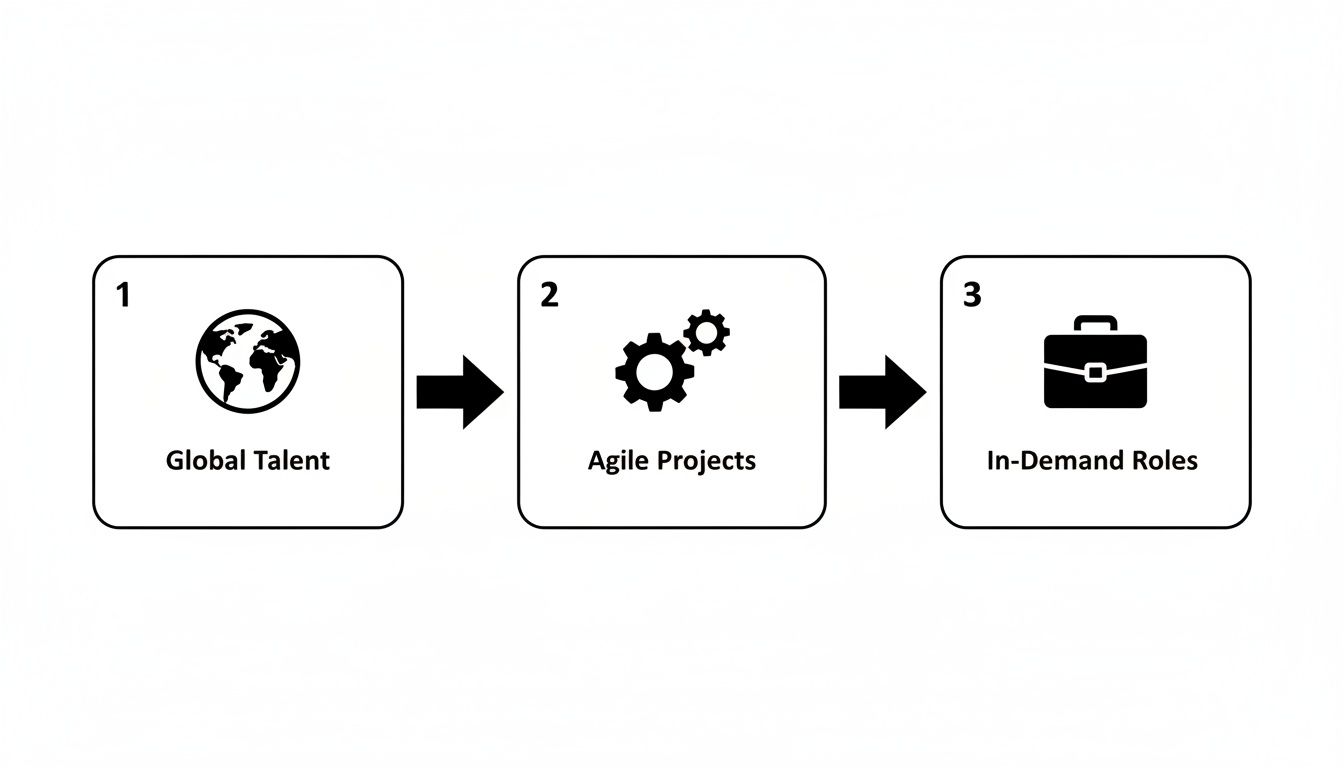
This entire process is driven by the decentralized nature of Web3, which thrives on project-based agility and creates a constant demand for specialized contract roles.
Hunt Where the Alpha Is
Top-tier projects don't post on Indeed. They use specific channels to find contractors, and your first job is to become an active, visible participant in those circles. Your next great role depends on being in the right place at the right time.
- Niche Job Boards: Platforms dedicated to the blockchain space filter out the noise and connect you with serious, funded projects. For anyone focused specifically on remote work, checking out dedicated listings for remote blockchain jobs is the most efficient way to find relevant opportunities.
- Project Discords and Telegrams: This is where you find the freshest "alpha" on hiring. Many teams post roles or "bounties" directly in their community channels. Join the servers of projects you admire, contribute meaningfully to discussions, and monitor announcement channels to get in on the ground floor.
- VC and Accelerator Networks: Follow venture capital firms and startup accelerators prominent in Web3. Their portfolio companies are constantly hiring, and these networks are often the first to know, giving you an inside track.
The rise of remote work has reshaped the hiring landscape. Fully remote opportunities now make up 15% of all U.S. listings—a threefold increase from pre-2020. Globally, 40% of job postings offer some form of remote work. On blockchain-specific job boards, this translates into a steady stream of contract roles that can serve as stepping stones to more senior positions in operations, security, and community management.
Dissecting Job Descriptions: Spotting Green and Red Flags
Once you find a promising opportunity, it's time to vet it with the lens of a hiring manager. A vague job description is often the first red flag of a disorganized project that won't add value to your resume. Learning to spot key signals will protect you from scope creep and frustrating contracts that could stall your career momentum.
A good job post respects your time as a professional. It clearly outlines the problem they’re trying to solve and what success looks like.
Vetting a project is as important as them interviewing you. A great contract is a partnership that should be a net positive for your career. If a project can’t clearly state its needs or the team is a complete mystery, you’re risking your reputation. The goal is career progression, not just a paycheck from a ghost team.
Before applying, use this checklist to gauge whether a gig is a step forward for your career.
Web3 Contract Opportunity Vetting Checklist
| Vetting Area | What to Look For (Green Flags) | What to Avoid (Red Flags) |
|---|---|---|
| Scope & Deliverables | The description details exactly what you’ll produce (e.g., "audit a set of five smart contracts," "write three long-form blog posts per week"). | Vague phrases like "help with marketing" or "assist with development" with no specifics. |
| Project Timeline | It provides a realistic timeframe for the project, whether it’s a three-month contract or a specific set of milestones. | No timeline is mentioned, or the expectations seem completely unrealistic for the pay. |
| Team Transparency | You can easily find the core team members on LinkedIn or Twitter. This shows accountability and that they aren't afraid to put their names on the project. | A completely anonymous team for a significant project. While some anonymity is part of the culture, "anon" founders are a major risk for contractors. |
| Community & Traction | The project has an active and engaged community on platforms like Discord or Twitter, indicating genuine interest and a real user base. | A dead Discord server, fake-looking Twitter followers, or no community presence at all. |
| Budget Discussion | The project is upfront about its budget range or willing to discuss compensation early in the conversation. | Any refusal to discuss the budget early on. This is usually a sign they are trying to lowball you or are just wasting your time. |
Always trust your gut. If something feels off during the vetting process, walk away. There are plenty of high-quality projects that will enhance your portfolio, so don’t settle for one that raises red flags.
Crafting a Pitch That Actually Gets You Hired
When you're pursuing remote contract work, your application is your first deliverable and a direct reflection of the quality of your work. Forget traditional cover letters. Hiring managers are drowning in generic, copy-pasted messages. To stand out, you must stop thinking like an applicant and start acting like a strategic consultant.
Your pitch should be a concise proposal that demonstrates you understand their specific problem and have a clear, actionable plan to solve it. This approach immediately elevates you above other candidates. You're no longer just another person asking for a job; you're a proactive partner ready to deliver immediate value.

Go Way Beyond Your Resume
Your resume shows what you've done. Your pitch must show what you can do for them. This requires connecting your past achievements directly to their current needs. It takes research, but the payoff is landing an interview for a top-tier role.
Before writing a single word, do your homework. Read their whitepaper. Analyze their recent announcements. Lurk in their Discord to understand community pain points. Your goal is to identify a specific challenge or a key milestone on their roadmap. This insight is the secret to a pitch that feels personal and proves you’re already thinking strategically.
Structure Your Pitch for Maximum Impact
A winning pitch isn't a list of your skills; it's a compelling business case for hiring you. Ditch the formal "To Whom It May Concern" and get straight to the point with a direct, professional tone that respects the hiring manager's time.
This structure consistently lands interviews:
- The Hook: Open by demonstrating you've done your research. Reference a recent launch, a technical challenge they’ve mentioned, or a community goal. This proves you're not just mass-applying.
- The Solution: In one or two sentences, state precisely how your expertise solves that challenge. This draws a direct line from their problem to your skills.
- The Proof: This is the most critical part. Provide undeniable evidence that you can deliver. Link to specific, relevant work that proves you've solved similar problems before.
Your pitch is an audition. A generic message signals you'll deliver generic work. A thoughtful, customized pitch shows you're a strategic partner who pays attention to detail—a quality that every hiring manager is looking for.
Show, Don't Tell: Your Value in Action
Talk is cheap, especially in an industry built on verifiable proof. Your GitHub, portfolio, and past results are your most powerful assets. But don't just drop a link to your homepage. You must curate the evidence to match the role.
This is what sets top candidates apart. You are not making the hiring manager hunt for your value; you are presenting it to them directly. This shifts the conversation from "Is this person qualified?" to "When can they start?"
Here are actionable examples:
- Smart Contract Auditor: Instead of sending your GitHub profile, link directly to a specific audit report you authored. Highlight a critical vulnerability you discovered and briefly explain your recommended fix, connecting it to their protocol's security needs.
- Community Manager: Don't just claim you "grew a community." Link to a specific campaign you managed. Show the strategy, the content, and the results (e.g., "increased Discord activity by 40% in two months by implementing a new ambassador program").
- Content Strategist: Find an article or thread you wrote that explains a complex topic similar to their project. Link to it and mention the engagement it received. This demonstrates you can communicate effectively with their target audience.
- Solidity Developer: Point them to a specific, well-documented smart contract you built. Briefly explain an architectural decision you made to optimize for gas or security, and connect it directly to the type of work they need done.
When you provide this level of targeted proof, you aren’t just applying for a job; you are demonstrating your value in real-time. This builds instant trust and makes you the obvious low-risk, high-reward choice for any remote contract work, fast-tracking you past the initial screening and straight to the interview.
Mastering the Remote Interview and Negotiation
You've landed the interview—this is your opportunity to seal the deal. In Web3, interviews are more than a Q&A session; they're a live demonstration of your problem-solving skills and strategic thinking. It’s your chance to prove you’re not just a contractor looking for a gig, but the right strategic partner to help them succeed.
Following the interview, you enter negotiation. This isn't just about your rate; it's about structuring the engagement for success. A well-negotiated contract prevents future conflicts and establishes your professionalism from the start, setting the tone for your entire working relationship.
Acing the Remote Web3 Interview
Remote interviews are a unique test of your communication and preparation. Without the benefit of in-person cues, your clarity and technical setup are under a microscope. You must control your environment so your expertise can shine.
First, master your setup. Test your camera, microphone, and internet connection. Ensure you have a clean, professional background. These details signal to the interviewer that you are a serious, organized professional who is reliable and prepared—key traits for any remote team member.
During the interview, focus on these actionable strategies:
- Think Out Loud: When faced with a technical problem or a hypothetical scenario, walk the interviewer through your thought process. Explaining the why behind your approach is often more revealing and impressive than just providing the correct answer.
- Ask Insightful Questions: This is how you demonstrate genuine interest and strategic thinking. Avoid generic questions. Instead, ask something specific that shows you've done your homework: "I saw on your roadmap that a mainnet launch is planned for Q3. What are the biggest technical hurdles you're anticipating, and how would this role contribute to overcoming them?"
- Frame Your Value: Don't just list past duties. Connect your accomplishments directly to the company's needs using a "Problem-Action-Result" framework. This clearly demonstrates how you deliver tangible value in situations similar to theirs.
A remote interview is a live demo of your professional capabilities. Your preparation, clarity, and communication are just as critical as your technical skills. Your goal is to prove you’re a low-maintenance, high-output collaborator they can trust from day one.
Moving from Interview to Negotiation
Once you receive an offer, the dynamic shifts. This is a business discussion, not a job application. Enter the negotiation with confidence, backed by research on market rates and a clear understanding of the value you provide. Many talented contractors undervalue themselves at this stage.
Remember, you are defining a business partnership. This is your opportunity to clarify all expectations to avoid scope creep and build a healthy working relationship. Before discussing your rate, ensure you have a complete understanding of the scope, deliverables, and timeline.
For an idea of what's expected in senior roles, look at descriptions like this senior backend developer position. It provides insight into the responsibilities that justify top-tier compensation.
Key Negotiation Points Beyond Your Rate
A strong contract is built on clear expectations. Your rate is just one component. Several other terms are crucial to negotiate upfront to protect your time, ensure fair payment, and establish a professional engagement.
Insist on clarifying these key points:
- Payment Terms: How and when will you be paid? Define the schedule (e.g., bi-weekly, upon milestone completion) and currency. If payment is in crypto, be specific: USDC? ETH? How will you handle volatility? Is the payment pegged to a fiat value at the time of transfer?
- Scope of Work (SOW): This is non-negotiable. Require a detailed SOW that lists all deliverables and responsibilities. Crucially, it should also state what is out of scope.
- Revision Rounds: For creative or strategic work, define the number of revision rounds included in your fee. This simple clause is your best defense against endless feedback loops and scope creep.
- Communication Channels: Set clear expectations for communication. Establish primary channels (e.g., Slack, Telegram) and expected response times to ensure a smooth workflow.
Mastering these negotiations is a core competency for a successful contracting career. It's how you secure engagements on favorable terms and build productive, long-lasting partnerships.
Navigating Contracts, Invoicing, and Taxes
Turning a successful interview into a sustainable career requires mastering the operational side of contracting. Once you've agreed on terms, formalizing the relationship in writing is essential. This isn't just administrative work; it’s the foundation that protects you, showcases your professionalism, and ensures you get paid.
Handling this process smoothly demonstrates to any hiring manager that you are a serious professional who operates as a business. Getting these details right from the start builds confidence and sets the stage for a successful engagement.

Your Contract Is Your Shield
Let's be clear: never start work without a signed contract. A verbal agreement or a casual message on Discord is not legally binding and offers no protection. A solid contract defines the relationship and manages expectations, which is crucial for a productive and positive working relationship.
Think of your contract as the project's official rulebook. When both parties agree on the rules upfront, it eliminates potential confusion and conflict, allowing you to focus on delivering high-quality work.
A well-structured contract is your single most important tool for preventing scope creep and ensuring you get paid on time. It’s not about mistrust; it’s about creating professional clarity and accountability for both you and the client.
To ensure you're protected, your agreement must include several key clauses. Skipping these is a common but costly mistake for contractors.
Essential Clauses for Your Web3 Freelance Contract
Before signing, review the contract for these non-negotiable clauses. They are designed to create a fair and clear framework for your professional engagement.
| Clause | Why It's Critical | Example Language Snippet |
|---|---|---|
| Detailed Scope of Work (SOW) | This defines exactly what you will deliver and, crucially, what is not included. It is your primary defense against scope creep. | "Contractor will deliver a five-module smart contract audit report, including vulnerability analysis and gas optimization suggestions. Frontend UI/UX mockups are explicitly out of scope." |
| Payment Schedule and Terms | This clause specifies how and when you get paid—the currency (USD, USDC, etc.), rates, and due dates. Clarity on crypto specifics is essential. | "Client will pay Contractor 50% upfront and 50% upon final project approval. Payments will be made in USDC to the specified wallet address within 15 days of invoice receipt." |
| Intellectual Property (IP) Rights | This clarifies who owns the work you create. The industry standard is that the client owns the final work product upon full payment. | "Upon receipt of final payment, Contractor transfers all rights and ownership of the final deliverables to the Client. Contractor retains rights to use the work in their private portfolio." |
| Termination Clause | This is your exit strategy. It outlines how either party can end the contract professionally, including notice periods and payment for work completed. | "Either party may terminate this agreement with 14 days' written notice. Client agrees to pay for all work completed up to the effective date of termination." |
Having these clauses in place provides a safety net, allowing you to focus on delivering excellent results without worrying about potential disputes.
Professional Invoicing and Getting Paid
Your invoice is a professional document that reflects your business. Keep it clean, simple, and easy to process. Use a template that includes your contact information, the client's details, a unique invoice number, the date, an itemized list of services, and the total amount due.
When dealing with crypto payments, add extra clarity:
- Specify the Cryptocurrency: Be explicit about the payment currency (e.g., USDC, DAI, ETH).
- Address Volatility: To mitigate risk from price swings, peg the payment to a stable value. For example: "The equivalent of $5,000 USD in ETH at the time of transfer."
- Include Wallet Address: Double-check your public wallet address. For significant payments, ask the client to send a small test transaction first to verify the address.
Sending a polished invoice promptly after completing a milestone reinforces your professionalism and ensures consistent cash flow. For senior-level roles like this Site Reliability Engineer contract, demonstrating this business acumen is a significant advantage.
Understanding Your Tax Obligations
As an independent contractor, you are running a business. This means you are responsible for tracking your income, managing expenses, and paying your own taxes. Ignoring this can lead to serious financial and legal problems.
Keep meticulous records of all payments, whether fiat or crypto. You must record the fair market value of any cryptocurrency in your local currency on the day you receive it. Equally important, track all your business-related expenses—software, hardware, home office costs, professional development—as these are often tax-deductible.
A simple, effective strategy is to set aside 25-30% of every payment for taxes. This ensures you are prepared when tax season arrives.
Your Top Questions About Web3 Contract Work, Answered
Navigating a career as a Web3 contractor presents unique challenges and questions. As you build your freelance business, understanding the practical realities of the space is key to your success.
Here are concise, actionable answers to the most common questions from Web3 professionals, designed to provide clarity and help you advance your career.
How Do I Figure Out My Rate for a Web3 Contract?
Setting your rate involves balancing market value with your expertise. Begin by researching Web3-specific job boards and professional communities to understand the current rates for your role, whether you're a Solidity developer or a GTM strategist. Your years of experience, the project's technical complexity, and the specific tech stack are all key factors.
When quoting a project fee, use this formula:
- Estimate the total hours the project will realistically take.
- Multiply that number by your target hourly rate.
- Add a 15-20% buffer to account for client revisions, unforeseen challenges, and project management overhead.
Your strongest negotiation tool is a portfolio showcasing tangible results. In initial conversations, consider presenting a rate range. This frames the discussion as a collaborative negotiation rather than a rigid demand, which hiring managers appreciate.
What Are the Go-To Tools for Remote Collaboration?
Proficiency with the standard Web3 collaboration toolkit is a baseline expectation for any remote contractor. It allows you to integrate seamlessly into new teams and start delivering value immediately.
Most remote Web3 teams use a combination of these tools:
- Real-Time Communication: Discord and Telegram are standard for community-facing and internal team communication. Slack is also common for more structured internal collaboration.
- Project Management: Expect to use Notion, Trello, or Asana to track tasks, monitor roadmaps, and report on progress.
- Code and Docs: GitHub is the non-negotiable standard for all code collaboration, version control, and technical documentation.
Fluency in these tools signals to a hiring manager that you are an experienced professional who can operate independently without extensive onboarding.
How Can I Build a Reputation That Brings Me Work?
In a decentralized world, your reputation is your most valuable asset. A strong track record and a visible professional presence will eventually lead to inbound opportunities, which is the ultimate goal for any contractor.
Building a powerful reputation comes down to three key actions:
- Always Over-Deliver: Consistently meet deadlines, communicate proactively (especially when facing challenges), and ensure your work is of the highest quality. A reliable, high-performing contractor is invaluable.
- Be a Great Collaborator: Be responsive, maintain a positive attitude, and be a helpful team member. People rehire and recommend contractors who are professional and easy to work with. After a successful project, ask for a testimonial for your portfolio or LinkedIn profile.
- Be Visible in the Community: Your personal brand is a career multiplier. Participate in relevant discussions on X (formerly Twitter), share valuable insights in Discord servers, or contribute to open-source projects. This visibility establishes you as an expert and keeps you top-of-mind for future remote contract work.
Think of every contract as an audition for your next five. The goal is to leave every project with the team wishing they could hire you full-time. That's the mark of a top-tier contractor and the fastest path to career growth.
What's the Best Way to Handle Crypto Payments?
Handling crypto payments professionally requires diligence. The first step is to ensure the terms are explicitly defined in your contract, including the exact cryptocurrency (e.g., USDC, ETH) and payment schedule.
To protect yourself from market volatility, peg the payment amount to a fiat value. For instance, your contract should state, "The equivalent of $5,000 USD in ETH, calculated at the time of transfer."
For tax purposes, you must record the fair market value of the crypto on the day you receive it. Tools like CoinTracker can simplify this process. Always receive payments in a secure, non-custodial wallet that you control, and ensure your contract specifies who is responsible for network gas fees. This is a professional detail that protects you and builds trust with clients.
Ready to find your next high-impact role in Web3? Blockchain Jobs is the premier job board for professionals seeking remote contract work in DeFi, NFTs, and the decentralized future. Explore open positions and get hired today!