
Blockchain Developer Resume: How to Prove On-Chain Skills
You've got a job posting open beside your resume. The posting asks for Solidity, protocol experience, and security judgment. Your resume lists the tools, but the strongest work is buried under phrases like built smart contracts and contributed to Web3 projects.
The fix isn't another keyword. A strong blockchain developer resume gives an interviewer a claim they can test, an artifact they can inspect, and a clear boundary around what you owned. Choose the engineering track first, then decide how to present that evidence at your career stage.
Role-Specific Evidence for Each Blockchain Track
Proof to show for each blockchain engineering track
The example metrics below are illustrative, not achievements to copy. Replace them with evidence from your own work.
| Track | Proof to show | Artifact to link | Example metric |
|---|---|---|---|
| Smart-contract engineer | Invariant and fuzz suites, reviewed contracts | Repo test folder and verified contract | 18 invariants covered, no open high-severity issues at handoff |
| Protocol engineer | Cross-chain messaging or upgrade design | Design doc and testnet deployment | Two testnets live, one upgrade path tested |
| Infrastructure or node engineer | Node operations and monitoring | Redacted dashboard screenshot and runbook | Uptime over a stated 90-day window |
| Backend or indexing engineer | Indexers, APIs and data pipelines | Public API docs and repo | Indexed blocks per day and API latency at the 95th percentile |
| Security engineer | Reproducible exploits and threat models | Audit report excerpt or PoC repo | Findings reported and accepted by the team |
The same lending project can support different applications. A smart-contract candidate should foreground liquidation invariants and access controls. A backend candidate should foreground event ingestion, reorg handling, and API behavior under load.
Georgije Ignjatov's blockchain hiring commentary emphasizes deployed systems, reliability, GitHub activity, and prior protocol work over hackathon achievements alone. That distinction matters: a demo proves you can assemble a working path, while operating a system gives you evidence about failure, recovery, and maintenance.
Translate adjacent experience without relabeling it
Kubernetes reliability work can support a node-operations application when you explain health checks, persistent storage, recovery procedures, and alert ownership. It doesn't become validator experience until you've operated validators.
Financial controls can demonstrate approval boundaries and risk management relevant to smart contracts. High-throughput backend work can demonstrate the batching, consistency, and replay decisions needed in indexers and rollup services. Keep the original context visible, then add a blockchain artifact that shows you understand the differences.
Use a focused set of blockchain development tools to close a specific evidence gap, not to expand your skills list indiscriminately.
Practical rule: Name the deployment state explicitly: portfolio project, testnet release, externally audited mainnet deployment, or maintained production system.
For confidential work, link an approved architecture excerpt, sanitized postmortem, or public contribution. Don't expose customer information just to make a claim clickable.
Tailoring the Resume to Your Career Stage
Seniority changes what a reviewer will infer from the same words. Owned architecture suggests decision authority; implemented a component suggests a narrower delivery responsibility.
BlockchainDose's development guide reports that roles requiring more than five years of experience represented 41% of Web3 listings, alongside a 47% rebound in crypto developer roles from 2024 to 2025. Those figures don't mean junior applicants should imitate senior resumes. They make accurate positioning more important.
What to lead with at each career stage
| Career stage | Lead with | Proof to add | Avoid |
|---|---|---|---|
| Career switcher | Transferable systems work mapped to protocol needs | Testnet deployments, open-source contributions | Tutorial lists with no shipped code |
| Junior | Verifiable projects and reproducible findings | Repos with passing tests, issue triage, testnet deployments | Claims of production ownership |
| Mid-level | One or two shipped systems at stated scale | Cross-chain experience, deployment volume, performance baseline | Filler skills with no outcomes |
| Senior or protocol | Architecture ownership and incident response | Audit remediation, value secured, team leadership | A tool inventory without design decisions |
Match the claim to your actual authority
Career switchers should preserve their strongest engineering accomplishments. Replacing substantial backend experience with a collection of introductory Solidity exercises makes the resume weaker. Add enough chain-specific work to demonstrate that you understand transaction execution, finality, and adversarial environments.
For junior candidates, narrow evidence is useful evidence. A merged bug fix, reproducible security finding, or documented architecture decision gives an interviewer something concrete to discuss. Explain what you implemented independently and where maintainers or teammates guided the work.
Mid-level engineers should make delivery boundaries clear: what they shipped, which dependencies they coordinated, and what happened after deployment. Cross-chain experience helps only when they can explain the platform-specific decisions rather than name multiple networks.
Senior candidates need to show judgment under constraints. Describe why an upgrade strategy was selected, how audit remediation was prioritized, or how an incident changed operational practice.
Your title should describe the role you held. Your bullets should establish the scope you're ready to take on next.
For progression, identify the missing responsibility in your target role. Seek that responsibility through a real project rather than rewriting your current title to imply you already have it.
Resume Layout and Section Order
A reviewer's first-pass question is straightforward: does this candidate's recent work match the role? Arrange the page so they can answer without decoding a dense technology inventory.
Use this order, keeping experience ahead of projects unless project work is your strongest evidence.
Resume sections, contents and length
| Section | What to include | Length |
|---|---|---|
| Header and links | Name, location, remote status, GitHub, portfolio, one verified contract link | 2-3 lines |
| Summary | Main chains, languages and years of production work | 2-3 sentences |
| Skills | Languages, chain environments and tools used in real work | 1 compact block |
| Experience | Three to four most recent roles, three to five bullets each | Bulk of the page |
| Selected projects | Two to four projects with repo, test, audit or deployment evidence | 2-3 lines each |
| Education and certifications | Relevant degree; certificates from recognized courses only | 1-2 lines |
Group skills accurately: Solidity, Rust, and TypeScript are languages; EVM, Solana, and Cosmos SDK describe environments or frameworks. Move belongs with languages. Include Foundry, Hardhat, and Slither only where you can discuss their use.
A compact skeleton
Header template: Name | City, Country | Remote-ready | GitHub profile | Portfolio | Verified contract on a block explorer.
Hypothetical summary: Backend and smart-contract engineer with six years in production, shipping Solidity and TypeScript on Ethereum L2s and Rust programs on Solana. Contracts reviewed internally, with one external audit remediated. Focused on lending systems and event-driven services.
The U.S. Bureau of Labor Statistics projects software-developer employment to grow 17.9% from 2023 through 2033. Show databases, APIs, testing, security, and system design because blockchain candidates also compete with experienced general software engineers.
I'd use one page under five years of experience and two at senior level. Remove every chain name temporarily: the remaining text should still demonstrate engineering ownership.
How to Write Bullets That Prove On-Chain Work
Start with the job, not your complete work history. An analysis of 20,000 IT job postings identified programming languages as the most demanded hard-skill category, while communication, collaboration, and problem-solving led the soft-skill categories. Your bullets need searchable technical terms and evidence of delivery.
Use this workflow to connect requirements to work a reviewer can inspect.
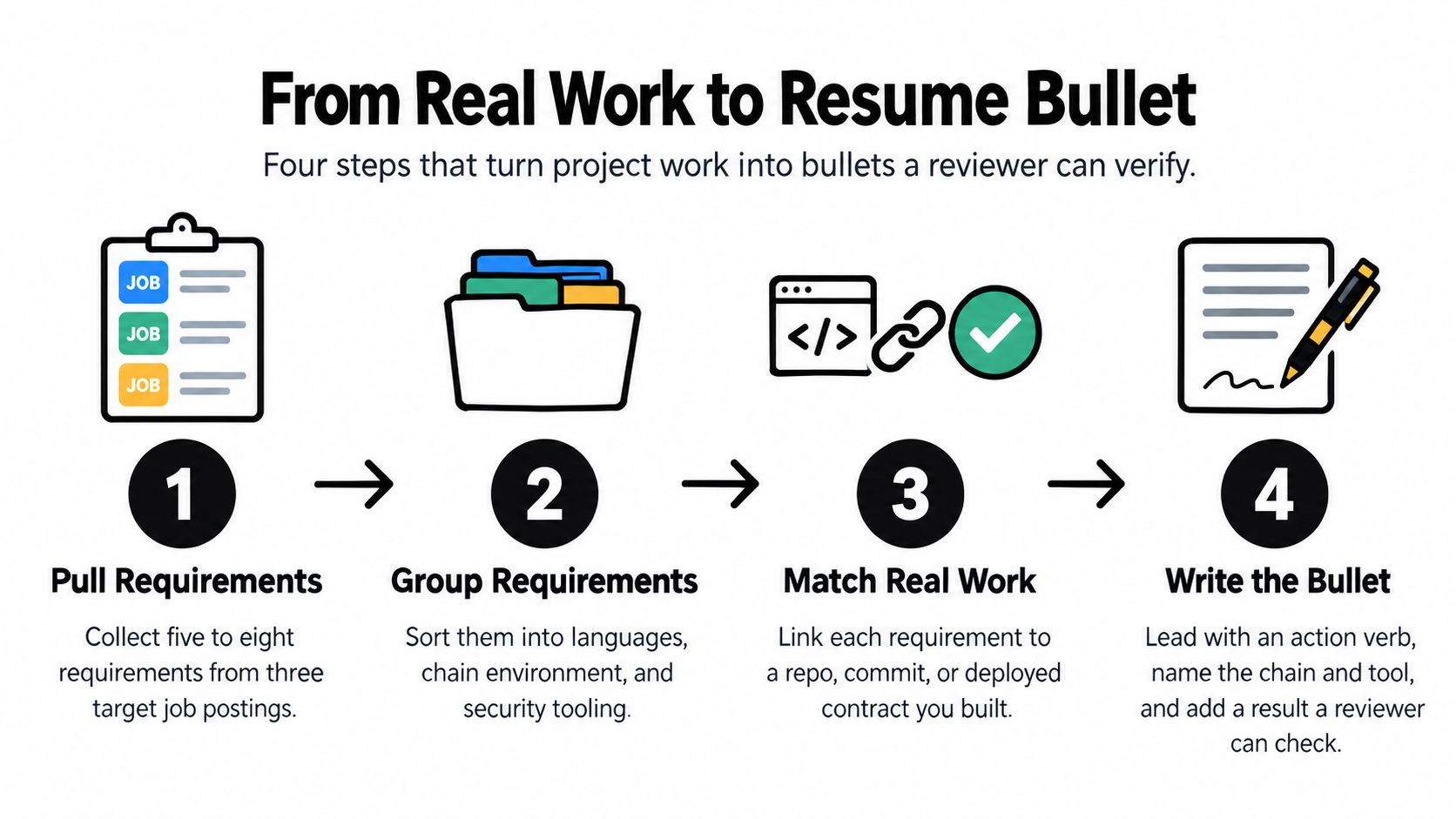
Build the claim in four passes
Extract and group requirements. Pull five to eight requirements from three target postings into languages, chain environment, security tooling, infrastructure, and collaboration. Before: broad blockchain experience. After: EVM lending-contract development, backed by the relevant repository and deployment record. Select the requirement because you have evidence, not because it appears repeatedly.
Match only real work. Mark whether each skill comes from production, testnet work, or reviewed code; drop unsupported terms. Before: multichain expert. After: implemented Ethereum event ingestion with reorg recovery, backed by the ingestion module and recovery tests. A single well-supported environment is stronger than a list of chains touched once.
Write action + technical method + quantified outcome + verification context. Before: improved contract testing. A hypothetical documented replacement: implemented a Foundry fuzz-test suite for 18 Solidity invariants, reducing escaped high-severity defects in pre-audit testing, with the suite linked from the repository. Use the reduction claim only if defect records support it; otherwise, state the covered properties without asserting improvement.
Challenge the cost and trade-off. Ask what changed, what it cost, and what an interviewer could reproduce. Before: optimized gas. After: replaced repeated storage reads with cached values in the settlement path, with before-and-after gas snapshots in the pull request. Add your measured reduction and disclose any readability or complexity cost.
A STAR-method resume structure can help compress the context. Keep the technical method visible rather than spending the bullet on background.
Replace vague scope with inspectable scope
Before: built a DeFi lending protocol.
After: shipped lending contracts to Sepolia with invariant tests covering collateral and liquidation paths, linked from the repository README.
Add a measured figure only when you have one. Deployment to a testnet is a useful accomplishment; implying mainnet adoption isn't.
Security claims should name a threat model or test method, such as oracle manipulation simulations or access-control tests. Collaboration should appear through delivery: coordinated audit remediation with reviewers, documented an upgrade procedure for operators, or handled incident communication with product and support. A separate list of interpersonal adjectives proves little.
Portfolio and GitHub Checks Reviewers Make
Make the first click useful. A reviewer shouldn't need to search through abandoned forks to find the project behind your strongest bullet.
Present a focused profile rather than an archive of everything you've tried.
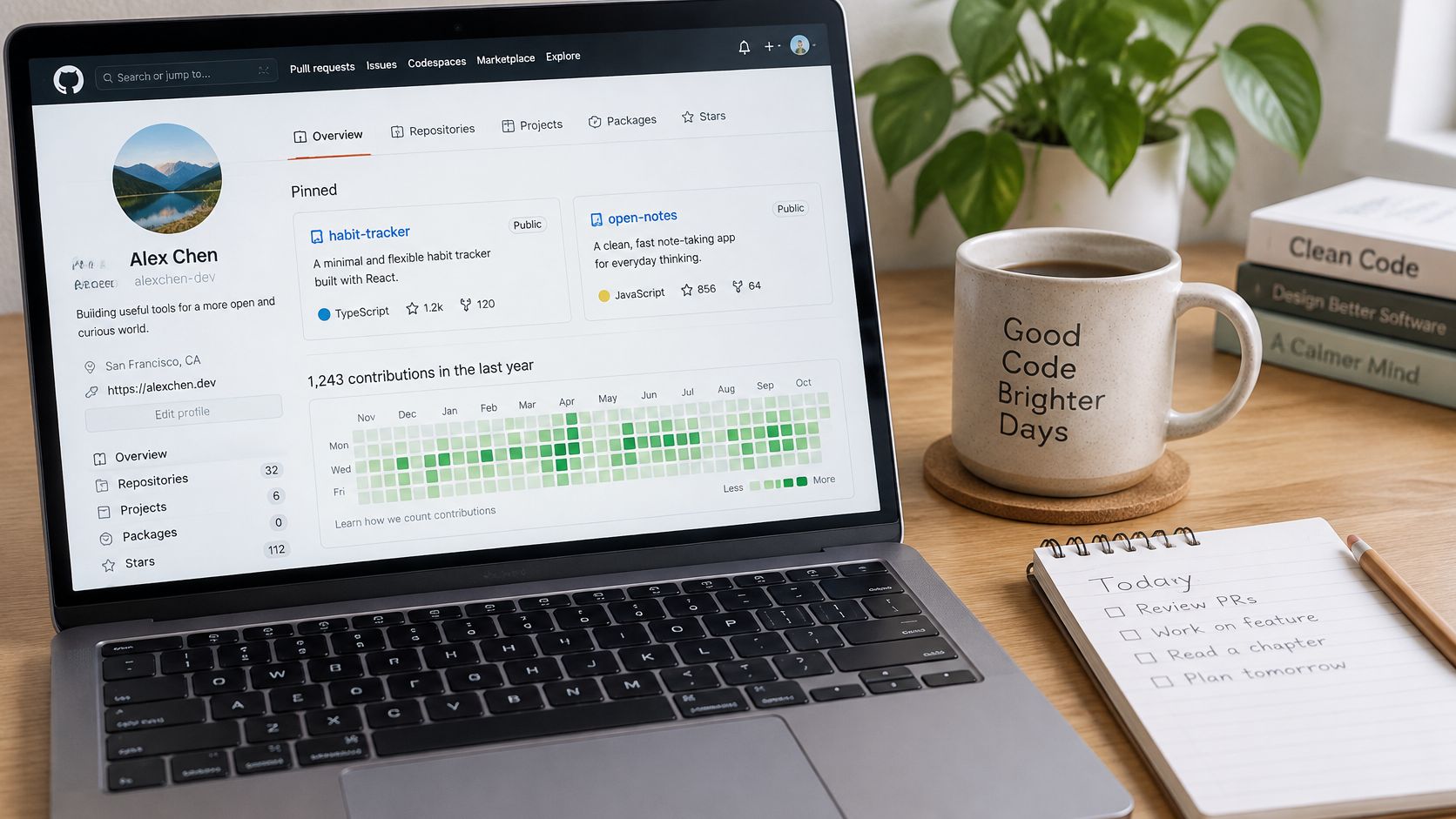
Prepare the reviewer's click path
- Profile: Pin two or three repositories aligned with the target track.
- README: Include the problem, architecture, run instructions, test results with command output, and known limits.
- Tests: Provide a single entry command, such as
forge test, with invariant and fuzz suites in visible folders. - Deployment: Link verified explorer source and identify the repository commit, compiler settings, and proxy implementation where relevant. Verification alone doesn't establish that your latest repository matches deployment.
- Analysis and operations: Include Slither output, Echidna or Medusa results where available, and a short incident or testnet postmortem covering cause, fix, and recovery time.
Codeminer's blockchain hiring guide frames evidence across implementation, testing, security, and operations. Make each layer inspectable: storage-layout rationale, runnable tests, a specific threat model, and deployment or recovery documentation.
For project context, Fundl's Kedolik Swap's traction profile provides a separate project-facing reference. Keep that kind of traction material distinct from proof of your own code contribution. Likewise, use smart-contract examples to inform implementation choices, not as substitutes for original work.
Use the video as a supplementary resource, while keeping your own repository self-contained.
Sanitize before publishing
- Secrets: Remove private keys,
.envfiles, and seed phrases. Rotate any credentials exposed in commit history. - Permissions: Exclude client code covered by an NDA unless publication is expressly authorized.
- Privacy: Redact user data, sensitive infrastructure details, and confidential dashboard identifiers.
- Review scope: Say internal review when no external audit exists. Replace audited or production-ready with contracts reviewed, findings resolved, or value handled on a named deployment.
A clean test run demonstrates behavior under the tested conditions. It doesn't establish that a contract is safe against every attack.
Recruiter Screens and Interview Alignment
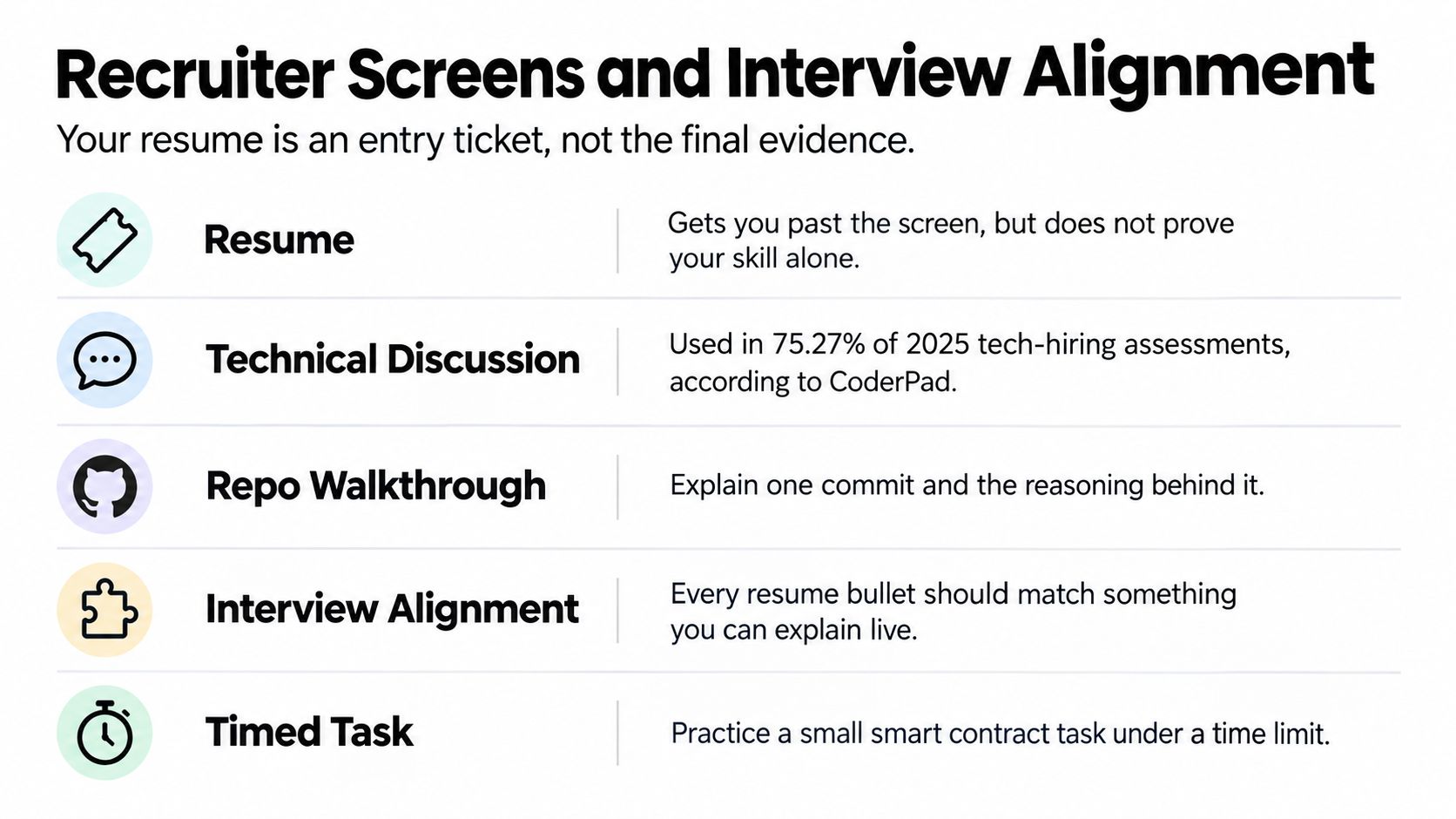
Your resume is an entry ticket, not the final proof of competence. A polished description becomes a liability if you can't explain the implementation behind it.
In CoderPad's 2025 tech-hiring survey, technical discussion was selected by 75.27% of respondents, resume review by 71.61%, live coding by 49.82%, asynchronous technical tests by 24.54%, and take-home projects by 21.06%, as reported in its State of Tech Hiring report. These are assessment-format selections, not a universal interview sequence.
Prepare for multiple ways of testing the same claim.
Turn achievements into interview prompts
| Resume claim | Likely follow-up | Preparation |
|---|---|---|
| Improved scalability | Where was the bottleneck? | Architecture, load assumptions, rejected alternatives |
| Strengthened security | Which attacker capability did you model? | Threat model, failing test, remediation |
| Improved performance | Compared with what? | Baseline, measurement conditions, regression checks |
Practice a two-minute explanation: problem, design choice, trade-off, result. Include what you personally decided and what teammates owned. For live coding, rehearse a small contract change with tests rather than memorizing a finished solution.
Mirror posting terminology only where it's true. Screening systems may filter by skills, education, job title, and certifications, so use recognizable labels while preserving your actual employment title.
Pre-send checklist
- Links: Every repository, explorer page, and document opens without an unexpected permission request.
- Metrics: Every figure has an underlying report, benchmark, dashboard, or approved record.
- Tools: Every listed tool appears in at least one defensible project.
- Lead bullets: Your top three achievements can be explained with the relevant code open on screen.
If a claim requires several disclaimers to become accurate, narrow it before sending.
Send Your Resume to Matching Engineering Roles
Choose applications by responsibility, not just by the presence of blockchain in the title. A node-operations role and a smart-contract role need different lead evidence, even when both use the same ecosystem.
Our board lists 6,934 open blockchain and Web3 jobs across crypto, DeFi and Web3. Engineering has the most open roles at 1,624, followed by Legal & Compliance at 551; email alerts send new blockchain and Web3 jobs once a day as they're posted.
Put the resume to work
- Choose the track. Filter to Engineering and select listings whose responsibilities match your strongest proof. For infrastructure-focused applications, also review BroLabel's careers page to find roles in crypto infrastructure.
- Set the alert. Use daily emails to identify relevant openings, then read each posting before choosing which resume to send.
- Maintain focused versions. Keep a resume per track and rewrite the top three bullets for each posting, matching its language only where your work supports it.
Before applying, open every resume link from the exported document. Then prepare a five-minute walkthrough of your strongest project: the problem, design choice, trade-off, result, and what you'd change now. Make that walkthrough your next task, so you're ready when an interviewer asks you to explain the work.
Blockchain Jobs connects candidates with engineering opportunities across blockchain, DeFi, and Web3. Visit Blockchain Jobs, choose roles that match your evidence, and send a resume customized to each role, with your strongest project ready to discuss.