
Your Guide to Remote Cyber Security Internships in 2026
A remote cybersecurity internship isn't just another line on your resume—it's your fast track into a high-demand, high-stakes career. Think of it as a direct pipeline that lets you gain critical, real-world experience that hiring managers value, all without leaving your desk.
Why a Remote Internship Is Your Best Career Move

The demand for cybersecurity talent is absolutely exploding, and companies are scrambling to fill the void. This massive skills gap has created a golden opportunity for anyone looking to break into the field. Companies aren't just hiring locally anymore; they’re casting a global net, which has made remote cybersecurity internships a strategic tool for building their future workforce.
This isn't just about getting your foot in the door. A good internship is a long-term audition for a full-time job. Hiring managers use these programs to identify and groom their next generation of talent. If you prove your value, a job offer is often the logical next step.
The Unprecedented Talent Shortage
So, what’s driving this trend? A severe talent shortage. Right now, the US cybersecurity sector has around 750,000 unfilled jobs, and that number is only expected to grow.
This scarcity has pushed companies to get creative with how they find people. Since 2020, we've seen a surge of over 50% in remote cybersecurity internships as businesses realize it's one of the best ways to build a pipeline of skilled professionals. This puts you in a surprisingly powerful position. Companies are eager to invest in passionate people they can mold from the ground up.
From a hiring manager's perspective, an intern who shows initiative, learns quickly, and contributes to real projects is a far less risky hire than an unknown external candidate. Your internship is a three-month-long job interview where you can prove your value every single day.
So, What Kind of Work Will You Be Doing?
Remote internships aren't a one-size-fits-all deal. They cover a huge range of specializations, giving you the chance to figure out which path really clicks with your skills and interests. Each role is an opportunity to build a specific skillset that hiring managers are looking for and will ask about in interviews.
To help you see where you might fit in, here’s a breakdown of some of the most common internship roles you’ll find.
Common Remote Cyber Security Internship Roles
This table breaks down some typical roles, the work you'll perform, and the valuable skills you'll gain that directly translate to a full-time career.
| Internship Role | Key Responsibilities | Skills Gained for Your Career |
|---|---|---|
| Security Operations Center (SOC) Analyst Intern | Monitoring networks for threats, analyzing security alerts, and responding to incidents in real-time. | SIEM tools (e.g., Splunk, QRadar), incident response procedures, threat detection, network traffic analysis. |
| Threat Intelligence Intern | Researching new and emerging threats, analyzing malware samples, and tracking attacker groups (APTs). | Open-Source Intelligence (OSINT), malware analysis, threat modeling, report writing. |
| Penetration Tester / Red Team Intern | Legally attempting to hack into systems to find vulnerabilities before criminals do. | Vulnerability scanning, exploit development, scripting (Python/Bash), Metasploit, Burp Suite. |
| Cloud Security Intern | Securing cloud environments (AWS, Azure, GCP) by configuring security controls and monitoring for misconfigurations. | Cloud security posture management (CSPM), Identity and Access Management (IAM), container security. |
| Web3 Security Intern | Auditing smart contracts for vulnerabilities, analyzing blockchain protocols, and securing decentralized applications (dApps). | Solidity, smart contract auditing tools, blockchain fundamentals, decentralized finance (DeFi) security concepts. |
These roles provide the hands-on experience that turns your academic knowledge into a career. For those particularly drawn to the cutting edge of finance and tech, you might find your niche in specialized Web3 security jobs that focus on securing the next generation of the internet.
Ultimately, these internships are your launchpad. They bridge the gap between theory and practice, setting you up for a stable and rewarding future in a field that desperately needs you.
Finding the Best Remote Opportunities Before Anyone Else
If you want to land a great remote cyber security internship, you can't just follow the crowd. Sure, massive job sites have their uses, but the best opportunities are often snapped up from niche platforms and tight-knit communities long before they hit the mainstream.
You need a targeted strategy. Think less about casting a wide net and more about fishing where the hiring managers are. This is how you find—and apply for—roles before the competition even knows they exist.
Look Beyond the Obvious Job Boards
Your first move should be to ditch the giant aggregators and focus on specialized job boards. These platforms are goldmines because the companies posting there are serious about finding security talent, and the listings are incredibly relevant.
For example, if you’re fascinated by the new frontier of Web3, don't waste time on general tech sites. Instead, head straight to places that list remote jobs in the blockchain industry, where security expertise is always in high demand. This approach saves you time and puts your resume in front of employers who are already looking for your specific skills.
Another savvy tactic is to go directly to the source. Identify companies with a reputation for solid security programs, like Palo Alto Networks or Ascension Technologies, and bookmark their career pages. Even better, set up a Google Alert for "[Company Name] + cyber security internship" so you’re notified the second a new role goes live.
A quick tip from the other side: As a recruiter, I can tell you that a candidate who applies directly through our company site always stands out. It shows initiative and a genuine interest that you just don't get from a mass job board application. It signals you want to work for us, not just for a job.
The market for these roles is bigger than you might think. Looking ahead to 2026, Ascension's 10 flexible Cyber Security Internship positions are a great example, offering summer roles from $17.37-$23.50/hour with full benefits. A quick search on ZipRecruiter reveals dozens of similar remote cybersecurity internships available right now. The opportunities are there if you know where to look.
Network in Digital Security Hubs
Next, you need to become part of the communities where security pros and recruiters actually hang out. These aren't just places to ask questions; they're active hunting grounds for talent.
- Join Specialized Discord and Telegram Channels: Find servers dedicated to cybersecurity, pen testing, or specific tools you use. You'd be surprised how many recruiters quietly monitor these channels for passionate, up-and-coming talent.
- Engage Authentically: Don’t just be a lurker. Jump into conversations, ask smart questions, share projects you're working on, and help others when you can. This is how you build a reputation as someone who is proactive and knowledgeable—key traits for any hire.
By making a name for yourself in these digital hubs, you open the door to hearing about jobs directly from hiring managers. A simple, insightful chat in a Discord channel can absolutely lead to an interview, letting you bypass the formal application process altogether. This is the secret to finding the best remote internships first.
Crafting an Application That Hiring Managers Actually Read
Let’s be honest. For competitive remote cyber security internships, most applications are dead on arrival. A generic resume and cover letter will get you nowhere. Your application isn't just a document; it’s your opening pitch to a hiring manager. You need to make it count.
The goal isn't just to list your skills—it's to demonstrate your value and make them want to talk to you. That starts by understanding exactly what they're looking for. Scour the job description for specific keywords and required skills. If they mention threat intelligence and OSINT, your application had better highlight your experience in those areas. This isn’t about fudging the truth; it’s about strategically aligning your experience with their needs.
From Resume to Story
A successful resume answers one simple question for the hiring manager: "Why should I hire you?" Instead of a boring list of skills, frame them as accomplishments that deliver value.
Don't just say you know Python. That tells them nothing. Instead, say you "Wrote a Python script to automate log analysis, reducing threat identification time." See the difference? One is a passive skill; the other is an active achievement that solved a business problem.
Your cover letter is where you connect the dots and show genuine interest. It’s your opportunity to prove you’re interested in this specific company. Mention a recent project they worked on or a security challenge they tackled. It shows you’ve done your homework.
As someone who has been on the hiring side, an application that connects a candidate's passion directly to our work immediately goes to the top of the pile. A cover letter that says, "I was inspired by your team's research on XYZ vulnerability" is a world away from one that just rehashes a resume.
To put this into practice, you need a smart approach for finding the right opportunities in the first place. This isn't about spamming applications; it's about targeted effort.
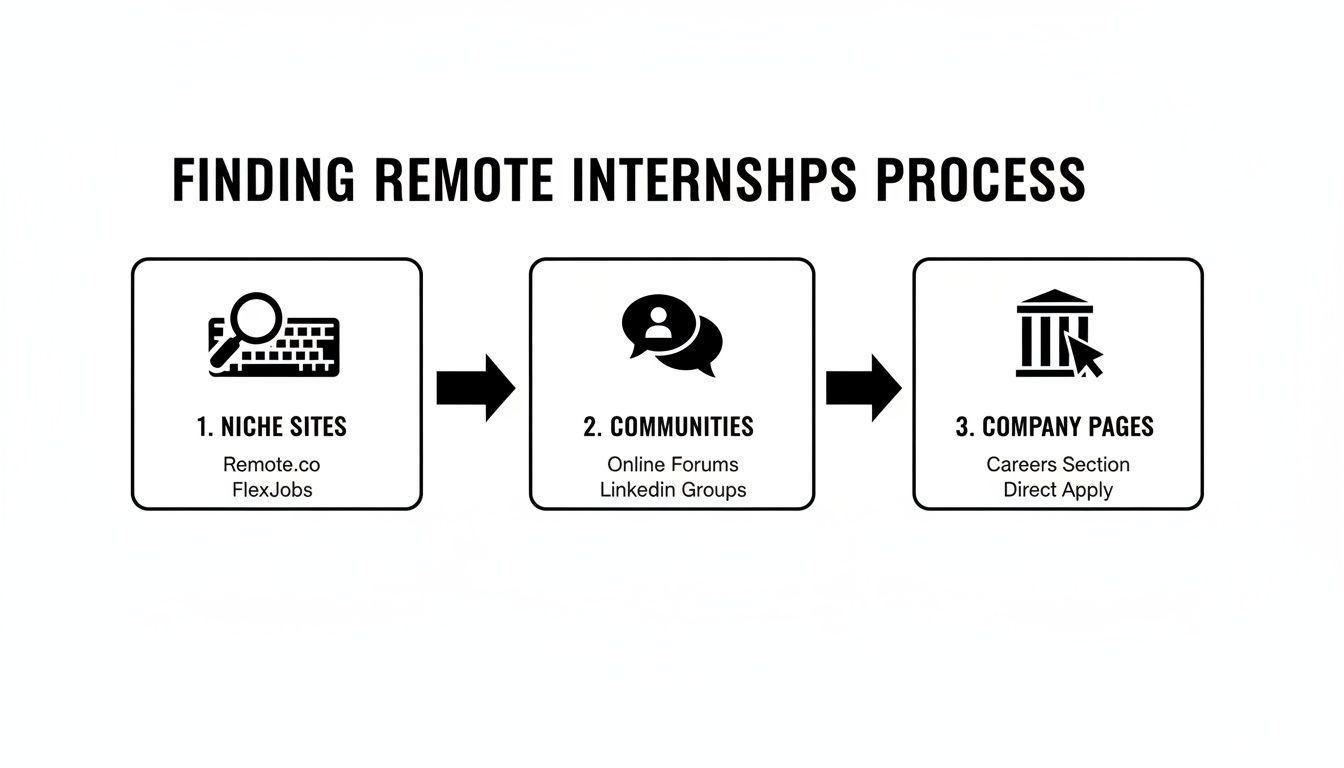
This process isn't just a random workflow. It's a strategy. By focusing on high-signal sources like niche communities and company career pages, you ensure your carefully crafted application gets seen by the right people.
Prove It With a Project Portfolio
Here's the single most important piece of advice: a project portfolio is non-negotiable, especially if you lack formal experience. A portfolio is your proof. It shows initiative, technical chops, and problem-solving skills—the three things every hiring manager is desperate to find.
Here are a few high-impact project ideas that will get you noticed:
Build a Home Lab: This is a classic for a reason. Set up a virtual network and document everything. Show how you configured a firewall, deployed an IDS like Snort, and used Wireshark to analyze traffic. Put your configs on GitHub and write a blog post explaining your setup and findings. This gives interviewers a concrete example of your skills.
Write a CTF Walkthrough: Don't just complete challenges on TryHackMe or HackTheBox. Pick one you found interesting and write a detailed, step-by-step walkthrough. Explain your thought process, the tools you used, and what you learned. This showcases your technical reasoning far better than any certificate.
Audit a Smart Contract: If you're eyeing Web3 security roles, this is a game-changer. Find an open-source smart contract, analyze it for common vulnerabilities (like reentrancy or integer overflows) using a tool like Slither, and document your findings. This is a rare skill, and demonstrating it makes you an incredibly attractive candidate.
Your portfolio is your evidence. It provides concrete proof of your abilities and gives you powerful talking points for your interviews. When you show, not just tell, you make it easy for a hiring manager to see you as a valuable part of their team.
Acing Your Technical and Behavioral Interviews
So your resume and portfolio got you noticed. Great. Now comes the real test: the interview. This is where you prove you’re more than just a list of skills on paper.
For a remote cyber security internship, the interview is a two-part challenge. You have to demonstrate your technical chops, of course, but you also have to prove you can think, communicate, and collaborate effectively from a distance. It's less about knowing every single answer and more about showing how you arrive at an answer.
Hiring managers want to see your problem-solving mind in action. In a remote role where they can't just walk over to your desk, seeing your thought process is everything.
The Technical Gauntlet
Don't think of the technical interview as a final exam. It's more like a collaborative problem-solving session where they want to see how you'd tackle the kind of challenges the team faces every day.
You can bet they'll throw some scenarios at you based on security fundamentals. Be ready to talk through:
- The OWASP Top 10: Don’t just list them. Be prepared to pick one, like SQL Injection or Cross-Site Scripting (XSS), and walk the interviewer through how you’d find it, exploit it, and recommend a fix. Get specific.
- Networking Fundamentals: How does DNS actually work? What's the practical difference between TCP and UDP? Walk me through the three-way handshake. These aren't just trivia; they are the bedrock of network security.
- Core Cryptography: You need to be able to clearly explain the difference between symmetric and asymmetric encryption and give a real-world example of when you'd use each.
The candidates who get offers are the ones who go beyond the simple answer. If asked about a firewall, a good candidate explains what it does. A great candidate explains the different types (like stateless vs. stateful) and, most importantly, discusses its role within a defense-in-depth security posture. That shows strategic thinking, not just memorization.
Showing that you’ve done more than just memorize definitions is what will make you stand out.
Mastering the Behavioral Side
On the other side of the coin are the behavioral questions. This is where they figure out who you are as a person and a future colleague. Are you curious? Do you take initiative? Can you work well with a team you only see on a screen?
Practice your stories for common prompts. They're trying to gauge your passion and work ethic.
- “How do you stay current with security trends?”: Be specific. Mention the podcasts you actually listen to (like Darknet Diaries), the security researchers you follow on Twitter, or the blogs you check every morning. This shows you're genuinely invested in the field, not just looking for a paycheck.
- “Describe a complex problem you’ve solved.”: This is the perfect time to bring your portfolio to life. Talk them through setting up your home lab or that tricky CTF challenge you finally cracked. Explain your thought process, where you got stuck, and how you figured it out. This demonstrates resilience and problem-solving.
Solid preparation makes a massive difference. Just look at the results from industry expert Josh Matakor—in 2025, his Cyber Project saw participants land new jobs every 4 days. What’s more, 50% of them came from non-cyber IT roles, proving that a strong narrative can bridge the experience gap. You can find excellent preparation tips on sites like Indeed.
Finally, don't forget to ask your own questions. This is your chance to interview them, too. Ask about the team's biggest challenges right now, their security tool stack, or what success looks like for an intern in the first 90 days. It shows you’re already thinking like a member of the team.
Turning Your Internship into a Full-Time Career

Landing one of the top remote cyber security internships is a huge win, but don’t stop there. The real prize is converting that temporary gig into a permanent, full-time role. Excelling in a remote internship demands a different kind of hustle than you’d need in an office.
Your manager can’t just see you grinding away at your desk. You have to make your work—and your value—impossible to miss. It all comes down to being intentional about how you communicate, contribute, and connect with the team.
The reward for getting this right is massive. When you transition from intern to full-time, salaries often jump into the $102k-$180k range annually. Companies are willing to pay a premium for defenders who have already proven their skills on the job. You can research salary expectations on sites like ZipRecruiter.
Be Seen and Be Proactive
When you’re remote, visibility is everything. You have to actively hunt for opportunities and make your progress known. Don't just wait for tasks to land in your lap. If you hit a lull, ping your mentor or manager and ask what’s next on the priority list or if there’s a backlog task you can pull.
Always look for a way to go the extra mile. If you're assigned to analyze logs, don’t just flag the suspicious activity. See if you can write a simple script to automate that detection next time. This shows you’re not just a task-doer; you’re a problem-solver, and that's exactly what security teams need to hire.
From a hiring manager's perspective, the interns who get offers are the ones who make my job easier. They document their work clearly, ask insightful questions, and volunteer for tasks that others might avoid. They behave like full-time employees from day one.
A simple but powerful habit is to keep a "brag document." Note down every project, every find, and every piece of positive feedback. This log becomes your evidence when it’s time to talk about your performance and future with the company.
Turn Initiative into Opportunity
Here’s a perfect example of what gets an intern a job offer. A security operations intern was given a routine task: review the latest vulnerability scan reports. Most people would just forward the critical findings and call it a day. But she didn't. She noticed a low-level, "informational" finding on a server that wasn't considered critical.
Instead of ignoring it, she got curious and started digging. She found that this tiny issue, when chained with another misconfiguration, could actually lead to unauthorized access. She documented everything, wrote up a proof-of-concept, and presented it to her manager.
The team was blown away. This intern hadn't just completed her task; she found a real risk no one else had seen. That one act showed more potential than weeks of just checking boxes. When a full-time spot opened up, she wasn't just a candidate—she was the only choice.
Build Your Internal Network
Finally, don't just put your head down and work. Use the internship to build genuine relationships that can lead to career-long allies and mentors. Set up 15-minute virtual coffees with people on your team and even in other departments. Ask them about their careers, what they're working on, and the biggest challenges they face.
These conversations are gold. They give you a map of the organization and help you become a familiar, respected face. It’s opportunities like these, such as this Security Engineer Intern role at Ripple, where taking initiative can really pay off and set you on a fast track.
Answering Your Top Questions About Remote Internships
When you're trying to land a remote cyber security internship, it's easy to get stuck wondering what skills you really need or how to get noticed without on-the-job experience.
Let's clear the air. Here is direct, actionable advice to help you build a winning strategy and impress hiring managers.
Do I Need a Degree for a Remote Cyber Security Internship?
This is a big one, and the short answer is: not necessarily. While a Computer Science degree can open doors, many of the most innovative companies care far more about what you can do than where you went to school.
For a hiring manager, proven ability is what truly matters.
Practical experience and relevant certifications often carry more weight than a degree. For instance:
- Certifications: Seeing a CompTIA Security+ or an eJPT on a resume tells a hiring manager you've already invested in building a solid foundation.
- Projects: A killer portfolio is your best friend. A well-documented home lab, write-ups from CTF competitions, or contributions to open-source security tools? That’s tangible proof you can handle the work and will be a valuable team member.
Your main goal is to make it incredibly easy for a recruiter to see your value. A strong portfolio can easily outshine a 4.0 GPA.
What Are the Most In-Demand Skills for Web3 Security Roles?
Breaking into Web3 and blockchain security requires a specific—and rare—skill set. To stand out to hiring managers in this niche, you have to dig deeper than general cybersecurity knowledge.
You'll need to focus your energy on a few core areas:
- Smart Contract Auditing: Getting comfortable analyzing smart contracts is non-negotiable, especially those written in Solidity.
- Blockchain Protocols: You need a solid grasp of how different blockchains actually function to spot their unique security flaws.
- Key Languages and Tools: If you’re fluent in languages like Rust or Go and have used auditing tools like Slither or Mythril, you’re going to jump to the top of the pile.
Specializing in Web3 security is a brilliant career move right now. When you can talk confidently about common DeFi exploits like flash loan attacks or reentrancy vulnerabilities in an interview, you’re signaling to employers that you’re ready to solve their biggest, most urgent problems.
How Can I Stand Out with No Professional Experience?
So you're starting from zero? No formal job experience on your resume? That's okay. Your job is to create your own experience. Initiative is the single most impressive trait you can show a hiring manager.
Don't wait for someone to give you a chance—build your own. And remember to document everything to create a story about your passion and drive.
Here are a few actionable ideas to build your resume:
- Build and Document: Set up a home lab to practice your network defense skills. Then, document your entire process and all your configurations on GitHub to create a project you can discuss in interviews.
- Hunt for Bugs: Sign up for a bug bounty platform like HackerOne. Even finding and reporting small, low-impact bugs proves you have the right mindset and adds real-world experience to your profile.
- Find Your Voice: Start a blog. Write about a security concept you just figured out or do a detailed write-up of a CTF you crushed. This demonstrates you can communicate complex ideas, which is absolutely critical for any remote employee.
Taking these steps shows you’re a self-starter who doesn't wait around. That’s exactly the kind of person any manager would be thrilled to have as an intern.
Ready to find your place in the fast-growing world of blockchain security? At Blockchain Jobs, we connect talented professionals like you with top opportunities in Web3, DeFi, and beyond. Explore curated roles and find your next career move at https://blockchain-jobs.com.