Your Guide to Becoming a Smart Contract Dev in 2026

If you're looking to become a smart contract developer, you're making a smart career bet. It’s one of the most direct paths to a high-impact, high-paying career in tech, with average salaries that often blow past what you see in traditional software roles. But this isn't a field you can just stumble into. It demands a specific set of skills centered on security, efficiency, and a gut-level understanding of how blockchains actually work.
This roadmap is designed to cut through the noise and show you what really matters to get hired and advance your career—moving you from the basics to being a candidate that gets the job offer.
Your Roadmap to a High-Demand Smart Contract Dev Career
Forget what you know about traditional tech hiring. In Web3, your resume or degree comes second. What truly matters is what you can build and, more importantly, what you can secure. The whole space is built on code that can’t be easily changed and often controls millions of dollars. Because of that, hiring managers are looking for proof—proof that you can write contracts that are both powerful and rock-solid.
Your journey starts with the fundamentals. You don't need a Ph.D. in cryptography, but you absolutely must get your head around concepts like decentralization, immutability, and the different ways networks agree on what's true (consensus mechanisms). In an interview, being able to articulate these concepts clearly shows you understand the 'why' behind the code, a key differentiator between a junior coder and a true engineer.
Mastering the Foundational Skills
For most aspiring developers, the journey begins with one language: Solidity. It’s the undisputed king of the Ethereum Virtual Machine (EVM), which powers the lion's share of decentralized apps and finance protocols across major chains like Ethereum, Polygon, and Avalanche. Your goal here isn't just to learn the syntax; it's to think in Solidity.
But don't stop there. A savvy career move is to get your hands dirty with Rust. With ecosystems like Solana and Polkadot gaining serious traction, knowing Rust shows you’re adaptable and thinking about career longevity. Imagine being in an interview and being able to clearly articulate the security differences between Solidity and Rust. That’s how you stand out from the pack.
Beyond the language, you have to truly understand the machine it runs on. For Solidity developers, that's the EVM. This isn't just theory; it directly impacts your value as a developer and what you'll be asked in interviews.
- Gas Optimization: Knowing how the EVM works under the hood is the key to writing code that doesn't cost a fortune to run. This is a skill every senior dev and hiring manager is desperate to find.
- Security: So many common hacks and exploits come from a simple misunderstanding of how the EVM behaves. Demonstrating this knowledge shows you're a low-risk hire.
- Debugging: When a contract goes sideways on-chain, a deep knowledge of the EVM is your single best tool for figuring out what went wrong. This is a critical day-to-day skill.
The fastest way to get hired is to focus on the why. Don’t just learn how to write a contract. Obsess over why it needs to be secure, why it must be gas-efficient, and why it has to be robust. Nailing these fundamentals is your ticket to passing technical interviews.
Understanding DeFi Primitives
To get a job building useful things, you need to understand the building blocks. In Web3, those building blocks are often called "money legos"—the core protocols of Decentralized Finance (DeFi). This is where the jobs are, and your career will depend on being able to work with these systems.
Before your first interview, make sure you can confidently explain these concepts:
- Automated Market Makers (AMMs): These are the engines that run decentralized exchanges like Uniswap. You need to understand how liquidity pools and constant product formulas create a market without traditional order books.
- Lending and Borrowing Protocols: Get familiar with how platforms like Aave or Compound use code to manage collateral, issue loans, and calculate interest rates.
- Staking and Yield Farming: Learn the mechanics of how users lock up assets to secure a network or provide liquidity, and how they earn rewards for doing so.
A candidate who can talk intelligently about the trade-offs in a new AMM design or the risks of a specific yield farm isn't just a coder—they're a potential product owner. It shows you understand the business, not just the syntax. That makes you exponentially more valuable and a better candidate for senior roles.
Mastering Your Smart Contract Developer Toolkit
Knowing the theory behind blockchain is one thing, but getting hired—and being effective on the job—is all about execution. Your real value as a smart contract developer comes from your ability to build, test, and deploy secure, functional contracts. In any job interview, you absolutely have to prove you can handle the modern developer toolkit.
This isn't about memorizing a few commands. It’s about understanding the why behind your tools so you can justify your choices to a hiring manager. You need to know which framework fits a specific project, how to rig up a local environment for rapid iteration, and how to bridge the gap between your on-chain logic and a user-facing app. These are the skills that separate a hobbyist from a professional hire.
For newcomers, the first major career decision is often where to focus. Do you stick with the massive, established EVM ecosystem or venture into the world of non-EVM chains?
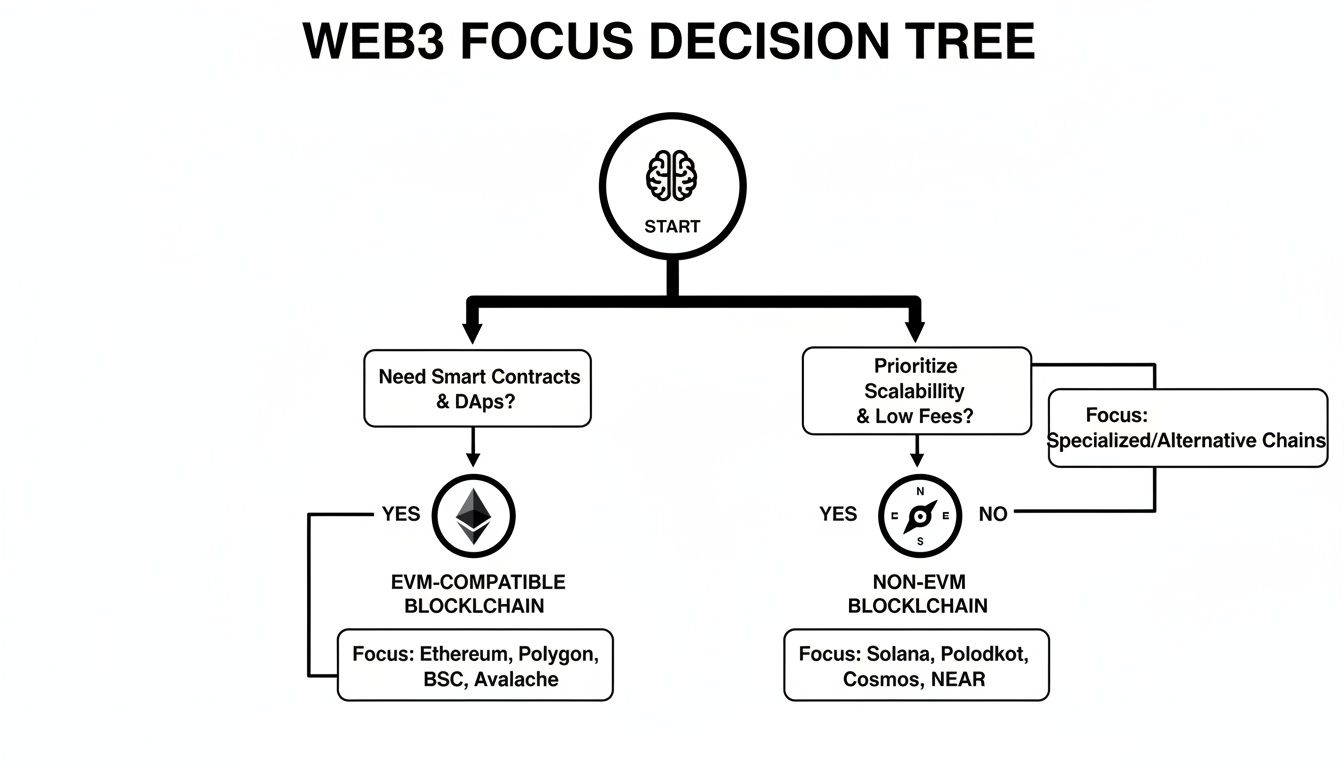
Your answer to that question will dictate the tools you need to master to be job-ready. By far, the EVM path has the most job openings and the most mature set of tools available today.
Choosing Your Development Framework
In the EVM world, the two heavyweights are Hardhat, which is based on JavaScript/TypeScript, and Foundry, which is Solidity-native. The one you choose will shape your entire workflow, from writing tests to deploying contracts. Hiring managers will expect you to have a strong, reasoned opinion on which one you prefer and why.
Hardhat has long been the industry go-to. Its JavaScript core makes it incredibly accessible for web developers transitioning into Web3.
- Strengths: It boasts a huge ecosystem of plugins, rock-solid documentation, and lets you write complex deployment scripts and tests in a language many are already comfortable with (JS/TS).
- Best For: Projects that require a lot of off-chain logic, teams with deep JavaScript expertise, or situations where you need to plug into a vast ecosystem of existing tools.
Foundry, the fast-growing challenger, flips the script entirely by letting you write your tests directly in Solidity. This is a game-changer for many developers.
- Strengths: Testing is blazing fast. You get to write tests in the same language as your contracts (which is more intuitive than you'd think), and powerful features like mainnet forking are baked right into its core toolkit,
forge. - Best For: Protocol-level development with heavy contract-to-contract interactions, performance-critical testing, and for teams who want to live entirely inside the Solidity ecosystem.
"When I'm interviewing candidates, I'm not just looking for someone who knows Solidity. I'm looking for a developer who understands their tools. Can you write a complex, multi-stage deployment script in Hardhat? Can you fork mainnet in Foundry to run a realistic simulation? That’s what tells me you’re a mid-level engineer, not a junior."
A classic interview question is: "You need to test an upgrade for a complex DeFi protocol. Which framework would you pick, and why?" A stellar answer would be to choose Foundry for its native mainnet forking, explaining that it lets you simulate the upgrade against real, live state with minimal fuss. This shows you can think practically about solving engineering problems.
Setting Up Your Local Blockchain
You simply can't build and iterate efficiently on a live testnet. The latency is a killer, and constantly begging for testnet ETH gets old fast. This is exactly why we use local development blockchains. Being proficient here is table stakes for any professional role.
A crowd favorite is Ganache. It fires up a personal Ethereum blockchain right on your machine, complete with 10 pre-funded accounts so you can start deploying and testing immediately. It comes in two flavors: a command-line interface and a clean desktop app that gives you a visual on your transactions, blocks, and events.
Tying Ganache into your Hardhat or Foundry setup is the key to a fast feedback loop. You can deploy contracts, run your test suite, and debug your code in seconds, not minutes. This speed is non-negotiable for professional productivity.
Interacting with Contracts From a Frontend
Of course, your smart contracts are only half the picture. For anyone to actually use your dApp, you need a way for them to interact with it through a web browser. This connection is handled by JavaScript libraries that talk to the blockchain.
- Ethers.js: A lean, complete library for interacting with the Ethereum ecosystem. It's widely loved for its simple API, fantastic documentation, and great TypeScript support.
- Web3.js: The OG library for this job, originally backed by the Ethereum Foundation. It can be a bit more verbose than Ethers.js, but its massive, long-standing user base means you can find a tutorial or forum post for almost any problem you run into.
As a smart contract developer, you're expected to know how these libraries work. You’ll be the one helping a frontend dev debug a tricky transaction or providing the ABI (Application Binary Interface) they need to call your contract's functions. Knowing these tools shows you can collaborate effectively within a team and see a project through to completion.
Your Portfolio: The Only Resume That Matters

Let’s be direct: in Web3, your GitHub profile is your resume. It's your technical interview and your proof-of-work, all in one place. A thoughtfully constructed portfolio is the single most compelling asset you can have when trying to land a serious smart contract dev role. It speaks volumes more about your actual skills than any certificate ever could.
Too many aspiring developers have portfolios filled with half-finished tutorial clones. A strong portfolio, on the other hand, tells a story of your career progression. It shows a clear learning path, demonstrating that you can do more than just follow instructions—you can solve real problems, think critically about security, and document your work like a seasoned pro. This is where you build the undeniable proof that you're ready for the job.
Crafting a Strategic Project Roadmap
The best portfolios I've seen all have one thing in common: they show a clear learning trajectory. Recruiters want to see that you didn’t just jump into the deep end. They want to see you master the fundamentals and then deliberately take on more complex challenges. This approach proves you have a solid foundation and aren't just copy-pasting code you don't fully grasp.
Think of your portfolio as a three-act story that showcases your growing expertise, mirroring the path from junior to mid-level developer.
First, Build a Custom ERC-20 Token: This is the quintessential starting point. Building your own fungible token using a trusted standard like OpenZeppelin is the "Hello, World!" of smart contracts. But don't just deploy a generic token. Go further. Try implementing a
burnfunction with custom rules, add apausablemechanism for emergencies, or integrate snapshot capabilities for governance. These additions show an interviewer you can think beyond the template.Next, Create a Dynamic NFT Minting dApp: This project proves you can connect the dots and build a full-stack application. It requires on-chain logic and a frontend, demonstrating you understand how real people will interact with your contracts. To really make it shine, build in dynamic features. Instead of a flat price, maybe the minting fee increases as the supply dwindles. Or you could build a presale whitelist. This shows you can handle genuine application logic and are ready for feature-level work.
Finally, Tackle a Core DeFi Protocol: This is your capstone. It’s the project that signals to employers you’re ready to work on high-stakes financial applications. Pick a DeFi primitive—like a staking contract or a simple lending market—and build a simplified but fully functional version. A great idea is a staking contract where users can deposit the ERC-20 token you made in your first project to earn rewards. This is a powerful signal that you understand the core financial mechanics of Web3 and are ready for a mid-level role.
"I’ve reviewed hundreds of portfolios. The ones that stand out aren’t just copies of popular tutorials. They're the ones where the developer took a tutorial, then added three unique features and clearly explained their decisions in the README. That’s what shows me they can think independently and are worth interviewing."
Documentation That Gets You Noticed
Writing clean code is only half the job. If a hiring manager can't figure out what your project does or how to run it, they're not going to waste their time. Your documentation is your first—and sometimes only—chance to make a good impression.
Every single project on your GitHub needs a fantastic README.md. It should be clean, clear, and professional.
Make sure your README includes:
- A Clear Project Description: What does it do? What problem did you set out to solve?
- Technologies Used: List the frameworks (Hardhat, Foundry), libraries (ethers.js), and languages (Solidity, TypeScript) you used.
- Running the Project: Give dead-simple, copy-paste instructions for setup, compiling, testing, and deploying.
- Architectural Decisions: This is your chance to shine. Briefly explain why you made certain design choices. Why did you use the Checks-Effects-Interactions pattern? Why did you opt for a particular access control model? This is where you prove you think like an engineer, not just a coder.
This level of detail shows you’re a professional with strong communication skills—a massive plus for any hiring manager. As you build, it’s a great idea to look at real job descriptions, like this Senior Smart Contract Engineer position at Uniswap Labs, to align your projects with what top teams are actually looking for.
Putting Security and Efficiency Front and Center
Ultimately, your portfolio needs to communicate one thing above all else: you are obsessed with security. Every company's biggest fear is hiring a developer whose code leads to a multi-million dollar hack. You have to proactively prove you're not that person.
Weave security best practices into every project. Use a "Security Considerations" section in your README to highlight how you've mitigated common risks like reentrancy or integer overflows.
Don't forget about gas efficiency, either. Show you understand the financial implications of your code. Add comments explaining why you chose calldata over memory for a function parameter or how a specific data structure was selected to minimize gas costs. This level of detail shows a maturity that separates junior candidates from serious contenders. It proves you’re not just a coder—you’re an engineer who’s ready for the responsibility of a full-time role.
Embracing a Security-First Mindset
In traditional software development, a bug is an inconvenience. In the world of smart contracts, a bug can be a multi-million dollar catastrophe. Because blockchains are immutable, once you deploy code that handles real money, there's often no "undo" button. This reality makes security and testing the most critical skills for any serious smart contract developer.
It’s not just about writing code that works. It’s about writing code that can defend itself against clever and highly motivated attackers. When you walk into an interview, the ability to talk confidently about security principles instantly separates you from the crowd. It tells a hiring manager you understand the stakes and are a low-risk, high-value hire.

Writing Secure Solidity Code
Your code itself is the first line of defense. You absolutely must adopt secure coding patterns from day one. Many of the most infamous hacks—costing projects billions in total—exploited a handful of well-known vulnerabilities that were entirely preventable.
If you want to pass a technical interview, you need to master these concepts:
Preventing Reentrancy: This is the classic Solidity exploit. You have to understand and religiously use the Checks-Effects-Interactions pattern. A great interview answer would also mention using a Reentrancy Guard modifier from a library like OpenZeppelin as a second layer of defense.
Handling Integer Overflows/Underflows: Since Solidity 0.8.0, the compiler handles this automatically. But any senior interviewer will expect you to know why this was such a massive problem before. Be ready to explain how libraries like
SafeMathwere the standard solution in older codebases. This shows historical context and depth of knowledge.Implementing Proper Access Control: Not every function should be public. Using patterns like
Ownableto restrict sensitive functions is fundamental. To really impress, go a step further and discuss the tradeoffs ofOwnableversus a more flexible multi-signature wallet or a role-based system for decentralized projects. This demonstrates architectural thinking.
"I can teach a developer a new coding pattern, but I can't easily teach them a security mindset. Candidates who talk about testing, potential exploits, and gas optimization from the start always get moved to the top of my list."
Building a Bulletproof Testing Suite
If you say your code is secure, you have to prove it. A comprehensive test suite is your proof. For a professional smart contract dev, testing isn't an optional step you do at the end; it's woven into the entire development process. This is a non-negotiable skill for getting hired.
You'll get familiar with libraries like Chai for writing assertions and Mocha for structuring your tests. Your goal is to build a "testing pyramid" that covers your contract's logic from every possible angle, something you can show off in your portfolio.
The Three Layers of Smart Contract Testing
An effective testing strategy needs multiple layers. Each one serves a different purpose in catching bugs before they ever touch a mainnet.
- Unit Tests: This is your foundation. Each test focuses on a single function in isolation. For instance, you’d write a test to make sure a
transferfunction correctly updates the balances of both the sender and the receiver. You'd also test edge cases, like what happens when a user tries to transfer more tokens than they own. - Integration Tests: Here, you test how multiple contracts work together. If you have a staking contract that needs to interact with an ERC-20 token, an integration test would simulate the entire flow: approving the token spend, calling the stake function, and then verifying the reward calculation. This is where a lot of unexpected behavior is discovered.
- Fork Testing: This is an incredibly powerful technique that really impresses hiring managers. Using a tool like Foundry or Hardhat's mainnet forking, you can run your tests against the actual, live state of the Ethereum mainnet. This lets you see exactly how your new protocol will interact with major existing protocols like Uniswap or Aave in a realistic, completely risk-free sandbox. Mentioning this in an interview shows you're ready for professional-grade development.
Using Professional Security Tools
Before you ever submit code for a professional audit, you should run it through the same automated tools the auditors use. It shows professionalism and initiative. It also proves you respect the auditor's time by catching all the low-hanging fruit yourself.
Two essential tools to add to your workflow are:
- Slither: A static analysis tool that scans your Solidity code for a long list of known vulnerabilities.
- Mythril: A symbolic execution tool that hunts for security issues directly in the EVM bytecode.
Mentioning that you integrate these tools into your CI/CD pipeline is a massive green flag in an interview. It shows you have a mature, security-first approach. If this side of the ecosystem really sparks your interest, you could even explore roles like this Smart Contract Auditor position at Nethermind, which are built entirely around this critical discipline.
How to Land Your First Smart Contract Developer Job
So you've built a solid portfolio and adopted a security-first mindset. That's a huge step. Now, let’s turn those hard-earned skills into a job offer.
The Web3 job market is a different beast entirely. It’s less about who you know or what your resume looks like and far more about what you can prove you can build. Your job search isn't a passive scroll through job listings; it's an active campaign to get your work in front of the right people.
Where the Real Opportunities Are
You can forget about casting a wide net on generic job boards. The best roles for a smart contract dev are found in crypto-native communities where the teams actually doing the hiring hang out.
Niche Job Boards: Sites like Web3 Career and CryptoJobsList are your first stop. They cut through the noise, connecting you directly with companies that live and breathe blockchain. You can start by exploring these blockchain engineering jobs to get a feel for what’s in demand.
X (formerly Twitter): "Crypto Twitter" is the industry's digital town square. Follow the builders, security researchers, and projects you admire. Jumping into technical discussions with thoughtful replies is one of the fastest ways to get noticed by founders and engineering leads.
Discord Communities: This is non-negotiable. You need to be in the Discord servers for major DeFi protocols (think Aave or Uniswap) and infrastructure projects (like Chainlink). But don't just lurk—participate in the #dev-talk channels, ask intelligent questions, and help others solve problems. That’s how you build a reputation and get on the radar of hiring managers.
Your on-chain activity and GitHub are your new resume. Hiring managers will often look at your Etherscan history and your public repositories before they even read your application. What you build in public matters more than any bullet point on a PDF.
The earning potential in this field is substantial, especially as demand continues to outpace the supply of qualified developers. Projections show strong salary growth across all major regions.
Smart Contract Dev Average Salaries by Region (2026 Projections)
The table below offers a glimpse into the projected average annual salaries for smart contract developers in key global markets, reflecting the high value placed on this specialized skill set.
| Region | Average Annual Salary (USD) | Typical Range (USD) |
|---|---|---|
| North America | $195,000 | $150,000 - $250,000+ |
| Western Europe | $160,000 | $120,000 - $210,000 |
| Asia-Pacific | $145,000 | $100,000 - $190,000 |
| Remote (Global) | $170,000 | $130,000 - $220,000 |
These figures underscore the incredible financial opportunities available to developers who can demonstrate a deep understanding of blockchain engineering and security.
Building a Resume for a Web3 World
Even though your GitHub is your real credential, you’ll still need a document to get past the initial HR filter. A Web3 resume is different, though. It should be a clean, one-page document that immediately points people to your proof of work.
Put your GitHub profile and portfolio website right at the top—even before your name. When describing your experience, skip the vague duties and focus on tangible, project-based achievements.
For example, don't just say this:
- Weak: "Wrote smart contracts for a DeFi project."
Instead, show your impact like this:
- Strong: "Architected and deployed a staking protocol in Solidity, implementing a reentrancy guard and achieving a 20% reduction in gas costs for key functions through optimized data structures."
This shows you're not just a coder; you're an engineer who thinks about security, efficiency, and business value. It's the language that gets you interviews.
Acing the Smart Contract Interview Gauntlet
Be prepared—the interview process for a smart contract role is intense. It’s designed to test your practical skills and your ability to think under pressure. Most companies follow a similar multi-stage format.
First, you'll likely have a technical screen with a senior engineer. This is to vet your fundamentals. Expect deep-dive questions on the EVM, common exploits like reentrancy, the Checks-Effects-Interactions pattern, and the differences between storage, memory, and calldata.
Next up is often a take-home assignment. This is your time to shine. Don’t just build something that works; deliver a professional-grade project. That means a thorough test suite (aim for near 100% coverage), a crystal-clear README, and code comments that explain your security decisions. This is a direct simulation of your on-the-job performance.
Then comes the part everyone dreads: the live coding challenge. The real secret here isn't just getting the right answer, but clearly communicating your thought process. Talk through your approach, consider edge cases out loud, and discuss potential security flaws. Showing how you think is often more important than the final code.
Finally, for more senior positions, expect a system design discussion. You might get a prompt like, "Walk me through how you'd design a simple decentralized exchange from scratch." This tests your ability to think holistically about protocol architecture, from contract interactions and oracles to gas efficiency and major security trade-offs.
Common Questions on the Path to Becoming a Smart Contract Dev
Alright, so you're diving into the world of smart contracts. It’s natural to have questions pop up as you get deeper—everyone does. Let's tackle some of the most common ones I hear from developers breaking into the space, with real-world answers focused on career impact.
Do I Need a Computer Science Degree?
Short answer? No. In the Web3 world, what you can build and secure matters far more than a piece of paper.
Hiring managers aren't looking for a specific university on your resume; they're looking for proof you can write clean, secure, and well-tested code. Your GitHub profile is your new diploma. A portfolio filled with thoughtful projects that showcase your understanding of security patterns and gas optimization will open more doors than any traditional credential. Focus on building things that prove you know your stuff.
What Is the Typical Career Progression?
The career ladder for a smart contract developer is steep but incredibly rewarding. You’ll find your responsibilities grow quickly as you gain experience and trust.
- Junior Smart Contract Developer (0-2 years): Your world will revolve around writing and testing specific contracts, usually under the wing of a senior dev. You'll be focused on learning the existing codebase, shipping smaller features, and absorbing every security best practice you can. Your goal is to become a reliable contributor.
- Mid-Level Developer (2-4 years): This is where you start to take ownership. You'll tackle more complex features, weigh in on architectural decisions, and be responsible for entire components of a protocol. You’ll also start mentoring the next wave of junior devs, a key step towards seniority.
- Senior Smart Contract Developer (5+ years): At this stage, you’re leading the charge. You'll guide protocol design from the ground up, make critical architectural calls, and often specialize in deep, complex areas like advanced security audits, novel gas-saving techniques, or Layer 2 architecture. From here, you might move into a Protocol Architect or Head of Smart Contracts role.
Besides Solidity, What Other Skills Will Make Me Stand Out?
While Solidity is your bread and butter, a few other skills will make you a much stronger and more versatile candidate, opening up more career paths.
First, get familiar with Rust. You don't need to be an expert, but even a basic grasp of the language powering ecosystems like Solana and Polkadot shows you’re adaptable and curious about the future of the space.
Second, build some real backend skills using a language like Node.js or Go. Almost every dApp needs off-chain services, APIs, and monitoring. Being the person who can build that infrastructure makes you a far more complete and valuable engineer, capable of working across the full stack.
The real game-changer is understanding the why behind the code. A deep knowledge of tokenomics, DeFi mechanics, and governance models allows you to contribute to a protocol's fundamental design, not just its implementation. That's how you go from being a coder to a leader.
How Important Is Gas Optimization for a Junior Developer?
It’s hugely important. No one expects you to be a world-class expert on day one, but showing you’re conscious of gas costs is a massive green flag for any hiring manager.
If you can walk through an interview and intelligently discuss the gas implications of using a mapping versus an array, or when to use calldata instead of memory, you immediately stand out. It proves you have a deeper level of understanding than most other junior candidates. Start building gas-conscious habits from your very first "Hello, World!" contract to make it second nature.
Ready to turn your skills into a career? Blockchain Jobs is the premier platform for finding your next role in the Web3 space. Explore hundreds of curated opportunities from top companies and connect with teams building the future of decentralized technology. Find your dream job today.