
Your Career Guide to Web 3 Marketing

At its heart, Web3 marketing is a massive departure from the old "broadcast and hope for the best" model. We're moving away from simply shouting a message at an audience and into the world of building active, engaged communities. To land a job in this space, you need to prove you understand this shift.
The key difference? It's all about empowering users by giving them a real, tangible stake in a project's success through things like ownership, community governance, and token-based incentives.
What Is Web3 Marketing and Why It Matters for Your Career
Think of your Web2 marketing experience like renting an apartment. Sure, you can decorate it and make it your own, but you’re ultimately playing by the landlord's rules. You’re building value for platforms like Facebook or Google, not for your users or even for yourself in a lasting way.
Web3 marketing, on the other hand, is like owning a home in a homeowners' association. You have a direct say in how things are run, a financial stake in the property's rising value, and you get to co-create the entire neighborhood alongside your fellow residents.
This shift from "renting audiences" to "building with owners" is exactly what forward-thinking hiring managers are looking for. They aren't just filling a "marketer" slot; they need community architects and ecosystem builders. The game is no longer about juicing clicks and impressions on a centralized platform. Instead, the real goal is to cultivate a vibrant, self-sustaining community where users are genuine participants and advocates, not just passive consumers.
The Career Mindset Shift
If you're gunning for a role like a Senior Marketing Manager in the blockchain world, truly getting this distinction is non-negotiable. Your resume, your portfolio, and especially your interview answers need to show you understand this new way of thinking.
- From Campaigns to Contributions: Your focus shifts from executing short-term campaigns to nurturing an environment of continuous community contribution. Can you show examples of this on your resume?
- From Audiences to Owners: You stop marketing to people and start building with people who have a vested interest in seeing the project succeed. How would you explain this in a job interview?
- From Trust Signals to Trustless Systems: Brand reputation still matters, of course. But the real foundation of trust in Web3 is built on verifiable, on-chain actions and transparent code. Your ability to articulate this is a key differentiator.
The modern Web3 marketer's primary job is to perfectly align the project's incentives with the community's incentives. Success isn't just about user growth; it's measured by the collective health, engagement, and active participation of the entire ecosystem. Frame your past experience in these terms to catch a recruiter's eye.
This evolution isn't some far-off future trend; it's happening right now, and fast. The Web3 market is exploding, with projections showing it growing from USD 3.47 billion in 2025 to a staggering USD 29.97 billion by 2031. That's a compound annual growth rate of 43.21%. For a deeper dive, you can explore the Web3 market's growth trajectory on Mordor Intelligence.
Getting a handle on this new approach isn't just about keeping your skills fresh. It’s about placing yourself at the very center of one of the fastest-growing industries on the planet.
To really nail down how different this world is, let's break down the key career differences between the old playbook and the new one.
Web 2 vs Web 3 Marketing: A Career Perspective
This table highlights the fundamental changes in strategy, mindset, and skills that anyone looking to transition into a Web3 marketing career needs to understand. Use it to audit your own skills and prepare your interview talking points.
| Aspect | Web 2 Marketing (The Old Playbook) | Web 3 Marketing (The New Career Path) |
|---|---|---|
| Primary Goal | Drive traffic, leads, and sales through centralized platforms. | Build a decentralized, self-sustaining community and ecosystem. |
| Audience Relationship | Transactional: The audience is a target for ads and content. | Collaborative: The community members are co-creators and stakeholders. |
| Key Channels | SEO, PPC (Google/Facebook Ads), Social Media Marketing, Email. | Community platforms (Discord/Telegram), DAOs, Tokenomics, Influencer/KOLs. |
| Core Skillset | Platform-specific ad management, content creation for mass appeal, A/B testing. | Community management, incentive design, understanding token mechanics, DAO governance. |
| Measurement (KPIs) | Clicks, Impressions, Conversion Rate, Customer Acquisition Cost (CAC). | Active wallet addresses, DAO participation, token holder growth, on-chain activity. |
| Trust Mechanism | Brand reputation, reviews, social proof, influencer endorsements. | Code transparency, on-chain data, smart contract audits, decentralized governance. |
Understanding these distinctions is the first step. The next is learning how to apply them and demonstrate that you can think like a native Web3 builder, not just a marketer renting space in someone else's ecosystem.
Mastering the Core Channels of Web3 Marketing
If you're looking to jump into Web3 marketing, you'll quickly find it’s a whole new ballgame. This isn't just about giving your resume a quick polish; it's about learning a completely different set of channels. In Web2, your world revolves around optimizing Google Ads and mastering SEO. In Web3, success is built on something far more tangible: genuine community, open communication, and shared ownership.
This is the fundamental shift hiring managers are looking for. They want people who get that we've moved on from renting audiences on platforms like Facebook and Instagram to actually owning the relationship and building value with the community.
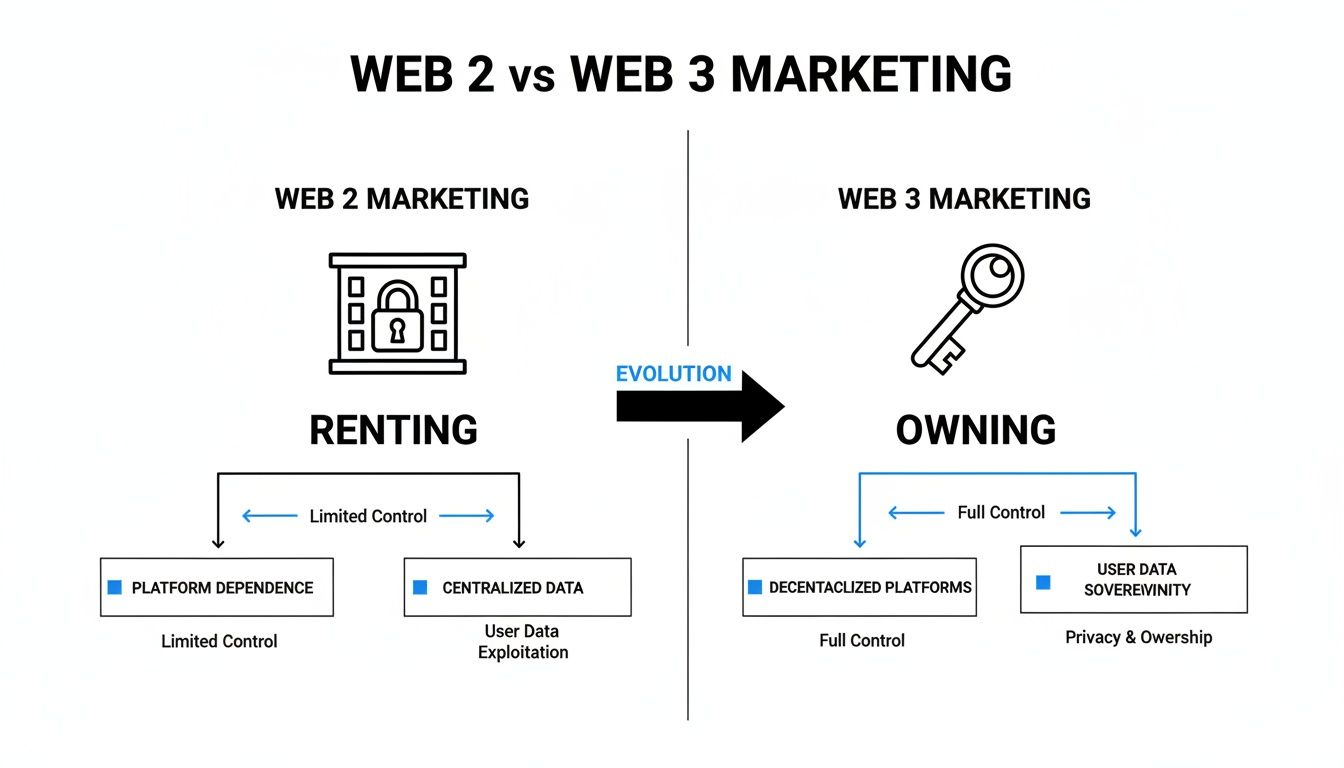
Think of it this way: Web2 marketing is like being a tenant in a building you can't change. Web3 hands you the blueprints and the keys. For marketers, this means your job is less about shouting for attention and more about creating an ecosystem where people genuinely want to hang out and contribute.
Let's break down the channels where this all happens and the skills that will actually get you hired.
Community: The Digital Town Square
In Web3, a project's Discord or Telegram server isn't just a help desk—it's the town square. It’s the heart of the project, where the culture is built, big ideas are debated, and true loyalty is earned. That's why a great community manager is often one of the first and most important hires for any team in this space.
Hirable Skills to Highlight:
- Active Moderation and Engagement: Show you can keep conversations healthy and productive while shutting down the inevitable spam and FUD (fear, uncertainty, and doubt). Use STAR method (Situation, Task, Action, Result) in interviews to demonstrate this.
- Event Coordination: Have you organized AMAs (Ask Me Anything sessions), community calls, or workshops? This is gold. It proves you can keep people plugged in and should be a bullet point on your resume.
- Feedback Synthesis: You need to be the bridge between the community and the core team. The ability to collect, analyze, and report what people are saying is a seriously valuable skill. Highlight your experience with tools for this.
When you can show a hiring manager you get this, you’re proving you understand that Web3 marketing is a dialogue, not a monologue.
DAOs and Governance: Driving Collective Action
Decentralized Autonomous Organizations (DAOs) are the next evolution of community. They give members actual skin in the game through formal voting power on a project's future. Marketing in a DAO-driven project isn't about traditional promotion; it's about education and empowerment.
Imagine this: in an interview, you're asked about growth. Instead of talking about click-through rates, you explain your strategy for boosting voter turnout on a critical governance proposal. That’s how you impress. It shows you know how to mobilize a community of owners, not just attract an audience of followers.
In a Web3 interview, your ability to explain how you would foster active DAO participation demonstrates a deep understanding of what truly drives long-term ecosystem health. It shows you think like a steward, not just a marketer.
Token Airdrops and Incentives: The Modern User Acquisition
Forget 10% off coupons. The go-to tools for user acquisition and loyalty in Web3 are airdrops and token incentives. An airdrop is essentially a giveaway of free tokens to early users or community members, instantly turning them from passive observers into active stakeholders.
But there's a right way and a wrong way to do it. A lazy airdrop just attracts mercenaries who dump the token and disappear. A well-designed one, however, can seed an entire community of passionate advocates. The data backs this up—currently, 46% of people plan to use at least one Web3 service, a huge jump from the 31% who are active today. This growth is being driven by smart incentives, just look at the 86% surge in daily active wallets for gaming DApps in 2022. You can dig into more of this data by exploring the latest Web3 usage statistics.
Career-Defining Airdrop Skills:
- Sybil Resistance: You need to know how to design mechanisms that stop one person from creating a thousand wallets to game the system. Mentioning this concept in an interview shows technical depth.
- Targeted Distribution: The best airdrops identify and reward specific on-chain behaviors that signal a user is here for the long haul. Can you give an example of this?
- Incentive Alignment: Can you structure rewards that encourage the right actions, like providing liquidity or, you guessed it, participating in governance? This is a key interview question.
Having a solid grasp of token mechanics is a massive advantage. It shows you can use the unique economic levers of the blockchain to build a real, engaged user base. This kind of expertise is exactly what's needed for roles like the Performance Marketing Manager in emerging media at Kraken.
What It Takes to Get Hired in Web3 Marketing
If you want to land a great role in Web3 marketing, a casual interest in crypto won’t cut it. You need a unique mix of technical chops and community-building instincts that truly sets you apart. This is your guide to building a profile that hiring managers can’t ignore, turning abstract ideas into the concrete skills they look for on a resume.

The real challenge for anyone breaking into this field is proving you can thrive in a world built on decentralization and transparency. It's your ability to blend hard and soft skills that will show you’re a genuine builder, not just a tourist. Let’s get into exactly what you need to focus on.
The Hard Skills Recruiters Actually Look For
These are the tangible, teachable skills that underpin any solid Web3 marketing strategy. When you can speak fluently about these topics in an interview, it proves you've gone deeper than just reading headlines. You get how the machine works.
- Understanding Tokenomics: You don't have to be a trained economist, but you absolutely need to grasp how a project's token functions. This means knowing its utility (what can you do with it?), its supply mechanics (is it inflationary or deflationary?), and how it's distributed over time. Can you explain how those levers create incentives that shape user behavior? This is a common interview question.
- On-Chain Analytics: This skill is a massive advantage. Recruiters are looking for marketers who can pull real data directly from the blockchain to prove their campaigns are working. Getting comfortable with tools like Dune Analytics or Nansen to track metrics like daily active wallets, token holder growth, and smart contract interactions will put you leagues ahead. List these tools on your resume.
- Smart Contract Basics: No one expects you to code, but you must know what smart contracts are and what they enable. Being able to explain how they automate processes, manage governance votes, or execute a token airdrop shows you understand the foundational technology.
"The most valuable marketers in Web3 are data-driven storytellers. They can look at a Dune dashboard, find a compelling insight about user behavior, and then translate that into a narrative that energizes the community." Use this framework to describe your past successes in an interview.
Nailing these points turns a generic marketing interview into a high-value conversation about how you can directly contribute to an ecosystem's growth.
The Soft Skills That Seal the Deal
In a world where community is everything, your soft skills are often even more important than your technical knowledge. These are the interpersonal abilities that show you can build and nurture the human side of a decentralized network. They’re frequently the tie-breaker in hiring decisions.
Take a look at job postings, like this one for a Web3 Marketing Manager at Metisio, and you'll see just how often these skills are listed as top requirements.
Essential Soft Skills to Highlight:
- Deep Community Empathy: This is about genuinely understanding the motivations, fears, and culture of your community. It’s about listening more than you talk and being a real advocate for your users, not just a corporate mouthpiece. Prepare examples of how you've done this.
- Radical Transparency: Web3 was built on an ethos of openness. When things go wrong—a bug is discovered, a launch is delayed, the market tanks—your ability to communicate clearly, honestly, and quickly is everything. Hiding bad news is the fastest way to lose trust. A great interview answer would involve a time you handled a crisis with transparency.
- Narrative Crafting: The best projects are built on a powerful story. Your job is to create a compelling narrative around the project's vision. This isn't just about writing good copy; it's about forging a shared belief system that turns casual users into passionate evangelists. Link to your writing portfolio from your resume.
At the end of the day, a successful career in Web3 marketing comes down to merging these two skill sets. You need the hard skills to understand what is happening on-chain and the soft skills to explain why it matters to your community. Developing this dual expertise is the surest path to becoming indispensable.
In-Demand Web 3 Marketing Roles and Key Responsibilities
As the Web 3 marketing landscape matures, specialized roles are becoming more common. The table below breaks down some of the most in-demand positions, their core duties, and the skills you'll need to land them. This can help you see where your own experience fits and what skills you might need to develop.
| Job Role | Primary Responsibility | Must-Have Skills |
|---|---|---|
| Community Manager | Nurturing and engaging the project's community on platforms like Discord and Telegram. | Empathy, communication, conflict resolution, content creation, event moderation. |
| Growth Marketer | Designing and executing campaigns to acquire and retain users, often through airdrops, quests, and incentive programs. | On-chain analytics, tokenomics, A/B testing, user journey mapping, SQL (for Dune). |
| Content Marketer | Creating educational and engaging content (articles, videos, threads) that explains the project's value proposition. | Storytelling, technical writing, SEO, video production, understanding complex concepts. |
| Developer Relations (DevRel) | Building relationships with developers to encourage them to build on the project's ecosystem. | Technical understanding, public speaking, documentation writing, empathy for developers. |
| Product Marketing Manager | Acting as the bridge between the product/dev team and the community to craft messaging and go-to-market strategies. | Project management, narrative crafting, user research, competitive analysis. |
Understanding these roles is the first step toward positioning yourself effectively in the job market. Whether you're a community-first people person or a data-obsessed growth hacker, there's a place for you in Web 3.
How to Measure Success and Prove Your Value in an Interview
If you've been in a Web2 marketing interview, you've probably talked about Cost Per Click (CPC) or Customer Acquisition Cost (CAC). But walk into a Web3 interview, and the conversation completely changes. When a founder asks, "How will you measure the ROI of your campaigns?" they're not looking for vanity metrics like impressions or follower counts. They want to know if you can prove your work is making the entire ecosystem stronger.
This is a huge sticking point for a lot of companies. In fact, 62% of Fortune 500 executives say that unclear ROI is the single biggest barrier holding them back from adopting Web3—a much bigger concern than regulations or even low user interest. You can read more about these executive insights by checking out the latest Web3 statistics.
Learning to speak this language of on-chain value is how you cut through the noise, prove you can deliver real results, and land a senior role.
Shifting from Vanity Metrics to On-Chain KPIs
The fundamental difference in Web3 is that value can be tracked directly on the blockchain. Instead of guessing with proxy metrics from a platform like Facebook or Google, you can point to hard, verifiable data that shows actual user engagement and economic activity. The blockchain is your new source of truth.
In an interview, if you can frame your experience around these kinds of KPIs, you immediately show that you think like an ecosystem builder, not just a marketer.
- Daily Active Wallets (DAW): Think of this as the Web3 version of daily active users. It counts the number of unique wallet addresses that interact with your project's smart contracts each day. A high and steady DAW is a clear sign of a healthy, engaged user base. Be prepared to discuss strategies to increase this number.
- Token Holder Growth: This is as straightforward as it gets. Tracking the number of unique wallets holding your project's token directly measures how much your community is growing. A steady climb shows your marketing is bringing in new people who believe in where the project is headed.
- On-Chain Retention: This metric tells you how many wallets that were active last month (or last week) are still active today. High retention is the ultimate proof that your project has real utility and isn't just a flash in the pan. Discussing retention strategies shows you think long-term.
In Web3, success isn't just about getting people through the door. It's about proving they're actively participating in the economy you're building, and the blockchain provides the undeniable evidence.
Proving Ecosystem Health and Justifying Your Strategy
Beyond just user activity, senior hiring managers want to know that you get the bigger picture—the financial health and governance of the ecosystem. This is where you connect what you do in marketing directly to the project's core goals. The conversation shifts from "generating awareness" to "creating tangible value."
When you're in an interview, bring up these more advanced metrics to explain how your strategies would strengthen the project's foundation.
Key Metrics for Strategic Conversations:
- Total Value Locked (TVL): This is a huge one for DeFi projects. TVL is the total value of all the assets people have staked or locked in your protocol. When TVL grows, it’s a powerful signal of trust and market confidence—something that good marketing can directly influence by attracting new capital.
- Governance Participation: This tracks the percentage of token holders who are actually voting on proposals. High participation means you’ve built a community that truly cares about the project's future, which is a major win for any Web3 marketer.
- Cost Per Wallet (CPW): This is quickly becoming the new standard for measuring acquisition costs. It calculates exactly how much it costs to get a new, active wallet into your ecosystem. Talking about how you'd work to lower the CPW shows you have a sophisticated, data-driven mindset.
When you focus on these on-chain KPIs, you’re no longer making subjective claims; you’re dealing in verifiable proof. This ability to articulate and influence the numbers that founders and investors obsess over is what separates a good candidate from a great one.
Web3 Marketing Success Stories to Discuss in Interviews
Knowing the theory is one thing, but being able to talk through real-world examples is what separates a good candidate from a great one. When you’re in an interview, you need a handful of go-to success stories to show how you think strategically. These case studies prove you don’t just understand the concepts—you know how they actually drive results.
Let's break down a few legendary campaigns. You can use these to frame your answers and show you’ve got what it takes to build something meaningful in this space.

Uniswap: The Airdrop That Built an Army
You can't talk about Web3 marketing without mentioning Uniswap's retroactive UNI token airdrop. It's one of the most iconic moves in the industry. Instead of blowing millions on ads, Uniswap rewarded its earliest users by dropping 400 UNI tokens into their wallets, instantly making them owners and decision-makers in the protocol.
This wasn't just a freebie; it was a masterclass in aligning incentives.
Interview Talking Points:
- Rewarding True Users: The airdrop specifically targeted wallets that had already used the protocol. This move filtered out the speculators and rewarded the genuine early adopters who believed in the project from the start. How could you apply this principle to a new project?
- Decentralizing Governance: By distributing the token so widely, Uniswap bootstrapped one of the largest and most active DAOs overnight. It wasn't a marketing stunt—it was a foundational step toward true community ownership.
- Creating Evangelists: The people who received the airdrop became more than just users. They turned into vocal advocates and active participants, driven by a real sense of ownership and a financial stake in the project's success.
So, when a hiring manager asks how you’d launch a new protocol, referencing the Uniswap airdrop shows you get how to build a community from the ground up, not just buy traffic.
Bored Ape Yacht Club: Building a Culture Engine on Discord
The incredible rise of projects like the Bored Ape Yacht Club (BAYC) wasn't just about the art. It was about creating an exclusive, high-energy digital culture, with their Discord server as the epicenter. This community-first strategy is what turned a collection of JPEGs into a global brand.
The BAYC team understood a core Web3 principle: the community is the product. Their Discord wasn't a help desk; it was a 24/7 digital social club where owning the NFT was your membership card.
The real marketing genius of BAYC was realizing they weren't selling JPEGs. They were selling access to a community, a new identity, and a shared cultural movement. This mindset is critical for any Web 3 marketing role.
This approach created a tidal wave of organic demand. The fear of missing out (FOMO) wasn't about the potential to flip an NFT for profit; it was about the fear of being left out of the in-crowd. Use this example to discuss the power of community as a moat in an interview.
Axie Infinity: The Viral Growth Loop of Play-to-Earn
Axie Infinity basically wrote the playbook on the play-to-earn (P2E) model, building a powerful growth loop fueled entirely by token incentives. The game's success came from a simple but brilliant mechanic: players could earn real money, in the form of tokens, just by playing.
This economic hook turned every single player into a potential marketer. They had a direct, financial reason to bring their friends into the game, creating a viral coefficient that traditional marketing campaigns can only dream of. The success of gaming DApps proves this model's power. In 2022, they led adoption with 15 million daily active wallets, an 86% increase from the previous year. You can dig deeper into the explosive growth of Web3 gaming to find more stats like these.
In an interview, bringing up Axie Infinity shows you understand how tokenomics can be a powerful user acquisition tool. You can explain how aligning player incentives with the ecosystem's growth creates a self-sustaining marketing engine—which is the holy grail for any ambitious Web3 project.
How to Land Your First Web3 Marketing Job
Trying to break into Web3 marketing can sometimes feel like you're trying to get into a secret club. But here’s the good news: many of the skills you already have from Web2 are not just relevant—they're in high demand. It’s not about starting over. It’s about learning to speak a new language and applying your experience in a new context.
The key is to show you're not just a marketer; you're a participant. Hiring managers are looking for people who are genuinely curious about the space and aren't afraid to get their hands dirty.
Reframe Your Web2 Experience
Your background in traditional or digital marketing is your strongest asset. The trick is to translate your past accomplishments into the language and priorities of Web3. Think about how your skills map to a decentralized world, and be ready to explain that connection.
- Community Management: Did you manage a brand's social media accounts? Reframe that as building and nurturing a digital community. Talk about how you drove engagement, encouraged user-generated content, and served as the voice of the community.
- Brand Strategy: If you developed a brand's story or voice, that’s a huge plus. In Web3, this translates directly to crafting a narrative that creates a shared identity and turns users into true believers and advocates for the project.
- Performance Marketing: Ran ad campaigns on Google or Meta? Focus on your analytical skills. You can talk about applying that same data-driven thinking to on-chain metrics, optimizing for things like active wallet growth instead of just website clicks.
Build Your Web3 Portfolio
To really stand out, you have to show, not just tell. A portfolio with real, tangible contributions is your proof that you’re committed to the space. It gives hiring managers concrete evidence of what you can do.
In the Web3 job market, your on-chain activity and public contributions are often more valuable than a traditional resume. It’s a verifiable record of your engagement and expertise.
Here are a few practical ways you can start building that portfolio right now:
- Contribute to a DAO: Find a Decentralized Autonomous Organization that aligns with your interests and jump in. Start by joining their Discord, participating in governance discussions, voting on proposals, or even completing small paid tasks (bounties). This is priceless hands-on experience to discuss in an interview.
- Create Crypto-Focused Content: Start a blog, a newsletter, or even just a series of Twitter threads analyzing a Web3 project you find interesting. This proves you can understand complex ideas and explain them clearly, which is a massively valuable skill for any marketing team. Add this to your LinkedIn and resume.
- Get Active in the Conversation: Your digital footprint is your new resume. Engage in thoughtful discussions on platforms like X (Twitter) or Farcaster. Ask good questions, share your insights, and connect with people. You'd be surprised how many recruiters are paying attention.
By getting involved, you stop being just another applicant and become a recognized member of the community. This proactive approach doesn't just build your skills; it puts you on the radar for interesting roles, like this Junior Performance Marketer role at Everai. When you finally land that interview, you won't be just answering questions—you'll be sharing stories from your own journey into Web3.
Burning Questions Answered
Jumping into a new field like Web3 marketing always sparks a ton of questions. Let's tackle some of the most common ones I hear from people trying to break into the space.
Do I Actually Need to Know How to Code?
Short answer: definitely not. You don't need to be a developer to land a great marketing job in Web3.
What you do need is a solid grasp of the fundamentals—what a smart contract is, how a blockchain operates, and why decentralization matters. Think of yourself as a car salesperson. You don't need to know how to build the engine from scratch, but you absolutely need to understand how it works to sell the car effectively. Your job is to translate the technical magic into a compelling story, not to write the code itself.
How Do I Get Experience if I Don't Have a Web3 Job Yet?
This is the classic chicken-and-egg problem, but in Web3, it's surprisingly easy to solve. Forget polishing your resume for a moment. This space runs on a "show, don't tell" ethos.
You can start building a rock-solid portfolio of real-world experience right now, without a formal job title. Here's how:
- Jump into a DAO: Join a Decentralized Autonomous Organization that interests you. Start by participating in discussions, then vote on proposals, and maybe even pick up a few small tasks or bounties. It’s real work with real impact that you can list on your resume.
- Create your own content: Got a project you're fascinated by? Start a blog or an X (formerly Twitter) thread breaking down its marketing strategy or tokenomics. This proves you can think critically and communicate complex ideas clearly.
- Become a community legend: Find a project's Discord server and become a genuinely helpful, active member. Answering questions and welcoming new folks is community management in action, and everyone can see you doing it.
In Web3, your on-chain activity and public contributions are your new resume. A vibrant digital footprint, from your DAO votes to your content threads, often carries more weight than a traditional CV because it's verifiable proof of your skills and passion.
What Does a Web3 Marketing Career Path Even Look Like?
Forget the rigid corporate ladder. Career paths here are much more fluid and often look more like a jungle gym than a straight line up.
Many people get their start as a Community Manager or Content Creator. These roles are the perfect entry point because they put you right at the heart of the action.
Once you're in, you can pivot based on what you're good at and what you enjoy. If you love digging into data, you might move into a Growth Marketing role analyzing on-chain metrics. If you’re a master storyteller, you could aim for a Product Marketing Manager or Head of Content position. The name of the game is adaptability. Your career progression is defined by the skills you acquire and the value you prove, not by a title.
Ready to find your spot? Blockchain Jobs is the go-to job board for roles in the decentralized world. Start exploring our hand-picked listings to find your next Web3 marketing opportunity. Discover your next career move on blockchain-jobs.com.