Blockchain Technology Jobs: 2026 Career Guide
The demand for jobs in blockchain is exploding, and it's not just for coders. As everyone from finance to gaming starts to build on decentralized tech, a whole new world of roles in engineering, product, marketing, and legal is opening up. If you've been curious about Web3, this guide will give you the lay of the land and provide an actionable roadmap for your next career move.
The 2026 Blockchain Job Market Is Booming

If you're evaluating a career change, you need to know that the blockchain industry isn't a niche hobby anymore—it’s a serious source of high-paying jobs. The space has matured beyond the early hype and is now focused on building the real, functional infrastructure for the next version of the internet, often called Web3.
From a hiring perspective, this means companies need all kinds of talent to build, sell, and support these new systems. For anyone looking for a job, this is a clear signal of opportunity. It means your skills, whether technical or non-technical, are in high demand.
The numbers from 2025 paint a clear picture of this growth. To give you a quick snapshot, here are the key metrics that defined the market.
Key Blockchain Job Market Statistics for 2026
| Metric | Statistic (Based on 2025 Data) | Implication for Job Seekers |
|---|---|---|
| Total New Roles Created | 66,494 | The market is actively and aggressively hiring. |
| Year-Over-Year Growth | 47% increase from 2024 | The industry is expanding rapidly, signaling long-term stability and demand. |
| Technical vs. Non-Technical | >50% of roles were technical | While engineering is dominant, a huge number of non-technical roles exist. |
| Top Hiring Sectors | >70% of hires by exchanges & DeFi | Focus your search on financial and infrastructure-based companies. |
These statistics show an industry that's not just surviving; it's thriving and in constant need of new talent to sustain its momentum.
Why Is Demand Accelerating?
So, what's fueling this hiring frenzy? It’s not just abstract growth; it's driven by real-world applications that need skilled people to build and run them. It helps to think of it like the early days of the internet. Back then, companies needed web developers, sure, but they also desperately needed project managers, marketers, and lawyers to make it all work. The same exact thing is happening right now in blockchain.
A few key areas are leading the charge:
- Decentralized Finance (DeFi): This sector is essentially rebuilding financial services—like lending, borrowing, and trading—on the blockchain. To do this, companies need engineers who can write secure code, financial experts to design the economic models, and compliance officers to help them navigate complex regulations.
- Gaming and NFTs: Blockchain is changing gaming by allowing players to truly own their in-game items through Non-Fungible Tokens (NFTs). This has blown the doors open for game developers with crypto knowledge, digital artists, and community managers who can rally and support a player base.
- Enterprise Adoption: Big companies are now using blockchain for practical things like managing their supply chains, verifying identities, and sharing data securely. This has created a huge need for enterprise blockchain architects, consultants, and business development pros who can act as a bridge between the traditional corporate world and Web3 technology.
This expansion was reflected in the hiring numbers from 2025. The crypto job market bounced back in a big way, adding 66,494 new Web3 roles, which was a 47% jump from 2024. With technical positions making up over 50% of those openings and major players like exchanges and DeFi protocols scooping up over 70% of the new hires, it's clear the industry is building for the long haul.
From a career perspective, this growth means you can advance quickly. The industry is still young enough that a driven professional can make a real impact and move into a senior role much faster than in a more established field.
The most important takeaway for your job search is the sheer variety of roles available. You don't need to be a cryptography genius to find a place in Web3. The ecosystem needs communicators, organizers, strategists, and creatives just as much as it needs world-class engineers. For a deeper dive into specific career paths, check out some other articles on our blog. This guide will give you the context to see where you fit in and how to make a successful move.
Finding Your Place in the Web3 Ecosystem
When I talk to people about blockchain jobs, the first thing they picture is a developer, head down, buried in lines of complex code. And sure, that person definitely exists. But that's like thinking the only job in filmmaking is being the director—it completely misses the massive, collaborative world that exists just out of frame.
The idea that you have to be a coding prodigy to work in Web3 is probably the biggest myth I see holding talented people back. The truth is, the industry is starved for smart people from every background imaginable. Your experience in marketing, finance, design, or operations isn't just "transferable"; it's essential. The real trick is learning the language and understanding where your unique skills fit into this new digital economy.
To get a handle on it all, I find it helps to think of the roles in three main "families." It's a simple framework, but it's incredibly useful for figuring out where you belong and how to tell your story to a hiring manager.
The Builders: Laying the Technical Foundation
These are the architects and engineers, the people quite literally building the future of the internet. Their entire world revolves around creating, securing, and scaling the decentralized infrastructure that everything else runs on. If you're drawn to a Builder role, you want to be close to the metal, writing the code that has a direct and immediate impact.
- Blockchain/Protocol Engineers: Think of these folks as the civil engineers of Web3. They’re the ones designing and building the core highways, bridges, and tunnels—the blockchain itself—that all the traffic will run on.
- Smart Contract Developers: If protocol engineers build the highways, smart contract developers build the intelligent systems that run on them. They're like the architects designing the automated toll booths, secure building access systems, and traffic light grids—all with code that executes automatically and reliably.
- Smart Contract Auditors: This is Web3's elite security force. Before a project locks millions of dollars into a smart contract, these are the experts who are called in to break it. They are the bank vault inspectors, meticulously stress-testing every line of code for a potential vulnerability that could lead to a catastrophic hack.
For these roles, your resume is your GitHub. Hiring managers want to see proof of work—what you’ve built, your contributions to open-source projects, and maybe a few hackathon wins. The interview will be a deep technical gauntlet, testing not just what you know, but how you think through complex problems.
The Strategists: Charting the Course
Builders can construct a technical marvel, but the Strategists are the ones who make sure it's a marvel anyone actually wants to use. They are the visionaries, the product leads, and the user advocates who decide what to build, why to build it, and how it should feel. If you're coming from a traditional tech or product background, this is often the most natural entry point into Web3.
Strategists are the critical link between deeply technical concepts and real-world human needs. Their job is to tame the complexity and create something valuable, intuitive, and maybe even beautiful.
When you interview for a strategist role, your superpower is your ability to tell a compelling story. You need to articulate a product vision that perfectly balances what's technically possible, what users are desperate for, and what makes sense for the market. It’s about showing you can think big while navigating the very real constraints of Web3.
Key roles in this family include:
- Product Managers: They are the captains of the ship. It's their job to set the destination (the product roadmap) and make sure the engineering, design, and marketing crews are all rowing in sync to get there.
- UX/UI Designers: These are the people obsessed with making Web3 usable for the other 99% of the world. They design the interfaces and craft the user journeys that can take a confusing, decentralized process and make it feel as simple and intuitive as any app on your phone.
The Connectors: Building the Community
You can have the best code and the sharpest strategy, but without a community, you have nothing. This is where the Connectors shine. They are the evangelists, storytellers, and organizers who build and nurture the living, breathing human layer of Web3. If you excel at communication, building relationships, and making things happen, you'll feel right at home here.
Their mission is to attract users, spark conversations, and cultivate a culture that turns a project into a movement.
- Community Managers: This role is so much more than moderating a chat. A great Web3 community manager is like the mayor of a bustling digital city. They're on the ground floor, welcoming newcomers, facilitating debates, organizing events, and making the project’s Discord or Telegram the kind of place people genuinely want to hang out.
- Marketing Managers: Marketing in crypto is its own unique art form. Forget traditional ad buys. These pros know how to generate real excitement through "crypto-native" channels—mastering the meta on X (formerly Twitter), forging deep community partnerships, and understanding the intricate dance of tokenomics and narrative.
- Operations & Finance: These are the unsung heroes who keep the whole machine from falling apart. Whether it's managing the treasury for a DAO (Decentralized Autonomous Organization), navigating the legal complexities of a token launch, or handling HR for a remote-first team, they provide the stable foundation that allows a project to grow and thrive.
Once you identify which family—Builder, Strategist, or Connector—resonates with your background and passion, everything else gets easier. You can start tailoring your resume, focusing your job search, and walking into interviews ready to show not just that you're qualified for a job, but exactly where you fit in the ecosystem.
Understanding Your Earning and Growth Potential
Sure, the technology is exciting, but let’s talk about one of the biggest draws to a career in blockchain: the incredible potential for your bank account and your career path. This industry moves at lightning speed, and for the right people, so do the promotions and paychecks.
Let's get into what you can realistically expect and how to climb the ladder.
A Web3 salary isn't just a number on a bi-weekly check. While a strong base salary is always part of the deal, the total compensation often includes a few other powerful ingredients that tie your personal success directly to the project's growth.
- Base Salary: This is your steady, reliable income—the foundation of your pay.
- Equity: If you join an established, venture-backed company, you'll likely get stock options. Think of it as getting a small piece of the company you're helping to build.
- Token Incentives: This is where things get really interesting. Many projects, especially DAOs and new protocols, will pay you partly in their own native tokens. If the project takes off, the value of those tokens can skyrocket, making it a serious wealth-building opportunity.
This combination means your total take-home pay can often dwarf your base salary. It’s a powerful motivator to do great work because when the project wins, you win.
From Junior to Principal: A Clear Career Ladder
In blockchain, you don't have to wait a decade to get a promotion. If you're skilled and you show up with initiative, you can move up the ranks surprisingly fast. Forget the rigid corporate hierarchies of older industries; the path from an entry-level gig to a leadership role is often much, much shorter.
A career trajectory here is less about a straight line and more about a rapid ascent. Someone could easily start as a Junior Community Manager, learning the ropes and chatting with users. Before they know it, they're a Community Lead, running an entire ambassador program. A year or two later? They could be the Head of Growth, making strategic decisions that shape the entire project.
The same goes for the tech side. A sharp developer can go from Junior to Senior to Principal Engineer or Architect in a fraction of the time it would take at a big, traditional tech firm. What matters is your impact, not how many years you've been in the seat.
When you're interviewing, don't be shy about your long-term goals. Good hiring managers aren't just looking to fill a vacancy; they're scouting for future leaders. Telling them you have a vision for your own growth shows you're serious and in it for the long haul.
Salary Expectations: What the Data Shows
Let's be blunt: blockchain jobs pay well. Really well. The salaries often blow traditional tech roles out of the water, especially for developers and security experts. Why? Simple supply and demand. There's a massive need for talent and not enough people with the right skills to fill the roles.
This diagram is a great way to see how the industry thinks about roles, breaking them down into three core groups: Builders, Strategists, and Connectors.
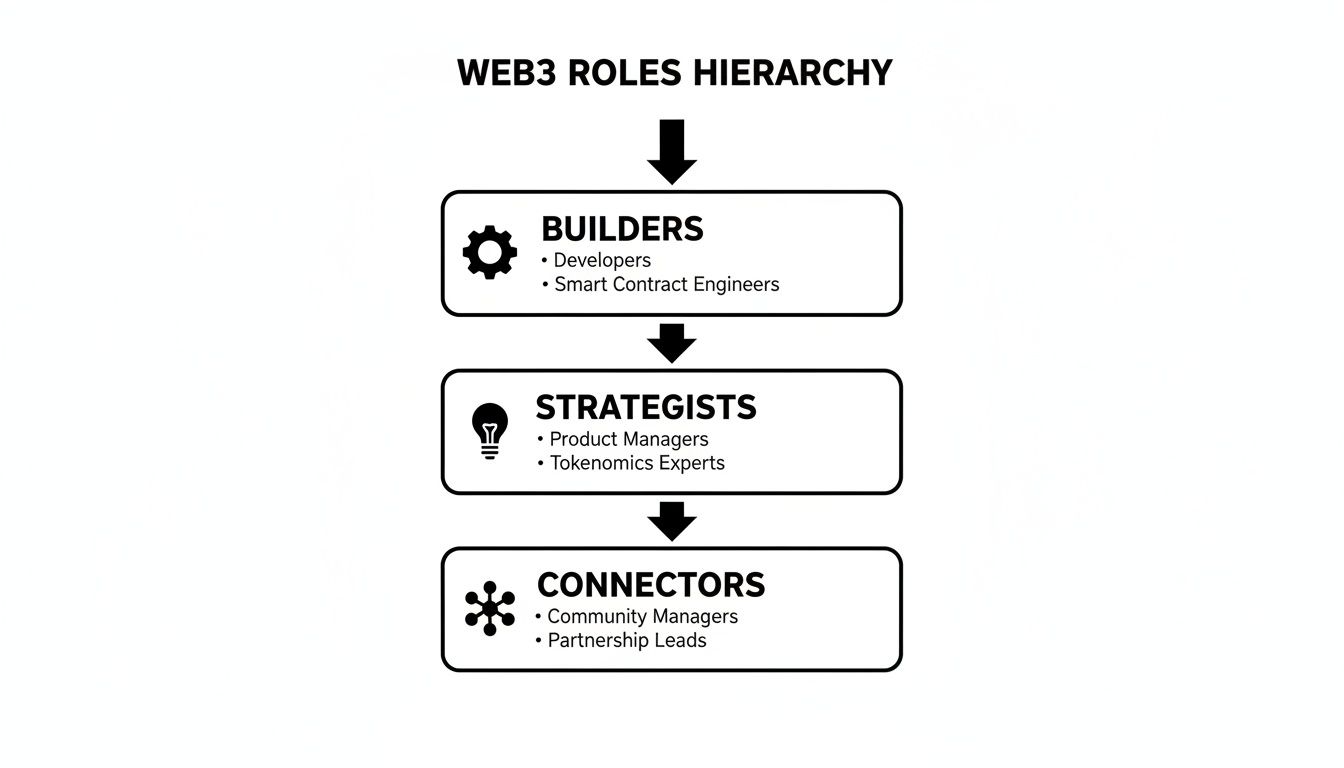
As you can see, it takes all three types—the technical wizards, the big-picture thinkers, and the community champions—to make a project successful.
The latest salary data from 2026 really drives the point home. The average blockchain developer in the U.S. is pulling in $146,250 a year. Even entry-level developers are starting around $121,000, and senior engineers can easily command $187,500 or more.
If you specialize in a hot language like Rust, you can expect a 20-30% premium on top of that. And for the elite security auditors who keep billions of dollars safe? They're earning anywhere from $130,000 to $600,000, a number that reflects just how critical their work is. You can dig into more detailed salary data and job outlook trends to get a feel for the market.
Ultimately, your earning and growth potential are tied directly to the value you provide. If you build skills that are in high demand, show your impact with a killer portfolio, and understand how to navigate the unique compensation models in Web3, you’ll set yourself up for a career that’s both challenging and incredibly rewarding.
Building the Skills That Get You Hired

If you're trying to break into the blockchain space, figuring out which skills to learn can feel like a monumental task. But here’s the good news: in a field this young, the right skills can get you noticed much faster than in more established industries.
It's not just about what you know—it's about what you can do. Hiring managers want to see tangible proof. They're more interested in your GitHub repository, a market analysis you wrote, or a community you helped grow than a long list of certifications.
Think of your skill set as having two distinct but equally important sides. On one hand, you have the specific, technical abilities, and on the other, you have the strategic and people-centric talents that make you effective. A smart career move involves developing a blend of hard skills and soft skills to become a truly well-rounded candidate.
Mastering the Essential Hard Skills
These are the technical foundations, the bedrock of any serious engineering role in blockchain. If you're aiming for a "Builder" career, this is your starting line. The demand here is intense, which gives a huge leg up to anyone who can master them.
- Solidity for Smart Contracts: This is the lingua franca of the Ethereum ecosystem, where the vast majority of DeFi and NFT projects live. Learning Solidity is like a web developer learning JavaScript—it’s absolutely essential.
- Rust for High-Performance Chains: When you look at blockchains built for raw speed and ironclad security, like Solana or Polkadot, you'll find Rust. It provides memory safety without bogging down performance, a killer combination for building robust, high-throughput systems.
- Security Auditing: This is the fine art of finding and fixing vulnerabilities before bad actors can exploit them. It demands a deep knowledge of smart contract logic, a paranoid eye for potential attack vectors, and a mindset focused on breaking things to make them stronger.
The talent gap for these skills is nothing short of staggering. Right now, there's roughly a 17:1 ratio of open jobs to qualified developers. We're talking about an estimated 440,000 jobs chasing a global pool of only 26,000 smart contract experts. This severe shortage puts a massive premium on specialized knowledge in Solidity, Rust, and ZK engineering as companies scramble to find people who can actually build.
Cultivating In-Demand Power Skills
Hard skills will get your resume looked at, but it's the "power skills" that will determine how far you go. These abilities show you understand the bigger picture—the why behind the what—and can thrive in the unique culture of Web3. They are absolutely critical for Strategist and Connector roles.
A balanced approach is your best bet. If you can pair a core technical competency with strategic insight and strong interpersonal skills, you instantly become an invaluable asset to any team.
Here are a few power skills that will set you apart:
- Tokenomics: This is the science and art of crypto-economics. It's about designing the rules that govern a token's supply, distribution, and function to engineer a healthy, sustainable ecosystem.
- Crypto-Native Marketing: Forget about banner ads and SEO. This is about generating genuine excitement and building a loyal following on platforms like X (Twitter) and Discord. You have to craft compelling narratives for a smart, often skeptical audience.
- Community Building: In Web3, the community is the product. This skill is about nurturing a passionate, engaged group of users who feel a real sense of ownership and belonging in the project.
Your ultimate goal is to build a skill stack that tells a story. Combine a deep technical skill with a few of these power skills, and you're no longer just a coder or a marketer. You’re a well-rounded professional who can build, think, strategize, and lead.
To see what skills companies are prioritizing right now, take a look at some current blockchain engineering jobs and see what the market demands.
Your Strategy for Landing the Job
Let's be blunt: a polished resume is table stakes. In the blockchain world, it won't get you nearly as far as you think. To get noticed here, you need to throw out the old playbook. This industry values verifiable proof and genuine community involvement far more than a perfectly formatted CV.
Your entire game plan needs to be about proving your worth before you even land an interview. A traditional resume tells a hiring manager what you can do. A Web3 portfolio shows them. That's the difference between a promise and a receipt.
Craft a Resume That Speaks Web3
While your resume isn't the whole story, it's still the opening chapter. It needs to survive the initial 10-second scan and convince a recruiter you're worth a deeper look. To do that, it has to speak the language of Web3. Drop the corporate jargon and get specific.
- Quantify Your Wins: Don't just say you "managed a community." Say you "Grew a Discord community from 500 to 10,000 members in six months." Numbers talk.
- Be Explicit with Your Tech Stack: List the specific blockchains (Ethereum, Solana), languages (Solidity, Rust), and tools (Hardhat, Foundry, Dune Analytics) you've actually worked with. Don't be shy.
- Link to Your Work: For every project you mention, provide a direct link. Whether it's a live dApp, a public report, or your GitHub repo, make it effortless for them to see what you've built.
Think of your resume as the key that gets you in the door. Your online footprint is what convinces them to let you stay.
Build Your Online Presence as Proof of Work
In Web3, your online presence is your professional reputation. Hiring managers absolutely will search for you online, and what they find—or don't find—can make or break your chances. This is where you build your "proof-of-work" portfolio, validating everything you claimed on paper.
Your GitHub is your new resume. Your blog posts are your new cover letter. Your insightful comments in a Discord channel are your first interview.
Start by optimizing the profiles that matter most:
- LinkedIn: Update your headline with keywords like "Web3," "DeFi," or "Smart Contracts." Don't just list your past jobs; use the description to link to specific projects and use blockchain-native language.
- GitHub: This is non-negotiable for anyone in a technical role. An active GitHub with clean, well-documented personal projects or contributions to open-source protocols is the single most powerful asset a developer can have. It’s your digital craftsmanship on display.
- X (Twitter): This isn’t just for scrolling. Dive into real conversations about the space. Follow the builders and thinkers you admire, share your take on new developments, and show that you're an active participant, not just a tourist.
Master the Art of Crypto-Native Networking
The best jobs in this space are often filled long before they ever hit a public job board. They're found through networks built on trust, shared passion, and mutual respect. Forget stuffy corporate networking events; it’s all about genuine engagement.
Your goal is to become a familiar, respected voice in the communities you care about. Here’s how you do it:
- Live in Discord and Telegram: Don't just lurk in the background. Join the channels of projects you admire. Ask intelligent questions, help newcomers, and participate in governance votes. Meaningful contributions get noticed.
- Join a DAO: Participating in a Decentralized Autonomous Organization is a fast track to hands-on experience. You can contribute to treasury proposals, marketing bounties, or code reviews, all while building a public record of your work and connecting with other builders.
- Create Your Own Content: Start a blog, a newsletter, or a series of threads on X. Write an analysis of a protocol that fascinates you, explain a technical concept you’ve recently mastered, or share your thoughts on a market trend. This is how you go from being a consumer of information to a creator of value.
By weaving these strategies together, you stop being a passive job applicant and become an active member of the ecosystem. You’re no longer just looking for a job; you’re showing that you're already part of the future they're building. For those focused on finding flexible work, a great next step is to explore a curated list of remote blockchain job opportunities.
How to Ace Your Blockchain Job Interview
Think of the blockchain job interview as the final stage where everything comes together. It’s not just a quiz on your technical knowledge; it’s a conversation to see if you truly live and breathe this space. You'll need to prove your skills, show your passion, and demonstrate that you understand the unique culture of Web3.
Most interview processes follow a similar path, starting with an HR screen and escalating to challenging technical or strategic rounds. At each step, they’re testing something different. Be ready to get on a whiteboard, explain your thinking out loud, and show them you’re there to build, not just to clock in.
Navigating Technical and Non-Technical Questions
The questions you face will obviously depend on the role, but they will all circle back to your core understanding of how this technology works and why it matters.
For Technical Roles: You won't be asked to simply define a term. Instead, expect something like, "Explain the trade-offs between a Layer 2 rollup and a validium." They're not looking for a Wikipedia answer; they want to see how you think about system design, scalability, and security from a practical, builder’s perspective.
For Non-Technical Roles: Your test might sound like, "How would you design the token launch for a new Web3 game?" This isn't just about marketing. They're evaluating your grasp of tokenomics, community incentives, and what makes a project feel authentic to a crypto-native audience.
The candidates who get hired don't just give the right answer. They explain the why behind it, connecting technical decisions to the project's mission and the user's experience. They prove they can see the entire board, not just the piece in front of them.
Showing Passion and Cultural Fit
Your resume got you in the door, but your genuine enthusiasm for the ecosystem will get you the job. Hiring managers want to see that you’re an active participant, not just a spectator on the sidelines.
Don’t be afraid to talk about the DAOs you’ve joined, the protocols you use every day, or a recent whitepaper that blew your mind. This shows you’re truly invested.
Remember, an interview is a two-way conversation. You are interviewing them, too. Knowing the right questions to ask in an interview is crucial for making sure the company is a good fit for you. Asking sharp, insightful questions signals that you’re a serious professional looking for a partnership, not just a paycheck.
Frequently Asked Questions About Blockchain Careers
If you're looking to break into the blockchain world, you probably have a lot of questions. It's a field that moves incredibly fast, and what's true one day can be outdated the next. Let's tackle some of the most common things people ask when they're getting started.
Do I Need a Computer Science Degree to Get a Blockchain Job?
This is probably the biggest myth out there. While a formal CS degree is certainly helpful for anyone aiming for a deep protocol engineering role, it's far from a requirement. In Web3, your skills and what you can build are what truly matter.
A rock-solid GitHub portfolio showcasing your projects often carries more weight than a diploma. For non-technical blockchain technology jobs—like marketing, product management, or community roles—what hiring managers really want to see is your expertise in your field combined with a genuine understanding of the crypto space. They need to know you get the culture and can apply your skills effectively here.
How Important Is Being Active on Crypto Twitter and Discord?
Extremely important. I'd even say it's non-negotiable. The heart of the crypto industry beats on platforms like X (formerly Twitter), Discord, and Farcaster. Being active there isn't just about networking; it shows you're passionate and can keep up with the breakneck speed of innovation, a quality every hiring manager is looking for.
More than that, it's where the real opportunities surface. Founders, developers, and investors are all there, sharing ideas and building in public. By joining the conversation, you can build relationships that lead to jobs that never even make it to a traditional job board. It’s your inside track.
The core crypto principle is "don't trust, verify." The hiring principle is similar: "show, don't just tell." Your public activity on these platforms is your proof-of-passion and a living part of your professional portfolio.
What Red Flags Should I Watch For in a Web3 Job?
As with any fast-growing industry, you have to be careful. Be wary of job posts with fuzzy responsibilities, unbelievable promises about token rewards, or teams that stay anonymous. A real project will almost always have a public-facing team you can verify, a clear whitepaper, and a roadmap that makes sense.
During the interview process, keep an eye out for these specific red flags:
- Requests for Funds: If any "job" asks you to send crypto or pay for your own training, it’s a scam. Full stop.
- Identity Inconsistencies: Does the interviewer's LinkedIn not match their resume? Do they seem like they're reading from a script? Scammers sometimes try to get hired to gain access to a company's internal systems.
- Pressure Tactics: A legitimate company will give you adequate time to think over an offer. Anyone pressuring you to decide immediately is a major warning sign.
When in doubt, trust your gut. Always do your own digging on the project and its founders before you sign anything.
Ready to find your place in the future of tech? Explore thousands of roles from top companies on Blockchain Jobs and take the next step in your career. Start your search today!