
7 Solidity Developer Jobs Remote Boards to Watch

The popular advice is to pick one crypto job board, turn on alerts, and apply quickly. That approach misses how fragmented solidity developer jobs remote searches have become. A stronger search combines specialized discovery, remote and timezone filters, toolchain matching, compensation context where available, and direct verification that a listing is still open. Candidates also need to distinguish fully location-independent work from jobs that require regional clustering or working-hour overlap, a point that matters in broader remote work advice for executives.
This comparison evaluates each platform by the decision it helps you make: focused discovery, high-volume monitoring, toolchain matching, compensation calibration, remote-first access, or senior-level signal quality. It also connects each board to resume tailoring and interview preparation. Blockchain Jobs is the broad Web3-focused starting point for category-tagged roles across engineering, security, product, and adjacent functions. From there, the right combination depends on your experience, location, stack, and tolerance for listing noise.
1. Blockchain Jobs
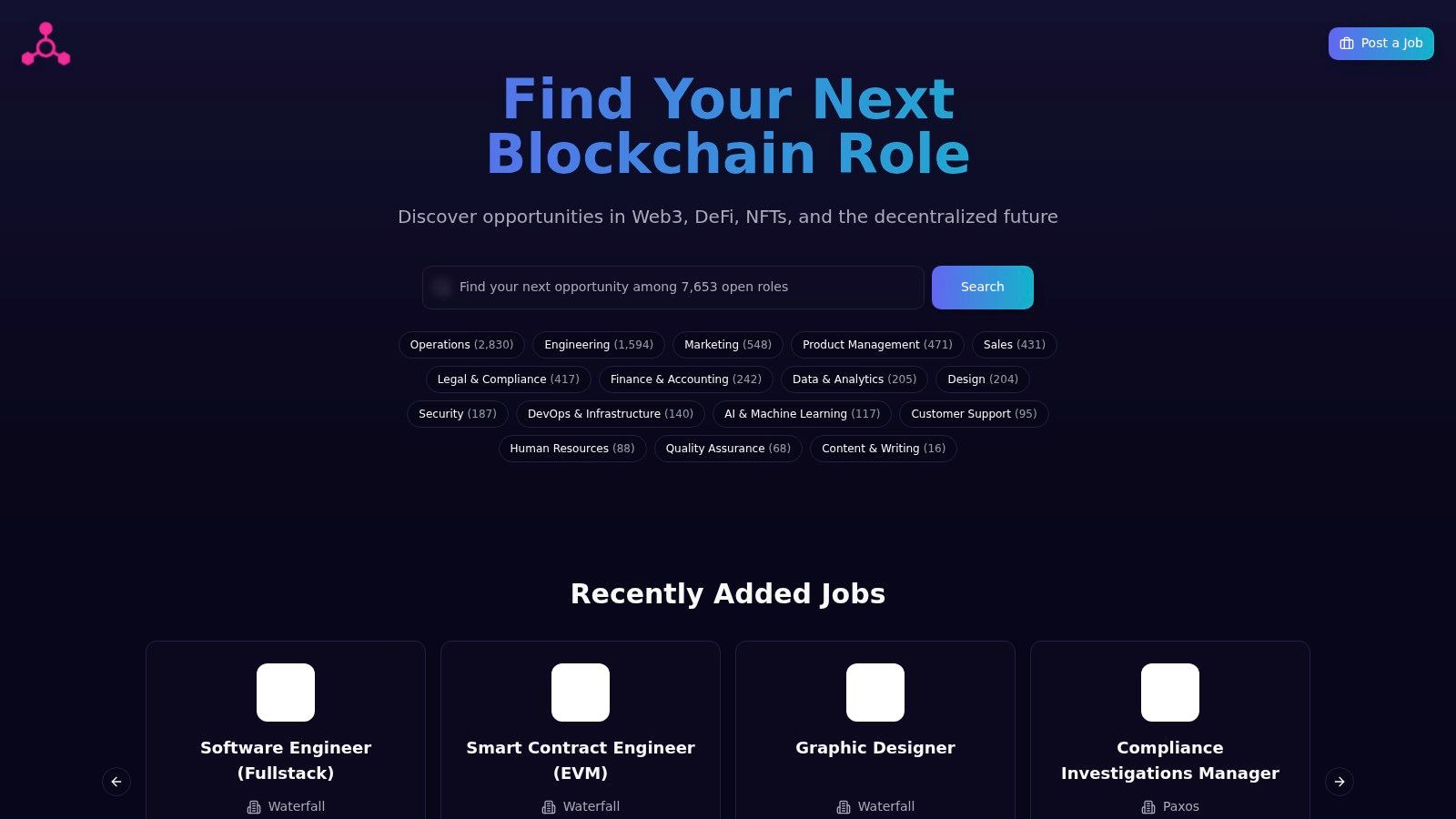
Blockchain Jobs is the strongest starting point when you want a Web3-native search without limiting yourself to one engineering niche. Its categories span blockchain, DeFi, NFTs, decentralized infrastructure, operations, product, security, legal and compliance, finance, design, and other functions. That breadth helps Solidity developers understand where their work fits inside a hiring organization, rather than treating smart contracts as an isolated coding specialty.
The platform's inventory includes category-tagged engineering and smart-contract opportunities, alongside adjacent roles such as backend engineering, DevOps and infrastructure, security, and product management. Its Recently Added Jobs feed is useful for candidates who want to act while a posting is still fresh. Hiring organizations represented on the platform include Uniswap Labs, Paxos, JumpCloud, TRM Labs, Coinme, Shakepay, Waterfall, Tala, and Luxor Tech.
Best decision supported
Use Blockchain Jobs for focused discovery with ecosystem context. Search for Solidity, smart-contract, EVM, security, and infrastructure roles, then compare how different employers describe similar work. A protocol team might emphasize Foundry, invariant testing, and threat modeling. A product company may prioritize Solidity plus TypeScript, API integration, and collaboration with frontend engineers.
That language should shape your resume. Mirror the employer's actual terminology only where it accurately reflects your experience. For interviews, use the posting to prepare examples that connect contract design to product risk, audit readiness, deployment practices, and communication with non-engineering stakeholders.
Practical rule: Treat a job board listing as a starting point, then confirm the application destination, location rules, timezone expectations, and whether the role is still active.
Blockchain Jobs also shows hiring activity through recently filled positions, with examples including roles at Serotonin, Crypto Finance, Anchorage Digital, and Framework Ventures. That can give candidates useful context about the types of organizations using a specialized board. Employer pricing isn't visibly published, so hiring teams should contact the platform or inspect the employer workflow for current posting details.
2. Cryptocurrency Jobs
Cryptocurrency Jobs is better suited to candidates who want curated discovery and stronger signal quality than a broad, high-volume scan. Its dedicated Solidity category, remote engineering filters, and tags for areas such as DeFi and security make it practical for mid-level and senior developers targeting full-time smart-contract positions.
The company and protocol name attached to a listing matters here. Before applying, open the employer's own careers page and compare the role description. If the board says “remote” but the employer specifies a region, work authorization requirement, or required overlap, the employer's page should win.
How to use it in a senior search
Search by Solidity, security, DeFi, protocol engineering, and seniority, rather than relying on the phrase “smart contract developer” alone. Then tailor the top third of your resume to the role's actual priorities. A security-heavy position should see audit findings, remediation work, testing decisions, and vulnerability analysis early. A protocol engineering role should see architecture, integrations, deployment ownership, and production maintenance.
Listings may include salary details or indicate that compensation is paid in cryptocurrency when the employer provides that information. Don't treat the absence of a salary tag as evidence of low pay. Use the posting to identify the questions you need to ask later, including base currency, token components, vesting, contractor status, benefits, and payment jurisdiction.
Email alerts support a targeted workflow, but this board generally offers less value for junior candidates who need a large volume of entry-level experiments. That's a trade-off, not a flaw. If your portfolio is still developing, use the board to study how established teams write requirements, then build projects that demonstrate the same capabilities before applying broadly.
3. CryptoJobsList
CryptoJobsList supports the decision to monitor a fast-moving market continuously. Its filters cover remote roles, Solidity, smart contracts, skills, and posting recency. The platform also provides API access, Telegram and Discord bots, and RSS options, which makes it a strong fit for candidates who already have a disciplined search process.
High volume creates a predictable problem: duplication. A role may appear on CryptoJobsList while also being syndicated from an employer ATS or another board. Don't submit multiple applications because the same vacancy has different URLs. Find the company's original application page, record it in your tracker, and use the freshest or most authoritative destination.
Turn monitoring into preparation
A useful setup is to route alerts into a folder or feed, then review them at a fixed time. For every promising role, capture:
- Required stack: Record whether the posting emphasizes Solidity, EVM, Hardhat, Foundry, auditing, security, or backend integration.
- Work model: Note whether “remote” means global, region-limited, contractor-only, or dependent on timezone overlap.
- Employer evidence: Save the company, protocol, product, and application page before the listing changes.
- Interview clues: Convert every responsibility into a question you may need to answer, such as upgradeability risks, testing strategy, or deployment ownership.
For candidates comparing sources, this board is especially useful as a discovery engine, not as the final authority on listing freshness or compensation. Salary visibility varies by employer. Cross-check the role directly, and use a specialized listing such as the Solidity developer role at Pilvi Systems as an example of the kind of smart-contract opening worth tracking alongside broader searches.
4. Web3.career
Web3.career is the most useful choice when your main decision is whether your toolchain matches the job. Its taxonomy can distinguish Solidity and EVM work from specific tools such as Hardhat and Foundry. That lets candidates search beyond a language keyword and identify roles whose daily engineering practices resemble their own.
The dedicated remote Solidity pages also make it easier to compare roles by location and seniority. Candidates should inspect posted dates closely because some older listings can remain visible, and educational or bootcamp content may sit near job results. A listing that looks relevant but hasn't been refreshed should go into a verification queue, not an immediate application queue.
Use compensation data carefully
Web3.career is also useful for compensation calibration, particularly for candidates comparing U.S.-market roles. Remote Solidity listings can range from roughly $45,000 to $80,000 at the lower end to $160,000 to $190,000 in other disclosed examples, and some postings are limited to India or the United States or require CET overlap, according to available 2026 Solidity listings. Those figures describe listing variation, not a guaranteed market rate.
The practical lesson is to negotiate from the role's geography, employment model, seniority, and responsibilities. A contractor role with no benefits shouldn't be compared casually with a location-gated employee role. Before an interview, prepare a compensation range for yourself, then ask how the employer defines remote eligibility, payment, benefits, and timezone expectations.
For resume tailoring, copy the exact tool names that match your background. If the role says Foundry and your project used it for unit and fuzz testing, explain what you tested and why. Don't add a tool merely because it appears in the posting.
5. Crypto.jobs
Crypto.jobs works well as a balanced source for role discovery and career planning. It has dedicated Solidity and remote Solidity pages, company and role tags, and supporting material around salary benchmarks and career paths. That combination helps candidates who aren't only looking for their next application, but are also deciding whether to move toward protocol engineering, smart-contract auditing, or security-focused work.
The board has a global orientation and regularly surfaces remote-first employers. Still, candidates should verify timestamps because some pages can function as evergreen resources or retain older listings. Salary information also isn't guaranteed on each individual vacancy, so treat the absence of a range as a prompt for due diligence rather than a compensation signal.
Match the board to your progression stage
Early-career developers can use Crypto.jobs to compare the language employers use for junior, intermediate, and senior roles. Entry-level Solidity compensation is commonly summarized at $60,000 to $100,000 annually, while hourly work is commonly listed at $30 to $150, depending on experience, complexity, and location, according to Solidity developer salary guidance. These figures are context for planning, not an offer or promise.
Your portfolio should show progression rather than a collection of disconnected tutorials. Include deployed contract work, readable tests, a clear README, and an explanation of security trade-offs. If you're applying to an audit-adjacent role, document how you identified and fixed a risk. If you're targeting protocol engineering, explain deployment assumptions, upgradeability, integrations, and operational decisions.
The EVM smart contract engineer listing at Waterfall is the kind of role you can use to practice this comparison. Extract the required technologies, map each to evidence in your repository, and prepare one concise interview story for every major responsibility.
6. Remote3
Remote3 supports the decision to search remote-first without wading through general remote job sites. It focuses on Web3 roles and offers filters for timezone or region, category, and contract type. That makes it useful for candidates who need to separate full-time employment from contract or freelance work before investing time in an application.
The platform's employer workflow encourages salary ranges in USD, which can improve early compensation screening when employers provide the information. It also surfaces protocol, infrastructure, and product roles from smaller or emerging teams. Those employers may offer broader ownership, but candidates should examine the job description for signs that one person is expected to handle contracts, frontend work, DevOps, support, and security without clear boundaries.
Check the remote promise
“Remote” is not a complete work arrangement. The wider Web3 labor market still shows substantial remote hiring, but the definition has tightened. One 2025 hiring recap reported that 70% to 90% of Web3 roles were remote, while fully remote listings fell by 50% as companies increasingly required timezone overlap and regional clustering, with Solidity and Rust developers among the fastest-growing in-demand roles at +36%. The CryptoJobsList hiring recap is useful context for asking sharper questions.
Ask whether you can work from your country, whether the employer hires employees or contractors there, which hours must overlap, and whether travel or periodic team meetings are expected. If the page requires login to view or apply, complete the minimum account setup necessary, then still verify the employer's own application route.
You can also compare the platform's results with the remote jobs directory on Blockchain Jobs, especially when you want to see whether the same role appears with clearer category or company context.
7. gm.careers
gm.careers is the strongest option when you want senior-level signal quality and compensation clues. Its feed emphasizes remote Web3 roles, engineering tags such as Solidity, Hardhat, and security, and role pages that explain expectations and pay bands. Examples of recognizable teams cited on the platform include Uniswap, Aave, Chainlink, and Optimism.
That brand concentration can help experienced candidates identify employers with established protocols and clearer engineering standards. It can also create false confidence. A recognizable name doesn't remove the need to verify employment geography, reporting lines, contract type, or the actual scope of the role.
Prepare for selective screening
Use each listing as a compact interview brief. If it highlights security, prepare to discuss threat modeling, access control, upgrade paths, audit findings, and incident response. If it emphasizes Hardhat or Foundry, be ready to explain test structure, fixtures, fuzzing decisions, and how you'd diagnose a failing invariant. If it mentions async collaboration, prepare written examples that show how you communicate risk and unblock teammates.
Remote Solidity screening can explicitly test both production proof and communication. One contractor platform describes a two-stage process: profile and LinkedIn review focused on production shipping experience on mainnet or major Layer 2s, with audited code preferred, followed by a soft-skills interview covering English, communication, and role-play, as described in Lemon.io's Solidity developer screening guidance.
The platform has a smaller inventory than the largest aggregators, but that's part of its value. Use it for quality-focused applications, not as your only alert source. A concise resume, strong GitHub evidence, and practiced explanations of technical trade-offs matter more than submitting to every matching title.
Top 7 Remote Solidity Developer Job Boards Comparison
| Platform | Complexity 🔄 | Resources & Speed ⚡ | Expected outcomes ⭐ / 📊 | Ideal use cases 💡 | Key advantages |
|---|---|---|---|---|---|
| Blockchain Jobs | 🔄🔄🔄 Moderate, niche posting workflow | ⚡⚡⚡ Good reach to crypto talent; moderate cost/effort | ⭐⭐⭐⭐ Strong placement signal; broad role coverage 📊 | Hiring across Web3 functions (engineering, ops, legal) | True Web3 focus; large, fresh inventory; proven hires |
| Cryptocurrency Jobs | 🔄🔄 Low, curated listings, simple filters | ⚡⚡ Efficient for targeted searches | ⭐⭐⭐⭐ High-quality matches for mid–senior engineers 📊 | Mid–senior Solidity and full-time smart-contract roles | Curated, low-noise; strong company presence; clear tags |
| CryptoJobsList | 🔄🔄🔄 Moderate, many listings & integrations | ⚡⚡⚡⚡ Fast for active searchers via API/bots/RSS | ⭐⭐⭐⭐ High visibility and frequent refresh 📊 | Power users who want automation and broad coverage | High volume; robust filters; integration tools |
| Web3.career | 🔄🔄🔄 Moderate, granular taxonomy to manage | ⚡⚡⚝ Good for benchmarking; some manual review | ⭐⭐⭐ Useful for compensation calibration; granular matches 📊 | Salary benchmarking and toolchain-specific hiring | Granular skill tags; salary explorer; EVM/toolchain focus |
| Crypto.jobs | 🔄🔄 Low–Moderate, straightforward posting | ⚡⚡⚡ Balanced speed and resources | ⭐⭐⭐⭐ Balanced outcomes; useful career resources 📊 | Hiring Solidity/audit roles and career planning | Solidity focus; salary guides; consistent smart-contract roles |
| Remote3 | 🔄🔄 Low, remote-first posting emphasis | ⚡⚡⚡ Fast for remote hires; encourages USD ranges | ⭐⭐⭐ Good for remote-first crypto teams 📊 | Fully remote crypto roles across contract types | Web3-only remote focus; compensation transparency; time-zone filters |
| gm.careers | 🔄🔄 Low, simple, modern UX | ⚡⚡ Efficient signal with salary ranges | ⭐⭐⭐⭐ Strong signal quality; salary transparency 📊 | Top-tier protocol roles; US-remote compensation insights | Frequent brand-name listings; pay ranges; helpful role guides |
Turn Board Research Into Interview Momentum
A job board becomes useful only when it changes what you do next. Save searches across the boards that match your decision: Blockchain Jobs for broad Web3 discovery, Cryptocurrency Jobs for curated senior roles, CryptoJobsList for monitoring, Web3.career for toolchain and salary comparison, Crypto.jobs for career planning, Remote3 for remote-model filtering, and gm.careers for stronger senior-level signals.
For every promising listing, verify the posting date and application destination. Record the required Solidity, EVM, Hardhat, Foundry, audit, and security skills in a simple tracking document. Note the employer's stated geography, timezone expectations, contract type, and compensation details. Tailor your resume to the exact language of the role, but don't claim production experience, audits, deployments, or tools you haven't used.
Build a role-specific evidence bank before interviews. Include deployed-contract work, testing decisions, security trade-offs, incident lessons, and collaboration examples. A strong answer explains not only what you built, but why you chose a design, what could fail, how you tested it, and what you'd change after learning more.
For technical interviews, prepare to discuss architecture choices, threat modeling, testing strategy, gas or performance considerations, upgradeability, and deployment risk. For remote teams, practice explaining those decisions in writing and in conversation. Screening can evaluate communication as directly as technical proof, particularly when the role involves async collaboration or distributed engineering.
Compensation data should guide questions, not dictate expectations. Remote Solidity pay varies by geography and work model. One U.S. benchmark places average annual remote Solidity pay at $144,548, with most roles between $119,000 and $172,500, while another benchmark reports a $150,000 median base and a typical range of $129,000 to $200,000, as shown by ZipRecruiter's remote Solidity salary data. Treat those figures as benchmarks for disclosed U.S. roles, not as universal rates for global candidates.
Confirm the details directly with the employer before you invest heavily in an interview process. Ask whether the company can hire in your country, how it handles taxes and benefits, whether payment is in fiat or cryptocurrency, which hours require overlap, and whether the role is employee, contractor, freelance, or fixed-term. Candidates who verify those points early avoid wasting time on a job that was never accessible to them.
If you want more opportunities, combine board alerts with direct outreach to hiring teams, but keep the message specific. A short email that links to one relevant repository and explains the security or protocol problem you solved is more useful than a generic application, and can help you get more job interviews with email.
Blockchain Jobs gives Solidity developers a focused way to find remote-friendly engineering, security, infrastructure, and adjacent Web3 roles without sorting through unrelated technology listings. Visit Blockchain Jobs to search fresh category-tagged opportunities, compare employers, and take the next step toward a role that matches your actual Solidity experience.