
8 Types of Data Engineers: Roles, Skills, and Hiring Tips
A DeFi protocol launches, the community dashboard goes live, and the TVL number disagrees with two other dashboards by eight figures. Someone calls a war room. Three weeks in, the team finds the problem was never the query. Nobody had defined how wrapped and staked assets roll into TVL, nobody owned the decoded event tables, and the person hired as "the data engineer" had spent two years writing marketing models in dbt.
That's a hiring failure wearing an engineering costume. Web3 teams don't need one data engineer. They need a specific profile pointed at a specific data problem, and picking wrong costs months of rework.
The job is also more maintenance-heavy than most job descriptions admit. A 2025 survey of 459 data practitioners and leaders found that 57% spend most of their workday maintaining or organizing datasets, according to a CIO Pages data engineering job analysis. Hire for the wrong specialization and that maintenance load lands on someone who can't carry it.
The eight types of data engineers below map to the work each one does in crypto, the interview questions each should get, and the career path out of each. Use it to write a job description, or to decide which path you're on.
1. Analytics Engineer, Modeling Data for Business Decisions and Hiring Pipelines
Analytics engineers own the layer between raw warehouse tables and the people making decisions. They write SQL that is version-controlled, tested, documented, and reviewed like application code, usually in dbt, and they sit close enough to the business to argue about metric definitions. In a protocol, that means turning swaps, liquidity deposits, governance votes, and wallet activity into TVL, active wallets, volume, and retention cohorts that product, finance, and growth all trust.

The interview signal
One question distinguishes experienced professionals from dbt tourists. "Define TVL for a protocol that accepts wrapped, staked, and bridged assets. Which models, which edge cases, and what happens to your number when a chain reorganizes?" Weak candidates list dbt features. Strong candidates name the grain of the table, how they handle token decimals, what they exclude, and the test that catches a double count.
What to build before applying
- Publish a dbt project on public on-chain data. Decoded Ethereum transfers are a fine dataset. The tests, documentation, and metric definitions matter more than which protocol you pick.
- Document every metric with a definition, an owner, and known edge cases. Chain reorgs and wrapped tokens are what break most candidate models.
- Use incremental models on large event tables. Full refreshes on a swap table burn warehouse credits, and cost questions come up in every serious loop.
For hiring managers, a 45-minute modeling exercise on a small swap table beats a LeetCode SQL round. You're testing judgment about definitions, not speed at window functions.
2. Data Platform Engineer, Building the Internal Foundation for Data Teams
Platform hiring goes wrong in one predictable way. The job description asks for SQL and dashboards, and the actual work is Kubernetes, Terraform, and developer experience for other data engineers. These people build the shared infrastructure: orchestration, compute, storage, access control, and self-service tooling. At a crypto exchange that usually means Airflow or Dagster on Kubernetes, Spark or Trino clusters for market data, and compliance pipelines that a dozen teams depend on.

The evaluation criteria differ from transformation roles. Nerd Level Tech's breakdown of data engineering roles notes that platform-focused engineers are assessed on system design, infrastructure as code, service reliability, multi-tenant isolation, deployment workflows, and API design rather than SQL exercises alone.
What a platform loop should include
Run a whiteboard round on a platform that serves both batch and streaming workloads, with per-team cost attribution and isolation between tenants. Then ask how they'd onboard a new internal team without giving that team production write access on day one.
Practical rule: if the role touches Terraform or Kubernetes, drop one SQL round and add a design round. SQL is teachable on the job. Broken tenant isolation in a shared platform is not a training problem.
Ask for outcomes, not tool lists. "Reduced pipeline failure rate from X to Y" or "cut Spark spend by consolidating small files" tells you whether they've operated a platform or only stood one up.
3. Streaming Data Engineer, Real-Time Pipelines for On-Chain and Market Data
Streaming engineers design systems that process events continuously instead of on a schedule, and the design trade-offs are quite different. Microsoft's data roles training module frames the split plainly, with batch systems prioritizing scheduled throughput while streaming systems prioritize latency and continuous delivery.
In Web3, that means ingesting block data, mempool activity, price feeds, and bridge messages in near real time to power liquidation monitoring, MEV-aware analytics, and live dashboards. Ask a candidate what happens when a price feed lags by ninety seconds while the lending contract's oracle has already moved.
Reorgs are not late data
This is the question that sorts the field. "A block you already processed gets reorged out at depth two. What happens to the row you wrote, and what does your dashboard show in the meantime?" Candidates who treat reorgs as ordinary late-arriving events fail, because the correct handling is different: you may need to retract, re-key by block hash, or gate publication on finality thresholds.
- Build a small consumer that reads Ethereum logs through a node provider and writes to Kafka. A toy setup teaches more than reading docs.
- State your finality assumptions per chain. Twelve confirmations on Ethereum and a different bar on an L2 are not the same contract.
- Rehearse failure modes. Interviewers push on what breaks when a broker dies or a consumer falls behind, and on how you'd know before a user did.
4. Blockchain Data Engineer, Indexing and Modeling On-Chain Data
This is the most domain-specific role in the group. Blockchain data engineers pull raw blocks, transactions, traces, and event logs, decode smart contract ABIs, and produce structured tables that analysts, compliance teams, and product features can query. The subtle parts are trace-level internal transfers that never appear in logs, and the finality rules of each chain you support.
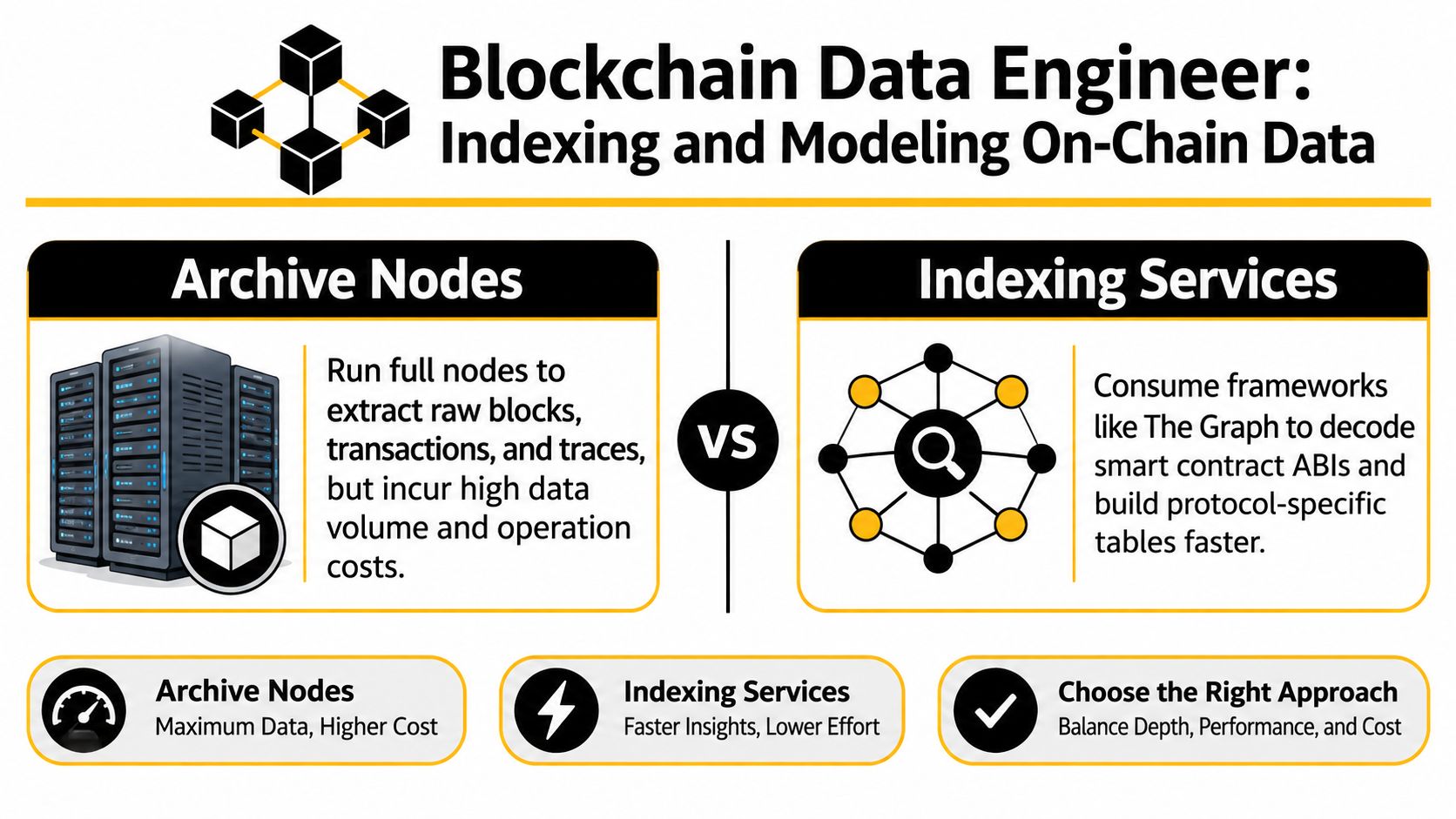
The ecosystem already shows what good output looks like. Dune Analytics and Flipside Crypto host community-built dashboards on decoded on-chain data, The Graph indexes protocol data into subgraphs consumed by DeFi front ends, and firms such as Chainalysis and Nansen produce wallet-level intelligence for risk and investigations. For a wider view of the analytics stack built on this layer, our guide to on-chain data analytics covers the modeling and dashboard side.
What separates a strong candidate
Ask them to walk through a wallet cohort from raw logs to a finished table. You want to hear about ABI decoding, decimal handling, proxy contracts, and how they distinguish a real transfer from an internal one. A published subgraph or Dune dashboard on a well-known protocol is worth more than any certification.
If you're choosing infrastructure for this work, this comparison of the best on-chain data APIs for 2026 is a reasonable starting point before you build your own indexer.
5. Machine Learning Data Engineer, Feature Pipelines and Training Data
ML data engineers build the foundations that models depend on: batch and real-time ingestion, feature stores, cleansing and validation, lineage, monitoring, and schema evolution. A representative AI/ML data engineer role specification also names MLOps, model operationalization, and metadata management as core responsibilities, plus close collaboration with data scientists on feature engineering and deployment.
Demand is moving fast. Data engineers' average share of working time on AI projects rose from 19% in 2023 to 37% in 2025, according to MIT Technology Review Insights' survey of 400 senior data and technology executives.

Point-in-time correctness is the whole job
Test leakage awareness directly. "You're building a wallet risk score. How do you make sure a feature computed today doesn't leak future behavior into a training row from March?" The answer involves point-in-time joins, event timestamps rather than ingestion timestamps, and versioned training sets.
In crypto this role shows up as account takeover scoring at an exchange, wallet-level features for NFT recommendations, and price forecasting. Build a small feature pipeline on public on-chain data, serve features through an API, and track freshness and null rates as operational metrics. Hiring managers should ask for evidence that a dataset is a reliable input to a deployed model, not just a dashboard feed.
6. Data Infrastructure Engineer, Storage, Compute, and Lakehouse Architecture
Infrastructure engineers work one layer down, on the storage and compute that everything else sits on. They design lakehouse architectures on Apache Iceberg, Delta Lake, or Apache Hudi, tune query engines, and manage compaction and partitioning so full-history chain analytics stay affordable. When a single protocol's historical traces run to hundreds of terabytes, the difference between a good and a careless partition strategy is a monthly cloud bill.
The interview question that reveals experience
"You partition an event table by date and queries are still slow. What do you change?" Strong answers talk about file sizes, small-file compaction, clustering on frequently filtered columns, and Iceberg snapshot metadata. Weak answers add an index and hope.
- Quantify cost savings from partitioning or compaction changes in your portfolio. A stated percentage beats a tool list.
- Benchmark query patterns before choosing partition keys, especially for block-number or timestamp columns where the filter shape varies by consumer.
- Learn how Iceberg manages snapshots and metadata before the interview. Expired snapshots and metadata bloat are the topics that expose reading-only knowledge.
If you're moving a legacy warehouse onto cloud infrastructure, this overview of cloud migration services from Continuum Solutions covers the general shape of that project. For the operational side of running it, our guide to infrastructure as code practices for data platforms is the closer reference.
7. Data Reliability Engineer, Quality, Observability, and Incident Response for Data
Reliability engineers apply site reliability principles to data. They define SLAs, monitor freshness and completeness, catch anomalies, and run incident response when a pipeline or dashboard breaks. At a DeFi risk team, a stale oracle feed or a missed reorg isn't a cosmetic dashboard bug, it's the difference between liquidation logic running on current prices or last hour's.
Ask for a postmortem, not a philosophy. "Walk me through the last data incident you led. Timeline, root cause, what you changed afterward." Candidates who can't name the detection gap and the corrective action haven't owned reliability, they've watched it.
Frame your experience in outcomes
- Incidents prevented and time to detection. "Cut freshness alerts from four hours to eleven minutes" is a hiring signal. Tool familiarity isn't.
- Data contracts for one critical feed. Propose the contract, the schema change policy, and who gets paged when it breaks. Initiative beats theory.
- Schema-change discipline. Most breakages start upstream, so ask how they'd stop a producer from renaming a column on a Friday.
A useful general reference on monitoring data itself is this guide to bank data observability, since financial data carries similar freshness and audit requirements. For the broader operational context, see our overview of DevOps and infrastructure roles in Web3.
8. Cloud Data Engineer, Building Data Pipelines on AWS, GCP, and Azure
A DeFi team needs decoded blockchain data for reporting, but each backfill adds cloud costs and each provider has different limits. Cloud data engineers build and operate pipelines using managed services such as AWS Glue, Redshift, Kinesis, and S3, or BigQuery and Dataflow on Google Cloud, or Azure Data Factory and Synapse. They also connect those services to third-party blockchain data providers. For teams building on conventional cloud infrastructure, this role is often where the first data hire lands.
The AI services now sitting in this role
Cloud data engineers may also set up the data services used by AI applications, such as a vector store for searching on-chain documentation or embeddings for a recommendation service. A 2025 executive study from Heidrick & Struggles on AI and data analytics officers identified agentic AI frameworks as the most in-demand AI capability. The study also flagged persistent barriers in data quality, security, and compliance, and found stronger interest in vector databases, embeddings, MLOps, and LLMOps among US organizations than European ones.
- Choose certifications to fit the target cloud. AWS Certified Data Engineer or Google Cloud Professional Data Engineer can demonstrate familiarity with a provider's managed services. In an interview, ask candidates to explain which services they would use for a given pipeline and why.
- Estimate query cost before a backfill. Ask how the candidate would estimate the cost of reprocessing a year of decoded logs on BigQuery, and how they would limit unnecessary scans.
- Protect credentials. Store RPC and API keys in a managed secrets service rather than hardcoding them in a Glue job. Hardcoded keys create a security risk in crypto data stacks.
How the eight data engineer types differ by focus, skills, Web3 use case, and career path
| Item | Core Focus | Key Skills | Web3 Use Case | Career Path |
|---|---|---|---|---|
| Analytics Engineer: Modeling Data for Business Decisions and Hiring Pipelines | Turn warehouse data into trusted business metrics | Advanced SQL, dbt, dimensional modeling, metric definition | Model swaps, liquidity, and wallet activity for dashboards | Analytics Engineer → Senior → Lead or Staff; paths to data or product analytics leadership |
| Data Platform Engineer: Building the Internal Foundation for Data Teams | Build shared infrastructure and tooling for data teams | Python, cloud platforms, Kubernetes, CI/CD, Spark or Trino | Operate orchestration and self-service platforms for protocol data teams | Data Platform Engineer → Senior or Staff → Principal or Platform Lead |
| Streaming Data Engineer: Real-Time Pipelines for On-Chain and Market Data | Process events continuously with low latency | Kafka, stateful stream processing, Java, Scala, Python, or Go | Stream blocks, prices, and bridge events for monitoring and risk | Streaming Engineer → Senior → Staff or Architect; paths to real-time platform leadership |
| Blockchain Data Engineer: Indexing and Modeling On-Chain Data | Extract, decode, and model blockchain data | EVM, ABIs, SQL, Python, indexing frameworks, Solidity reading | Build structured multi-chain data for analytics, compliance, and products | Blockchain Data Engineer → Senior → Data Lead or Protocol Data Architect |
| Machine Learning Data Engineer: Feature Pipelines and Training Data | Prepare reliable features and datasets for machine learning | Python, SQL, feature stores, point-in-time joins, ML lifecycle | Support wallet risk scoring, fraud detection, and recommendations | ML Data Engineer → Senior → ML Platform Lead or Staff; paths to ML infrastructure leadership |
| Data Infrastructure Engineer: Storage, Compute, and Lakehouse Architecture | Design scalable, cost-efficient storage and compute | Parquet, Iceberg, Delta Lake, Hudi, Trino, Spark, cloud storage | Store and query large-scale historical blockchain data | Data Infrastructure Engineer → Senior → Staff or Principal; paths to data architecture leadership |
| Data Reliability Engineer: Quality, Observability, and Incident Response for Data | Ensure data quality, freshness, and availability | Data observability, SLAs and SLOs, SQL, Python, incident response | Detect stale oracle feeds and prevent broken data products | Data Reliability Engineer → Senior → Staff or Principal; paths to governance or data quality leadership |
| Cloud Data Engineer: Building Data Pipelines on AWS, GCP, and Azure | Build and operate pipelines with managed cloud services | AWS, GCP, or Azure, SQL, Python, Terraform, cloud security | Integrate blockchain providers and process on-chain data in the cloud | Cloud Data Engineer → Senior → Cloud Data Architect or Staff; paths to solutions architecture |
Hiring the Right Data Engineer for Your Stage and Stack
A team preparing protocol dashboards needs a different hire from one processing live swaps or rebuilding its data platform. Start with the bottleneck: early teams often need an Analytics Engineer to model data for decisions or a Blockchain Data Engineer to make raw on-chain activity usable. As more products depend on timely data, Streaming, Platform, and Reliability expertise become more relevant.
Use the role-specific interview question and a work sample to test the match. Ask entry-level candidates to explain tested SQL models, mid-level candidates to walk through orchestration and ownership of a data domain, and senior candidates to reason through reliability, incident causes, and architectural trade-offs.
Hiring checklist: Define the data problem, choose the role that addresses it, and use the interview question from that role's section. Before the final round, ask for one relevant artifact, such as a dbt project, a subgraph, a postmortem, or evidence of a cost reduction.
Blockchain Jobs lists 6,934 open roles across crypto, DeFi, and Web3, including 4,171 remote roles. Its 21 categories include Engineering and Data & Analytics. Engineering has the largest count, with 1,624 open roles.
A role title alone does not fix weak foundations. Inconsistent schemas, poor lineage, and insecure pipelines can constrain every data product built on top of them.
Blockchain Jobs organizes jobs into 21 role categories, including Data & Analytics. Candidates can browse openings by category, while employers can post roles for a crypto-native audience. Visit Blockchain Jobs to browse openings or post a role.