Web 1 vs Web 2: A Guide to Building Your Tech Career
The real dividing line between Web 1.0 and Web 2.0 is participation. At its heart, Web 1.0 was a read-only internet of static pages, a place where we went to passively consume information. Web 2.0 flipped that model on its head, becoming the read-write social web we know today—a dynamic ecosystem built on user-generated content, interaction, and community.
This wasn't just a technological upgrade; it was a cultural shift that completely reshaped the job market and the skills companies hire for. Understanding this evolution is critical for acing job interviews and planning your career progression.
From Information Highways to Digital Town Squares
The jump from Web 1.0 to Web 2.0 is one of the most important stories of the internet's evolution, and it directly influences the skills companies look for. If you're a tech professional, knowing this history helps you frame your experience and prove your value in an interview. It's the story of how the web grew from a digital library into a global conversation, creating entirely new career paths along the way.
The early era, often called the "static web," was all about a one-way flow of information. Businesses put up websites that were essentially digital brochures. They gave you information but offered no real way to interact or contribute. This model, dominant from about 1991 to 2004, was a one-way street where companies served up unchanging HTML content.
By 2000, there were around 20 million active websites, but traffic was a trickle compared to today, with the average site getting fewer than 1,000 unique visitors daily.
Then came Web 2.0. The term was coined in 2004, and suddenly, user-generated content was everywhere. By 2010, YouTube was racking up 2 billion views a day, and Facebook had hit 500 million users. The web had become a platform for participation. You can find more detailed analyses of this web transformation on platforms like EBSCO.
Web 1 vs Web 2 At a Glance
To really grasp how much things changed, it helps to put the two eras side-by-side. This table breaks down the core philosophical and functional differences that shaped the career skills each era demanded. In an interview, being able to articulate these differences shows a deep understanding of the industry.
| Characteristic | Web 1.0 (The Read-Only Web) | Web 2.0 (The Social Web) |
|---|---|---|
| Core Philosophy | One-way information broadcast. | Two-way, community-centric collaboration. |
| User Role | Passive consumer of content. | Active creator and participant. |
| Content Source | Created by a few "webmasters." | Generated by the masses (users). |
| Key Technologies | Static HTML, basic CSS, page counters. | AJAX, JavaScript, APIs, social media platforms. |
| Primary Job Focus | Building and maintaining static sites. | Engineering interactive applications, managing communities. |
This table shows a fundamental shift from just publishing information to building platforms for interaction. The job of a "webmaster" who simply uploaded HTML files became obsolete, replaced by specialized roles like front-end developer, community manager, and data scientist—careers that are now foundational to the tech industry.

Think of an old GeoCities homepage—it was a collection of static, personal pages with almost zero interaction. The user's only real move was to click and read. That design perfectly captures an era when the main technical skill was just getting information online. It’s a world away from the dynamic, engagement-driven engineering required for Web 2.0 applications and the specialized roles that build them.
Technical Stacks and User Experience: A Tale of Two Webs
To really grasp the shift from Web 1.0 to Web 2.0, you have to look under the hood at the code. The technology of each era directly shaped what users could do online, and in turn, created wildly different job markets for developers. If you’re in a job interview, explaining this evolution shows you understand the big picture and the "why" behind your technical skills.
Web 1.0 was built with a simple, no-frills toolkit. Think static HTML, a bit of CSS for basic styling, and maybe a sprinkle of server-side scripts like Perl or early PHP. This was the era of the "brochure web," where just getting information to display correctly was the main technical hurdle.
Because the technology was so limited, the user experience was completely passive and read-only. People clicked hyperlinks, read text, and looked at images. That was about it. Any real interaction was a rarity, usually just a basic contact form. Every time you wanted to see something new, the entire page had to reload from the server, making for a clunky, disjointed experience.
The Leap to Dynamic Interaction
The move to Web 2.0 wasn't just an update; it was a total reimagining of what the internet could be. A whole new set of tools made this possible, turning the web from a one-way street into a bustling, two-way conversation and creating a demand for new engineering expertise.
A few key technologies were at the heart of this change:
- AJAX (Asynchronous JavaScript and XML): This was the magic ingredient. It allowed web pages to quietly grab data from a server in the background without forcing a full page reload. Suddenly, websites felt smooth, fast, and responsive—like a desktop application.
- JavaScript Frameworks: First came libraries like jQuery, and later, powerful frameworks like React and Angular. These tools gave developers the power to build incredibly complex and interactive user interfaces that could react to user input in real time.
- APIs (Application Programming Interfaces): APIs became the glue of the internet, letting different websites and services talk to each other. This is how developers could suddenly embed Google Maps or add a "Login with Facebook" button right into their sites.
This new tech stack completely flipped the user experience on its head, turning passive consumers into active creators. The big shift happened around 2004-2005, as HTML5, CSS3, and modern JavaScript made the web "read-write." The explosion in user-generated content was staggering—by 2006, MySpace had 100 million users, and by 2011, the number of blogs skyrocketed from 500,000 to 173 million. This was a universe away from the static Web 1.0 sites, where a visitor might stick around for less than 30 seconds. To dig deeper into this transformation, check out the great overview on Creative Tim's blog.
From a career standpoint, this is when the all-in-one "webmaster" role shattered into specialized fields. The job wasn't about putting up pages anymore; it was about engineering seamless, data-driven experiences that could serve millions of users.
What This Means for Your Tech Career
This technological leap created a huge demand for developers with an entirely new set of skills. In a job interview, showing you understand the why behind this shift is a game-changer. It proves you don't just know how to code—you know how technology drives user behavior and business goals.
Back in the Web 1.0 days, knowing HTML and some basic scripting was plenty. Your success was measured by whether a page looked right in Netscape Navigator. The role was all about presenting content.
Fast forward to Web 2.0, and a developer needed to be an application architect. Hiring managers started looking for people who could build systems that were interactive and could scale. For example, companies began posting jobs for a frontend developer with React skills to build dynamic interfaces for thousands of simultaneous users. Expertise in JavaScript, API integration, and database management became the new gold standard. This foundation—building complex, interactive systems—is exactly what today’s Web3 roles are built on.
Analyzing Business Models and Data Ownership
The leap from Web 1.0 to Web 2.0 wasn't just a technical upgrade—it was an economic earthquake. It completely remade industries and invented entirely new career paths. If you want to articulate your value in a job interview, you need to understand this shift, because it shows you get how business strategy drives the tech roles you're applying for.
Web 1.0 business models were pretty simple. Companies either sold products directly through basic e-commerce sites or made money from banner ads. Success was all about eyeballs; how many people saw your ad. Data was collected, sure, but it wasn't the core asset that hiring was built around.
The Rise of the Platform Economy
Then came Web 2.0 and the platform economy. Suddenly, the business model was the product. Companies like Google and Meta didn't just sell things; they built massive ecosystems that ran on user engagement. This move turned personal data into the new oil, fueling a multi-trillion-dollar industry built on targeted advertising.
This economic overhaul flipped the script on what companies looked for in new hires. The goal was no longer just to build a functional website. It was to engineer platforms that could hook users, keep them creating content, and monetize every click and scroll at a mind-boggling scale.
This is where you can see the fundamental split between the two eras—Web 1.0 was a one-way street, while Web 2.0 created a two-way flow where user data became the ultimate currency.
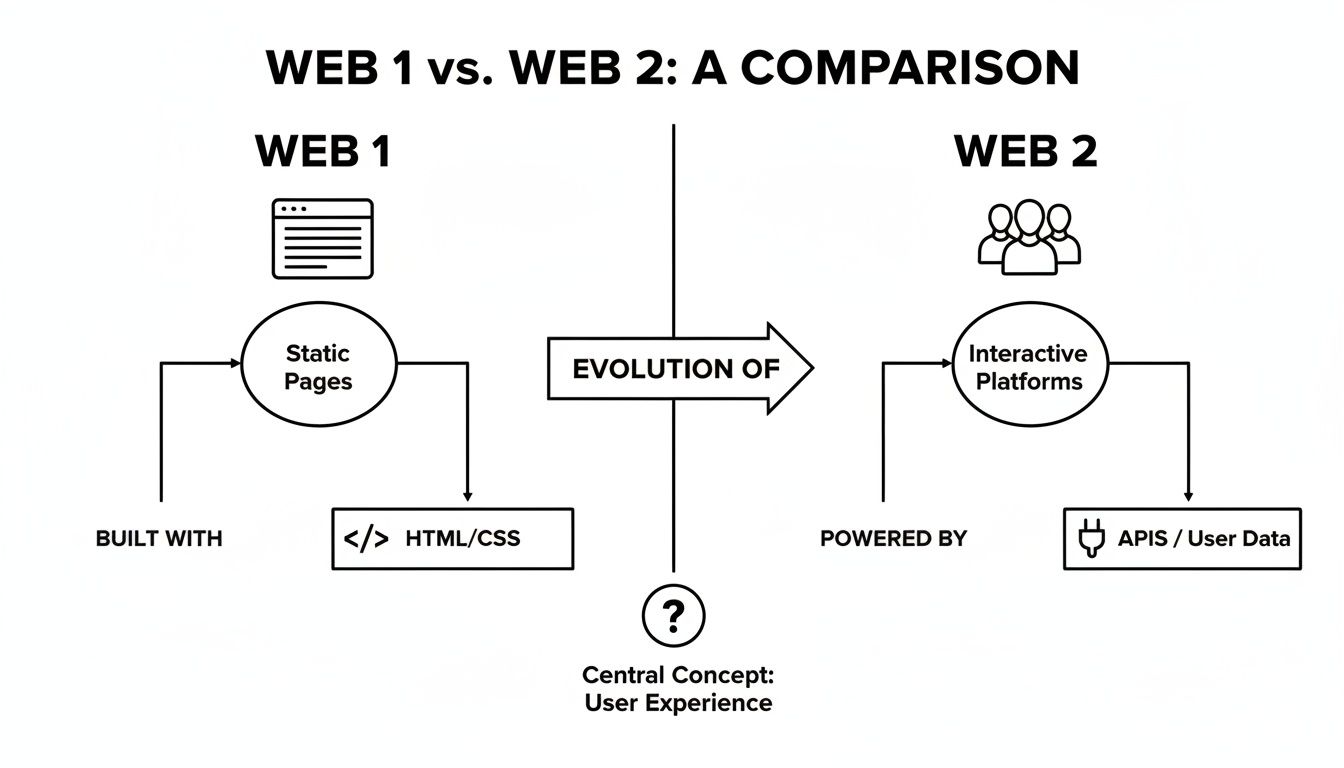
The diagram really hits it home. Web 1.0 was built on static tech like HTML. But Web 2.0's entire existence depends on APIs and user interaction, which created the feedback loop that made data so valuable and created so many new jobs.
How Data Ownership Shaped the Modern Job Market
The real game-changer between Web 1.0 and Web 2.0 comes down to one thing: data ownership. In the early days, the company hosting the website owned the data. While that’s technically still true in Web 2.0, the sheer scale and purpose of data collection changed everything.
In the Web 2.0 world, we, the users, create the content and the data. But the platform owns it and profits from it. Your photos, your posts, your searches—they all became corporate assets. This created an incredibly powerful, centralized system where a handful of tech giants held all the cards.
From a career perspective, the monetization of user data was the single biggest catalyst for job creation in the last two decades. It forced companies to hire for roles that had never existed before.
This table breaks down how the monetization strategies directly influenced the kinds of jobs that emerged.
Monetization and Data Models Compared
| Aspect | Web 1.0 Approach | Web 2.0 Approach | Resulting Job Roles |
|---|---|---|---|
| Primary Revenue | Direct e-commerce sales, banner ad impressions. | Targeted advertising, subscription models, data sales. | Growth Marketer, AdOps Specialist, Sales Engineer. |
| Data Control | Company-owned, used for basic analytics. | Platform-owned, user-generated, used for deep personalization. | Data Scientist, ML Engineer, Business Intelligence Analyst. |
| Value Creation | Content was created by the company and consumed by users. | Value is co-created by the platform and its users. | Community Manager, Product Manager, UX Researcher. |
Understanding this table is key for your career. It shows a direct line from a business model decision—like "let's monetize user data"—to the creation of a role like a Data Scientist.
This explosion in data-centric businesses gave rise to a whole new class of high-demand jobs. Hiring managers weren't just looking for developers anymore. They needed specialists who could make sense of all this user data and turn it into growth.
- Data Scientists became crucial for poring over user behavior to tweak products and perfect ad targeting.
- Growth Marketers emerged to use data for acquiring and keeping users through relentless A/B testing and targeted campaigns.
- Platform Product Managers focused on building addictive features that kept users engaged and generating even more valuable data.
These jobs are a direct result of the Web 2.0 business model. When you're in an interview, connecting your skills back to this reality—showing how your work in data analysis or user engagement directly serves the company’s bottom line—is how you prove your worth.
Of course, this centralized control also planted the seeds for the next evolution. People started to realize the trade-off: we gave up our privacy and ownership for "free" services. That exact tension is what's now fueling the entire Web3 movement, where top talent is drawn to the promise of decentralization and giving data ownership back to users. Knowing this history is how you explain why your skills are not just relevant today, but essential for tomorrow.
How In-Demand Skills and Hiring Have Changed
The leap from Web 1.0 to Web 2.0 wasn't just a technical upgrade—it completely rewired the tech job market. The move from static, one-way brochures to dynamic, interactive platforms created a demand for an entirely new kind of professional. If you want to build a career in this space, you have to understand this shift, because it’s the bedrock of why certain skills are so valuable today.
Back in the Web 1.0 days, the dominant role was the "webmaster." This was usually a single person, a generalist who did a bit of everything: writing basic HTML and CSS, uploading files to a server, and making sure the lights stayed on. Their main job was simply getting content online.
Success was pretty easy to measure. Did the page load? Was the information correct? The technical skills needed were foundational—basic markup languages and server maintenance. That was about it.
The Great Specialization of Web 2.0
Web 2.0 blew that "one-person-does-it-all" model to pieces. As websites evolved into complex applications serving millions, the need for deep, specialized knowledge exploded. The webmaster role didn't just evolve; it fractured into a handful of distinct, high-demand careers.
This is when we saw the rise of the specialized roles that are now standard in any tech company:
- Front-End Engineers: They went way beyond static HTML, mastering JavaScript frameworks like React and Angular. Their job became about engineering complex, responsive user interfaces that could handle live data and intricate user interactions.
- Back-End Engineers: Their focus shifted from just serving files to building scalable, data-driven systems. They needed serious expertise in languages like Node.js or Python, database management (both SQL and NoSQL), and designing APIs that could power a dynamic front end.
- DevOps and Cloud Specialists: The simple FTP server from the Web 1.0 era was replaced by massive, distributed cloud infrastructure on platforms like AWS. This created an urgent need for pros who could manage deployment pipelines, guarantee uptime, and scale systems on the fly.
- UX/UI Designers: When user engagement became the most important business metric, designing intuitive and compelling experiences became its own critical discipline. This role barely existed in the "read-only" web.

This modern team structure is a direct result of the specialization that started in Web 2.0. The sheer diversity of skills required to build and grow a tech product today—from engineering to marketing to design—shows just how far we've come from the lone "webmaster" of the early internet.
From Page Building to System Architecture
This specialization didn't just create new job titles; it fundamentally changed how companies hire. The interview questions themselves shifted from tactical to strategic, reflecting the new, complex challenges of the interactive web.
In an interview, the fundamental question changed from, "Can you build a static page?" to "How would you architect a system to handle one million concurrent users?"
This shift meant candidates had to prove more than just their ability to code. They needed a deep understanding of system design, scalability, and data management. It was no longer enough to know how to write the code; you had to explain why you chose a particular database, API design, or caching strategy to solve a real business problem.
Positioning Your Web 2.0 Skills for the Future
For any professional looking to get ahead, especially if you're eyeing the Web3 space, this history is more than just a lesson—it's a playbook. The skills you sharpened in the Web 2.0 world aren't becoming obsolete; they're the essential foundation for building the decentralized future. Your experience is directly transferable.
When you're preparing for an interview or polishing your resume, don't just list your Web 2.0 skills. Frame them as the solutions to Web3's biggest challenges.
Actionable Steps for Career Progression:
- Reframe Your API Experience: The work you did integrating third-party APIs is directly relevant to connecting dApps with oracles and off-chain data. You already know how to make separate systems talk to each other.
- Highlight Your Database Knowledge: Your expertise in managing massive, centralized databases gives you a powerful perspective on the trade-offs of on-chain data storage and the need for decentralized solutions like IPFS.
- Emphasize Community and UX Skills: Your ability to build engaging user experiences and foster online communities is even more critical in Web3, where user governance and participation are everything. This experience is exactly what companies are looking for in roles like a Senior Web3 Product Manager focusing on user experience.
By mapping your proven Web 2.0 skills to the problems of tomorrow, you position yourself as an essential builder who has the experience to navigate the next evolution of the internet.
Connecting Web 2.0's Legacy to the Rise of Web3
The shift from Web 1.0 to Web 2.0 was all about opening the doors. We went from a static, read-only internet to a dynamic, interactive space where anyone could be a creator. But that progress came with a trade-off, creating a legacy that directly paved the way for Web3. If you're building a career in blockchain, grasping this connection is non-negotiable for job interviews.
Web 2.0’s biggest win was making content creation accessible to everyone and connecting the globe. It gave us platforms where ideas could travel at the speed of light and communities could spring up without geographic barriers. Its biggest failure? Funneling all that power, data, and value into the hands of just a few massive companies. Our data became their product, leading to the privacy debacles and data monopolies we grapple with today.
That core conflict—the user creates the value, but the platform owns it—is exactly what sparked the Web3 movement. The issues baked into the Web 2.0 model weren't just bugs; they were the very blueprints for what the next era of the internet had to fix.
From Platform Economies to Ownership Economies
At its heart, Web3 is a direct answer to the flaws of the Web 2.0 business model. While the leap from web 1 vs web 2 was about adding interaction, the jump to Web3 is all about ownership. It's designed to dismantle the centralized control that defined the social web and put users firmly back in charge of their own digital identities and assets.
This shift provides a powerful narrative you can use in job interviews to explain why you're moving into the decentralized world. It proves you have a deep, mission-driven understanding of what this industry is trying to achieve.
Think of it this way—frame Web 2.0’s problems as Web3’s solutions:
- Centralized Data Silos: In Web 2.0, your data is locked away on servers owned by Google or Meta. Web3's answer is self-sovereign identity and decentralized storage, where you own your data and grant access on your own terms.
- Monetization Without Representation: You create the content that fuels billions in ad revenue, but you don’t see a dime. Web3 brings in tokenomics and NFTs, giving creators a direct way to monetize their work and own a piece of the platforms they help build.
- Censorship and De-platforming: Centralized platforms hold all the power over who gets a voice. Web3 is built on censorship-resistant protocols where the rules are baked into the code, not subject to a corporation's whims.
To a hiring manager, a candidate who can clearly explain this evolution shows more than just technical chops. It demonstrates strategic insight into why this technology actually matters. You're not just switching jobs; you're taking a logical step toward solving the internet’s most fundamental problems.
Talking Points for Your Web3 Job Interview
When an interviewer asks why you're moving from a Web 2.0 background into Web3, your answer needs to bridge your past experience with the future. Don't just say you find blockchain interesting; show them how your Web 2.0 skills are the perfect foundation for building a better internet.
Here are a few ways to frame your story:
- Connect Your Skills to a Problem: "My experience scaling centralized databases for millions of users in Web 2.0 gave me a front-row seat to the vulnerabilities of having a single point of failure. I’m now focused on building resilient, decentralized systems to eliminate those risks for good."
- Show Your User-Centric Mindset: "I've spent years designing user engagement loops for social platforms. I want to take that expertise and apply it to token-based ecosystems where users aren't just engaged—they're rewarded as true owners and stakeholders."
- Frame it as a Natural Progression: "The move from Web 1.0's static pages to Web 2.0's interactive apps was about empowering users to create. I see Web3 as the next logical step: empowering users to own. My goal is to be on the front lines of that transition."
A narrative like this is incredibly effective in an interview. It shows you get the historical context of the web 1 vs web 2 evolution and can articulate exactly why Web3 is the necessary next chapter. This proves you aren't just chasing a trend. You're committed to the core principles of decentralization, which makes you a much stronger candidate for a forward-thinking role like a blockchain application engineer, where understanding the "why" is just as crucial as the "how."
A Few Career Questions, Answered
If you want to navigate the tech job market, you have to understand the web's history. The jump from static pages to interactive platforms didn't just change websites; it created entirely new jobs and completely redefined what it means to be a tech professional. Let's break down how the web 1 vs web 2 shift still shapes your career today.
What's the Biggest Career Difference Between Web 1 and Web 2 Developers?
The simplest way to put it is the evolution from "page builder" to "application architect." A Web 1.0 developer was focused on one thing: creating static pages. Success was measured by whether the content looked right in a browser. Their job was all about content presentation.
Fast forward to Web 2.0, and the role is almost unrecognizable. A modern developer builds complex, data-driven systems that have to juggle user interactions, real-time data, and massive scale. The focus shifted from just presenting information to engineering the logic and user experience behind it.
This transition meant that skills in modern backend languages, database management, API design, and cloud infrastructure became absolutely essential. These Web 2.0 competencies now form the foundational skill set required for today's advanced Web3 roles.
How Did the User's Role Change Product Development Jobs?
In the Web 1.0 era, the user was just a passive consumer of information. Because of that, product development was pretty straightforward and centered on delivering information effectively. The main goal was just to publish content for an audience to read.
Web 2.0 flipped that script completely by turning the user into an active "creator" and "participant." This pivot was a game-changer for product managers and UX designers. Suddenly, success wasn't just about good content; it was about designing for engagement, community, and user-generated value. This created massive demand for roles focused on understanding user behavior, like UX Researchers and Community Managers.
We're seeing this model evolve again in Web3, where the user is also becoming an "owner" with a direct, and often financial, stake in a platform's success.
Are Web 1.0 Technologies Totally Obsolete in Today's Job Market?
Not at all. While nobody is looking to hire a GeoCities page builder, the foundational technologies of Web 1.0 didn't disappear—they just evolved. HTML and CSS remain the essential building blocks of the web, but now they operate inside sophisticated JavaScript frameworks like React or Vue. A deep understanding of these fundamentals is still a non-negotiable for any front-end role.
On top of that, a solid grasp of the basic client-server model from the Web 1.0 days is crucial for mastering today's advanced, distributed architectures. If you can demonstrate that historical knowledge in an interview, it shows a depth of understanding that sets you apart from candidates who only know the modern tools. It proves you get the "why" behind the tech you use.
How Can I Frame My Web 2.0 Experience for a Web3 Job?
The key is to position your Web 2.0 experience not as a liability, but as the perfect foundation for solving Web3’s unique challenges. Your expertise gives your move into the decentralized space credibility.
When you're in an interview, connect your most transferable skills directly to Web3 needs.
- API Development: Your experience building and integrating APIs is directly relevant to connecting dApps with oracles and other off-chain data sources.
- Database Management: Your knowledge of scaling centralized databases gives you a unique perspective on the trade-offs of on-chain storage and why solutions like IPFS are so important.
- Front-End Development: Your skill in building dynamic user interfaces for Web 2.0 apps is exactly what’s needed to create intuitive front-ends for dApps.
- Community Management: If you’ve built engagement on social platforms, that’s even more critical in Web3, where community governance and active participation are everything.
Go a step further and emphasize that you understand Web 2.0's limitations. Explain how building scalable, centralized applications has given you a firsthand appreciation for why decentralization is so critical for the next iteration of the internet.
Ready to make your next career move in the decentralized web? At Blockchain Jobs, we connect top talent with leading companies in the blockchain, DeFi, and NFT space. Find your perfect role and start building the future today. Explore the latest opportunities on blockchain-jobs.com.