Web3 Jobs Entry Level: Your 2026 How-To Guide

You're probably staring at the same problem most strong junior candidates face. You've spent time learning wallets, chains, DAOs, maybe a bit of Solidity or maybe a lot of time in Discord and Telegram communities, and yet the whole market still feels closed. Every role says “junior,” but the description reads like they want someone who's already shipped product, handled users, or understands protocol mechanics.
That frustration is normal. Web3 hiring has a high jargon barrier, and a lot of advice online makes it worse by pretending the path is simple. It isn't simple. It is clear, though, once you stop thinking like an applicant and start thinking like the person screening applicants.
Hiring teams in Web3 don't want enthusiasm by itself. They want evidence. They want to see that you can operate in an open, fast-moving, sometimes messy environment without constant hand-holding. That applies whether you want to write smart contracts, run community, support users, analyze on-chain data, or help with partnerships.
The good news is that web3 jobs entry level is no longer a tiny corner of the market. There are enough real openings, across enough functions, that a prepared candidate can break in. The candidates who get interviews aren't always the ones with the fanciest credentials. They're usually the ones who make it easy for a recruiter or hiring manager to say, “This person already looks like they belong here.”
From Outsider to Insider A Practical Start
A familiar pattern shows up in junior hiring. A candidate has real drive, maybe even more than some mid-level applicants, but everything they present is still framed like a traditional job search. Resume bullets. Course certificates. Generic cover letters. A list of “skills” with no proof attached.
That doesn't travel well in Web3.
A stronger candidate often has a messier profile on paper, but their signal is obvious. Their GitHub has a small contract project. Their wallet history reflects real protocol use. Their X account includes a few thoughtful threads on something they built or learned. If they're non-technical, they've moderated a community, written governance summaries, created onboarding docs, or helped answer support questions in a project server.
Web3 hiring gets easier once you stop asking, “How do I look qualified?” and start asking, “What can a stranger verify about me in five minutes?”
That's the shift from outsider to insider.
Most junior candidates don't need a grand strategy. They need a practical one. Pick a lane. Learn the tools people use in that lane. Build one or two public artifacts that prove competence. Then approach projects and employers with specificity, not volume.
The rest of this guide follows that logic. Not the inflated version of Web3 careers, but the one hiring teams deal with every day. What counts as a real entry point. Which roles are actually accessible. What kind of proof gets attention. How to apply without looking generic. And how to judge your first offer like someone building a career, not just chasing a logo.
Decoding Entry-Level Web3 Roles Beyond Engineering
A lot of entry-level advice still treats Web3 as if the only serious path is engineering. That's outdated. One major jobs board separates entry-level roles from entry-level non-tech roles, and its non-technical category alone listed 975 jobs, including marketing interns, junior technical account managers, and sales associates on Web3.Career's entry-level non-tech listings.
That matters because many promising candidates disqualify themselves too early. They assume no computer science degree means no path in. In practice, support, operations, community, marketing, sales, and account-facing roles often provide the cleanest first move into the space.
What entry-level actually means
“Entry-level” in Web3 doesn't always mean beginner-friendly. Some roles are designed for early-career candidates. Others use junior titles but still expect familiarity with Git, APIs, analytics tools, wallets, governance, or smart contract basics.
That's why the better question isn't “Can I get into Web3 with no experience?” It's “Which kinds of experience count?”
For many employers, adjacent experience counts if you can translate it properly:
- Customer support experience can transfer into wallet support, exchange operations, or community moderation.
- Digital marketing experience can transfer into growth, content, partnerships support, or campaign execution for a protocol.
- Business development or account work can transfer into ecosystem, partnerships, or junior technical account management.
- Data and QA experience can transfer if you show tool fluency and comfort with blockchain-specific workflows.
For a broader beginner-oriented overview, the practical role breakdown in this guide to jobs for beginners in blockchain is useful alongside live job board research.
Tech track and non-tech track side by side
The fastest way to assess fit is to compare role families by what they demand and what proof you can produce.
| Role | Track | Key Skills | Example Proof-of-Work Project |
|---|---|---|---|
| Junior QA Engineer | Tech | test cases, bug reporting, product thinking, wallet usage | A test plan for a dApp, with reproducible bugs and screenshots |
| Junior Backend or Smart Contract Developer | Tech | Solidity or backend fundamentals, Git, APIs, debugging | A small contract repo or simple app that interacts with a protocol |
| Data Analyst | Tech-adjacent | SQL, dashboards, on-chain interpretation | A Dune dashboard with a short written analysis |
| Community Moderator | Non-tech | empathy, conflict handling, product understanding, async communication | A community FAQ, moderation playbook, or support knowledge base |
| Marketing Intern or Coordinator | Non-tech | content writing, campaign execution, crypto-native tone | A mini content calendar or launch thread set for a protocol |
| Junior Technical Account Manager | Non-tech / hybrid | stakeholder communication, product walkthroughs, issue triage | Onboarding docs for users integrating a wallet or API |
| Sales Associate | Non-tech | outbound communication, qualification, product positioning | A mock prospecting sequence tailored to a Web3 product |
What hiring managers want to infer in year one
In the first year, employers aren't expecting deep mastery. They are looking for signs that you can become dependable fast.
They usually want to see four things:
- Tool comfort: you don't freeze when asked to use MetaMask, Etherscan, Discord, Notion, GitHub, or a block explorer.
- Context awareness: you understand basic Web3 concepts well enough to avoid obvious confusion.
- Ownership: you can take a task from vague instruction to usable output.
- Communication: you can explain what happened, what you tried, and what needs to happen next.
Practical rule: Entry-level candidates get ruled out less for lacking senior skill and more for lacking visible evidence of initiative.
Building Your High-Signal Web3 Skill Stack
Most junior candidates make the same mistake early. They try to learn everything at once. Ethereum, Solana, Rust, Solidity, DeFi, NFTs, DAOs, ZK, trading, governance, analytics, community, content. The result is broad exposure with no hiring signal.
A better approach is narrower. Build one core stack, then layer in one differentiator.
Start with one lane
If you want technical roles, choose a focused path such as Solidity plus EVM networks or Rust plus Solana. If you want non-technical roles, choose one operational lane such as community, support, growth, or partnerships, then learn the Web3-specific tools and workflows used there.
Useful foundations often include:
- Blockchain basics: transactions, wallets, tokens, gas, governance, smart contracts
- Core tools: MetaMask, Etherscan, GitHub, Discord, Telegram, Notion
- Role-specific tools: Hardhat or Foundry for developers, Dune for analytics, CRM and help-desk workflows for support or account roles
Free learning resources can help, but hiring teams rarely care which course you completed. They care whether you can turn the knowledge into something usable.
Add AI as a workflow, not a personality trait
AI fluency now functions as a practical filter in many roles. According to Zipmex's Web3 hiring guide, 14% of Web3 job descriptions explicitly require AI workflow skills, and roles that combine blockchain fundamentals with AI workflow integration are disproportionately represented in the 60 to 120 applicant range versus 400+ for generic roles, which gives those hybrid profiles a 4× higher likelihood of interview conversion.
The key is how you use it.
Don't say “I use AI.” Show where it improves your work:
- For engineers, use it to draft tests, review contract patterns, summarize audit findings, or speed up debugging.
- For analysts, use it to turn dashboard observations into concise writeups or anomaly-check prompts.
- For community and support roles, use it to build response libraries, FAQ drafts, or issue categorization workflows.
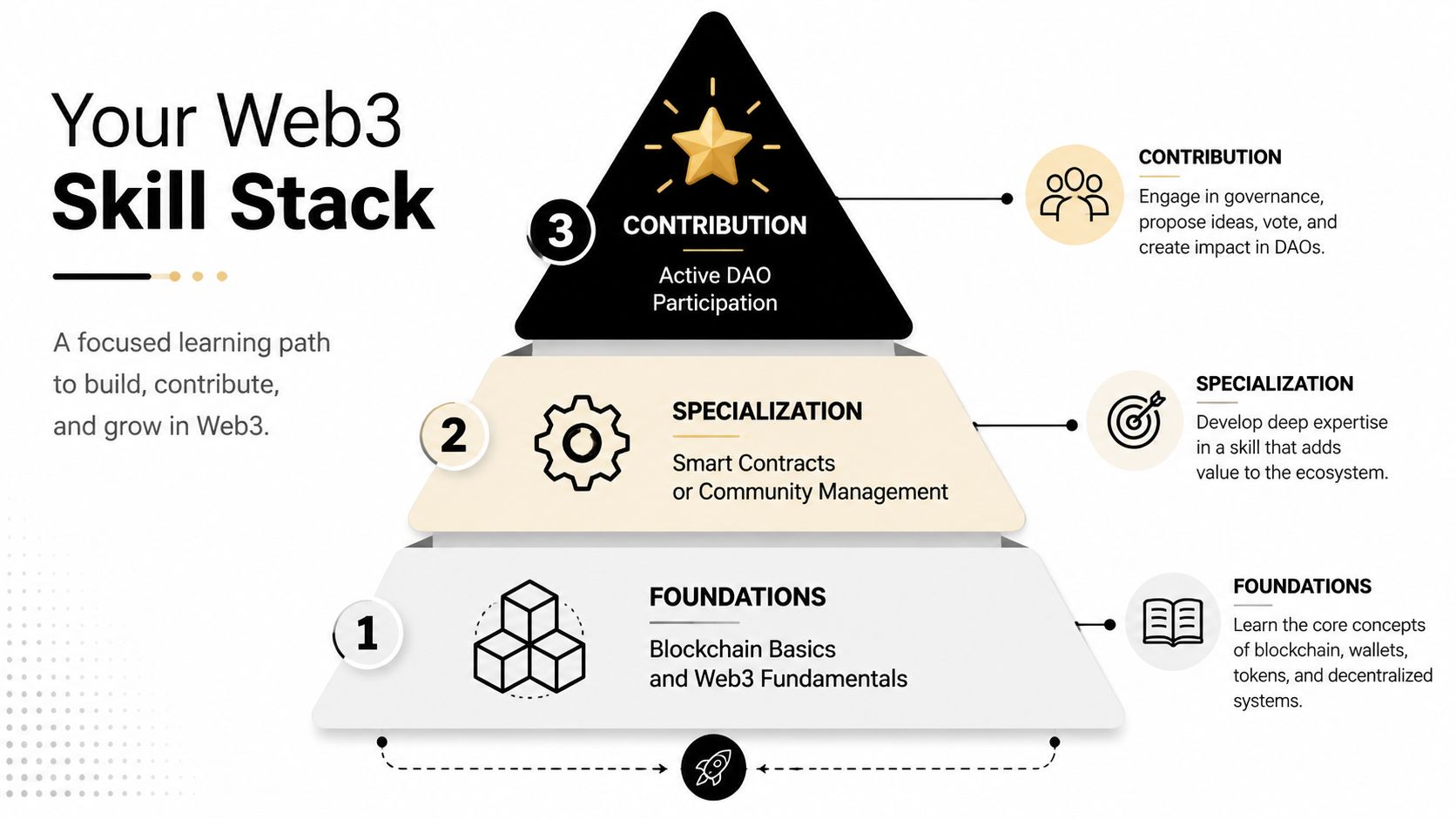
What a good junior learning plan looks like
Foundation
Learn enough to avoid sounding borrowed. You should be able to explain a wallet transaction, how a token contract works at a high level, and what problem a protocol is solving.
Specialization
Choose one skill family and get operational. Build one project. Finish it. Document it.
Contribution
Make your work public. Push code. Publish analysis. Share a walkthrough. Help a community. Public output is where learning becomes signal.
Candidates stand out when their skill stack looks intentional. Random exposure looks like curiosity. Finished work looks like readiness.
Crafting Your Proof-of-Work Portfolio and Resume
In Web3, your portfolio often matters more than your resume. Not because resumes are useless, but because resumes are easy to fake and public work is harder to fake.
Hiring managers increasingly prioritize verifiable, public artifacts over generic resumes, and personalized cold outreach tied to a concrete contribution can perform far better than standard applications according to OKX's analysis of Web3 hiring trends.

What counts as proof of work
For technical candidates, the obvious version is code. But the project doesn't need to be huge. It needs to be clear, complete, and understandable.
Strong junior portfolio pieces include:
- A simple NFT minting contract or dApp with a short README explaining architecture and trade-offs
- A small DeFi interaction app that connects a wallet and performs a straightforward action
- A Dune dashboard with a written interpretation of what the data says
- A QA walkthrough documenting bugs, edge cases, and recommended fixes
For non-technical candidates, proof of work looks different but can be just as strong:
- A community onboarding guide for a protocol
- A content series that explains a product or governance proposal clearly
- A support documentation set built from common user questions
- A mini ecosystem map for a chain, protocol category, or partner network
What makes a portfolio piece high signal
A lot of junior work gets ignored because it feels unfinished or performative. High-signal work usually shares a few traits:
- It solves a small real problem
- It's easy to inspect quickly
- It shows your reasoning, not just output
- It reflects actual Web3 context
That last point matters. If you built a front end with no wallet flow, no on-chain context, and no explanation of why blockchain is involved, many hiring teams will treat it as generic software work wearing a Web3 label.
A weak portfolio says, “I completed a tutorial.” A strong portfolio says, “I can take a scoped problem and ship something another person can review.”
How to fix your resume without overpolishing it
Your resume still matters because recruiters need a fast summary. But it should point toward evidence, not try to replace evidence.
A cleaner structure works better:
Top summary with actual direction
State the lane you're pursuing and the type of public work you've done.Selected Web3 projects
Put these above unrelated work history if they're your best signal.Experience translated into Web3 language
If you did support, say what kind of issues you handled, what systems you used, and where you improved process clarity. If you did marketing, emphasize execution, messaging, analytics, and community-facing work.Tools and ecosystems
Keep this honest. Don't list a chain or tool you can't discuss under pressure.
If you need help tightening format and presentation, this breakdown of a blockchain-style resume from Hiration, Inc. is a useful reference point for structure.
Finding and Engaging with Opportunities
Once you have visible proof of work, the search changes. You're no longer trying to persuade employers with words alone. You're trying to get the right people to look at something concrete.
That matters because the entry-level market is broad enough to support a targeted search. One major Web3 jobs board reported 2,979 entry-level jobs in May 2026, spread across hubs such as Taipei, Sofia, London, Hong Kong, and remote-first roles on Web3.Career's entry-level jobs board. The same listings also showed junior compensation can be meaningful, with examples including $82k to $110k for a Junior QA Engineer and $84k to $108k for an IT Junior Python Developer.
Use more than one channel
A weak search strategy is passive. It relies on applications alone. A stronger one combines listings, communities, and direct contact.
A practical mix looks like this:
- Curated job boards: Use role filters and set a review rhythm so you don't apply in bursts and disappear.
- Project communities: Join Discord and Telegram groups where teams and contributors talk.
- DAO and ecosystem participation: Follow governance, comment thoughtfully, and look for repeated pain points you can help with.
- Targeted outreach: Contact people only after you understand what they're building and where your work overlaps.
For role discovery beyond mainstream boards, this overview on how to find a job in crypto is useful because it reflects how many candidates piece together opportunities across different channels.
What good outreach sounds like
Most outreach fails because it asks for too much too soon. “Are you hiring?” is lazy. “I'd love to pick your brain” is vague. Generic enthusiasm gets ignored.
A better message does three things:
- references a specific product, release, governance proposal, or pain point
- links one relevant piece of public work
- asks for a small next step
For example:
Hi, I've been using your protocol and noticed the onboarding docs still leave new users confused about wallet setup on first use. I put together a revised quick-start version here. If your team is hiring for support, community, or docs-related work, I'd be glad to help further.
That works because it lowers the employer's effort. They don't need to imagine your value. They can inspect it.
Where candidates waste time
Three patterns hurt otherwise strong juniors:
- Spraying applications everywhere without adapting materials
- Lurking in communities for months with no visible contribution
- Treating outreach like networking theater instead of value creation
The candidates who break through tend to become recognizable in a small number of places, not invisible in many.
Nailing the Web3 Interview Process
Interviews in Web3 usually reveal one thing fast. Did you do the work you listed, or did you assemble a story around it?
That's why junior interviews often feel sharper than expected. Even for non-technical roles, interviewers want to test direct familiarity with products, workflows, and trade-offs.

What interviewers are usually checking
A good interviewer is not just checking if you know terms. They're checking whether you think clearly under incomplete information.
For junior candidates, that often means questions like:
- Walk me through the project you're proudest of. What did you build yourself?
- What broke during development or launch, and how did you debug it?
- Which protocol do you use regularly, and what does it do well or poorly?
- If you worked in community or support, how would you handle a frustrated user who thinks funds are lost?
- What security risks or user mistakes would you watch for in this flow?
If you're applying for technical roles, expect follow-ups on architecture, tooling choices, testing, and failure cases. If you're applying for non-technical roles, expect scenario questions that test judgment, user empathy, and product understanding.
How to answer without sounding rehearsed
Weak answers are abstract. Strong answers are specific.
Instead of saying, “I'm passionate about DeFi,” say which protocol you used, what action you took, and what the experience taught you.
Instead of saying, “I'm a quick learner,” explain the exact obstacle you hit while building or supporting something and how you got unstuck.
A simple answer pattern works well:
- Name the situation clearly
- Explain what you did
- Describe the trade-off or challenge
- End with what you'd improve next time
Security-minded thinking travels well in interviews. Even junior candidates earn trust when they naturally discuss user risk, failure modes, and edge cases.
Questions worth asking the company
Good candidates also vet the employer. Web3 teams vary a lot in maturity.
Ask questions like:
- How does the team define success for this role in the first few months?
- What does your review process look like for launches, support incidents, or code changes?
- How much of the work is reactive versus planned?
- Who gives feedback, and how often?
- What does someone do here that gets them trusted quickly?
A short prep resource can help if you want to hear common interview framing out loud.
Red flags to avoid in the room
Don't bluff chain knowledge. Don't claim tool fluency you can't demonstrate. Don't talk about decentralization in slogans while showing no understanding of users, incentives, or operational messiness.
And don't frame every answer around compensation, token upside, or remote lifestyle. Early-career candidates win trust when they sound like contributors, not tourists.
Salary Expectations and Your First Career Move
Your first Web3 role matters less for prestige than for trajectory. The goal isn't to land the perfect title immediately. The goal is to get into a role where your work becomes more legible, your judgment improves, and your next move gets easier.
That perspective helps with salary too. Junior compensation can be attractive, but a good offer is not just the top number. It's the mix of pay, role scope, mentorship, market exposure, and the quality of the team you'll learn from.
What current compensation data suggests
Coincub's 2025 report says Web3 added 66,494 new roles in 2025, a 47% increase from 2024, with 26,925 remote roles, up 40% year over year, according to Coincub's Web3 jobs report. For junior roles defined as 1 to 2 years of experience, the average pay across the roles analyzed was $72,500. The same report says employers took about 79 days on average to close a job opening.
That last number is important. A slow process doesn't automatically mean you're failing. Many candidates panic too early, especially if they're used to faster hiring cycles elsewhere.
How to judge your first offer
Compensation matters, but four filters matter more in the first role:
- Learning density: Will you be exposed to real users, real systems, and real decision-making?
- Manager quality: Is there someone who can review your work properly?
- Scope clarity: Do you know what success looks like?
- Proof creation: Will this role give you stronger public or transferable evidence for your next step?
If two offers are close, choose the one that compounds your credibility faster.
Career progression in the first few years
Early Web3 careers tend to branch, not climb in a straight line.
A junior community operator might move into growth, partnerships, or product operations. A QA or junior engineering hire might move toward smart contract development, infrastructure, or security-focused work. A support hire with strong product instincts can become a technical account manager, operations lead, or implementation specialist.
The common pattern is simple. People advance when they become trusted with ambiguity.
That's also why it's worth studying adjacent compensation paths over time. If you want a longer-term benchmark for where specialized paths can lead, this look at jobs that make 150 k a year is useful as a planning reference, not a starting expectation.
Your first role should buy you leverage. Better judgment, better artifacts, better references, and better options.
Don't optimize only for title. Optimize for the environment that makes you sharper.
If you're actively searching for web3 jobs entry level, start with a board built specifically for blockchain hiring. Blockchain Jobs lets you search across functions like engineering, operations, marketing, support, product, legal, security, QA, and data, which is useful when you're comparing technical and non-technical entry paths instead of forcing yourself into one narrow category too early.