How to Hire Web3 Developer Talent in 2026

In 2025, Web3 added 66,494 new roles, a 47% rebound from 2024, according to Coincub's Web3 Jobs Report 2025. Remote U.S. demand accounted for 21,612 jobs, while Europe and Asia were nearly in parity. That combination changes the hiring problem. You're not filling an experimental niche anymore. You're competing in a global market for engineers whose production mistakes can create security, financial, and reputational damage.
Hiring a Web3 developer successfully requires more than posting a familiar job title and running a standard software interview. You need to verify deployed work, define the specialization precisely, test security judgment, move quickly, and structure compensation around token-based work realities. The strongest hiring process treats technical evidence and long-term alignment as equally important.
Why Web3 Hiring Demands a Different Playbook
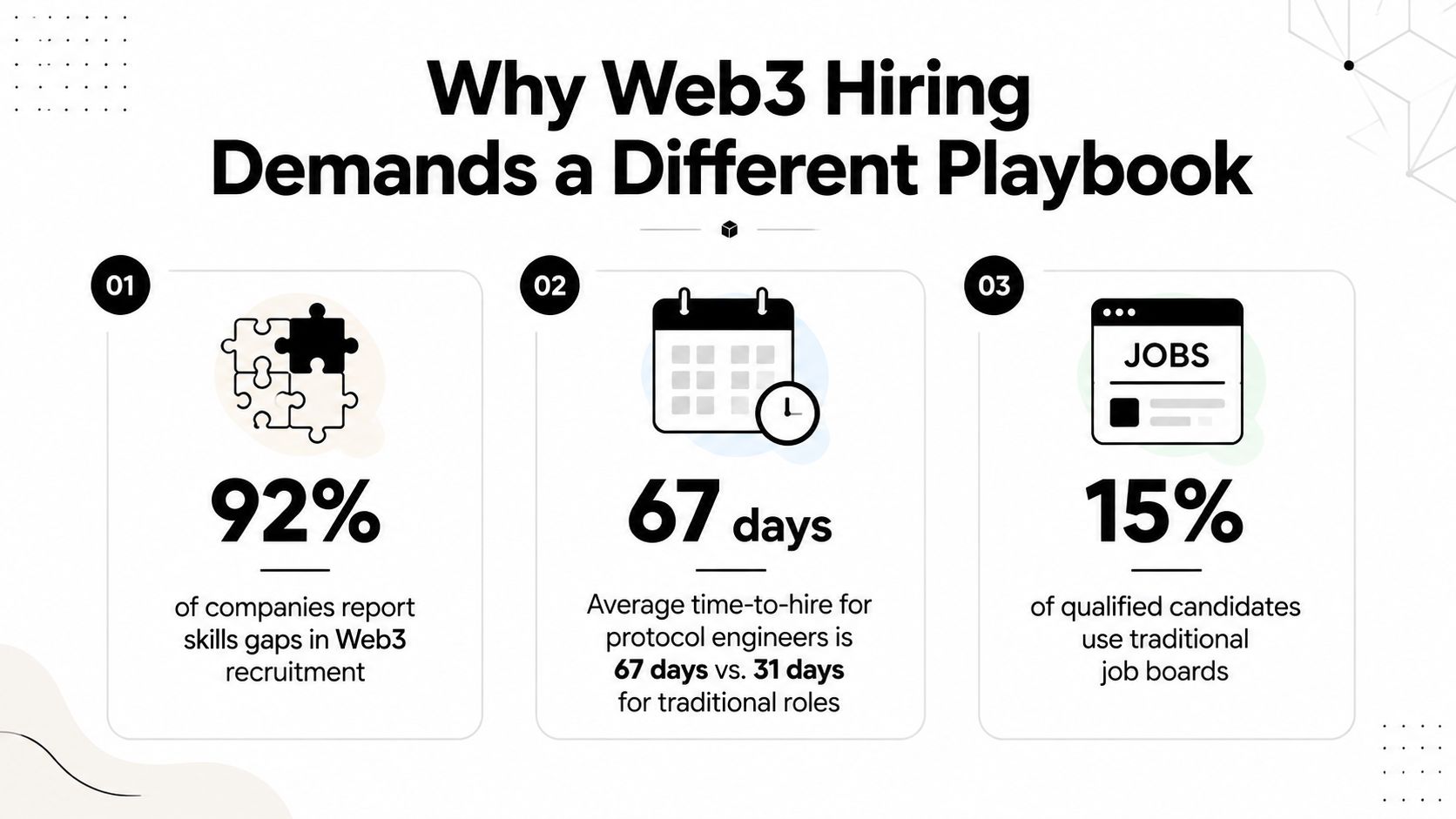
The 2025 rebound shows why Web3 hiring has become a strategic capability rather than an occasional recruiting exercise. The market now supports specialized searches across engineering, product, compliance, go-to-market, and operations, but the most difficult roles still draw from a scarce global technical pool. The demand is distributed across regions, while qualified candidates can compare opportunities without relocating.
That creates a difficult contradiction for employers. The market is broad enough to support specialization, yet the candidates with credible production experience remain limited. Historical data reinforces the point. A Computerworld report cited by Crypto Jobs placed the median blockchain developer salary at $132,000, with experienced workers earning more than $176,000 when moving to new organizations. The same report noted more than 10,000 open blockchain developer positions in the United States, while Burning Glass Technologies had previously counted 12,006 blockchain-related IT jobs, representing 316% year-over-year growth.
Why conventional filters produce weak hires
A résumé can confirm that someone has used Solidity or worked near a blockchain. It can't prove that the person understands upgrade risk, adversarial inputs, contract permissions, or the consequences of an irreversible deployment. A LeetCode-style exercise can measure algorithmic fluency, but it may tell you little about whether a candidate recognizes a reentrancy path or challenges an unsafe protocol assumption.
The same problem appears in job descriptions. “Blockchain developer” can describe protocol engineering, smart-contract development, dApp integration, infrastructure, or security work. Each track needs different evidence and a different interview design. If you advertise one generic role, you'll attract candidates whose backgrounds look similar on paper but whose production capabilities differ sharply.
Speed is part of the assessment
Strong candidates are often off the market in 10 to 14 days, according to independent recruiting guidance from Pin. A process that takes several weeks to schedule basic screens signals indecision and loses candidates before your technical team has tested them.
The practical playbook is therefore clear:
- Verify evidence early: Look for a mainnet deployment, contract addresses, merged pull requests, audit exposure, and production contributions.
- Separate specialties: Decide whether you need protocol, smart-contract, dApp, infrastructure, or security capability before sourcing.
- Test production judgment: Use code review and vulnerability analysis instead of relying only on abstract programming puzzles.
- Make decisions quickly: Give candidates a defined process, named interviewers, and prompt feedback.
You can use a specialist marketplace such as Blockchain Jobs as one sourcing channel, but the channel won't compensate for a poorly scoped role or a slow evaluation loop.
Defining the Role Before Writing the Job Description
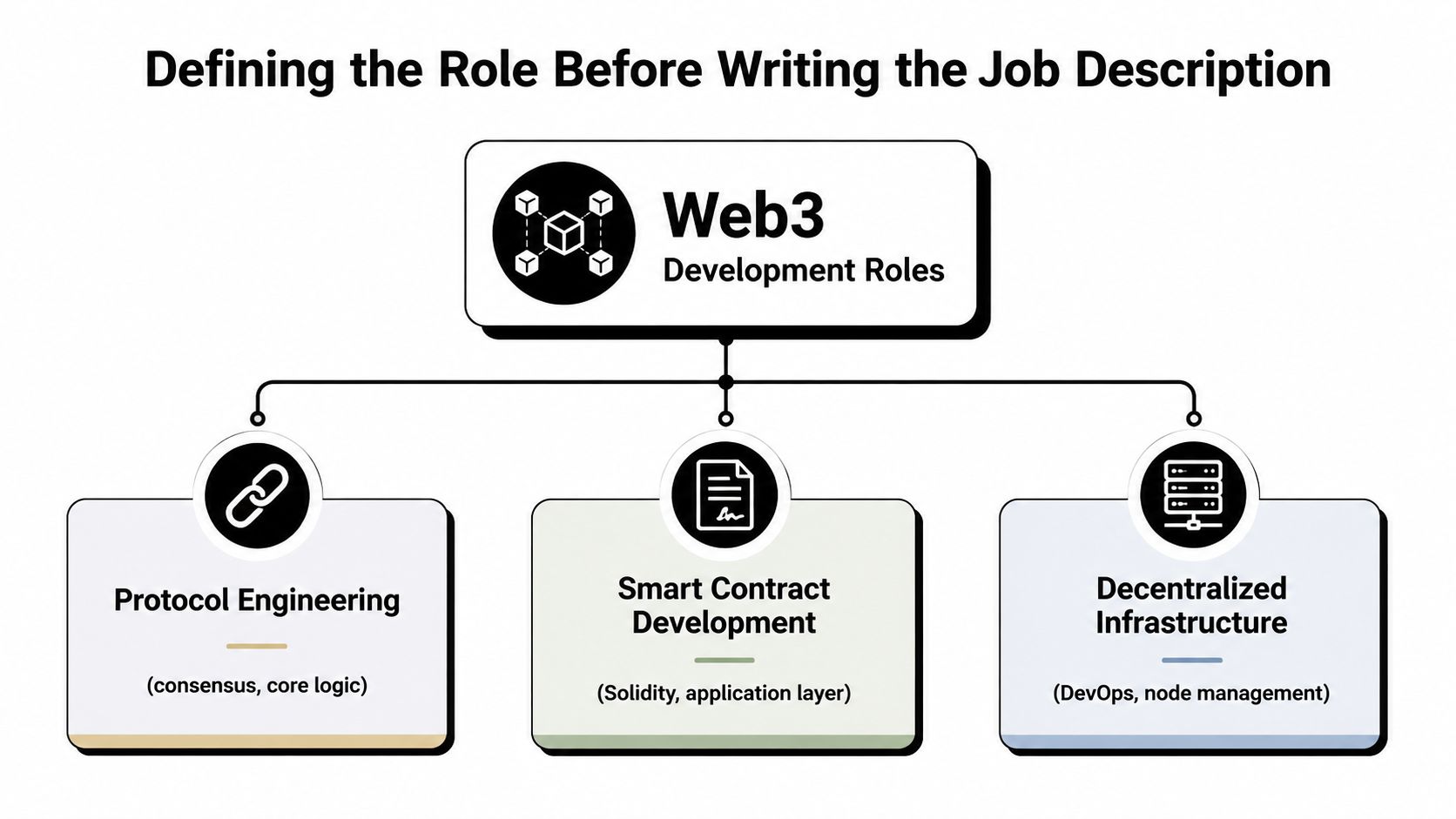
Start with the product roadmap, not the candidate search. Ask what the hire must own after joining. If the answer involves consensus, validator incentives, chain performance, or core network logic, you're looking for a protocol engineer. If the work governs asset transfers, permissions, vaults, or application logic on-chain, the need is closer to smart-contract engineering. If the main challenge is connecting wallets, indexing on-chain state, and building the user experience, you need a dApp or full-stack engineer.
Match the specialization to the work
| Role track | Primary ownership | Evidence to request |
|---|---|---|
| Protocol engineering | Consensus, core logic, protocol behavior, and infrastructure design | Contributions to protocol code, distributed-systems work, design documents, or production network experience |
| Smart-contract development | Solidity contracts, application-layer rules, permissions, testing, and deployment | Mainnet contracts, audit remediation, Foundry or Hardhat projects, and security-focused code reviews |
| dApp or full-stack development | Wallet integration, transaction flows, front-end behavior, APIs, and on-chain data | Shipped dApps, TypeScript repositories, wallet connections, indexers, and user-facing production work |
These categories overlap, but they shouldn't be collapsed. A strong dApp engineer may understand wallet integration and on-chain data handling without being ready to design a lending protocol. A capable smart-contract developer may not have the distributed-systems background needed for consensus or node architecture. Misclassification creates frustration on both sides, because the developer gets judged against work they weren't hired to perform and the team discovers the gap after onboarding.
Write a credible job description
Experienced candidates scan for technical specificity. Name the chain or execution environment, the contract responsibilities, the deployment stage, and the security expectations. Mention Solidity, EVM tooling, TypeScript, wallet integration, on-chain data handling, Foundry, or Hardhat only when those tools reflect real work rather than keyword stuffing. A Web3 engineering role example should make the expected ownership visible.
Include the questions candidates will use to judge your team:
- What code is already in production?
- Who reviews deployments and handles audits?
- Does the engineer own architecture, implementation, or both?
- How do product and security teams resolve disagreements?
- What does success look like during the first phase of employment?
Avoid demanding every language and framework in the ecosystem. A focused description attracts specialists who recognize the problem, while an inflated list suggests that the hiring team doesn't understand the role. Define required experience separately from useful exposure, and explain which decisions the person will make.
Treat the interview as career signaling
A serious candidate evaluates your process as evidence of engineering maturity. If you ask a protocol engineer only generic data-structure questions, or ask a contract specialist to build an unrelated application, you're telling them that the company doesn't understand their craft. A role-specific evaluation respects the candidate's career progression and gives your team better hiring signal.
Sourcing Candidates Where They Actually Work
The best Web3 candidates often leave a public trail before they ever apply. That trail may include a deployed contract, a merged GitHub pull request, an audit contribution, a technical design discussion, or a thoughtful explanation of a protocol failure. Sourcing starts by reading that evidence, not by waiting for a résumé to arrive.

Build a target list from proof of work
For a smart-contract search, begin with public deployments and repositories connected to the protocols your team uses or respects. Review wallet and contract addresses, then follow the code history behind the deployment. You're looking for the candidate's actual contribution, not merely an association with a project.
GitHub review should focus on substance:
- Merged pull requests: Check whether the person made production changes or only opened small exploratory branches.
- Review quality: Look at comments that identify security, testing, or architecture concerns.
- Audit exposure: Determine whether the candidate responded thoughtfully to findings and documented remediation.
- Ownership: Find evidence that they maintained a component over time rather than making a single contribution.
- Technical communication: Read design notes and issue discussions for clarity under ambiguity.
The same approach works for protocol and infrastructure roles, but the evidence changes. Look for node tooling, indexers, RPC reliability work, distributed-systems contributions, and discussions about failure recovery. A candidate's public work should shape the first conversation.
Meet candidates in ecosystem channels
Crypto-native professionals often discover roles through developer communities, Discord groups, technical Twitter discussions, referrals, open-source repositories, and specialist boards. A general job platform can add reach, but it rarely provides the context needed to identify a security-conscious engineer.
Your outreach should be specific enough to prove that someone read the candidate's work. Mention the repository, deployment, or design decision that caught your attention. Explain the problem the hire will own, the chain or stack involved, and why the work is technically interesting. Don't lead with inflated culture language or vague promises about changing finance.
After the initial message, give the candidate a useful reason to respond. Share the architecture problem, explain the current constraint, or ask for their view on a clearly defined engineering decision. Senior developers are more likely to engage with a technically honest problem than with a generic request to schedule a call.
This engineering jobs category can support discovery, but referrals remain especially valuable because trusted engineers can explain how a candidate behaves during reviews, incidents, and deadline pressure.
The video below offers another way to frame collaborative technical work and team interaction.
Keep passive candidates engaged
Passive candidates need clarity early. Tell them how many stages exist, who makes the technical decision, whether the exercise uses a real codebase, and how quickly your team gives feedback. Don't ask for a broad unpaid project before explaining the role or compensation structure.
A referral process works best when employees can describe the role accurately. Give them a short brief covering specialization, production stage, security responsibility, working model, and compensation philosophy. That prevents referrals from becoming another source of mismatched generalists.
Technical Screening That Predicts Performance
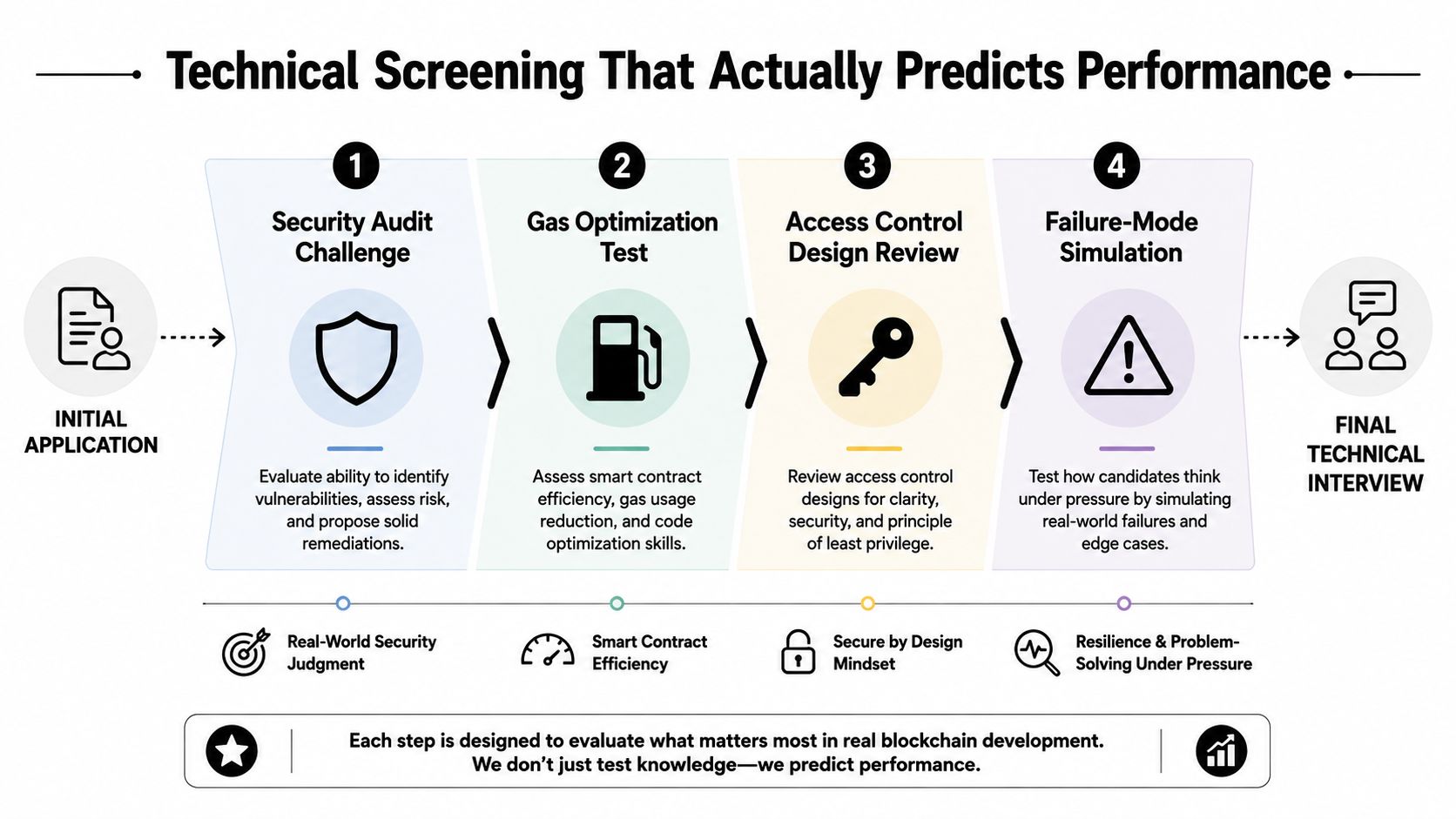
A technical screen should verify shipped work before it rewards polished résumés. Ask for at least one mainnet deployment, inspect the related wallet and contract addresses, and review GitHub history for merged pull requests, audit involvement, and production contributions. A broad “blockchain developer” title can hide major differences between protocol, smart-contract, and dApp experience, so Pin's recruiting guidance is a useful reference for checking the work behind the label.
Start with evidence, then test reasoning
On-chain verification is only the starting point. Ask the candidate what they owned, which trade-offs they made, what changed after deployment, and what they would redesign today. If they cannot separate their contribution from the team's work, the deployment provides weak evidence.
For smart-contract roles, use a real codebase or a contract containing planted vulnerabilities. Daily.dev's recruiter framework recommends assessing bug-finding accuracy, access-control reasoning, gas-optimization decisions, test coverage, and remediation quality during a code walkthrough.
A practical exercise can ask the candidate to:
- Identify vulnerable functions and explain the attack path.
- Rank findings by severity and exploitability.
- Propose a fix without introducing a new state or permission problem.
- Discuss gas implications and whether an optimization affects readability or safety.
- Add or describe tests for adversarial inputs and edge cases.
- Explain assumptions that could fail in production.
Score the reasoning, not only the final patch. A candidate who finds fewer issues but explains uncertainty, attack surfaces, and remediation trade-offs may be safer than someone who produces a confident, shallow list.
Use role-specific evaluation
Protocol candidates need design discussions about state transitions, incentives, fault tolerance, and system behavior. dApp candidates should demonstrate wallet flows, transaction-failure handling, TypeScript quality, and dependable use of on-chain data. Infrastructure candidates need to discuss nodes, indexers, observability, recovery, and production operations.
Practical rule: If the role touches irreversible state, the interview must examine how the candidate thinks about failure before it examines how quickly they write code.
Common red flags include a résumé with no verifiable deployment, enthusiasm for frameworks without security analysis, inability to explain audit findings, and resistance to code review. Treat access control, upgradeability, oracle assumptions, and testing as part of the candidate's responsibility when the role affects them. A protocol engineer who cannot discuss system incentives should not be assessed with the same rubric as a dApp engineer focused on wallet UX.
Compress the decision without lowering the bar
A rigorous hiring loop can still move quickly. Send the exercise promptly, schedule the walkthrough while the candidate remains engaged, and assign one accountable decision-maker. Avoid repeating the same technical conversation across several interviewers.
The aim is to remove administrative delay, not to rush someone into an offer. A precise screen gives candidates a fair opportunity to show their ability and gives the team enough signal to decide before the market moves.
Compensation Structures That Attract and Retain
Compensation is where many Web3 hiring processes become strategically inconsistent. Teams offer a large token allocation to compensate for a weak base, then wonder why candidates hesitate. Others pay a premium for a broad “blockchain developer” profile while underfunding the security or protocol capability their roadmap needs.
U.S. base-pay guidance in CoinTerminal's Web3 jobs guide places junior smart-contract developers around $80,000 to $100,000, mid-level developers around $120,000 to $160,000, and senior developers around $180,000 to $250,000 or more. Senior protocol and infrastructure engineers can reach $200,000 to $300,000. A separate USV compensation analysis found that senior Web3 engineers earned a 23% premium over comparable general-market engineers, while early-career engineers earned a 27% premium.
Benchmark the role, not the label
The table below is a practical benchmark for U.S. base pay. It reflects smart-contract developer guidance, not a universal rate card for every country or specialty.
| Role | Junior | Mid-Level | Senior |
|---|---|---|---|
| Smart-contract developer | $80,000 to $100,000 | $120,000 to $160,000 | $180,000 to $250,000+ |
| Protocol or infrastructure engineer | Not specified in the cited benchmark | Not specified in the cited benchmark | $200,000 to $300,000 |
Security and audit work can command a further premium. Recent Crypto Recruit guidance describes Web3 base pay broadly ranging from about $80,000 to $250,000 or more, with senior auditors and engineers sometimes reaching $300,000 or more before bounties or token upside.
Don't use those figures as automatic offer amounts. Use them to identify the market position of the work. A generalist who can build a prototype isn't interchangeable with an engineer who has handled protocol infrastructure, zero-knowledge systems, or security-critical contracts.
Balance fiat certainty with token upside
A stablecoin or fiat base gives candidates predictable purchasing power and makes the offer easier to compare. A token grant can create upside and connect the engineer to the network's long-term success, but its value may fluctuate and its liquidity may be constrained.
A durable package should explain:
- Base compensation: State whether pay is in fiat, stablecoins, or a combination, and clarify how payment timing works.
- Token allocation: Define the number of tokens or the allocation method, rather than presenting an undefined future reward.
- Vesting mechanics: Tie vesting to continued contribution and explain cliffs, releases, and departure treatment in plain language.
- Milestones: Use measurable technical or product milestones only when the candidate can influence them.
- Risk disclosure: Explain liquidity, lockups, governance, and tax treatment without presenting upside as guaranteed value.
Milestone-based vesting can align incentives, but poorly designed milestones punish engineers for delays controlled by product, legal, or funding teams. Retention improves when the package reflects the employee's real sphere of control.
Don't confuse excitement with retention
Candidates may accept token upside because they believe in the protocol, but they stay when the role has credible ownership, strong reviews, manageable risk, and transparent leadership. Compensation should reinforce those conditions, not substitute for them.
Ask candidates which combination they value. Some want a larger predictable base. Others want meaningful token exposure and are comfortable with uncertainty. The right offer makes that trade-off explicit instead of hiding it inside a headline allocation.
Onboarding Compliance and Long-Term Retention
Closing the offer doesn't transfer production judgment to the new hire. The first phase should give the engineer enough context to understand the architecture, threat model, deployment process, and decision boundaries before they touch sensitive systems.
Remote onboarding works best when access follows responsibility. Start with documentation, repository history, architecture diagrams, test environments, incident records, and a clear explanation of who approves deployments. Provision production access gradually, use peer review for high-risk changes, and make security escalation paths explicit.
Build the first 90 days around evidence
The opening period should produce visible learning and controlled contribution:
- Architecture understanding: Have the engineer map the systems they'll own, including dependencies and trust boundaries.
- Security context: Review previous audit findings, known assumptions, upgrade paths, and incident procedures.
- Low-risk contribution: Begin with tests, documentation, tooling, or a narrowly bounded fix that reveals how the engineer works.
- Review calibration: Pair the hire with a senior reviewer and compare expectations about severity, testing, and release readiness.
- Ownership transition: Expand responsibility only after the engineer demonstrates reliable reasoning in the team's actual workflow.
Avoid assigning a critical contract or protocol component immediately because the résumé looks impressive. On-chain proof confirms past work, but your architecture, process, and risk tolerance are new to the hire.
Treat cross-border compensation as an operating issue
Token grants, stablecoin payments, and contractor arrangements can create legal, tax, classification, and reporting obligations that vary by jurisdiction. Involve legal and finance teams before presenting the package, document whether the token component is discretionary or contractual, and explain how payment and vesting are administered.
The same care applies to access and identity. A remote engineer still needs controlled credentials, documented approvals, secure communication, and an offboarding process that removes access promptly. These practices protect the protocol while giving the developer a professional environment in which to do their best work.
Retention depends on the working relationship
Top candidates receive competing offers, but compensation is only one part of the decision. Retention improves when engineers can influence architecture, see how their work affects users, receive technically credible feedback, and understand how their token or fiat package changes over time.
Review the role after the initial ramp. If the company hired a smart-contract engineer but keeps assigning front-end tasks, or hired a protocol specialist but limits them to ticket execution, the mismatch will eventually appear in performance and engagement. A precise hiring decision must be followed by equally precise role management.
The complete framework is simple to state, even if it takes discipline to execute: verify proof of work, classify the role correctly, test security judgment, make a clear offer, and onboard through controlled ownership. That sequence prevents the hidden failures that resumes and generic interviews routinely miss.
Blockchain Jobs helps employers reach crypto-native candidates across engineering, security, protocol, infrastructure, product, and other Web3 functions, while giving candidates a focused place to find relevant opportunities. Visit Blockchain Jobs to post a specialized role or start your search with a more credible talent pool.