Master the STAR Method for Resume Success in 2026

You're probably looking at your resume right now and thinking a version of the same thing most strong candidates think: “I've done real work. Why doesn't this sound impressive on paper?”
That problem usually isn't experience. It's translation. Most resumes describe duties, but hiring managers shortlist outcomes. If your bullets read like job descriptions, your resume blends in with everyone else who held a similar title.
The STAR method for a resume fixes that. It gives you a structure for turning work history into evidence. Not vague claims. Not inflated language. Clear proof of what you handled, what you changed, and why it mattered when someone else paid you to do it.
Why Your Resume Is More Than a List of Duties
A weak resume says what you were assigned. A strong resume says what you achieved.
That distinction matters because recruiters don't hire responsibilities. They hire people who can solve problems, improve a process, ship a feature, calm a community, close a gap, or move a product forward. When your bullet says “managed partnerships” or “handled Discord moderation,” the reader still has to guess whether you did that well.
The STAR method helps remove that guesswork. Career guidance built around resume writing uses Situation, Task, Action, Result to turn work history into measurable achievement statements, and guidance commonly recommends about three bullet points under each employer, with up to five for a most recent role, while starting each bullet with a strong action verb and adding numbers whenever possible to show impact, as explained in Indeed's STAR method resume guide.
What recruiters actually scan for
In practice, most hiring reviews are fast. The first pass usually looks for:
- Relevant scope: Did you work on the kind of problem this team has?
- Clear ownership: Were you the driver, contributor, or observer?
- Visible impact: Did anything improve because of your work?
- Fit for the next step: Does your history support the interview?
A duty-based bullet hides all four.
Compare “Responsible for smart contract testing” with “Built and ran smart contract testing workflows before launch, reducing deployment risk and giving the team cleaner release decisions.” The second version gives context, ownership, action, and business value, even if you don't have a perfect metric to include.
Practical rule: If a bullet could be copied onto another candidate's resume with the same title, it's too generic.
That's why the STAR method for resume writing is more than a formatting trick. It changes the lens. Instead of asking, “What was my job?” you ask, “What did I influence, improve, fix, launch, or protect?”
If you're actively refining your positioning for Web3 roles, the hiring advice on the Blockchain Jobs blog is worth reviewing alongside your resume work. Resume strategy works best when it matches how the market is hiring.
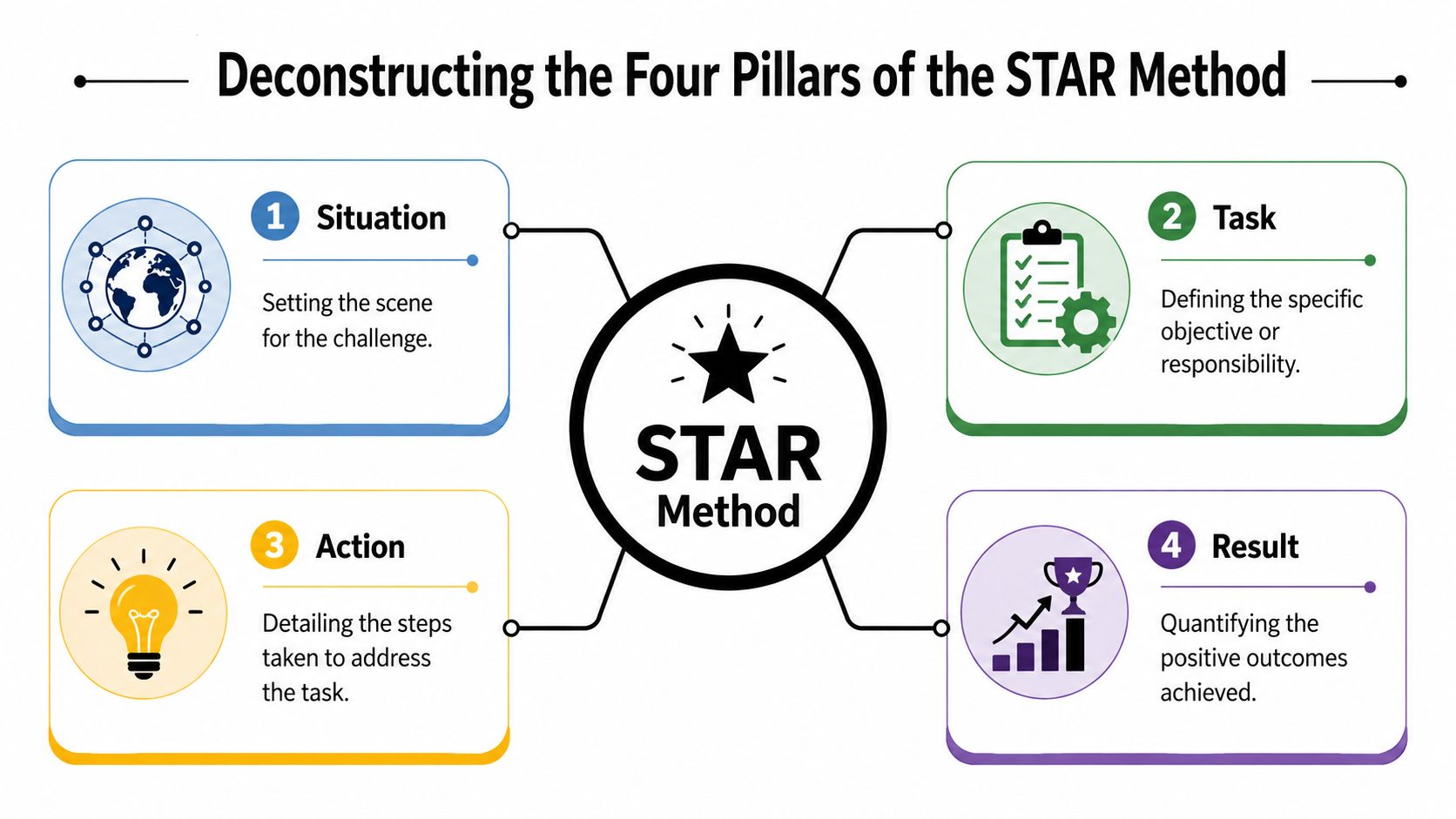
Deconstructing the Four Pillars of the STAR Method
The STAR method works because it forces specificity. You stop writing broad claims and start writing evidence.
Situation
This is the context. It answers, “What was going on?”
On a resume, the situation should stay short. You're not writing a story. You're giving the reader just enough background to understand the challenge, the environment, or the business need.
Good prompts:
- What team, product, or function were you supporting?
- What problem existed before you stepped in?
- What made the work high-stakes, messy, or time-sensitive?
For example, a blockchain engineer's situation might be a contract deployment with heavy gas concerns. A community lead's situation might be a fragmented Discord with low-quality engagement. A compliance analyst's situation might be a growing operational workload with inconsistent documentation.
Task
This is your specific objective or responsibility inside that situation.
Many candidates skip this and go straight from context to action. That creates fuzzy bullets. The task is what clarifies your role. It tells the employer what you were accountable for.
Ask yourself:
- What was I expected to deliver?
- What decision, project, or issue sat on my desk?
- What outcome was I responsible for influencing?
The strongest task statements usually align with the hiring target. If the role emphasizes stakeholder management, process design, smart contract audits, token operations, or documentation, pull that thread into the task portion of your bullet.
Action
This is the most important part for credibility. It explains what you did, not what the team did around you.
Use verbs with real meaning. Built. Launched. Audited. Negotiated. Reworked. Automated. Prioritized. Diagnosed. Standardized.
If you need help choosing stronger language, a good reference is this guide for finance professionals' interviews, because competency-based interview prep and resume writing rely on the same core skill: showing what you did under pressure.
Useful action prompts:
- What steps did I personally take?
- What tools, workflows, or systems did I use?
- What decisions did I make that changed the outcome?
Result
Most average resumes fall apart here. They stop at activity.
The result tells the employer why your action mattered. It can be a metric, a quality improvement, a speed gain, reduced risk, better handoff, stronger adoption, smoother execution, or cleaner decision-making. If you have numbers, use them. If you don't, state the outcome clearly and accurately.
Results don't have to be dramatic. They do have to be concrete.
A practical way to build STAR bullets is to start with the job description, choose 2 to 3 target behaviors or skills, then translate your experience into Situation, Task, Action, and Result before condensing it into accomplishment bullets, as outlined in Resume Worded's STAR resume advice.
From Vague Duties to High-Impact Accomplishments
Most resumes don't fail because the candidate lacks experience. They fail because the writing is passive, padded, or too broad to prove value.
A strong STAR bullet isn't long. It's selective. Career guidance commonly recommends keeping individual STAR bullets to roughly 20 to 25 words and limiting a resume summary to 2 to 4 sentences, reflecting the push for brevity and quantification. That same guidance often reinforces results with example metrics such as 20% sales growth or 15% process-time reduction, as shown in MyPerfectCV's STAR CV guidance.
The editing test that improves almost every bullet
Take any bullet on your resume and check it against three questions:
- Does it start with action?
- Does it show ownership instead of participation?
- Does it end in a result or business value?
If the answer is no, rewrite it.
Here's the shift in practice.
| STAR Method Transformation Example | |
|---|---|
| Before STAR Method | After STAR Method |
| Responsible for managing community channels | Rebuilt community moderation workflows across Discord and Telegram, improving response consistency and giving members clearer support paths |
| Helped with smart contract development | Developed and tested smart contract components for protocol releases, improving deployment readiness and reducing back-and-forth during review |
| Worked on product roadmap | Prioritized roadmap items with engineering and design, aligning feature delivery with user pain points and improving release focus |
| Created onboarding documents | Built onboarding documentation for internal teams, shortening ramp-up friction and making recurring processes easier to follow |
Why the “after” version works
The improved bullet doesn't just sound more polished. It answers the hiring manager's hidden questions.
- What kind of work was this? Community ops, engineering, product, documentation.
- What did the candidate do? Rebuilt, developed, prioritized, built.
- Why should I care? The work improved consistency, readiness, focus, or ramp-up.
That's the whole point of the STAR method for resume writing. You're compressing a work story into a line that earns an interview.
A quick rewrite formula
Use this formula when you're stuck:
Action verb + what you worked on + how you did it + result
For example:
Managed treasury operations
becomes
Standardized treasury reporting across internal stakeholders, improving visibility into recurring workflows and reducing manual follow-upWrote technical content
becomes
Produced protocol documentation for developers and partners, clarifying implementation details and reducing repeated support questionsModerated Discord
becomes
Led daily Discord moderation and escalation handling, improving member experience and keeping issue resolution organized
If your verbs feel weak, scan a dedicated list like the Resumatic action verbs resource and replace placeholders such as “helped,” “worked on,” and “responsible for.” That one change sharpens a resume faster than most candidates expect.
Shorter usually wins. If a bullet needs two breaths to read, it probably needs editing.
STAR Method Examples for Blockchain and Web3 Roles
A hiring manager reviewing ten Web3 resumes in a row will spot the same weak pattern fast. Candidates list tools, protocols, and communities they touched, but they do not show what changed because of their work. In blockchain hiring, that gap matters more because titles vary, teams are lean, and the work often spans product, engineering, operations, and go-to-market.

Strong STAR bullets for Web3 roles do two jobs at once. They make the scope clear for a recruiter skimming in seconds, and they include the technical context an ATS or hiring manager expects to see. That is the difference between “worked on smart contracts” and a bullet that signals shipping discipline, cross-functional judgment, and relevance to the role.
Blockchain engineer example
Before
Wrote smart contracts for DeFi product.
After
Developed and tested Solidity smart contract logic for DeFi product releases, partnering with auditors and internal reviewers to catch issues earlier and reduce last-minute revision cycles.
Why it works: “Solidity,” “smart contract,” and “DeFi” give ATS systems concrete matches. “Partnering with auditors” tells an engineering lead this candidate understands production risk, not just coding.
Web3 community manager example
Before
Managed Discord and helped users.
After
Led daily Discord moderation, support escalation, and community event coordination for a Web3 project, improving response clarity and reducing repeat issues across member channels.
Why it works: community teams do not hire for posting alone. They hire for judgment, consistency, and the ability to keep public-facing operations under control when things get noisy.
DeFi product manager example
Before
Oversaw roadmap for lending platform.
After
Prioritized roadmap decisions for a DeFi lending product by balancing engineering constraints, user feedback, and release goals, helping the team ship features with clearer scope and fewer downstream blockers.
Why it works: good product bullets show trade-offs. In DeFi, that often means balancing speed, risk, compliance concerns, and technical debt without turning the bullet into a wall of jargon.
One of the fastest ways to sharpen your wording is to compare your bullets against active roles in the market. Read a posting like this senior technical writer role at QuickNode, then mirror its terminology only where your experience matches. That approach helps you optimize your job application without stuffing keywords or weakening the result.
Technical writer and operations examples
Technical writer before
Created docs for developer tools.
Technical writer after
Produced developer documentation for blockchain tooling and API workflows, translating implementation details into clearer guidance that reduced confusion for users and internal teams.
Why it works: technical writing resumes often fail because they describe output, not usefulness. This version shows audience, subject matter, and business value.
Operations manager before
Handled partnerships and internal processes.
Operations manager after
Standardized partner-facing operating processes across internal teams, improving handoffs, clarifying ownership, and making recurring execution more reliable.
Why it works: operations hiring in Web3 often sits between partnerships, compliance, support, and product. A bullet like this shows process control, which is usually what the team needs.
If you want more help tailoring bullet language for screening systems, this guide on how to optimize your job application is a useful supplement.
This short video is a useful companion if you want another walkthrough of how the framework translates into resume-ready bullets.
In Web3 hiring, specificity beats buzzwords. “Built governance tooling” beats “passionate about decentralization.”
Optimizing STAR Bullets for ATS and Job Descriptions
A bullet can be excellent and still underperform if it doesn't match the language of the role.
That's the gap many candidates miss. Mainstream STAR resume guides often say to incorporate keywords, but they rarely explain how to preserve the Situation, Task, Action, Result structure while matching the job description. That gap matters in technical markets like blockchain, where roles require distinct skill clusters and tailoring is essential, as noted in Resume Now's discussion of STAR resumes.
Match language without sounding robotic
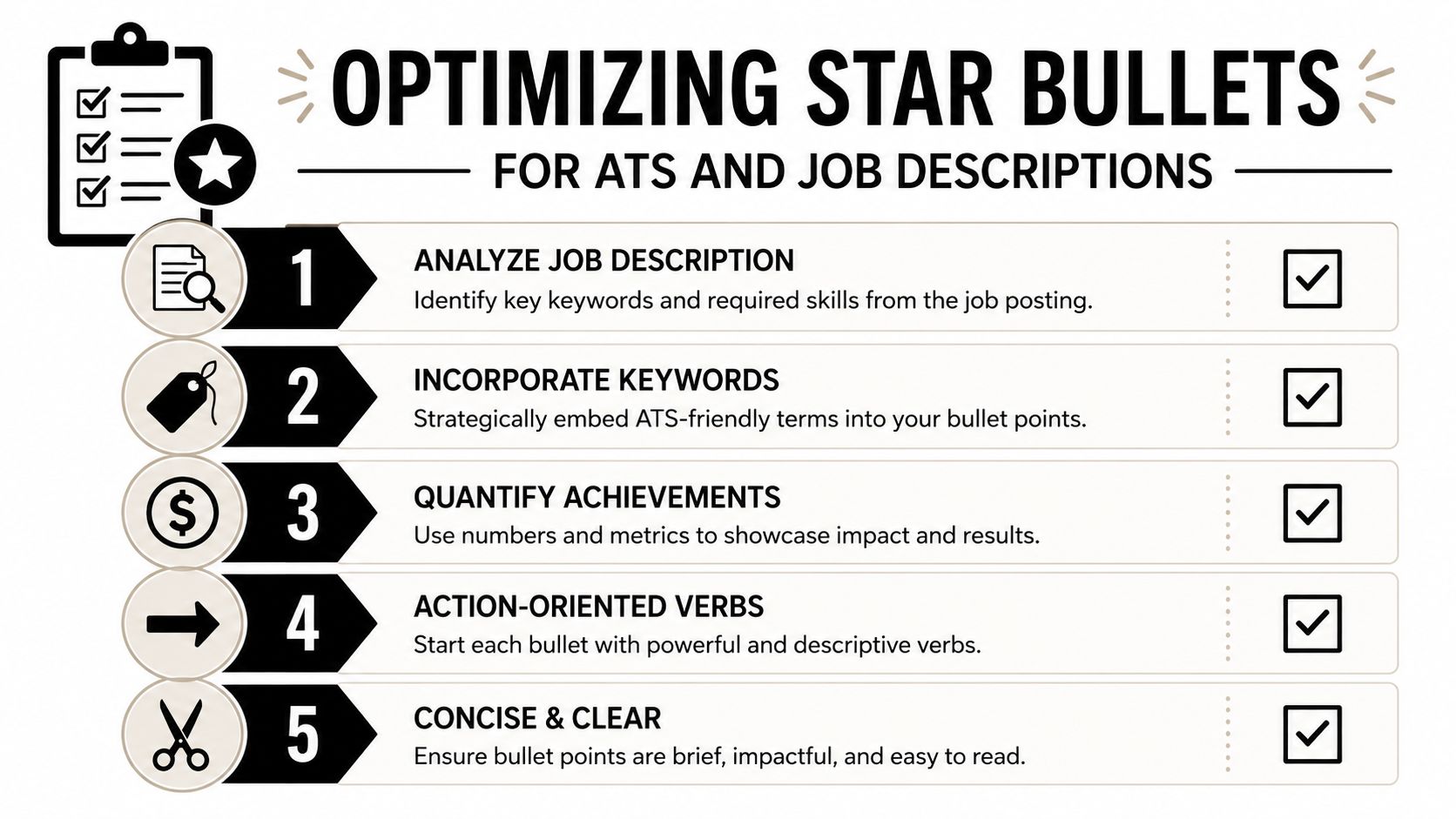
Start by pulling repeated terms from the posting. In blockchain hiring, that might be things like smart contracts, protocol design, ecosystem growth, compliance operations, governance, product analytics, incident response, or developer documentation.
Then rewrite your existing bullets so the terminology lines up where it's true.
For example:
- “Built backend features” becomes “Built backend features supporting blockchain data workflows”
- “Created documentation” becomes “Created developer documentation for API and integration workflows”
- “Managed support process” becomes “Managed support and escalation workflows for partner integrations”
That isn't keyword stuffing. It's alignment.
Formatting choices that help both systems and humans
ATS-friendly resumes are usually simple resumes. Use standard headings. Keep bullets clean. Avoid turning core information into unusual layout elements. If the system can parse the content and a recruiter can scan it quickly, you're in good shape.
Use this checklist:
- Mirror the posting language: If the role says “smart contract security,” don't hide the match under a vague phrase like “blockchain code review.”
- Keep bullets scannable: One idea per bullet is easier to read and easier to parse.
- Lead with substance: Put the strongest verb and relevant keyword early.
- Tailor by role family: The same experience can be framed differently for engineering, product, compliance, or content.
If you want a separate tactical read on ATS mechanics, this guide on how to optimize your job application is a helpful supplement.
For candidates targeting people-focused functions in Web3, browsing actual human resources roles is also useful because it shows how quickly keyword priorities shift from one job family to another.
Common Mistakes to Avoid and Final Pro Tips
The biggest mistake is leaving out the result. The second is writing bullets that describe participation instead of contribution. The third is making every bullet so long that the signal gets buried.
A few fixes matter most:
- Cut generic openings: Replace “Responsible for” with a real verb.
- Stop at one core win per bullet: Don't cram an entire project into one line.
- Keep proof honest: If you don't have numbers, state the outcome qualitatively.
- Build a master bank: Keep a document of STAR stories from every role, project, launch, audit, incident, and collaboration.
- Tailor before you apply: The best bullet for a protocol role usually isn't the best bullet for a community or product role.
Your resume doesn't need more adjectives. It needs clearer evidence.
If you're ready to turn stronger resume bullets into real interviews, explore current opportunities on Blockchain Jobs. It's a focused place to find Web3 roles across engineering, product, marketing, operations, compliance, content, and more, without digging through generic job boards.