
Crypto Engineer Jobs: A 2026 Career & Salary Guide

You're probably in one of two camps right now.
Either you're a backend or infrastructure engineer looking at crypto engineer jobs and wondering whether the salaries are real, or you've already tried the standard path, learned some Solidity, built a toy token, and realized that didn't make you feel job-ready. Both reactions are reasonable.
Most of the public advice is too narrow. It treats crypto engineering like a small niche where everyone writes smart contracts all day. Actual hiring is broader than that. Teams still need people who can reason about distributed systems, ship backend services, secure production systems, debug ugly failures, and work across messy integration boundaries.
That's the opening most mid-level engineers miss. You do not need to become a pure protocol researcher overnight. In many cases, the stronger path is to bring your existing production engineering skills into Web3, then add the blockchain-specific layer on top.
Why Crypto Engineering Is More Than Just Hype
You deploy a backend service on Friday. By Monday, a normal web bug means a rollback, a patch, and an incident review. In crypto, the same level of mistake can mean stuck funds, bad state written on-chain, broken signing logic, or an exploit that someone notices before your monitoring does.
That is why serious engineers stay in this field.
The noise around crypto is real. Prices swing, product categories get renamed every few months, and job posts pile on terms like zk, MEV, rollups, bridges, intents, and account abstraction. Strip that away and the underlying work is still difficult, technical, and worth doing. Teams are building execution clients, custody systems, wallet infrastructure, indexers, cross-chain services, payment rails, data pipelines, and developer tooling. Those systems have real users, real operational load, and expensive failure modes.
The biggest misconception is that crypto engineering means smart contracts and little else. Hiring managers at strong teams usually need a wider profile. They need engineers who can run production systems, reason about distributed state, secure key material, debug unreliable RPC behavior, and build off-chain services that stay consistent with what happened on-chain.
That is why backend, security, and infrastructure engineers often have a faster path into Web3 than people who start with Solidity tutorials alone.
What the work actually feels like
A good mental model is distributed systems under financial and adversarial pressure. You are still dealing with queues, retries, replicas, APIs, databases, and observability. But you are also dealing with finality rules, signer isolation, replay protection, mempool behavior, chain reorganizations, and the fact that attackers can study your system in public.
The trade-offs are different too. Shipping fast still matters. So do correctness and operational discipline. A small shortcut in a wallet flow, withdrawal pipeline, or contract integration can create a security issue instead of a minor product bug.
If you already enjoy tracing race conditions, tightening trust boundaries, and making unreliable systems behave in production, you are not starting from zero here.
Why the field keeps attracting strong engineers
The durable demand is tied to system design, not hype cycles. Crypto products need engineers who can make hard systems safe enough to use and boring enough to operate.
Some roles are highly chain-specific. Others look much closer to high-stakes backend engineering. A team may need a service that consumes chain events, reconciles deposits, handles reorgs, exposes an API to the product layer, and fails safely when an RPC provider returns inconsistent data. That is crypto engineering work, even if you never write a complex contract yourself.
The teams worth taking seriously are usually solving problems like these:
- State correctness: keeping off-chain services, internal ledgers, and on-chain activity in sync
- Security boundaries: protecting keys, signer access, admin flows, and contract assumptions
- Operational reliability: handling RPC failures, indexing lag, duplicate events, reorgs, and degraded providers
- Interoperability: connecting wallets, contracts, rollups, custodians, and backend systems without brittle glue code
That is the practical reason this field keeps pulling in experienced engineers. The work combines production engineering, security thinking, and financial correctness in ways that standard SaaS rarely does. For the right kind of builder, that is not hype. That is a hard job with real consequences, which is exactly why it is interesting.
Decoding the Different Crypto Engineer Roles
Role names in crypto are messy. Two companies can use the same title for different work, and one company can split a role into multiple specialties. Ignore the title first. Look at the layer of the stack and the failure modes you'd own.
Here's the role map that helps.
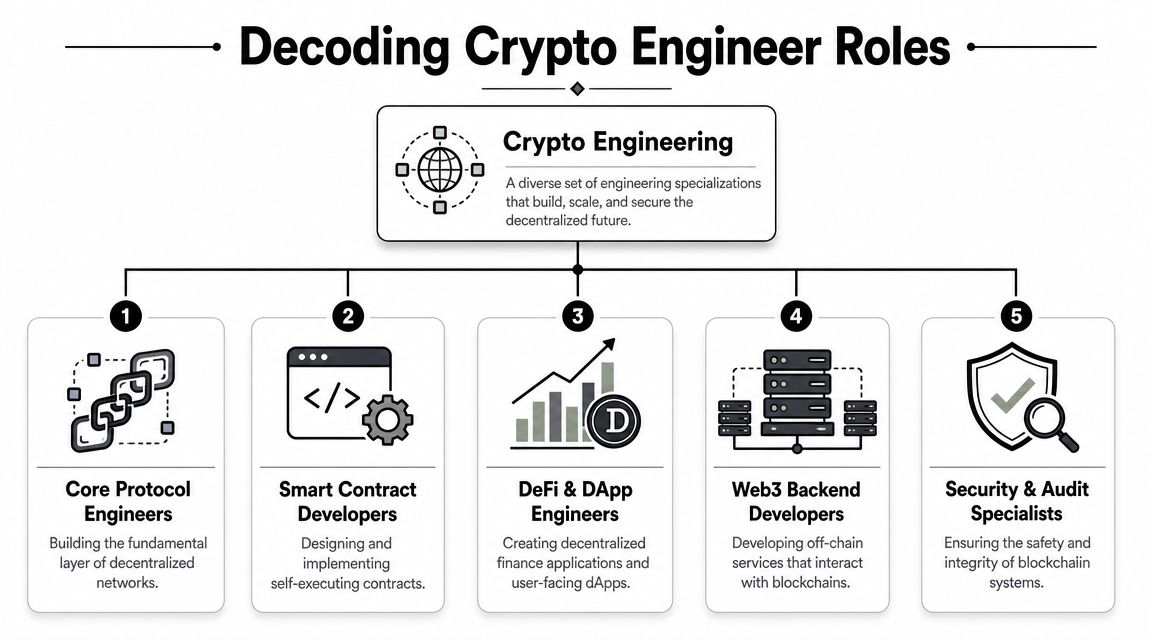
The five role families that matter most
| Role | Core Focus | Analogy | Key Problems Solved |
|---|---|---|---|
| Protocol Engineer | Network rules, consensus, execution, node behavior | Civil engineer designing roads and bridges | Throughput, finality, correctness, protocol safety |
| Smart Contract Engineer | On-chain application logic | Product manufacturer building the machine itself | Asset logic, permissions, settlement, upgrade patterns |
| DeFi and DApp Engineer | User-facing product plus contract interactions | Application architect connecting machines to customers | Wallet flows, transaction UX, event handling, product logic |
| Web3 Backend Developer | Off-chain services that support blockchain apps | Logistics operator keeping everything coordinated | Indexing, APIs, signing services, data pipelines, notifications |
| Security and Audit Specialist | Threat modeling and code review across the stack | Building inspector checking structural risk | Vulnerabilities, unsafe assumptions, attack paths, exploit prevention |
A visual walkthrough helps if you want to see how these roles relate in practice.
Protocol engineering versus smart contracts
These two get lumped together too often.
Protocol engineers work closer to the chain itself. They care about peer-to-peer networking, execution clients, consensus rules, storage, transaction propagation, and systems correctness. If you like Go, Rust, distributed systems internals, and performance work, this is the heavy machinery layer. The pay often reflects that depth. One market snapshot put average annual pay at about $154K for protocol engineers versus $125K for smart contract engineers in CryptoJobs' engineering salary breakdown.
Smart contract engineers own the business logic that runs on-chain. The work is narrower in one sense and harsher in another. You ship code into an adversarial environment where mistakes can be permanent. This path fits engineers who like product logic, formal constraints, and careful security review.
The overlooked middle ground
A lot of mid-level engineers don't belong in either extreme right away. They fit better into roles that connect chain systems to production software.
That usually means one of these:
- Web3 backend engineering where you build services around RPC providers, event listeners, transaction orchestration, auth, notifications, and data pipelines
- Infrastructure and SRE work where you harden nodes, observability, deploy pipelines, secrets handling, and incident response
- Security engineering where you review contracts, model attack surfaces, and improve secure SDLC practices
Most hiring managers would rather train a strong production engineer on chain specifics than hire someone who only knows tutorial Solidity and can't operate real systems.
How to choose your lane
Pick the role family that matches the kind of mistakes you're comfortable owning.
If low-level correctness, performance, and systems behavior excite you, protocol work may fit. If you like product logic and tight execution constraints, smart contracts are a better match. If you already know backend systems, queues, APIs, data stores, and production operations, Web3 backend is usually the fastest route into crypto engineer jobs.
The common mistake is trying to force yourself into the most glamorous title. The better move is to enter where your existing strengths already create trust.
The Essential Skills and Tooling for 2026
The market doesn't reward “learn Solidity” nearly as much as people think. Solidity matters, but employers increasingly want engineers who can move across the full system, from chain logic to backend integration to operational reliability.
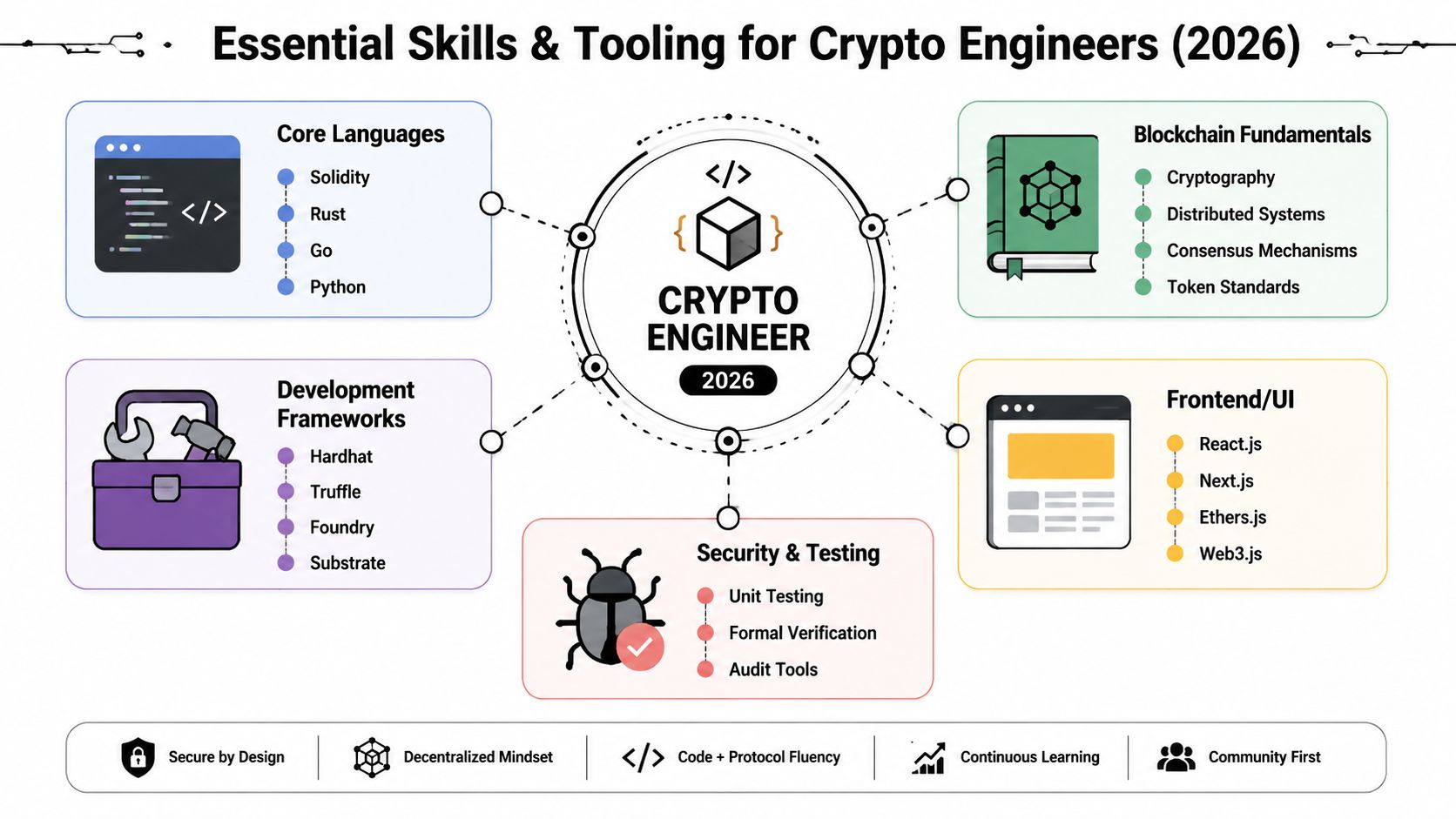
Start with the foundations that transfer
The strongest engineers in this space usually have ordinary software fundamentals done well.
That means:
- Distributed systems thinking: You should understand replication, eventual consistency, failure handling, message ordering, and trade-offs around availability and correctness.
- Security basics: Access control, signing, key management, replay risk, unsafe assumptions, dependency hygiene, and threat modeling all matter.
- Data modeling discipline: A lot of Web3 product bugs come from weak off-chain representations of on-chain state.
- Networking and backend fluency: RPC behavior, retries, idempotency, queues, and service boundaries matter more than most tutorials admit.
If your local workflow still feels clumsy, spend time finding a text editor for coding that supports fast navigation, linting, and multi-language work. Crypto engineering often means switching between Solidity, TypeScript, Rust, shell tooling, and config files in the same hour.
Learn chain-specific tools, but don't stop there
A modern crypto developer profile is broader than contract syntax. Braintrust's role spec highlights experience with smart contracts, dApps, blockchain protocols, consensus algorithms, cryptographic techniques, and platforms such as Ethereum or Solana, along with bridges, layer-2 solutions, and cross-chain communication in its crypto developer job description guide.
That's a better hiring lens than “know Solidity.”
Useful tools and stacks include:
- Contract development: Foundry, Hardhat, OpenZeppelin
- Chain interaction: ethers.js, viem, web3.js
- Backend integration: Node.js services, queues, webhooks, event processors
- Protocol-side languages: Rust and Go show up often in deeper systems work
- Indexing and data access: The Graph, custom indexers, chain data pipelines
- Wallet and signing flows: EIP standards, transaction simulation, nonce handling
For a concrete example of how specialized these roles look in practice, browse a live smart contract engineer opening on Blockchain Jobs and compare the listed requirements with your current stack.
Build the production layer most candidates skip
At this stage, candidates separate themselves.
A lot of applicants can deploy a contract. Fewer can answer questions like:
- How will you recover if an RPC provider returns inconsistent data?
- How do you reconcile chain reorganizations in an event-driven backend?
- What's your strategy for secret rotation and signer isolation?
- How do you test cross-chain logic when multiple components can fail differently?
The engineers who get hired fastest usually combine chain knowledge with operational maturity.
So build projects that include more than contracts. Add a backend service. Add monitoring. Simulate failure. Show that you can make a crypto product survive contact with production.
Crypto Engineer Salary and Market Demand
A common hiring scenario looks like this. One candidate has a few Solidity projects and strong opinions about token design. The other has spent years running payment systems, handling incident response, building event-driven services, and learning the chain-specific parts on top. The second candidate often gets the interview faster, and in many teams, gets the higher offer.

Compensation in crypto engineering is real, but it is uneven. Pay rises with responsibility for money movement, security exposure, distributed systems complexity, and production ownership. Hiring managers are not paying extra for a Web3 label. They are paying for engineers who can keep critical paths correct under failure.
Why some roles earn more than others
The strongest salaries usually cluster around work that is hard to replace and expensive to get wrong.
That includes:
- Protocol engineering, where correctness bugs can affect node behavior, consensus assumptions, or chain performance
- Security-heavy engineering, where review quality, threat modeling, and exploit prevention directly protect funds
- Backend and infrastructure roles in crypto, where teams need engineers who can run indexers, transaction pipelines, signer services, observability, and recovery workflows in production
This is the part of the market many candidates miss. A company launching wallets, exchanges, bridges, custody systems, or onchain data products often needs fewer pure contract specialists than expected. It needs engineers who can connect chain logic to reliable services, queues, databases, monitoring, and operational controls.
How to read market demand correctly
Job demand in crypto is wider than the title "crypto engineer" suggests. Companies hire under backend engineer, infrastructure engineer, security engineer, protocol engineer, developer tooling engineer, and platform engineer, then list chain experience as part of the stack.
That matters during a job search.
If you only search one title, you will miss a large part of the market. A better approach is to scan active crypto companies currently hiring, then read the role descriptions for signs of chain data handling, signing flows, smart contract integration, indexing, or protocol work. The title is often less informative than the actual responsibilities.
What this means for career decisions
Engineers tend to get the best compensation when they bring four things at once:
- Ownership of business-critical systems
- Security judgment
- Production experience
- Useful depth in a hard technical area
That is why the "crypto + production engineering" profile keeps winning. A backend engineer who understands reorgs, signer isolation, transaction lifecycle management, and chain data consistency is valuable to more teams than a candidate whose experience stops at writing contracts. For a mid-level developer entering Web3, that is usually the smarter path.
How to Frame Your Resume for a Crypto Job
The best crypto resume doesn't scream “I love Web3.” It shows that you can build reliable systems in a hostile environment.

A lot of candidates make the same mistake. They lead with tutorial projects, bury their serious engineering work, and make themselves look junior even when they aren't. Meanwhile, job listings increasingly ask for Node.js, backend technologies, and 2 to 10+ years of experience, which supports the idea that the strongest candidates position themselves as “crypto + production engineering” specialists in current blockchain engineer listings on Indeed.
Translate your old experience into crypto language
Don't rewrite your background. Reframe it.
If you've worked on event-driven systems, you've already dealt with asynchronous state. If you've built payment systems, you know correctness and reconciliation. If you've handled secrets, auth, observability, and incident response, you've done work crypto teams need.
Bad bullet:
- Built backend APIs for customer transactions
Better bullet:
- Built backend services for transaction orchestration, idempotent processing, and failure recovery across external dependencies
Bad bullet:
- Managed deployment pipelines and cloud infrastructure
Better bullet:
- Owned production deployment workflows, secrets handling, observability, and rollback safety for customer-facing services with strict reliability requirements
Bad bullet:
- Integrated third-party data feeds into internal systems
Better bullet:
- Built ingestion and reconciliation pipelines for external data sources, including schema validation, retry handling, and downstream consistency checks
Those revised bullets sound closer to the daily needs of wallets, exchanges, custody systems, indexers, and DeFi infrastructure.
What to put near the top
The first half of your resume should answer one question fast: why should a crypto team trust you with production systems?
Use that space for:
- A sharp summary: Mention backend, infra, security, or distributed systems strengths before listing chain tools
- Relevant keywords: Smart contracts, EVM, Node.js, RPC, event indexing, wallets, signing, Solidity, Foundry, Rust, Go, security review
- Selected projects: Fewer, deeper projects beat a gallery of clones
- GitHub proof: Tests, docs, issue discussions, and sensible repo structure matter
If you want to see which companies are hiring across different slices of the ecosystem, scan the current employer mix on Blockchain Jobs company listings. It's a good reminder that not every crypto role sits at the same layer of the stack.
A hiring manager will forgive limited chain experience faster than weak engineering judgment.
What works better than another side project
One polished side project is enough if it proves the right things. A better use of time is often one of these:
- Open-source contributions: Bug fixes, tests, docs, tooling improvements
- Security write-ups: Explain a vulnerability, patch, or trade-off clearly
- Operational case studies: Show how you built indexing, monitoring, retries, or signer safety
- Protocol notes: Break down how a system works and where it can fail
That kind of material gives interviewers something concrete to trust. It also makes your resume feel like evidence instead of aspiration.
Acing the Crypto Engineering Interview
Crypto interview loops vary, but the strong ones test three things. Can you code? Can you reason about systems? Can you see risk before it becomes an incident?
What each interview stage is really checking
The recruiter screen usually filters for motivation and fit. You don't need a grand narrative. You need a coherent reason for moving into crypto and a realistic understanding of the work.
The technical screen often looks ordinary on the surface. Coding, debugging, maybe some backend design. Don't relax too much. Interviewers are listening for whether you think in terms of correctness and adversarial conditions, not just feature delivery.
The deeper rounds tend to split in one of these directions:
- Smart contract focus: Vulnerabilities, access control, upgradeability, testing strategy, gas trade-offs
- Backend focus: Event indexing, RPC reliability, reorg handling, transaction orchestration, wallet integrations
- Protocol focus: Consensus assumptions, node architecture, state transitions, networking behavior
- Security focus: Threat modeling, exploit paths, trust boundaries, incident response
Questions worth practicing out loud
You should be able to answer these clearly, without rambling:
- How would you design a secure token bridge?
- Walk me through a smart contract bug you found or prevented.
- How would you handle chain reorganizations in a backend service?
- What trade-offs would you make between on-chain logic and off-chain computation?
- How would you design a signer service that minimizes blast radius?
- What does “finality” mean in practice for your application?
If your answer ignores operational failure, the interviewer will assume you've only built demos.
What candidates get wrong
A surprising number of engineers over-index on jargon. They mention the newest protocol vocabulary but can't explain basic risk trade-offs.
Good answers are simpler. State your assumptions. Name the failure modes. Explain what you'd monitor. Show where you'd put guardrails. If you don't know a chain-specific detail, say so, then reason from fundamentals.
That approach works because strong interviewers aren't looking for theatrical certainty. They're looking for someone who can safely own real systems.
Where to Find Your Next Crypto Engineering Job
General job boards are useful for breadth, but they create a lot of noise. Titles are inconsistent, requirements are vague, and many postings treat blockchain as a buzzword rather than a real engineering domain.
A better search strategy combines a few channels.
Use a layered search, not a single feed
Start with specialized boards, then widen out through communities and direct company research.
That usually means:
- Dedicated crypto job boards for role relevance and cleaner filtering
- Open-source ecosystems where maintainers often know about unposted roles
- Developer Discords and technical communities where hiring conversations happen informally
- Hackathons and protocol communities where you can show work before you ask for an interview
When you search, use adjacent titles too. Look for backend engineer, infrastructure engineer, security engineer, protocol engineer, smart contract engineer, platform engineer, and developer relations roles with technical depth.
Vet the company before you apply
A flashy brand won't fix a weak engineering environment.
Check for signs of seriousness:
- Clear technical problem statement: You should understand what they build
- Reasonable role scope: “Full-stack blockchain ninja” usually means confusion
- Evidence of engineering maturity: Docs, public repos, thoughtful writing, or careful job descriptions help
- Alignment with your strengths: Don't force yourself into a lane that doesn't fit
If you want a cleaner starting point than broad search engines, browse current engineering roles on Blockchain Jobs. A specialized board won't replace networking, but it will cut down the amount of irrelevant filtering.
The strongest job search in crypto still looks a lot like the strongest job search anywhere else. Build proof. Get specific about your value. Apply where the role matches your actual strengths. Then use interviews to show that you understand both the code and the risk.
If you're ready to move from browsing to applying, Blockchain Jobs is a practical place to start. It's focused on Web3 roles, easier to filter than generalist boards, and useful whether you're targeting smart contract work, backend infrastructure, security, or protocol engineering.