
Wei to Ether Conversion: A Safe Guide for 2026

You're in the middle of a code review, and the bug report is ugly. A dApp that should show a clean 0.1 ETH balance is rendering something like 0.100000000000000001 ETH, or worse, a fee preview looks fine in test data and breaks the first time a user connects a wallet with a real balance. That's the moment many teams learn that wei to ether is not a trivial UI conversion, it's a precision problem that reaches from RPC responses to product decisions to interview performance.
In production, the arithmetic is the easy part. The hard part is keeping values exact while they move through JavaScript, Python, smart-contract tooling, and frontends that want human-readable strings. Ethereum stores value in wei to avoid floating-point rounding errors, and common libraries expose helpers such as formatEther and FromWei for BigInt-safe conversion, which is why the skill is not remembering the formula, but knowing where precision can leak. That gap is one reason this topic keeps showing up in hiring loops for blockchain engineers, backend developers, and Web3 product teams.
Why Wei to Ether Conversions Trip Up Developers
A junior engineer ships a wallet screen that reads the raw balance from an RPC response, divides by 10 ** 18, and formats the result with JavaScript's native Number. It looks fine in staging, then a user reports a balance display that carries extra decimal noise, and the support team has to explain why the app shows a number no human would type. That's the kind of bug that teaches the same lesson fast, precision matters more than the formula.
The real failure point is not the math
Ethereum uses wei because the protocol needs an integer representation that doesn't depend on floating-point behavior. Once you move that value into a type that can't represent large integers exactly, you've already lost the guarantee the chain gave you. The failure often hides in a harmless-looking line of code, especially when the value came in as a string from JSON-RPC and someone treated it like a normal number.
Practical rule: Keep amounts as integers or stringified integers for as long as possible, then convert only at the display boundary.
The interview angle matters because senior candidates are expected to spot this before it reaches production. When someone asks how to handle balances safely in JavaScript or TypeScript, they're often testing whether you understand BigInt-safe conversion, not whether you can recite “divide by 10^18.” That distinction separates a developer who can ship a demo from one who can support wallets, fee logic, and back-office reconciliation.
Why this keeps showing up in hiring screens
Hiring managers like this topic because it exposes how you think about hidden failure modes. If you can explain why raw chain data should stay in wei until the last possible moment, you're also signaling that you understand RPC payloads, UI formatting, and test design. The same applies in backend roles, where the bug might not show up in a dashboard at all, but in logs, accounting exports, or payout jobs.
A useful way to think about it is simple. Wei is for computation, ether is for presentation. If a candidate blurs those two, they'll usually miss the edge cases that matter most in real systems. For deeper Solidity context, the internal curriculum at learn Solidity language is a useful adjacent reference point for how unit handling shows up inside contracts, not just in frontends.
Understanding Ethereum Unit Relationships
Ethereum's unit ladder is simple on paper, but the context changes everything. Wei is the smallest unit, gwei is the common gas-price unit, and ether is the unit most users recognize. The protocol's fixed 18-decimal base keeps those relationships stable, which is why conversions stay mechanical even when the values themselves are large.
The important habit is to choose the unit that matches the job. A node operator or contract developer often needs raw wei for exact computation, while a trader or wallet user expects ether because that's the unit that reads naturally in a balance view. Gas fees sit in the middle, and that's why so many interfaces surface gwei for fee estimation but ether for holdings.
The threshold that interviewers like to probe
A concrete example helps lock the model in place. 500,000,000,000,000,000 wei equals 0.5 ETH because the calculation is 500,000,000,000,000,000 ÷ 10^18 = 0.5. That kind of threshold question appears in blockchain engineering interviews because it reveals whether someone can reason about fixed-point math without drifting into floating-point habits.
A common follow-up is why smart contracts avoid floats entirely. The short answer is that floating-point numbers trade exactness for convenience, and exactness is what financial code needs. That's why integer math, BigInt wrappers, and unit-aware helpers are the normal tools of the trade.
Interview-ready answer: Use wei for contract-side and backend calculations, use gwei for gas discussions, and use ether for user-facing balances unless the product specifically needs raw precision.
A quick way to anchor the mental model
Think of the denominations as display layers, not separate value systems. The chain doesn't “become” ether when a wallet shows it that way, and it doesn't “turn into” gwei when a fee estimator formats it for a human. It's the same value, just expressed in a different unit for a different audience.
The practical payoff is better debugging. If a fee screen looks wrong, you can ask whether the value is being interpreted in wei, formatted in gwei, or rounded too early for display. That kind of unit awareness saves time in code review and makes interviews feel like problem-solving instead of memorization.
For adjacent reading on how developers think about gas-facing UX, browse gas optimization articles can be a useful context set, especially when you're comparing internal arithmetic to what users see.
| Context | Recommended Unit | Why |
|---|---|---|
| Smart contract internals | wei | Exact integer math and raw storage values |
| Wallet balances | ether | Human-readable account display |
| Gas pricing | gwei | Matches common fee conventions |
| RPC payload handling | wei | Preserves precision before formatting |
| Financial reporting | wei or precise derived strings | Avoids rounding surprises in reconciliation |
Converting Wei to Ether in JavaScript and Python Libraries
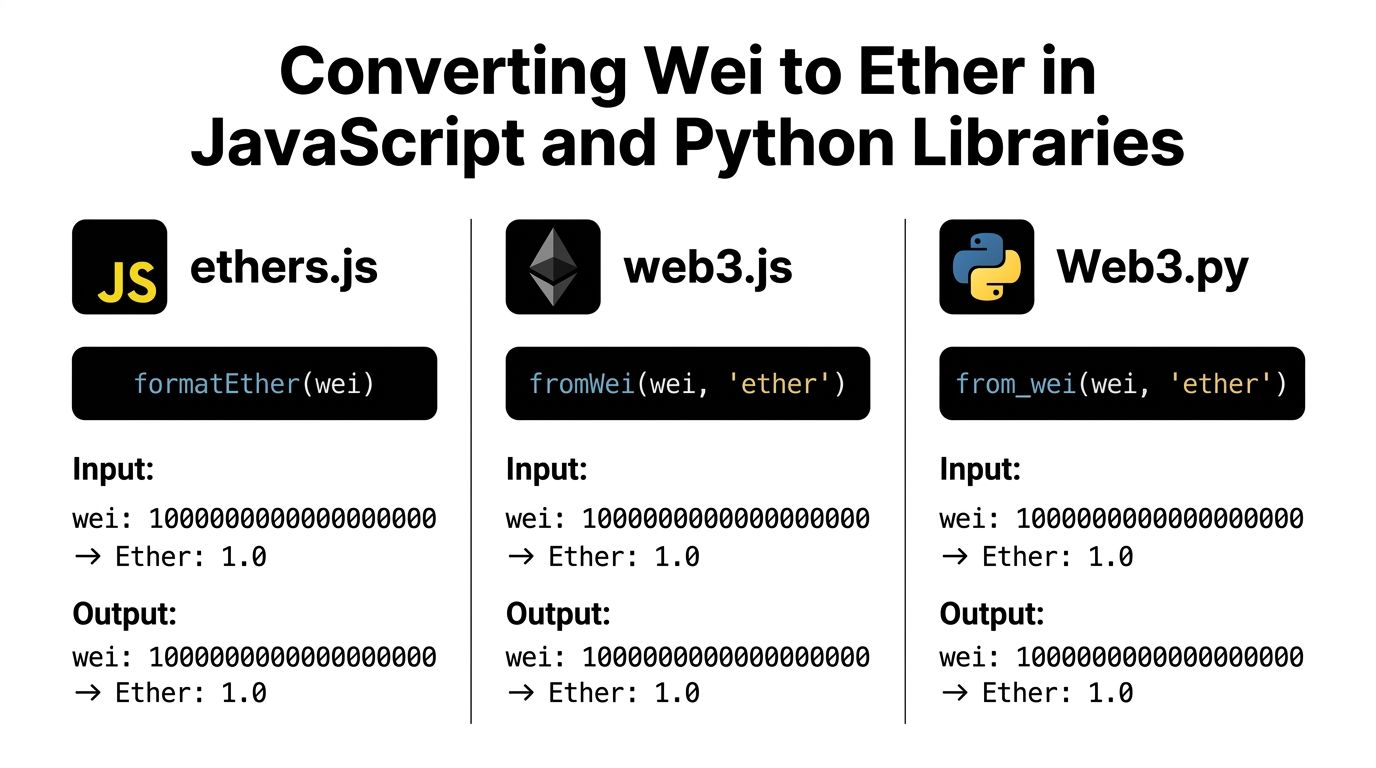
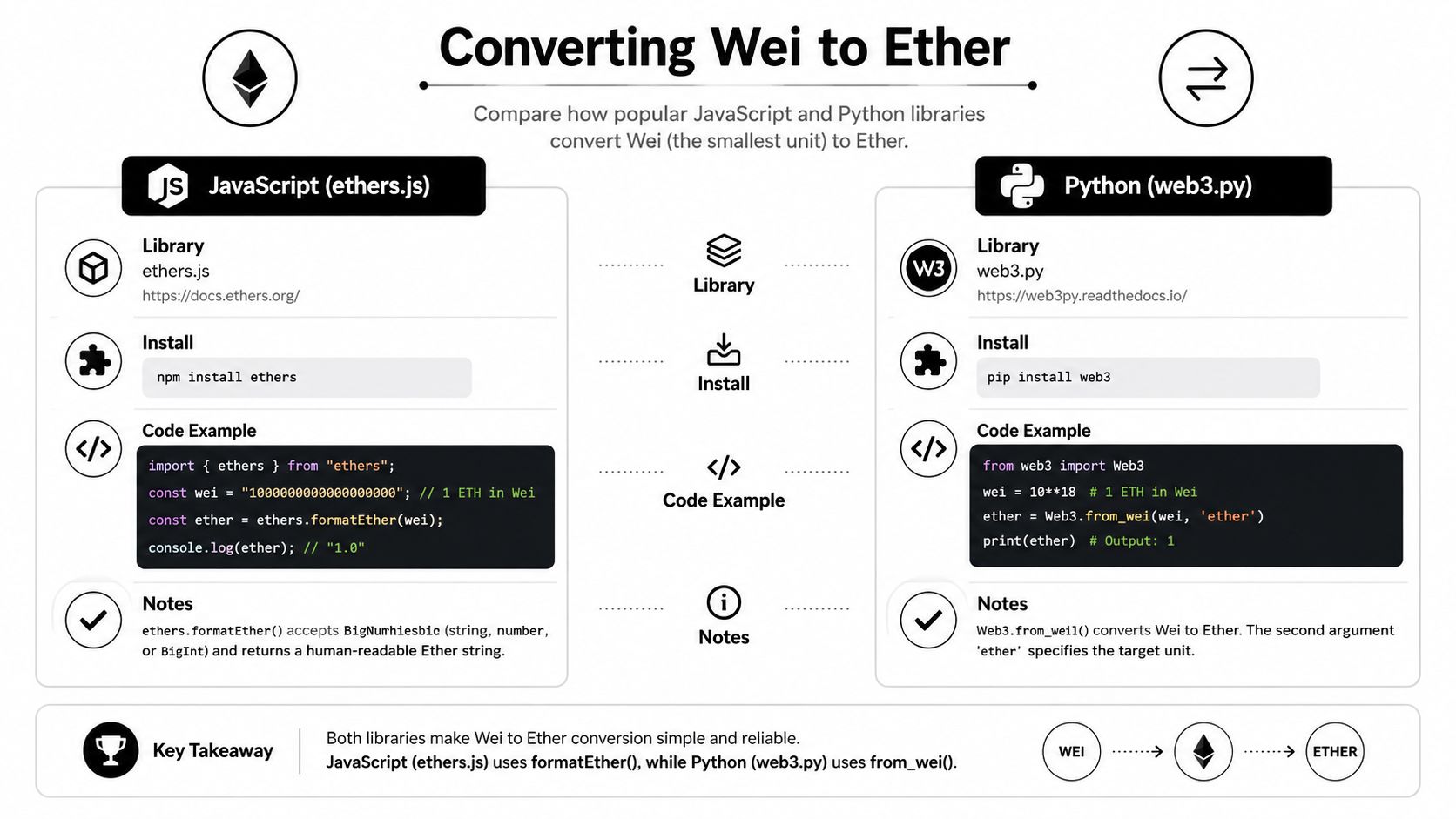
The safest way to convert values is to use the library helpers built for the job. In practice, that means ethers.js for modern JavaScript stacks, web3.js in older or mixed environments, and web3.py for backend scripts or services that do chain work outside the browser. Those helpers exist because they keep arithmetic in integer-safe form and return correctly formatted strings.
JavaScript patterns that won't bite you later
In ethers.js, the common pattern is formatEther for display and parseEther for user input. That gives you a clean boundary between raw chain values and human-readable values.
import { formatEther, parseEther } from "ethers";

const rawWei = "1000000000000000000";
const displayEth = formatEther(rawWei); // "1.0"

const userInput = "0.25";
const weiForTx = parseEther(userInput); // BigInt-style value for transactions
In web3.js, the equivalent utilities are fromWei and toWei.
const rawWei = "1000000000000000000";
const displayEth = web3.utils.fromWei(rawWei, "ether");

const userInput = "0.25";
const weiForTx = web3.utils.toWei(userInput, "ether");
The useful detail is that both libraries expect you to treat the amount as a string or BigInt-friendly value, not as a floating-point number. That keeps the result stable when the input is tiny, huge, or coming from RPC as a string.
Python backends need the same discipline
In web3.py, the pattern is just as direct.
from web3 import Web3

raw_wei = 1000000000000000000
display_eth = Web3.from_wei(raw_wei, "ether")

user_input = "0.25"
wei_for_tx = Web3.to_wei(user_input, "ether")
For scripts, indexers, or ops jobs, that's usually enough. The main point is that the conversion happens through a dedicated helper instead of a hand-rolled division that might get copied across a codebase and subtly drift over time.
Practical rule: Use library helpers at the edge, never manual decimal shifting in scattered utility files.
Edge cases that deserve test coverage
Zero values should round-trip cleanly. Very small balances should display predictably without turning into misleading noise. String inputs from RPC or forms should be handled deliberately, not cast casually into Number.
The interview version of this problem often asks for exactly that judgment. A strong answer names the helper, explains why it exists, and describes how you'd test both directions of the conversion. That's the kind of answer that sounds like someone who has fixed a wallet bug, not just read the docs.
Choosing the Right Unit for User Interfaces and Smart Contracts
The hardest product mistake is not bad arithmetic, it's bad denomination choice. A user checking a wallet expects to see ether, a trader watching fees may want gwei, and a contract interaction screen often needs raw wei behind the scenes so the system can stay exact. The same value can be correct in all three places and still be wrong for the audience.
Context drives the display choice
Web3 products that serve traders, dApps, and finance teams need to match the unit to the action. A gas estimator that shows ether for a fee calculation can confuse users because the number looks too abstract, while a raw wei balance in a wallet can feel unusable to anyone outside engineering. The right unit reduces friction because it matches the mental model the user already has.
The same logic applies in smart-contract tooling. Engineers debugging an interaction need the raw number because that's the value the contract sees, but a product manager reviewing fee impact usually needs a formatted human unit. That's why conversion logic should sit close to the UI layer, not buried inside business logic where it's hard to inspect.
Practical rule: Expose the unit explicitly in your interface, because hidden conversions create support tickets later.
| Context | Best display choice | Reason |
|---|---|---|
| Wallet balance screen | ether | Familiar and readable for most users |
| Gas fee preview | gwei | Matches fee thinking and quick comparisons |
| Contract call debug view | wei | Shows the exact on-chain value |
| Accounting export | precise integer form | Minimizes ambiguity during reconciliation |
| Admin console | both raw and formatted | Helps support teams verify conversions |
The product trade-off senior teams have to make
The trade-off is clarity versus exactness. Ether is easier to read, but wei is better for exact reasoning. Teams that support finance workflows or multi-step transactions often need both, one for display and one for verification, which is why conversion utilities should be deterministic and easy to audit.
That's especially important for people interviewing for product-facing blockchain roles. If you can explain why a fee line item should not always use the same unit as a balance line item, you're showing that you understand user experience, not just protocol math. For a broader contract-building frame, the practical notes in web 3 smart contract are a useful complement to this unit-selection problem.
Common Conversion Mistakes and How to Avoid Them
The most expensive mistake is still using JavaScript's native Number for wei values. It's convenient, it reads cleanly, and it's the wrong type once values get large enough to matter in production. When that happens, the number doesn't fail loudly, it just stops being exact.
Where the bugs usually start
One common bug is parsing a wei value from an RPC response and converting it to Number before formatting it. Another is mixing up gwei and wei during gas math, which leads to fee estimates that look plausible but aren't. A third is applying floating-point division before the value reaches a unit-aware formatter, which creates rounding artifacts that are hard to track down in review.
The safest correction is boring on purpose. Keep the value as a string or BigInt-compatible type, use the library helper, and only format once you know whether the output is for display or for computation. That discipline also makes code review easier because reviewers can spot the conversion boundary quickly.
Rounding is a product choice, not a math afterthought
Truncation and rounding don't mean the same thing to users. For informational displays, teams often prefer a stable, readable result that doesn't flicker between values. For financial operations, the exact amount matters more than presentation polish, which is why you want the computation path to stay separate from the display path.
If a candidate says “just round it,” that usually tells me they haven't thought through downstream effects. A wallet balance, a fee preview, and a withdrawal request do not all deserve the same formatting rule. The best engineers make that distinction explicit in code comments and tests, then keep the conversion helpers near the edges where the data enters or leaves the system.
Interview answer to remember: The bug is rarely the conversion itself, it's converting too early or with the wrong type.
Best Practices for Blockchain Engineering Interviews and Production Code
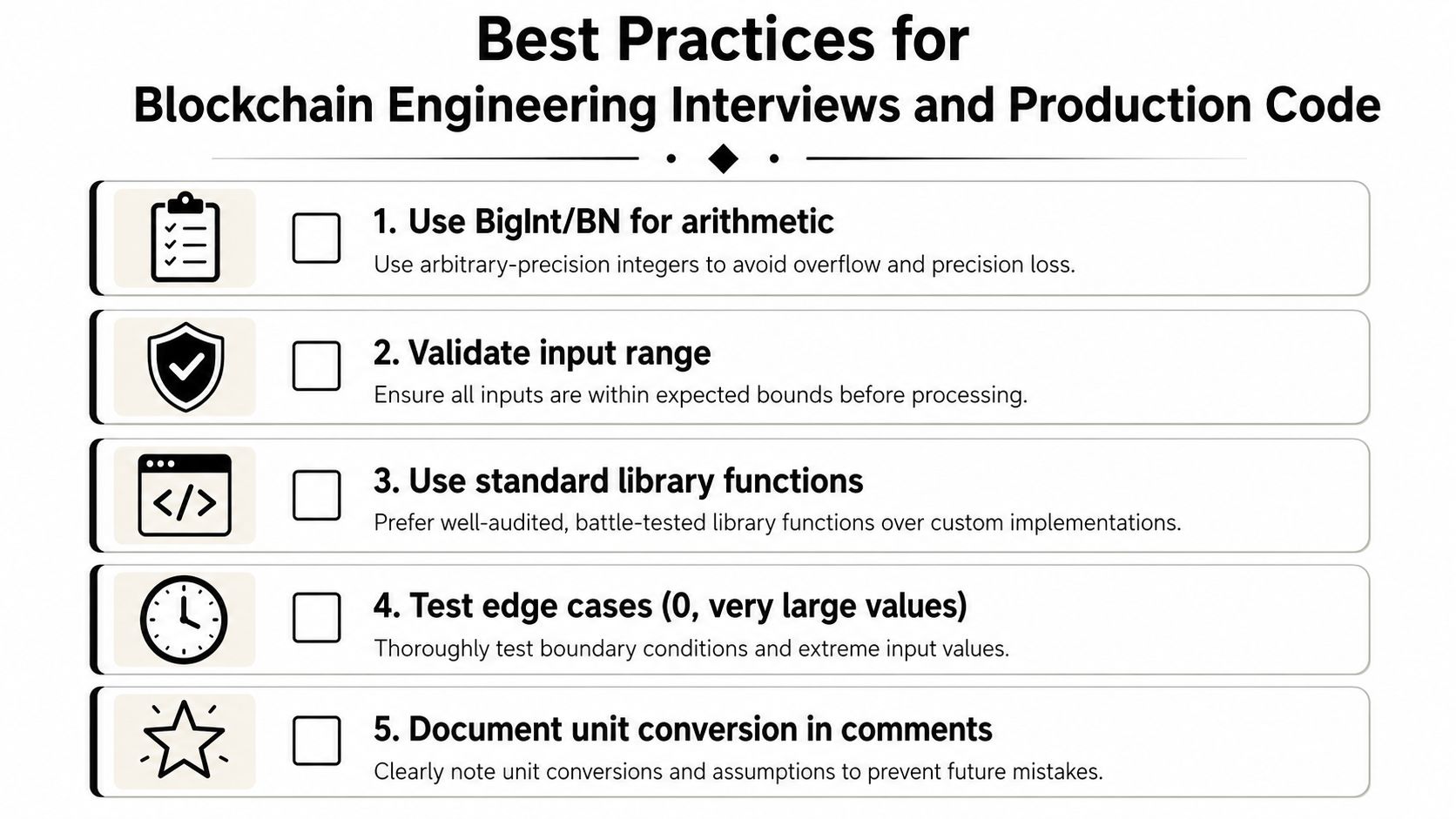
Strong teams treat wei to ether handling as a small architecture problem, not a utility function. The safest pattern is to keep values in wei for storage, transport, and computation, then convert at the presentation layer with a library helper that preserves exactness. That rule holds up in frontend code, backend services, and interview whiteboards because it makes the unit boundary obvious.
A practical checklist that scales
Precision safety
- Store raw values as wei strings or BigInts. That keeps RPC data exact until the last possible moment.
- Use library helpers for conversion.
formatEther,fromWei, andWeb3.from_weiare there to remove guesswork. - Test zero, tiny balances, and large values. Edge cases are where hidden rounding bugs show up first.
User experience
- Show ether for balances. Most users understand that unit fastest.
- Show gwei for gas. Fee screens read better when the unit matches how users think about gas.
- Expose raw units in debug views. Support and engineering teams need the exact value when a transaction looks odd.
Maintainability
- Centralize conversion code. One utility is easier to review than ten ad hoc snippets.
- Comment the unit boundary. A short note near the formatter prevents future confusion.
- Write round-trip tests. Input to wei, wei back to display, and confirm the result stays stable.
The interview benefit is straightforward. If you can explain these trade-offs clearly, you sound like someone who can review code, mentor others, and keep a production system safe under real load. That matters in code screens for wallet teams, DeFi platforms, infra roles, and product engineering groups.
For a deeper career-oriented path into this kind of work, develop smart contract is a helpful adjacent topic because it forces you to connect unit handling, contract behavior, and production discipline in one mental model.
If you're building or interviewing in Web3, Blockchain Jobs can help you find roles where precision, unit handling, and production judgment matter. Visit Blockchain Jobs to explore blockchain engineering, DeFi, product, finance, and infrastructure openings that reward the exact skills covered here.