Your Essential Guide: Hire blockchain developer - win top Web3 talent
Before you can hire a great blockchain developer, you need to know exactly who you're looking for. It's easy to get this wrong. Simply posting a job for a "blockchain developer" is like advertising for a "doctor"—are you looking for a brain surgeon or a general practitioner? The first and most critical step is to move past generic titles and map out the specific technical skills your project actually needs.
Getting this right from the start saves you from chasing candidates who are a poor fit and signals to top talent that you know what you're doing.
Pinpointing Your Ideal Blockchain Developer Profile

Before writing a single line of a job description, you need a crystal-clear picture of your ideal hire. A common mistake hiring managers make is creating a "unicorn" role that mashes three distinct specializations into one. This is a major red flag for experienced engineers and clutters your interview pipeline with unqualified candidates.
The best way to start is by asking a simple question: what will this person build?
Will they be writing, testing, and securing smart contracts for a new DeFi protocol? Or will they be working on the core infrastructure of a Layer-1 or Layer-2 network? The answers will point you toward completely different types of engineers with very different skill sets and career paths.
Differentiating Key Developer Roles
The web3 space has matured, and with it, the roles have become much more specialized. A candidate who excels in one area might be a terrible fit for another, so understanding these archetypes is crucial for effective hiring.
- Smart Contract Developer: This is the role most people think of. These engineers live and breathe languages like Solidity (for EVM chains) or Rust (for Solana and Near). Their world revolves around security, gas optimization, and writing immutable on-chain logic. When interviewing, probe their obsession with attack vectors like reentrancy and oracle manipulation; a top-tier candidate will have war stories.
- Protocol or Core Engineer: These are the people who build the blockchains themselves. They work on the really deep, foundational stuff: consensus mechanisms (like Proof-of-Work or Proof-of-Stake), peer-to-peer networking, and cryptography. It's a highly specialized field requiring serious chops in systems languages like Go, Rust, or C++. This talent pool is much smaller, so your interview process must be sharp and efficient. For a great real-world example, check out this Infrastructure Engineer position at the Solana Foundation.
- Web3 Full-Stack Developer: This person is the bridge between your on-chain logic and the end-user. They use libraries like Ethers.js or Web3.js to build dApps that people can actually use. Their skills blend traditional web development (think React and Node.js) with a solid understanding of how to interact with a blockchain. Their career often involves a transition from Web2, so ask about what drew them to Web3.
Hiring Tip: Underestimating the importance of domain-specific experience is a critical mistake. A developer with five years of experience building NFT marketplaces may not have the deep security mindset required for a lending protocol where millions of dollars are at stake. Always align their past projects with your project's risk profile during the interview.
Calibrating Seniority and Experience
Once you've nailed down the type of developer, you need to define the seniority level. This isn't just about years on the job; it's about the complexity of the problems they've solved and how much autonomy you can give them. This calibration directly impacts their career progression and compensation expectations.
Junior Developer (0-2 years): Juniors need mentorship and well-defined tasks to thrive. They should have a good grasp of the fundamentals and at least one core language. In an interview, focus on their ability to learn, their genuine passion for the space, and their understanding of basic concepts, like the lifecycle of a transaction. Their career goal is to learn from seniors, so highlight mentorship opportunities.
Mid-Level Developer (2-5 years): A mid-level engineer should be able to own a feature from start to finish. They work independently, make solid architectural decisions for the components they're building, and actively contribute to code reviews. The key differentiator is their ability to explain the "why." Ask them to walk you through the trade-offs in their past projects. Why did they choose a specific contract design pattern over another? Their reasoning reveals their potential to progress to a senior role.
Senior Developer (5+ years): Seniors are your technical leaders. They're responsible for the big picture—system-level architecture, mentoring other engineers, and tackling the gnarliest technical challenges. They're constantly thinking about security, scalability, and long-term maintainability. When interviewing a senior, test their ability to design entire systems from scratch, anticipate future problems, and guide a team through a crisis. Their career focus is on impact and leadership.
How to Write a Job Description That Top Web3 Talent Actually Wants to Read

In Web3, your job description isn't just a boring HR document. It's one of your most critical hiring assets. A generic, corporate-sounding post will get completely ignored by the developers you actually want to hire.
Crypto-native engineers are scanning for a compelling mission, a tough problem to solve, and proof that you understand their career goals. Think of it as your first handshake—it has to be strong. This is your shot to sell the vision and the unique technical challenges your project offers, attracting builders who want to make an impact, not just punch a clock.
Ditch the Laundry List of Tasks
The single biggest mistake I see is job descriptions that read like a laundry list of "responsibilities." Top-tier engineers are problem-solvers at heart. They want to know what they'll be building and, more importantly, why it matters for their career growth.
Instead of listing generic tasks, frame the role around its impact and the skills they will develop.
For example, don't just say, "Write and deploy smart contracts." That’s boring. Try something more compelling like, "You'll be architecting and securing the core smart contracts for our new cross-chain lending protocol, gaining deep expertise in liquidity management and oracle security."
This simple reframe does two crucial things: it filters for candidates who are genuinely excited by the problem you're solving, and it appeals to the intellectual curiosity that drives career progression.
Get Specific About Your Tech Stack
Being vague about your technology is a massive red flag in a job description. Simply listing "blockchain experience" is lazy and signals incompetence. You need to be precise about the languages, frameworks, and protocols you're actually using. It shows your team is professional and respects a candidate’s time.
A clear, specific tech stack section is non-negotiable. For instance:
- Languages: Solidity, Rust, Go
- Frameworks: Hardhat, Foundry, Anchor
- Chains: Ethereum, Solana, Cosmos SDK
- Tools: The Graph, Alchemy, Ethers.js
This level of detail means a dedicated Rust developer won't waste their time applying for a role that's secretly a Solidity-only gig, improving the quality of your applicant pool.
Sell the Mission, Not Just the Job
The best Web3 talent is almost always mission-driven. They aren't just looking for another paycheck; they want to join a project that aligns with their vision for a decentralized future. Your job description must appeal to this career motivation.
Hiring Tip: Don't treat your company's "About Us" section as an afterthought. It should be a powerful, concise pitch. Explain your project's core purpose, where you fit in the ecosystem, and the values that guide your team. This is how you connect with candidates on a human level.
Showcasing your culture is just as important. Are you fully remote? Do you contribute to open-source projects? Do you fly the team out for hackathons? These details paint a vivid picture of what it’s actually like to work with you and are often deciding factors in a candidate's career choice. For more ideas on building out your employer brand, check out the other guides on the Blockchain Jobs blog.
Talk About Growth and Ownership
Ambitious developers are obsessed with growth. Your job description needs to explicitly spell out the opportunities for career progression and learning. This is especially true for senior roles, where candidates are looking to make a significant impact and take on leadership.
Be sure to mention things like:
- Technical Leadership: Will they get to lead architecture design or mentor junior engineers?
- Autonomy: Frame the role around ownership. Give them hard problems to solve, not just tickets to close.
- Learning Budget: Do you offer support for conferences, courses, or personal research?
These points signal that you're invested in your team's long-term success. It makes your opportunity far more appealing than a role that just offers a salary. A well-crafted job post acts as a powerful filter, ensuring you attract people who are not just qualified, but genuinely invested in their career with you.
Sample Job Description Snippets for Key Roles
To help you get started, here are a few quick-reference examples of how you can frame responsibilities and requirements for different blockchain roles. Use these as a jumping-off point for your own job descriptions.
| Role Title | Key Responsibilities Snippet | Technical Requirements Snippet |
|---|---|---|
| Smart Contract Engineer | "Design, develop, and deploy secure and gas-efficient smart contracts on Ethereum for our decentralized exchange (DEX), with a focus on protocol-level security and upgradability patterns." | "Deep expertise in Solidity and the EVM. Proficient with development frameworks like Hardhat or Foundry. Proven experience with smart contract security audits and testing methodologies." |
| Protocol Engineer (L1/L2) | "Contribute to the core design and implementation of our L2 optimistic rollup, focusing on consensus mechanisms, transaction processing, and P2P networking components in Go." | "Strong proficiency in Go or Rust. A solid understanding of distributed systems, consensus algorithms (PoS, BFT), and cryptography. Experience working with a large, open-source codebase." |
| Blockchain Infra Engineer | "Build and maintain our high-availability node infrastructure across multiple chains (Ethereum, Arbitrum, Solana). Automate deployment, monitoring, and scaling using Kubernetes and Terraform." | "Extensive experience with Docker, Kubernetes, and cloud providers (AWS, GCP). Hands-on experience running and maintaining blockchain nodes (e.g., Geth, Erigon, Solana validators)." |
These snippets move beyond generic lists and connect the role directly to the product and the specific technical challenges involved, which is exactly what top-tier candidates are looking for in their next career move.
Where to Find Your Next Blockchain Developer
The very best blockchain developers aren't scrolling through mainstream job sites. To hire top talent, you have to go to them—into the digital spaces where they build their careers and reputations. This means getting active in the crypto-native communities where the real work happens.
Trying to find elite Web3 talent with a Web2 playbook is a classic hiring mistake. The engineers building the future of the decentralized web are on platforms that value proof-of-work over a polished resume. Your sourcing strategy has to focus on places where skill is proven through code and contribution, not just words on a page.
Go Beyond Traditional Job Boards
Niche job boards are a good start, but they can't be your entire strategy. The developers you really want are often "passive" candidates. They aren't actively job-hunting because they're already building cool things. Getting their attention requires a much more targeted, authentic approach.
The trick is to think like a developer. Where do they go to solve a tough coding problem, learn about a new protocol, or debate the latest EIP (Ethereum Improvement Proposal)? The answers to those questions will lead you straight to the highest-quality talent.
Hiring Tip: The most expensive mistake you can make is looking for Web3 talent in Web2 places. Top-tier, anonymous builders respected throughout the community simply aren't on platforms like LinkedIn. Sourcing in Web3 is an active intelligence-gathering process, not a passive waiting game.
Engage in Developer-Native Ecosystems
To find the best people, you have to immerse yourself in their world. This means shifting your focus from traditional recruitment channels to the platforms where developers build their careers and showcase their skills.
- GitHub: This is a developer’s real portfolio and career history. Don't just glance at their profile; dig into their commit history. Are they contributing to respected open-source projects like Aave or Compound? Looking at their actual code gives you direct proof of their skills and what they’re genuinely passionate about.
- Discord & Telegram: These platforms are the town squares of Web3. The technical channels inside a protocol’s server are a goldmine for talent. Look for the people who consistently ask smart questions and provide detailed, helpful answers to others. These are often the skilled engineers with serious hands-on knowledge.
- Hackathons: Events run by groups like ETHGlobal or Chainlink are breeding grounds for motivated talent. The participants are passionate enough to spend a whole weekend building something new, showcasing practical skills that a resume could never capture. Keeping an eye on the winning projects is a fantastic way to spot rising stars for future roles.
When you engage in these communities, you build credibility. If you provide value by answering questions or sharing helpful resources, you stop being just another recruiter sending a cold message. You become a peer. You can see how other companies are attracting talent by checking out the latest blockchain engineering jobs.
Writing Outreach That Actually Gets a Response
Once you’ve found a promising candidate, your first message is everything. Generic, copy-pasted templates get deleted on sight. Good outreach is personal, short, and proves you've done your homework on their career.
Your message needs to show you understand their work right from the first sentence. For example, instead of "I liked your profile," try something like this: "I was impressed with your recent contribution to [Project Name] on GitHub, specifically how you optimized the gas usage in the [specific function]. We're tackling a similar challenge..."
That kind of opener proves you value their specific skills and aren't just spamming people based on keywords. Keep your message brief, clearly state the opportunity, and explain why they are a particularly good fit.
End with a simple, low-pressure call to action, like asking if they're open to a quick, informal chat about their career. It’s about starting a conversation, not demanding an interview. This respect for their time and expertise is what separates outreach that works from the noise.
How to Actually Interview a Blockchain Developer
This is where you validate a candidate's career experience. A slick GitHub profile or a polished resume is one thing, but the live interview is your chance to see how a developer really thinks. You need to get past the buzzwords and find out if they can actually build secure, efficient systems on-chain.
In the world of blockchain, a single line of bad code can cost millions. That’s why your interview process must be more than just a vibe check; it's your best defense against a catastrophic hire. It’s how you find the true builders whose skills match their resume.
Ditch the Generic Tech Questions
Forget about asking standard algorithm brain teasers. They tell you almost nothing about a candidate's ability to navigate the unique minefield of blockchain development. Your interview questions must be grounded in the real-world problems they'll be facing in the role.
Your goal is to simulate the job. Probe their understanding of security, their obsession with gas optimization, and their grasp of decentralized system design.
Here are a few interview questions that cut right to the chase:
- On Security: "Walk me through your personal security audit checklist for a new smart contract. What are you looking for first? What tools do you use to spot vulnerabilities like reentrancy?"
- On Gas Optimization: "A contract you deployed to mainnet has high transaction fees. What's your step-by-step process for diagnosing and fixing the gas-guzzling parts of the code?"
- On Consensus: "Explain Proof-of-Work vs. Proof-of-Stake, focusing on the trade-offs around finality and decentralization. Describe a specific scenario where PoW might still be the better choice."
Notice how these questions don't have a simple right or wrong answer. They’re designed to start a conversation about their practical experience. You’ll quickly see who has only read the documentation versus who has actually wrestled with these problems.
The Make-or-Break Coding Challenge
A practical coding challenge is the best way to see a developer’s skills in action. But be respectful of their time. If you give them a generic puzzle or a massive project that takes all weekend, your best candidates will simply withdraw.
The key is to create a small, focused task that mirrors an actual on-the-job problem. Keep it to 2-4 hours maximum.
A couple of ideas that work well in interviews:
- For a Smart Contract Dev: Give them a simple ERC20 token contract with a few intentional, classic vulnerabilities. Ask them to find the bugs, write tests that prove they exist, and then patch the code.
- For an Infra Engineer: Ask them to write a simple script to listen for new block headers on an Ethereum node and pull out specific event data. It’s a great test of their ability to work with RPC endpoints.
The most valuable part is the code review. Schedule a follow-up call and have them walk you through their solution. Ask why they chose a particular approach. What would they have done differently if they had more time?
Hiring Tip: A candidate’s ability to clearly explain their code and defend their design decisions is a massive signal of seniority. It tells you about their technical depth, their communication skills, and how they’ll handle constructive feedback when they’re part of your team.
Don't Ignore the Red Flags
While you're looking for positive signals, be just as vigilant about spotting the red flags that indicate a candidate may not have the depth or attitude for a high-stakes blockchain role.
Keep your radar tuned for these interview warning signs:
- Buzzword Bingo: They use terms like "MEV" or "zk-SNARKs," but their explanations are vague when you press for details. This suggests a superficial understanding.
- No Concept of Trade-offs: Every engineering decision is a trade-off. If a candidate can't articulate why they made certain choices in a past project, they likely weren't the primary decision-maker.
- The Blame Game: When you ask about a project that failed, do they blame their former manager or teammates? A lack of ownership is a major red flag for any role.
- Zero Questions for You: A great developer is interviewing you just as much as you're interviewing them. If they have no questions about your tech stack, team culture, or their potential for career progression, it often signals a lack of genuine interest.
A sharp, well-designed interview process is your single greatest hiring asset. It ensures you bring on someone who can not only write the code but also strengthen your entire engineering culture.
Structuring Competitive Compensation to Close the Deal
You've spent weeks, maybe even months, sourcing, screening, and interviewing. You finally found the perfect blockchain developer. Now comes the moment of truth: the offer.
In the competitive Web3 talent market, a weak or poorly structured compensation package is the fastest way to lose your top choice. Getting this right isn't just about the salary number. It’s about crafting an offer that shows you're a serious project, aligns incentives for the long haul, and speaks directly to what motivates a developer's career choice.
Understanding What Top Blockchain Talent Is Worth
Before you put a number on paper, you need a solid grasp of the market. The blockchain space moves fast, and salaries move with it. Data from recent Web3 career reports shows the average blockchain developer pulls in around $150,000 a year.
But averages can be misleading. That figure is bookended by junior roles around $78,000 and senior specialists commanding up to $262,000. And don't forget market cycles—at the peak in December 2025, the average salary shot up to $272,000.
To build a competitive offer, you have to benchmark against several factors:
- Seniority: Lead and senior developers are compensated for their architectural and security expertise, not just their coding ability.
- Niche Skills: A core protocol engineer in Rust commands a different salary than a frontend developer interacting with smart contracts.
- Location: While Web3 is remote-first, you're competing in a global talent pool. To land the best, you must be ready to match top-tier market rates, regardless of the candidate's location.
Here's a look at what different sources report for US-based blockchain developer salaries. This should give you a clearer picture of the landscape you're competing in.
Blockchain Developer Salary Benchmarks in the US
| Data Source | Average Base Salary | Reported Salary Range / Notes |
|---|---|---|
| Glassdoor | $125,000 | Ranges from $85,000 to $183,000. |
| Web3.career | $150,000 | Ranges from $78,000 to $262,000. |
| Indeed | $146,000 | Notes that additional cash compensation can average over $10,000. |
| ZipRecruiter | $154,000 | Sees a wide range from as low as $85,000 to as high as $215,000. |
As you can see, while the exact numbers vary, they all point to a high-demand, high-compensation field. A lowball offer based on old data or general software engineering salaries simply won't get you in the game.
The Three Pillars of a Killer Web3 Offer
A truly compelling offer in this space is a balanced package that speaks to builders who want to be owners. The best offers are built on three key components that align with their long-term career goals.
- A Strong Base Salary: This is the bedrock of your offer. It provides stability and proves your project is well-funded. Don't skimp here.
- Meaningful Equity (Stock Options): For incorporated startups, traditional equity is a massive draw. It gives team members a real, legal stake in the company's success.
- Token Incentives: This is the Web3 secret sauce. Offering your project’s native tokens gives developers a direct share in the value of the network they're building. For candidates who believe in your mission, the potential upside from tokens can be the most exciting part of the package.
Hiring Tip: The way you balance salary, equity, and tokens acts as a filter. A higher base salary attracts talent looking for stability. A package weighted more heavily toward tokens and equity will excite the entrepreneurial builders who are ready to bet on your long-term vision.
The skills you tested for during the interview process are what drive these compensation expectations. Candidates with deep expertise in the areas that matter most—security, algorithms, and optimization—know their value.
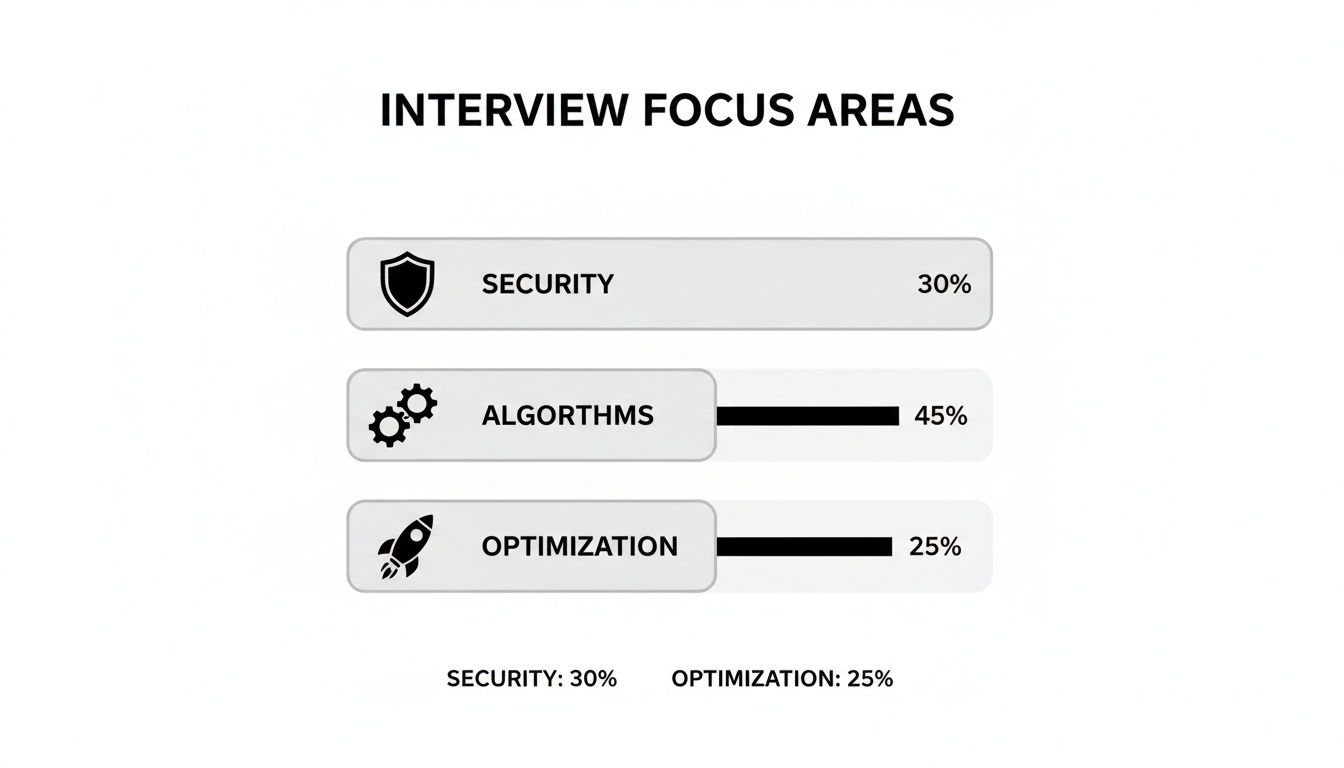
When a developer has proven they can build secure, efficient, and scalable systems, they rightly expect to be compensated at the top of the market.
Closing the Deal with Confidence
Once the offer is out, the conversation isn't over. The best candidates almost always have other options, so be prepared to negotiate. This isn't a battle; it's a collaborative discussion to align their career goals with your company's needs.
Be transparent about how you structured the package. If they push for a higher base, perhaps you can counter with a larger token grant, framing it as an opportunity for them to capture more of the upside they’ll help create.
Finally, remember that time kills all deals. A slow, bureaucratic offer process sends a terrible signal. When you've found your person, act decisively. A swift, professional, and generous offer shows you're a high-performing team and makes it an easy "yes."
Setting Up New Developers for Long-Term Success

You’ve found the right developer and they’ve accepted your offer. The hiring process is over, but the work of retention and career development is just beginning. A clunky onboarding process can kill momentum, while a great one confirms they made the right career choice.
Think of onboarding as the first real test of your company’s culture. It’s your chance to prove you’re as organized and professional as you claimed to be during the interviews, setting the tone for a long-term partnership.
Nailing the First Week
The first few days are all about removing friction and setting a foundation for their career progression. Your goal is to get your new hire from zero to pushing their first commit. This means having a clear checklist ready before they log in on day one.
This is about more than HR paperwork; it's about setting up their technical world for immediate success.
- Environment & Access: Have their dev environment specs, software licenses, and access to private repos (like GitHub) and team chat (Discord, Slack) ready to go.
- Hardware: If you’re sending a laptop, make sure it arrives before their start date.
- Key Contacts: Provide a simple one-pager listing who to contact for technical, HR, and administrative questions.
Hiring Tip: A thoughtful onboarding plan signals that you value your new hire's time and are invested in their success. Small things, like pre-configured accounts, prevent a painful first few days and show you respect their contribution from day one.
Building Connections and Setting a 30-60-90 Day Plan
Integrating a new person into your team's culture requires a deliberate plan. Assign a dedicated mentor or "buddy" to provide a safe space for questions and help them navigate the codebase and team dynamics.
Your plan should also map out clear, achievable goals for their first 30, 60, and 90 days. A great 30-day goal, for instance, is shipping a small, non-critical bug fix. It delivers an early win, builds confidence, and integrates them into the development lifecycle. This plan should be the first step in their career progression at your company.
This process also ties directly into retention. As developers grow, you need to ensure their compensation keeps pace with their increasing value. In the US, blockchain developer compensation can vary widely, with sources showing averages from $136,566 to $159,000. Knowing these benchmarks helps you keep their career and compensation on a competitive track. You can find more detail in the latest salary data for blockchain roles.
Finally, don't skip the weekly check-ins. A standing 1-on-1 with their manager is non-negotiable for discussing progress, roadblocks, and career aspirations. These early conversations are the foundation of a strong working relationship and are critical for long-term retention.
Ready to find your next top-tier blockchain developer? Post a job on Blockchain Jobs today and connect with thousands of crypto-native professionals who are ready to build the future. Visit https://blockchain-jobs.com to get started.