Online community manager job description: Build a winning Web3 team
Crafting an effective online community manager job description for a Web3 project is a different beast entirely. It's not just about posting on social media. This is a strategic role, one that’s responsible for nurturing a project's entire ecosystem. When you're hiring, you need a unique blend of diplomat, marketer, and product expert—all focused on building a fiercely loyal and active user base. If you're job hunting, proving you are that blend is how you land the role.
What Defines a Web3 Community Manager
In a decentralized project, the Web3 Community Manager is the linchpin. A traditional social media manager’s job is to broadcast messages out. A Web3 Community Manager, on the other hand, builds a two-way bridge between the core team and its global—and often anonymous—community.
Think of them as the gardener of a project's ecosystem. Their core job is to create a healthy environment where trust, a vibrant culture, and genuine participation can thrive. This is absolutely critical on platforms like Discord and Telegram, which have become the town halls for the crypto world.
The Strategic Importance of the Role
If you're a hiring manager, getting this strategic depth right is the key to writing a job description that attracts top talent. For candidates, understanding this is how you'll nail the interview. This isn’t just about moderating chat; it's about taking ownership and driving real influence.
A great Web3 Community Manager has a direct, measurable impact on a project's success. When interviewing, you should be able to provide examples of how you:
- Built Trust: In an industry built on trust-minimized technology, you are the human connection that establishes credibility.
- Drove Engagement: You are the one who turns passive token holders into passionate contributors and brand evangelists.
- Gathered Intelligence: You acted as the project's ears, funneling crucial user feedback and market sentiment straight back to the product and dev teams.
- Guided Culture: You set the tone, enforced the rules, and ultimately made the community a place people actually want to hang out.
A Web3 Community Manager isn't just a moderator. They are a diplomat, a strategist, and the very pulse of the project's user base. They are the human layer of a decentralized network, responsible for its social fabric and growth.
A Career Built on Connection
This unique combination of skills makes for a career path that's both demanding and incredibly rewarding. You have to be fluent in crypto culture, a pro at crisis communication when the market gets volatile, and skilled with all the niche community platforms. It’s less about managing a brand’s voice and more about empowering the community to find its own.
Whether you're looking to hire or get hired, seeing the role through this strategic lens is essential. You can see this mix of duties in real-world listings for roles like the Global Community Manager at Binance, where ecosystem growth and user advocacy are always front and center. At the end of the day, a top-tier manager is someone who can turn a scattered group of users into a powerful, self-sustaining community.
What Does a Web3 Community Manager Actually Do?
So, what does a day in the life of a Web3 community manager really look like? Forget what you think you know about old-school forum moderation. This role is a whirlwind of strategic planning, real-time engagement, and putting out the occasional fire.
It’s not about just posting announcements and walking away. It’s about building a living, breathing ecosystem where people feel a true sense of ownership. When you're hiring, you need someone who’s been in the trenches, running events and sparking real conversations, not just broadcasting messages into the void.
Fostering an Unforgettable Vibe
First and foremost, a community manager is the heart and soul of the project's public-facing world. Their job is to turn silent lurkers into passionate advocates who feel like they're part of something special.
This breaks down into a few key activities you should highlight on your resume or in a job description:
- Hosting Live Events: You’ll find them running the show during high-stakes AMAs (Ask Me Anything) on X Spaces or commanding a Discord stage. It takes a certain kind of person to do this well—someone who can think on their feet, keep the energy up, and guide the conversation without missing a beat.
- Creating Native Content: We’re not talking about corporate blog posts. We’re talking about creating content that actually connects with a crypto-savvy audience. Think sharp-witted memes, insightful educational threads, and polls that get people talking and feeling heard.
- Daily Moderation: This is ground zero. Managing the constant flow of conversation in chaotic channels like Discord and Telegram is an art. It's about more than just banning spammers; it’s about calmly shutting down FUD (Fear, Uncertainty, and Doubt) and making sure the community remains a place where people want to hang out.
A great candidate won’t just say they "managed a Discord." They’ll tell you about the time they ran an AMA with a key founder, the custom bots they set up to filter out scams, or how a meme campaign they launched boosted engagement by 25%.
Acting as the Bridge Between Users and Devs
A truly great community manager is the essential link between the people using the product and the team building it. They are the project's eyes and ears on the ground, gathering insights that can completely change a project's direction for the better. This is what elevates the role from a simple support function to a strategic powerhouse.
If you're writing a job description, you need to spell this out. It shows that you understand the role’s true value. For anyone applying, this is your chance to show you do more than just chat—you deliver real, tangible value that shapes the product itself.
Here's how they do it:
- Gathering User Feedback: They have a system for collecting, sorting, and making sense of all the feature requests, bug reports, and general sentiment from the community. This isn't just a messy list of complaints; it's a clean, actionable report delivered straight to the product team.
- Facilitating Governance: In a decentralized world, they help guide the community through governance. That could mean helping someone write a formal proposal, moderating a heated debate about a critical vote, or simply ensuring everyone understands the process.
At the end of the day, the role is a constant balancing act. One minute you're celebrating awesome fan art from a community member, and the next you're deep in a spreadsheet analyzing user feedback for the next team meeting. It’s this unique mix of social intelligence and strategic thinking that separates the good from the great.
What It Takes: Essential Skills and Tools for the Job
To really thrive as a Web3 community manager, you need a special mix of tech know-how and genuine people skills. This isn't your typical corporate community gig with a strict brand rulebook. Here, you're navigating a world that’s fast-paced, often skeptical, and deeply technical.
If you're hiring, finding someone with this combination is everything. If you're looking for a job, this is how you prove you're the real deal. The role really boils down to two things: the hard skills to operate in the Web3 space and the soft skills to actually lead a decentralized group of people. Getting the balance right in an online community manager job description is where many companies stumble.
Mastering the Technical Toolkit
A great Web3 community manager has to be a native in the ecosystem's core platforms. We're not just talking about knowing how to send a message. They need to be able to build, secure, and fine-tune these digital spaces to get people talking.
Their go-to tech stack should include:
- Platform Mastery: You absolutely must have deep, hands-on experience with Discord. That means setting up complicated role permissions, locking down the server with bots like MEE6 or Wick, and designing a channel layout that sparks conversation, not confusion. Knowing your way around Telegram for quick announcements and group chats is also a must.
- Analytics and Insights: The best managers don't just guess what's working—they use data to prove it. They should be comfortable with tools like Commsor or Orbit to track engagement and spot key contributors. Even better if they can pull insights from custom Dune dashboards to show real ROI.
- Product Knowledge: They have to get the project's technology. Whether it’s a DeFi protocol, an L1 blockchain, or an NFT drop, they need to be able to answer technical questions clearly or know exactly who to tag for help.
The flowchart below breaks down how these tools come into play during day-to-day tasks.
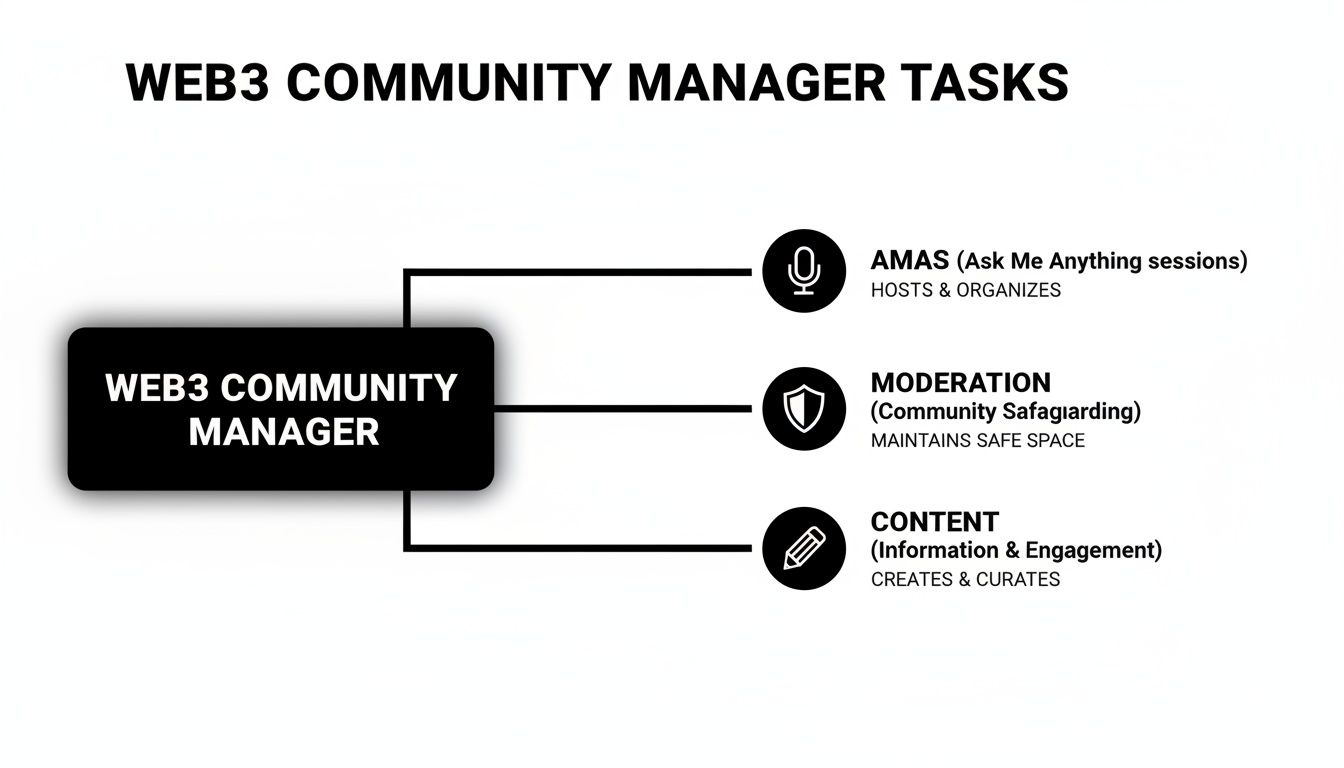
As you can see, core duties like running AMAs, moderating chats, and creating content are the pillars of the job. Each one demands a specific set of skills and the right tools to pull it off well.
The Soft Skills That Separate the Great from the Good
While the tech skills get you in the door, it's the soft skills that make you a star. This is where a candidate shows they can do more than just manage a Discord server—they can actually lead a community.
Empathy is the ultimate tool in a community manager's kit. In a space filled with anonymity and high stakes, the ability to understand and validate a user's perspective—even during a crisis—is what builds unbreakable trust.
Here are the key people skills to screen for in an interview or highlight on your CV:
- Crisis Communication: Crypto is a rollercoaster. A manager has to stay cool under pressure and communicate clearly and calmly during FUD attacks, protocol hacks, or just a brutal market dip.
- Cultural Fluency: They have to speak the language of crypto. This means knowing the memes, the slang, and the inside jokes. It’s what makes their content feel real and helps them build a genuine connection. If a candidate doesn’t know what "WAGMI" means, that’s a huge red flag.
- Diplomacy and Empathy: You’re dealing with people from all over the world, with all sorts of opinions and emotions running high. A great manager knows how to de-escalate fights and make every member feel like they’ve been heard.
To put it in perspective, let's look at how the skillset for a Web3 community manager stacks up against a more traditional role.
Web3 vs. Traditional Community Manager Skillsets
| Skill Area | Traditional Community Manager | Web3 Community Manager |
|---|---|---|
| Platform Expertise | Facebook Groups, Instagram, LinkedIn, Khoros, Lithium | Discord, Telegram, Twitter (X), Farcaster, Lens |
| Technical Knowledge | Basic social media analytics, CRM software | Blockchain fundamentals, smart contracts, tokenomics, wallet security |
| Crisis Management | Handling customer complaints, negative PR | Managing FUD, responding to exploits/hacks, market volatility comms |
| Cultural Acumen | Brand voice, corporate messaging, industry trends | Meme culture, crypto-native slang (gm, WAGMI), decentralized ethos |
| Moderation | Enforcing brand guidelines, removing spam | Bot configuration, anti-raid protocols, sybil attack prevention |
| Engagement Tactics | Contests, polls, user-generated content campaigns | AMAs, POAPs, governance proposals, gamified experiences |
This table makes it clear: while the core goal of building community is the same, the tools, environment, and culture couldn't be more different.
Ultimately, this role is a unique blend of a tech expert and a human connector. The necessary skills often cross over with positions like a Web3 Social Media Manager, where deep platform knowledge and authentic engagement are just as critical. For anyone trying to break into this field, being able to show you’ve got both the hard and soft skills is your ticket to landing a fantastic role.
How Do You Actually Measure a Community's Success?
So, how can you tell if a community is really firing on all cylinders? In the Web3 world, success is so much more than just looking at the member count in a Discord server. That number can be a total vanity metric, easily pumped up by bots or people who joined once and never came back. To get a real read on performance, you have to dig into the Key Performance Indicators (KPIs) that show genuine health and activity.
If you’re a hiring manager putting together an online community manager job description, spelling out these KPIs is crucial. It sets clear, measurable goals right from the start. And if you’re a candidate, this is your secret weapon. Walking into an interview and talking about these specific metrics is the fastest way to show you’re not just a social butterfly—you’re a strategic force who delivers tangible results.
It's Not About Size, It's About Vibe
The best community managers are obsessed with metrics that show how deep the connections are, not just how wide the audience is. They understand that a tight-knit, super-active group of 1,000 true believers is infinitely more valuable than a ghost town of 100,000. This is the mindset shift that separates the pros from the amateurs and proves real ROI.
Here are the numbers that actually move the needle:
- Engagement Rate: This is the pulse of your community. You find it by dividing the number of active members (people who are actually posting, reacting, or showing up to events) by the total member count. A healthy, buzzing community often sits in the 5-10% active engagement range. If a manager can hit or beat that, they know what they’re doing.
- Community-Generated Content (CGC): Are your members creating stuff on their own? This is a huge indicator of passion. CGC can be anything from deep-dive discussion threads and killer fan art to user-made tutorials and, yes, even hilarious memes. When people are creating for you, they feel like they own a piece of the project.
- Sentiment Analysis: What’s the general mood in the room? Keeping a finger on the community's pulse—whether it’s positive, negative, or just neutral—lets you spot fires before they become infernos. It’s also the clearest feedback you'll get on how a big announcement or a new product feature is landing.
A great candidate doesn't just say they "grew a community." They'll hit you with something like this: "I took our active member engagement rate from 3% to 8% in six months. I did it by launching a weekly AMA series and creating an ambassador program that jacked up user-generated content by 40%." See the difference?
Tying Community Health to Business Goals
Ultimately, a community manager's true worth is measured by how well they connect the people on the ground with the project's core team. The work they do shouldn't just exist in a social bubble; it needs to directly shape the product and drive its success.
You can even put a number on this. Tracking the number of actionable product suggestions that come from the community and end up on the official roadmap is a gold-standard KPI. Another powerful one is measuring the drop in support tickets because members are helping each other solve problems. When you can draw a straight line from community activity to a better product and a more efficient company, you've won the game.
Web3 Salary Insights and Career Progression

Let's talk about compensation and career growth. Whether you're a project trying to attract top talent or a community pro looking for your next move, understanding the landscape is crucial. In Web3, the community manager isn't just a support role—it's a blend of marketing, product feedback, and user retention. That’s why it often pays a premium.
Compensation in this space is anything but static. It's heavily influenced by things like a project’s last funding round, the mood of the crypto market (bull or bear), and whether a candidate understands the nuances of tokenomics or DAO governance. This volatility cuts both ways, offering huge upside for those who can navigate the inherent risks of the ecosystem.
Understanding the Salary Landscape
Given the high-stakes nature of the job, salaries for Web3 community managers reflect their importance. As of early this year, the demand for people who can cultivate these decentralized online spaces has pushed the average yearly salary to around $80,000.
This figure has seen some serious swings, which tells you a lot about the market. For instance, the average dipped to $58,000 during quieter times, while it has spiked as high as $128,000 and $123,000 during bull runs. This salary advantage is a major draw for crypto-native professionals who are comfortable managing passionate, high-stakes communities. For a deeper dive into the numbers, check out the data on Web3 non-tech salaries at Web3.career.
When you're at the negotiating table, don't just fixate on the base salary. Many Web3 projects sweeten the deal with token allocations, which can have massive upside. A smart candidate will always ask about vesting schedules and the token's real utility to get a full picture of the offer's value.
So what pushes a salary to the higher end of the range? A few key factors come into play:
- Project Stage and Funding: A well-funded project that has already launched can usually afford a higher base salary. An early-stage startup, on the other hand, might compensate with more equity or tokens.
- Scope of Responsibility: There's a big difference between managing a single, budding Discord server and overseeing a multi-platform community of 100,000+ members. The bigger the scope, the bigger the paycheck.
- Technical Expertise: If you can confidently discuss protocol-level updates or help shape governance proposals, you're immediately more valuable than someone who can only handle surface-level questions.
Mapping Your Career Trajectory
The career path for a community manager in Web3 is surprisingly clear and leads straight to senior leadership. This isn't a dead-end job; it’s a launchpad. Highlighting this potential for growth is a great way to make any online community manager job description more compelling.
The journey usually looks something like this.
1. Junior Moderator / Community Advocate
This is where you start, right on the front lines. The job is all about moderating conversations, answering user questions, and learning to spot which issues need to be escalated. This is your chance to absorb the project’s voice and the community's unique culture from the ground up, building a strong foundation for future growth.
2. Online Community Manager
At this stage, you graduate from reacting to planning. You’re now owning the community strategy—creating content calendars, organizing AMAs with the founders, digging into engagement metrics, and feeding those insights back to the core team. You become the main bridge between the users and the developers, demonstrating real strategic value.
3. Senior Community Manager / Head of Community
Here, your role shifts to management. You're likely leading a team of moderators and junior managers, setting the high-level community strategy, and managing the budget for all community-related activities. Your main job is to ensure the entire ecosystem is healthy and growing, proving your leadership capabilities.
4. Head of Ecosystem Growth / Director of Community
This is a true leadership role. Your focus expands to big-picture strategy and partnerships. You're working on scaling the entire ecosystem, building relationships with developers, and making sure the community's direction aligns with the project's long-term business goals. At this level, your work can directly influence the project’s market cap and token value.
Top Interview Questions for Hiring Managers and Candidates
The interview is the final handshake, the moment where a great project and a talented community manager finally connect. But for this to work, both sides need to go beyond the generic questions. The real test lies in exploring real-world scenarios that reveal strategic thinking and hands-on skills.
For hiring managers, the goal is simple: test a candidate's ability to solve problems under fire. For candidates, it's the perfect chance to show you've been in the trenches and can handle the beautiful chaos that is Web3. Thinking through these questions is a crucial step in building out a solid online community manager job description and a successful hiring process.
Questions for Hiring Managers to Ask
The most effective questions throw a candidate right into the situations they'll face every single day. Ditch the classic "tell me about yourself" and get straight to what matters. These questions are designed to probe their crisis management instincts, strategic planning skills, and their feel for Web3 culture.
- "Tell me about a time you handled a coordinated FUD (Fear, Uncertainty, and Doubt) attack on Discord. What were the exact steps you took to regain control and reassure the community?"
- "Walk me through how you'd build a community ambassador program from the ground up. What specific metrics would you track to know if it's actually working?"
- "Picture this: our project suffers a minor technical glitch, but no funds are lost. How do you break the news to the community to keep their trust without causing a panic?"
- "How do you tell the difference between valid, constructive feedback and pure, unhelpful negativity? Give me an example of how you've dealt with both."
Questions like these force candidates to pull from genuine experience, giving you a much clearer picture of their capabilities than a resume ever could.
Questions for Candidates to Prepare For
As a candidate, your job is to prove you're more than just a moderator—you're a strategist. The best way to do this is to frame your answers using a simple but powerful framework like the STAR method (Situation, Task, Action, Result). It helps you turn a simple answer into a memorable story about your impact.
The STAR method gives your answer a clear narrative. Start with the Situation you faced, explain the Task you were given, detail the specific Action you took, and cap it off with the tangible Result of your work.
Get ready to answer questions that show you understand the bigger picture.
- "How would you measure the ROI of our community-building? What KPIs would you focus on in your first 90 days?"
- "What's your system for collecting user feedback and making sure it gets to the product and dev teams in a way they can actually use?"
- "Looking at our project, what kind of content or events do you think would really connect with our audience, and why?"
When you back up your answers with concrete examples and real data, you're not just answering a question—you're demonstrating your value on the spot. Senior roles, like this Head of Community at Crypto Banter, demand this kind of high-level thinking. Nailing these questions shows you're not just ready to join the team, you're ready to help lead it.
Ready-To-Use Job Description Templates for Your Next Community Manager
A great job post is half the battle. To get you started, we’ve put together three distinct, ready-to-use templates for hiring an online community manager. These aren’t just cookie-cutter outlines; each one is built for a specific corner of the Web3 world—DeFi, NFTs, and Layer-1 protocols—and reflects the unique challenges of each.
Think of these as your launchpad. We've baked in the best practices discussed earlier, covering everything from day-to-day responsibilities to the must-have skills and those "nice-to-have" extras that make a candidate stand out. They're designed to speak directly to crypto-native talent who already get it. Just copy, tweak to fit your project, and you’re ready to post.
DeFi Protocol Community Manager
You're looking for someone who is equal parts educator, analyst, and security advocate. This person needs to be able to break down complex financial ideas into plain English and build unshakable trust with a user base that's often highly technical and risk-aware.
Job Title: Community Manager, [Your DeFi Protocol Name]
Location: Remote
About Us:
[Add a short, compelling paragraph about your DeFi protocol. What’s your mission? What problem are you solving? Why should a top-tier candidate be excited to join?]
What You’ll Do:
- Own and grow our community hubs on Discord, Telegram, and X (formerly Twitter).
- Host regular AMAs and learning sessions to walk users through protocol updates, new features, and the wider DeFi landscape.
- Take complex technical details and translate them into clear, accessible content for everyone from degens to institutions.
- Be the ears of the project: monitor community sentiment, collect user feedback on features and security, and deliver concise reports to the product and engineering teams.
- Design and run campaigns that foster a healthy, engaged, and supportive vibe for our liquidity providers and token holders.
What You Bring to the Table:
- At least 2 years of experience steering the community for a DeFi, FinTech, or blockchain project.
- A solid grasp of DeFi fundamentals (think liquidity pools, yield farming, AMMs, etc.).
- Proven experience handling crisis communications with a calm, strategic head.
- Familiarity with community analytics tools to measure what’s working and what isn’t.
Bonus Points For:
- Previous experience participating in DAO governance.
- Knowing your way around on-chain analysis tools.
NFT Project Community Manager
This is a role for a storyteller and a culture creator. You need someone who lives and breathes the NFT scene, can generate genuine hype, and knows how to turn token holders into passionate evangelists for your brand.
Job Title: Community Manager, [Your NFT Project Name]
Location: Remote
About Us:
[Write a short, engaging paragraph about your NFT project. What's the story behind the art? What utility does it offer? What kind of culture are you building?]
What You’ll Do:
- Drive our community engagement strategy across Discord, X (formerly Twitter), and wherever else the culture is happening.
- Dream up and run community events that people actually want to join, like mint reveals, art contests, and exclusive calls for holders.
- Create and share content that hits the mark—memes, project lore, sneak peeks, you name it.
- Build and maintain genuine relationships with influencers, artists, and other communities in the space.
- Serve as the bridge between the community and the core team, making sure feedback on art, utility, and the roadmap is heard loud and clear.
What You Bring to the Table:
- 1-2 years of community management experience, preferably for an NFT project, art collective, or gaming community.
- You’re a native to NFT culture. You know the lingo, the trends, and the market inside and out.
- Exceptional skills in both written and visual communication.
- A track record of growing an online community from the early days.
Bonus Points For:
- Skills in graphic design or video editing.
- Experience running whitelist campaigns or securing collaborations.
Layer-1 Blockchain Community Manager
This is a strategic role for a true ecosystem builder. You’re looking for someone who can connect with developers, nurture a global network of builders and validators, and make your blockchain the best place to create the future of Web3.
Job Title: Community Manager, [Your L1 Blockchain Name]
Location: Remote
About Us:
[Share a short, impactful paragraph about your Layer-1 blockchain. What are its core technical advantages? What’s your big-picture vision for the ecosystem?]
What You’ll Do:
- Foster a thriving developer community through forums, dedicated Discord channels, and online hackathons.
- Create top-notch educational content—like tutorials, documentation guides, and deep-dive threads—that makes it easy for developers to start building on our platform.
- Manage all communications with node operators and validators, keeping them in the loop on network upgrades and other critical info.
- Act as the main point of contact between our core engineers and the external developer community.
- Keep a close eye on ecosystem growth, tracking key metrics like dApp deployment and developer engagement.
What You Bring to the Table:
- 3+ years in a community or developer relations role for a highly technical project (blockchain experience is a huge plus).
- A strong technical mind; you’re comfortable discussing blockchain architecture and complex concepts.
- Experience planning and running developer-focused events, both online and offline.
- World-class communication skills, with the rare ability to connect with both deeply technical and non-technical audiences.
Bonus Points For:
- A background in software development or technical writing.
- Experience managing developer grant programs or ecosystem funds.
Finding the right person to fill your online community manager job description is much easier when you’re fishing in the right pond. At Blockchain Jobs, we connect innovative Web3 projects with the crypto-native professionals you need to build a world-class community. Post your job today and get in front of a specialized audience that’s ready for their next big thing.