
Peer 2 Peer Applications: Master Web3 for Top Blockchain
USD 3.21 trillion. That's where the global P2P payment app market stood in 2024, and it's projected to reach USD 16.4 trillion by 2034 at a 19.9% CAGR according to Intel Market Research. If you still treat peer 2 peer applications as a side topic for protocol nerds, you're reading the market wrong.
P2P is the operating model behind Web3. It's the difference between asking a platform for permission and designing systems that keep working without one. If you're a mid-level developer and you want to move into higher-value blockchain roles, this is one of the few topics that upgrades both your technical range and your interview credibility.
I'll be blunt. Teams hiring for serious Web3 work don't just want smart contract syntax. They want engineers who understand how nodes discover each other, how messages propagate, where network failure happens, and how attackers abuse distributed systems. If you can explain those mechanics clearly, you stop sounding like an app developer with crypto experience and start sounding like someone who can build infrastructure.
What Are Peer 2 Peer Applications Really
Peer 2 peer applications let participants communicate or exchange data directly instead of routing everything through one central owner. That sounds simple, but it changes everything.
In a normal client-server system, one company runs the core machine, stores the critical data, and decides what happens when traffic spikes or policy changes. In a P2P system, each participant contributes some combination of bandwidth, storage, validation, or routing. Control spreads out. Failure spreads out too, which is exactly why the architecture is useful.
The practical shift
Think about a central library versus a book-swapping club. In the library model, one building holds the books, one staff controls access, and every borrower depends on that one institution staying open. In the club model, members lend to each other directly. Coordination still matters, but the system doesn't depend on one shelf, one desk, or one owner.
That's the meaning of peer 2 peer applications. They aren't just “apps where users connect.” They're systems that push core platform responsibilities outward to the network itself.
Practical rule: If the product's core function breaks when one operator goes offline, it isn't meaningfully decentralized.
That matters beyond engineering. A product manager needs it to scope trust assumptions. A security engineer needs it to model attacks. A marketer needs it to explain why the product is different from a faster Web2 clone. And a developer needs it because every serious Web3 stack sits on top of distributed coordination.
Why hiring teams care
When interviewers ask about decentralization, many candidates answer with ideology. That's weak. Strong candidates explain architecture.
Use this lens instead:
- Data flow: Who sends data to whom, and who can interrupt it?
- Trust model: Which actor can censor, reorder, or block activity?
- Failure mode: What happens when nodes disappear or act maliciously?
- Economic value: Why does removing intermediaries create a better product?
If you can answer those four questions, you understand peer 2 peer applications at a level that maps directly to protocol design, dApp infrastructure, and security roles.
Understanding P2P Network Architectures
Most developers learn “P2P good, centralized bad” and stop there. That's not enough for interviews. You need to know which architecture fits which product, and what trade-off each choice creates.
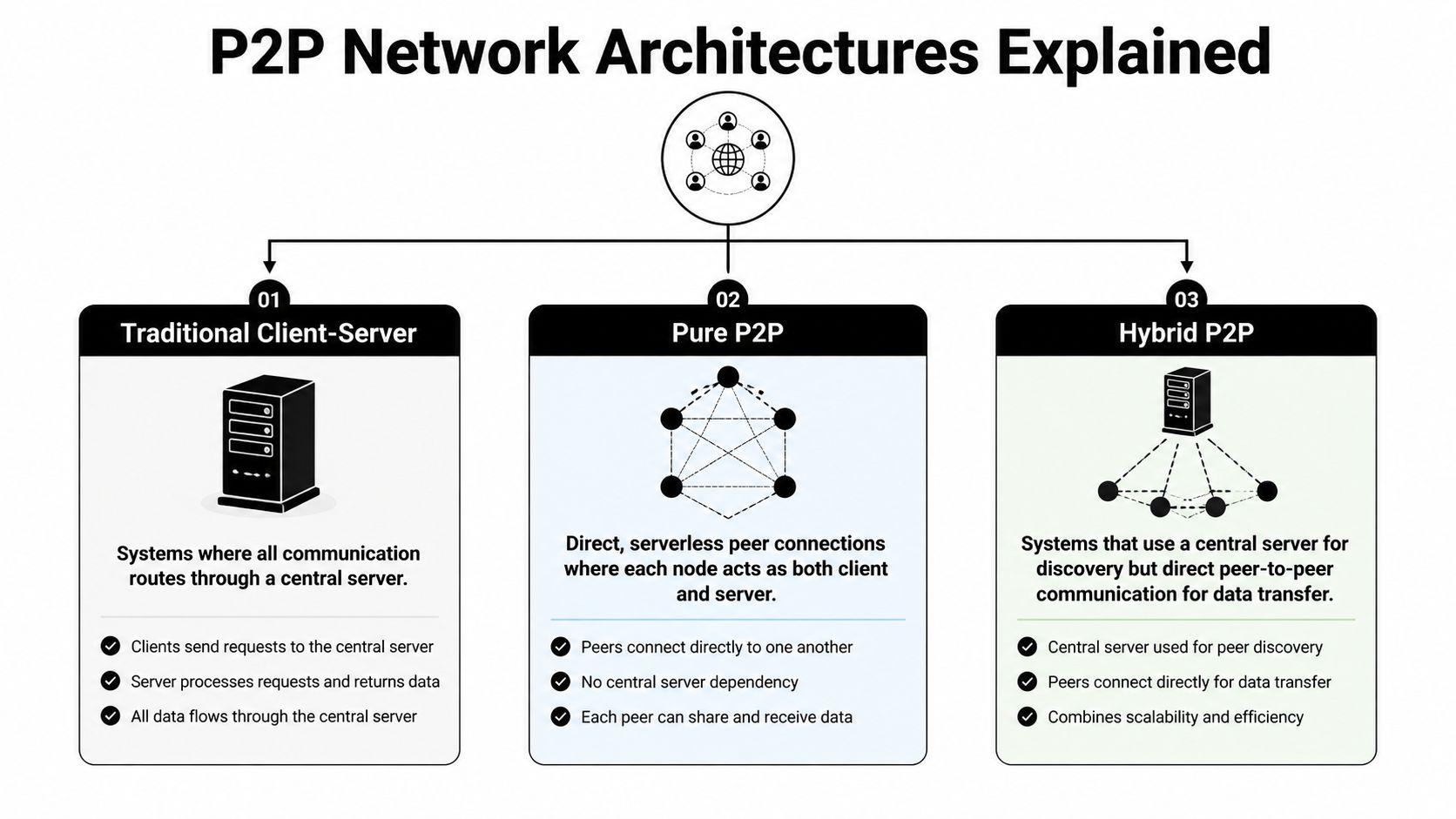
Client-server versus peer-to-peer
Start with the basic contrast.
In a client-server model, every user talks to the same central service. That gives you easier monitoring, simpler coordination, and straightforward policy enforcement. It also gives you a bottleneck.
In a P2P model, participants communicate with each other directly. That improves resilience and reduces dependence on one operator, but it increases complexity around discovery, reputation, consistency, and abuse prevention.
A useful interview line is this: client-server optimizes control, P2P optimizes distribution.
Three architecture patterns that matter
Unstructured networks
Unstructured P2P networks are loose and flexible. Peers connect in a more ad hoc way, and requests move through the network without a rigid placement rule.
Gnutella is the classic mental model. This kind of network is resilient because it doesn't depend on precise organization. It's also messy. Search can be inefficient, and traffic can become noisy.
Use unstructured designs when flexibility and openness matter more than deterministic lookup.
Structured networks
Structured networks impose rules. Data or peers get arranged through predictable mechanisms, often using a distributed hash table.
This is cleaner for lookup and routing. You gain efficiency because nodes don't guess where information might live. They follow a defined structure.
The downside is rigidity. Joins, leaves, and adversarial behavior become more sensitive because the network relies on that structure staying coherent.
Hybrid networks
Hybrid systems use a central service for a narrow role, usually discovery or coordination, while the actual data transfer happens peer-to-peer. This is the architecture pattern many practical products choose because it balances usability with distribution.
It's also where many mid-level candidates get confused. They assume any server means “not P2P.” That's too simplistic. A system can use centralized discovery while still keeping the core data path decentralized.
How to discuss trade-offs like a senior candidate
Use a quick comparison when you're asked to evaluate a system design:
| Model | Strength | Weakness | Good fit |
|---|---|---|---|
| Client-server | Clear control and simpler operations | Central bottleneck and single point of failure | Admin-heavy consumer platforms |
| Unstructured P2P | Resilient and flexible | Inefficient discovery | Open participation networks |
| Structured P2P | Predictable routing | More rigid coordination | Deterministic lookup systems |
| Hybrid P2P | Better user experience with partial decentralization | Discovery layer can still centralize risk | Mainstream P2P products |
If you can explain why a team chose hybrid discovery instead of pure P2P, you're already ahead of most applicants.
Key Protocols Driving P2P Communication
Architecture tells you the network's shape. Protocols tell you how it works.
The easiest entry point is BitTorrent because it makes P2P mechanics visible. A file isn't fetched from one overloaded server. It's split into pieces, and peers exchange those pieces in parallel. That's why P2P systems can outperform centralized download patterns under load. As EBSCO's overview of P2P architecture notes, a file can be split into chunks and retrieved simultaneously from multiple seeding nodes, which removes the single-server bottleneck and lets download speed increase as more concurrent users participate.
What BitTorrent teaches you
BitTorrent is worth studying even if you never build a file-sharing app. It teaches four principles that show up across Web3 infrastructure:
- Chunking: Break large payloads into smaller transferable units.
- Seeding: Peers serve data as well as consume it.
- Swarming: Multiple sources deliver different parts in parallel.
- Reciprocity: Healthy networks reward useful participants.
Those concepts map well to blockchain networking. Replace file chunks with transactions, state data, or blocks, and the logic starts to look familiar.
The blockchain protocol layer
Blockchain nodes also need to find peers, exchange messages, validate what they receive, and spread new information quickly. In practice, that means a few protocol-level concerns show up again and again.
Peer discovery
A node can't join a network by magic. It needs an initial way to discover other participants. In interviews, call this the bootstrapping problem. Discovery might begin through a bootstrap node, a DNS seed, or another coordination method.
If you skip this detail, your decentralization story sounds naïve.
Gossip and propagation
Once a node has peers, it starts sharing what it knows. New transactions and new blocks spread through repeated peer-to-peer forwarding. People often call this gossip because each node relays information onward until the network converges on the update.
Interviewers care about this because propagation quality affects latency, reliability, and mempool behavior.
Validation before trust
A strong node doesn't accept data because it came from a peer. It validates. That's the line between “distributed messaging” and “distributed consensus infrastructure.”
The vocabulary that raises your signal
If you're preparing for protocol, backend, or infra interviews, get comfortable using these terms naturally:
- Bootstrapping
- Peer discovery
- Message propagation
- Gossip
- Seeding
- Chunk distribution
- Bidirectional transfer
- Network topology
You don't need to overcomplicate it. You need to speak precisely enough that the hiring manager knows you've worked below the UI layer.
The Essential Role of P2P in Web3 and Blockchain
Web3 without P2P is branding. The architecture is the substance.
A blockchain only deserves the word decentralized when independent nodes can validate transactions, propagate state, and maintain the ledger without asking one company's servers for truth. That's why P2P networking isn't a side component. It's the foundation.
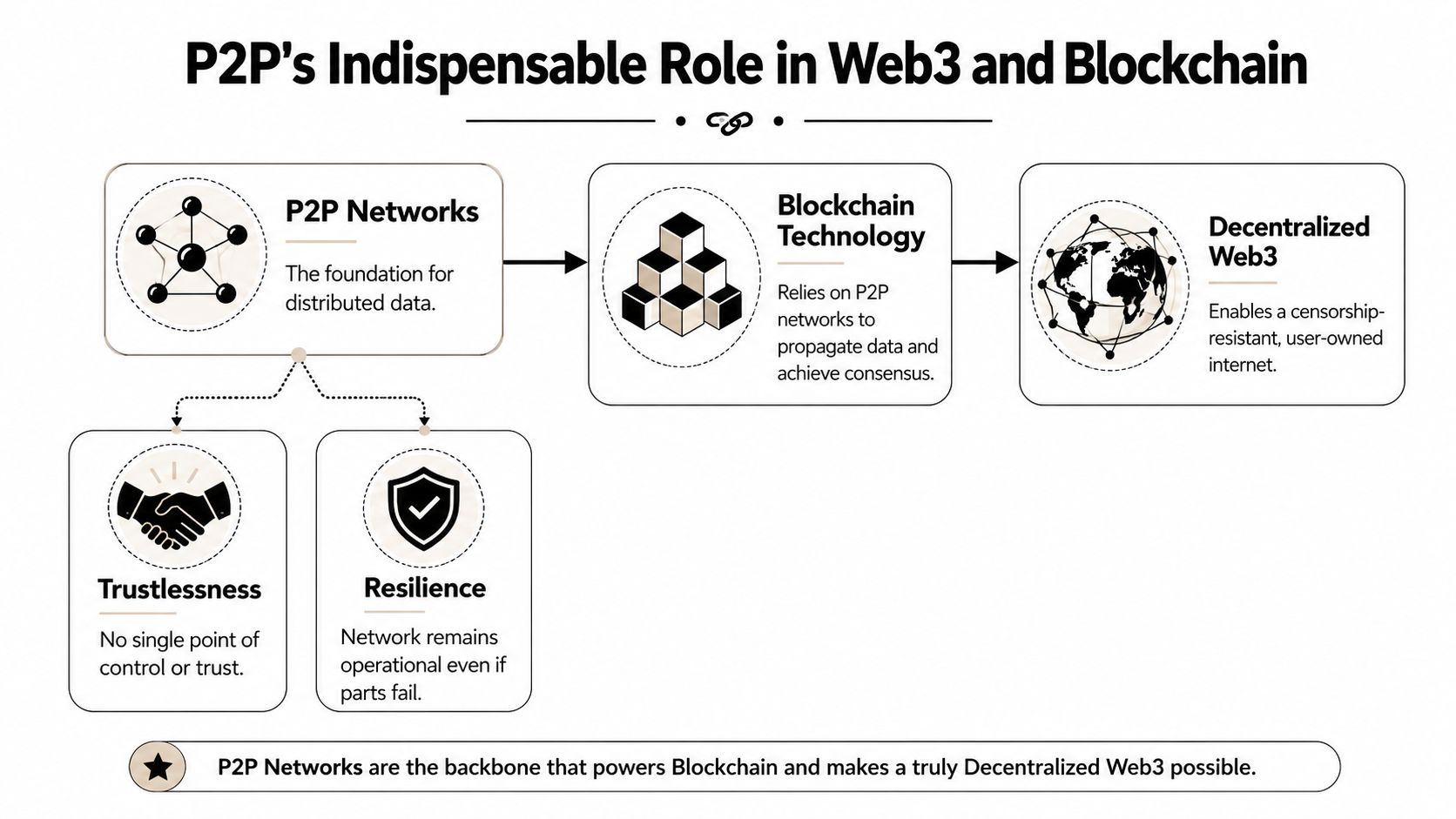
Why blockchain needs P2P
According to Coursera's overview of peer-to-peer networking, decentralized blockchain applications use a serverless consensus model where every node validates transactions and propagates them directly to peers, so network integrity doesn't depend on a central coordinator.
That one design choice creates three properties people talk about constantly in Web3.
Decentralization
No single operator controls ledger updates. Anyone can run a node, inspect the rules, and participate in verification according to the protocol.
Censorship resistance
If one actor can't shut down the main server, blocking the network gets much harder. That doesn't make every application unstoppable, but it changes the attack surface.
Trust minimization
Users don't need to trust a platform owner to preserve balances or transaction history. They trust protocol rules, validation logic, and distributed replication.
The moment one company becomes the unquestioned gatekeeper for transaction validity, you've rebuilt Web2 infrastructure with blockchain branding on top.
Bitcoin is still the clearest example
Bitcoin remains the cleanest example because its architecture is legible. Nodes validate transactions, broadcast them to peers, and replicate the ledger broadly across the network. No central party gets to rewrite history because the system doesn't route truth through one authority.
That's the point many candidates miss in interviews. They describe blockchain as immutable because “it's on-chain.” That answer is shallow. It's harder to alter because many independent nodes hold and validate the same history.
What this means for your career
Senior candidates can explain not just how a blockchain works, but why P2P is necessary for the value proposition. If you're interviewing for protocol engineering, backend infra, or technical product roles, expect some variation of these prompts:
- Why can't a centralized API replicate the same guarantees as a P2P blockchain network?
- What role does node propagation play in network trust?
- Where does decentralization break down in products that still rely on centralized relayers or gateways?
If your answer stays at the slogan level, you'll lose to someone who can map product claims to network mechanics.
Exploring Real-World P2P Applications in Web3
Real P2P skill shows up in products people use, infrastructure teams maintain, and job descriptions that pay well. If you want stronger Web3 roles, stop treating peer 2 peer applications as a theory topic and start mapping them to concrete systems.
Decentralized storage
Storage is one of the clearest examples because the trade-offs are obvious. A centralized cloud vendor controls uptime, pricing, geographic access, and account policy. A P2P storage network spreads those responsibilities across independent nodes, which changes how you design retrieval, replication, and durability.
That shift matters in interviews. Protocol and infra hiring managers want to hear content addressing, data availability, incentive design, and retrieval latency. They do not want another vague speech about censorship resistance.
If you can explain why a file retrieval market behaves differently from a managed object store, you are already operating above average candidate level.
Decentralized messaging
Messaging exposes whether you understand hostile networks. Messages need peer discovery, relay logic, spam resistance, delivery guarantees, and reasonable metadata protection. That is engineering work, not branding.
It is also a real hiring category. A role like this decentralised messaging engineer role in Rust at Logos signals what the market pays for. Employers expect you to reason about gossip, transport layers, offline delivery, adversarial peers, and failure recovery. If you can build that stack, you qualify for harder-to-fill protocol and communications roles that command higher salaries than standard frontend Web3 work.
DeFi and direct value exchange
DeFi gives P2P architecture an immediate business case. Users can swap, lend, borrow, and post collateral through protocol rules instead of relying on a single financial intermediary to match, approve, and settle every action.
For developers, architecture and money intersect. Interviewers will ask where P2P ends and smart contracts begin, how off-chain order flow affects trust assumptions, and which parts of a trading or lending product still depend on centralized infrastructure. Good answers connect network topology to execution, liquidity access, and failure modes.
Distributed browsing and content access
Web3 products also apply P2P design to publishing and content delivery. Instead of one host deciding what stays online, content can be replicated and fetched across participating nodes. That improves resilience, but it also creates hard product questions around indexing, versioning, discovery, and abuse control.
Teams that build these systems also need serious security review. If your app mixes user-generated content, wallets, browser clients, and relay infrastructure, third-party testing like affordable SaaS pentesting becomes a practical step, not a compliance checkbox.
Answer like a builder
Use a sharper framework in interviews and architecture reviews:
- State the product bottleneck caused by centralization.
- Explain the P2P mechanism that removes or reduces it.
- Name the engineering costs introduced by that choice.
- Tie the design to a role. Protocol engineer, decentralized messaging engineer, storage infra engineer, or backend Web3 systems engineer.
That answer pattern gets you past surface-level discussion and into the salary band reserved for people who can design distributed systems instead of just talking about them.
Navigating Security and Privacy in P2P Systems
Scam rates on consumer P2P platforms are high enough to change how you should design these systems. As noted earlier, frequent users report even more scam exposure. Treat that as a product requirement. If you build peer 2 peer applications without an explicit threat model, you are shipping risk to users and creating the exact weakness interviewers will ask you to explain.

Security in P2P is harder because the network is open, identities are cheap, peers are unreliable, and message paths are not fully under your control. Privacy is hard for the same reason. Broadcast patterns, peer metadata, timing, and IP exposure can reveal more than the application payload itself. Mid-level developers often focus on cryptography and miss network-layer leakage. Senior engineers do not make that mistake.
Attacks interviewers expect you to explain clearly
Sybil attacks
Sybil resistance is table stakes. An attacker creates large numbers of fake identities, floods discovery or voting processes, and gains influence that honest peers did not intend to grant.
Your answer should go past the definition. Explain the control. Use staking, proof-of-work costs, allowlists for sensitive roles, hardware-backed identity, reputation systems, or rate limits tied to scarce resources. Then explain the tradeoff each choice introduces. That is how protocol engineers and security engineers answer.
Eclipse attacks
Eclipse attacks matter because they break a node's view of reality. If an attacker controls enough of a node's peer set, they can filter transactions, delay blocks, distort mempool visibility, or feed manipulated state.
A good mitigation answer includes peer rotation, connection diversity across subnets and ASNs, authenticated bootstrapping, inbound and outbound peer limits, and monitoring for suspicious topology concentration. If you stop at “connect to more peers,” your answer is too shallow for a serious Web3 interview.
Data poisoning and malicious responses
Open networks invite bad data. Storage nodes can serve corrupted content. Indexers can return misleading results. Messaging peers can replay, reorder, or fabricate packets.
Verification has to happen before state changes, not after. Signatures, content addressing, replay protection, schema validation, and deterministic verification rules are the baseline. Anything less is a prototype.
Privacy failures are usually network failures
Developers love to say data is encrypted. That is not enough. P2P systems still leak who talked to whom, when they did it, how often they did it, and which peers were online at the same time. That metadata can expose users, traders, validators, or operators even if the payload is unreadable.
If you want to build systems people can trust, reduce metadata leakage on purpose. Use relay layers where appropriate. Minimize peer-identifiable logs. Separate public gossip from sensitive coordination paths. Review what the client exposes by default, especially in browser-based apps that mix wallets, APIs, and third-party infrastructure.
What mature teams build into the system
Strong teams put concrete controls in place early because fixing network security after launch is expensive and reputationally brutal.
- Identity friction: Make large-scale fake peer creation costly.
- Peer selection rules: Enforce diversity in geography, subnet, client version, and connection source.
- Message verification: Validate signatures, payload structure, freshness, and expected state transitions before processing.
- Rate limiting and abuse controls: Slow down spam, replay, scraping, and resource exhaustion attempts.
- Telemetry: Track peer churn, propagation anomalies, connection clustering, and suspicious retry patterns.
- Adversarial testing: Run attack simulations before releases, not after incidents.
For teams wrapping decentralized infrastructure in dashboards, APIs, and admin panels, external review matters too. affordable SaaS pentesting is a useful reference because attackers often hit the web layer, cloud permissions, and operational tooling before they touch the protocol.
This skill set maps directly to hiring demand. Study a senior blockchain security engineer role covering Solidity, Rust, and Golang at CertiK and you will see the pattern. Employers pay more for engineers who can explain peer behavior, abuse paths, verification rules, and incident controls without falling back on vague security language.
Leveraging P2P Knowledge for Your Web3 Career
P2P moves beyond theory into practical application.
In 2025, technical roles including blockchain development and security auditing made up over 50% of all crypto jobs, and global crypto-related openings increased 47% year over year to approximately 66,000 new roles, according to Gate Research's 2025 crypto employment report. If you're trying to move upmarket, network-level competence is one of the clearest ways to separate yourself from the flood of generalist applicants.
Roles where P2P knowledge pays off
Protocol engineer
This is the obvious one. You're expected to understand peer discovery, propagation, node behavior, and network reliability.
Weak candidates talk about consensus at a whitepaper level. Strong ones can explain message flow and failure handling.
Smart contract developer with infra awareness
Even if your daily work is Solidity or another contract language, you'll stand out if you understand how transactions reach the chain, how nodes relay them, and where off-chain services distort decentralization claims.
This is also where compensation gets serious. Pro Global Search's 2025 crypto market overview says senior smart contract developer roles command $180K to $350K+, and US-based blockchain developers average $146,250 annually. If you want to argue for the top end, you need more than contract syntax. You need systems judgment.
Security auditor
Network security knowledge is a force multiplier for auditors. You're not just reviewing code paths. You're asking how adversaries join, isolate, spam, poison, or manipulate the network around the code.
Technical product manager
A good Web3 product manager can discuss trust assumptions, gateway dependencies, and fallback behavior with engineers. If you can't, you'll end up shipping “decentralized” products that fail under centralized constraints.
A market-facing example is this Java backend engineer role for a P2P marketplace at Binance. Even backend roles around exchange and marketplace systems benefit from clear P2P thinking because transaction flow, trust, abuse prevention, and reliability all sit close to distributed coordination.
Interview questions you should be ready for
Use these as drills, not trivia.
- How does a new node discover peers in a decentralized network?
- What trade-offs separate pure P2P from hybrid P2P?
- How would you reduce the risk of a Sybil or eclipse attack?
- Why is transaction propagation critical to blockchain integrity?
- Where does decentralization weaken when products rely on centralized gateways?
Your answer should include architecture, risk, and product consequence. Don't answer in slogans.
How to present this on your resume
Most mid-level developers bury their strongest signal. Don't write “worked on blockchain features.” Write what you improved or designed in the networked system.
Better resume framing:
- Implemented peer discovery or node communication logic
- Designed validation paths for untrusted network inputs
- Built or maintained event propagation, relayer, or indexing infrastructure
- Modeled network-level abuse cases and defined mitigations
- Worked across smart contracts and off-chain P2P services
Your resume should show that you understand distributed behavior, not just on-chain syntax.
A short technical walkthrough can help you sharpen your story before interviews.
The blunt career recommendation
If you're a mid-level developer, spend less time chasing every new narrative and more time mastering the core mechanics that serious teams keep needing. Learn how nodes connect. Learn how data propagates. Learn how attackers manipulate network assumptions. Learn where centralized shortcuts re-enter supposedly decentralized products.
That combination is what moves you from “can build in Web3” to “can architect for Web3.” And that's the range that gets shortlisted for top-tier roles and compensation.
If you're ready to turn that knowledge into a better role, explore curated openings on Blockchain Jobs. It's a focused place to find Web3 engineering, security, product, and infrastructure roles without digging through generic job boards.