Programming on Blockchain: A Guide to Your First Web3 Job
Diving into the world of Web3 can feel like you're standing at the edge of a vast, new universe. This guide is your launchpad. We're not here to talk abstract theory; we're here to give you a practical, direct path into a high-growth industry and get you hired. Forget the hype—we're focusing on the exact skills and projects that make recruiters sit up and take notice.
Your Launchpad into a Web3 Development Career

Think of blockchain less as a confusing technology and more as the foundation for a new, decentralized internet. When you learn to program on it, you're learning to build the core infrastructure of this new frontier. That's a skill set in seriously high demand, and your ticket to a high-impact career.
The numbers don't lie. The global blockchain technology market was valued at $0.57 billion in 2023. It’s projected to explode at a compound annual growth rate of 87.7% from 2024 to 2030. For you, this isn't just a statistic; it's a clear signal of immense job opportunity.
This massive expansion is being fueled by companies scrambling for more secure and transparent systems, creating a huge talent gap. Firms are practically tripping over themselves to find engineers who understand scalable protocols and can deploy them reliably. You can get a better sense of the momentum by reading up on emerging blockchain technology trends.
Why This Matters For Your Career
This is about more than just learning another programming language. It's about strategically placing yourself in a lucrative, future-proof career path. Right now, the demand for skilled blockchain developers completely overwhelms the supply, which gives you incredible leverage in the job market, from salary negotiations to choosing projects you're passionate about.
You don’t have to take my word for it. Just take a quick look at a specialized job board like Blockchain Jobs, which is a hub for Web3 opportunities.
The listings aren't just for hardcore coders. You'll see everything from engineering to product management, which just goes to show how broad the need for talent is across the entire ecosystem. This guide will walk you through the precise concepts, tools, and portfolio projects that will make you a top candidate for roles just like these.
Our goal is simple: teach you what you actually need to know to get hired. We'll cut through the noise and focus on the practical skills that hiring managers are actively looking for.
Every section that follows is a deliberate step on your career path. We’re going to cover:
- Core Concepts: The foundational ideas that separate junior applicants from senior hires in an interview.
- Development Stacks: How to choose the languages and frameworks that recruiters want to see on your resume.
- Portfolio Projects: Building real, tangible proof of your skills that will get you past the screening stage.
- Professional Workflows: Adopting the security-first mindset that top companies demand from their engineers.
Thinking Like a Blockchain Developer
Before you ever write a line of code, you need a mental shift. This is the single most important skill you can build, and it's what hiring managers are searching for in candidates. Programming on blockchain isn't just learning new syntax; it’s absorbing a completely different paradigm where every line of code can be final, public, and costly.
Get this right, and you're already halfway to acing that technical interview. You're no longer just building an app; you're engineering a small, autonomous, and permanent digital economy. Every decision you make is final, and every bit of inefficiency costs your users real money. This is the level of thinking that commands senior-level salaries.
Smart Contracts: The Digital Vending Machines
The first and most fundamental concept you must master is the smart contract. Forget the dry, academic definitions. In an interview, the best way to explain it is as a digital vending machine.
You put in a coin (a transaction), and press a button for what you want (a function call). The machine whirs to life, checks if you paid enough, and drops your snack (executes the code and transfers an asset). There's no person behind the counter, no room for negotiation, and no way for the machine to change its mind after you've paid.
- The rules are coded upfront: The logic is locked in from the start, dictating exactly what happens and when.
- Execution is totally automatic: Once it's live, the contract just runs. It doesn't need a human to push a button when the right conditions are met.
- The outcome is guaranteed and final: The result is irreversible and burned into the blockchain's public ledger for everyone to see.
When you're in a job interview, especially for a DeFi role, explaining this with a practical example is everything. Anyone can recite a definition. But if you can describe how a smart contract automates a lending protocol or an NFT mint, you're showing you understand why they exist. You see them as tools for building systems where trust isn't needed—a core value proposition of the entire industry.
A senior developer understands that a smart contract isn’t just a script; it’s a binding, transparent, and unstoppable agreement. Your job is to architect that agreement to be flawless from day one, because there are no second chances on-chain. This is the mindset that gets you hired.
Consensus Mechanisms: How Anything Gets Done
Next up is the engine that makes the whole thing run: consensus mechanisms. This topic comes up constantly in interviews because it directly impacts application performance, cost, and security. You absolutely must know the big two: Proof of Work (PoW) and Proof of Stake (PoS).
Imagine a group of people trying to agree on a single, official version of a story.
- Proof of Work (PoW): This is the brute-force method. Everyone in the group tries to solve an insanely hard math puzzle. The first one to crack it gets to add the next page to the story and earns a reward for their effort. It's incredibly secure but, as you can imagine, also very slow and burns a ton of energy. Bitcoin is the classic example.
- Proof of Stake (PoS): This approach is more like a lottery. Instead of solving a puzzle, people who have a financial "stake" in the story (by locking up tokens) get a chance to be chosen to add the next page. The more you have at stake, the higher your chances. It's far more energy-efficient and faster, which is why networks like Ethereum made the switch.
If a hiring manager brings this up, they're testing your ability to think commercially. A good answer isn't just defining PoW and PoS. It's explaining why you wouldn't build a high-frequency trading dApp on a slow PoW network—the fees and lag would make the product unviable. That shows you think like an architect who makes sound business and technical decisions, not just a coder.
On-Chain vs. Off-Chain Data: The Scalability Puzzle
Finally, a truly great blockchain developer knows that the secret to building anything useful is knowing what not to put on the blockchain. This brings us to the critical difference between on-chain and off-chain data.
Think of the blockchain as a maximum-security bank vault. It’s transparent, tamper-proof, and ridiculously secure. But it's also expensive to use and slow to access. You only put your most critical assets in there—things like account balances, ownership records, or the final outcome of a critical vote.
Everything else—user profiles, chat messages, high-resolution images—gets stored in a regular warehouse next door (off-chain). It’s cheaper, faster, and way more flexible. The real art, and what companies will pay you for, is building a secure and reliable link between that warehouse and the bank vault.
This understanding is a huge sign of maturity to an interviewer. You might get a question like, "How would you design a decentralized social media app?" The junior dev will say, "Store all the posts on-chain!" It's a tempting answer, but it's also absurdly expensive and unworkable. The senior-minded candidate will immediately talk about storing post content off-chain on a system like IPFS and only recording the content hashes and ownership tokens on-chain.
That's the answer that gets you hired. It shows you're pragmatic, cost-conscious, and focused on building something that can actually scale.
Choosing Your Blockchain Development Stack
Picking your first language and framework in the blockchain world is a massive career decision. It's not just a technical choice; it dictates the types of jobs you're qualified for, the projects you'll build, and your earning potential.
Think of it like being a chef. A pastry chef and a grill master are both experts in the kitchen, but their tools, techniques, and the restaurants that hire them are worlds apart. In the same way, a Solidity developer building DeFi apps works in a completely different ecosystem than a Rust developer engineering a blockchain's core protocol. Making the right choice now is the first step in crafting your professional brand.
No matter which path you take, the fundamentals are the same. You'll be writing code that interacts with a decentralized network, all governed by the core principles of smart contracts, consensus, and data integrity.
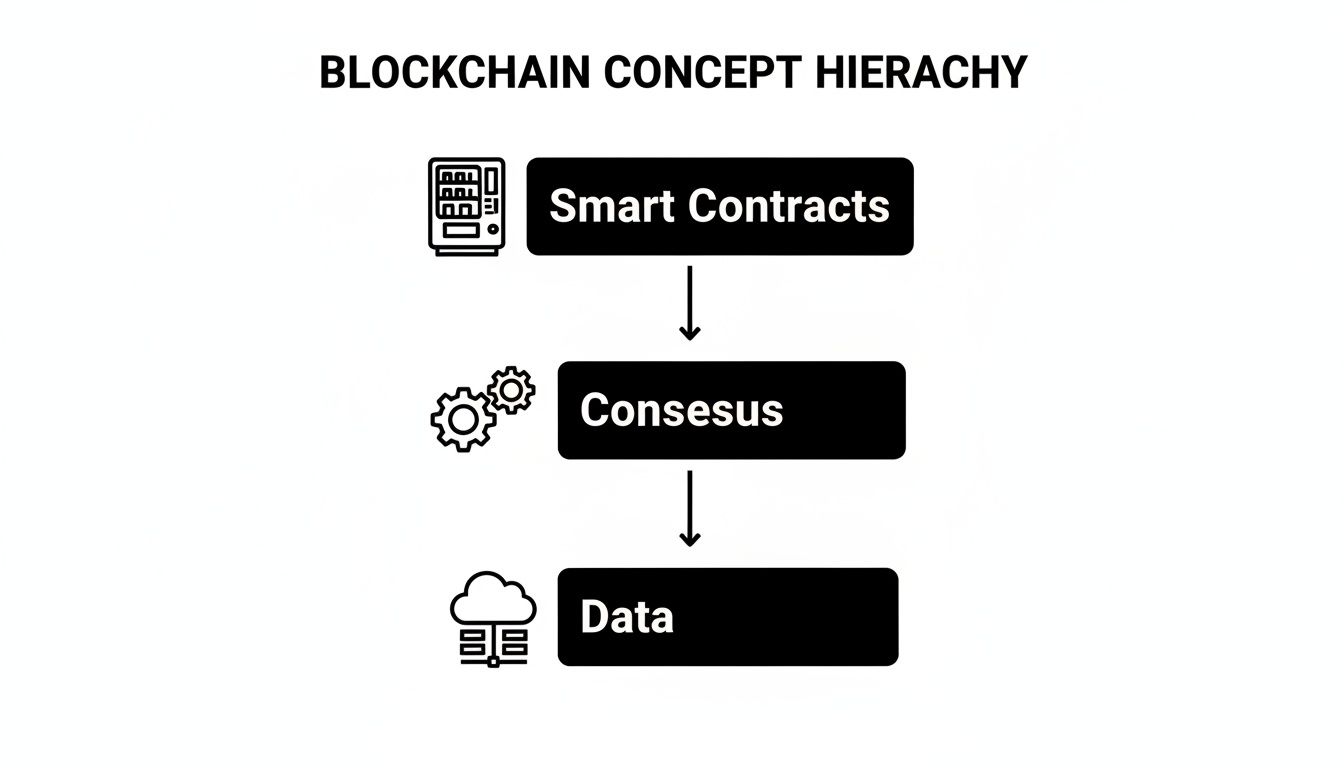
This simple hierarchy gets to the heart of it: your code (the smart contract) is only as good as the consensus mechanism that validates it and the on-chain data it manages.
Solidity: The Undisputed King of EVM
If you want the most direct path to the largest number of jobs in DeFi, NFTs, or DAOs, you must learn Solidity. It’s the language of the Ethereum Virtual Machine (EVM), which isn’t just for Ethereum—it’s the engine behind a massive ecosystem of chains like Polygon, Avalanche, and BNB Chain.
This dominance is staggering. An estimated 80-90% of all value locked in smart contracts sits on EVM-compatible chains. That translates to a huge, constant demand for skilled Solidity developers.
When a recruiter posts a "Smart Contract Developer" job, 9 times out of 10, they're looking for someone who knows Solidity. Mastering it opens the door to the biggest slice of the Web3 job market, period. It's the safest bet for landing your first role quickly.
For a hiring manager, a candidate who knows their way around Solidity and its toolchains (like Hardhat or Foundry) is a reliable choice. It shows you can work with established protocols, use proven libraries, and grasp the security models that protect billions of dollars.
Rust: The Language of High Performance
While Solidity owns the application layer, Rust is the go-to for building the high-speed infrastructure that powers next-generation blockchains. It's the language behind performance-obsessed protocols like Solana, Polkadot, and Near.
Learning Rust opens up a different, often more senior, set of career opportunities.
- Protocol Engineer: You’ll work on the blockchain’s core engine—improving consensus, optimizing transaction processing, and making the entire network faster and more secure.
- Infrastructure Developer: You’ll build the lightning-fast tools, indexers, and bridges that allow decentralized applications to function at scale.
These roles are less about application logic and more about deep systems programming, handling concurrency, and ensuring memory safety—all areas where Rust shines. Job postings like this Solana Program Engineer position give you a real-world glimpse into this career path. Choosing Rust is a bet on the future of high-throughput blockchains and a path to highly specialized, high-paying roles.
Move: The Emerging Security Specialist
A fascinating new language gaining serious momentum is Move. Originally designed for Meta’s Diem project, it was built from the ground up with one thing in mind: asset security. Today, it powers innovative Layer 1 blockchains like Aptos and Sui.
Move's killer feature is its "resource-oriented" model. It treats digital assets like tokens and NFTs as special, protected types within the language itself. This design makes it structurally harder to write code that accidentally duplicates, loses, or mishandles assets—the very bugs that have led to catastrophic hacks in other ecosystems.
Learning Move makes you a standout candidate for companies building on these new, security-focused chains. The job market is smaller than Solidity's, but the talent pool is far less crowded. Having Move on your resume tells recruiters you're ahead of the curve and a specialist, positioning you perfectly for high-impact roles where security is paramount.
Which Blockchain Language Is Right for Your Career?
Choosing your first language can feel overwhelming, so I've put together this table to help you compare the main options from a career perspective. Think about the kind of work that excites you most and see which ecosystem aligns with your professional goals.
| Language | Primary Ecosystem | Best For These Roles | Key Feature |
|---|---|---|---|
| Solidity | Ethereum, Polygon, Avalanche, BNB Chain | Smart Contract Developer, DeFi Engineer, NFT Developer | Dominant market share and largest job pool |
| Rust | Solana, Polkadot, Near | Protocol Engineer, Infrastructure Developer, Core Dev | Unmatched performance and memory safety |
| Move | Aptos, Sui | Security-Focused Engineer, L1 Developer | Built-in safeguards for digital assets |
Ultimately, there’s no single "best" language—only the one that’s best for your career. Solidity offers the most jobs right now, Rust positions you for deep infrastructure roles, and Move puts you on the cutting edge of smart contract security. Your choice will shape your journey in this exciting field.
Building Your First Portfolio-Ready dApp
Theory is one thing, but a solid portfolio is what actually gets you hired. When it comes to programming on blockchain, your GitHub is your new resume. A clean, functional project speaks volumes more than any certificate ever could. Hiring managers need to see that you can do more than just write code; they want proof you can handle the entire development process, from a blank file to a live, working application.
Think of this section as your hands-on workshop for building that first crucial project. We're going to build a simple but effective decentralized voting application. This kind of project is perfect because it's straightforward enough to complete in a reasonable time but complex enough to showcase all the essential skills hiring managers look for in an entry-level developer.

By the time we're done, you won't just have a folder of code. You'll have a real, tangible asset you can deploy, share with others, and discuss with confidence in your next technical interview. Let's get started on the project that could land you your first Web3 job.
Setting Up Your Professional Environment
Before we even think about writing a line of Solidity, we need to set up our workspace like a pro. Being able to explain your development environment in an interview shows you understand how real-world teams operate. We’ll be using Hardhat, a go-to development environment in the Ethereum world that makes compiling, testing, and deploying contracts so much easier.
First things first, make sure you have Node.js and npm (or yarn) installed. Got those? Great. Now, open up your terminal and create a new project directory:
- Create a Project Folder: Run
mkdir voting-dapp && cd voting-dappto create the folder and jump into it. - Initialize npm: Next, run
npm init -y. This creates apackage.jsonfile to manage our project's dependencies. - Install Hardhat: Time to add Hardhat. Run
npm install --save-dev hardhat. - Create a Hardhat Project: In that same directory, run
npx hardhat. You'll get a few prompts—just choose "Create a JavaScript project" and accept the defaults. Hardhat will then set up a standard project structure with folders for your contracts, scripts, and tests.
Getting comfortable with this setup is huge. It's the standard for countless Web3 companies, and knowing it like the back of your hand is a baseline expectation for any junior developer role.
Writing the Smart Contract
Alright, now for the fun part—the core logic. Our smart contract will run a simple public poll. It needs to know the voting options, keep a running tally of the votes for each, and, most importantly, stop people from voting more than once.
Go ahead and create a new file named Voting.sol inside your contracts folder. Here's the basic code, with comments walking you through what each piece does.
// SPDX-License-Identifier: MIT
pragma solidity ^0.8.20;

contract Voting {
    // A mapping is like a dictionary or hash map.
    // This one stores the name of each candidate by their ID.
    mapping(uint256 => string) public candidates;

    // This mapping will store the vote count for each candidate.
    mapping(uint256 => uint256) public votes;

    // We need to track who has voted to prevent double-voting.
    // This mapping will link a user's address to a true/false value.
    mapping(address => bool) public hasVoted;

    // The constructor runs only once, right when the contract is deployed.
    // We'll use it to set up our two initial candidates.
    constructor() {
        candidates[1] = "Candidate A";
        candidates[2] = "Candidate B";
    }

    // This is the function users will call to cast their vote.
    // 'require' statements are our security guards. If a condition isn't met,
    // the transaction fails immediately.
    function vote(uint256 _candidateId) public {
        // First, check if this person has already voted.
        require(!hasVoted[msg.sender], "You have already voted.");

        // Next, make sure they're voting for a real candidate.
        require(_candidateId == 1 || _candidateId == 2, "Invalid candidate ID.");

        // If both checks pass, we record their address so they can't vote again.
        hasVoted[msg.sender] = true;

        // Finally, we add one to the vote count for their chosen candidate.
        votes[_candidateId]++;
    }
}
This is exactly the kind of clean, well-commented code that gets a hiring manager's attention. It shows you've got a handle on state variables (mappings), function visibility (public), and essential security checks (require).
Testing and Deploying Your Contract
A smart contract without tests is a ticking time bomb. In Web3, bugs can mean real, irreversible financial loss, so thorough testing isn't just a good practice—it's absolutely mandatory. Hardhat integrates beautifully with JavaScript testing frameworks like Mocha and Chai to make this a smooth process.
In your test folder, you would create a file like Voting.test.js. In it, you would write tests to confirm that a user can vote successfully, that the vote count updates correctly, and that the contract properly rejects a second vote from the same person. Adopting this test-first mentality is a massive green flag for employers and something to highlight in interviews.
Once all your tests are passing, it's time for deployment. We'll push it to a test network like Sepolia, which works just like the real Ethereum network but uses free, valueless ETH.
- Get Testnet ETH: First, you’ll need some Sepolia ETH from a "faucet" to cover the deployment gas fees.
- Configure Hardhat: You'll need to update your
hardhat.config.jsfile with the Sepolia network URL (which you can get from a service like Infura or Alchemy) and your wallet's private key. - Write a Deploy Script: Inside the
scriptsfolder, you'll create adeploy.jsscript that tells Hardhat how to compile and deploy yourVoting.solcontract. - Run the Script: From your terminal, just run
npx hardhat run scripts/deploy.js --network sepolia.
And just like that, your smart contract is live on a public blockchain! You now have a contract address you can link to in your portfolio as concrete proof of your work.
Building a Simple Frontend Interaction
A smart contract on its own is just a backend. To turn it into a dApp that people can actually use, you need a frontend. This is where your skills can open up a ton of job opportunities, with companies constantly looking for people in roles like a Frontend Engineer for a Web3 Wallet.
We can use a library like Ethers.js to let a website talk directly to the Ethereum blockchain. A simple HTML file with a bit of JavaScript is all you need to:
- Connect to a Wallet: Add a button that lets users connect their MetaMask wallet to your site.
- Read Data: Fetch the current vote counts from your deployed contract and display them on the page.
- Write Data: Create buttons for each candidate that call the
vote()function. When a user clicks one, it will prompt them in their wallet to approve the transaction.
Taking this last step turns your project from a cool command-line script into a complete, portfolio-ready decentralized application. You've now shown you understand the full dApp development stack from end to end—a skill set that will put you way ahead of the competition.
From Junior Dev to Production-Ready Engineer

The leap from building a simple dApp to becoming a true production-ready engineer is all about a change in mindset. Anyone can write code that works. Hiring managers and senior devs are looking for people who build systems that are secure, efficient, and absolutely unshakable under pressure. This is how you leave the junior applicant pool behind and start competing for higher-level roles.
A huge piece of that puzzle is adopting a professional workflow. I’m talking about moving past manual deployments and embracing practices like automated testing and Continuous Integration/Continuous Deployment (CI/CD) pipelines. In Web3, where one bug can mean irreversible financial losses, this stuff isn't a luxury—it's a non-negotiable part of any serious project.
When you can speak to this disciplined approach in an interview, you’re signaling that you understand the entire lifecycle of a production-grade application. It proves you're thinking about maintainability, collaboration, and risk—the real hallmarks of a seasoned engineer.
Adopting a Security-First Mindset
When you're programming on blockchain, security isn't just another box to check. It's the bedrock of everything you build. A single, overlooked vulnerability can be exploited to drain millions of dollars from a protocol in minutes. This is why having a security-first mindset is easily the most valuable trait a Web3 developer can possess.
Top firms will absolutely grill you on this during interviews. You need to walk in ready to talk about common attack vectors and, more importantly, how to prevent them.
- Reentrancy Attacks: The classic smart contract nightmare. An attacker's contract calls back into yours repeatedly before the first function call is even finished, siphoning funds. Mentioning your use of the Checks-Effects-Interactions pattern and tools like OpenZeppelin's ReentrancyGuard is mission-critical.
- Integer Overflows/Underflows: Before Solidity 0.8.0, simple math could go horribly wrong. While newer compilers have built-in protection, being able to explain the why this was a problem shows a deeper level of understanding that impresses interviewers.
- Access Control Flaws: Forgetting to properly secure functions with modifiers like
onlyOwneris like leaving the vault door wide open. It’s a rookie mistake that can expose critical admin functions to anyone on the network.
There's a reason smart contract auditing firms like OpenZeppelin and ConsenSys Diligence exist. Go read their public audit reports. Seriously. It’s like getting a free masterclass in spotting high-stakes vulnerabilities. Bringing up what you've learned from those reports in an interview shows you’re proactive and dead serious about protecting user assets.
The field is constantly moving, too. By 2026, many expect to see a fusion of AI and blockchain, where the blockchain provides an immutable log for AI-driven decisions. Auditing these hybrid systems will be an enormous challenge, creating massive demand for security specialists who can guarantee their integrity. You can read more about these futuristic blockchain use cases to stay ahead of the curve.
The Art of Gas Optimization
After security, efficiency is king. Every single operation in a smart contract costs users real money in gas fees. A production-ready engineer is obsessed with writing lean, optimized code that keeps those costs to a minimum. This isn't just about saving users a few cents; it's a direct reflection of your skill and your respect for the product's viability.
Don't be surprised if a technical interview involves refactoring a snippet of code to make it more gas-efficient. Here are a few techniques you should know cold:
- Minimize Storage Writes: Writing to the blockchain's state (the
SSTOREopcode) is one of the most expensive things you can do. Always ask yourself: "Can I do this without a state change?" - Use Memory and Calldata: For data that only needs to exist for the duration of a function call, use
memoryorcalldata. They are worlds cheaper thanstorage. - Efficient Data Packing: Solidity is smart. If you declare smaller variables (like a
uint128or abool) right next to each other, it can pack them into a single 256-bit storage slot, which can slash your storage costs.
Mastering gas optimization demonstrates a deep, fundamental understanding of how the EVM actually works. It proves you're not just writing code; you're engineering applications that are practical and affordable for people to use—a skill that creates immediate value for any company.
Landing Your First Web3 Job
So, you've been grinding away, learning the ins and outs of blockchain development. Now what? Turning that hard-earned knowledge into a job offer is the next critical step. The Web3 job market moves fast, and knowing which roles are hot is key to getting noticed for programming on blockchain positions.
Despite what you might hear, the market is actually in a pretty good spot. In 2025, VC funding for US crypto companies bounced back in a big way, hitting $7.9 billion—a solid 44% increase from 2024. The catch? That money is flowing into a smaller number of high-conviction projects. Investors are betting on strong engineering teams to build the future, from complex DeFi protocols to AI-crypto integrations. If you're curious, you can get more details on the 2026 crypto outlook.
Crafting a Compelling Web3 Resume and Portfolio
Your resume and portfolio are your ticket in the door. In the Web3 space, they need to do more than just list your skills; they have to prove you understand the unique challenges of building on-chain.
Your portfolio is everything. Seriously. It must showcase at least one complete decentralized application (dApp). This shows employers you can handle the entire lifecycle: writing the smart contract, testing it rigorously, and connecting it to a working frontend. Make sure your GitHub READMEs are pristine. Explain why you made certain design choices, how you tackled security, and any steps you took to optimize for gas.
A well-documented GitHub profile is more powerful than a perfect resume. Recruiters want to see your thought process, not just the final code. They will look at your commit history and how you solve problems. This is your chance to show, not just tell.
Navigating the Blockchain Technical Interview
Get ready, because the Web3 technical interview is a different beast entirely. It’s not just about whether you can code; it’s about whether you can think like a blockchain developer. They’ll dig deep into your understanding of the core principles of decentralization and security.
You can expect to run into a few common scenarios:
- Live Coding: You’ll likely be asked to spin up a simple smart contract on the spot. They'll be watching closely to see if you instinctively follow security patterns, like Checks-Effects-Interactions.
- Conceptual Deep Dives: Be prepared for questions that go beyond code. An interviewer might ask you to explain the trade-offs between Proof-of-Work and Proof-of-Stake from a product perspective, or why putting large files on-chain is a terrible idea.
- Security Scenarios: This one is huge. You might get a snippet of code and be asked to find the vulnerability. They're looking for your ability to spot common exploits like reentrancy attacks or integer overflows before they become a disaster.
Ultimately, they want to see that you get it—that you’re always thinking about the constraints of building for an immutable and often adversarial environment. A great way to prepare is to study real job descriptions to see what companies are actually looking for. For example, check out this opening for a Software Engineer in the Binance Accelerator Program. It’s a direct window into the skills that top-tier teams value right now.
Common Questions from Aspiring Blockchain Developers
As you start looking beyond the tutorials and think about a career, you're bound to have some practical questions. Let's tackle a few of the most common ones I hear from developers trying to break into the Web3 space.
Do I Really Need a Computer Science Degree to Get a Blockchain Job?
Honestly, no. A formal CS degree is not a hard requirement. The Web3 world is a meritocracy at its core—it cares far more about what you can build than what's on your diploma. Some of the best developers I know are self-taught or came out of a bootcamp.
What really matters is that you have a rock-solid grasp of programming fundamentals. You need to show deep expertise in your chosen stack, whether that's Solidity and the EVM or Rust and Substrate. A killer GitHub profile that shows you can build secure, well-documented projects will always beat a fancy degree.
What's the Biggest Mistake Junior Web3 Developers Make?
By far, the most common—and most career-damaging—mistake is treating security as an afterthought. This isn't like traditional web development, where you can just push a patch if you find a bug. A flaw in a smart contract that's already deployed is permanent and can lead to a catastrophic, irreversible loss of funds.
Too many junior devs just focus on getting the code to work. They completely overlook common attack vectors like reentrancy, oracle manipulation, or simple integer overflows. When I'm interviewing candidates, I'm specifically looking for a security-first mindset. Show me you know how to use tools like Slither and that you write exhaustive tests. That’s how you prove you're ready for the big leagues.
How Can I Stand Out to Web3 Recruiters?
You have to show you're genuinely invested in the space. Simply completing a bunch of tutorials won't cut it. The best way to get noticed is to start contributing to open-source Web3 projects on GitHub. This shows you can work with a team, navigate a complex codebase, and add real value.
Recruiters want to see passion and initiative, not just a list of completed courses. Building a unique dApp that solves a real problem, however small, and documenting your process in a blog post or detailed README will set you apart from the crowd.
Get active in the community. Join the conversation on X (formerly Twitter) or jump into a project's Discord. It shows you're proactive and committed, which are exactly the kinds of traits hiring managers want on their teams.
Ready to find your place in the decentralized future? At Blockchain Jobs, we connect talented professionals with the best opportunities in the Web3 ecosystem. Explore thousands of roles in engineering, product, marketing, and more. Find your next great role today.