
10 Portfolio-Worthy Project in Cryptography Ideas for Your 2026 Job Hunt

In the competitive Web3 job market, theoretical knowledge of cryptography isn't enough. Hiring managers at top blockchain firms and protocol teams are actively searching for candidates who can translate complex concepts into secure, efficient, and innovative systems. A well-executed project in cryptography on your portfolio is the single most powerful way to demonstrate your practical skills, problem-solving abilities, and readiness for a high-impact role. It provides the tangible proof that separates you from the crowd and turns a job application into a compelling interview.
This article moves beyond abstract theory to provide a strategic blueprint for your career advancement. We will break down 10 distinct project ideas, treating them not just as technical exercises, but as deliberate career moves designed to showcase the skills that get you hired. For each project, you will find a clear roadmap detailing:
- Core Objectives: What the project aims to achieve and why it matters in a business context.
- Key Cryptographic Concepts: The specific primitives and protocols you will implement.
- Suggested Tech Stack: The tools and languages that will get the job done.
- Actionable Milestones: A step-by-step guide from setup to completion.
- Portfolio-Ready Deliverables: How to package your work for maximum impact in a job application.
- Why This Project Matters for Your Career: Crucial notes on how to frame your project to catch the eye of recruiters and engineering leads, highlighting the skills they are looking for right now.
Forget generic tutorials. This guide is built to help you create a project in cryptography that directly answers the needs of the industry, making you a more desirable candidate. Let's build your next career milestone.
1. Zero-Knowledge Proof (ZKP) Implementation for Privacy-Preserving Applications
Zero-Knowledge Proofs (ZKPs) are a cryptographic breakthrough enabling one party (the prover) to prove to another (the verifier) that they know a piece of information, without revealing the information itself. This "proof of knowledge without revelation" is a cornerstone for building private, scalable, and compliant systems in Web3. For anyone building a project in cryptography, mastering ZKPs demonstrates a deep understanding of modern blockchain challenges.
This technology is not just theoretical; it powers some of the most innovative projects in the space. Zcash utilizes zk-SNARKs for fully shielded, private transactions, while StarkNet employs zk-STARKs to build a major Ethereum scaling solution. These examples showcase ZKPs' dual utility in enhancing both privacy and throughput.
Why This Project Matters for Your Career
A ZKP implementation is a standout portfolio piece because it signals expertise in cutting-edge cryptography that top Web3 companies desperately need. Recruiters for roles in protocol engineering, L2 development, and DeFi are actively searching for candidates with hands-on ZKP experience. During an interview, discussing your ZKP project allows you to showcase your ability to tackle complex problems in privacy and scalability—two of the most significant challenges in blockchain today, and a common topic in technical discussions.
Actionable Plan & Key Considerations
To get started, consider building a simple privacy-preserving voting or authentication application.
- Technology Stack: Begin with user-friendly libraries like
circom(for writing circuits) andsnarkjs(for generating proofs), or explore more advanced frameworks like StarkWare'sCairo. - Mathematical Foundations: Before coding, invest time in understanding the underlying elliptic curve cryptography and polynomial commitments. This knowledge is crucial for answering deep-dive questions in an interview.
- Security First: While building, remember that a flawed ZKP implementation can create severe security vulnerabilities. Be prepared to discuss potential issues, such as the need for a trusted setup in certain zk-SNARK systems, to show your security-conscious mindset.
Building a functional ZKP application is a challenging yet highly rewarding endeavor. This project places you at the forefront of Web3 innovation, making you a highly desirable candidate and giving you a powerful talking point for any technical interview.
2. Multi-Signature (Multisig) Wallet and Key Management System
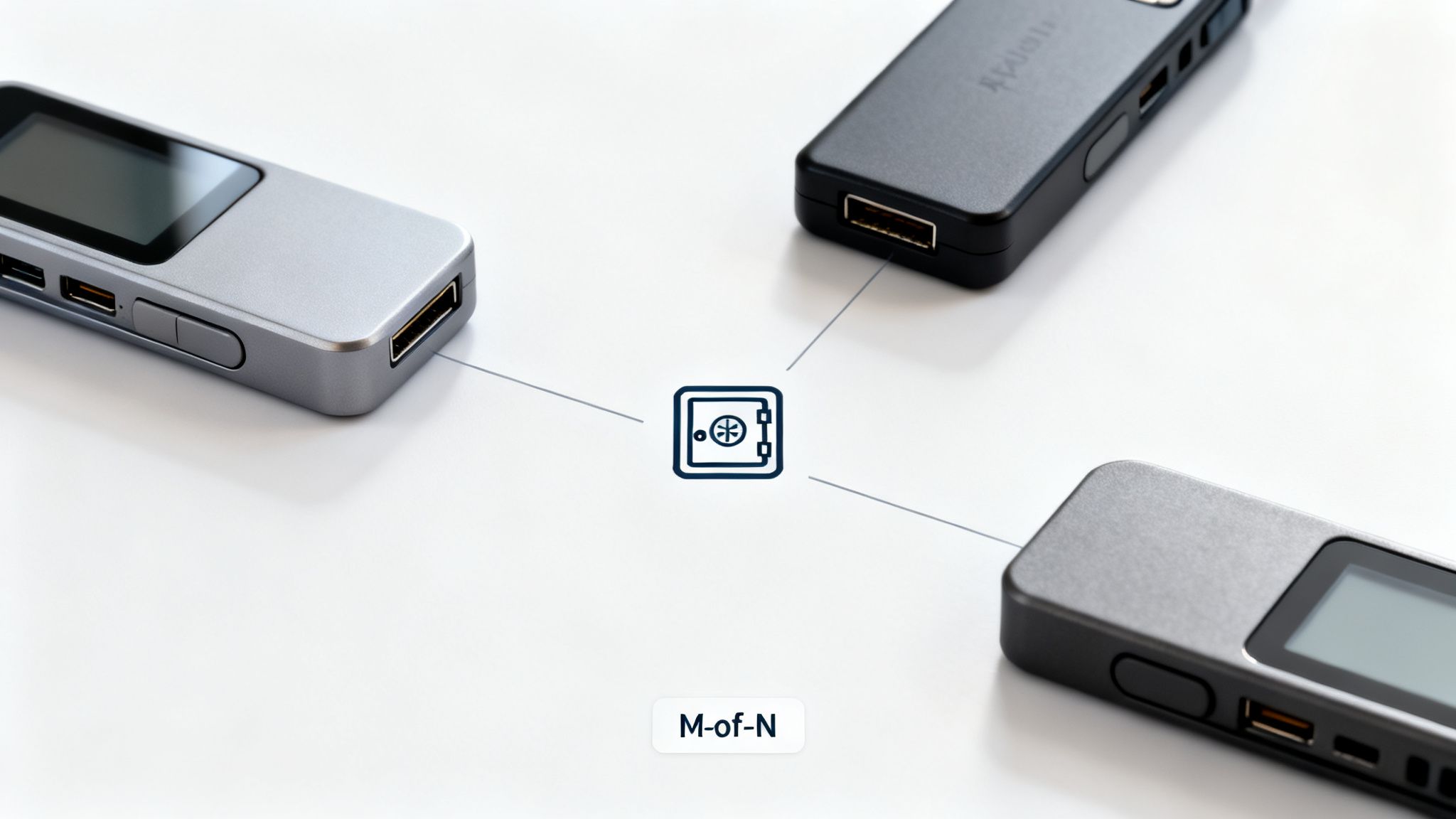
Multi-signature (multisig) wallets are smart contracts that require multiple private keys to authorize a single transaction, effectively distributing trust and eliminating single points of failure. This M-of-N scheme (e.g., 2-of-3 signatures required) is a foundational security primitive for any serious project in cryptography involving asset management. It prevents unauthorized access even if one key is compromised.
This technology is the gold standard for securing high-value treasuries and critical protocol functions. Gnosis Safe (now Safe) is the ubiquitous multisig wallet on Ethereum, trusted by DAOs and projects to manage billions in assets. Similarly, institutional custodians like Coinbase Custody rely on robust multisig architectures to provide enterprise-grade security, showcasing its importance for both decentralized and centralized finance.
Why This Project Matters for Your Career
Building a multisig wallet demonstrates your ability to engineer secure, production-ready systems, a skill that is non-negotiable for protocol developers and smart contract engineers. Recruiters for DeFi protocols, infrastructure providers, and crypto-native companies view multisig experience as a clear indicator of a candidate's maturity in security and operational best practices. This project proves you can be trusted with the keys to the kingdom, literally, and is a perfect answer to the interview question, "Tell me about a project where you had to focus on security."
Actionable Plan & Key Considerations
To get started, focus on building a basic multisig wallet smart contract that can receive, hold, and send native assets like ETH.
- Technology Stack: Use
Solidityfor the smart contract logic and leverageHardhatorFoundryfor your development environment. For the frontend, a simple interface withEthers.jsorWeb3.jswill allow users to propose and confirm transactions. - Cryptographic Primitives: Focus on understanding digital signatures (ECDSA) and how a contract can programmatically verify multiple unique signatures for a single transaction hash. Use established libraries like OpenZeppelin's
SignatureChecker. - Security First: Multisig logic is a prime target for attackers. Pay close attention to potential reentrancy vulnerabilities and ensure proper access control mechanisms. Documenting clear procedures for key rotation and recovery will show a hiring manager you think like a senior engineer.
Creating a functional and secure multisig wallet is a powerful portfolio project. It directly addresses the critical need for robust asset management and governance in the Web3 ecosystem, making you an exceptionally attractive candidate for security-focused engineering roles.
3. Homomorphic Encryption for Encrypted Data Processing
Homomorphic Encryption (HE) is a transformative form of encryption that allows computation to be performed directly on ciphertext. This means data can be processed by a third party, like a cloud server or a smart contract, without ever needing to be decrypted, ensuring complete privacy. For anyone undertaking a project in cryptography, mastering HE is like learning to operate on a locked safe without ever opening it.
This "holy grail" of cryptography is no longer just theoretical. Projects like Fhenix are building fully homomorphic encryption (FHE) layers for Ethereum, enabling private smart contracts. Similarly, Zama provides open-source libraries that make it easier for developers to build FHE-powered applications, demonstrating its growing practicality in the Web3 ecosystem.
Why This Project Matters for Your Career
Building an application using homomorphic encryption is a clear signal to employers that you can handle next-generation data privacy challenges. Companies in DeFi, confidential computing, and blockchain infrastructure are actively seeking engineers who can work with these advanced techniques. A portfolio piece demonstrating HE showcases your ability to build systems that are not just secure but also fundamentally private-by-design, a highly valued skill that makes you stand out for specialized, high-paying roles.
Actionable Plan & Key Considerations
To get started, consider developing a simple application like a private on-chain voting system or a confidential financial calculator where inputs and outputs remain encrypted.
- Technology Stack: Leverage existing FHE libraries to manage the complexity. Zama's
Concretelibrary orOpenFHEare excellent starting points that abstract away much of the underlying mathematics. - Mathematical Foundations: While libraries help, a basic understanding of lattice-based cryptography is essential for debugging and performance optimization. Being able to discuss the concept of "noise" in FHE ciphertexts during an interview will set you apart.
- Performance First: Homomorphic operations are computationally intensive. Start with partially homomorphic schemes (which support only one type of operation, like addition or multiplication) before moving to fully homomorphic encryption. Documenting your performance benchmarks shows a practical, engineering-focused mindset.
A functional HE project is a deeply impressive accomplishment. It proves you can navigate the complexities of advanced cryptographic primitives to solve real-world privacy problems, positioning you as a top-tier candidate for specialized roles in Web3 and beyond.
4. Threshold Cryptography and Distributed Key Generation (DKG)
Threshold Cryptography is a method that distributes a secret key among multiple parties, requiring a minimum number (a "threshold") of them to collaborate to perform a cryptographic operation, such as signing a transaction. A core component of this is Distributed Key Generation (DKG), which allows the group to create this shared secret key without a single trusted party ever holding the entire key. This makes it an essential project in cryptography for building decentralized and fault-tolerant systems.
This technology is foundational for securing modern Web3 infrastructure. It powers the validator key ceremonies in Ethereum's proof-of-stake consensus, secures cross-chain bridges, and enables decentralized custody solutions. By removing single points of failure, DKG and threshold schemes enhance the security and resilience of critical network functions, preventing catastrophic key compromises.
Why This Project Matters for Your Career
Building a project that implements DKG and threshold signatures demonstrates an advanced understanding of distributed systems security, a skill set highly valued by companies building layer-1 blockchains, bridges, and institutional-grade custody platforms. Recruiters from firms like Polygon, Chainlink, and Fireblocks are constantly seeking engineers who can design and implement resilient, multi-party computation protocols. This project proves you can tackle complex coordination problems and build systems that remain secure even if some participants are malicious or offline, a core requirement for senior infrastructure roles.
Actionable Plan & Key Considerations
To start, aim to build a simplified multi-signature wallet or a distributed oracle system that relies on a threshold of participants.
- Technology Stack: Leverage networking libraries like
libp2pfor peer-to-peer communication and cryptographic libraries that support threshold schemes, such as those based on Shamir's Secret Sharing or Pedersen Commitments. - Protocol Design: Focus on implementing a robust DKG protocol first. Ensure your design can handle participant drop-offs and includes verification steps so parties can validate the shares they receive. Explaining these design choices in an interview demonstrates architectural thinking.
- Security First: The entire system's security hinges on the DKG implementation. Be prepared to discuss how you tested your system against Byzantine actors (malicious participants) and secured communication channels, showing you prioritize robust security.
A DKG project is a powerful statement about your ability to secure decentralized networks. It showcases skills that are critical for infrastructure-level roles, positioning you as a candidate capable of building the backbone of Web3.
5. Post-Quantum Cryptography and Quantum-Safe Algorithms
Post-Quantum Cryptography (PQC) focuses on developing cryptographic algorithms that are secure against attacks from both classical and quantum computers. As quantum computing advances, it poses a significant threat to current standards like RSA and ECC. Creating a project in cryptography that implements quantum-safe algorithms is essential for the long-term security and viability of any blockchain protocol.
This isn't a distant future problem; major players are already preparing for this shift. The NIST PQC Standardization process is selecting the next generation of public-key cryptography, with algorithms like CRYSTALS-Dilithium (for signatures) and CRYSTALS-Kyber (for key exchange) emerging as leading standards. The Ethereum Foundation is also actively researching PQC integration to future-proof the network, highlighting the immediate relevance of this field.
Why This Project Matters for Your Career
A PQC implementation is a forward-thinking portfolio piece that demonstrates foresight and expertise in long-term protocol security. Companies building critical infrastructure, from Layer-1 blockchains to enterprise-grade custody solutions, are beginning to prioritize quantum resistance. Having this project on your resume shows recruiters you can think beyond current challenges and are capable of building systems designed to last for decades—a highly valued skill for senior engineering and research roles. This expertise is a key differentiator that can shape promising careers in cryptography.
Actionable Plan & Key Considerations
To begin, you could implement a simple digital signature scheme or key exchange using one of the NIST-selected PQC algorithms.
- Technology Stack: Leverage established cryptographic libraries that include PQC modules, such as the Bouncy Castle API (Java) or Open Quantum Safe (
liboqs), which provides C implementations of various quantum-resistant algorithms. - Performance Analysis: A key challenge with PQC is that new algorithms often have larger key sizes and signatures, impacting performance. Your project should measure and analyze this overhead compared to classical algorithms like ECDSA, as this is a critical topic in any real-world implementation discussion.
- Hybrid Implementation: A practical first step for real-world systems is a hybrid approach, combining a classical algorithm with a PQC one. Discussing the rationale for a hybrid model in an interview shows practical, forward-looking judgment.
Building a PQC system shows you can address complex, next-generation security threats. This project signals to employers that you are not just a developer but a forward-looking security architect prepared for the evolution of cryptographic warfare.
6. Commitment Schemes and Merkle Trees for Data Integrity
Commitment schemes allow a party to commit to a value while keeping it hidden, with the ability to reveal it later. Merkle trees use hashing to create a compact, verifiable proof of a dataset's integrity. Together, these tools are fundamental to blockchain architecture, enabling efficient verification of large datasets without processing the entire set. Building a project in cryptography using these structures is essential for anyone serious about protocol-level development.

This cryptographic duo is the backbone of systems like Bitcoin, where Simplified Payment Verification (SPV) nodes use Merkle proofs to verify transactions without downloading the entire blockchain. Similarly, Ethereum relies on various Merkle-like structures to commit to its world state. These examples prove that mastering these concepts is not an academic exercise but a prerequisite for building robust, scalable decentralized systems.
Why This Project Matters for Your Career
Implementing a Merkle tree and commitment scheme in a project is a clear signal to hiring managers that you understand the foundational mechanics of blockchain. Recruiters for roles in core protocol development, smart contract auditing, and L2 scaling solutions look for this skill. Demonstrating your ability to build an efficient data integrity solution shows you can handle the core engineering challenges that define blockchain performance and security, making you a prime candidate who can pass the technical screening.
Actionable Plan & Key Considerations
A great starting point is to build a verifiable data registry where users can prove ownership of an item without revealing the entire dataset.
- Technology Stack: Use a language like Rust or Go for a high-performance implementation. Libraries like
ethers.jsorweb3.pycan be used to interact with smart contracts that store the Merkle root. - Mathematical Foundations: Solidify your understanding of cryptographic hash functions (SHA-256, Keccak-256) and binary tree structures. For advanced applications, explore Poseidon for ZK-friendly hashing. This is foundational knowledge expected in any protocol engineering interview.
- Security First: Ensure your implementation is secure against second-preimage attacks on the hash function. When storing Merkle roots on-chain, consider the security implications of state updates and re-orgs.
Building a system based on Merkle proofs is a powerful way to demonstrate your grasp of core blockchain principles. This project showcases your ability to think about data efficiency and cryptographic security, positioning you as a capable engineer ready to contribute to significant infrastructure projects.
7. Digital Signatures and Key Pair Management (ECDSA, EdDSA, BLS)
Digital signatures are the cryptographic bedrock of blockchain, providing the authenticity and integrity required for every transaction and smart contract interaction. By implementing various signature schemes like ECDSA, EdDSA, or BLS, you build a core competency that underpins nearly every action on a distributed ledger. For anyone undertaking a project in cryptography, mastering these algorithms is not just beneficial; it is a fundamental requirement for building secure and reliable systems.
This technology is ubiquitous across the Web3 ecosystem. Bitcoin and Ethereum famously rely on ECDSA for transaction signing, Polkadot utilizes the more performant EdDSA (specifically Ed25519), and Ethereum’s consensus layer leverages BLS for its powerful signature aggregation capabilities. These examples highlight how different signature schemes are chosen to meet specific performance, security, and scalability needs.
Why This Project Matters for Your Career
A portfolio project focused on digital signatures and key management is a powerful signal to employers that you understand the foundational security layer of blockchain. Recruiters for roles in core protocol development, smart contract auditing, and wallet engineering specifically look for this expertise. Demonstrating you can securely generate key pairs, sign messages, verify signatures, and manage key lifecycles proves you are ready to handle the critical security responsibilities inherent in Web3 roles. This project provides a direct, tangible answer to common interview questions about core cryptographic primitives.
Actionable Plan & Key Considerations
To get started, build a simple command-line tool or a small web application that can generate key pairs, sign a piece of data, and verify the resulting signature.
- Technology Stack: Use a low-level cryptographic library like OpenSSL's
libcrypto, Go'scrypto/ecdsa, or Rust'sed25519-dalekandbls12_381crates to get hands-on experience with the primitives. - Algorithmic Nuances: Dive deep into the differences between the algorithms. Implement ECDSA using deterministic nonces (RFC 6979) to avoid catastrophic key leakage. For BLS, focus on implementing signature aggregation. Being able to explain these nuances shows a depth of knowledge that hiring managers seek.
- Security First: Proper key management is paramount. Your project should include secure key generation, storage, and a plan for key rotation. Documenting defenses against common attacks like side-channel vulnerabilities demonstrates a mature security outlook.
Building a secure signature and key management utility is a challenging but essential project. It solidifies your understanding of blockchain’s core security principles, making you a more qualified and attractive candidate for engineering roles that demand a deep appreciation for cryptographic security.
8. Secure Multi-Party Computation (MPC) for Distributed Consensus
Secure Multi-Party Computation (MPC) is a subfield of cryptography that enables multiple parties to jointly compute a function over their private inputs without revealing those inputs to one another. In the context of decentralized systems, this is a game-changer, allowing for collaborative computation without a central trusted authority. For anyone building a project in cryptography, mastering MPC is essential for tackling challenges in distributed consensus and validator security.
This technology is the backbone of advanced blockchain infrastructure. For instance, Dfinity’s Internet Computer uses a form of threshold cryptography, an application of MPC, for its consensus mechanism. Similarly, Distributed Validator Technology (DVT) solutions are exploring MPC to reduce single points of failure for Ethereum validators, enhancing network security and decentralization.
Why This Project Matters for Your Career
Building an MPC-based system is a powerful signal to employers at leading Layer-1 foundations, infrastructure providers, and institutional custody firms. Recruiters for roles in protocol research, core engineering, and high-security digital asset solutions actively seek candidates who can design and implement robust, fault-tolerant distributed systems. A portfolio project in this domain proves you can handle complex cryptographic protocols and understand the security models vital for mission-critical infrastructure, setting you up for senior-level interviews.
Actionable Plan & Key Considerations
To get started, focus on a practical application like creating a distributed key generation (DKG) protocol for a group of validators or a simple consensus mechanism.
- Technology Stack: Begin with libraries designed for MPC, such as
lib-mpcor exploring frameworks used in real-world protocols. For a more fundamental approach, you could implement a basic secret-sharing scheme like Shamir's Secret Sharing in Python or Go. - Theoretical Foundations: A deep understanding of Byzantine Fault Tolerance (BFT) is non-negotiable. Being able to discuss how MPC protocols handle malicious actors and network partitions is a key indicator of seniority in an interview.
- Network Realities: In your implementation, pay close attention to communication overhead. MPC protocols are often communication-intensive. Documenting how you optimized message patterns shows a practical, performance-oriented mindset that employers value.
Developing a functional MPC application demonstrates your ability to build secure, collaborative systems that form the very foundation of decentralized networks. It’s a challenging project that places you at the intersection of cryptography and distributed systems, making you an exceptionally strong candidate for advanced engineering roles.
9. Elliptic Curve Cryptography (ECC) and Curve Selection
Elliptic Curve Cryptography (ECC) is the high-performance engine of modern public-key cryptography, providing the foundation for nearly all digital signatures and key exchanges in Web3. Compared to older methods like RSA, ECC offers the same level of security with significantly smaller key sizes, which is crucial for the efficiency and scalability of blockchain networks. For anyone undertaking a project in cryptography, a deep dive into ECC is essential for understanding how blockchains secure digital assets.
This technology is ubiquitous across the ecosystem. Bitcoin and Ethereum famously rely on the secp256k1 curve for transaction signing, while privacy-focused projects like Monero use Ed25519 for its performance and security features. More advanced applications, such as ZK-rollups, often employ specialized pairing-friendly curves like BLS12-381 to enable complex cryptographic operations like proof aggregation.
Why This Project Matters for Your Career
Demonstrating a solid grasp of ECC and the rationale behind curve selection is a major differentiator in technical interviews for protocol engineering or blockchain security roles. Employers need specialists who understand the subtle trade-offs between different curves concerning security, performance, and compatibility. Presenting a project where you analyze or implement an ECC-based system shows you can make informed architectural decisions—a key trait of a senior engineer.
Actionable Plan & Key Considerations
A great starting point is to implement a basic digital signature scheme (like ECDSA) from scratch or to build a tool that visualizes operations on different elliptic curves.
- Technology Stack: Use low-level programming languages like Rust or C++ for performance-critical implementations. Lean on battle-tested libraries like
libsecp256k1for signing orristretto255for high-security group operations. - Mathematical Foundations: Focus on understanding the group law of elliptic curves, scalar multiplication, and the Elliptic Curve Discrete Logarithm Problem (ECDLP). A clear understanding of how cryptography works at this level is non-negotiable for serious developers and a frequent topic in tough interviews.
- Security First: Your implementation must use constant-time operations to protect against side-channel attacks. Mentioning this consideration in an interview shows you are aware of subtle but critical security vulnerabilities.
Building with ECC not only sharpens your low-level development skills but also positions you as a candidate with a deep appreciation for the fundamental security principles that underpin the entire Web3 space.
10. Encryption Protocols for Layer-2 Scaling and Cross-Chain Bridges
Encryption protocols are the cryptographic backbone of Layer-2 (L2) solutions and cross-chain bridges, ensuring data integrity and confidentiality as transactions move off-chain or between blockchains. These protocols use a combination of digital signatures, hash functions, and sometimes more advanced primitives like threshold signatures to secure asset transfers and authenticate messages. For anyone looking to build a project in cryptography, focusing on this area addresses the critical need for secure interoperability and scalability.
This technology is foundational to the multi-chain ecosystem. Projects like Polygon's Plasma chains, optimistic rollups like Optimism and Arbitrum, and interoperability protocols such as LayerZero all rely on robust cryptographic systems. These systems ensure that off-chain computations remain verifiable and that cross-chain transactions inherit the security guarantees of their underlying chains, preventing catastrophic exploits that have plagued the industry.
Why This Project Matters for Your Career
Building and securing a cross-chain bridge or an L2 component is a high-stakes, high-impact portfolio piece. It demonstrates an ability to protect billions of dollars in value, a skill that is in constant demand by top infrastructure providers, L2 teams, and DeFi protocols. Recruiters for protocol security and core engineering roles actively seek candidates who understand the cryptographic trade-offs in bridge design and rollup security. Proving you can build or audit these systems shows you are ready to tackle some of the most challenging and valuable problems in Web3.
Actionable Plan & Key Considerations
Start by designing a simplified asset bridge between two testnets, focusing on the cryptographic security model.
- Technology Stack: Use
Solidityfor smart contracts on EVM-compatible testnets. For off-chain components, languages likeGoorRustare industry standards. Libraries likeethers.jsorweb3.pyare essential for interacting with the contracts. - Cryptographic Primitives: Implement a multi-signature wallet for the bridge validators using basic digital signatures (ECDSA). Ensure you understand how hash locks or time-locks can be used to secure atomic swaps between chains.
- Security First: The history of bridge hacks underscores the importance of a security-first mindset. Discussing how you would implement multi-layered defenses, monitoring, and validator slashing mechanisms in an interview will impress hiring managers and demonstrate your understanding of real-world operational security.
Developing a secure L2 or bridge protocol is a formidable challenge that showcases your ability to protect user assets at scale. This expertise places you in an elite tier of blockchain developers, making you an extremely attractive candidate for senior roles in Web3 infrastructure.
10-Project Cryptography Comparison
| Technology | 🔄 Implementation complexity | ⚡ Resource requirements | 📊 Expected outcomes | 💡 Ideal use cases | ⭐ Key advantages |
|---|---|---|---|---|---|
| Zero-Knowledge Proof (ZKP) Implementation for Privacy-Preserving Applications | High — advanced math & circuit design | High CPU (proof gen), tooling (circom/Cairo) | Strong privacy, reduced on-chain data, scalability via zk-rollups | Private transactions, identity verification, confidential smart contracts, rollups | Strong privacy guarantees; on-chain efficiency; regulatory-friendly |
| Multi-Signature (Multisig) Wallet and Key Management System | Moderate — signer coordination, workflow design | Low–Moderate — signer infrastructure, HW wallets, ops | Enhanced custody security, reduced single-point-of-failure, governance support | Treasury management, DAOs, enterprise custody solutions | Proven security model, cross-chain support, mature tooling |
| Homomorphic Encryption for Encrypted Data Processing | Very high — advanced crypto, noise & bootstrapping | Very high — heavy CPU, large ciphertext storage | Compute-on-encrypted-data without decryption; experimental practicality | Encrypted analytics, private DeFi computation, secure cloud processing | Enables private computation; removes need for trusted intermediaries |
| Threshold Cryptography & Distributed Key Generation (DKG) | High — distributed protocols, coordination & refresh | Moderate — multiple participants, communication overhead | Resilient key management, no single trusted dealer, validator safety | Validator key ceremonies, distributed relays, bridge validators | Resilience to compromise; decentralization; proven security models |
| Post-Quantum Cryptography and Quantum-Safe Algorithms | Moderate — algorithm selection & migration planning | Moderate — larger keys/signatures, bandwidth/storage impact | Quantum-resistant security, long-term protocol durability | Long-lived assets, protocol upgrades, hybrid classical/quantum-safe rollout | NIST-standardized options; compatible with existing stacks |
| Commitment Schemes & Merkle Trees for Data Integrity | Low–Moderate — well-understood implementations | Low — logarithmic proofs, modest storage for paths | Efficient state verification, compact inclusion proofs, L2 enabler | SPV/light clients, zk-rollups, state commitments, data integrity proofs | Battle-tested primitive; small proof sizes; wide adoption |
| Digital Signatures & Key Pair Management (ECDSA, EdDSA, BLS) | Moderate — careful key management & implementation | Low — efficient sig ops; HSMs recommended for storage | Secure authentication/authorization; aggregated signatures for consensus | Transaction signing, consensus, identity systems, signature aggregation | Efficient, standardized, essential for blockchain operations |
| Secure Multi-Party Computation (MPC) for Distributed Consensus | Very high — protocol complexity, synchronization | High — significant communication & compute across parties | Privacy-preserving joint computation; decentralized decision-making | Private voting, distributed custody, MPC-based consensus primitives | No trusted third party; supports complex private functions |
| Elliptic Curve Cryptography (ECC) and Curve Selection | Moderate — curve properties & constant-time impl. | Low — efficient computations with proper libraries | Strong security with small keys; impacts interoperability | Core protocol crypto, signatures, key exchange, curve migration | Compact keys, fast ops, widely standardized |
| Encryption Protocols for Layer-2 Scaling and Cross-Chain Bridges | High — cross-chain coordination, complex threat models | Moderate–High — validators, monitoring, audits | Scalable cross-chain transfers while preserving security guarantees | Layer-2 rollups, sidechains, cross-chain bridges, off-chain state commitments | Enables interoperability at scale; preserves cross-chain security |
Showcasing Your Work and Landing Your Next Role
You've navigated the intricate landscapes of zero-knowledge proofs, wrestled with the complexities of multi-party computation, and perhaps even future-proofed a system with post-quantum algorithms. Completing a challenging project in cryptography is a significant achievement, but its true value is unlocked when you strategically present it to a potential employer. The projects outlined in this article are more than academic exercises; they are direct answers to the industry's most pressing questions about privacy, security, and scalability.
By tackling these projects, you've moved beyond theoretical knowledge. You have demonstrated a practical command of cryptographic primitives that are fundamental to the next generation of decentralized systems. This hands-on experience is precisely what top-tier blockchain companies and protocol teams are searching for. They don't just need developers who can use a library; they need engineers who understand the cryptographic foundations that make these libraries work and can reason from first principles.
From Code to Career: Translating Your Project into Job Offers
The final, crucial step is to package your work for maximum impact during your job search. A GitHub repository is your foundational asset, but a simple code dump is not enough. To truly stand out, you need to build a comprehensive portfolio piece that tells a compelling story to a hiring manager.
Here is a blueprint for transforming your completed project into a powerful career tool:
- Create a "Hiring Manager-Ready" README: Your README file is the first thing a potential employer will see. It should function as an executive summary and a technical guide. Structure it clearly with sections for the problem statement ("What business problem does this solve?"), the cryptographic concepts applied ("This project uses BLS signatures to..."), a high-level architectural overview, and concise setup instructions.
- Document Your "Why": In your documentation or an accompanying blog post, go beyond what you built and explain why you made specific design choices. Why did you choose BLS signatures over ECDSA for your aggregation project? What trade-offs did you consider when implementing your ZKP circuit? This demonstrates the critical thinking and engineering maturity required for a senior role.
- Write a Technical Deep-Dive: Authoring a blog post on a platform like Medium or your personal website serves two purposes. First, it forces you to articulate your understanding in clear terms, solidifying your own knowledge. Second, it creates a shareable asset that showcases your expertise to recruiters and the wider Web3 community, improving your professional visibility.
- Prepare Your Interview Narrative: When asked about your project in cryptography during an interview, have a concise and compelling narrative ready. Frame your project using the STAR method (Situation, Task, Action, Result). For example: "The situation was the need for private transactions on a transparent ledger. The task was to implement a system using zk-SNARKs. The action I took was building a prototype in Circom and Hardhat to prove concept X. The result was a functional demo that could shield and unshield tokens, demonstrating the feasibility of the approach."
By investing this effort into showcasing your work, you are no longer just a candidate with a list of skills on a resume. You become a problem-solver who can prove their capabilities with tangible, well-documented evidence. You demonstrate not just technical competence, but also the communication and strategic thinking skills that define a top-tier contributor. This is how you transition from building a project to building a career in the innovative and demanding field of applied cryptography.
Ready to find the team that values your deep technical expertise? The most innovative companies in the Web3 space are actively seeking engineers who have proven their skills by building a robust project in cryptography. Explore the latest opportunities for cryptography engineers, protocol developers, and blockchain security specialists on Blockchain Jobs today.