Proof of Play A Career Guide for Web3 Professionals

You keep seeing the same phrases in Web3 job posts. Onchain game economy. Verifiable user actions. L3 infrastructure. Proof of play. If you're an engineer, you're wondering whether this is a niche gaming term or a real hiring signal. If you're a product manager, you're trying to figure out whether you need protocol depth or just enough vocabulary to survive the interview loop.
The short answer is that proof of play matters because it sits at the intersection of product truth and blockchain trust. Teams need ways to prove that a user completed meaningful activity in a game, app, or digital experience, then turn that activity into state, rewards, credentials, access, or reputation. That requirement touches engineering, design, analytics, token design, compliance, and growth.
You can see the career pattern already. The same companies that care about verified state transitions in games also care about secure identity, auditable records, and user-owned data. That overlap is why people exploring joining the inabit fintech team or reading practical market context like this overview of how to build a career in crypto keep running into adjacent themes. The labels differ by sector, but the underlying work is similar. You are building systems that can be trusted when multiple parties have incentives to cheat, dispute, or fork the story.
Introduction Why Proof of Play is on Every Web3 Job Description
You are halfway through a Web3 interview. The hiring manager gives you a simple prompt: users finish a match, earn rewards, and some of them start farming the system with bots and spoofed clients. What do you verify, where do you verify it, and how do you keep the game fast enough that players do not quit?
That is the actual reason proof of play keeps showing up in job descriptions. It names a class of problems that sits between product, infrastructure, and security. Teams need systems that can treat user actions as trustworthy enough to trigger rewards, progression, access, or reputation without handing attackers an easy payout.
For an engineer, this shows up as architecture work. You need to decide what belongs onchain, what stays offchain, what gets signed, what gets replay protection, and what can be challenged later. For a product manager, it shows up as abuse prevention, economy design, and analytics you can defend in front of users, partners, and auditors. If you are trying to build a career in crypto, this is the kind of cross-functional problem that gets you hired because it maps to real shipping work.
Proof of play is also a useful hiring filter. It tells a team whether a candidate can reason about trust boundaries instead of repeating protocol vocabulary. A strong answer usually covers four things: which actions matter, who might fake them, how the system verifies them, and what trade-off the team accepted on cost, latency, and user experience.
That trade-off matters.
A fully onchain approach can improve auditability, but it can also raise latency and transaction costs. A server-signed model is faster and easier to ship, but it puts more trust in the operator and creates key management risk. Hybrid systems often win in practice because they let teams reserve expensive verification for actions that affect money, rankings, scarce items, or portable identity.
This is why the term appears far beyond pure gaming roles. The same reasoning shows up in identity, loyalty, social reputation, anti-fraud systems, and fintech products where user actions need a credible record. That overlap is part of why people compare game infrastructure roles with adjacent paths like joining the inabit fintech team. Different product surface, similar trust problem.
In interviews, do not treat proof of play like trivia. Treat it like a system design prompt with business consequences. If you can explain how verification choices affect fraud rates, retention, infrastructure cost, and user trust, you will sound like someone who can ship the product, not just describe it.
What Is Proof of Play Beyond the Buzzword
Proof of play is evidence that a user action happened in a way the system can trust. Think of it as a tamper-resistant receipt for digital behavior. The “play” part comes from gaming, but the pattern is broader than games.
A normal app stores actions in its own database and asks everyone else to trust the operator. Proof of play tries to reduce that trust burden. It records or attests to enough information that a third party can verify the action later, or at least verify that an approved authority observed it and signed off on it.

A useful analogy
If proof of work and proof of stake are ways blockchains agree on who gets to produce blocks, proof of play is about proving what happened inside an application.
Use this analogy in interviews:
- Proof of work / proof of stake: “Who gets to help secure and order the chain?”
- Proof of play: “What user action can the application and outside parties trust?”
That distinction matters because many candidates mix up consensus and application verification. Hiring managers catch that fast.
The clearest real-world example
One concrete implementation comes from ProLeague.gg. The company states that the Proof of Play Protocol transforms gamers' virtual career statistics from Web2 titles like CS:GO and CoD into immutable, blockchain-stored real-world data, enabling tamper-proof resumes for college and professional scouting in its protocol write-up.
That matters because it shows proof of play isn't only about rewards. It's also about portable reputation. A player can carry verified achievements into recruiting, sponsorship, or scholarship conversations. Product managers should read that as credential infrastructure. Marketers should read it as trust-based user-owned identity. Engineers should read it as an attestation pipeline problem.
What this means in practice
A lot of teams talk loosely about “verifying engagement.” That phrase is too vague to design with. You need to ask sharper questions:
- What action are we proving? Match completion, item ownership, ranking movement, session participation, content creation.
- Who needs to trust the proof? Your own smart contracts, a tournament organizer, another game, a sponsor, a school.
- How much privacy do we need? Full event logs, selective disclosure, or simple yes/no attestations.
- How expensive can verification be? Cheap and frequent, or slower and more rigorous.
If you want a non-blockchain analogy, think about a company preparing evidence for an auditor. The issue isn't whether data exists. The issue is whether another party can inspect that data and trust how it was produced. That's why a solid guide to audit evidence is surprisingly relevant reading for Web3 builders. The same mindset applies.
The Technical Toolkit Comparing Proof of Play Methods
No single implementation wins everywhere. The right proof of play method depends on what you're verifying, how fast it must settle, and how much trust you're willing to import. Good engineers don't chase purity. They choose the least bad trade-off for the job.
Comparison of Proof of Play Implementation Methods
| Method | Core Principle | Pros | Cons | Relevant Engineering Skill |
|---|---|---|---|---|
| Onchain attestations | Write game or app events directly to smart contracts | High transparency, easy for other contracts to consume | Expensive if event volume is high, can hurt UX | Solidity, gas optimization, event schema design |
| Cryptographic signatures | A trusted signer attests that an action occurred | Fast, flexible, works well for offchain gameplay with onchain claims | Introduces signer trust and key management risk | Wallet signing flows, signature verification, backend security |
| Trusted oracles | External services relay validated events to chain | Good for connecting Web2 data to Web3 systems | Oracle becomes a trust bottleneck and attack surface | Oracle design, API integration, failure handling |
| ZK proofs | Prove a statement about gameplay without revealing all raw data | Strong privacy and verification guarantees | Complex circuits, proving overhead, hard debugging | Rust, Circom, Cairo, applied cryptography |
| Secure enclaves | Execute sensitive logic inside trusted hardware | Useful for cheat resistance and protected computation | Hardware trust assumptions, operational complexity | Systems engineering, enclave tooling, remote attestation |
Onchain attestations work when the game loop is simple
If the action itself belongs onchain, writing it directly to contracts is the cleanest option. You get composability and native verifiability. Other contracts can react to those actions without waiting on a separate proof system.
This works well for slower loops. Think crafting, ownership changes, leaderboard settlement, or reward claims. It works badly when every user action would generate heavy write load or when users expect instant feedback.
For interviews, say this clearly: onchain-first verification improves trust but often pushes cost and latency into the user experience. If you're applying for a gameplay infra role, be ready to discuss batching, event compression, and which state really needs permanence.
Signatures and oracles are common because they're practical
A lot of production systems don't need every move onchain. They need a believable, enforceable summary. That's where signatures and oracle-based attestations win.
A backend can validate a match result, sign a payload, and let a contract accept that signed claim. Or an oracle network can post approved results after checking external conditions. This is less ideologically pure than full onchain logic, but it often produces a better product.
If you're newer to backend auth flows, brushing up on concepts like integrating JWTs and refresh tokens helps. Not because JWTs are proof of play, they aren't. But the habit of thinking about issuance, expiration, replay risk, trust boundaries, and verification endpoints carries over directly.
Practical rule: when someone says “we'll just sign the result,” ask who signs, how keys rotate, what prevents replay, and how disputes are handled.
Those questions separate protocol thinking from surface-level implementation.
ZK proofs are powerful, but don't use them to impress yourself
Zero-knowledge systems are attractive because they let you prove a property of gameplay without exposing every detail. That's useful when the proof matters more than the transcript. You might want to prove a player met conditions for a reward without publishing all internal actions.
The catch is familiar. Circuit design is hard. Tooling can be rough. Prover cost and latency can become product problems. Debugging can slow a team down more than people expect.
If a job requires zk experience, interviewers often care less about fancy terminology and more about engineering maturity. Can you explain which statements belong in the circuit, which data stays offchain, and how you'd keep the proving pipeline observable in production?
Secure enclaves sit in the uncomfortable middle
Secure enclaves appeal to teams that need low latency and stronger integrity around sensitive logic. They can help with cheat resistance or protected computation, but they shift trust into hardware and operational processes.
That doesn't make them bad. It makes them conditional. If your team can manage the trust model and threat surface, enclaves can be useful. If not, they become a brittle abstraction that no one on-call wants to own.
For your career, the pattern is simple:
- Smart contract roles favor candidates who can define minimal onchain state and safe claim paths.
- Protocol and infra roles reward threat modeling, attestation design, and performance reasoning.
- ZK-heavy roles want applied cryptography skills plus patience with immature tooling.
- Backend roles need strong operational security and event integrity thinking.
Use Cases Where Proof of Play Creates Jobs
A hiring manager asks a simple question: “What exactly are we verifying, and who owns the failure case when that proof is wrong?” If you can answer that clearly, you already sound more senior than a lot of candidates.
Proof of play creates jobs because verification turns product ideas into operating systems. Someone has to define the event model, choose what gets checked, price the fraud risk, and ship a user experience that does not feel slow or hostile. That is why these roles show up across engineering, product, data, trust and safety, and operations.

Onchain gaming
Onchain gaming is the clearest labor market signal because games produce high-frequency events with real economic consequences. Every match result, crafting action, quest completion, and inventory change raises the same question. Should this become trusted state, or stay as an app-side convenience?
Proof of Play is a useful company example here. It was founded in 2022, raised a $33 million seed round led by a16z and Greenoaks, and its game Pirate Nation has reached tens of thousands of daily active users while processing millions of transactions per day, as noted earlier in the company material referenced elsewhere in this article. Those details matter less as startup trivia and more as a hiring signal. Teams will pay for engineers and product leaders who can make verified gameplay work at scale without turning every action into a wallet pop-up and a support ticket.
That creates demand for roles such as:
- Gameplay protocol engineers who decide which game rules belong onchain and which belong in supporting services
- Economy designers who tie verified actions to rewards without making the system easy to farm
- Fraud analysts who investigate bots, collusion, and scripted behavior before the economy gets distorted
- Technical product managers who choose where proof adds trust and where it only adds latency
These jobs also tend to pay better than generic Web3 roles because they sit close to revenue, retention, and abuse prevention. If you want a salary benchmark, compare them with other blockchain jobs that make 150k a year.
For interviews, expect variants of this prompt: “A player wins a rare item after a battle. What do you verify, where do you verify it, and what happens if the client lies?” Good candidates talk about replay protection, event ordering, reward claim paths, and operational visibility. Weak candidates stop at “put it onchain.”
Portable player reputation and scouting
The next job cluster shows up when proof stops being only about rewards and starts becoming a credential.
A verified match history, tournament result, or rank can travel outside the original game. That changes how teams think about scouting, esports qualification, guild recruitment, creator programs, and loyalty systems. Once performance becomes portable, companies need people who can turn raw events into credentials other products can trust.
The technical work is only part of it. Teams also need people who can define evidence standards, design dispute flows, and explain to partners what a badge or score proves. If the proof does not hold up outside the original app, it is not much of a reputation product.
This area often creates openings for:
- Identity and reputation engineers building attestations, credential schemas, and verification APIs
- Partnerships and operations leads defining what outside platforms will accept as valid evidence
- Product managers deciding how much transparency users and partners need
- Trust and safety specialists handling appeals, edge cases, and account-linking abuse
For your career, this use case is a good signal that Web3 hiring is not limited to smart contract work. Some of the highest-impact roles sit in product infrastructure, identity, and external integrations.
Here's a quick industry overview before the next example:
Advertising and media verification
Ad tech and digital media have the same core problem. A logged event is not the same as a trusted event.
A campaign says it got views, clicks, or engagement. A publisher says a user consumed content that should trigger attribution or payment. Someone still has to decide whether that action came from a real user flow, whether the event was duplicated, and whether the proof is strong enough for settlement. That need creates jobs for backend engineers, analytics specialists, and product operators who can handle abuse without crushing conversion.
The trade-off is practical. Loose rules let bots through. Strict rules block legitimate users and upset growth teams. People who can tune that boundary are valuable because they protect both margin and user experience.
Career focus
This use case tends to create openings for:
- Data and analytics specialists who inspect event quality and identify suspicious patterns
- Backend engineers who build ingestion, deduplication, and attestation pipelines
- Growth product managers who balance anti-fraud checks against funnel drop-off
- Compliance and operations professionals who document what evidence partners can rely on
Interviewers in this area often ask for system judgment, not theory. They want to hear how you would define a valid event, monitor false positives, and respond when a paying partner disputes the output.
Creator and community ecosystems
Communities are starting to reward contribution instead of just token balance. That sounds simple until you try to define contribution in a way that cannot be gamed.
Attendance, content creation, tournament participation, moderation work, governance activity, and collaborative output can all become inputs to proof. Once that happens, teams need hybrid talent. The best people in this category understand incentives, community behavior, and enough systems design to avoid building a reward loop that gets farmed on day two.
For junior candidates, this is one of the easier entry points into the field. You do not always need advanced cryptography knowledge to be useful. You do need clear reasoning about incentives, abuse, and what a community is trying to reward.
Designing a Proof of Play System Architecture Patterns
A good proof of play system is not one component. It's a chain of decisions about where events originate, who validates them, when they become final, and how they get challenged.
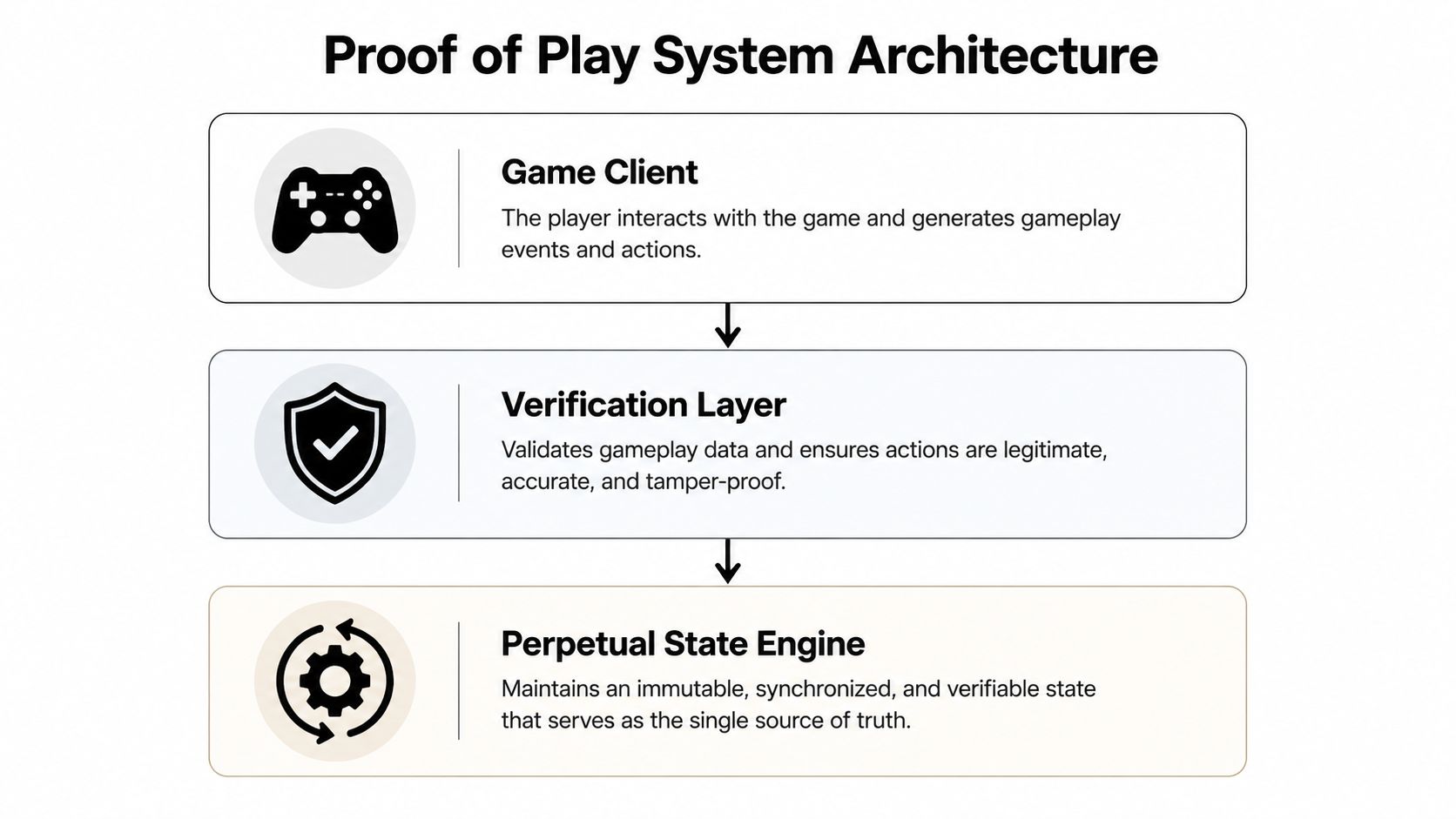
A practical reference architecture
Most production systems end up with three layers:
Client or gameplay layer
The user acts. The game client, app, or service emits events.Verification layer
A backend, sequencer, oracle, enclave, or proving service evaluates whether the event meets the rules.State settlement layer
The accepted result lands onchain as state, an attestation, a reward trigger, or a portable credential.
That pattern sounds obvious, but interview candidates often skip the hard part. They explain how data moves. They don't explain where adversaries enter.
The trade-offs that actually matter
Latency comes first. If the system waits too long to confirm meaningful actions, the product feels broken even if the cryptography is elegant. This is why high-performance chain design matters in onchain gaming.
Proof of Play's Apex Chain is a useful benchmark here. Conduit reports that the Apex Chain, an L3 on Arbitrum Orbit, achieves 250ms block times and throughput peaks of 67.8 Mgas/s by using the Orbit stack and AnyTrust DA, which sets a strong performance reference for gaming-oriented architectures in this Conduit overview. For an interview, you don't need to memorize every implementation detail. You do need to understand why low latency changes product feasibility.
Cost comes next. If every action requires expensive settlement, designers start cutting features or moving too much logic offchain. The architecture has to reserve expensive verifiability for the moments that create economic or reputational consequence.
Fraud is the final filter. A proof of play design fails if it trusts the easiest thing to fake.
The abuse cases juniors often miss
When a lead engineer asks about security, they usually expect these answers to show up fast:
- Replay attacks: Can an old signed payload be reused for a new claim?
- Client tampering: What stops a modified client from inventing success conditions?
- Server compromise: If the verifier is breached, how much fake state can enter the system?
- Collusion: Can groups coordinate to manufacture valid-looking outcomes?
- Dispute handling: Is there any path to challenge or roll back a fraudulent attestation?
Architecture interviews get easier when you describe both the happy path and the cheat path. Good teams design for both.
Where teams usually get it wrong
They verify too much, too early, or too opaquely.
The first failure mode is trying to force every event onchain. That tends to hurt UX before it improves trust. The second is trusting a backend signer without auditability, monitoring, or revocation planning. The third is building an attestation format so custom that no external tool or partner can reason about it later.
A stronger approach is to define a minimal set of high-value events, verify those rigorously, and keep everything else as supporting telemetry. Product managers should push for this. Engineers should insist on explicit trust boundaries. If a company can't explain where truth comes from in its system, it probably doesn't have proof of play. It has branding.
The Skills You Need to Master Proof of Play
Over-indexing on smart contracts is a mistake. Proof of play hiring is broader than pure contract development because the problem spans infrastructure, product design, abuse resistance, and developer usability.

For blockchain engineers
If you're applying as an engineer, your baseline needs to cover smart contracts, offchain systems, and performance-aware design.
Focus on these:
- Solidity and contract interfaces so you can accept attestations, manage claims, and model state cleanly
- Event and data modeling because badly structured state becomes impossible to index, audit, or compose
- L2 and L3 architecture knowledge so you can discuss sequencers, DA choices, and settlement patterns without hand-waving
- Security thinking around signatures, replay prevention, key rotation, and privilege boundaries
- Tool literacy across common Web3 stacks, indexing, observability, and testing
A strong interview answer doesn't stop at “I'd write a contract for claims.” It explains how claims are issued, challenged, consumed, and monitored in production.
For product managers and designers
PMs and designers have a different job. You don't need to prove you can build the verifier. You need to show you can shape the product around what is realistically verifiable.
That means being able to answer:
- Which user actions deserve cryptographic certainty?
- Which actions only need application-level logging?
- What friction will users accept at reward time versus gameplay time?
- How do we explain trust assumptions without making the interface unreadable?
If you want to understand the breadth of roles around these systems, this snapshot of blockchain technology jobs is useful because it shows how often product, infra, analytics, and compliance overlap in real hiring.
The underrated hiring gap
One of the clearest ecosystem gaps around Proof of Play is developer experience. Existing coverage lacks detailed documentation, SDKs, and deployment guidance, which points to a meaningful need for Developer Relations Engineers and Technical Writers according to the company-level ecosystem gap noted on Proof of Play's site.
This matters for your career because it opens a path many people miss. Not everyone has to become a protocol cryptographer. Teams also need people who can make hard systems understandable and usable.
That creates room for:
- DevRel engineers who can turn rough infra into adoptable workflows
- Technical writers who can document trust models, APIs, and deployment flows
- Solutions engineers who can guide studios or partners through implementation decisions
- Finance and operations professionals who can model monetization and compliance around user-owned assets
The fastest way to stand out isn't always deeper math. Often it's clearer reasoning, cleaner docs, and better system communication than the average candidate.
A resume and interview checklist
Use this when you're preparing:
- Resume bullet quality: Describe systems you verified, not just features you shipped.
- Interview stories: Bring one example where you balanced trust, speed, and user experience.
- Threat model fluency: Be ready to name concrete abuse paths and mitigations.
- Architecture clarity: Draw the client, verifier, and settlement layers without rambling.
- Cross-functional language: Translate technical choices into business consequences.
If you can do that, you'll sound like someone who can ship proof of play systems instead of just discussing them.
Conclusion The Future is Verifiable
Proof of play matters because Web3 keeps moving from abstract ownership to verifiable participation. It's no longer enough to track balances and mint assets. Teams need credible ways to prove who did what, under which rules, and with what consequences.
That shift creates a hiring signal. Engineers who can reason about attestation pipelines, signatures, replay risk, and settlement trade-offs will keep getting attention. Product managers who can decide what needs verification will be more valuable than PMs who treat decentralization as branding. Analysts, DevRel specialists, writers, and operations people also have room here because these systems only work when users, partners, and internal teams can understand them.
You don't need to become an expert in every proof system to benefit from this trend. You do need a working model of trust boundaries, latency constraints, abuse cases, and product consequences. That's what interviewers are really testing.
The most useful way to think about proof of play is simple. It is part of the infrastructure for a more verifiable internet. The companies that build it well will shape gaming, reputation, media, and digital coordination. The people who understand it early will have better conversations in interviews, make better architecture decisions on the job, and spot better opportunities before the titles catch up.
If you're ready to turn that understanding into your next move, explore roles on Blockchain Jobs. It's a focused place to find Web3 openings across engineering, product, data, operations, security, marketing, legal, finance, and more, without digging through generic job boards.